Contents:
Cybersecurity: 5 steps to becoming a specialist
Find out moreStages of the Vsevolod Opanasenko case: from tenders to criminal charges
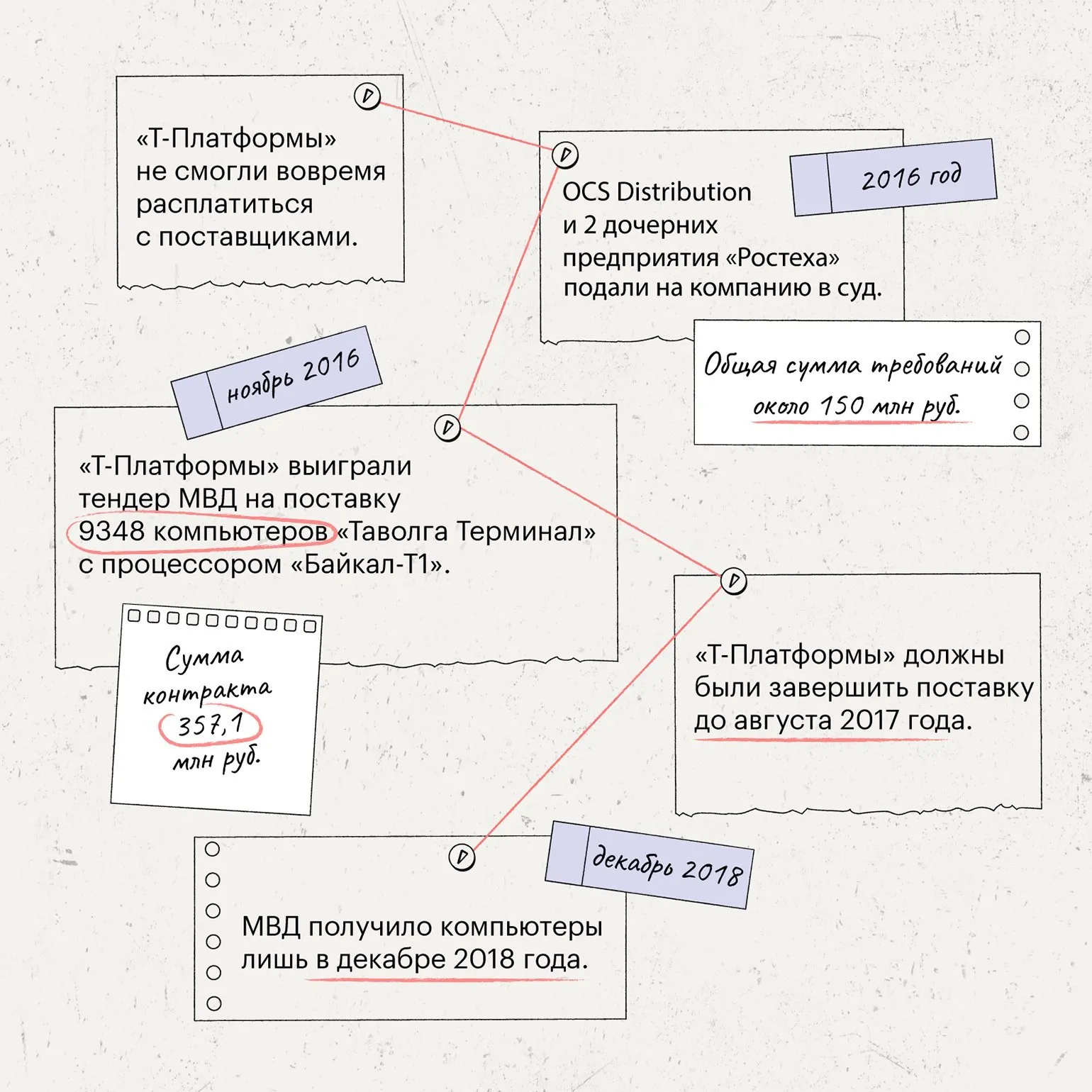
The case of Vsevolod Opanasenko and company The T-Platforms dispute began in 2016, when several organizations filed lawsuits against the company. Among the plaintiffs were major players such as OCS Distribution, the Scientific Research Center for Electronic Computing Technology, and the Solnechnogorsk Instrument-Making Plant, all associated with Rostec. The total amount of claims reached approximately 150 million rubles. The main reason for the financial difficulties was delays in payments from clients, which, according to company representatives, led to a significant "cash gap." This situation drew attention to issues of financial stability and liabilities in the high-tech sector.
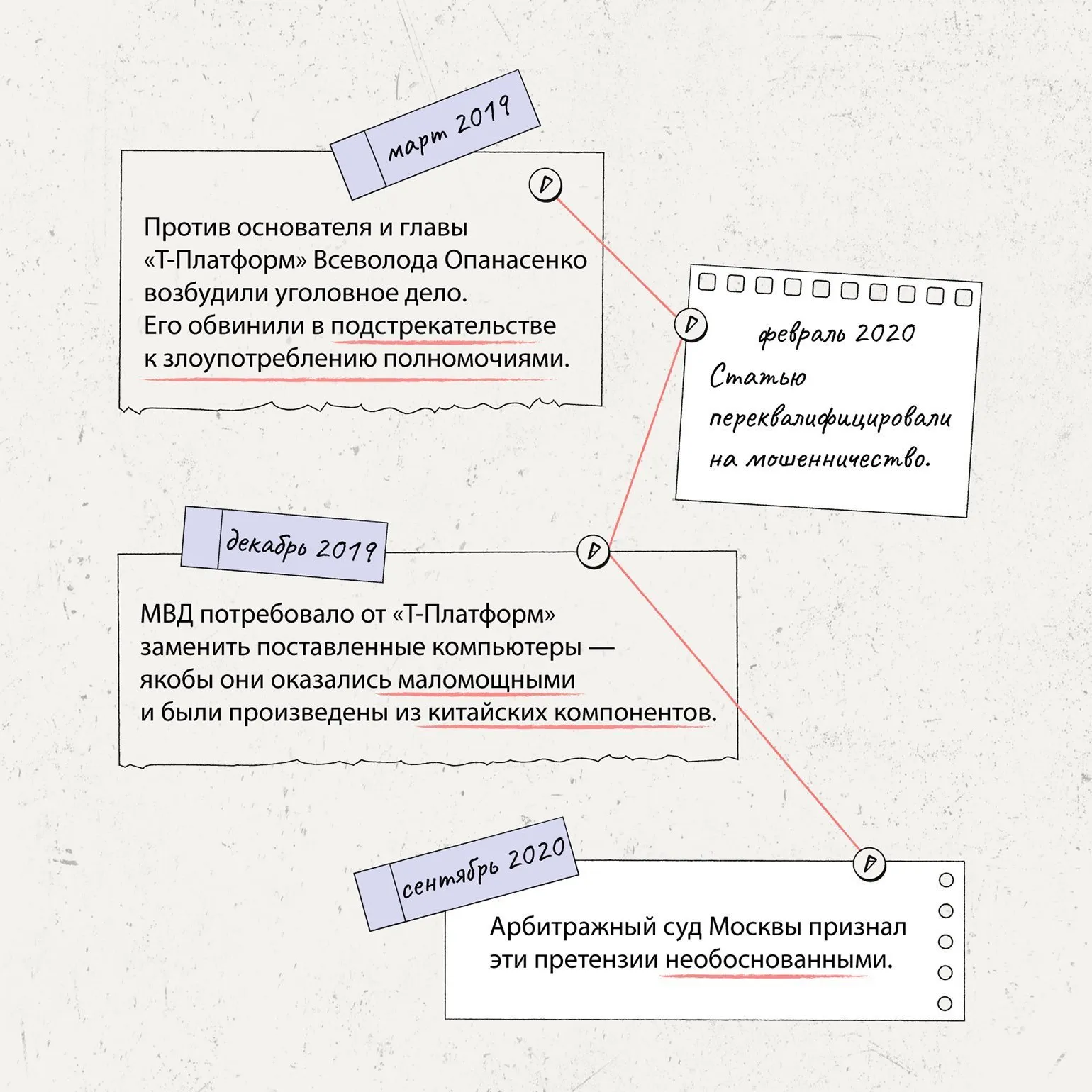
In 2016, T-Platforms won a tender from the Ministry of Internal Affairs (MVD) for the supply of 9,348 Tavolga Terminal computers with Baikal-T1 processors. The total contract value was 357.1 million rubles. These computers were planned to be used for conducting driver's license exams. However, despite the scheduled delivery date of August 1, 2017, the contract was delayed. A company representative explained that the main reasons for the delay were the lack of an advance payment from the Ministry of Internal Affairs and a lack of information about the project. As a result, the actual delivery of the computers only took place in December 2018. The situation surrounding T-Platforms escalated in March 2019, when the Russian Investigative Committee opened a criminal case against Vsevolod Opanasenko. The businessman was charged with attempting to persuade Alexander Alexandrov, the head of the Ministry of Internal Affairs' communications department, to assist T-Platforms in a tender. In February 2020, the charges were amended: Opanasenko and Alexandrov were charged with fraud instead of abuse of office. After spending a year in pretrial detention, they were transferred to house arrest. This case has become a significant event in the Russian business world and has raised questions about corruption and transparency in government tenders.
According to investigators, the computers supplied by T-Platforms did not meet the stated technical requirements. Specifically, they were underpowered and contained components manufactured outside of Russia, in China. In late 2019, the Russian Ministry of Internal Affairs demanded that the installed Tavolga equipment be replaced. However, in September 2020, the Moscow Arbitration Court found these claims unfounded. The court relied on the results of an expert examination and the testimony of witnesses from the State Traffic Safety Inspectorate, who confirmed that the devices were functioning properly. This case highlights the importance of maintaining technical standards and transparency in the procurement of equipment for government needs.
The arbitration court's decision could significantly impact the criminal case against Opanasenko. If the Meshchansky Court of Moscow delivers a guilty verdict, the defense will have the opportunity to file an appeal, relying on the results of the expert examination. At the time of writing, the hearing in Opanasenko's case had been postponed until January 25, 2022. Thus, further events will depend on the court's decision and the actions of the defense.
Overview of events surrounding T-Platforms
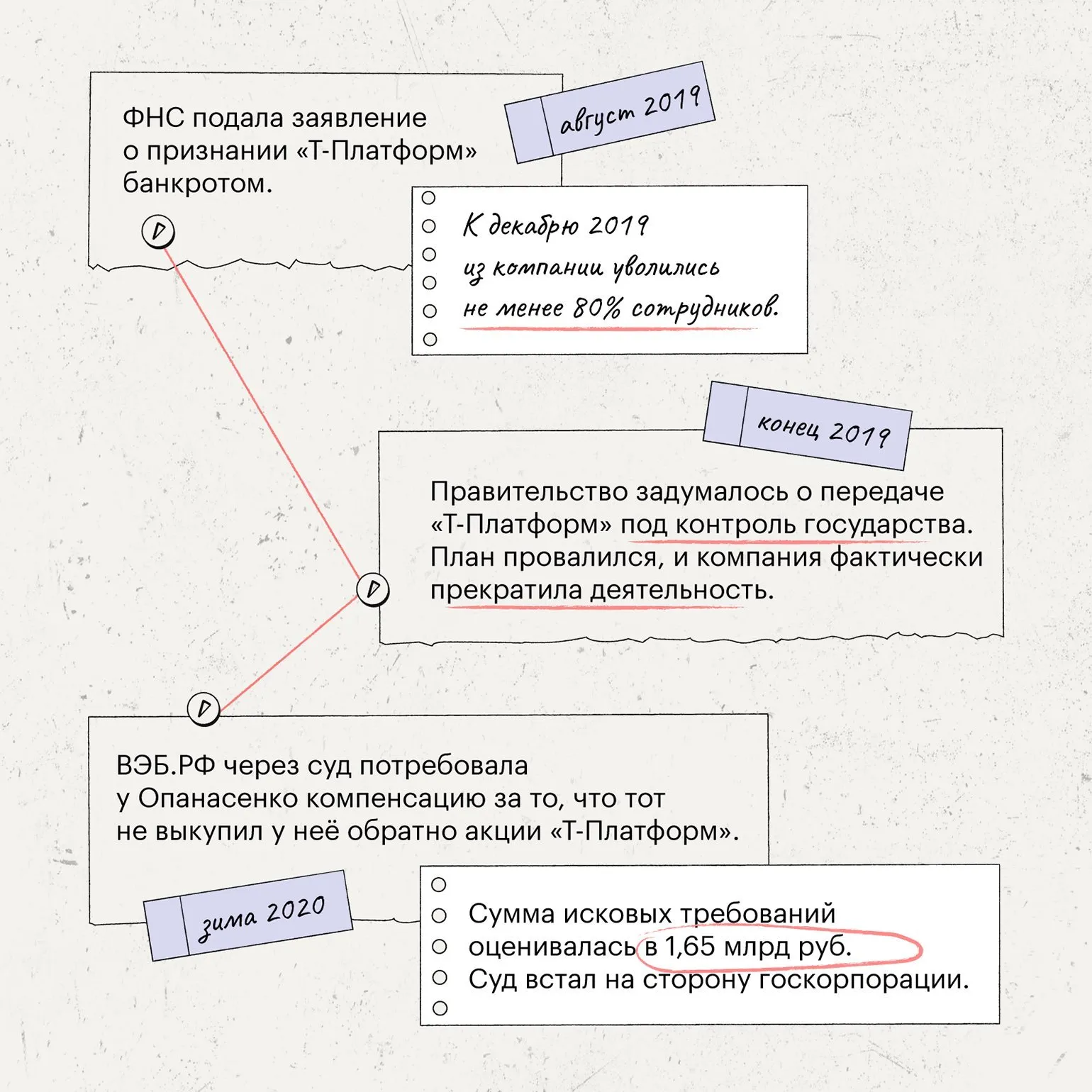
Since the arrest of Vsevolod Opanasenko, the founder of T-Platforms, the organization has faced serious difficulties. In August 2019, the Federal Tax Service (FTS) initiated bankruptcy proceedings, significantly damaging the company's reputation. In November of that year, a press release was published on T-Platform's official website with an optimistic statement that the team was continuing to fight and not giving up. However, internal problems remained evident: company representatives told Vedomosti that the lack of bank guarantees was preventing them from participating in government tenders. Furthermore, constant investigations by investigative authorities created an atmosphere of stress, leading to team demoralization and employee attrition. These factors seriously impact the company's future operations and its market opportunities.
Amid a deteriorating economic situation, the Russian government began considering transferring control of T-Platform to the state-owned corporation NM-Tech, which already held a 25% stake in the company. However, this plan fell through, and T-Platform ultimately ceased operations. As a result, VEB.RF, which held a stake in T-Platform, sought to divest its assets. In the winter of 2020, it sued Opanasenko for compensation for the unavailable shares, highlighting the complexity of the company's situation and its financial obligations.
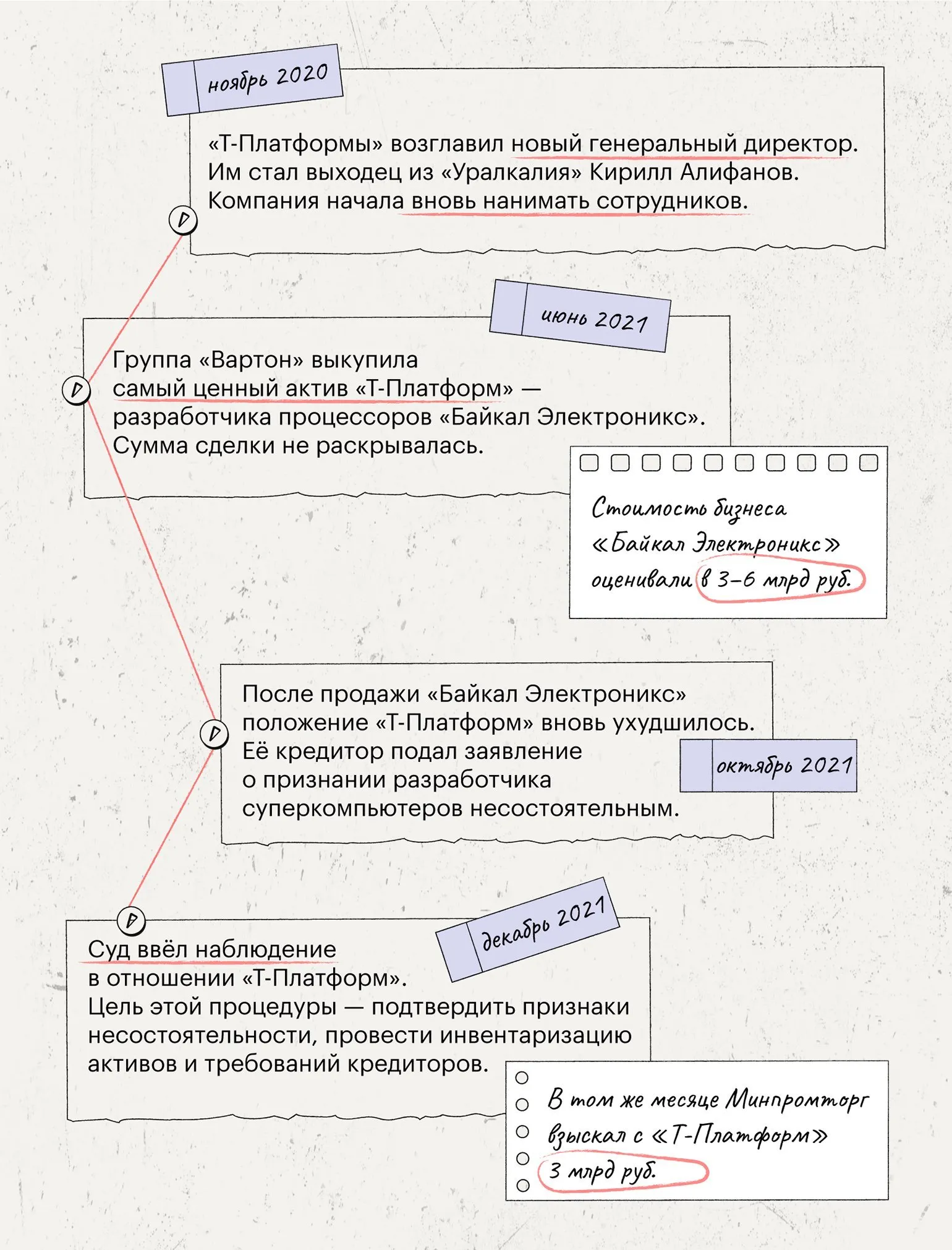
By the end of 2020, significant changes occurred at T-Platforms. Kirill Alifanov, who previously held a position at Uralkali, became CEO. Under the new leadership, the company has resumed hiring. According to CNews, one of the key factors in the company's recovery was the sale of a 74.9% stake in Baikal Electronics to LED manufacturer Varton, which is part of the Astra Linux group. These changes open up new opportunities for the company's growth and development in the high-tech market.
Following the arrest of the founder of Baikal Electronics, the company faced the need to attract investment and market support. During this period, the company's financial indicators underwent significant changes: revenue fell from 198.76 million rubles in 2019 to 13.88 million rubles in 2020. At the same time, T-Platforms reported revenue of 2.82 billion rubles in 2018, of which 632.98 million rubles were profit. More up-to-date financial data is not yet available, which creates additional difficulties for analyzing the current market situation.
The sale of Baikal Electronics in June 2021 was a key event for T-Platforms. According to Kommersant, after this transaction, T-Platforms was left without significant assets, as the remaining subsidiaries were liquidated. The situation worsened on October 11, 2021, when RM-Capital, the management company, filed for bankruptcy against T-Platforms, citing its intention to challenge the deal with Varton. This stage in the company's history highlights the serious financial difficulties and consequences of transactions in the high-tech sector.
Lawyer Kirill Snegiryov emphasizes that the main goal of bankruptcy proceedings is to confirm the facts of insolvency and conduct an inventory of the company's assets. At the same time, he notes that declaring T-Platforms bankrupt at this time is premature. It is important to consider all aspects of the company's financial condition and legal proceedings before drawing final conclusions about the company's status.
The situation worsened when the Ministry of Industry and Trade initiated legal proceedings against T-Platforms for over 3 billion rubles for failure to fulfill project obligations. This is not the first time the ministry has taken action against contractors: in December 2021, a lawsuit was filed against Baikal Electronics. Such actions highlight the importance of upholding contractual obligations in high-tech and manufacturing operations.
Government funding: in focus and responsibility
Litigation between government customers and contractors is becoming commonplace, according to lawyers interviewed by Skillbox Media. Ivan Khorev, partner at the Olimp law firm, emphasizes that government customers often exhibit little flexibility, preferring to resolve disputes through litigation rather than through negotiations. This phenomenon can negatively impact contract deadlines and the overall effectiveness of cooperation between the parties. Resolving conflicts through negotiations could significantly reduce the number of lawsuits and improve cooperation between government agencies and contractors.
In an environment of strict reporting standards, as Valeria Brusnikina, IT Project Portfolio Manager at the IPChain Association, notes, carefully drafting government contracts requires taking into account numerous public procurement laws and internal regulations. This, in turn, leads to increased scrutiny from law enforcement agencies and relevant ministries, underscoring the importance of complying with all established requirements to ensure the transparency and efficiency of government processes.
The need for rapid import substitution is prompting the Ministry of Industry and Trade to allocate new subsidies for microelectronics manufacturers. At the end of 2021, JSC NTC Modul won a 7.6 billion ruble tender for the development of a multiprocessor system based on the Russian NeuroMatrix architecture. This system is similar to NVIDIA's Jetson Xavier module, which is used in self-driving vehicles. Supporting domestic microelectronics developers is a key step toward reducing dependence on foreign technologies and strengthening Russia's position in the high-tech market.
Alexander Trokhin, Vice President of Information and Communications Hardware Solutions at Sitronics Group, asserts that government support for businesses and demand stimulation can play a key role in changing public opinion about Russian IT products. This, in turn, will lead to a significant increase in import substitution in the coming years. It is important to note that the successful development of the domestic IT industry depends not only on new technologies but also on active government policy aimed at supporting local manufacturers and their innovative solutions.
Pavel Kulakov, CEO of the Oxygen data center, expressed the opinion that import substitution policies have the potential to attract new players to the microelectronics market. Although this will require significant investment, such an initiative could facilitate the emergence of domestic companies capable of competing with international giants. Similar changes have already been observed in China, where sanctions imposed on the US have become a catalyst for Huawei's growth. Despite government support, many electronics manufacturers are facing serious challenges. According to Skillbox Media, most of them are focused on government customers, which negatively impacts the performance of domestic processors and the diversity of their product range compared to global leaders like Intel and AMD. This leads to financial difficulties and limits companies' capabilities, as is the case, for example, with Rosatom's plans to acquire a controlling stake in JSC MCST, the developer of the Elbrus processor. Competition with international manufacturers requires domestic companies to adopt an innovative approach and diversify in order to strengthen their market positions.
Manufacturers express concern about the control of state corporations, which could negatively impact the development of the industry. Ivan Pokrovsky, executive director of the Association of Electronics Developers and Manufacturers (ARPE), emphasizes that the hierarchical structure of state corporations stifles initiative and replaces personal responsibility for results with accountability to management. In his opinion, support for companies should be provided through long-term contracts, the coordination of technology development plans, and the stimulation of a competitive environment, which will ultimately facilitate growth and innovation in electronics.
Acquiring a company is often easier than retaining a development team under bureaucratic restrictions. Acquiring a controlling stake does not always ensure complete control over technology, Pokrovsky emphasizes.
T-Platforms' Prospects: What's in Store?
The situation surrounding T-Platforms remains uncertain. Although there are no official comments from company representatives, experts are actively analyzing possible scenarios for its return to the market. It is important to keep in mind that the company's recovery may depend on a variety of factors, including market conditions, the competitive environment, and strategic decisions by management. The company's next steps are expected to be discussed within professional circles, which will provide a better understanding of its future and potential growth opportunities.
According to information provided by attorney Dmitry Yakushev of the law firm Andrey Gorodissky & Partners, restoration of solvency after bankruptcy proceedings is extremely rare. Statistics show that only 0.1% of bankruptcy cases result in successful business recovery, 5% result in debt repayment, and 6% result in settlement agreements. Success in these cases largely depends on the company's ability to negotiate with creditors and find financing for rehabilitation. Importantly, an effective debt restructuring strategy and sound financial management can significantly increase the chances of a successful recovery.
Ivan Khorev, a corporate law specialist, notes that a successful return to the market is possible even after multiple bankruptcy proceedings. Key factors in this process are the company's confidence in its solvency and the ability to provide the necessary guarantees to restore market confidence. This demonstrates that even in challenging financial situations, companies can regain their niche if they are willing to work on their reputation and financial stability.
Despite the absence of legal barriers to resuming operations, T-Platforms faces a serious challenge. IVK CEO Grigory Sizonenko notes that the absence of founder Vsevolod Opanasenko significantly complicates the process of restoring the company's market position. In a highly competitive environment, the company must not only overcome internal challenges but also develop a strategy to regain the trust of customers and partners.
Sizonenko emphasizes that Opanasenko's personality has had a decisive influence on the company's development as a leading player in the design of ARM and MIPS processors for Russian microelectronics. His statement expresses sincere gratitude for Opanasenko's significant contribution: "Managing a successful business is not an easy task; it requires immense effort, passion, and complete dedication."

Grigory Sizonenko focuses on the strategic mistakes that led to the bankruptcy of T-Platform. He emphasizes that these mistakes negatively impacted the development of domestic microelectronics and raised serious doubts among developers of Russian IT products. Thus, the consequences of this bankruptcy affect not only the company itself, but the entire industry, which requires careful analysis and measures to restore confidence in domestic technologies.
The company's future remains uncertain. Currently, 75% of the shares are still owned by Opanasenko. If the legal proceedings are decided in his favor, he may again assume the post of head of T-Platform. However, according to Sizonenko, the likelihood of this is low.
Sizonenko points out the low probability that someone will be able to take Opanasenko's place and lead the company to success. He notes that the new management will likely be presented as "effective managers" who will adhere to a strict action plan rather than be inspired by creative ideas. This underscores the need for a systematic approach to achieving sustainable business results.
The future of T-Platform remains uncertain. Without a reliable and strong leader, it will be difficult for it to regain its market position and customer trust. For successful development, a company needs to focus on innovation and strategic management, which will help it take a stable position in the competitive environment.
Cybersecurity Specialist: 5 Key Skills for Success
Want to become a cybersecurity specialist? Learn 5 skills that will secure your career in IT!
Learn more