Contents:

Thinking about a new profession, but don't know where to start? Find out what suits you: IT, design, game development, management or marketing. Take a free career guidance course.
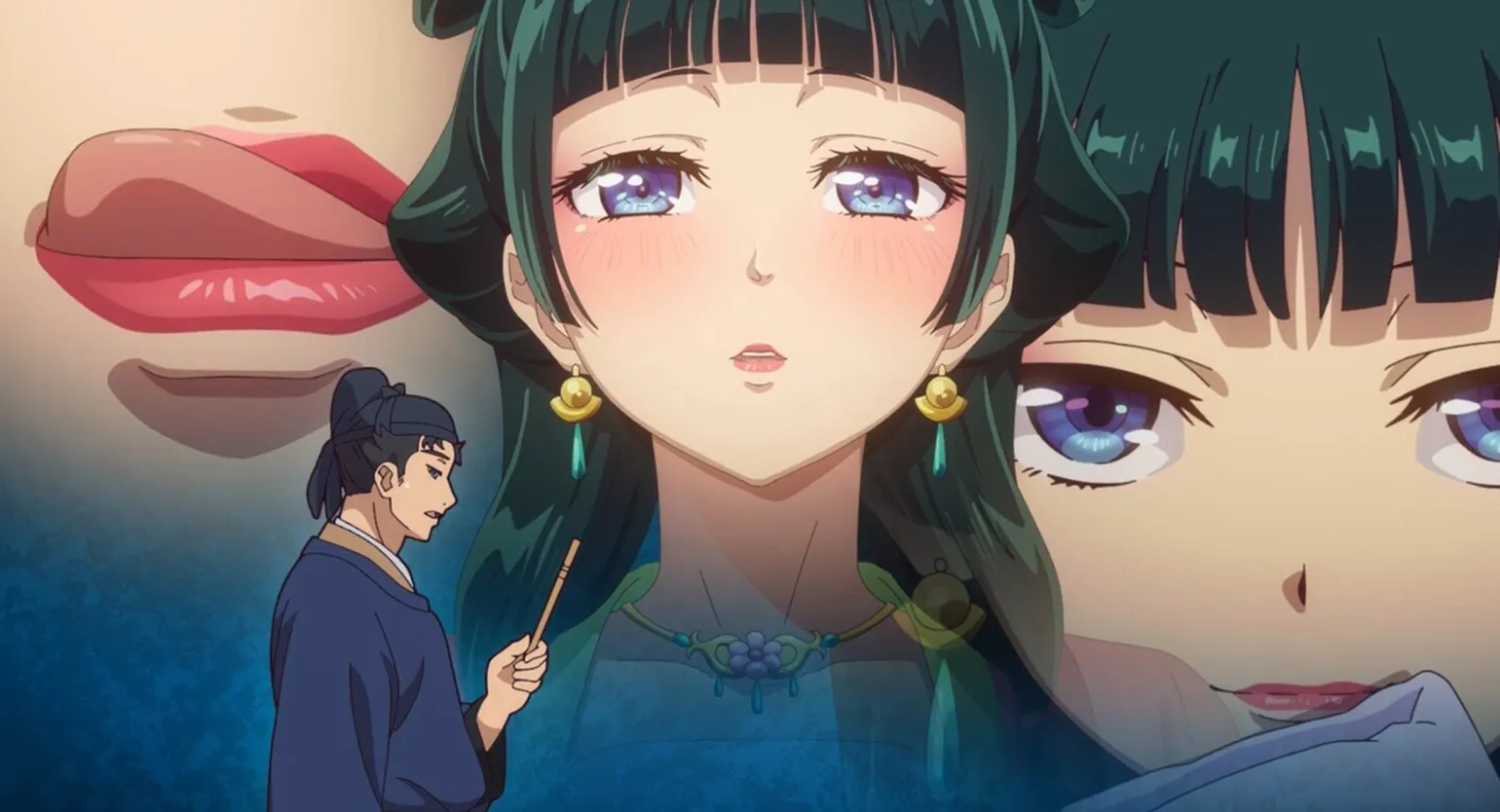
Learn more"The Pharmacist's Monologue" is an adaptation of Natsu Hyuga's light novel about a kidnapped girl who becomes a pharmacist for an imperial concubine. Unlike most modern anime, this series lacks action scenes. Instead, the creators focus on character development, complex plot twists, intrigue, and the struggle for power. It can be compared to "Game of Thrones," but done in the style of Japanese manga. Let's consider what makes this series successful and popular among viewers.
In this article, you will become familiar with the main aspects of the topic that will be discussed. We will share useful information and practical recommendations that will help you better understand the subject matter. You will gain valuable knowledge and insights that can be applied in practice. Stay tuned to find out more.
- What does a pharmacist spend most of his screen time doing?
- What do "The Pharmacist's Monologue" and Sherlockiana have in common?
- Why will Makoto Shinkai fans love the series?
- What is the series' main intrigue?
- How will "The Pharmacist's Monologue" surprise even anime connoisseurs?
Subscribe to the "How Are You?" Telegram channel. In this channel, our experts discuss psychology and self-development in detail and clearly, and also share useful tips. Every weekend, we publish new selections of films and music that will help you relax and get inspired. Join us to stay up-to-date on current trends in personal growth and cultural news.
About the anime "The Pharmacist's Monologue"
Maomao is the daughter of a poor pharmacist who spent her childhood near the courtesan quarter. Her father taught her the basics of pharmacy, and the courtesans taught her how to stand up for herself. As a teenager, Maomao was kidnapped and sold for a pittance to the imperial court. At first, she worked as a laundress, then became a servant to the concubine Gyokuyo. Maomao's erudition and empathy played a key role in her fate: upon learning that the emperor's children were suffering from an illness, she discovered the cause and anonymously reported it. The eunuch Zhenshi was able to identify the laundress and transferred her to a new position. Thanks to her knowledge and ingenuity, Maomao was able to change her fate and take an important place at court.
Following the instructions of Zhenshi and Gyokuyo, the girl manages not only to fulfill their requests, but also to help other residents of the courtyard. As a result, she unwittingly becomes involved in conflicts that arise between the inhabitants. This interaction not only complicates her life, but also opens up new facets of relationships in this diverse community.
Maomao's main occupation is checking food and cosmetics for the concubine. She is not afraid of poisons, as she has encountered dangers since childhood, including a scar from a snake bite. Food and drink in the palace are often poisoned, and Maomao acts as a skilled forensic chemist, using his knowledge and deductive skills to solve crimes.
The maid is not only resistant to poisons, but also immune to Zhenshi's charm. The purple-haired gentleman is unable to attract the attention of the meek and plain young lady, despite his popularity among the other women and men in the palace. However, the relationship between Maomao and Zhenshi cannot be considered indifferent.
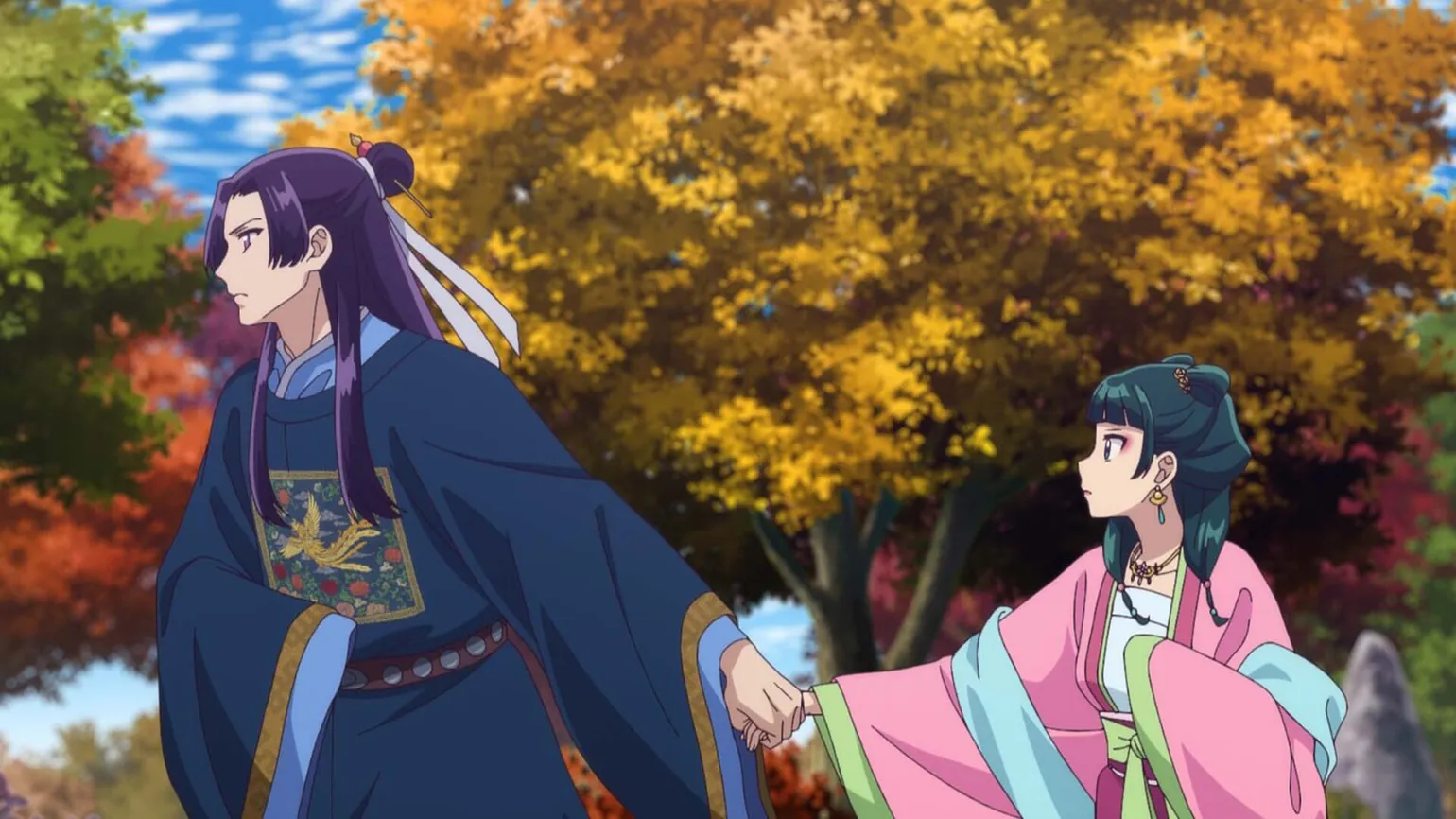
The girl constantly supports her boss in solving various problems and solving mysteries. She occasionally turns her attention to the suspiciously active eunuch, casting interested glances at him. However, more often than not, her facial expression betrays her dislike for him.
How the creators of "The Pharmacist's Monologue" play with genres
This 24-episode ongoing series is a vertical series, where each episode has an independent plot connected to the overall narrative line. You can start watching from any episode, including the current one. To avoid monotony in poisoning investigations, the creators of the project diversified the detective genre by integrating elements of other styles. A crime story can easily transition into a romantic comedy, a thriller, or even a Shakespearean tragedy. An example of this is the episode about the maid of one of the concubines, whose child was poisoned, and she herself survived thanks to the intervention of Maomao. This approach makes the series engaging and multifaceted, captivating viewers and keeping them interested throughout.
Filler stories play an important role in the plot development. When Maomao leaves the palace for a few days to meet with his family, it creates an atmosphere reminiscent of the series Sherlock with Benedict Cumberbatch. These moments add depth to the characters and allow viewers to see them in new circumstances, which makes the plot more layered and interesting.
Why The Pharmacist Will Please the Eyes
The series' visual design is being handled by OLM and Toho. OLM is known for its work on the Pokémon project, while Toho gained popularity thanks to the anime Magic Battle and Weathering With You. The visual style of The Pharmacist stands out for its detail and three-dimensional, lively mise-en-scènes, which are reminiscent of Weathering With You. Makoto Shinkai's works have had a significant influence on the series' artists: they meticulously craft natural elements, combining a flat graphic style with volumetric chiaroscuro. This allows for an expanded frame and alters the camera's optics. In addition, in "The Pharmacist," the environment plays a significant role, sometimes even drowning out the main characters' voices.
Read also:
Makoto Shinkai is a Japanese animator, director, and screenwriter known for his unique cartoons that explore themes of love, time, and separation. In this article, we will present 13 animation films that became iconic in his career and won recognition both in Japan and abroad.
First, it is worth mentioning "The Garden of Words", which explores the connection between two characters who meet on a rainy day. This cartoon stands out for its visual beauty and deep emotional component.
"Your Name" is one of the most successful animated films of all time, telling the story of two teenagers who unexpectedly begin to swap bodies. The film became a cultural phenomenon and attracted the attention of audiences around the world.
"Spirited Away" is the story of a girl who finds herself in the spirit world. Although this cartoon is not Shinkai's work, it had a significant influence on him, inspiring him to create his own unique worlds.
"5 Centimeters Per Second" is a touching story about love and distance that touches the hearts of viewers. Each segment of the film focuses on different stages of the protagonist's life, demonstrating how time affects relationships.
"Light in August" is a stylish and visually appealing animation that explores themes of nostalgia and remembrance. Shinkai once again demonstrates his talent for creating atmospheric and emotionally charged scenes.
"Voice of a Distant Star" is a short film that explores how distance and time can affect human relationships. It was one of Shinkai's first significant projects and laid the foundation for his subsequent career.
"Weathering with You" is the story of a teenager who has the ability to control the weather. The film touches on important themes of ecology and human responsibility.
"Your Name: Rising" is a sequel that expands on the original film's plot lines and deepens the characters' personalities.
"A Bright Future" is an animated film that explores themes of hope and dreams, showing the importance of believing in the best despite difficulties.
"The World We Lost" is a story about how the past influences our perception of the present. Shinkai once again addresses the theme of time and loss.
"The Sound of a Distant World" is an animation that explores how sounds can influence our emotions and memories, adding new dimensions to his filmography.
"Winter's Tale" is a romantic story that immerses viewers in the atmosphere of winter holidays and the warmth of human relationships.
Each of these animations reflects Makoto Shinkai's unique style, his ability to create beautiful, emotionally rich stories that resonate with viewers of different ages and cultures.
The locations in "The Pharmacist" differ significantly from those in Shinkai's works. While Shinkai's hero lives in modern-day Tokyo, Maomao's story unfolds against the backdrop of a magnificent Chinese imperial palace dating back to the early Middle Ages. These historical settings create a unique atmosphere and highlight China's cultural heritage, making the plot more captivating and rich.
The costumes featured in "The Pharmacist's Monologue" are striking in their splendor and detail. The artists spent considerable time creating the intricate outfits, meticulously crafting every detail and accessory. Makeup is an important element, helping the heroine create the right impression depending on the situation. For example, freckles on her face serve to deter clients in the prostitute quarter, while in preparation for a court celebration, she accentuates her eyes and wears pink lipstick, attracting the attention of eunuchs and resulting in gifts of hairpins. This approach to costumes and makeup emphasizes not only the aesthetic component but also the deep connection between the character's appearance and social interactions.
The glamorous aesthetic of manga-style drawing harmoniously combines with the playful, cartoonish chibi animation. This contrast creates a unique atmosphere that attracts attention and gives the audience a variety of visual impressions.
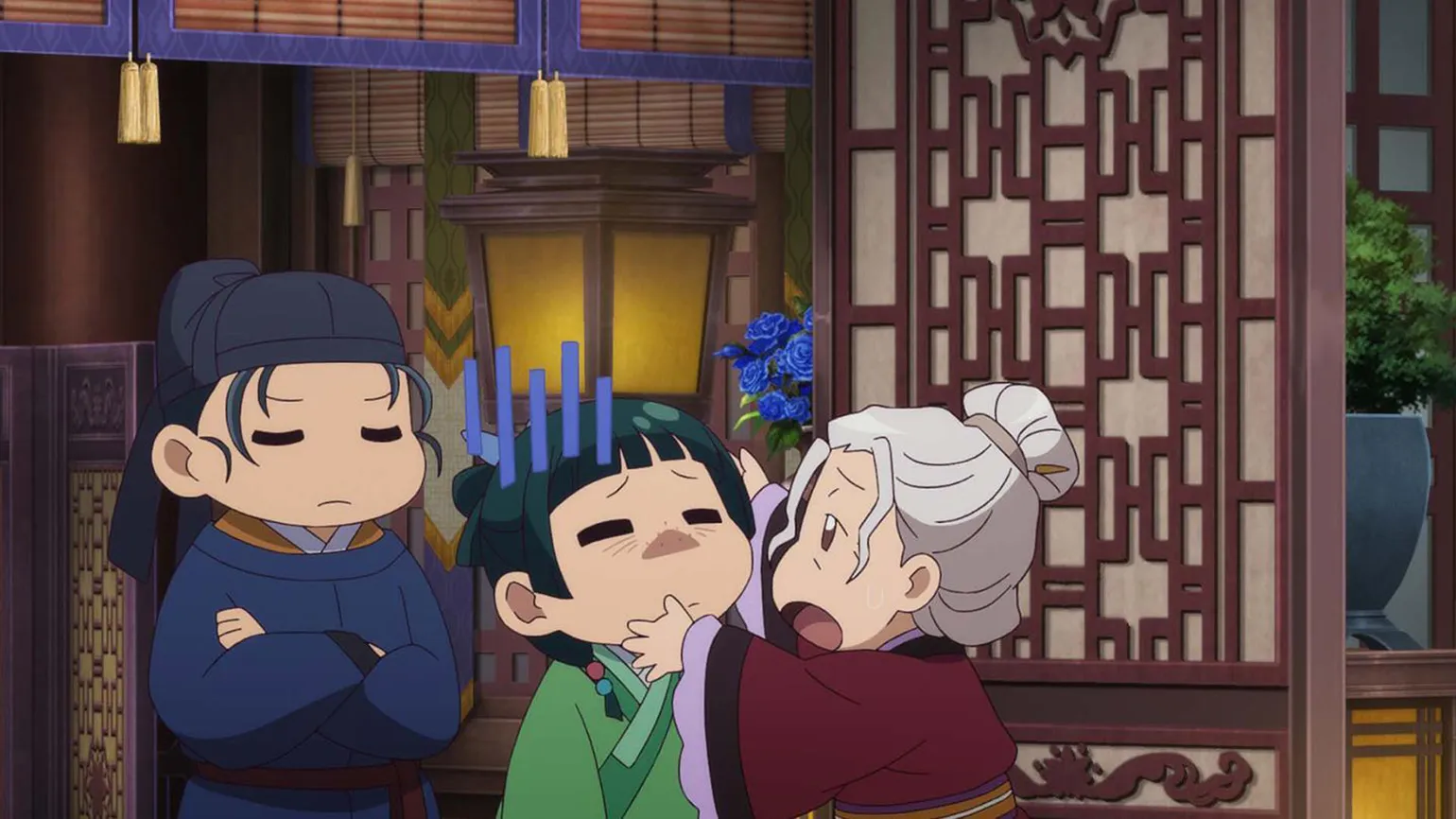
At first, such inserts can cause confusion and even irritation. One would like to exclaim: "Be more serious, colleagues!" However, after a few episodes, it becomes obvious that without chibi elements, the sullen Maomao quickly begins to tire the viewer. Chibi adds dynamism and lightness to the narrative, making the character more multifaceted and interesting. This creates a contrast that helps hold attention and attracts the audience.
Why the characters are interesting to watch
The series "Monologue of a Pharmacist" got its name for a reason: the main focus here is on the inner world of the main character, her thoughts and experiences. Secondary characters, such as Zhenshi and his retinue, play the role of testers, creating new challenges for the main character. The nickname Herbalist, given by the eunuch, emphasizes her unique role in court life. She not only treats physical ailments but also helps her patients cope with their emotional suffering. A case in point is the hostile concubine whom the Herbalist saved from death and cured of suicidal thoughts, demonstrating her significance and influence on the emotional well-being of those around her. Thus, the series emphasizes the importance of medical practice and psycho-emotional support in the difficult environment of the court.
Zhenshi plays a key role in developing the enigmatic Maomao, plunging her into various adventures that, in turn, spark the audience's imagination. The secrets he harbors are gradually revealed, including questions about whether a eunuch is truly capable of experiencing attraction and how this relates to his work. Zhenshi is an intriguing character with an ambivalent nature: he can be both sensible and intelligent, yet unpredictable. In one scene, he signs important documents, while in another, he plays with honey, reaching for the heroine's lips. These contrasts highlight the complexity of his character and add depth to the plot.
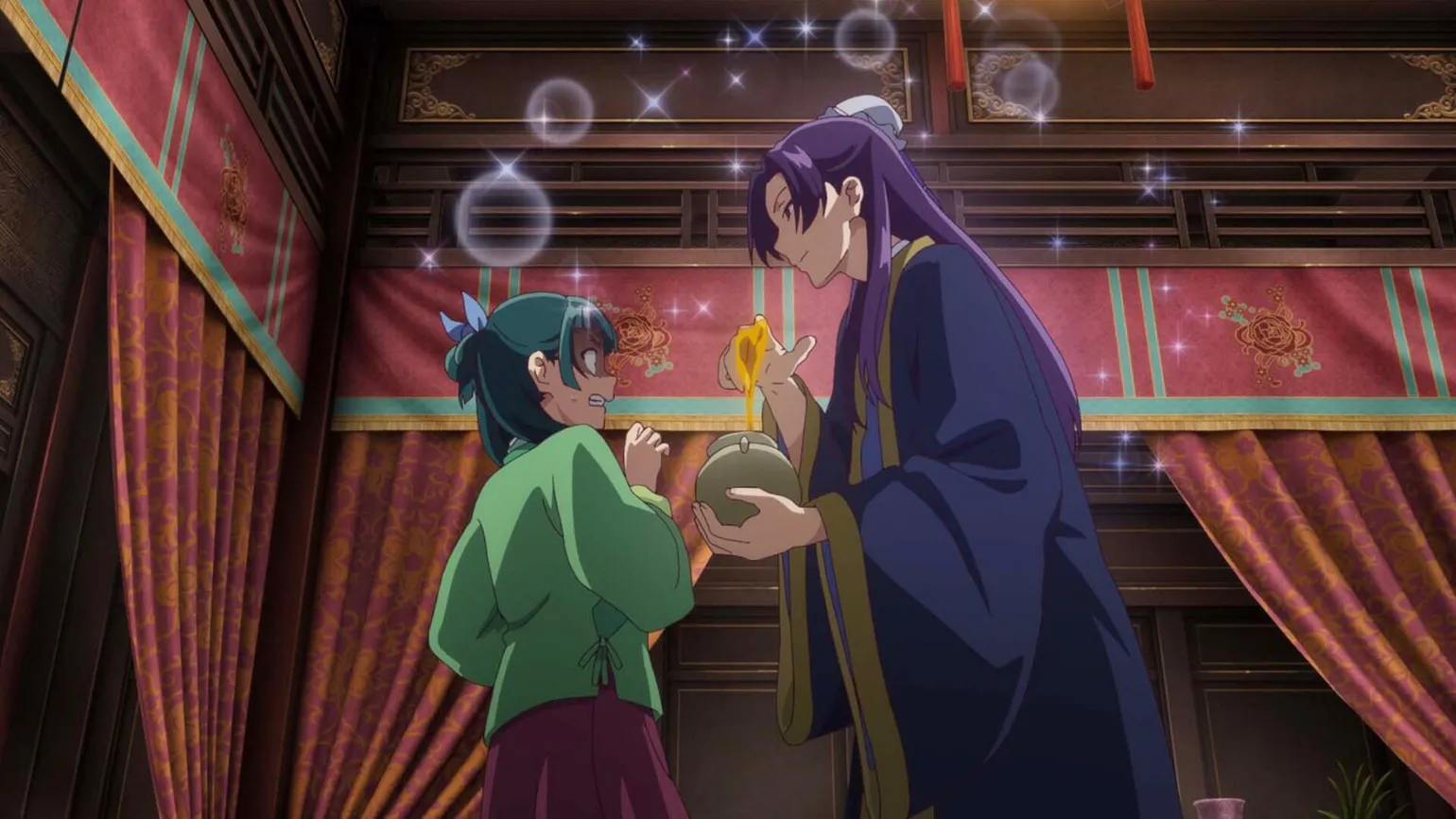
Zhenshi's extravagance puzzles the Herbalist, who calls him a peacock. The funny names the characters choose for each other emphasize the special connection between them, although it defies a clear definition. It is not codependency, not love, and not friendship, but their connection is deeper than that of typical anime couples, and each of them is an independent and interesting individual.
What anime will surprise even fans of Japanese animation
In a modern world where many popular anime series are saturated with violence and action scenes, such as Chainsaw Man, Attack on Titan, and Parasite, The Pharmacist Project is a real revelation. It stands out thanks to witty dialogue, dynamic editing, and funny chibi episodes. The anime's plot develops quickly and does not lose momentum, providing viewers with a captivating narrative. "The Pharmacist" successfully combines elements of a historical drama, a prequel to the cult series "Breaking Bad," and a romantic story, making it appealing to a wide audience.
"The Pharmacist" features a striking character—the female protagonist, Maomao. At first glance, she may seem inexperienced and vulnerable, but upon closer inspection, it becomes clear that she possesses an unbreakable spirit. Maomao accepts all the hardships and privations she faces with dignity. She doesn't speak insolently to her superiors, but she also doesn't feign deference—she boldly seeks an audience with a concubine. Medieval patriarchy is powerless to break her strong character. Compared to such a heroine, Zhenshi sometimes appears weak and childish, especially when he drinks too much and begins to feel sorry for himself. This contrast highlights Maomao's strength and independence, making her one of the series' most memorable characters.
The Pharmacist's Monologue draws attention with its sincerity and lack of desire to please. It possesses a vintage charm that successfully blends genre traditions with modern elements. Like Death Note, this series delivers a captivating story that focuses on unusual characters and their complex relationships. "The Pharmacist" borrows from the cult series' successful tropes, including vibrant characters and a distinctive visual style. Anime fans will find the elements that first drew them to Japanese animation, newcomers will be able to delve deeper into the genre, and mystery fans will enjoy the gripping intrigue. Romantics will also appreciate the emotional depth and visual beauty. Don't miss this amazing series!
How to make money in IT
Take a simple test to understand which IT field suits you best. Master Python and Java, mobile and web development, data analysis, neural networks, testing, and cybersecurity. Write your first programs and create a personal career plan to start in IT.
Learn more