Contents:

Learn: Free career guidance
Learn moreTraditional church music
Christian music originated simultaneously with the first Christian communities, where psalms borrowed from the Jews and based on the texts of the Psalter were performed. The Gospels of Matthew and Mark contain references to Jesus singing psalms with his disciples: "And when they had sung, they went out to the Mount of Olives" (Matthew 26:30, Mark 14:26). In early Christian practice, songs were performed a cappella, without musical accompaniment, which became an important characteristic of this period. The use of instruments was considered unacceptable, as they were associated with pagan rituals and orgies, which contradicted Christian values. Christian music developed in the context of spiritual worship and the unification of believers in their communion with God.
Until the 8th-9th centuries, the use of musical instruments in churches was limited, but from that time on, organs began to be actively used in churches. This became an important stage in the development of church music, giving worship services a new sound color and depth. Organs became not only instruments for performing hymns and prayers, but also symbols of spiritual life, enriching the atmosphere of religious rites.
Gregorian Chant
Gregorian chant became the main form of religious singing in the Middle Ages. These works were distinguished by a monophonic sound, which meant that the choir performed the music in a single voice. This approach emphasized the idea of the equality of all people before God and created an atmosphere of spiritual unity. Gregorian chants played an important role in the liturgy and church life, contributing to the deepening of religious feelings and spiritual experience of believers.
In the 8th and 9th centuries, choral singing began to develop, and melodies began to be performed in different voices. Choir members performed melodies in parallel with each other and also used a technique known as "organum point," in which one voice held a bass tone for a long time, while the other voices created independent melodies. At the turn of the 11th and 12th centuries, the composer Pérotin, who led the choir of Notre Dame, became the first to write compositions for three and four voices. His works combined melodies with different rhythms, which was called "organum."
Masses
A Mass is a form of Christian music that is a musical presentation of the liturgy. Masses can take a variety of forms, including being performed a cappella or accompanied by instruments, including a full orchestra. This musical form plays an important role in worship and spiritual practice, enriching the liturgical atmosphere and deepening the faith of the parishioners.
Masses, based on Gregorian chant, began to develop in the late first millennium and by the beginning of the Renaissance had become the main form of religious music. By the 15th century, the practice of composing masses as independent original works, rather than as compilations of excerpts from various composers, had become established. This led to the emergence of the first musical stars. The most famous composers of the early Renaissance were William Byrd, Tomás Luis de Victoria, and Giovanni Pierluigi da Palestrina, whose works had a significant influence on the development of musical art of the time.
By the 18th century, masses had acquired a much more complex structure. A school arose in Vienna where composers began to create masses in the format of an opera, including soloists and a choir. These works were divided into four parts, like symphonies. Many masses of that time were so complex that they were not used in church services; they became independent musical works intended for the concert stage. Composers such as Handel, Mozart, and Haydn worked in this genre, making a significant contribution to the development of musical art.
Carols
Carols are a genre of Christian music that became especially popular during Christmas thanks to classic compositions such as "Carol of the Bells". Originally, carols were composed for various holidays, and since the 13th century they have been performed in everyday life. It was not until the 18th and 19th centuries that carols began to be used in church services and associated exclusively with Christmas celebrations. This genre of music continues to attract attention today, maintaining its relevance and popularity during the holiday season.
Traditionally, carols were built on chord progressions characteristic of the Middle Ages, which gave them a unique sound. These musical works, reflecting the spirit of their time, continue to inspire musicians and music lovers around the world. The use of medieval chords creates an atmosphere that immerses the listener in a historical era and helps preserve musical heritage. Carols remain popular today, often performed at holidays and cultural events, which testifies to their timeless relevance and appeal.
The song "Angels from the Realms of Glory" has roots in the Middle Ages and is one of the oldest musical works still performed today. This composition maintains its popularity due to its deep spiritual content and melody, making it a favorite of both performers and listeners for centuries. The importance and historical value of such songs confirm their place in musical culture and traditions.
Read also:
Carols: who sings what at Christmas
Carols are traditional Christmas songs performed during the Christmas celebration. They convey the spirit of the holiday, telling about the birth of Jesus Christ and reflecting folk customs. Carols are performed both in churches and on the streets, where groups of performers, called kolyadschiki, visit homes, congratulating people on the holiday.
The main themes of carols are associated with the birth of Christ, joy, and the hope of salvation. The lyrics often mention shepherds, angels, and Magi who come to pay homage to the newborn. Some carols also feature elements of folk art, blending religious and secular motifs.
Carols are performed by both professional groups and amateurs, creating a variety of styles and melodies. Each country has its own unique caroling traditions, reflecting the cultural characteristics of the region. This musical form not only preserves historical memory but also unites people during the holiday season, creating an atmosphere of warmth and unity.
Thus, carols are an important part of Christmas celebrations, helping to preserve traditions and pass on cultural heritage from generation to generation.
Spirituals
The spirituals genre emerged in the 1860s and 1870s, but a cappella singing in a similar style began to develop among African Americans long before this period. Its roots are in African folklore, which was brought to the New World by black slaves. Under the influence of Christian culture, folk songs acquired new meaning and became an important expression of the spiritual and social experiences of African Americans. Spirituals not only reflect the richness of musical traditions but also serve as important historical testaments to struggle and hope.
Most classic spirituals are based on biblical stories that reflect the suffering of the people. These works often draw parallels between the biblical Hebrews and African Americans, emphasizing the similarities in their fates. Like African Americans kidnapped into slavery, the Hebrews of the Old Testament also experienced suffering in slavery, but under the ancient Egyptians. The arrival of the deliverer Moses was a turning point: he led the Hebrews out of Egypt, granting them long-awaited freedom. Spirituals, therefore, not only tell of suffering but also serve as a symbol of hope and liberation.
The famous spiritual "Go Down, Moses," which you may have heard performed by Louis Armstrong, reflects profound social and historical significance. African Americans, singing this spiritual hymn, called on Moses to appeal to Pharaoh with the demand: "Let my people go." This appeal symbolized their hope for liberation from oppression and their expectation of change from the US government. Unlike traditional chants, which focus on eternity, religious spirituals emphasize current, earthly demands for civil rights and liberties, emphasizing the importance of the struggle for justice and equality.
Many biblical stories of deliverance can be found in spirituals. The composition "Wade in the Water" is dedicated to the exodus from Egypt, and the songs "Run Old Jeremiah" and "Follow the Drinkin' Gourd" also touch on the theme of flight. "O Canaan" tells of the Promised Land, which God gave to the Jewish people. In turn, "Swing Low, Sweet Chariot" describes the death and ascension of the prophet Elijah on a heavenly chariot. These works not only reflect important moments in biblical history, but also convey the spirit of the struggle for freedom and hope for a better future.
In Catholicism and Orthodoxy, musicians adhere to a strict canon, performing chants from sheet music and reciting only the texts prescribed in the Menaion. In contrast, spirituals are based on collective improvisation, where the opening theme is enriched with expressive notes, expressive passages, and variations in tempo and rhythm. This freedom in performance allows musicians to convey emotions and feelings, creating a unique musical work in each performance.
Spirituals are traditionally performed in a specific sequence. This sequence helps create an atmosphere of spiritual upliftment and unites the listeners. The performance typically begins with a melody that attracts attention and sets the right mood. This is followed by deeper, more emotional compositions that explore themes of hope, faith, and struggle. The performance concludes with a powerful finale that leaves a deep impression and inspires the audience. The correct structure of the spirituals' performance plays a key role in conveying their spiritual meaning and emotional charge.
- Song-sermon - the minister sings the text of the sermon in a question-and-answer format, addressing the congregation. Everything begins with a simple melody, but gradually the preacher complicates the performance with the help of improvisation and syncopation.
- The spirituals themselves - the preacher and the people around him sing the song together, everything is accompanied by clapping, stomping, and body movements that convey strong emotions.
- Ring-shout - the believers move in a circle counterclockwise, energetically dancing with their whole bodies to syncopated rhythms. There is also a soloist, but he changes spontaneously.
Gospel
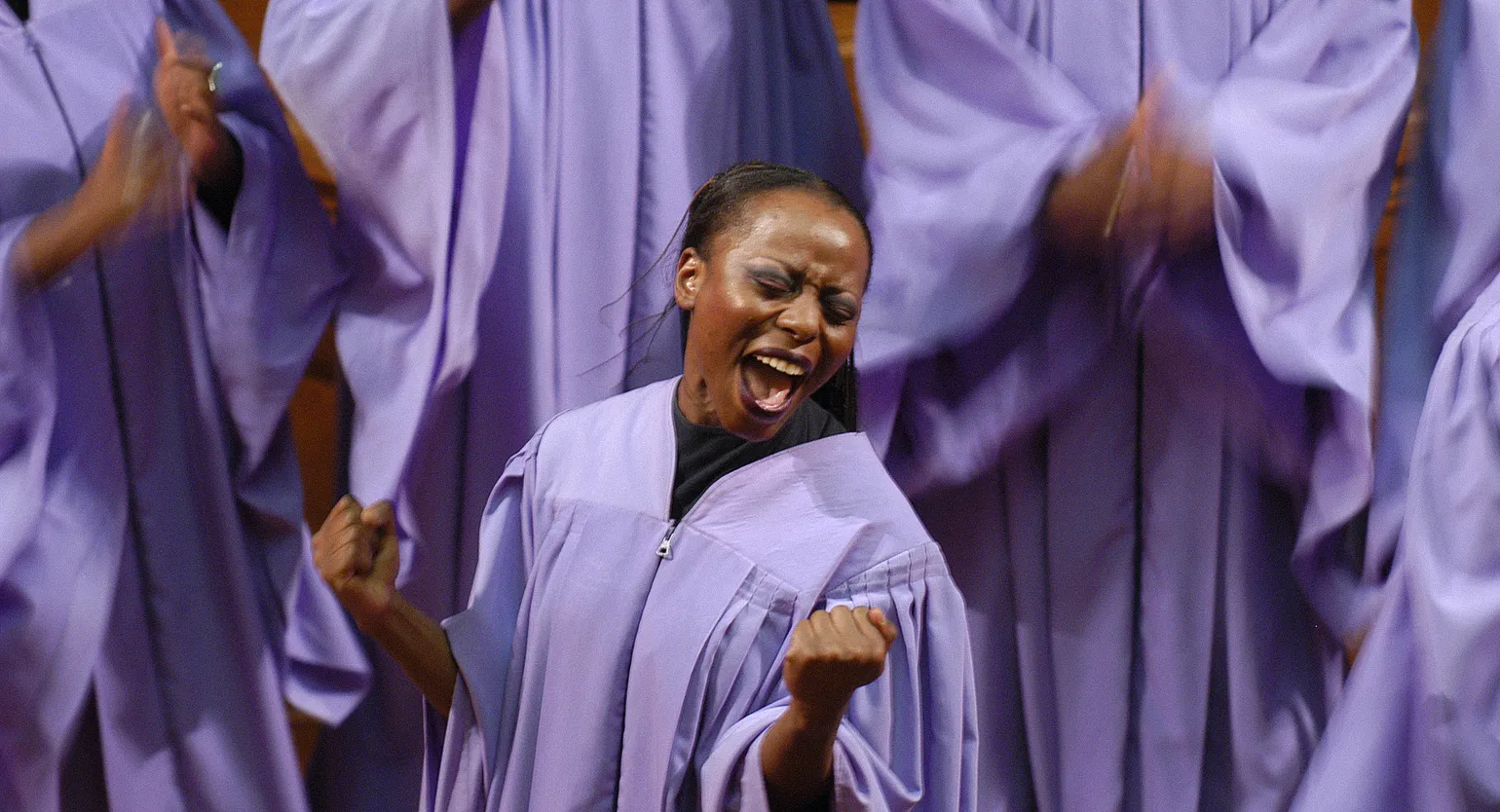
Gospel, which emerged in the late 19th century in Methodist churches in the southern United States, is a musical genre that evolved from spirituals. This style of music retains many features of its predecessor, including the exchange of lines between the preacher and the congregation. Gospel is distinguished by a unique combination of structure and improvisation, which makes it expressive and emotional. This genre continues to exert a significant influence on modern music, inspiring performers of various genres and remaining an important part of the cultural heritage of the United States.
Gospel differs from spirituals in that its musical structure actively uses elements from various genres. Gospel music was originally based on a simple piano and organ accompaniment, but with the beginning of the 20th century, musicians began to incorporate a wider range of instruments, including tambourines and electric guitars. Gospel music typically features a soloist supported by a choir, creating a harmonious and emotional sound.
The Protestant church played a key role in the development of gospel music, actively hiring composers to create new songs, unlike spirituals, where only folk melodies were performed. Among the prominent composers are Ira David Sankey and Philip Bliss, whose collection "Gospel Hymns", published in 1875, remains popular to this day. Charles Albert Tindley also made a significant contribution to the gospel genre, writing many well-known songs that enriched the repertoire and legacy of this musical movement. Gospel music continues to be an important part of the Protestant musical tradition, attracting new generations of listeners and performers.
Compare different interpretations of Tindley's song "The Storm Is Passing Over". In the first video, the choir performs it in a classical version with a piano, creating the atmosphere of traditional gospel. In the second video, the preacher and the choir perform a more dynamic version, accompanied by lively drum rhythms, guitar, and organ improvisations. While this interpretation may seem unusual to classical music fans, it beautifully reflects the African-American roots of the genre. The syncopated rhythm and pronounced joy in the performance highlight the ecstatic feeling of closeness to God that is an important part of this musical tradition.
Gospel music underwent significant changes in the early 20th century. The main reason for these changes was the economic crisis that affected the lives of many African Americans. The collapse of the cotton market forced them to leave the rural areas of the South and move to the cities of the North. Finding themselves in a multicultural environment, gospel composers began to move away from traditional church music and experiment with new genres. Elements of blues, Irish folk, and country music began to appear in their works. These changes not only enriched the sound of gospel but also contributed to its further development and popularization in the music world.
By the 1930s, gospel music had taken the form we are familiar with today. Its development was significantly influenced by the following factors:
- the hymns of Charles Tindley, who wrote instrumental accompaniment for spirituals, added a blues rhythm and left room for improvisation;
- minimalist melodies of "country gospel" performed solo;
- the relaxed, boisterous style of worship characteristic of the Pentecostal church.
The music of Thomas Dorsey is considered a classic of its time and occupies an important place in the history of gospel music. Dorsey, known as one of the most significant composers in the genre, was also a talented blues and jazz pianist. He collaborated with Mahalia Jackson, one of the greatest singers with a powerful voice, who left an unforgettable mark on the music industry. Despite initial condemnation from African-American religious leaders, who considered Dorsey's music too close to "wicked" secular genres, his works quickly gained popularity and began to be performed throughout the United States. Dorsey's music not only reflected the cultural changes of his time but also became the basis for the development of gospel music, which has had a significant influence on modern music.
Gospel, while maintaining its religious content, has become a popular genre accessible to a wide audience, including those who do not attend church. This musical style attracts listeners due to its emotional richness and depth, allowing everyone to find something close and meaningful in it. Gospel music has become not only an expression of faith but also an important part of cultural heritage, uniting people of different faiths and backgrounds through powerful melodies and inspiring lyrics.
Christian Rock
The prototype of rock emerged in the 1930s and 1940s thanks to gospel singer Sister Rosetta Tharpe. Her performance of sacred music was distinguished by energetic guitar playing, where she sometimes used primitive distortion. Sister Rosetta Tharpe had a significant influence on rhythm and blues and is rightly called the "grandmother of rock and roll." Her innovative approach and unique sound became the basis for the further development of rock music, which confirms the importance of her contribution to musical history.
Elvis Presley always dreamed of performing Christian music, especially gospel, and in the sixties he began to realize this dream. In 1957, Little Richard demonstrated his devotion to his faith when, in the midst of his tour, he abandoned performing rock 'n' roll. He became a Pentecostal minister and until 1962 focused exclusively on recording church songs. These examples show how Christian music influenced famous performers, shaping their careers and spiritual paths.
At that time, Christian rock had not yet emerged as a distinct genre. Church officials, including even progressive African-American preachers such as Martin Luther King, rejected the idea of its existence. This reflected the broader cultural and religious contradictions of the time, when musical genres and spiritual practices intertwined and interacted, but had not achieved the synthesis we see today.
The late 1960s saw significant changes with the emergence of the hippie movement. At this time, Christian preachers actively sought to bring youth, who had become addicted to drugs and sexual freedom, back to the true path. They called on young people to open their hearts to Jesus, offering an alternative to a lifestyle based on chaos and free pleasure. This interaction between religion and counterculture reflected profound social changes and a desire for spiritual exploration among the youth of the time.
This led to the emergence of the Jesus Movement, also known as the Jesus Freaks, a youth movement that actively used contemporary cultural forms, including rock music, to spread its ideas. Artists associated with this movement include Love Song, All Saved Freak Band, Barry McGuire, Randy Stonehill, and Larry Norman. Norman's 1969 album "Upon This Rock" is considered the first Christian rock record and a milestone in the history of this musical culture. The movement not only transformed the music scene but also had a significant impact on the spiritual development of young people, bringing Christian values and messages into rock culture.
The Jesus Freaks movement was a close-knit community that arose in the face of rejection from both rockers and traditional Christians. By the early 1980s, the movement had faded, but it was the origin of many of the rapidly growing denominations in the United States in the late 20th century, such as Calvary Chapel and the Vineyard Church. Thanks to this movement, a full-fledged Christian rock industry was formed, including its own charts and festivals, which contributed to the popularization of Christian music and the creation of a unique cultural environment.
The Jesus Freaks movement gave rise to such musical movements as Christian heavy metal, represented by the bands Stryper and Bloodgood, and Christian punk rock, in which the band Undercover stands out. In addition, the band Petra, performing stadium rock in the style of Foreigner and Journey, gained immense popularity and became one of the key figures in the Christian music scene.
Read also:
Truly Risen: Outstanding Interpretations of the Image of Christ in Cinema
The image of Christ on screen has always aroused great interest among viewers. Filmmakers strive to convey the depth and complexity of his personality, creating memorable images. From classic films to modern interpretations, each adaptation offers a unique perspective on his life and teachings. Films about Christ explore themes of faith, love, sacrifice, and redemption, making them relevant across eras. These vivid images inspire and provoke thought, leaving a deep impression on viewers. Importantly, high-quality work on such projects requires not only artistic mastery but also a deep understanding of the historical context. Thus, films about Christ continue to occupy an important place in world cinema, attracting the attention of both believers and those seeking meaning in life.
Contemporary Composers
Traditionally, masses were performed in Latin, but in the 20th century, this approach became less relevant. Parishioners did not understand Latin, and the church sought to become closer to the people. In the early 1960s, the Pope authorized Masses in modern languages, opening new horizons for musicians outside the church. For example, jazz pianist Mary Lou Williams, who had previously shown no interest in religion, converted to Catholicism and wrote the Mass "Black Christ of the Andes." This move symbolized changes in the musical and religious worlds, uniting diverse cultural traditions and demonstrating how music could serve as a vehicle for spiritual expression and connection to faith.
In the United States, masses have undergone significant changes, becoming enriched by the religious traditions of African Americans. Choir singing began to be accompanied not only by the organ, but also by the guitar and piano, which brought new musical nuances. One of the initiators of this transformation was Dennis Fitzpatrick, who created a mass called the "Demonstration Mass." He recorded it on vinyl and distributed it among bishops in the United States, receiving positive approval for his work. This Mass marked an important step in integrating various musical styles into church practice, attracting a larger congregation and adding variety to the liturgical life.
In 1964, the first official English-language Mass was celebrated, featuring Clarence Rivers's "God Is Love." This work became a significant event in church music, as it harmoniously intertwines Gregorian chant with the melodic patterns and rhythms of spirituals. This Mass symbolized the transition to more contemporary forms of worship and opened up new horizons for musical expression in religious practice.
Avant-garde composers are actively creating Christian music, introducing unique elements to traditional forms. Estonian composer Arvo Pärt is known for his Orthodox works, among which the most notable are "Triodion," "Canon of Repentance," and "I Am the True Vine." These compositions are performed a cappella and reflect a deep spirituality. British composer John Tavener, after converting to Orthodoxy, also enriched the Christian musical tradition by writing works in Russian, including "Six Russian Folk Songs," "Akhmatova: Requiem," and "Songs of Akhmatova." These works demonstrate a synthesis of tradition and modern sound, attracting the attention of listeners and researchers of Christian music.
In 1996, Swedish composer Fredrik Sixten created a unique musical work, "Mass in Jazz Style," which became an iconic example of the combination of traditional church music and modern jazz sounds. In 2006, the Evangelical Lutheran Church of Finland held its first heavy metal mass, demonstrating the diversity of musical genres that can convey spiritual values and the depth of religious experience. These events highlight the evolution of church music and its adaptation to modern trends, attracting the attention of new listeners and expanding the boundaries of traditional formats.
Chorales in the Modern World
Currently, interest in Gregorian chant has significantly declined. However, in the early nineties, there was a brief surge in the popularity of this musical genre. Gregorian chant, which is a polyphonic church hymn, attracted the attention of listeners and musicians, which contributed to its revival in certain periods. This unique musical style continues to influence modern music and culture, despite the loss of mass interest.
In 1990, the album of the group Enigma entitled "MCMXC a.D." reached multi-platinum status. This album became iconic thanks to its unique sound, which combined elements of calm electronic music, new age, and female vocals imbued with sensuality. The use of samples from Gregorian chants added depth and originality to the compositions. This combination of musical styles was so provocative that the Vatican decided to ban the band's music from its radio stations. The album "MCMXC a.D." continues to be an influential work, which has had a significant impact on the development of electronic music and new age genres.
In 1991, Frank Peterson left the Enigma group and founded the Gregorian project. This musical group became known for its unique style, which features popular songs from The Beatles to Metallica performed in choral format. Gregorian brought a new sound to music, combining elements of classical choral music with modern hits, which allowed them to attract a wide audience and create a unique musical style.
In 1994, the album Chant, recorded by Benedictine monks from Santo Domingo de Silos in Spain, became a sensation. The monks had been performing chorales since the 11th century, but the initial recordings, released in the 1970s, were not very successful. In the 1990s, Angel Records reissued the album, positioning it as a means of combating the stress of modern life. This marketing strategy proved successful: the album reached number three on the Billboard album chart and sold four million copies worldwide. The album Chant became a symbol of a return to spiritual music and continues to attract the interest of listeners seeking harmony and peace.
Soul
All the founders of soul, such as Sam Cooke, Ray Charles and Otis Redding, began their careers in church choirs. Aretha Franklin was inspired by the musical legacy of her father, who was a famous preacher and performer. His voice was considered unique, and he was called the owner of the million dollar voice. These artists made a significant contribution to the development of soul music, thanks to which the genre has become an important part of musical culture.
Soul is a musical genre that arose from gospel and rhythm and blues. However, we're not talking about danceable R&B with fast rhythms and energetic melodies, but rather more melodic and romantic ballads. This style of music is distinguished by elegance and deep emotional expressiveness. A striking example of this sound is the 1954 hit "Earth Angel" by The Penguins, which became a landmark work in the history of soul.
Gospel singers brought powerful passion and emotional vocals to R&B, previously used to express religious ecstasy. In turn, rhythm and blues opened new horizons for gospel singers, allowing them to touch on personal themes, most often associated with love. As Ray Charles noted, "I began to do what had previously seemed impossible. I took lines from gospel and adapted them for secular songs." For example, he changed the lyrics to "This Little Light of Mine" to "This Little Girl of Mine," which caused dissatisfaction with one of the background singers, who could not come to terms with this approach. This example demonstrates how the intersection of genres can generate both inspiration and controversy, highlighting the importance of innovation in music.
Gospel music can carry a powerful social message. When Sam Cooke was arrested for trying to check into a white hotel, he wrote the song "Change Is Gonna Come." The song became a symbol of the civil rights movement and was performed at the funeral of activist Malcolm X. It was also quoted by Barack Obama during his election triumph, emphasizing its significance in the context of change and hope for a better future.
Aretha Franklin's song "Respect" became a symbol of women's emancipation in the 1960s. The power of her voice is beautifully complemented by the sounds of the Hammond organ, which is actively used in gospel music. This powerful musical union not only drew attention to women's struggle for their rights but also left a significant mark on the history of music and culture. "Respect" is rightfully considered one of the main anthems of the feminist movement, inspiring generations to strive for equality and justice.

To achieve the best results in search engines, it is important to optimize the text and make it more informative. First, focus on keywords that are related to your topic. Secondly, ensure the text addresses the questions and needs of your target audience. Use simple and clear wording to increase accessibility. It's also important to include internal links to other pages on your site, which will improve navigation and boost SEO rankings. Don't forget about meta tags and titles, which will help search engines better index your content. Optimized text will not only attract more visitors but also increase their engagement.
Read also:
Female music has always played a significant role in shaping the musical landscape. This review features 10 iconic songs that reflect the diversity and power of the female voice. From Ella Fitzgerald's jazzy scat singing, which has become a symbol of musical excellence, to Beyoncé's profound and ideological statements, these compositions demonstrate how women in music can inspire and unite. Each of these songs not only showcases vocal talent but also explores important themes such as love, struggle, freedom, and self-expression. These works remain relevant and influential, shaping cultural and social conversations. The female voice in music continues to evolve, and these songs serve as shining examples of its diversity and power.
Many soul singers are distinguished by their powerful voices, and Mavis Staples is a prime example. She began her career at an early age, debuting in the family group The Staple Singers, which gained popularity in the late 1950s. Radio DJs who played their songs had no idea that behind her powerful performance was only a 13-year-old girl. They imagined a mature woman with outstanding curves, like Ella Fitzgerald. Mavis Staples became an icon of soul, demonstrating that talent and vocal power can be inherent even in the youngest performers.
Sam Cooke is considered one of the most influential artists in the history of soul. After starting his career in a gospel group, he gradually moved on to performing secular music. In 1957, his single "You Send Me" reached number one on both the R&B and pop charts, marking the beginning of the soul era. Sam Cooke's vocals differ from those of The Penguins: they are more emotional and expressive, which is a cornerstone of the soul genre. Furthermore, the use of backing vocals in his music maintains the traditions of gospel and highlights the influence of this genre on the formation of soul.
Over time, soul songs became increasingly emotional and expressive. This change led to the loss of traditional blues rhythms and gospel elements. Instead, modern soul is dominated by acoustic guitars, orchestral strings, and trumpets, giving the genre new depth and variety in sound. The evolution of soul reflects artists' desire to create more intimate and personal works that resonate with listeners.
Blues
Numerous researchers unanimously agree that spirituals are the predecessors of the blues. Initially, the blues was formed under the influence of spirituals, to which the acoustic guitar was later added, and then the electric one. This evolutionary development of the musical genre emphasizes the deep connection between spiritual songs and the blues, which makes spirituals an important element in the history of American music.
The moods of two musical genres, spirituals and blues, have much in common: they explore themes of loneliness, rootlessness, suffering, and the inaccessibility of happiness. Spiritual performers found solace in collective creativity and faith in salvation. In contrast, blues is often performed alone, which emphasizes its depressive nature and expresses the performer's deep sense of loneliness. That is why there are so many blues songs about unhappy love, reflecting personal experiences and inner suffering.
Reading is an important aspect of our development and education. It not only broadens our horizons, but also improves critical thinking and analytical skills. Regular reading of books, articles, and other materials helps to enrich our vocabulary and improve our written language.
Furthermore, reading scientific and specialized publications helps you stay abreast of the latest trends and discoveries in various fields, be it science, technology, or art. This is especially relevant in a rapidly changing world where information is updated every day.
Don't forget to discuss what you've read with friends or colleagues. This not only reinforces your knowledge but also promotes the exchange of opinions and ideas, which, in turn, can lead to new insights and understanding.
In conclusion, reading is an essential part of personal and professional growth. Start your day with a book or article to take a step toward expanding your horizons and improving your skills.
Read also:
Blues Standards: The History of the Genre Through 7 Key Songs
Blues is a musical genre with a rich history that has had a significant influence on many other styles. In this article, we'll explore seven iconic songs that laid the foundation for the development of the blues and continue to inspire musicians today.
Each of these songs reflects unique aspects of the blues tradition and its evolution. From classic pieces originating in the early 20th century to modern interpretations, each composition tells its own story and showcases the power and emotion inherent in the genre.
Diving into these songs helps us understand how the blues developed as a musical style and how it continues to influence modern music. Listening to them, we can see how blues motifs and themes transcend time and space, creating a deep connection between generations of musicians and listeners.
Thus, studying blues standards not only enriches our musical experience but also allows us to better understand the cultural roots and social contexts that inspired the creation of this unique genre.
Jazz
Spirituals had a significant influence on the development of blues, passing on not only its repertoire but also its emotional richness. In turn, jazz inherited from spirituals rhythmic and melodic techniques that transformed musical culture. In spirituals, these elements served to enhance religious ecstasy, while in jazz they created an irresistible desire to dance. These techniques include a variety of rhythmic structures, improvisation, and melodic lines, which became fundamental to jazz music. These musical characteristics have allowed jazz to develop into a unique and influential genre that continues to inspire musicians and listeners around the world.
- off-beat — a shift in emphasis to the weak beats of the bar;
- off-pitchness — a deviation from a precise pitch;
- hot — heightened emotional expressiveness combined with improvisational freedom;
- portamento and glissando — a smooth glide from one sound to another.
Improvisation is a key element that unites spirituals and jazz. In contrast to the strict performance of notes characteristic of orthodox churches, the performance of spirituals implies freedom of interpretation. In jazz, as in spirituals, the opening theme undergoes transformation, enriched with expressive notes and expressive passages. Spontaneous changes of soloists, also coming from the spirituals tradition, have become an integral part of jazz music, giving it dynamism and uniqueness.
Read also:
The importance of regular reading is undeniable. It helps to broaden your horizons, improves your vocabulary and develops analytical thinking. Reading various genres of literature helps you gain a deeper understanding of the world and shapes your own views and opinions. Books can be a source of inspiration and motivation, which is especially relevant in today's society, where information is available in vast quantities. Remember that reading not only enriches your knowledge but also develops your emotional sphere, allowing you to better understand the emotions of others. So, find time to read, choose interesting books, and share them with others.
Jazz is a style of music that emerged in the early 20th century in the United States. This genre combines elements of African and European musical traditions, making it unique and diverse. Jazz is characterized by improvisation, complex rhythms and harmonies, and freedom of expression for the performer.
The main instruments of jazz include the saxophone, trumpet, piano, double bass, and drums. Each jazz performance can sound different thanks to improvisational elements, which add dynamism and liveliness to the music.
Jazz has influenced many other musical genres, including rock, blues, and pop. Its influence is felt not only in music but also in culture as a whole, including film and literature.
There are various subgenres of jazz, such as swing, bop, fusion, and others, each with its own characteristics and adherents. Jazz continues to evolve and find new forms of expression, attracting the attention of listeners around the world.
Free career guidance
• Determine what you want from a new profession• Take the test and find out which professions are right for you• Understand what such specialists do
Learn more