Contents
Why is sound design so important?
When watching another movie or a regular video on YouTube, it may seem that the main thing is the visual, and details such as the rustling of grass or the noise of the city are secondary. But studies published on sciencedaily.com and thenakedscientists.com confirm that the human brain perceives and processes sounds faster than a picture. Moreover, British researchers believe that people associate certain sounds with specific colors and shapes. And they use this information to form a holistic picture of the world around them.
Filmmakers, marketers, game and software developers are well aware of this feature of our perception. And they use it in their products. There is even a common principle among filmmakers: "70 percent of everything we see in films is sound."
The importance of sound is clearly illustrated by the example of low-budget horror and science fiction, especially films from the 70s-90s. Heavy footsteps that interrupt complete silence, the creaking of a door, the howling of wolves, or dramatic music. These inexpensive but effective techniques heighten the atmosphere, making the viewer feel like they're in the hero's shoes even when almost nothing is happening on screen. In some horror films, we don't see the main antagonist until the final scene, only hear him. And if you watch such scenes without sound, the ambience is lost or the plot line disappears altogether - the dramatic moments are hidden from the eyes, but we "see them with our ears."

Learn how to synthesize samples and process digitized sound fragments in the Sound Design course from scratch to PRO.
Learn more.For example, a person's scream and the sound of a gunshot, which remain off-screen, allow the viewer to understand what happened without displaying a bloody scene marked "18+" on screen. And ambient sounds help to immerse you more deeply in the atmosphere of a fictional world, as in the films "Avatar" or "Interstellar", and in the games "Far Cry" and "Crysis".
Sound also plays an important role in the usability of applications. Clicks and swipe sounds transform a "two-dimensional" interface into a "three-dimensional" one, and well-voiced software receives higher ratings.
But selecting or creating from scratch sounds that will help precisely shape the desired audience perception is a non-trivial task. Sometimes poor voiceover can ruin a visually excellent project. That's why many companies hire a dedicated specialist for this job—a sound designer.
Who is a sound designer?
A sound designer is a specialist who creates sound design for media and art projects: films, games, exhibitions, social media videos, and advertising. They create sound designs for musical compositions. Their main goal is to use sound effects to improve the overall perception of the content.
To understand who a sound designer is, you need to understand the difference between music and sound—sounds. The second concept is broader and includes both the music itself (edit:in films, this is soundtracks, off-screen and in-frame music), and various noises: rustling leaves, the babbling of a stream, the sounds of transport, birdsong, background voices of people, etc.
The profession of a sound designer is at the intersection of art and technical specialty. This professional does not simply edit sounds and add them to a project to fill the silence in a series. He is not like a DJ who puts together a playlist for an exhibition display in a retail space. A sound designer develops a holistic concept and, using sound, sets the right mood, evokes the necessary sensations, and enhances the impact of what's happening on screen.
To create a complete picture and immerse the audience in the action, the sound designer combines off-screen music, ambient noises, in-frame sounds such as clattering dishes or a doorbell, as well as design noises and other sound effects. It doesn't matter what he's working on - a contemporary art exhibition or a blockbuster.
It is not always possible to find suitable sounds in libraries. Often, a specialist needs to achieve an exclusive sound. Therefore, a sound designer not only takes ready-made compositions and samples, but also creates his own or edits existing ones. Mixes sounds, applies effects to them, changes the key and tempo.
At the same time, a sound designer should not be confused with specialists of related professions:
- Sound engineer. The responsibilities of these professions partially overlap. In some projects, one specialist is responsible for both areas. But generally speaking, a sound designer creates the design and develops new sound effects, while a sound engineer provides technical support: setting up equipment and sound during editing, participating in dialogue recording, and processing recordings to achieve high-quality sound.
- Foley artist.This specialist reproduces everyday sounds for sound recording. Footsteps, the rustling of leaves or clothing, the sound of a sword fight, the crack of breaking glass—all of these are usually recorded off-set; they are imitated by a foley artist during studio recording. And they usually work in tandem with other specialists. A sound designer compiles a list of the necessary sounds, the foley artist imitates them, and the sound engineer monitors the quality of the recording.
- Composer.They compose musical works: original soundtracks, voiceover music, music for songs, and full-fledged operas. A sound designer processes songs and soundtracks, adding audio effects to the sound. When working on films, TV series, and advertising, they select musical compositions or samples for specific scenes.
- Sound art. A separate direction of contemporary art, where sound is considered a subject of aesthetics.
What does a sound designer do?
The role of a sound designer can vary depending on the project, team size, and type of task. In small projects, a specialist may combine the functions of a sound engineer, recording engineer, and foley artist. In larger teams, they focus on sound design and working with special effects.
Let's consider the main tasks that a sound designer performs:
- Studies the script and develops a sound design concept for the project. This could be a film, TV series, event, or computer game.
- Discusses the sound design vision with the production director, sound engineer, and editor.
- Creates a detailed plan with timing, cues, and a description of the effects and necessary sounds.
- Selects background music and sounds: songs, sample music tracks from third-party libraries, if the project does not involve original ideas and a composer is not involved.
- If achieving an exclusive sound is important, then recording noises and sounds in the studio is also important. May work with a foley artist. In smaller projects, the sound designer sets up the equipment, simulates sounds, and directs the recording.
- Edits recorded or purchased sounds and soundtracks, applies effects, mixes, and trims sounds.
- Some sound designers create their own musical compositions based on ready-made samples or working together with a composer.
- Assembles a project: creates a detailed playlist for exhibitions or works with the soundtrack during editing.
What tools does a sound designer use in their work?
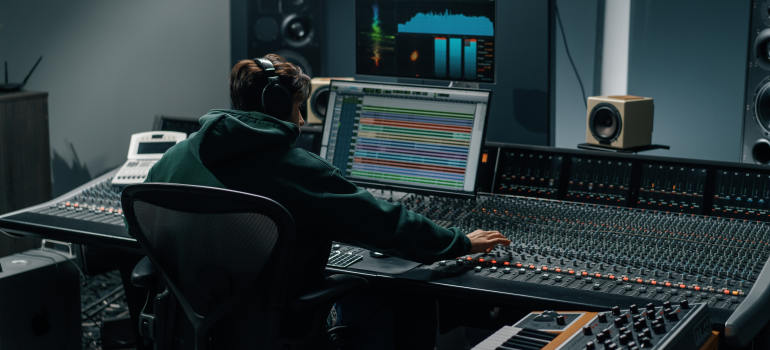
The sound designer profession encompasses the skills of a sound engineer, sound producer, and foley artist. Let's find out what hard skills a specialist needs to develop to succeed in this field:
- Ability to set up mixers, recorders, amplifiers, and other audio equipment.A sound designer must understand what types of microphones to choose for sound recording and how to arrange them.
- Ability to work with popular applications for music creation and sound recording (Digital Audio Workstation - DAW). Popular workstations used on large and small projects: Pro Tools, Logic Pro, Ableton Live, Adobe Auditions, WaveLab Elements, Cubase, FL Studio, Acid Pro, Nuendo;
- Knowledge of specialized software for sound processing. The list of plugins numbers in the dozens, the tools depend on the tasks and features of the project. The following applications can be used: Izotope RX - for sound restoration and noise removal, Dehumanizer 2 - for voice modification, Effectrix - an application with a library of sound effects, LANDR Mastering Plug - a plugin for mastering, etc.
- Understanding of the theory of acoustics and psychoacoustics, the physics of sound. A sound designer must have a good understanding of what kind of sound is needed for a particular phenomenon, how to extract and record it in the studio, how sounds propagate in a real environment. Many projects don't have a dedicated foley artist, so mastering their skills is essential.
- Music theory and music history.A sound designer must understand styles and how to select music to create a certain mood or evoke a desired emotion. For example, upliftment, jubilation or sympathy.
Features of sound design in different directions
Sound designers are in demand in the most unexpected areas - from the design of entertainment programs on television to sound accompaniment in shopping centers. We talk about the features of creating sound design in different areas.
Film, TV series and animation
In films and TV series, a sound designer is responsible for the sound accompaniment of the film. They ensure that the sounds match the visual style and help in the development of the plot, enhance what is happening on the screen and sharpen the senses.
When working on projects, a sound designer combines the following types of sounds:
- ambience (background noise) - the noise of the wind, city traffic, birdsong, barking dogs, unintelligible speech, etc.;
- intra-frame noise (noise that informs about ongoing events) - heavy footsteps or a creaking door in a horror film, the noise of an accident, the sound of an approaching car;
- Soundtrack music — short musical intros that help set the pace of an event and full-fledged songs.
When working in the film industry, it's important to sense strong and weak moments and understand how tempo and melodic movements will affect the viewer. In some cases, the designer needs to additionally study the features of the artistic production.
Associative thinking is also important for a specialist. In cinema, sounds are not limited to the roar of an engine, footsteps, or the rustling of leaves and wind. Whether it's the sound of notifications in a messenger or the sound of an accident, it's important to choose effects that will clearly let the audience understand what happened behind the scenes. This same quality will help harmoniously voice non-existent phenomena, such as alien creatures.
Game Development
Games are another field where great attention is paid to sound. Noises in a gaming environment are needed not only to immerse the player in the game world. Here, sounds provide information about current events, for example, about an approaching danger that needs to be addressed. Therefore, audio realism is very important here.
In addition to cinematic noises reproducing the environment, a lot of work has to be done on sound effects: laser blasters firing, spacecraft engines operating, time portals opening, etc. The sound designer also works on interface sounds.
It is also worth noting the fact that the intensity of sounds in the game environment depends on the player's actions. For example, during battles the music is more energetic, and when nothing is happening, it is calm. Therefore, the sound designer must simultaneously develop not one, but several scenarios at once. And you can't do without close work with the development team here.
Television and Advertising
The design of TV programs and advertising is another area where high-quality sound design is indispensable. The sound designer's task is to create a bright and memorable image. For example, everyone will recognize the signature sound of McDonald's or Danone advertising from the first note.
Exhibitions and Live Events
The organizers of modern exhibitions cannot do without the help of sound designers. The main goal is to set the participants and guests in the right mood. For example, to create a festive, relaxed atmosphere, to enhance the perception of paintings or sculptures.
The sound accompaniment may not be general, but separate for each art object. For example, the interactive design of exhibits - the sound can change as you interact with it.
Many museums and galleries provide an audio guide - a sound design is also created for it. Speech is accompanied by sound effects: the noise of a battle, the sounds of animals, or music that will create the desired emotions.
Smart devices and software
Gradually, ordinary household appliances are becoming smarter and communicate with people. Now large companies are attracting sound designers to sound household appliances and software interfaces. This includes both voice commands and sound signals for the interface.
How to become a sound designer. Useful resources from the editors of Skillbox.by
You can master the profession by getting an education at the Belarusian Academy of Arts in the following areas: "Sound Engineering of Audiovisual Arts", "Sound Design and Sound Art", or "Sound Engineer". A musical education will also be a good help.
Many Hollywood sound designers started out as musicians and composers. For example, Oscar winner Hans Zimmer. His famous works include: "The Lion King," "Pirates of the Caribbean," and "Pearl Harbor." He writes film soundtracks and works on sound design. He initially started out as a keyboardist in the bands Helden and The Buggles.
His student, Ramin Djawadi, who studied at the Berklee College of Music, also achieved notable success. He also won an Emmy Award for his musical score for Game of Thrones.
However, to become a sound designer, it is not necessary to study at a university or a music conservatory for four years. For example, Harry Barnes started as an assistant in a studio that created audiovisual content. And from brewing tea, he rose to become a sound designer and sound engineer who worked on such cult series as Doctor Who and Chernobyl.
Gary Rydstrom, a seven-time Oscar winner in the categories Best Sound and Best Sound Editing, has a similar story. He has worked on films such as Terminator 2: Judgment Day, Titanic, Jurassic Park, and Saving Private Ryan. He has no musical training and graduated from the School of Cinematic Arts, but he was able to become one of the most influential sound editors and sound effects designers thanks to his experience working at George Lucas Studios under Ben Beretta.
Unfortunately, not everyone has the opportunity to get a job as an assistant in a good production company. And independently mastering all the intricacies of the profession without experience working with studio equipment and professional software can take years. And there is still the risk of getting stuck doing sound design for local radio commercials and corporate events in a retail chain.
Therefore, as an alternative, you can choose distance learning courses. Typically, the curriculum is developed in collaboration with recording studio and production staff—sound engineers, sound producers, and sound designers. Therefore, when choosing such courses, we recommend paying attention to the relevance of the curriculum and the ability to create a portfolio.
And to get a better understanding of the profession, the Skillbox.by editorial team has compiled useful resources for study and films to develop your visual acuity.
Internet resources:
- studiobinder.com - media production blog dedicated to sound recording and sound design.
- LANDR Blog — a blog platform for musicians and sound engineers. Here you can find many articles about sound recording, mastering, and sound design.
- Sound design blog, all the most useful — Russian-language blog of a practicing sound designer.
- StudioBinder— YouTube channel dedicated to video production and video editing. You can find many videos on working with sound in the film industry.
- Mike Russell — On his YouTube channel, you can find videos about editing and working with sound. There are tips on sound design and tutorials on popular applications (Adobe Audition, Premiere, Audacity).
- Curtis Judd — A YouTube channel dedicated to working with sound and lighting in video production.
- Aftertouch Audio — A YouTube channel where you can learn a lot about sound design and sound recording.
Oscar-winning films for Best Sound Editing:
- «The Sound of Music» (1965);
- «The Deer Hunter» (1979);
- «Star Wars. Episode IV - A New Hope» (1978);
- «Back to the Future» (1985);
- «Terminator 2: Judgment Day» (1992);
- "Titanic" (1996);
- Pearl Harbor (2001);
- "Bohemian Rhapsody" (2018).
Master the profession of “Sound designer” with Skillbox
You'll learn how to create noise patterns, synthesize sound, and add voiceovers to objects. You'll be able to work on samples for Mubert, game sound, or video. Build a portfolio and understand how to make money with sound design.
Get access