Contents:

Thinking about a new profession but don't know where to start? Find out what's right for you: IT, design, game development, management, or marketing. Take a free career guidance course.
Learn moreParis, 1898. Only three years have passed since the first film screening on the Boulevard des Capucines. A crowd of spectators has gathered at the Grand Café, awaiting a unique screening. Tonight, none other than Jesus will appear on screen. This event attracts the attention of Parisians, who are eager to witness a new art form—cinema. Excitement and anticipation are in the air, as for many, this is not just entertainment, but an opportunity to see a story that has left a deep mark on culture and religion.
The Lumière brothers took a risk and created the film "The Life and Passion of Jesus Christ," presenting key moments from the biblical story to audiences. The film is only 10 minutes long and consists of 13 episodes, making it more of a collection of illustrations than a full-fledged narrative. It's like watching a Bible decorated with Gustave Doré engravings. In this short drama, Jesus is depicted with a vibrant head of hair, which in some moments is reminiscent of Karl Marx. Despite the modest budget, the oriental curtains, armor, and tunics look quite impressive, which led to positive reviews from audiences and, ultimately, the film's success.
The Christmas of Cinema Jesus marked the beginning of his unusual film career. He became more than just a character, but a symbol who learned to perform miracles on screen, acquired color and a voice, as well as a multitude of personalities and faces. In this article, we examine ten of the most significant and striking portrayals of Jesus in cinema, which have left their mark on the history of cinema. Each of these portrayals reflects different aspects of his personality and teachings, demonstrating how the film industry has interpreted this figure over time.
Subscribe to the "How Are You?" Telegram channel, where our experts share deep and scientific knowledge about psychology and self-development. Every weekend, we publish fresh selections of films and music that will enrich your leisure time and help you in your personal growth. Join us and discover new horizons in the world of psychology and cultural leisure.
1964. Revolutionary Jesus
Pier Paolo Pasolini's "The Gospel According to Matthew" became a landmark work that anticipated the wave of youth protests. The director, a Marxist and atheist, had already become famous for his scandalous short film "Sheep's Cheese," in which he ridiculed the hypocrisy of religious dogma. For this, he even received a suspended prison sentence for blasphemy. Nevertheless, Pasolini was not a primitive God-fighter; His works were distinguished by their depth and social criticism, which allowed him to become an important figure in 20th-century cinema and culture.
Director Pasolini initially planned to shoot his film in Israel, but considered the landscapes too "modern" for his interpretation. Ultimately, he decided to move the action to his native Italy. This decision was the embodiment of pure neorealism: the frame does not contain elements of antiquity or exoticism. The film featured non-professional actors, which added to the verisimilitude. Thus, the role of the Virgin Mary was played by Pasolini's mother, Susanna, and Judas was played by truck driver Otello Sestili. This approach emphasizes Pasolini's unique style and his desire for authenticity in depicting biblical stories.
In the film, the role of Jesus Christ was played by 19-year-old Spanish student of Jewish descent Enrique Irazoqui. His image of Jesus is distinguished by the absence of a beard, which gives him a light stubble and expressive black eyes. Irazoka's appearance resembles Sergei Bodrov, and he portrays Christ as a struggling activist, perhaps reflecting the perception of the Messiah in his lifetime. This interpretation is considered one of the first psychologically profound portrayals of Jesus in cinema. In 2015, the Vatican newspaper L'Osservatore Romano recognized Pasolini's film as the best in the story of Christ, emphasizing its significance and uniqueness.
1965. Cowboy Jesus
At the end of the peplum era, when audiences enjoyed films like Ben-Hur and Cleopatra, George Stevens created a masterpiece, The Greatest Story Ever Told. This epic film, distinguished by its lavish production values and high-quality production values, received five Oscar nominations in the visual effects and music categories. The leading role was played by 36-year-old Max von Sydow, who brought depth and charisma to the character, making the film an unforgettable work of art.
Before working on the film, von Sydow had little interest in religion, but he decided to familiarize himself with the Gospels and try to create an image of a modern-day Jesus. By that time, he had already played the famous knight Antonius in Bergman's The Seventh Seal, which gave him experience in portraying characters with a pessimistic outlook on life, foreboding their death. As a result, his interpretation of Jesus was lively, yet dark and quite brutal, reminiscent of a Western hero.
The film "History" was filmed in the picturesque desert landscapes of Utah and California, which added a unique atmosphere to the plot. John Wayne, an icon of the cowboy genre, appeared in a small role as a centurion at the cross. When his character utters the line, "Truly, this man was the Son of God," it seems as if he had just emerged from a shootout in a saloon. This moment underscores the powerful contrast between the brutality of the era and the spiritual depth of what was happening.
1973. Singing Jesus
Director Norman Jewison, who previously directed the famous musical Fiddler on the Roof, has adapted Andrew Lloyd Webber's rock opera Jesus Christ Superstar. This film uniquely combines elements of historical context and modernity: filming took place in picturesque locations in Israel, in the Negev desert. Against the backdrop of biblical events, modern-day soldiers are depicted – legionnaires in khaki and tanks, which gives the film a special atmosphere and relevance. This film adaptation not only attracts attention with its visual component, but also provokes reflection on the meaning of history and its interpretation in the modern world.
Singer Ted Neeley plays the role of Jesus, presenting the image of a thin and nervous hippie rocker who regularly experiences irritation with his apostles. His character often breaks into falsetto and demonstrates a fear of death. The question of whether he is God remains open for all who admire him, including Mary Magdalene, Judas, and Pilate. The play "Jesus Christ Superstar" can be seen as a reflection on the theme of modern show business, which has become a new form of religion and, like ancient times, demands sacrifice and readiness for suffering from its heroes.
1977. Handsome Jesus
Franco Zeffirelli, the renowned director behind Romeo and Juliet, has created the four-part series Jesus of Nazareth. The project became a landmark thanks to its impressive cast, which included such legends as Laurence Olivier, Christopher Plummer, Anthony Quinn, Rod Steiger, Peter Ustinov, and Ian Holm. The film not only immortalized biblical events but also became a showcase for Zeffirelli's mastery of historical drama.
Such celebrities as Dustin Hoffman and Al Pacino were considered for the role of Jesus Christ. However, director Francisco Zeffirelli chose British actor Robert Powell, who also auditioned for the role of Judas, adding an interesting ambivalence to his portrayal. The blue-eyed Powell was required to maintain a fixed gaze on camera, as Zeffirelli believed this enhanced the character's spiritual perception. The result is an appealing and kind, yet somewhat idealized, portrayal of Jesus that can evoke a variety of interpretations from viewers.
Powell himself stated, "Trying to play God is a surefire way to a nervous breakdown. I found a way to embody this by ignoring the traditional acting approach. Jesus is not human; he has no specific traits or habits; you can ascribe anything to him." The Vatican praised the adaptation, deeming it near-perfect and officially recommending it to the faithful. However, due to the excessive ideality of this image of Jesus, it is difficult to express anything concrete.
1979. Snide Jesus
This isn't "Buddy Christ" from "Dogma," nor is it the Jesus from "South Park" or "Family Guy." This is the Christ from "Monty Python's Life of Brian." British comedians filmed this cult classic in Tunisia, on sets left over from the filming of Francis Ford Coppola's movie, with financial support from George Harrison, a member of The Beatles. Jesus makes a limited appearance in the film: he delivers the Sermon on the Mount, mentioning the "blessed cheesemakers." Christ is played by Kenneth Colley, who later became famous as Admiral Piett in Star Wars.
Everyone mistakes his neighbor, a rather unremarkable man named Brian (Graham Chapman), for Christ. Because of the unfortunate resemblance, the story ends on the cross, where the protagonist, remaining calm, sings the well-known optimistic song "Always Look on the Bright Side of Life." This scene highlights the comedic aspect of the work and reflects the philosophy of finding positivity even in the most difficult situations.
The film caused a lot of controversy among believers and was banned for many years in Ireland and Italy. Screenwriters Eric Idle and Terry Gilliam noted that they considered Jesus "definitely a good guy" and did not intend to ridicule his teachings, emphasizing that "what he says is very honorable."
1986. Experimental Jesus
Berlin director and media artist Michael Brinntrup has created a unique film about Christ, in which he also plays the leading role. His work, "The Jesus Film," is 35 black-and-white episodes dedicated to the life of Jesus Christ, created by 22 German directors. This project is an alternative film version of the New Testament and was shot on the iconic Kodak Super 8 film, smuggled out of the GDR. The film stands out for its unusual concept and style, making it a significant work in contemporary art and cinema.
The film is a unique combination of German cinematic expressionism and an alternative rock arrangement, reminiscent of Padeluun. In this work, Jesus is depicted with a twin brother, and at the Last Supper, he turns into a vampire and drinks blood. The character's appearance resembles a young blond Berliner who, confusing reality with his own visions, finds himself lost at a party. This film has won numerous awards and has become a cult phenomenon, and is also considered the largest collective project in the history of German cinema.
1988. Scandalous Jesus
Director Martin Scorsese, being a Catholic, had long wanted to adapt the novel by Greek writer Nikos Kazantzakis "The Last Temptation of Christ". The filming process was marred by protests, boycotts and rallies. Scorsese was accused of anti-Semitism, anti-Christianity and malicious intent. This film became the subject of considerable discussion and controversy, attracting the attention of both critics and audiences, and left a noticeable mark on the history of cinema.
Christ, played by Willem Dafoe, appears to the audience as a brooding and slightly obsessive character. His appearance may seem ugly, but this does not detract from his appeal. He makes crosses for the Roman occupiers, and voices in his mind make him doubt his courage. He calls himself a coward, but at the same time he experiences a deep passion for Magdalene, a prostitute with whom he has complex feelings. Christ dreams of simple happiness, but at the same time strives for the salvation of all humanity, which creates a powerful internal conflict and makes his image multi-layered and profound.
Martin Scorsese's film causes confusion among orthodox Christians, who do not understand how much it corresponds to the ideas of the Gospel. On the cross, Christ faces the final, most powerful temptation: to abandon his mission, come down from the cross and live an ordinary human life. Ultimately, the Messiah rejects this temptation and dies for the salvation of humanity. This work of art demonstrates how blasphemy can be imbued with profound faith.
2012. The Unfilmed Jesus
Director Paul Verhoeven, known for his cult films such as RoboCop, Starship Troopers, and Basic Instinct, surprises with his unique style that combines violence, sexuality, and dark humor. However, despite his provocative works, Verhoeven also has interesting connections with the theme of Christ. His films often explore moral and philosophical aspects, questioning traditional values and norms of society. This creates a paradoxical image of a director who, being a misanthrope, at the same time touches on deep questions about humanity and faith.
Verhoeven is indeed an atheist, but he has always been attracted to the figure of Jesus Christ. After moving from Holland to the United States, he became a participant in the Jesus Seminar, where influential theologians, philosophers, and linguists debated the authenticity of the Gospels. These discussions led the director to conclude that Jesus was similar to Che Guevara: he shared the same qualities of a stubborn idealist, a revolutionary, and a dreamer. It's no surprise that among all the filmic interpretations of the life of Christ, Verhoeven favors the works of Pasolini and the comedy film Monty Python. These works offer a unique perspective on the person of Jesus and his cultural influence. Unable to produce his own film, Verhoeven decided to express his thoughts on Christ through text. The result was the book Jesus of Nazareth, in which the author shares his reflections on faith, analyzes the plausibility of the Gospel stories, and examines the image of Jesus from a dramatic perspective. This work has attracted attention and has been translated into many languages, including English, German, French, Spanish, Arabic, Finnish, and Russian. The book offers a unique perspective on religious themes and continues to captivate readers worldwide.
It would certainly be interesting to see a film version from a talented Dutch director. The question of who could play Jesus has given rise to much speculation. Perhaps a suitable candidate would be Peter Weller, who demonstrated traits reminiscent of Christ in the film "RoboCop." Such a choice could add depth and expressiveness to the character, emphasizing his humanity and suffering.
2004. Brutal Jesus
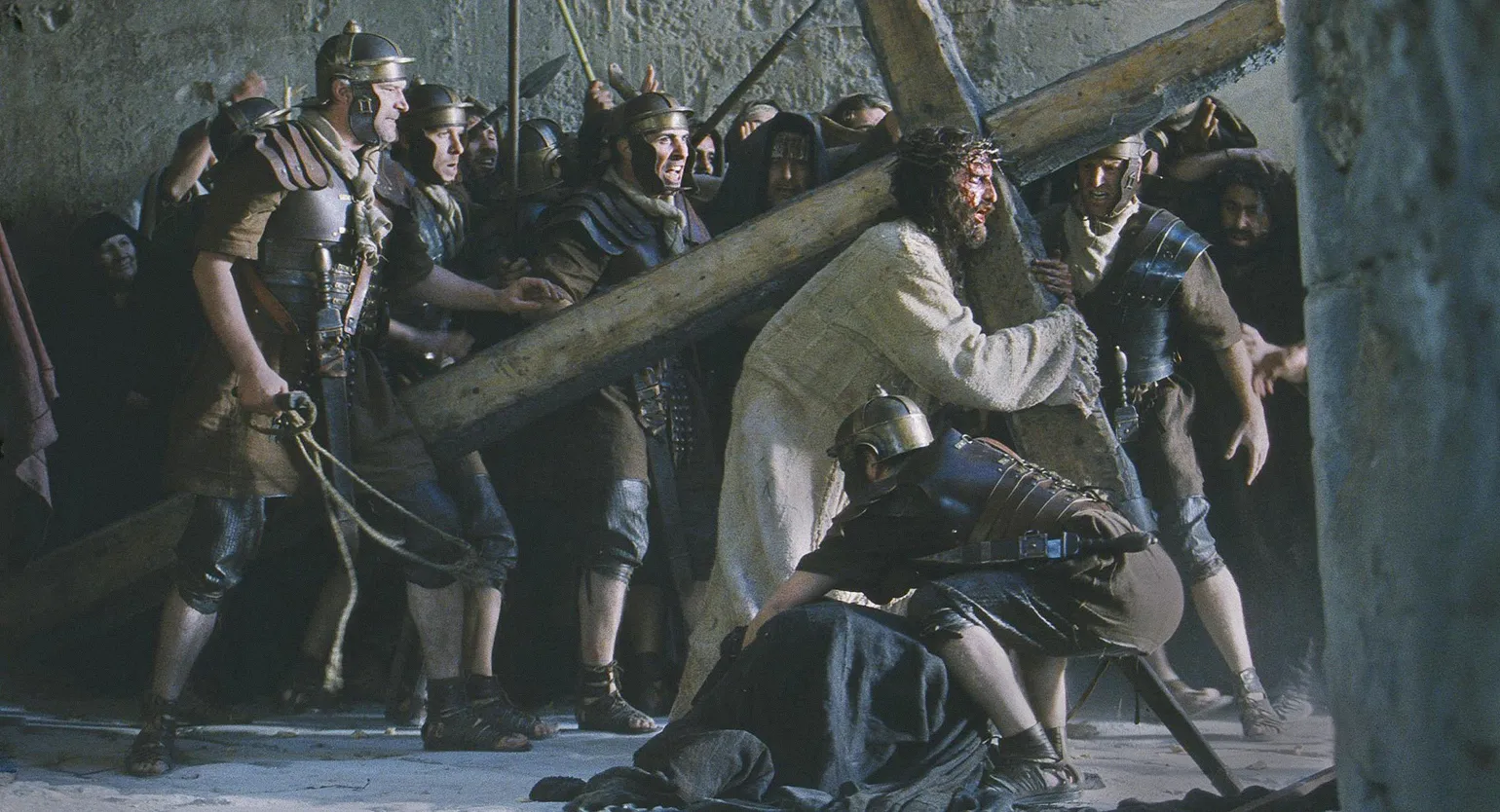
Mel Gibson, a renowned Catholic traditionalist, presented his film The Passion of the Christ to Pope John Paul II at a private screening. Rumor has it that after the screening, the Pope remarked that the film accurately reflected the events that took place at the time. This reaction from the most eminent predecessor of the Catholic Church added significance to the film and its religious themes. The Passion of the Christ became not only a work of art, but also a subject of discussion among believers, raising important questions about faith and suffering.
Mel Gibson truly showed mastery in the creation of his film, having the actors speak in Latin and Aramaic. He designed impressive sets and costumes that immerse the viewer in the historical context. The film's most important aspect is its emotional impact, conveyed through brutal scenes such as scourging, crucifixion, and beatings, creating an immersive experience of Christ's suffering. These elements make the film not only visually appealing but also deeply emotional, underscoring the significance of the events depicted in the Passion of the Christ.
It resembles a gossip film, focusing on violence and gore. The grotesque scenes here go beyond any imaginable suffering. As Verhoeven noted, Gibson's film about Christ sheds more blood than the human body actually contains.
James Caviezel, as Christ, is a strong, courageous, and determined character. His main task is to endure all the torment, and even in the chaos of blood and suffering, he sometimes loses sight of his true purpose. However, in the finale, Christ, as a true superhero, is resurrected, symbolizing hope and rebirth.
Mel Gibson is currently busy working on the sequel to the film "The Passion of the Christ: Resurrection." In this new film, Jim Caviezel again plays Jesus, who, according to the plot, may descend into hell to finally defeat Satan and destroy the walls of his kingdom. Gibson describes one of the script versions as saturated with images of hell and fallen angels, creating the impression of an acid trip. The premiere of the film is expected to take place in 2025.
2017. Heartfelt Jesus
In 2017, director Dallas Jenkins successfully crowdfunded a multi-season series about Jesus and his disciples. It was the first project in history to be completed in this format. The showrunners noted that such series as The Wire, Game of Thrones, and Battlestar Galactica influenced their work. This project opens new horizons in the interpretation of biblical stories and engages viewers with spiritual themes through high-quality content.
The creators of "Chosen" paid attention to compliance with religious traditions, which is evidenced by the depiction of Jesus as a God-man. To ensure the canonical nature of the image, a Catholic priest, a Protestant pastor, and a Jewish rabbi reviewed it. This approach contributes to a deeper and more respectful perception of religious themes in film, which can appeal to both believers and a wider audience interested in spiritual matters.
The screenwriters do not hold back in creating new details behind the evangelists, creating a deep backstory for the characters and connecting their relationships, while maintaining biblical integrity. Jesus, played by Jonathan Roumi, appears to the viewer as a down-to-earth and human character who plays with children, enjoys dancing at a wedding, and even jokes—a rarity in film depictions of Christ. This approach allows for a more profound exploration of Jesus's personality and his interactions with people, making his image relatable and relatable to viewers.
Four seasons have been released so far, but plans call for seven more, as well as the expansion of the universe into a full-fledged franchise, including additional films and series. Therefore, the on-screen Jesus does not need to be resurrected - he is still relevant and in demand.
Free career guidance
• Determine what you want from a new profession• Take the test and find out which professions are right for you• Understand what such specialists do
Learn more