Contents:
Free course: “Quick start in Python”
Learn more
Lokajit Tikayatrai
About the Author
The author of this text is an expert in his field with many years of experience. He has a deep understanding of the topic and strives to share this knowledge with readers. In his publications, the author focuses on current trends and innovations, offering practical recommendations and useful tips. His works are distinguished by a high level of analysis and originality, which allows readers to better navigate complex issues. The author actively explores new approaches and methods, making his articles a valuable source of information for professionals and amateurs.
A solutions architect at a Fortune 100 IT company, he considers his profession a labor of love. He strives to expand his knowledge and skills daily to stay at the cutting edge of technology and deliver innovative solutions. This allows him to effectively solve complex problems and make a significant contribution to the company's development.
Surprisingly, but true: popular emoticons can be used not only to liven up communication in instant messengers. Some talented developers have created entire programming languages based on emojis and emoticons. These languages open up new horizons in the world of programming, allowing the use of visual symbols for writing code. The innovative approach to creating emoji-based programming languages demonstrates how creativity and technology can be combined, making the coding process more accessible and fun.
Many of these programming languages belong to a category of esoteric languages known as esolangs. However, they are much easier to understand than most other esoteric languages.
Esoteric programming languages are ineffective for solving business problems. They are developed primarily to demonstrate conceptual ideas or as a joke. The main purpose of such languages is to prove the theoretical feasibility of a particular idea, rather than to provide practical application in real commercial projects. Therefore, the use of esoteric languages in business is limited and inappropriate.
Translator's Note
This section provides an important clarification that can help readers better understand the context and nuances of the translation. The translator strives to convey the meaning of the original text as accurately as possible, taking into account cultural and linguistic peculiarities. It is important to note that some phrases or expressions may have multiple meanings depending on the context. Therefore, if questions or ambiguities arise, it is recommended to refer to the original. The purpose of this note is to ensure the reader has a complete and accurate understanding of the translated material.
Esolang can be a unique work of art. For example, a program written in the Piet language looks like an abstract work. This language is named after Piet Mondrian, one of the founders of abstract painting. Esperanto languages like Piet demonstrate how programming can combine functionality and visual aesthetics, transforming code into artistic expression.
In this article, we'll explore five complex Esperanto languages that support the use of emoji. These languages have unique grammar and vocabulary, making them engaging to learn. Emoji can act as expressive tools, adding emotional nuance and simplifying communication. Learn how emoji are integrated into these languages and the benefits this brings. Read on to discover the most complex Esperanto languages and their features.
Emoji, or emoticons, are graphic symbols used to convey emotions, ideas, and information in digital communication. These vibrant and expressive images have become an integral part of modern online communication. Emoji help make text more vibrant and emotionally rich, allowing users to better express their feelings and intentions. It's important to remember that while using emoji correctly can significantly enhance the comprehension of a message, overusing them can distract from the core message. Emoji are widely used on social media, instant messaging apps, and other platforms, making them a popular tool for attracting attention and creating a unique communication style. Emojicode is a programming language that uses emoji as its syntax. This unique approach makes it accessible and understandable for beginners and adds a creative element to software development. Emojicode allows developers to create applications using vibrant and expressive symbols instead of traditional text commands. The language supports object-oriented programming, giving developers the ability to build complex data structures and develop powerful applications. Its originality and simplicity make Emojicode appealing to both novice programmers and experienced developers seeking new ways to express their ideas. Using emoji also enhances the visual perception of code, making it more intuitive. Emojicode continues to evolve, bringing fresh ideas and innovation to the world of programming.
Emoji-gramming is a unique approach to visual communication based on the use of emoji. This trend is becoming increasingly popular on social media and instant messaging apps, allowing people to express their emotions and ideas with vibrant and memorable symbols. Using emoji in texts helps make communication more lively and visual, attracting attention and improving information comprehension. It is important to consider the context and target audience when using emoji to ensure they effectively convey the desired meaning and avoid misunderstandings. Emoji can be used in both personal messages and commercial settings to increase user engagement and improve branding.
EmojiCoder is a tool that transforms text into emoji and vice versa. It simplifies the process of adding emoji to messages and content, making them more expressive and engaging for users. With EmojiCoder, you can quickly and easily transform words and phrases into corresponding emoji, enhancing the visual appeal of your content. This service is ideal for social media, messaging apps, and blogs, where engaging your audience is crucial. Using emoji helps emphasize emotions and moods, making communication more lively and engaging. Furthermore, EmojiCoder supports multiple languages and symbols, expanding its functionality and making it useful for a wide audience.
Emotinomicon is a unique and creative project that combines elements of art and technology. This term refers to a collection of symbols and emotions expressed through various visual images and graphic elements. Emotinomicon finds application in various fields, including marketing, design, and communications, allowing for the effective communication of feelings and ideas without words. By using Emotinomicon, companies can improve customer engagement and make their messages more memorable and engaging. In today's visually-driven world, Emotinomicon is becoming an essential tool for creating an emotional connection between a brand and a consumer.
Emoji
Stack-based Esolang uses emoji as command tokens to control the stack. The number of available emoji is limited, and all other characters do not function as tokens. This makes the language easy to understand and use, while maintaining the efficiency of working with stack-based structures.
To display the string "Hello, World!" using Emoji, you can use the following methods. First, create a simple HTML page. Inside the `<body>` tag, add the following code:
«`html
<!DOCTYPE html>
<html lang=»ru»>
<head>
<meta charset=»UTF-8″>
<meta name=»viewport» content=»width=device-width, initial-scale=1.0″>
<title>Hello, World! with Emoji</title>
</head>
<body>
<h1>👋 Hello, World! 🌍</h1>
</body>
</html>
«`
In this example, we use Emoji to create a more expressive title. When the page loads, the greeting using Emoji characters will be displayed on the screen, making it more engaging for users. Make sure your browser supports emoji display for the result to appear correctly.
The command (token) 💬 reads all characters up to the next token 💬 and pushes them onto the stack. Token ➡ then displays the contents of the stack. This process allows for the efficient management and display of text information within the system.
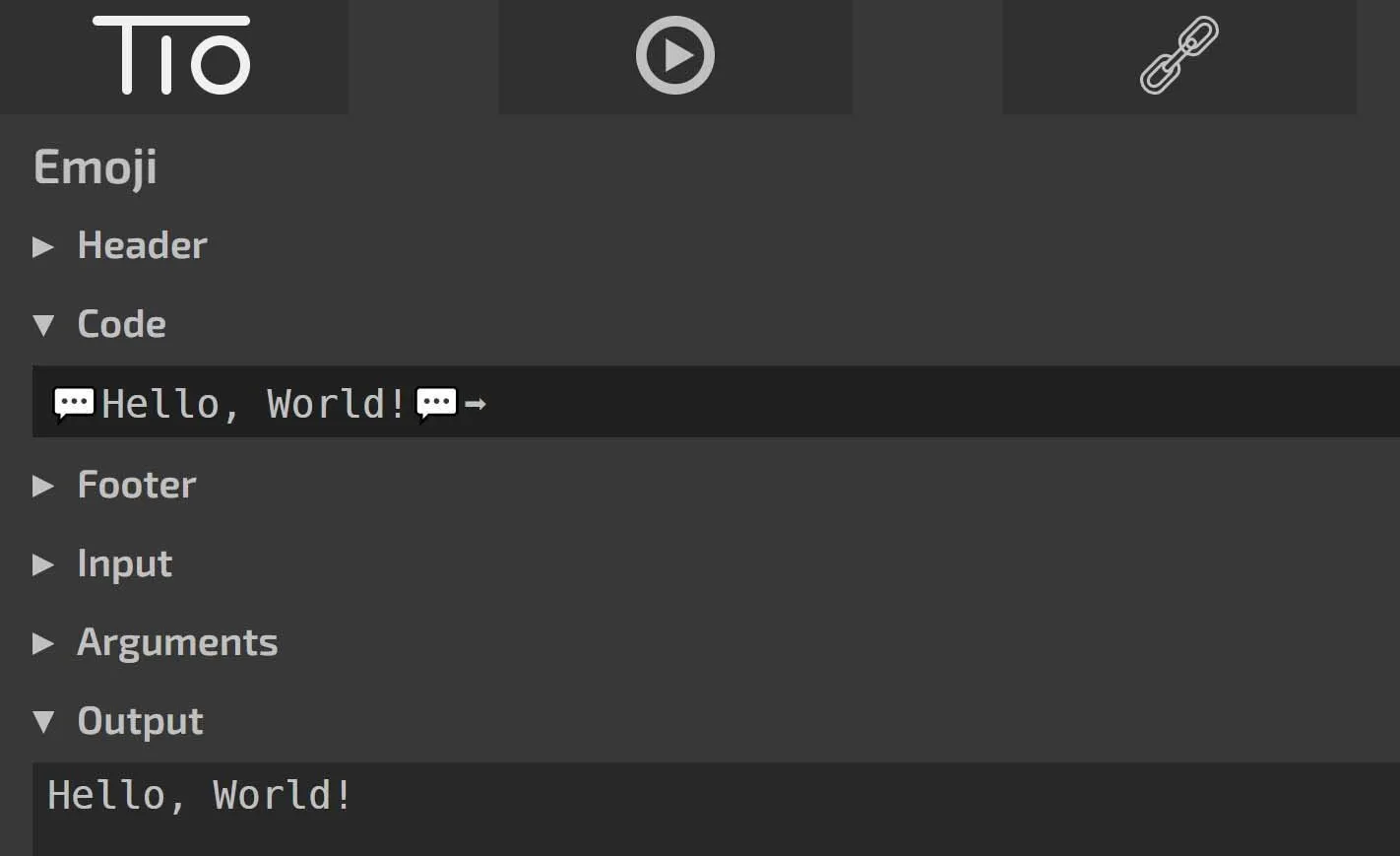
Description of all tokens Emoji language includes a variety of symbols that are used to visually convey emotions, ideas, and objects. Emoji have become an integral part of online communication, allowing users to convey feelings and moods without using words. Each token has its own unique meaning and can be combined with other emoji to create more complex expressions.
There are many categories of emoji: faces, animals, food, nature, sports, and many others. This diversity allows users to choose the most appropriate symbols for a particular context. For example, a smiling face emoji can be used to express joy, while a heart emoji is most often associated with love and affection.
Since their appearance in the 1990s, emoji have evolved significantly and have become part of a universal language understood by representatives of different cultures. It's important to note that differences in emoji display may arise due to platform or device specifics, making their interpretation sometimes ambiguous.
Using emoji in texts and messages can increase audience engagement and make communication more lively and expressive. However, it's important to remember that overusing emoji can lead to confusion and reduce the clarity of the message. Therefore, emoji should be used wisely, choosing them depending on the context of communication.
Run your Emoji programs right here.
Emojicode
Emojicode is an object-oriented programming language that makes coding fun through the use of emoji. This language allows developers to integrate visual symbols into code, which not only adds an element of play but also makes it more intuitive. Emojicode is suitable for both beginners looking to learn the basics of programming and experienced developers seeking innovative and creative ways to implement their ideas. Programming in Emojicode fosters creative thinking and helps you learn object-oriented programming principles.
It's a strongly typed programming language with strong object-oriented programming support. It provides powerful capabilities for working with classes and allows you to create structured and understandable code.
This pun emphasizes the ease of creating and using classes in Emojicode. As a modern programming language, Emojicode offers developers the opportunity to effectively work with object-oriented programming. Creating classes in Emojicode helps organize your code, improve its readability, and enhance reuse. Thanks to its intuitive syntax, developers can quickly learn how to create classes and use them in their projects, significantly simplifying the development process.
The creator of the Emojicode language strives to avoid errors such as NPE (null pointer exceptions), which occur when attempting to access an object without an assigned value. In Emojicode, it is important to immediately initialize each class instance variable to prevent such errors from occurring at compile time. This approach allows developers to minimize risks and increases the reliability of the code, making Emojicode safer to use. Proper initialization of variables is key to creating high-quality and stable applications in this programming language.
Code snippet for printing the string "Hello, World!" in this programming language looks like this:
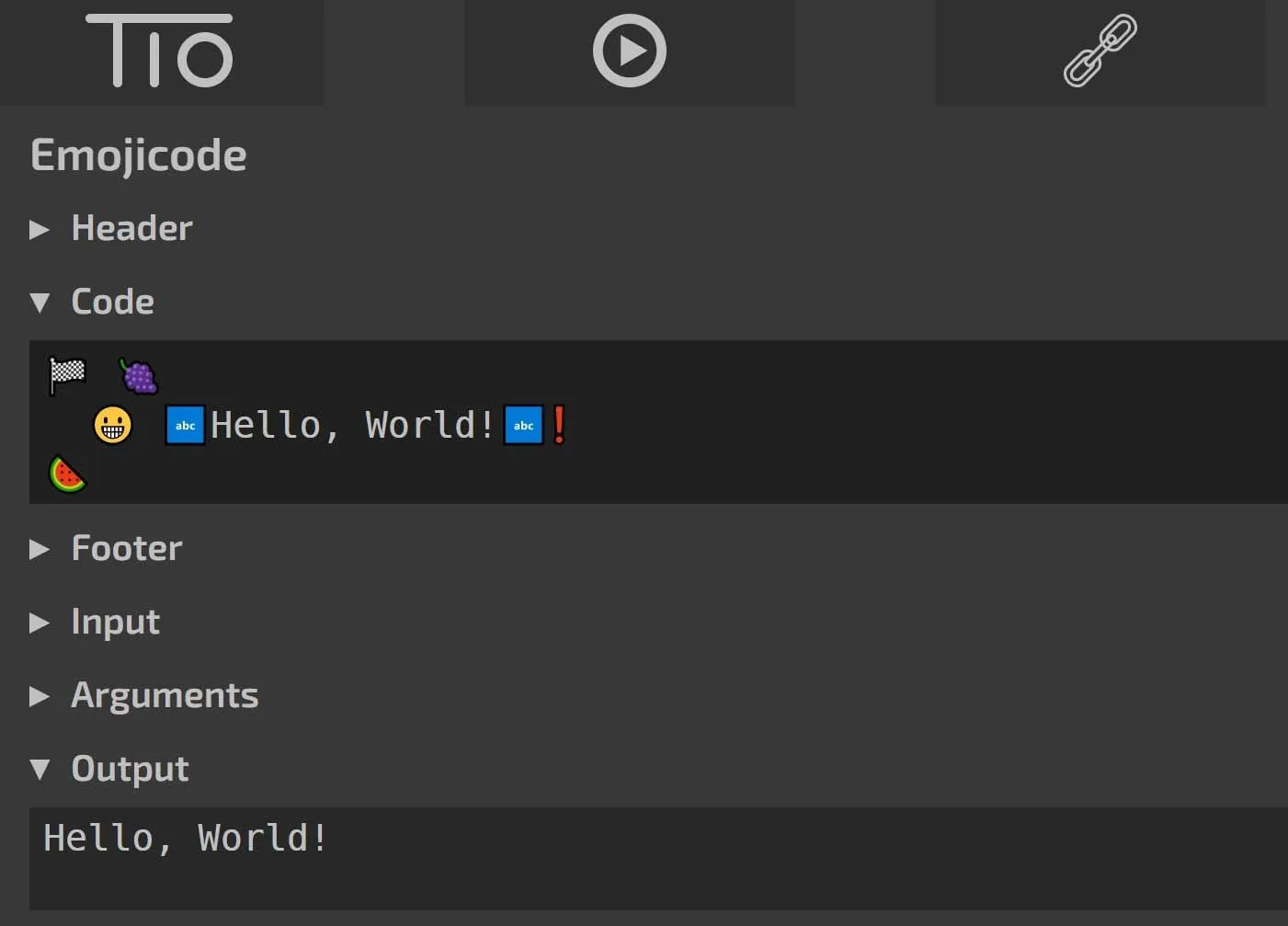
The official Emojicode documentation is available at the following link, and you can start coding with this language here. Emojicode offers a unique approach to programming with emoji, making it fun and accessible for developers. Check out the documentation to learn about Emojicode's capabilities and start building your projects.
Emoji-gramming
Emoji-gramming is a unique, esoteric programming language that uses emoji as its core elements. The language has only 25 variables and four commands, which are also represented as emoji. This approach makes programming more visual and accessible to a wide audience, allowing you to easily create simple programs. Emoji gramming offers a fun way to interact with code, drawing the attention of both novice and experienced programmers to the possibilities of using emoji in programming.
Constants in Emoji gramming are represented using heart symbols. These symbols serve as the basis for creating and working with variables in this programming language. Using hearts makes constants easy to identify and makes code more visual and understandable. This way, developers can effectively manage data using intuitive notations.
The symbol «💔» represents a broken heart and is often used to convey emotions associated with loss or disappointment in love. However, in a digital context, it can be interpreted as «0», which can symbolize a lack of feeling, emptiness, or the end of something. Using this symbol in communication can help express complex emotions when words prove insufficient. It's important to understand that visual symbols like emojis can carry multi-layered meanings and influence how a message is perceived.
The 💜 symbol represents a purple heart and is associated with love, romance, and emotional attachment. It is used to convey warmth and care, as well as to express tender feelings. In the context of communication on social media and instant messaging apps, this symbol is often used to denote friendly support and positive emotions. Purple can also symbolize creativity and individuality, making it popular among people seeking to express their feelings and uniqueness. Using this emoji in your content can attract attention and strengthen the emotional connection with the audience.
Mutual understanding and support are important aspects of love. Without these elements, relationships lose their harmony and meaning. True love is built on trust, respect, and a willingness to meet each other halfway. The ability to listen and hear your partner is the key to a successful relationship. Love requires constant attention and care, and only then can it develop and strengthen. It is important not to forget about romance and the little things that create an atmosphere of intimacy. Ultimately, love isn't just a feeling, but also the daily work that goes into creating a strong connection between people.
The 💞 symbol is a graphic image consisting of two hearts connected to each other. It is often used to express love, tenderness, and romantic feelings. This emoji can be used in a variety of contexts, including messaging with loved ones, on social media, or in content related to romantic relationships. Using this symbol helps convey emotion and create a warm atmosphere in communication.
The 💖 symbol represents the number 8. This sign is often used in a variety of contexts, including social media communication and text messages. The number 8 has many meanings in different cultures and traditions; it can symbolize infinity, good luck, and harmony. In numerology, the number 8 is associated with strength, authority, and material well-being. Using emoji in digital communication allows you to express emotion and enhance the meaning of messages.
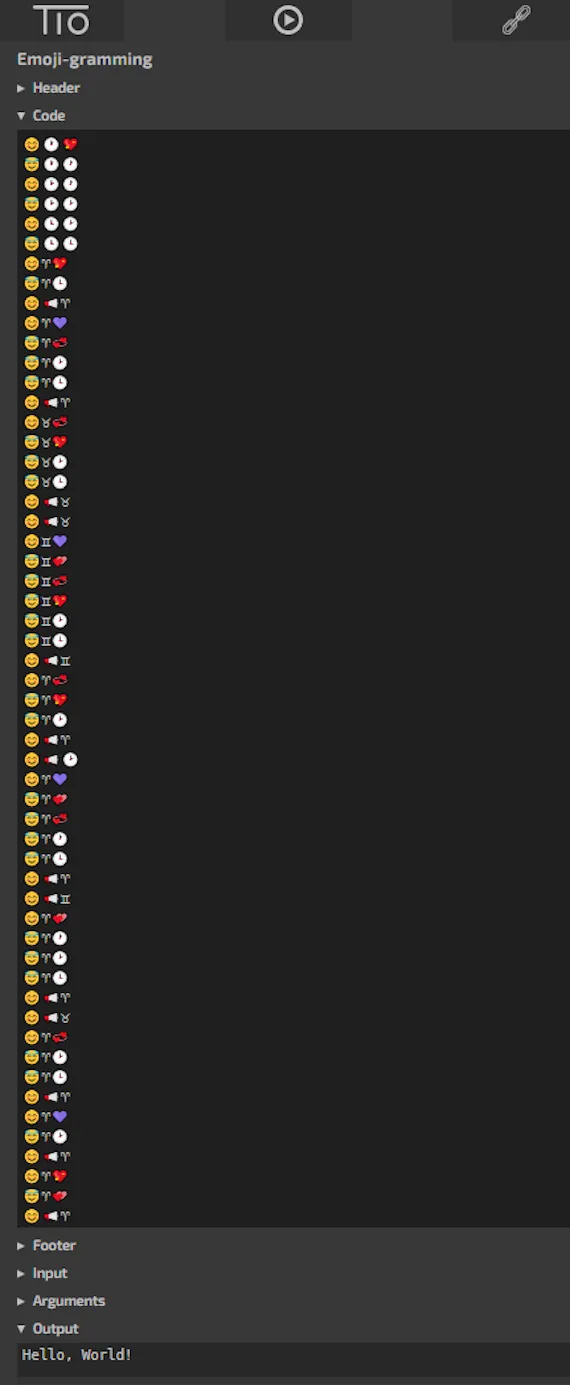
The microphone symbol represents the flow of input data, while the speaker indicates the output of information on the screen. This is logical and intuitive.
Below is code in Emoji-gramming that displays the message "Hello, World!" This simple example demonstrates the basics of using Emoji-gramming to create text output. Using programming languages like Emoji-gramming opens new possibilities for creativity and fun in programming.
Code:
«`
😀📦 Hello, 🌍!
«`
With this code, you can see how emoji can replace traditional symbols while still maintaining meaning. Emoji-gramming is increasingly gaining popularity among developers and programming enthusiasts thanks to its uniqueness and creative approach.
Sorry, you haven't provided any text for editing. Please paste the text you'd like to rework, and I'll help you optimize it and adjust it for SEO.
Of course, I'll help you rework the text. Please provide the original text to be edited.
EmojiCoder
EmojiCoder was developed by Jeremy and Sarah Nathanson. This unique, esoteric programming language allows commands and their arguments to be written using emoji. Using emoji in code makes it visually appealing and can make certain operations easier to understand for users familiar with the format. EmojiCoder is attracting the attention of programmers looking for new ways to express their ideas and create code.
The language includes emoji that represent zero and one. All other characters are formed using various combinations of these signs.
To correctly interpret a combination of ASCII characters or numbers, it must be preceded by a modifier, which is also represented as a symbol. This allows for a more precise definition of the meaning and functionality of a combination. Proper use of modifiers improves understanding and interaction with data in various contexts.
Consider a sequence of symbols, for example: 🌚🌝🌚🌚🌝🌚🌚🌚. Another example is the binary code 01001000. These sequences can be used to illustrate various concepts in programming and digital technology. It is important to understand how such combinations of symbols and numbers can represent information in different formats. Studying such sequences helps us better understand the principles of encoding and decoding data.
If a number is preceded by a symbol, it will be interpreted as the integer 72. If a number is preceded by a symbol indicating a code, this means that the symbol with the ASCII code 72 will be used, which corresponds to the Latin capital letter H.
Note for the translator
How did the number 72 come from zeros and ones? In the digital world, information is represented as binary data, where zeros and ones form the basis of all calculations. To understand how binary code is converted into decimal numbers, it is necessary to review the fundamental principles of the number system. In the binary system, each position in a number represents a power of two. For example, the number 72 in decimal is 64 (2 ^ 6) plus 8 (2 ^ 3) plus 0 and 0, which in binary is written as 1001000. This conversion process demonstrates how simple binary symbols can add up to more complex numerical values.
In everyday life, we use the decimal number system, which consists of combinations of ten digits, from zero to nine. Every number can be expressed as the sum of the products of its digits and a power of ten, which depends on the place value of each digit. The first place from the right is considered zero, which allows us to accurately determine the value of a number depending on its position. Understanding the structure of the decimal system helps you better master arithmetic and solve problems involving numbers.
Numbers can be represented as the sum of the products of their digits and powers of ten. For example, the number 72 can be factored as 7 times 10 to the first power plus 2 times 10 to the zero power. Similarly, the number 372 can be represented as 3 times 10 to the second power plus 7 times 10 to the first power plus 2 times 10 to the zero power. This representation of numbers helps us better understand their structure and the meaning of each digit in the decimal number system.
The binary number system uses only two digits: 0 and 1. In this system, numerical values are expressed in powers of two, replacing the decimal powers we are accustomed to. This simplifies data processing in digital devices and is the basis for the operation of modern computers and digital technologies. The binary system plays a key role in programming, computing, and information storage, making it an important element in the digital world.
01001000 can be represented as a sum, where each bit is multiplied by the corresponding power of two. This looks like this: 0*27 + 1*26 + 0*25 + 0*24 + 1*23 + 0*22 + 0*21 + 0*20. The resulting sum is: 0 + 64 + 0 + 0 + 8 + 0 + 0 + 0, which equals 72. Thus, the binary number 01001000 corresponds to the decimal value 72.
EmojiCoder uses the Waving Hand (👋) emoji to visualize the output on the screen. Each command should be placed on a separate line, which ensures clarity and ease of perception. Effective use of emoji in code helps make the interface more interactive and engaging for users.
Now we have all the information we need to display the string "Hello, World!" on the screen. This simple example is a classic start to learning programming and helps understand the basic principles of working with data output. Using basic commands, we can easily display text on the screen and make sure our program is working correctly.
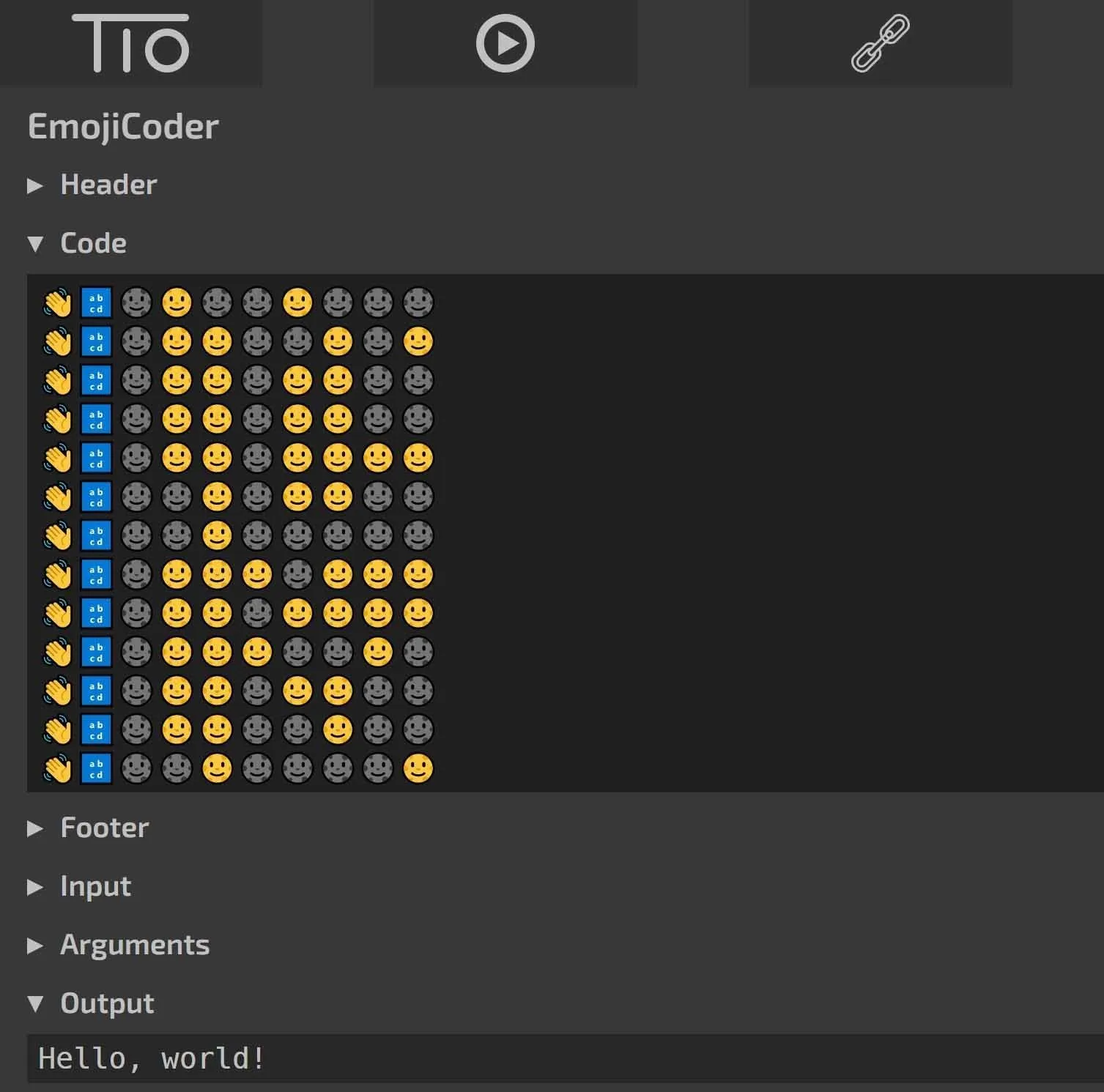
A full list of commands for EmojiCoder is available at the following link.
Emotinomicon
A stack-based programming language similar to Emoji that allows the use of both emoji and emoticons. This language was developed by Conor O'Brien. Stack-based programming languages are distinguished by their unique structure and ease of use, which makes them attractive to developers. Emoji and emoticons add a visual component that improves user interaction and makes code more descriptive.
To print the string "Hello, World!" in Emotinomicon, you need to use the appropriate syntax of this language. In Emotinomicon, commands are represented as symbols and emoji, which interpret the text. Enter the required characters to display the message. Make sure you follow the formatting rules and use the required characters correctly. After executing the command, the string "Hello, World!" will appear on the screen, confirming the operation was successful. Emotinomicon provides a unique way to interact with text, and mastering its syntax will open up new possibilities for creative expression. Tokens serve various functions in digital systems and blockchain projects. They represent units of account that can be used for exchange, transactions, or access to certain services. Tokens can be either utility or security tokens. Utility tokens grant users access to platform products or services, while security tokens can be used as investment vehicles for profit. It is important to understand that tokens differ from cryptocurrencies, as the latter function as independent currencies, while tokens are dependent on the platform on which they are created. Proper use and understanding of tokens can significantly improve the efficiency of working with digital assets and facilitate interaction with various services in the blockchain ecosystem.
A translator's note contains important comments and clarifications about the translated text. It serves to help the reader better understand the context and features of the original. In this section, the translator can point out cultural differences, stylistic nuances, and also explain the choice of words and phrases that can have multiple meanings. A properly formatted translator's note improves the perception of the text and contributes to a deeper understanding of its content. This element is especially important for literary works, scientific articles, and other texts where the accuracy and clarity of the translation play a key role.
Why is the text displayed upside down?
The stack works on the "last in, first out" principle. This means that the last element added will be the first to be popped. In this case, the H symbol was added to the stack last, and therefore it will be popped first. Then, the e characters will be extracted sequentially, and so on, all the way up to the ! character.
Finally, we achieved the desired result. This was achieved through careful analysis and optimization of all processes. We focused on key aspects, which allowed us to achieve maximum efficiency. The success of our project confirms the correctness of our chosen strategy and the efforts of the entire team. We continue to strive to improve and implement innovative solutions that will help further enhance the quality and satisfaction of our customers.
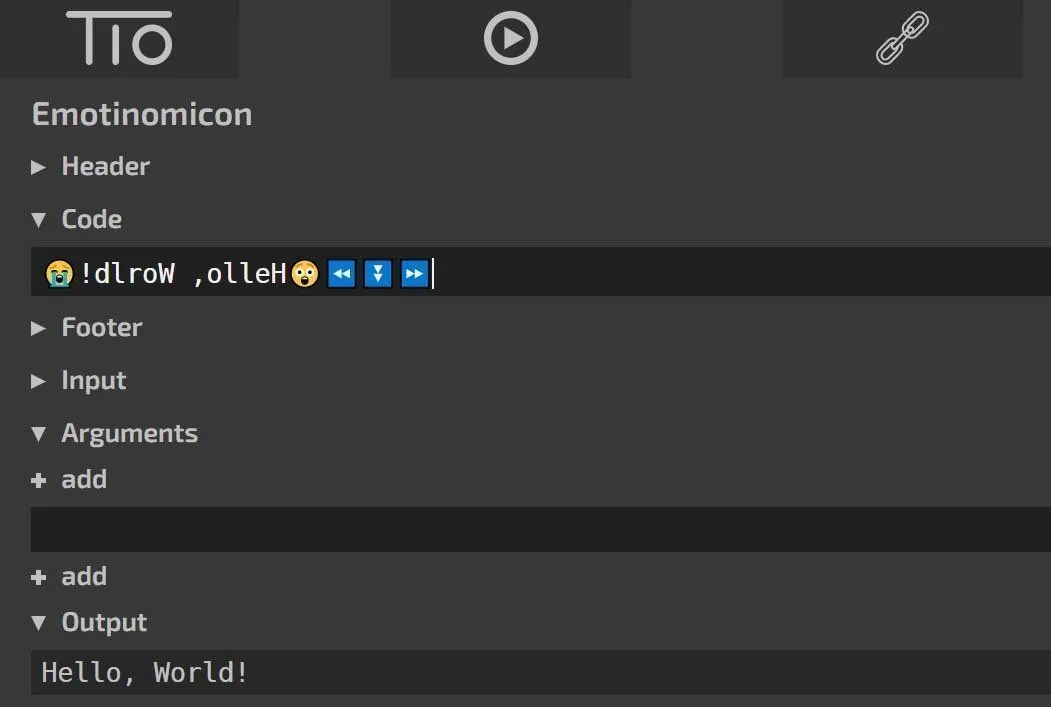
Use the power of string output in the user-friendly Emotinomicone environment. This platform provides easy access to the emoji you need, eliminating the need to copy them from other sources. Dive into coding and experiment with string output using built-in emoji to enhance the visual perception of your projects.
Emotifuck
This is an emoji dialect of the Brainfuck programming language, which literally means "Brain Fuck." Brainfuck is a minimalist language known for its complex and confusing syntactic structure. Emoji dialect adds a visual element to this unique system by allowing emoji to represent language commands. This approach makes learning and using Brainfuck more accessible and engaging, and draws attention to programming features and concepts related to artificial intelligence and programming languages.
Emotifuck is a programming language built on Rust by two enthusiasts known as Romulus10 and Insipx. The developers claim that their language provides safe memory access, making it attractive to developers seeking robust solutions for their projects. Emotifuck combines innovative approaches and safety principles, opening up new possibilities for programming.
List of Emotifuck commands and corresponding Brainfuck symbols:
A translator's note is an important element that helps the reader better understand the context and nuances of the translation. This section may contain explanations of cultural specifics, adaptations of terms, or clarifications regarding the original text. Translator's notes play a key role in ensuring the accuracy and completeness of a translation, avoiding misunderstandings and promoting a deeper understanding of the material. They are a useful tool for readers seeking a more detailed understanding of the content and style of the original.
This program uses an array of 30,000 cells filled with zeros. The pointer moves along this array, where the "shift right" and "shift left" commands allow you to move the pointer one cell in the corresponding direction. This data structure provides efficient memory management and allows for high-speed operations on cell values.
Jumping forward and backward is accomplished by moving the pointer left or right to the nearest paired character. Paired characters include, for example, the characters «[» and «]». This command will only be activated if the current cell contains a value other than zero.
Code for displaying the phrase "Hello, World!" In the Brainfuck programming language, this is how it is represented:
Using the dictionary provided, we can translate the text into the Emotifuck language.
That's all, dear friends!
If you are interested in this topic
Documentation and additional materials can be found here:
- Wikipedia on esoteric languages
- List of Emoji tokens
- Emojicode
- Emoji-gramming
- EmojiCoder
- Emotinomicon
- Emotifuck
What's next?
Learn different Esperantos and learn about the types of programming languages, as well as their diversity in modern world.