Table of Contents:
- What is Deep Learning?
- The Structure and Working Principles of a Simple Neural Network
- The Structure and Working Principles of a Multilayer Neural Network
- Deep Learning and Neural Networks: Basic Concepts
- Neural Network Training Methods: Understanding the Basics
- An Overview of Deep Learning Algorithms: What You Need to Know
- Deep Learning Applications: From Medicine to Entertainment
- Key Points to Remember

Artificial Intelligence: 5 Key Philosophical Ideas
Find out moreWhat is deep learning?
Deep learning is an advanced approach to artificial intelligence that enables computers to effectively solve complex problems. It finds applications in facial recognition, object identification in images, and text generation. This powerful technology is being actively implemented in various fields, including medicine, where it is used to diagnose diseases, and finance, where it helps in data analysis and predicting market trends. With its ability to process and analyze large amounts of information, deep learning is becoming an indispensable tool for developing innovative solutions in the modern world.
The main principle of deep learning is to train models on large datasets. For example, for a computer to distinguish between apples and bananas, it must be provided with a large number of images of each fruit and focused on their characteristic features. This approach allows models to identify patterns and features that may not be obvious to humans, which in turn facilitates more accurate classification and recognition of objects. Deep learning is actively used in various fields, including image processing, speech recognition, and text analysis, making it an important tool in modern technology.
When a neural network encounters a new image not included in the training set, it applies its algorithms to analyze and interpret the image. Neural networks are complex mathematical models that mimic the functioning of the human brain. They are able to recognize patterns and extract key characteristics, allowing them to draw conclusions about previously unseen data. This property of neural networks makes them a powerful tool in the fields of computer vision and artificial intelligence, capable of adapting to new conditions and tasks.
A neural network is a complex structure consisting of many interconnected neurons that actively exchange information. This network is capable of remembering data and making decisions based on the information received. Neural networks operate based on mathematical models, including probability theory and calculus. These technologies are widely used in fields ranging from image processing to big data analysis, demonstrating the efficiency and power of modern machine learning algorithms. Neural networks, despite their complex architecture and wide range of applications, are incapable of creativity. As ChatGPT points out, neural networks cannot create jokes, as humor requires a deep understanding of cultural and social context. Instead, neural networks rely on statistical computation and data processing. This limitation calls into question their ability to truly express themselves creatively, as they cannot interpret and create meaning based on human experience and emotional perception. Thus, although neural networks can generate text and images, they cannot replace true creativity based on intuition and sensory perception.
When analyzing an image, a neural network focuses on key characteristics such as shape, color, texture, and other parameters. It then compares these features with known data to classify an object, for example, as an apple or a banana. The recognition process involves training on a large number of images, which allows the model to improve the accuracy of its decisions.
To improve the recognition accuracy of neural networks, a large number of examples—from thousands to millions of images—are required. This volume of data is necessary for effective training of models and improving their results. The more diverse images used, the more accurately the neural network can recognize objects and perform tasks.
Neural networks are complex structures that mimic the functioning of the human brain. They consist of interconnected nodes called neurons, which process information. Each neuron receives input data, applies certain functions to it, and passes the result on to the next neurons. This process allows neural networks to effectively solve problems related to image recognition, natural language processing, and other areas.
Neural networks are widely used in real-world applications. They are used in computer vision for object recognition in images, in text processing for automatic translation and sentiment analysis, and in the financial sector for predicting market changes. Understanding the structure and operating principles of neural networks opens up new possibilities for their application in various industries and contributes to the development of artificial intelligence technologies.
Structure and Operating Principles of a Simple Neural Network
We'll start with the basics of simple neural networks, gradually delving into more complex multilayer architectures and modern deep learning models. All of these systems are based on fundamental operating principles that underlie their operation and training. Understanding the basic concepts of neural networks is key to mastering more complex methods and approaches in artificial intelligence and machine learning.
Neural networks are complex structures made up of neurons and the connections between them. Each neuron performs specific functions and processes input data, passing the results along the network. The connections between neurons ensure the transmission of information and determine how the data is processed and interpreted. Neural networks are used in a variety of fields, including machine learning, pattern recognition, and data analysis, due to their ability to detect complex patterns and make predictions based on large amounts of information. The efficiency of neural networks makes them an important tool in the development of intelligent systems and applications.
- A neuron can be thought of as a small program capable of performing three key tasks: receiving data, processing it, and passing the results along.
- The connections between neurons have a weight, which indicates the strength of the influence of a given neuron on the final decision. The larger the weight, the more significant the neuron's contribution.
The simplest neural network consists of a single neuron. The neuron is the core element that processes input data and produces output values based on specified weights and activation functions. Such simple models can be used to solve basic classification and regression problems, demonstrating the fundamental principles of neural networks. Despite its simplicity, the neuron can effectively process linear relationships and serves as the basis for more complex architectures such as multilayer perceptrons and deep neural networks. Understanding the operation of a single neuron is a key step in learning more complex machine learning models.
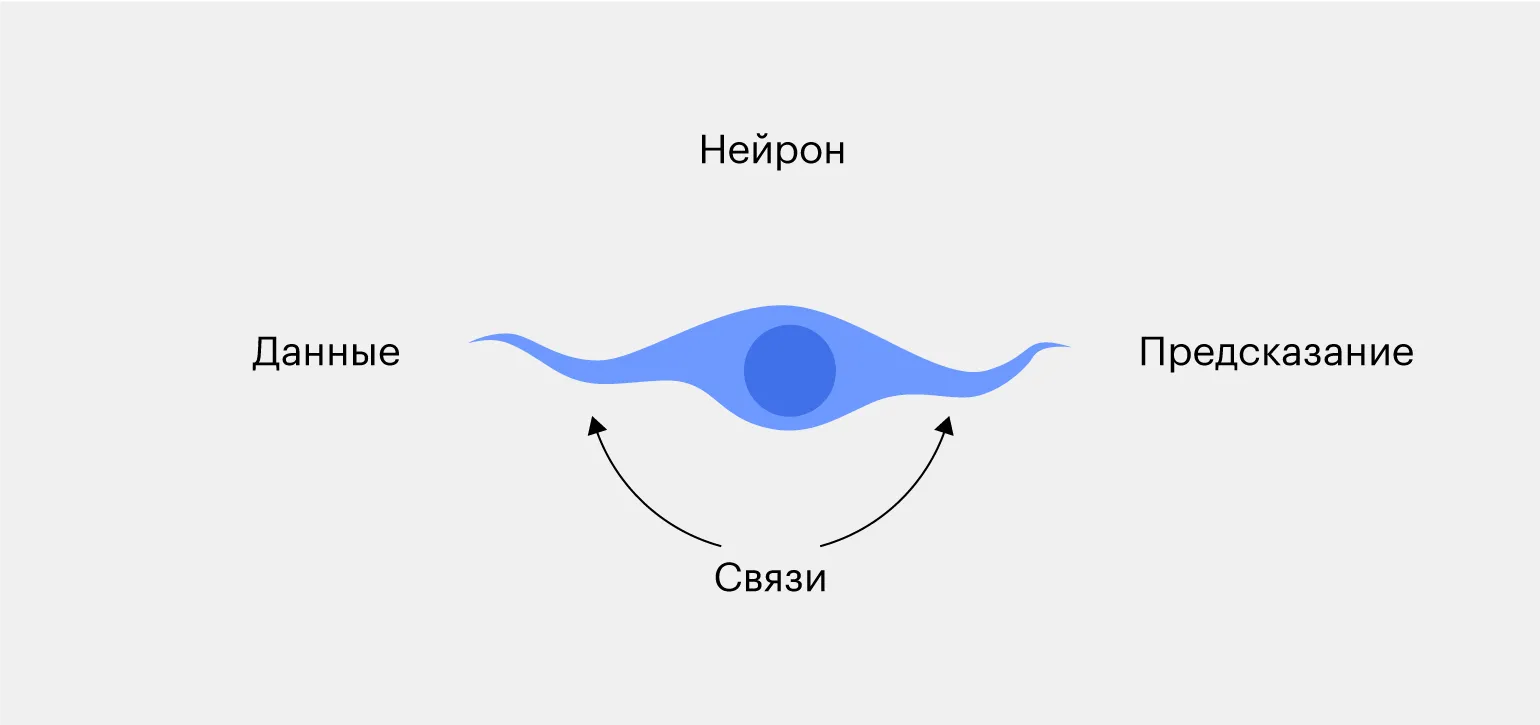
A neural network receives input data such as images of fruit, such as apples or bananas. It processes these images by analyzing the color values of the pixels. If the image is dominated by green pixels, the neural network concludes that it most likely depicts an apple. If the image is dominated by yellow pixels, it is probably a banana. This approach allows neural networks to effectively classify images based on color characteristics.
However, this algorithm has certain limitations and does not always demonstrate high accuracy. For example, how can a neural network distinguish an unripe green banana from a ripe one, or recognize a yellow apple? Assessing color alone is insufficient for accurate identification. More sophisticated methods that take into account the texture, shape, and other characteristics of the fruit are needed to improve recognition accuracy.
To improve the accuracy of the system, it is recommended to add two additional neurons. One of them will analyze the shape of the object, and the other will study its tail. This approach will significantly improve the quality of data processing and increase the efficiency of the neural network.
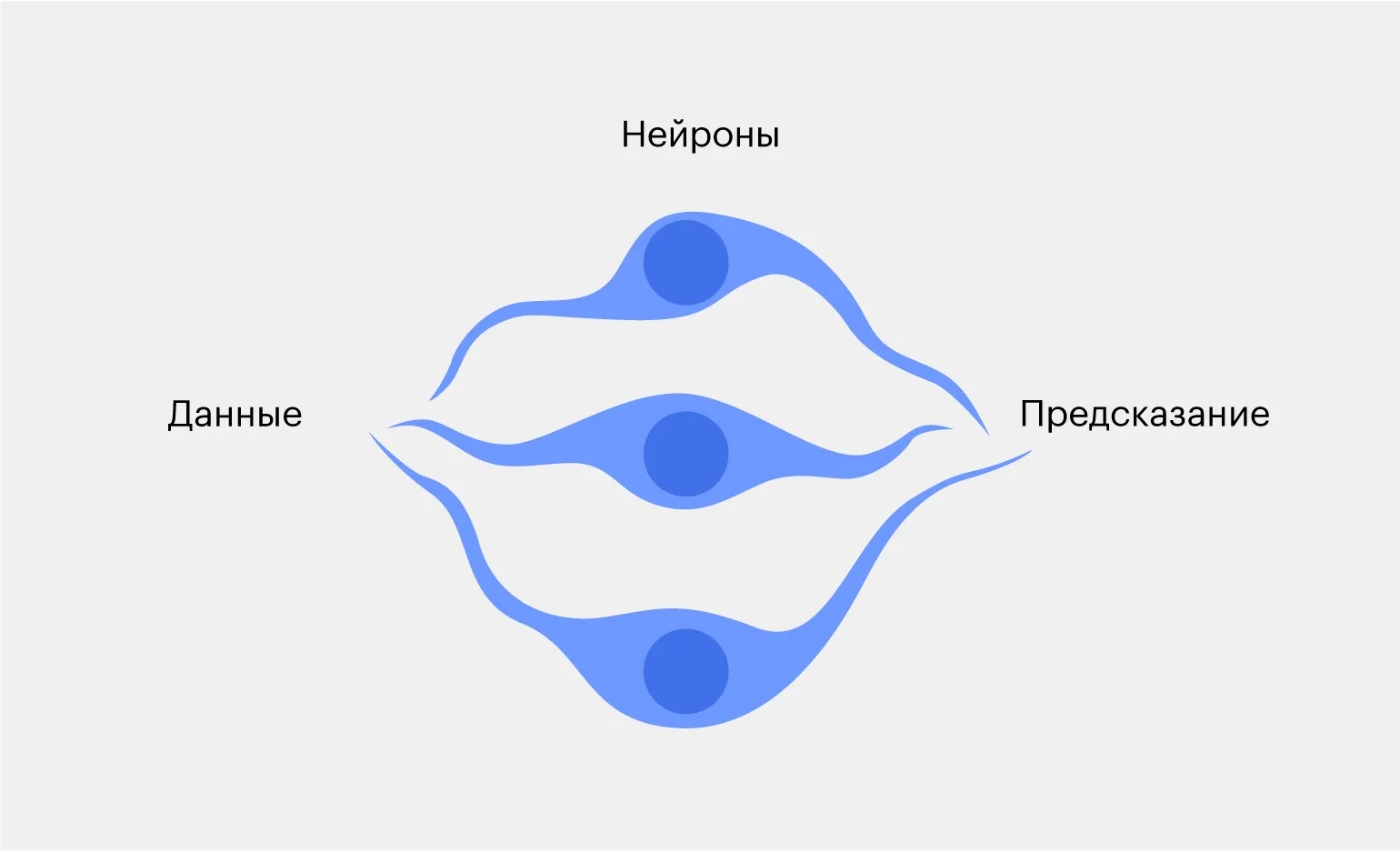
An image of a banana is fed to three neural networks, each of which analyzes it according to its own unique criteria and forms its own assumptions about the content.
After processing the data, three possible results are formed. For example, two neurons may identify an object as a banana, and one as an apple. The neural network analyzes the number of votes and makes a decision based on the majority opinion. This approach allows for increased accuracy of object recognition and improved network performance.
If the neural network makes an error, it is important to understand how to correct the situation. First, it is necessary to analyze the result to determine the cause of the error. This may be due to insufficient data, incorrect algorithms, or even specific features of the task. Once the problem is identified, adjustments should be made to the model or the data on which it was trained. It's also worth considering retraining the neural network using new data or improved algorithms. It's important to remember that errors are part of the process, and analyzing them can lead to improved neural network performance in the future.
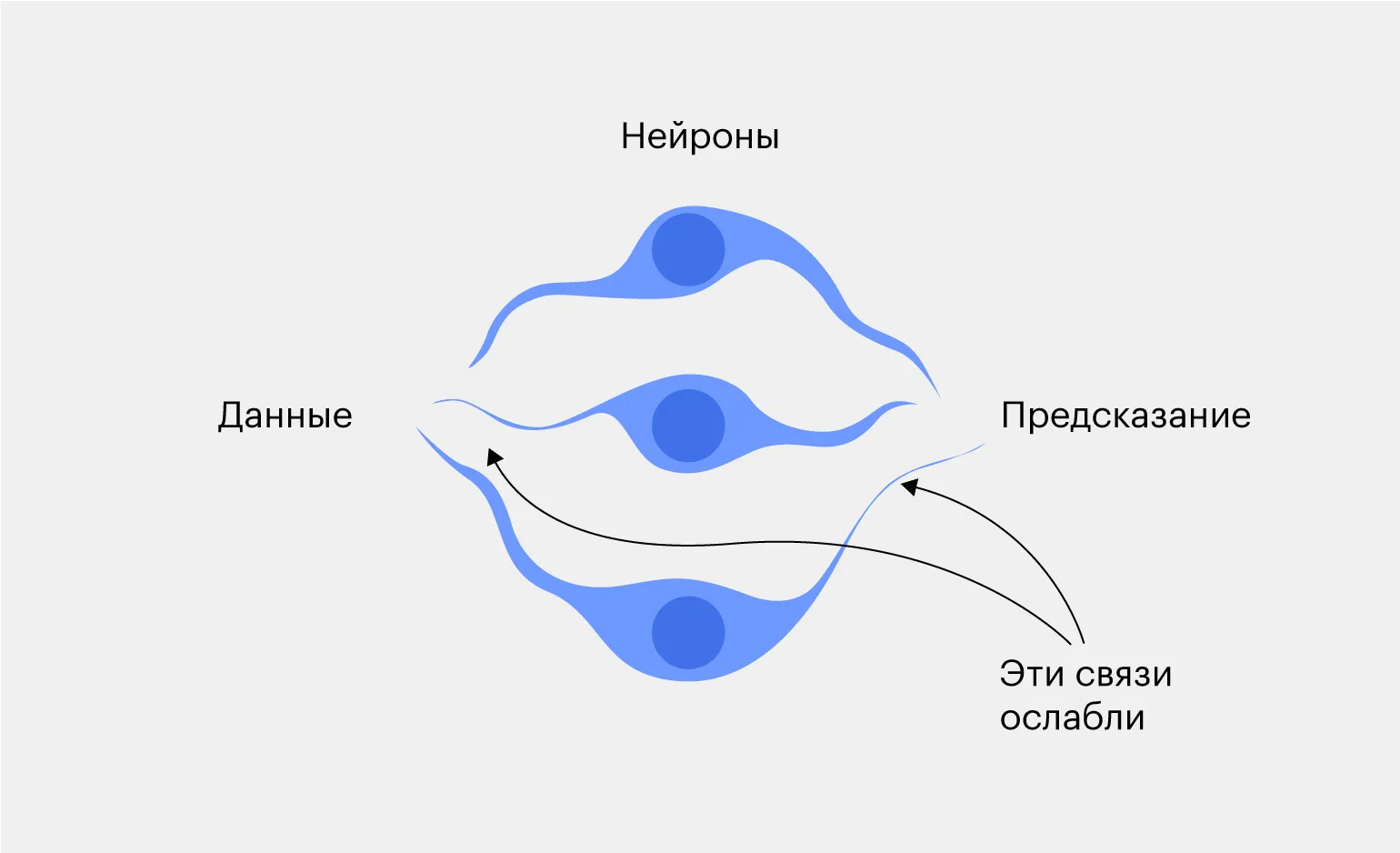
To improve results, it is necessary to weaken the influence of neurons that contributed to the erroneous conclusion. This process can be viewed as a kind of mechanical "punishment" aimed at correcting incorrect predictions and optimizing the neural network.
The connections between neurons determine the degree of influence each neuron has on the decision-making process. A weak connection means that a neuron contributes less to the final result. This creates an analogy with a real democratic system, where every vote counts, but the influence of individual participants can vary.
When a neural network generates erroneous results, we reduce the activity of those neurons that contributed to these results. This process is a key part of learning in deep neural networks. Training involves adjusting the weights of neurons based on error analysis, which allows the system to improve the accuracy of its predictions and adapt to new data.
We do program the neural network, but it's important to understand that artificial intelligence is not limited to this process alone. The programs that run in the neurons are not created manually; they are formed as a result of the neural network's training, based on trial and error. This process allows the system to adapt and improve its abilities by learning from data and experience, which is a key aspect of artificial intelligence.
The structure of the neural network, including the number of layers and neurons, is determined by the developer using programming languages such as Python and libraries such as TensorFlow. This configuration is a key step in the process of creating and training a neural network, as it affects the model's ability to process and analyze data. A properly chosen neural network architecture allows for more accurate results in machine learning and deep learning tasks.
We studied how neurons are able to analyze colors, shapes, and characteristics of objects. However, why neural networks function this way remains unclear. Neurons form learning algorithms on their own, and our role is to indicate what is correct and what is incorrect. Understanding how neural networks work opens new horizons in artificial intelligence and could lead to significant breakthroughs in various fields.
Neural networks can take into account unusual parameters, such as shadows or reflections of objects, such as fruit. This property makes them similar to the human brain, since people are sometimes unaware of how their minds work. This behavior of neural networks highlights their ability to process complex information, opening new horizons in the field of artificial intelligence and machine learning.
Now let's turn our attention to complex multilayer neural networks, which significantly expand the capabilities of artificial intelligence. These networks are capable of processing and analyzing large volumes of data, identifying complex patterns and relationships. Multilayer neural networks are used in a variety of fields, such as image processing, speech recognition, and text analysis, making them indispensable tools in modern AI. Their ability to learn from big data enables them to achieve high accuracy and efficiency in solving complex problems. Multilayer Neural Network Structure: How Does It Work? Multilayer neural networks, or deep neural networks, are an essential tool in artificial intelligence. These networks consist of multiple layers, each performing specific data processing functions. Due to their architecture, multilayer neural networks are able to effectively extract complex patterns and representations from large volumes of information. This makes them indispensable in fields such as computer vision, natural language processing, and speech recognition. The use of deep neural networks opens new horizons for the development of intelligent applications and technologies capable of solving complex problems.
The input layer is the starting point where the neural network accepts data, including images, numerical values, and text. It sets the foundation for further information processing. The output layer, in contrast, is responsible for presenting the final results of data processing. Intermediate layers, known as hidden layers, play a vital role in data analysis, enabling deep processing and identifying hidden patterns. Each of these layers contributes to the efficiency of the neural network, making them critical to achieving accurate and reliable results.

A multilayer neural network operates similarly to a simple neural network, but with an important difference: it processes data through multiple layers. This multi-layer transformation enables deeper analysis of information and improves the quality of the results. Due to their architecture, multilayer neural networks are able to identify complex patterns and dependencies in data, making them indispensable for machine learning and artificial intelligence tasks. Effective use of such networks opens new horizons in analyzing large volumes of information and solving complex problems related to classification, image recognition, and natural language processing.
The number of connections between neurons in this model may seem daunting, but it is precisely this complexity that allows the network to effectively identify complex patterns in data. Thanks to these many connections, neurons are able to process information at various levels, which facilitates deeper analysis and accurate forecasting. This ability of neural networks to recognize patterns makes them indispensable in fields such as machine learning, artificial intelligence, and big data analysis. Hidden layers in neural networks play a key role in processing input data, enabling the detection of complex patterns and nuances. For example, the difference between apples and bananas can be analyzed based on various features, such as color, texture, and shape. Hidden layers allow the neural network to process these characteristics at different levels of abstraction, making the model more effective at classifying and recognizing objects. Thus, the use of hidden layers significantly improves the accuracy and depth of data analysis, which is an important aspect in the development of modern machine learning technologies.
- The neural network receives an image measuring 200 by 400 pixels, which is 80,000 pixels, each of which is passed to all input neurons.
- The input layer pre-processes the image, determining the general shape of the object, and passes the processed data to the hidden layer.
- The first hidden layer performs additional processing, for example, recognizing the color of the object, and passes the results further.
- The second hidden layer analyzes the details of the object, which contributes to a more accurate classification.
- When the data reaches the output layer, the neural network forms a hypothesis based on all previous processing.
Despite the increased complexity of the mechanism, the neural network has achieved a new level of intellectual capabilities. This allows it to effectively solve more complex problems, including pattern recognition and automatic text generation. Modern neural networks demonstrate impressive results in data analysis and content creation, significantly expanding their application in various fields such as artificial intelligence, natural language processing, and computer vision.
To achieve a higher level of intelligence in a neural network, simply increasing the number of layers is not enough. While adding additional layers can help reduce errors, this is not a universal solution. Even with thousands of layers, the possibility of errors remains. More comprehensive approaches are needed, including architecture optimization, improved learning algorithms, and the use of high-quality training data. These measures can significantly improve the efficiency of neural networks and minimize the likelihood of errors in their operation.
Achieving the next level of "intelligence" requires the use of deep learning algorithms. In the following sections, we will examine these algorithms in detail. Before we describe them, let's first understand how deep learning and neural networks are related.
Deep Learning and Neural Networks: Basic Concepts
Neural networks are a key tool in artificial intelligence, modeling the functioning of the human brain. Deep learning encompasses a variety of methods and techniques that allow these networks to be trained effectively. These technologies are used in a variety of fields, such as natural language processing, image recognition, and data prediction, making them an integral part of modern AI solutions. The development of neural networks and deep learning methods opens new horizons for the automation and optimization of processes in various industries.
The terms "neural network" and "deep learning" are often perceived as synonyms, but there is an important difference between them. A neural network is an architecture consisting of many interacting neurons that process input data and generate output. For example, neural networks can effectively distinguish objects in images by analyzing their characteristics and structure. Deep learning, in turn, is a method that uses multi-layer neural networks to solve complex problems such as image recognition and natural language processing. Understanding these differences will help better navigate modern artificial intelligence technologies and their applications in various fields.
Deep learning is a method based on the creation of multi-layer neural networks, which allows for the effective solution of complex problems, including image classification, speech recognition, and text generation. According to a study published in the journal Nature, the use of deep learning has significantly improved accuracy in critical areas such as medical diagnostics and autonomous vehicles. This confirms its importance and potential in modern technology, opening new horizons for innovative solutions.
Neural networks are a key element of deep learning, without which the development of modern machine learning algorithms would be impossible. They represent the fundamental architecture upon which many cutting-edge technologies and applications in this field are based. For a more detailed examination of neural networks and their role in machine learning, we recommend reading our dedicated article on this topic.
Neural networks and deep learning are related but distinct concepts that are essential to the development of artificial intelligence technologies. Neural networks are architectures inspired by the human brain and are used to process and analyze data. Deep learning, in turn, is a subset of machine learning that applies multi-layered neural networks to solve complex problems such as image recognition, natural language processing, and more. These technologies continue to evolve, opening up new possibilities in fields ranging from medicine to finance.
Neural Network Training Methods: Understanding the Basics
Neural networks are powerful tools for data analysis and prediction. In this article, we will examine in detail the basic aspects of neural network training, using airline ticket price prediction as an example. Understanding how neural networks work allows us to identify hidden patterns in data and make accurate forecasts, which is especially important in the aviation industry, where price fluctuations can depend on many factors. We will analyze how data preparation, network architecture, and training affect the quality of predictions.
- Input data: flight date, departure location, and destination.
- Output data: predicted airfare.
We have historical price data, which we will use to train the neural network. This data will allow the model to effectively analyze trends and predict market changes. Using historical information is a key step in the training process, as it helps improve the accuracy of predictions and enhance the efficiency of the neural network.
Our neural network consists of three layers: an input layer containing three neurons, two hidden layers, each containing four neurons, and an output layer with one neuron. This structure allows for efficient data processing and analysis, ensuring high accuracy in machine learning tasks. The input layer receives data, hidden layers process it and identify complex patterns, and the output layer generates the final result. Using multiple hidden layers significantly increases the neural network's learning and adaptation capabilities, making it more effective at solving a variety of problems. Training the neural network begins with input data, which it uses to form price predictions. If the prediction is close to the actual value, the connections between neurons that contribute to this outcome are strengthened. Otherwise, if the prediction is incorrect, these connections are weakened. This adaptation process allows the neural network to improve its forecasts over time, increasing the accuracy and reliability of price analysis.

The terms "strengthening" and "loosening" connections in neural networks refer to changing weights, which are numerical values such as 2, 5, or 19.3. When a neural network makes a correct prediction, the connection weight increases, improving the model's accuracy. When a prediction is incorrect, the weight decreases, allowing the neural network to adjust its parameters to achieve better results. Initial weights are set randomly and then adapted during the training process, allowing the model to effectively process and analyze data.
After thousands of iterations, the neural network begins to produce more accurate results, and after a million iterations, it is capable of performing tasks at the level of an experienced travel agent. This level of learning allows the algorithm not only to process user requests but also to offer optimal solutions based on the analysis of large volumes of data. This opens up new horizons for the application of technology in the tourism sector and improves customer service.
The neural network has successfully completed the training process. Now, when entering any date and destination, it is able to accurately determine the ticket price with minimal error.
Supervised learning is a method in which historical data serves as the basis for training a neural network. In this process, the neural network analyzes the provided data, extracting patterns and dependencies from it. This approach allows for effective solutions to classification and regression problems, significantly improving the accuracy of predictions and decisions.
Supervised learning can face certain limitations, especially in situations where there are no labels for training. For example, how can you train a neural network to play Tetris without pre-defined data? In such cases, it is necessary to apply alternative methods, such as unsupervised learning or reinforcement learning, which allow the system to independently extract knowledge from the environment and make decisions based on its experience. These approaches open up new possibilities for developing effective algorithms and technologies capable of solving problems where traditional methods fail.
Unsupervised learning is the opposite method, in which a neural network independently determines acceptable results. Although this may seem unusual, this approach has proven highly effective in practice. This method allows models to identify hidden patterns and structures in data without prior labeling, making it particularly useful for analyzing large volumes of information. Unsupervised learning is actively used in various fields, including clustering, dimensionality reduction, and anomaly detection, contributing to a deeper understanding of data and improved decision making.
Imagine that we want to segment users of a video hosting site to provide them with relevant content. While this task is difficult to perform manually, a neural network can effectively handle it by analyzing data on videos viewed, likes, and subscriptions. Using machine learning technologies allows for a more accurate understanding of user preferences, which in turn contributes to a better user experience and increased engagement. A neural network can identify patterns in viewer behavior, opening the door to personalized recommendations and increasing audience retention. Using this data, the neural network can pair users with similar interests, contributing to the creation of an effective recommendation system. This improves content personalization and increases audience engagement, boosting user satisfaction and loyalty. Supervised and unsupervised learning are the two main methods used in neural network training. Developing complex systems like ChatGPT requires the use of modern deep learning algorithms. These approaches enable the efficient processing and analysis of large volumes of data, which is key to creating high-quality and functional models. Using advanced technologies and methods in training neural networks opens up new possibilities for developing intelligent systems capable of natural interaction with users.
Overview of Deep Learning Algorithms: What You Need to Know
Deep learning continues to develop rapidly every year, and new algorithms aimed at solving a variety of problems appear on the market. However, there is still no universal method that can effectively cope with all problems. Various approaches are currently used, such as convolutional neural networks, which are excellent for image processing, and recurrent neural networks applied to text analysis. The diversity of approaches allows for finding optimal solutions for specific problems, which makes deep learning a powerful tool in various fields, including computer vision and natural language processing.
Convolutional neural networks (CNNs) play a key role in the field of computer vision, providing effective analysis and interpretation of visual data. These networks are specifically designed to process images and video streams, enabling them to detect complex patterns and features. Key applications of CNNs include object recognition, image classification, and segmentation, making them indispensable in fields such as medicine, automotive, and security. Thanks to their ability to train on large volumes of data, convolutional neural networks continue to evolve, improving the accuracy and efficiency of computer vision. Convolutional neural networks (CNNs) work by integrating additional convolutional layers into their architecture, facilitating deeper image analysis. Each convolutional layer uses filters to identify various image elements, ranging from simple contours to complex textures. This multi-layered approach allows CNNs to efficiently process visual data, improving the accuracy of object recognition and image classification. Due to their ability to automatically extract features, CNNs are widely used in fields such as computer vision, image and video analysis, and deep learning.
The first convolutional layer of a neural network is designed to detect the edges and corners of objects in an image. With each subsequent layer, increasingly complex structures are processed, including shapes and textures. Ultimately, the final layer integrates all the collected information and forms a prediction about the image content. This approach allows deep neural networks to effectively analyze visual data and improve the quality of object recognition.
Recurrent neural networks (RNNs) are an important tool for processing sequential data, including text and time series. Due to their architecture, RNNs can remember information about previous elements, which significantly improves the accuracy of predictions of subsequent elements in a sequence. These networks are actively used in fields such as natural language processing, speech recognition, and time series analysis. Using RNNs, researchers and developers can build models that efficiently process and analyze data with respect to its sequence and context, making them indispensable for modern machine learning tasks. The architecture of recurrent neural networks (RNNs) is a sequential structure, similar to a string of beads, where each bead represents a piece of information, such as a word. These relationships give models the ability to establish associations and gain deeper context. Recurrent neural networks play a key role in processing sequential data, such as text and time series, due to their ability to remember information about previous elements in a sequence. This makes RNNs indispensable for tasks involving natural language analysis and sequence prediction.
One of the most popular forms of recurrent neural networks (RNNs) is the long-short-term memory (LSTM) network. These networks have the ability to retain information in memory for a long time, making them effective for processing sequential data. LSTMs are widely used in various fields, including natural language processing and text generation systems such as ChatGPT. Due to their ability to remember previous messages, LSTMs provide more accurate and contextually relevant responses, significantly improving the user experience.
Generative adversarial networks (GANs) are a revolutionary technology that is significantly changing the approach to creativity. These algorithms are capable of generating images, music, and poetry, emulating the styles of various authors. Using GANs, artists and musicians can experiment with new art forms, creating unique works based on the analysis of existing styles. This technology opens up vast opportunities for the creative industries, allowing the combination of artificial intelligence and human creativity. GANs are becoming an essential tool for those seeking innovation in art and design.
Generative adversarial networks (GANs) rely on the interaction of two neural networks: a generator and a discriminator. The generator, acting as an "artist," creates new works, while the discriminator, acting as a "critic," evaluates them, determining whether they were created by a human or a machine. This competitive process between the two networks promotes their continuous improvement, allowing the generator to create more realistic images and the discriminator to improve its ability to recognize counterfeits. As a result, GANs are becoming a powerful tool in the field of artificial intelligence, capable of generating high-quality content and opening up new possibilities in various fields such as art, fashion, and entertainment.
This approach allows neural networks to quickly adapt and learn without significant effort from developers. Simply using machine learning algorithms makes the process more efficient and less labor-intensive.
The synergy of deep learning algorithms is a powerful tool for improving results in various fields. Combining multiple algorithms can improve prediction accuracy and data processing efficiency. For example, integrating neural networks with other machine learning methods can lead to more accurate conclusions and improved analysis. By using a synergistic approach, researchers and practitioners can extract new insights from large volumes of data, opening up new horizons for developing innovative solutions and technologies. Synergy in deep neural networks not only enhances their performance but also expands their application in fields such as medicine, finance, and automation.
Deep learning algorithms can be effectively combined to develop more powerful solutions. For example, combining generative adversarial networks (GANs) and recurrent neural networks (RNNs) allows for the creation of neural networks that not only generate content but also take into account previous interactions. This makes systems more interactive and intelligent, significantly expanding their capabilities in various fields, such as writing, music, art, and many others. This approach enhances the potential of deep learning, allowing for more adaptive and intelligent solutions that can respond to changes in data and user requests.
Deep learning continues to develop rapidly, opening new horizons for solving complex problems in various industries. This area of artificial intelligence demonstrates significant potential, allowing for the efficient processing of large volumes of data and the extraction of useful information from it. Constant innovations in algorithms and neural network architectures contribute to improved accuracy and processing speed. Thanks to this, deep learning is becoming a key tool in fields such as medicine, finance, the automotive industry, and many others.
Applications of Deep Learning: From Medicine to Entertainment
Deep Learning has become an integral part of our daily lives, but it cannot completely replace all professions. The main reason for this is the limited computing power of modern computers, which hinders the development of algorithms. Despite advances in artificial intelligence and machine learning, many tasks require human intelligence and creativity. Deep learning effectively copes with the analysis of large volumes of data and pattern recognition, but its application is still limited. In the future, improved computing power is expected, which will allow algorithms to integrate more deeply into various fields and expand their capabilities.
Nevertheless, there are many areas in which deep learning technologies demonstrate clear advantages. These technologies are finding application in various industries, including healthcare, finance, automotive, and manufacturing. Deep learning allows for the analysis of large volumes of data, improved forecasting, and automation of processes. Due to their capabilities, such technologies contribute to increased efficiency and accuracy in decision-making, making them indispensable for modern companies.
Chips for gadgets. In recent years, companies have been actively implementing deep learning algorithms in their devices, significantly increasing their performance and functionality. For example, NVIDIA demonstrated how neural networks can improve the performance of graphics cards, providing smoother gaming. Similarly, Apple claims that their processors integrate neural networks that improve smartphone performance. While some may perceive this as a marketing gimmick, many experts confirm the reality and effectiveness of these technologies. Integrating deep learning into chips opens new horizons for gadgets, making them smarter and more responsive to user needs.
Modern technologies in the gaming industry provide immersive experiences where interactions with non-player characters (NPCs) become more believable. The introduction of ChatGPT has inspired developers to create dialogues that surprise players with their naturalness and depth. The use of neural networks in games opens up new possibilities for creativity and user engagement, allowing for the creation of unique scenarios and enhancing the overall gaming experience. Such innovations not only increase interest in games but also enrich the interaction between players and the game world.
Medicine While neural networks cannot provide definitive diagnoses, they play a vital role in diagnosing illnesses, significantly facilitating doctors' work. Startups such as Woebot have created innovative virtual psychologists who provide support and advice, making these technologies useful for improving mental health. The use of neural networks in medicine opens new horizons for improving the effectiveness of diagnosis and therapy, and also facilitates access to psychotherapeutic care.
Digital assistants. Neural networks are actively used to develop highly effective digital assistants that significantly simplify the process of preparing presentations, recording educational videos, and filtering spam calls. One example is Tinkoff Bank, which implemented an answering machine capable of handling customer calls. This solution not only improves the quality of service but also optimizes customer support, allowing staff to focus on more complex inquiries. The use of neural networks in this area opens up new opportunities for businesses, improving customer engagement and increasing overall operational efficiency.
Key Points to Remember
Today, we've covered key aspects to consider. We've focused on the central themes of our research. We've analyzed important factors that influence our results and highlighted key findings. These aspects will help to better understand the subject and form further steps for in-depth study.
- Deep learning is a method that allows computers to perform complex tasks, such as object recognition, for example, distinguishing between apples and bananas.
- Deep learning is based on neural networks, which function similarly to the human brain, processing and analyzing information.
- The structure of a neural network includes neurons connected by connections that allow the transmission of processed information from one neuron to another.
- Neural network training occurs through a reward process: neurons that lead to correct results are strengthened, while ineffective connections are weakened.
- Neural networks can be simple (one layer of neurons) and multi-layer, the latter can consist of several layers.
- A multi-layer neural network includes three types of layers: input, for initial data processing; hidden, for additional processing; and an output that generates the final prediction.
- There are two main methods of training neural networks: supervised learning, where predictions are compared with actual results, and unsupervised learning, where the network independently searches for the correct answers.
- Various deep learning algorithms are used to solve complex problems, among which the most popular are convolutional neural networks, recurrent models, and generative adversarial models.
- Neural networks are widely used in various fields, including games, voice assistants, and medical diagnostics.
Stay on top of the latest developments in programming and technology by subscribing to our Telegram channel. There you will find current news, useful tips, and interesting materials that will help you develop in this dynamic field. Don't miss the opportunity to stay up to date with the latest trends and updates!
We recommend that you familiarize yourself with additional materials that will help deepen your knowledge and expand your understanding of the topic. These resources contain relevant information and recommendations that may be useful for your learning. We are confident that they will be a great addition to your experience.
- Closed AI from OpenAI: Exploring the Power of the GPT-4 Neural Network
- Test: Rapper, Classical Musician, or Neural Network? Test your knowledge!
- TensorFlow Library: Creating a Neural Network and Learning the Basics of Machine Learning
Artificial Intelligence: Philosophy and Machine Thinking
Want to understand the philosophy of AI? Learn about machine thinking and the differences in intelligence! Read the article!
Find out more