

Alesya Bezrukova
Fullstack PHP developer
Graduated from the Faculty of Applied Mathematics and Informatics at BSU. She was on maternity leave for 10 years, but did not lose interest in work and development.
She took Skillbox courses to study in-demand areas of web development in more depth and achieve a high income. Now she works for the company as a freelance developer, takes freelance orders and earns $ 2,000.
Graduated from the Faculty of Applied Mathematics and Informatics at BSU. I was on maternity leave for 10 years, but I didn't lose interest in work and development.
I took Skillbox courses to gain a deeper understanding of in-demand web development areas and achieve a high income. Now she works for the company as a freelance developer, takes on freelance orders and earns $2,000.
Everything you need to know about PHP
PHP is a scripting programming language: programs written in it are converted into code that a computer can understand when the program runs. Therefore, changes can be made at any stage of the project's development. This is how PHP differs from compiled languages - C++, Java, Go, Swift, in which the program's source code is converted into machine code immediately after development. An executable file is generated that cannot be changed.
PHP is a universal or general-purpose language. It allows you to implement a variety of tasks. For example, create cross-platform applications or work with artificial intelligence. But it is mainly used for writing the server side of applications, which is what it was originally created for.
💡 Cross-platform applications are applications that can be run on different operating systems.
PHP appeared in 1995 to track visitors to the site. This is indicated by its first name - Personal Home Page Tool. A couple of years later, the application was converted into a full-fledged language for creating web scripts. Along with the emergence of new functions, the name also changed - PHP became known as a hypertext preprocessor, which reflects its essence.

💡 A preprocessoris an application that processes data and translates it into a format understandable by another application. For example, PHP translates the source text of a program into HTML and JS code understandable by web browsers.
PHP is the first programming language created to expand the capabilities of web development and simplify it. While previously websites were just pages with text, PHP made it possible to create full-fledged web applications with pluggable databases and plugins for collecting analytics.
Despite the emergence of alternative languages such as Go, Ruby, and Python, PHP remains the most common language for writing backend applications. According to the portal w3tech.com, 76.2% of websites run on it. You probably browse at least one of them every day. The list includes Wikipedia, VK and Facebook. Well-known CMS are also written for: WordPress, Drupal, Magento.
💡 CMS is a content management system and a ready-made platform for launching a website.

Learn how to create applications for Apple devices in the PHP Developer course. Basic Level
Learn moreAnd although the share of PHP has decreased by several percent in recent years, new projects continue to appear on it. And here is the reason for its popularity:
- Regular updates.New features improve performance and help solve current problems. In terms of code execution speed and capabilities, PHP is not inferior to other scripting languages. At the same time, ready-made solutions are already available for most tasks. PHP 8.3 will be available in 2024;
- Simple syntax and many ready-made functions.PHP is easy to learn. The language is designed so that the code will be executed even if an error creeps in;
- Open license. It allows everyone to use PHP for free and without restrictions. Therefore, PHP scripts support any server.
💡 Server Is a program that processes requests from users and provides access to websites.
- PHP scripts can be embedded in HTML code.That is, in the program code that is converted into the website design. This allows you to add new features without rewriting the project;
- PHP code is interpreted on the server.This generates dynamic HTML code or JavaScript scripts. This allows you to create cross-platform interactive web applications. Such programs adapt to the screen size and other device parameters;
- Built-in functions. These allow you to solve complex problems with less code. The shorter the code, the faster it is processed. This means that the site will be less demanding on computer resources.
Is there a demand for PHP developers?
The popularity of the language in new projects and the millions of sites that have already been launched and need support - all this means that the profession of PHP developer is in high demand.
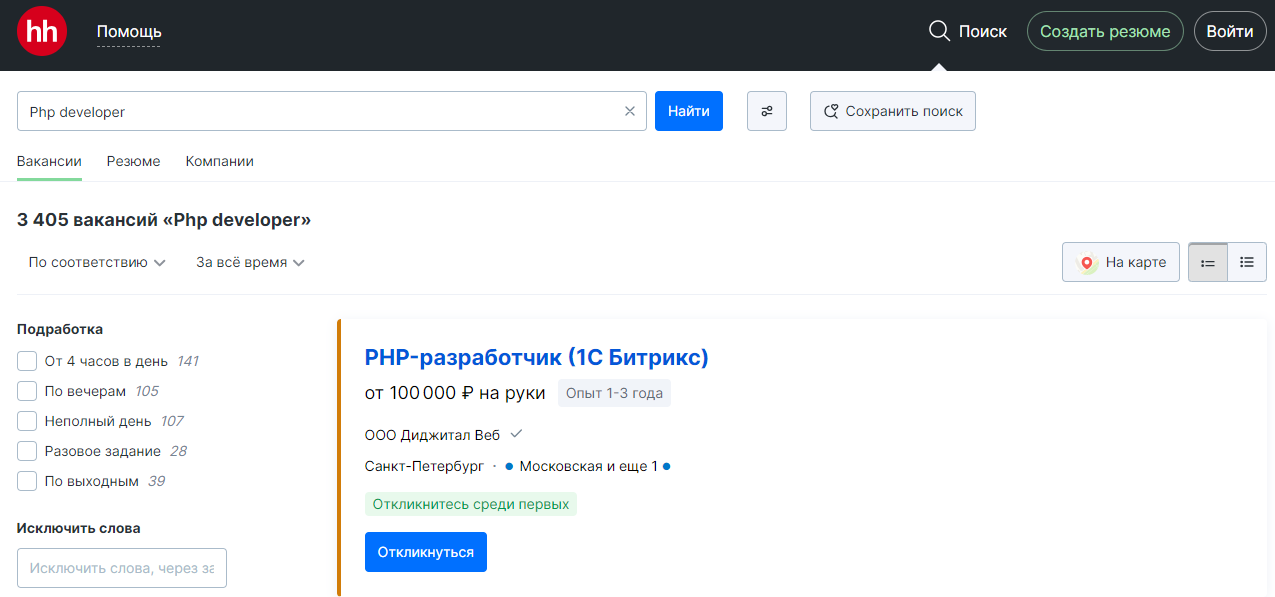
For example, at the end of June 2024, HH.ru published almost 3,500 vacancies for PHP developers. And more than 120 vacancies in Belarus on Rabota.by. Salaries range from $520 for junior level to $3,000 per month for senior developers.
In the US, according to the portal Glassdoor, vacancies for PHP developers with salaries from $90,000 to $151,000 per year have been published. There are many offers with remote employment and employment opportunities for programmers from other countries, including the CIS.
What do programmers do?
PHP developers work in different areas:
- Machine learning and artificial intelligence;
- Development of applications for Windows and MacOS.
But more often PHP programmers are needed in web development. They typically work on the backend—the part of websites and web applications that is processed on the server.
For example, a user fills out a registration form on a website. The entered information needs to be processed, added to the database, and redirected to the main page. All these operations occur on the server side—the part that the user doesn't see. The visitor interacts with the frontend—the user interface: forms with buttons, fields, links, and other elements.
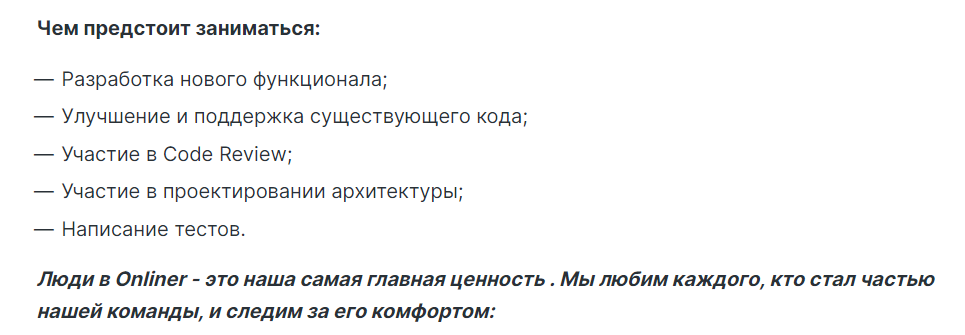
Let's look at the main responsibilities of a PHP developer using the example of job postings on Rabota.by and HeadHunter. Here a PHP developer is offered to perform the following tasks:
- Development and writing code for new web application functions;
- Refining existing code, implementing new approaches and development technologies;
- Participating in Code Review - analyzing application code, searching for errors and code blocks that slow down operation;
- Writing scripts for automatic testing of applications and individual modules. Duties include manual tests of the service;
- Creating scripts for connecting databases to a website, integrating third-party services via API, and adding new modules and plugins;
- Managing versions of written code through GIT tools.
Mid-level and higher specialists analyze business processes and develop application architecture. They discuss ideas and proposals with the project manager or customers, evaluate their functionality and how to implement them.
What they know and can do
People unfamiliar with the IT industry imagine a programmer as a technical genius who can mentally solve integrals and have a thorough understanding of microchips and electronics. In fact, perfect knowledge of mathematics is not necessary—a programmer doesn't calculate complex formulas unless they're creating an app for calculating planetary motion.

Therefore, you don’t need to be superhuman to get hired. Here are the skills that companies usually look for in a candidate.
Hard Skills
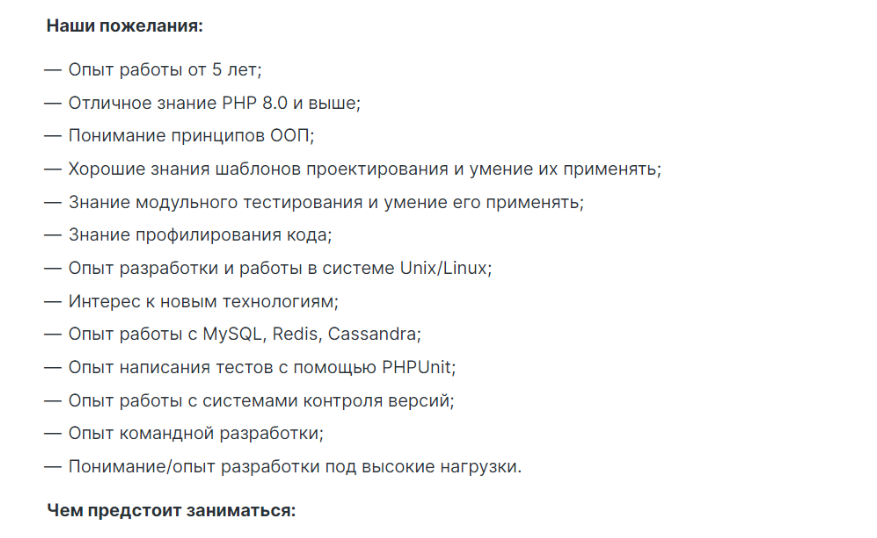
- Knowledge of the PHP programming language version 8 or higher;
- Knowledge of Symfony 5 and 6, Yii or Laravel frameworks;
- Understanding the features of working with and configuring database management systems: PostgreSQL, MySQL, Redis;
- Knowledge of network protocols: HTTP, FTP, TCP/IP, SSH and organizing data exchange in an application;
- Understanding the principles of object-oriented programming;
💡 OOP is a development method when a large task is broken down into separate blocks.
- Writing tests with PHPUnit;
- Working with the GIT version control system and GitHUB, Gitlub repositories;
- Configuring Apache, Ngnix web servers and working in the command line.
The following skills will be a bonus:
- Knowledge of HTML and CSS, frontend development - the part of the site that the user sees;
- JavaScript programming, knowledge of key libraries and frameworks: VueJS, Next.js, ReactJS, Bootstrap;
- Working with Docker, RabbitMQ, Memcached technologies.
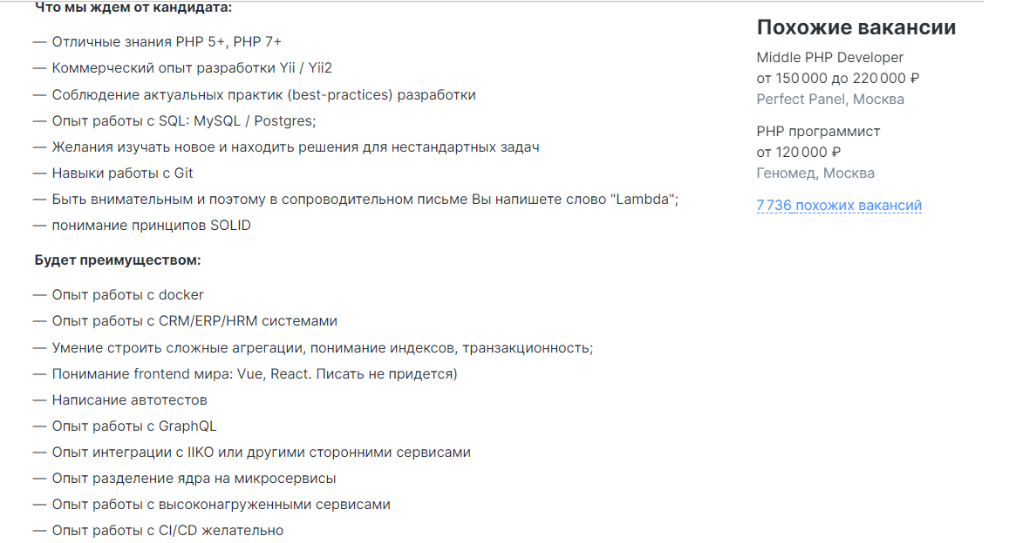
Yes, additional knowledge is not required. But it will be a plus during employment. Also, frontend development skills will help in career development. For example, becoming a project manager.
How to develop a career
Traditionally, a programmer's career develops in several stages:
- Intern. This is an intern without experience. For example, a graduate of courses, university, or self-taught;
- Junior. A junior developer who writes code, knows the basic principles of development and copes with repetitive tasks. A junior has little experience. For example, a portfolio includes several projects using current technologies;
- Middle. Knows the full stack of backend technologies, solves non-standard problems, can single-handedly create a module or complete a simple project. Typically, these are programmers with 2-3 years of experience. This figure is approximate. After all, everything depends on skills and development. You can become a middle in a year;
- Senior. A senior developer who has mastered the technology stack and knows several frameworks. Takes on complex projects alone, assumes responsibility for implementation, and develops the architecture. Guides junior colleagues. A PHP developer has several career advancement paths:
- Horizontal. Development in one direction. For example, when a programmer delves into working with databases or masters AJAX technology. Such developers have less responsibility, but they are valued in large companies, receiving salaries at the executive level;
- Vertical. Gradual development of skills and promotion up the career ladder - from junior to senior. After reaching the senior level, you can get a position of project manager, become a lead engineer, architect or technical director;
- Freelance. The prospect of assembling your own team and creating a web studio.
Regardless of the career path, a PHP developer needs to constantly develop. Monitor technological advancements and master them immediately. For example, PHP 8.3, which will be available in 2024, is three times faster than PHP 5.6, which was released in the mid-2000s. New libraries and frameworks are also emerging that speed up web development.
Pros and Cons of the Profession
Pros
- Simple language syntax.Writing scripts is similar to developing HTML code. We simply write the code and upload the file with the extension to the server. This means that the entry threshold is lower - you need to learn fewer technologies and tools to get your first job;
- A large community of PHP programmers.Lots of tutorials and ready-made instructions. If you have a question, it has probably already been answered;
- High demand for specialists.PHP solutions are available to small and medium businesses. For example, online stores that do not need a complex and expensive website. Therefore, there will always be a demand for developers.
Cons
- The simplicity of the language plays a cruel joke. PHP forgives errors, but they slow down the site;
- Low speed compared to other backend technologies. Because of this, PHP is gradually losing market share to other technologies, especially on large-scale projects;
- PHP is not suitable for mobile development.If you want to change direction, you will have to learn everything from scratch.
How to become a PHP developer. Tips for those taking their first steps in IT
In the IT industry, employers primarily pay attention not to education, but to completed projects and past experience. Therefore, how you acquired the profession is not important.
- At university. Education will take 4 years. A university degree is valued among employers in European and American companies, but does not play a role in getting a job. You'll still have to prove your qualifications at the interview—with portfolio projects and a test assignment;
- Self-study.A popular approach in the 2000s. Back then, web development was chaotic, and many standards and technologies were just emerging. In the mid-2020s, things are simpler. There are plenty of free instructions, books, and guides online. There's also a huge community ready to answer any question. However, without a clear plan, self-study takes a lot of time. It's easy to miss important tools and get stuck on simple projects;
- Online courses. Here you can master a profession, gain skills, experience, and become a junior in 9-18 months.The stack of technologies studied allows you to immediately take on projects without an internship.
Make sure you like the profession before delving into it. For example, you can attend open and free lessons, master classes at a university or in an online school. Try to understand the basics:
- Learn the capabilities of PHP and web development;
- Write your first "Hello World" app;
- Add it to the hosting and launch it.
Evaluate whether you have enough desire to finish what you started and continue working. To make it easier for you to take the first step, the Skillbox.by editorial team shares two useful materials:
- PHP Manual in Russian on the official website of the project;
- Habr — a blog platform for IT. Lots of articles and solutions for various web development tasks.
Master the profession of "PHP developer from scratch to PRO" with Skillbox
You will learn to program websites and web applications in PHP from scratch, master the Laravel framework, write cloud storage and work on an online store in a team. You can get a job as a Junior Developer.
Get access