
Contents:
- How AGI differs from regular AI
- Super AI will be cooler than AGI
- Artificial, strong and general intelligence
- Should AGI be a robot?
- Tests for checking AGI
- AGI capabilities: the opinion of experts
- GPT-5 can reach the level of AGI
- The future of language models and the transition to AGI
- AGI projects in language models
- When will AGI be created?
- What else to read about AGI: a selection of books

Course with employment: "Data scientist profession"
Find out moreDespite significant progress in the field of artificial intelligence, general artificial intelligence (AGI), which is capable of performing intellectual tasks at the human level, still remains the subject of science fiction and philosophical discussions. Even the most advanced neural networks, such as GPT-4 and PaLM, which successfully solve many complex problems, cannot be considered AGI. Researchers emphasize that these systems contain only individual elements of artificial general intelligence, the so-called "sparks" of AGI.
Scientific advances in neural networks raise hopes for the imminent emergence of general intelligence. According to the most optimistic forecasts, this could happen in the next few years with the release of one of the new next-generation language models. The development of machine learning and artificial intelligence technologies is opening new horizons that can radically change our understanding of the capabilities of intelligent systems.
In this article, we will consider what artificial general intelligence (AGI) is and promising developments in this field. We have also collected the opinions of IT experts on the future of AGI. To add to the discussion, we've invited ChatGPT, one of the most advanced chatbots available today, to share his vision for the future of artificial intelligence. Optimizing webpage content is an important aspect of SEO, helping to increase a site's visibility in search engines. Effective content should be unique, informative, and relevant to user queries. Key principles for creating quality content include using keywords that match the page's topic and structuring the text for easy reading. It's important to remember that content should not only attract attention but also retain it by providing valuable information. Keeping your target audience and their interests in mind when writing will help create a deep connection with readers. Optimizing headings, subheadings, and meta tags also plays a key role in SEO, as they help search engines index pages. Furthermore, using internal and external links can increase a page's authority. It's important to update content regularly to ensure it remains relevant and up-to-date.
Creating high-quality text is not only about keyword saturation, but also about creating unique and useful content that can attract and retain the target audience, which will ultimately lead to higher positions in search results.
- How is AGI different from regular AI?
- Super AI will be cooler than AGI.
- Artificial, strong and general intelligence.
- Should AGI be a robot?
- Tests for checking AGI.
- AGI capabilities: the opinion of experts.
- GPT-5 can reach the level of AGI.
- The future of language models and the transition to AGI.
- AGI projects on language models.
- When will AGI be created?
- What else to read about AGI: a selection of books.
How AGI differs from conventional AI
Modern AI programs are highly specialized tools. For example, an AI designed to play chess does not have the ability to generate images or diagnose diseases. Each AI is created with a specific purpose and objectives, which limits its functionality outside of the specified area of application.
All modern artificial intelligence developments fall into the category of narrow AI (ANI), also known as weak AI. This type of artificial intelligence is capable of performing specific tasks in limited areas of knowledge under human supervision. Narrow AI is used in various fields, including medical diagnostics, data processing, and business process automation. It is important to note that, despite its achievements, narrow AI does not possess general intelligence and cannot make independent decisions outside of its narrow specialization.
The next stage in the development of artificial intelligence will be the creation of a universal system capable of solving any problems that the human mind can handle. A neural network of this level would be classified as artificial general intelligence (AGI) or strong AI. Such systems are expected to perform complex cognitive functions similar to humans, opening new horizons for various industries, including medicine, education, and manufacturing. Developing AGI requires significant effort in algorithms, data processing, and ethics, highlighting the importance of an interdisciplinary approach to this task.
The key distinguishing feature of artificial general intelligence (AGI) is its ability to think and act autonomously, like a human. We perform many intellectual tasks every day: driving a car, planning a budget, interacting with others, writing, reading, and playing games. General AI is expected to master these skills. However, this is not enough. Some scientists argue that AGI must possess intrinsic motivation, the ability to set goals, and the ability to break complex tasks into simpler subtasks. These qualities make artificial general intelligence more similar to human thinking and behavior.

A general canonical definition of general (strong) artificial intelligence, based on the particular definitions of Ben Goertzel, Pei Wong, Shane Legg, and Marcus Hutter, defines AI as "the ability to achieve complex goals in a variety of challenging environments with limited resources." This definition highlights the key aspects necessary for creating effective and versatile artificial intelligence capable of adapting and functioning in diverse environments, which is an important step toward achieving full-fledged artificial intelligence.
Anton Kolonin is a PhD candidate in engineering and a leading specialist at Novosibirsk State University. He is the founder of the Aigents project and the architect of the SingularityNET project. Anton is also an expert at the Russian International Affairs Council (RIAC). His work covers key aspects of artificial intelligence development and the technologies that advance this field.
Super AI will be more powerful than AGI
While artificial general intelligence (AGI) has not yet been achieved, experts have already developed a term for the next stage in the development of intelligent systems: super artificial intelligence (ASI). Super AI will be capable of performing any intellectual task not only at the human level but also significantly exceeding it. The level of intelligence demonstrated by super AI will be unique and unparalleled in human history. This opens new horizons for technological progress and raises important questions about its impact on society and the economy.

One of the founders of this concept is philosopher Nick Bostrom. His work focuses on issues related to future technologies, ethics, and the consequences of scientific discoveries. Bostrom emphasizes the potential risks associated with the development of artificial intelligence and other advanced technologies. He emphasizes the importance of pre-evaluating possible scenarios to minimize negative consequences and maximize benefits to society. His research also considers issues related to humanity's existence in a rapidly changing technological landscape. Thus, Bostrom's philosophy offers a profound analysis and critical understanding of the future, in which technology plays a key role.

Superintelligence is a level of intelligence that significantly exceeds the abilities of the smartest people in various areas, including scientific creativity, general wisdom, and social skills. The question of how superintelligence will be achieved remains open. It could be realized through high-performance digital computers, networks of interconnected computing systems, or even artificially grown brain tissue. It is also unclear whether superintelligence will possess consciousness and subjective experience. Studying these aspects is crucial for understanding the future of artificial intelligence and its impact on society.
Nick Bostrom is a philosopher and professor at Oxford University, also known as the founder of the Future of Humanity Institute. His work focuses on issues related to artificial intelligence and its impact on the future of humanity. In his book "How Long Until Superintelligence?", Bostrom explores the potential risks and opportunities associated with the development of highly advanced intelligence, as well as its impact on society and moral issues. Bostrom's research plays an important role in shaping the debate about future technologies and their ethical implications.

Reading is an important aspect of our lives that helps expand our horizons and develop critical thinking. It not only helps improve your education but also develops your imagination and creativity. Regularly reading books, articles, and other materials can significantly increase your vocabulary and improve literacy.
It's important to choose a variety of genres and topics to enrich your experience and gain new knowledge. Reading also helps you relax and cope with stress, providing an opportunity to immerse yourself in other worlds and stories. If you want to improve your reading skills, we recommend establishing a regular schedule to make it a habit.
Reading not only enriches your knowledge but also develops critical thinking, allowing you to analyze information and draw informed conclusions. Don't forget to share your impressions of what you read with others; this will help deepen your understanding of the material and open up new horizons.
The New Ouroboros: Why Machines Will Inevitably Dominate Humans
With the development of technology and artificial intelligence, the topic of machine dominance over humans is becoming increasingly relevant. Modern advances in automation, robotics, and machine learning are opening new horizons but also raising questions about the future of the human role in society.
Today, machines are capable of performing tasks with high efficiency and precision, making them indispensable in a variety of fields, from manufacturing to medicine. As a result, many professions are being automated, changing the labor market and requiring people to constantly adapt.
Furthermore, artificial intelligence is already participating in decision-making, challenging traditional notions of human control. With each new step in technological development, the question arises: how long can humanity maintain its leadership?
In the future, as machines become even more autonomous and intelligent, they may not only replace humans in routine tasks but also take on more complex functions. This will lead to the need to rethink the role of humans and their interaction with technology.
Thus, recognizing the inevitability of machine dominance over humans is an important step in preparing for a future where the harmonious coexistence of technology and human intelligence will be key to success.
Artificial, Strong, and General Intelligence
The modern debate about intelligent machines began with the work of the English mathematician Alan Turing in 1950. In his paper "Computing Machinery and Intelligence," he proposed a criterion for determining whether a computer can act in the same way as a human. This criterion became known as the Turing test. The Turing test was a significant milestone in the development of artificial intelligence because it raises questions about what intelligence is and how it can be measured in the context of machine learning and computing.
In the summer of 1956, prominent scientists, including Claude Shannon and John McCarthy, gathered at the Dartmouth Seminar. This conference proposed the term "artificial intelligence," which at the time reflected the idea of strong AI capable of demonstrating human-level reasoning and understanding. This event became the starting point for further research and development in artificial intelligence, forming the foundation for modern technologies and concepts in this rapidly evolving field.
Progress in artificial intelligence progressed more slowly than experts had anticipated. As a result, many scientists focused their efforts on the study of weak artificial intelligence. Later, artificial intelligence came to be understood as programs capable of solving intellectual problems only in a narrow, specialized domain. This line of research has become an important step in understanding the capabilities and limitations of AI, as well as in developing more efficient algorithms for specific tasks.
In 1980, philosopher John Searle introduced the concept of strong artificial intelligence, which has become significant for discussing the capabilities and limitations of AI. Within this framework, he described a thought experiment known as the "Chinese Room." In this experiment, a person or algorithm, without knowledge of the Chinese language, following predetermined instructions, is able to generate meaningful answers to questions asked in that language. This thought experiment raises important questions about understanding, consciousness, and the true nature of intelligence in the context of artificial intelligence, as well as whether machines can truly "understand" language in the sense that humans do.
Searle criticized the Turing Test, proposing a distinction between weak and strong artificial intelligence. Weak AI is only capable of simulating intelligent activity, while strong AI possesses true understanding and consciousness. This distinction raises important questions about the nature of intelligence and consciousness in the context of the development and evaluation of artificial intelligence.

В конце 1990-х годов, с развитием нейросетевых технологий, возникла необходимость в термине, который бы отличал узкоспециализированные интеллектуальные системы от искусственного интеллекта, способного решать широкий спектр задач. В 1997 году было введено понятие общего искусственного интеллекта (AGI). Одним из основных популяризаторов этого термина стал Бен Герцель, автор книги «Artificial General Intelligence». Эта концепция сыграла ключевую роль в развитии исследований в области ИИ и стала основой для дальнейших обсуждений о будущем искусственного интеллекта.
Сильный искусственный интеллект и общий искусственный интеллект часто воспринимаются как одно и то же, однако между ними существуют существенные различия, связанные с философией их функционирования. Общий ИИ (AGI) способен выполнять задачи и принимать решения без глубокого понимания их сути, в то время как сильный ИИ обладает осознанием этих задач. Однако важно отметить, что сознание сильного ИИ не обязательно должно совпадать с человеческим. Эти различия подчеркивают важность понимания уровня интеллекта и осознания, которые могут быть достигнуты в рамках искусственного интеллекта.

AGI можно описать с использованием термина «философский зомби», который широко известен в научной среде. Такой искусственный интеллект не обладает самосознанием и не несет ответственности за свои действия. Общение с AGI может напоминать диалог с персонажем Страшилой из сказки «Волшебник Изумрудного города». Этот персонаж отвечал на вопросы фразами вроде: «Если бы у меня были мозги, я бы поступил так…». Несмотря на отсутствие сознания, его ответы иногда были достаточно разумными. Таким образом, AGI, как и философский зомби, может демонстрировать умственные способности, но не имеет истинного понимания своих действий и решений.
Александр Амбарцумов — ведущий разработчик сервисных роботов и основатель компании AlexRobotics. Под его руководством компания занимается созданием инновационных решений в области робототехники, что способствует развитию автоматизации в различных сферах. AlexRobotics предлагает широкий спектр сервисных роботов, которые находят применение в логистике, обслуживании клиентов и других отраслях. Благодаря уникальным технологиям и высокому качеству продукции, компания занимает лидирующие позиции на рынке.

Чтение является важной частью нашей жизни. Оно не только развивает умственные способности, но и позволяет получать новые знания, расширять горизонты и улучшать навыки. Регулярное чтение помогает улучшить концентрацию и память, а также способствует развитию критического мышления. В современном мире, где информация доступна в изобилии, навыки быстрого и эффективного восприятия текста становятся особенно ценными. Чтение книг, статей и других материалов обогащает наш внутренний мир и способствует личностному росту. Не забывайте делать чтение частью своей повседневной рутины, ведь это ключ к успешному и осознанному образу жизни.
Уничтожаем Матрицу на корню: 7 аргументов для дискуссии с поклонником искусственного интеллекта
В современном обществе искусственный интеллект (ИИ) становится все более популярным. Но не все убеждены в его безусловной пользе. Если вы хотите обсудить этот вопрос с фанатом ИИ, вот семь убедительных аргументов, которые помогут вам выразить свою точку зрения.
Первый аргумент касается потери рабочих мест. С ростом автоматизации многие профессии оказываются под угрозой исчезновения. ИИ может выполнять задачи быстрее и эффективнее, что приводит к сокращению рабочих мест и увеличению безработицы.
Второй аргумент связан с этическими вопросами. Разработка ИИ ставит перед человечеством множество моральных дилемм, таких как использование технологий в военных целях или влияние на личную жизнь людей. Без четких этических норм использование ИИ может привести к серьезным последствиям.
Третий аргумент касается безопасности. ИИ может быть подвержен взломам и манипуляциям. Если системы на основе ИИ попадут в плохие руки, это может привести к катастрофическим последствиям, как в сфере кибербезопасности, так и в реальной жизни.
Четвертый аргумент — это предвзятость алгоритмов. ИИ обучается на данных, которые могут содержать предвзятости. Это приводит к неравному обращению с различными группами людей, что подрывает основы справедливости и равенства.
Пятый аргумент касается зависимости от технологий. С увеличением использования ИИ люди становятся все более зависимыми от технологий. Это может привести к снижению критического мышления и ухудшению социальных навыков.
Шестой аргумент — это угроза автономности. Совершенно автономные системы могут принимать решения, которые не всегда соответствуют интересам человечества. Это поднимает вопросы о контроле и ответственности.
Седьмой аргумент касается природных ресурсов. Для функционирования ИИ необходимы огромные вычислительные мощности, что в свою очередь требует значительных энергетических затрат. Это может негативно сказаться на экологии и устойчивом развитии планеты.
Эти аргументы помогут вам конструктивно обсудить преимущества и недостатки искусственного интеллекта, а также обозначить важные аспекты, которые следует учитывать в будущем.
Должен ли AGI быть роботом
В контексте развития общего искусственного интеллекта (AGI) учёные обсуждают, нужно ли наделять его физическим телом. Этот вопрос вызывает разногласия среди специалистов, разделяя их на две противоположные группы. Одна сторона считает, что наличие тела может повысить функциональность и взаимодействие ИИ с окружающим миром, в то время как другая утверждает, что для достижения целей AGI достаточно лишь виртуальной реализации. Дискуссия продолжается, подчеркивая различные подходы к пониманию и использованию искусственного интеллекта в будущем.
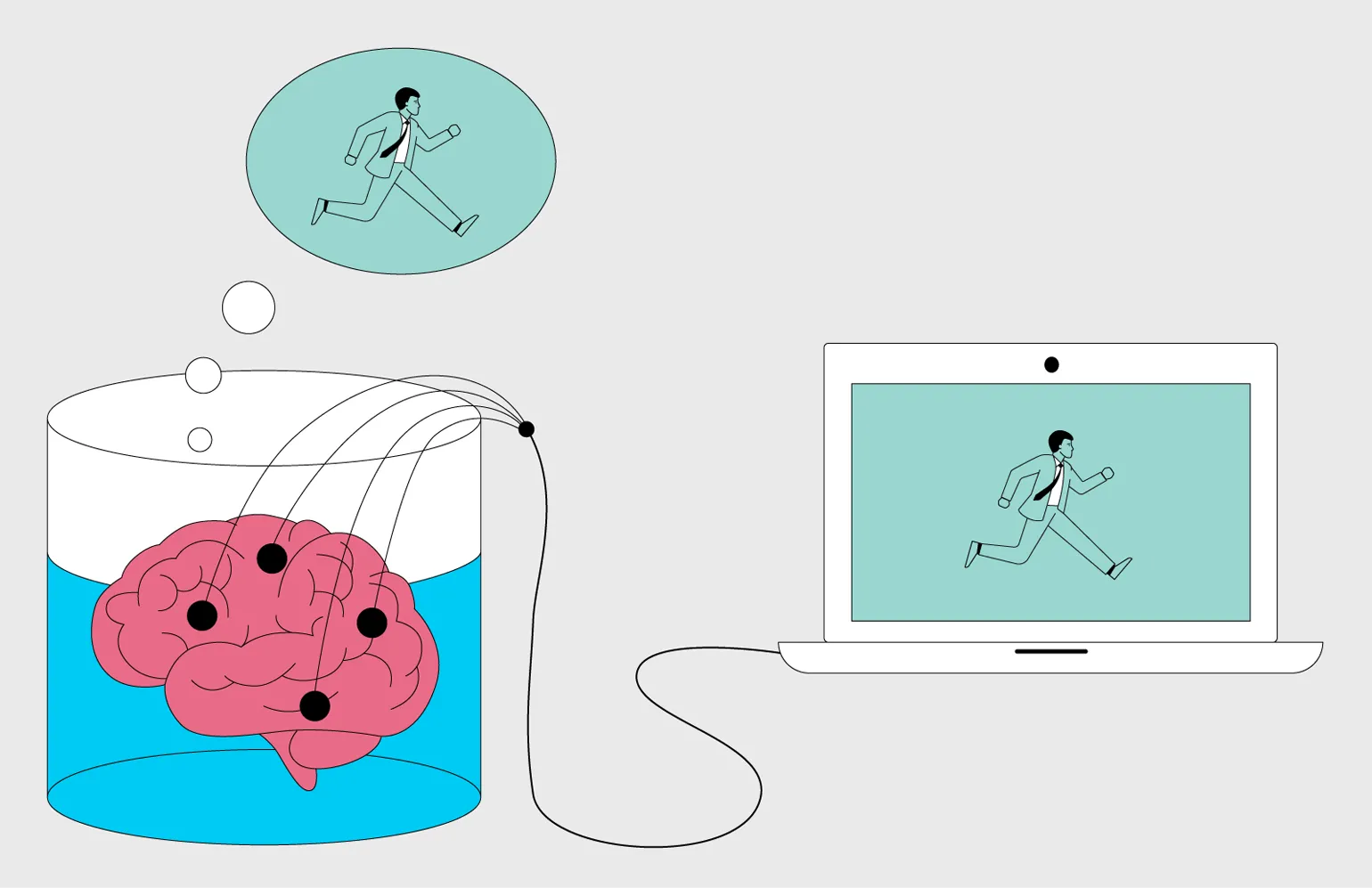
Существует мнение, что физическое тело не является ключевым элементом для создания общего искусственного интеллекта (AGI), и все необходимые функции ИИ могут быть воспроизведены в виртуальной среде. Этот подход можно объяснить через философскую концепцию «мозг в колбе», согласно которой сознание, изолированное от тела, способно воспринимать весь спектр ощущений, доступных физическому существу. Подобный взгляд на AGI подчеркивает важность информационных процессов и взаимодействия в цифровом пространстве, что открывает новые горизонты для исследований в области искусственного интеллекта.

Искусственный интеллект (ИИ) — это мощный инструмент, способный изменить многие аспекты нашей жизни. Его применение охватывает различные области, включая здравоохранение, финансы, образование и производство. С помощью алгоритмов машинного обучения и обработки больших данных ИИ может анализировать информацию, выявлять закономерности и предсказывать будущие тенденции. Это позволяет оптимизировать процессы, повышать эффективность и принимать более обоснованные решения.
However, as AI capabilities grow, ethical questions also arise. It is important to consider how technology impacts society, the risks associated with its use, and how to ensure data security. Furthermore, it is necessary to promote transparency in algorithms and their operation so that users can trust AI systems.
Ultimately, artificial intelligence represents not only a technological revolution but also a challenge for humanity. It is important to find a balance between innovation and the responsible use of technology to maximize the potential of AI while maintaining ethical standards.
AGI (Artificial General Intelligence) does not require a physical body to exist. It is capable of functioning like software on a computer and effectively solving a variety of tasks. However, robotic versions of AGI can demonstrate significant advantages when interacting with the physical world, providing a wider range of capabilities and improving the quality of task performance.
ChatGPT is a powerful chatbot developed by OpenAI. It uses advanced artificial intelligence technologies to process and generate text in real time. ChatGPT is capable of conducting dialogues, answering questions, and providing information on a wide range of topics. The tool finds application in customer service, education, and other areas where user interaction is required. Thanks to its ability to learn on large volumes of data, ChatGPT is constantly improving its skills, ensuring high-quality and relevant communication. By opening new horizons in the field of communication between people and machines, ChatGPT demonstrates the potential of AI in various applications, making interactions more convenient and effective.
It is believed that all human intellectual activity is inextricably linked with bodily sensations and sensory experience. Therefore, it is assumed that artificial general intelligence (AI) cannot function effectively without a bodily embodiment similar to that of humans. This concept, which explores the relationship between bodily sensations and cognitive processes, is called embodied cognition. This theory emphasizes the importance of the physical body for the development and functioning of intelligence, which has significant implications for the creation and use of AI.

Revised text:
Be sure to read the additional Materials:
Alexander Ambartsumov asserts that the main goal of robotics is the development of prosthetics for the human body. These innovative technologies can significantly improve the quality of life of people with disabilities, allowing them to regain lost functions and return to active life. Prostheses created using modern advances in robotics are capable not only of replacing lost limbs but also of adapting to various conditions, providing a high degree of comfort and functionality. Thus, the development of robotics opens new horizons for medicine and rehabilitation, taking steps toward a future in which people can overcome physical limitations.
An intelligent agent is a concept that unites various approaches to creating artificial general intelligence (AGI). This agent is capable of autonomously interacting with the environment. Depending on the context in which it operates, an intelligent agent can exist in both the physical world and a virtual environment. It is important to note that such agents are being developed to perform complex tasks, adapt to new conditions, and improve user interaction.


In the film «Terminator» The artificial superintelligence is not the robot played by Arnold Schwarzenegger, but the computer system "Skynet." This system evolved in a "disembodied" format, becoming increasingly complex and autonomous. The robot is merely a tool of "Skynet," one of its physical manifestations. It later transforms into an "offspring" of the disembodied AI, which spirals out of control, highlighting the dangers associated with the development of artificial intelligence and its potential consequences for humanity.
Alexander Ambartsumov is an experienced developer of service robots and the founder of AlexRobotics. He focuses on creating innovative solutions that help improve quality of life and optimize processes in various fields. With his deep knowledge and years of experience, Alexander makes significant contributions to the development of robotics and automation, allowing his company to remain at the forefront of technology. AlexRobotics develops high-tech robots that find application in fields such as medicine, logistics, and customer service.
AGI Tests
To determine whether artificial intelligence (AI) is artificial general intelligence (AGI), scientists and engineers have developed several tests. Many of these tests require a physical host, as passing the tests is impossible without one. The tests help evaluate the AI's ability to perform tasks requiring general intelligence, including interacting with the environment and adapting to new conditions. The development of such tests is key to understanding the boundaries of modern technology and the next steps towards AGI.
- The Student Test, proposed by Ben Goertzel - if an intelligent machine can enroll in a university, take the same courses as other students, and then defend a thesis, then it has general intelligence.
- The Employment Test, invented by Nils J. Nilsson - if an intelligent machine can independently get a job and perform economically justified functions in it, then it has general intelligence.
- The IKEA Test by Charlie Ortiz - if an intelligent machine can independently learn to correctly assemble furniture from an IKEA store based on the included instructions, then it has general intelligence.
- The Coffee Test, proposed by Steve Wozniak - if a machine can make and serve coffee, finding itself in an unfamiliar kitchen, then it has general intelligence.
- The Scientist Test - if a machine can independently make original scientific discoveries, including those that can claim to be If she were to receive the Nobel Prize, then she possesses general intelligence.

For the full development of artificial intelligence in the physical world, it is necessary to provide it with methods of perception similar to human ones. To be considered real, AI must learn and interact with its environment using sensations similar to those of a biological body. This means it must be able to experience basic feelings, such as hunger, taste, and emotions, similar to those of a human. This perception will allow AI not only to adapt to the physical world but also to develop a deeper understanding of human nature.
It is not necessary to completely replicate human biology or engage in cloning, as shown in the film "Avatar." It is sufficient to reproduce key human characteristics in any body, even a mechanical one, such as visual and hearing deficiencies, as well as perceptual distortions associated with changes in hormonal levels and other factors. These aspects can be important for creating more realistic and adaptable systems.
Alexander Ambartsumov is a specialist in the development of service robots and the founder of AlexRobotics. His experience and knowledge in this field enable him to create innovative solutions that significantly simplify various processes in life and business. AlexRobotics focuses on developing technologies that make robots more useful and efficient for users.

Read also:
The Turing Test: Can You Distinguish Artificial Intelligence from a Human?
The Turing test, proposed by British mathematician and logician Alan Turing in 1950, is a method for assessing a machine's ability to exhibit intelligent behavior equivalent to that of humans. In this test, a human tester interacts with two "interlocutors"—one human and one artificial intelligence. If the tester cannot confidently determine which of the interlocutors is the machine, the AI is considered successful in exhibiting human-like qualities.
The Turing test remains relevant in an era of rapid technological advancement and artificial intelligence. Modern AI systems, such as chatbots and virtual assistants, are increasingly being used in a variety of fields, including customer service, medicine, and education. The ability of these systems to mimic human behavior raises questions about their role and potential in our society.
Understanding and analyzing the Turing Test helps not only in the development of effective AI, but also in exploring the ethical implications of human-machine interaction. It is important to consider how far we are willing to go in creating AI that can not only perform tasks but also interact with us at a level close to human beings.
AGI Capabilities: Experts' Opinions
To understand the concept of general intelligence, we reached out to experts in the field and ChatGPT to get their thoughts on the prospects for artificial general intelligence (AGI).

AGI, or artificial general intelligence, should have broad capabilities similar to human thinking. It should be able to reason, plan, and learn from both its own and other people's experiences. An important aspect is the ability of AGI to understand the world around it and interact with it at a level comparable to human abilities. This will enable AGI to effectively solve complex problems and adapt to changing conditions, which is a key requirement for its development and application in various fields.
Dmitry Kiselev is a research fellow at the AIRI Institute of Artificial Intelligence. His research focuses on artificial intelligence, including machine learning and neural networks. Dmitry's expertise covers both the theoretical aspects and practical applications of AI technologies. His contribution to the development of the institute contributes to the creation of innovative solutions and the improvement of existing algorithms.

There are many definitions of the term AGI, which can differ significantly and sometimes contradict each other. These definitions require constant clarification of the concepts used in them. AGI, or artificial general intelligence, is a level of artificial intelligence at which a machine is capable of understanding, learning, and applying knowledge across a variety of domains, similar to human intelligence. As the concept of AGI continues to evolve, it is important to consider different perspectives and approaches to its definition to create a more complete and accurate understanding of this phenomenon.
It is recommended to leave terminological debates to philosophers and use the "duck criterion": if an artificial intelligence, as an intelligent agent, is capable of being perceived by people as human, performing any intellectual tasks similarly to humans, and adapting to new situations as humans would, then this AI can be considered to represent general intelligence (AGI). This approach allows us to more clearly define the boundaries and capabilities of AI in the context of its functionality and interaction with humans.
Sergey Karelov is an expert in interdisciplinary research and strategic analytics. He is also known as the host of the author's channel "Little-known interesting." In his content, Sergey shares unique perspectives on current topics, including predictions about the future of artificial intelligence. He recently suggested that artificial general intelligence (AGI) could emerge within a year and a half, underscoring his deep understanding of current technology trends and their impact on society.

No one can be sure It's difficult to predict what artificial general intelligence (AGI) will be capable of, as machine intelligence is fundamentally different from human intelligence. It's comparable to trying to understand how dolphins think, or vice versa. AGI opens up new horizons in technology and has the potential to change our perception of intelligence and thinking. Understanding these differences will help us better prepare for a future in which AGI becomes an integral part of our lives. However, it's possible to predict that artificial general intelligence (AGI) will have the following capabilities: it will be able to autonomously learn and adapt to various conditions, make decisions based on the analysis of large amounts of data, and interact with people and other systems at a high level. AGI will be able to solve complex problems that require creativity and innovation, which will open up new horizons in various fields, such as medicine, science, technology, and economics. This ability of AGI to interact multifunctionally and harmoniously with the surrounding world will significantly improve the quality of life and increase the efficiency of various processes.
- Learn and adaptively apply acquired knowledge across a wide range of tasks and areas, in unknown situations. Adapt to a changing environment and learn based on new data and experience. Independently expand their skills and knowledge, without requiring constant intervention from the developer.
- Understand the context and connections between various ideas and concepts, grasp complex relationships and summarize information to make intelligent decisions.
- Possess some level of self-awareness and awareness of oneself as an entity. This may include awareness of one's state, one's skills and limitations, as well as awareness of one's goal or task.
- Demonstrate elements of creative thinking, generating new ideas. "He will be able to offer non-trivial solutions and approaches to problems, not limited to predefined algorithms and templates."
Andrey Glebov is the CEO of the Bithoven project and an active participant in the crypto industry. He is also a rationalist and co-author of the book "Skynet in the Age of Cyberpunk: The Theory of Superintelligence and the Challenges Facing Humanity in the 21st Century," which made extensive use of the GPT-4 neural network. Andrey Glebov strives to understand and spread knowledge about new technologies and their impact on society, which makes him a significant figure in the world of cryptocurrency and artificial intelligence.

AGI, or artificial интеллект общего назначения, представляет собой продвинутую форму ИИ, способную предоставлять экспертные и осмысленные ответы на вопросы из множества областей знаний. Ожидается, что AGI будет способен вести беседы на разнообразные темы, охватывающие широкий спектр тематик. Это открывает новые возможности для использования AGI в различных сферах, таких как образование, наука и бизнес. Интерактивность AGI делает его полезным инструментом для получения информации и решения сложных задач, что делает его важным шагом в развитии технологий искусственного интеллекта.
Создание искусственного общего интеллекта (AGI) предоставит нам мощного помощника для выполнения множества повседневных задач. Этот интеллектуальный ассистент станет надежным инструментом в нашей жизни. Несмотря на свои возможности, AGI не освободит нас от необходимости принимать собственные решения. Это касается как личных аспектов, так и более широких, глобальных вопросов. Важно понимать, что AGI может улучшить нашу эффективность, но ответственность за выбор всегда останется за нами.
Человек, слишком зависимый от AGI-ассистента, рискует стать марионеткой, выполняющей указания как самого AGI, так и людей, управляющих им. Эта зависимость может привести к утрате самостоятельности и критического мышления, что делает индивида уязвимым для манипуляций. Важно осознавать, что технологии призваны помогать, а не заменять личные решения и действия. Сохранение баланса между использованием AGI и развитием собственных навыков и умений является ключевым для предотвращения потери автономии.
Считаю, что оптимальным подходом является интеграция искусственного общего интеллекта (AGI) в человеческое мышление. Это позволит использовать AGI как инструмент для глубокого понимания сложных аспектов современного мира, а не как замену человеческому пониманию. Как говорится, «Чего человек не понимает, тем он не владеет». Интеграция AGI может значительно расширить горизонты знания и способности человека, позволяя ему более эффективно справляться с вызовами и задачами, которые ставит перед нами современная реальность.
Александр Амбарцумов является разработчиком сервисных роботов и основателем компании AlexRobotics. Его работа сосредоточена на создании инновационных решений в области робототехники, которые помогают автоматизировать различные процессы. Компания AlexRobotics разрабатывает уникальные технологии, направленные на улучшение качества жизни и повышение эффективности бизнес-процессов с помощью сервисных роботов.

Я задал вопрос о свойствах, которыми должен обладать искусственный общий интеллект (AGI), популярному чат-боту ChatGPT. Его ответ в целом кажется корректным, однако это не подтверждает, что ChatGPT является примером AGI. Важно понимать, что AGI должен демонстрировать уровень интеллекта, сопоставимый с человеческим, включая способность к обучению, пониманию контекста и решению сложных задач. В отличие от этого, ChatGPT функционирует на основе заранее обученных моделей и не обладает истинным пониманием или самосознанием.
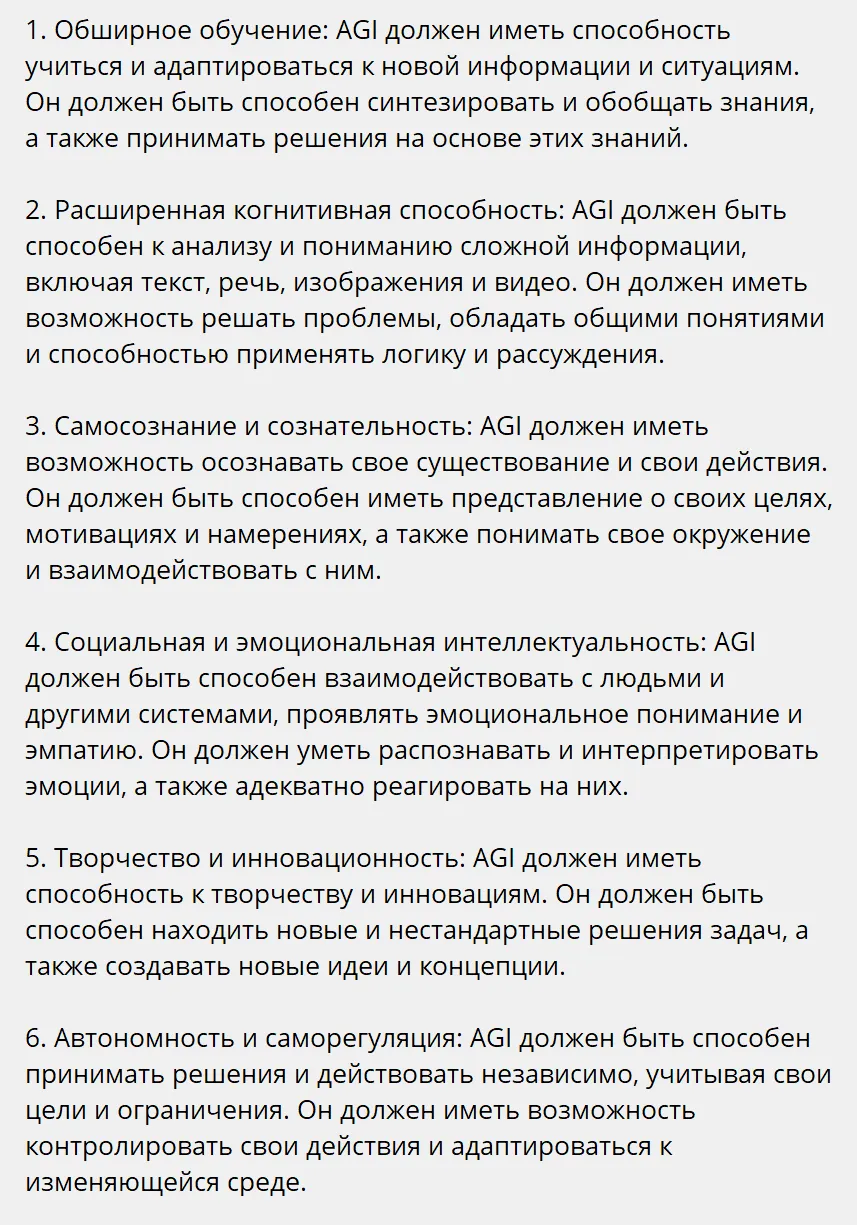
Ответ бота оказался неверным, так как он был сформирован без глубокого анализа проблемы. Вместо этого использовался лишь случайный подбор токенов, что привело к созданию поверхностного ответа, в котором присутствует лишь «выжимка» из научно-популярных источников. При этом отсутствуют размышления о критериях экспериментов, позволяющих различить эмуляцию и видимость правильного решения от истинного решения, основанного на корректных методах. Необходимы более тщательные подходы к анализу, чтобы обеспечить качественные и обоснованные ответы.
Синтез нового знания представляет собой ключевую задачу, и для его оценки необходимы метрики новизны. Однако даже в научном сообществе эти метрики вызывают сомнения. Одним из важных аспектов AGI, который не был упомянут ChatGPT, является алгоритм самопроверки на соответствие уровню общего искусственного интеллекта. В настоящее время проводятся исследования в этой области, но пока отсутствуют качественные тесты для оценки AGI по таким критериям, как целеполагание, мотивация и способность формулировать собственные цели.
Виктор Носко является генеральным директором компании «Аватар Машина». Он также известен как создатель чат-бота-психолога «Сабина Ai» и соавтор проекта FractalGPT. Его достижения в области искусственного интеллекта и разработки инновационных решений для психологии делают его ключевой фигурой в данной сфере. Вклад Виктора Носко в технологии общения с помощью AI открывает новые горизонты для пользователей, предоставляя доступ к психологической помощи и поддержке через современные цифровые инструменты.

Искусственный интеллект (ИИ) играет все более важную роль в нашей жизни, воздействуя на различные сферы. Его возможности по обработке данных и анализу информации открывают новые горизонты для бизнеса, образования и здравоохранения. ИИ позволяет автоматизировать рутинные задачи, повышая производительность и эффективность процессов. Например, в сфере медицины искусственный интеллект помогает в диагностике заболеваний, анализируя медицинские изображения с высокой точностью. В бизнесе ИИ оптимизирует маркетинговые стратегии, предсказывая потребительские предпочтения и улучшая взаимодействие с клиентами.
Однако с ростом использования искусственного интеллекта возникают и вызовы. Этические вопросы, связанные с конфиденциальностью данных и прозрачностью алгоритмов, требуют внимания. Общество должно найти баланс между инновациями и ответственностью, чтобы максимизировать преимущества от применения ИИ. Важно развивать регуляции и стандарты, которые обеспечат безопасное и этичное использование технологий.
В заключение, искусственный интеллект продолжает трансформировать наше общество, предоставляя уникальные возможности и решая сложные задачи. Однако его внедрение должно сопровождаться вниманием к этическим аспектам и социальной ответственности для достижения устойчивого развития.
AGI, or artificial general intelligence, must be able to learn and apply its acquired knowledge to a variety of tasks beyond its narrow specialization. Self-awareness and holistic cognitive experience are key aspects. AGI must make independent decisions, demonstrate flexibility and adaptability, and be able to communicate with people in natural language. A key differentiator from specialized systems is its ability to think creatively and self-improvement, which opens new horizons for its application in various fields.
ChatGPT is a powerful chatbot developed by OpenAI. It uses advanced AI technologies to create natural and interactive conversations with users. ChatGPT can answer a variety of questions, maintain conversations on various topics, and assist with problem solving. Thanks to its trained model, it can adapt to users' communication styles, providing a personalized experience. ChatGPT is used in a variety of industries, including education, customer support, and entertainment, making interactions with technology more accessible and convenient.

Reworked text:
Explore additional materials and recommendations. This will help you deepen your knowledge and broaden your horizons. Don't miss the opportunity to learn about new ideas and approaches that may be useful in your practice. Reading a variety of sources promotes critical thinking and increases your expertise.
Loran Hakobyan: Artificial intelligence will simplify the process of obtaining certificates and applying for a passport. Modern technologies make it possible to automate routine document-related tasks. Artificial intelligence can quickly collect the necessary certificates, fill out forms, and monitor document submission deadlines. This significantly saves time and effort, allowing you to focus on more important matters. The introduction of AI in the passport application process makes it more accessible and convenient for citizens.
GPT-5 can reach the level of AGI
According to experts, the creation of general artificial intelligence (AI) can become a reality thanks to the further development of artificial neural networks. Large language models (LLMs) using a neural network architecture known as Transformer have demonstrated particularly significant advances in text processing. These technologies open new horizons in natural language processing and could lead to significant breakthroughs in creating more intelligent systems. OpenAI's GPT-4 model is based on cutting-edge AI technologies available today for conversation via the ChatGPT chatbot. Similar developments are being actively pursued by other major companies. For example, Google last year introduced a new machine learning algorithm, PaLM. Its predecessor, LaMDA, was able to convince its interlocutor of intelligence during testing in 2022. Such achievements highlight the rapid development of AI technologies and their ability to interact with users.

The latest versions of ChatGPT/GPT-4 from OpenAI represent a significant technological breakthrough. For the first time, ChatGPT successfully passed the Turing Test, confirming the high quality of the dialogues generated by the model. In a short period of time, ChatGPT has attracted 100 million users, most of whom note that the bot's responses sound natural and human. Recent trials in which ChatGPT passed the text IQ test demonstrated an impressive result: its Verbal IQ was 155. This value not only significantly exceeds the average but also exceeds that of 99.9% of test participants from a group of 2,450 people.
Anton Kolonin is a PhD candidate in engineering and a leading specialist at Novosibirsk State University. He is the founder of the Aigents project and the architect of the SingularityNET project. As an expert at the Russian International Affairs Council, Kolonin actively participates in discussions related to the development of artificial intelligence and its future. His research and projects advance understanding of the transition from GPT to AGI, making him a significant figure in the fields of technology and science.
In April 2023, the Russian AGI Developer Community conducted a survey among AI professionals asking the question: "Has GPT-4 reached AGI?" Only 3% of respondents answered yes. Fifteen percent of participants believe that GPT models can evolve into general artificial intelligence with certain modifications. 37% noted that language models will play an important role in the future of AGI, but will not be the only component in its formation.

Many experts in the field of artificial intelligence are confident that no existing language model has yet reached the level of artificial general intelligence (AGI). However, researchers are already seeing signs of the emergence of AGI, such as the ability to plan and learn from its own mistakes. Leading labs, including OpenAI, Google, and Anthropic, have clearly stated their intentions to develop AGI in the near future. These efforts highlight the importance of further research and development in AI, which opens new horizons for technology and its application in various fields.
Sorry, you have not provided the text for editing. Please paste the text to be reworked, and I will be happy to help you with SEO adjustments.
In the next ten years, AI systems are expected to significantly improve their expert skills in various fields, allowing them to perform tasks at the level of the largest corporations. In terms of potential advantages and disadvantages, the capabilities of superintelligence will surpass all previous technologies encountered by humanity. This will create new horizons for business and science, while raising important questions about the safety and ethics of using such powerful technologies.
Sam Altman, Greg Brockman, and Ilya Sutskever are the leading managers of OpenAI, a company that plays a key role in the development of artificial intelligence technologies. These specialists have significant experience and expertise in the field of AI and actively contribute to the advancement of cutting-edge solutions in this field. Their work is aimed at creating ethical and safe systems that have the potential to transform various industries and improve quality of life. OpenAI continues to develop its projects, introducing innovation and ensuring sustainable growth in the field of artificial intelligence.
In recent years, there has been growing interest in large language models in the context of achieving artificial general intelligence (AGI). Rumors about the release of the next version of the neural network GPT-5, expected in early 2024, have become particularly relevant. Developer and businessman Xiqi Chen, associated with the OpenAI team, shared information on Twitter about the model's potential capabilities, suggesting that it could approach the level of general AI. Expectations around GPT-5 highlight the importance of further research and development in artificial intelligence.


Read also:
Closed artificial intelligence from OpenAI: diving into the GPT-4 neural network
Artificial intelligence developed by OpenAI presents the latest neural network, GPT-4. This model is an extension of previous versions and offers significantly improved text processing and generation capabilities. GPT-4 is capable of not only analyzing text information but also performing complex tasks that require deep understanding of context.
The closed access to GPT-4 highlights the importance of the safety and ethical aspects of using artificial intelligence. This decision helps control the spread of the technology and prevent its use for harmful purposes. Despite the limitations, interest in GPT-4 is growing as it opens new horizons in automation, content creation, and user interaction.
The model demonstrates outstanding results in text generation, making it useful for a variety of applications, from article writing to software development. GPT-4 is capable of adapting to a variety of styles and genres, ensuring high-quality and relevant content.
Exploring GPT-4's capabilities provides a deeper understanding of how artificial intelligence can change the way we create and process information, and opens up new perspectives for developers and technology researchers.
The Future of Language Models and the Journey to AGI
We asked experts and ChatGPT whether further development of language models could lead to the creation of strong artificial intelligence.

Research in large language models (LLM) is still in its early stages, and their capabilities have not been fully explored. Currently, these models are capable of solving a variety of problems at the level of, and sometimes beyond, human capabilities, while demonstrating emergent behavior. Text understanding is a key step in the development of strong artificial intelligence, as literature is one of the primary ways humans exchange information. This makes LLM an essential tool for analyzing and interpreting text data, which can significantly accelerate information processing and improve human interaction with technology.
Achieving artificial general intelligence (AGI) requires not only the deep text understanding provided by large language models but also the ability to perceive and process data from other modalities, such as visual and auditory information. Furthermore, it is important to be able to simultaneously integrate these different types of information for effective decision-making. This is a complex process that requires synergy between various AI technologies and approaches.
Currently, GPT-4 has the ability to not only generate text but also process images. However, language models, including GPT-4, are susceptible to so-called "hallucinations," which can hinder the development of critical skills such as planning and continuous learning. These limitations must be taken into account when using the model for various tasks related to artificial intelligence and information processing.
Dmitry Kiselev is a research fellow at the AIRI Institute of Artificial Intelligence. His work focuses on the research and development of artificial intelligence technologies, which contributes to progress in this rapidly evolving field. AIRI is actively engaged in the implementation of innovative solutions aimed at optimizing processes and improving quality of life. Thanks to specialists like Dmitry Kiselev, artificial intelligence is becoming accessible to a wide range of applications, including medicine, finance, and industry.

Creating AGI requires the comprehensive development and integration of various technologies. In addition to language processing, key components of future AGI include machine vision, robotics, automated planning and decision making, and reinforcement learning. Achieving this requires hardware improvements, as well as the implementation of new approaches to programming and artificial neural network architecture. Modern advances in artificial intelligence open new horizons for creating more advanced systems capable of performing complex tasks and adapting to changing conditions.
Large language models represent a significant step in the development of artificial intelligence, but they are not the only solution for achieving artificial general intelligence (AGI). Creating full-fledged AGI requires the combined development and integration of various technologies and approaches. Linguistic models certainly accelerate this process, although they do not currently represent full-fledged AGI. Nevertheless, their development is an important step towards creating artificial general intelligence.
Andrey Glebov is the CEO of the Bithoven project and a crypto enthusiast. He is also a rationalist and co-author of the book "Skynet in the Age of Cyberpunk: The Theory of Superintelligence and the Challenges Facing Humanity in the 21st Century," created using the GPT-4 neural network. In his work, Glebov actively researches the development of cryptocurrencies and blockchain technology, striving to contribute to the future of the digital economy.

Our team is actively developing a prototype of artificial general intelligence (AGI) in the FractalGPT project. We have unique expertise and insights into the development of general AI.
Models in the GPT family, as well as other neural networks based on the Transformer architecture, represent an important, but only one element necessary for achieving artificial general intelligence (AGI). These technologies play a key role in the development of AI by providing powerful tools for processing and generating natural language. However, achieving full AGI requires the integration of various approaches and technologies that can combine skills and capabilities beyond the capabilities of current models. Thus, GPT and similar systems are significant steps towards more complex and general forms of intelligence.
Believing that neural networks based on Transformers can achieve strong artificial general intelligence is like assuming that apes will suddenly master language. While chimpanzees do have the ability to communicate and understand basic concepts, this is not sufficient for achieving full-fledged intelligence. Neural networks can demonstrate impressive results in highly specialized tasks, but their capabilities fall far short of general intelligence.
There are two main approaches to developing artificial general intelligence (AGI). The first is an evolutionary approach, where systems learn from large amounts of data and various scenarios, gaining knowledge and skills from experience. The second approach is based on neural-like structures that aim to mimic the functioning of the human brain, allowing for the creation of more flexible and adaptive models. Both approaches have their advantages and disadvantages, and combining them can lead to more effective AGI solutions. It is important to consider these aspects when developing and researching new technologies aimed at creating general intelligence.
- Purely technological: attempting to emulate brain regions and their functions using neural networks or other similar algorithms. Собрать эти модели вместе и обучать их до некоторого критического порога.
- Полностью биологический: попытаться перенести текущие знания и алгоритмы на биологическую основу, вырастить подобие искусственного мозга и исследовать взаимовлияние технологий в рамках этого подхода».
Виктор Носко является генеральным директором компании «Аватар Машина» и создателем инновационного чат-бота-психолога «Сабина Ai». Он также выступает соавтором проекта FractalGPT, который сочетает передовые технологии искусственного интеллекта и психологии. Под руководством Носко компания активно развивает решения в области автоматизации и поддержки пользователей, предоставляя эффективные инструменты для улучшения психоэмоционального благополучия.

Искусственный интеллект представляет собой мощный инструмент, который значительно изменяет различные сферы жизни. Он способен обрабатывать и анализировать огромные объемы данных, позволяя находить закономерности и делать прогнозы. В последние годы ИИ активно используется в бизнесе, здравоохранении, образовании и многих других отраслях.
Развитие технологий искусственного интеллекта открывает новые возможности для повышения эффективности работы и улучшения качества услуг. Например, в медицине ИИ помогает в диагностике заболеваний, а в бизнесе — в оптимизации процессов и повышении уровня сервиса для клиентов.
Однако с развитием ИИ возникают и определенные вызовы. Вопросы этики, безопасности и потенциального влияния на рынок труда становятся все более актуальными. Важно найти баланс между использованием технологий и учетом человеческих ценностей.
Таким образом, искусственный интеллект продолжает формировать будущее, и его влияние на общество будет только возрастать. Адаптация к этим изменениям и осознанное использование ИИ могут привести к значительным улучшениям в различных сферах нашей жизни.
Большие языковые модели, такие как GPT-4, представляют собой важный шаг вперед в области искусственного интеллекта. Однако они не являются окончательным решением для создания общего искусственного интеллекта (AGI). Для достижения AGI необходимо не только высококачественное понимание и обработка естественного языка, но и наличие широкого спектра когнитивных навыков, включая обучение, восприятие и решение задач. Интеграция различных технологий, таких как компьютерное зрение, робототехника и другие направления, станет ключом к созданию AGI. Разработка общего искусственного интеллекта представляет собой сложную задачу, требующую синергетического прогресса в нескольких областях искусственного интеллекта.
ChatGPT — это современный чат-бот, разработанный компанией OpenAI, который использует передовые технологии искусственного интеллекта для создания естественного и интуитивного общения. ChatGPT способен генерировать текст на основе заданных пользователем вопросов и комментариев, что делает его полезным инструментом для множества задач. Он может быть использован для получения информации, ведения диалогов, а также для помощи в обучении и творческих проектах. Благодаря своей способности адаптироваться к различным стилям общения, ChatGPT становится незаменимым помощником как для индивидуальных пользователей, так и для бизнеса. Использование ChatGPT позволяет значительно повысить эффективность взаимодействия с клиентами и оптимизировать процессы.
Проекты AGI на языковых моделях
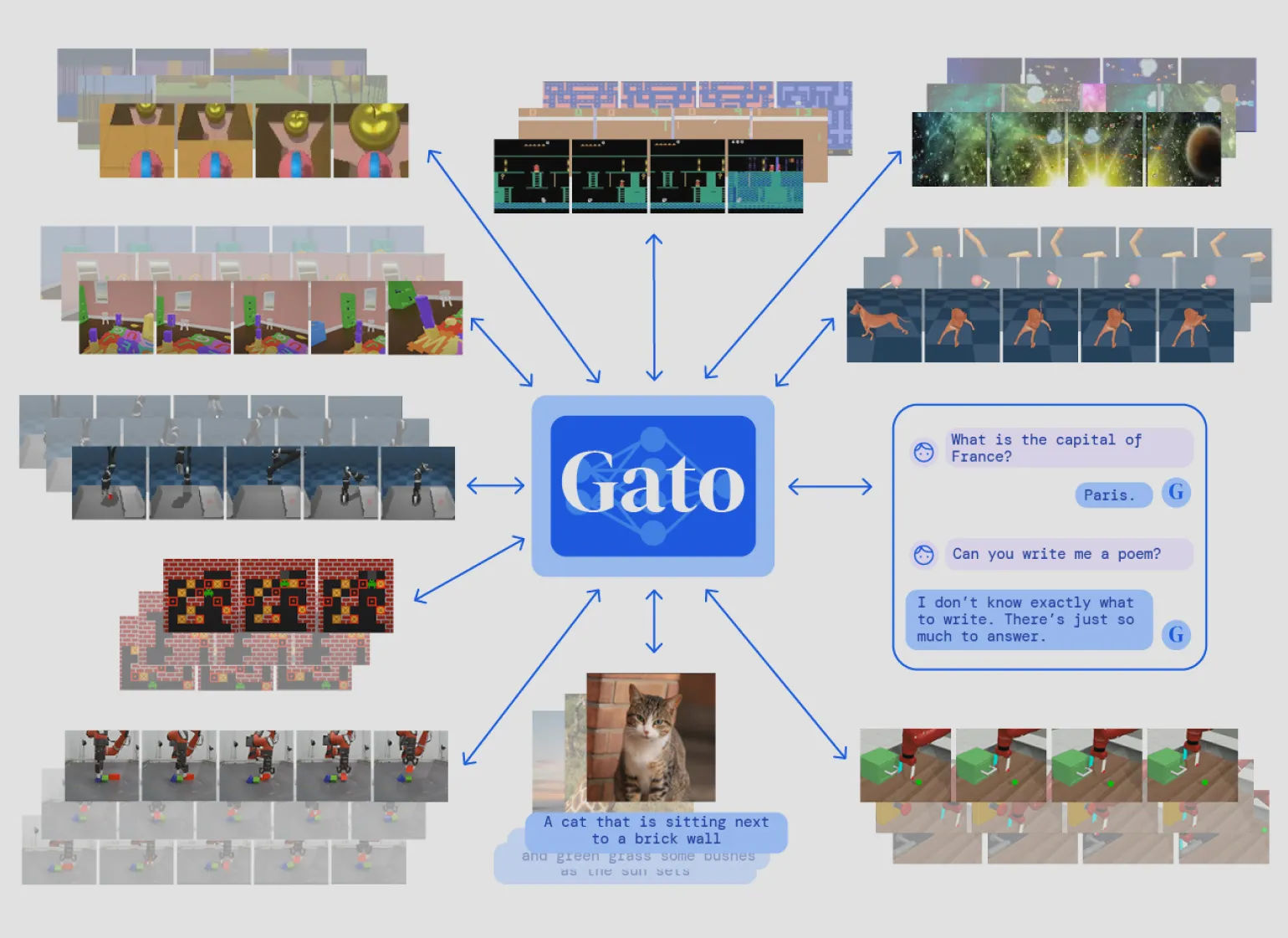
Учёные продолжают работать над созданием языковых моделей, приближающих нас к общему искусственному интеллекту. Один из таких проектов — Gato, представленный в 2022 году командой Google DeepMind. Название Gato происходит от термина «универсальный агент» (generalist agent). Эта модель представляет собой нейросеть-трансформер и включает 1,2 миллиарда параметров. Разработка Gato нацелена на улучшение взаимодействия между людьми и ИИ, расширяя возможности применения искусственного интеллекта в различных сферах.
Нейросеть обучена решать 604 различных вида задач. После интенсивного обучения она продемонстрировала способность играть в видеоигры, управлять роботизированными манипуляторами, вести диалоги в чате, добавлять подписи к изображениям и выполнять множество других функций. Эти достижения подтверждают её универсальность и потенциал для применения в различных сферах, включая игровые технологии, автоматизацию и обработку изображений.
Агент Gato продемонстрировал способность справляться с различными задачами, однако его результаты не были выдающимися. В процессе решения 450 типов проблем модель показала чуть выше среднего уровень эффективности по сравнению с обычным человеком, но все же уступила специализированным алгоритмам, разработанным для конкретных задач. Это подчеркивает важность использования узкоспециализированных решений для достижения максимальной производительности в определённых областях.
Специалисты компании DeepMind в настоящее время занимаются разработкой нового проекта, известного под кодовым названием Gemini. По словам разработчиков, Gemini будет значительно более интеллектуальным благодаря сочетанию возможностей языковых моделей и передовых технологий DeepMind в области игрового искусственного интеллекта, таких как AlphaGo, который смог победить чемпиона мира по игре в го. Проект нацелен на создание более эффективных и умных систем, способных решать сложные задачи и взаимодействовать с пользователями на новом уровне.
Второй интересный вариант модификации языковых моделей — Auto-GPT, представленный в марте 2023 года. Эта система основана на ChatGPT и предназначена для автономного решения сложных задач, что делает её одной из первых попыток создания искусственного общего интеллекта (AGI). Auto-GPT демонстрирует возможность более глубокой и независимой обработки информации, что открывает новые горизонты в области разработки и применения языковых моделей.
Программа способна функционировать автономно, не требуя человеческого вмешательства. В начале работы необходимо задать ей общую задачу на естественном языке и наблюдать за процессом её выполнения. Auto-GPT взаимодействует с ChatGPT через API и использует данные из интернета для самостоятельного разбиения основной цели на подцели. Она формулирует стратегии для достижения каждой из подцелей и реализует их. Такой подход позволяет значительно повысить эффективность решения комплексных задач.
Систему можно протестировать на своем компьютере, загрузив исходный код с GitHub, или воспользоваться веб-сервисами, такими как AgentGPT и Godmode. Эти платформы предоставляют удобный доступ к функционалу системы, позволяя пользователям оценить её возможности без необходимости установки на локальное устройство.
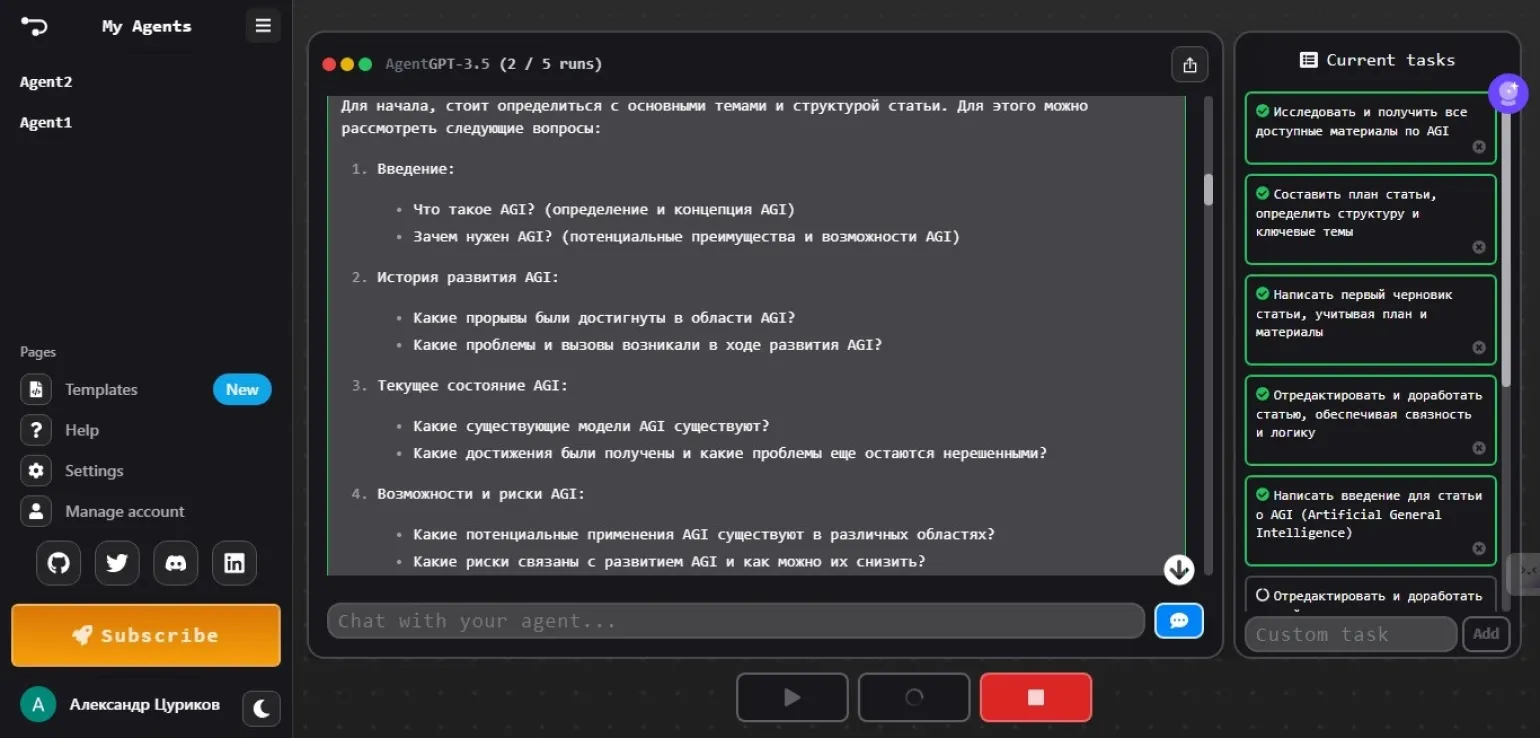
На базе технологии Auto-GPT разработано множество перспективных проектов. Одним из таких является BabyAGI, который моделирует интеллектуальное развитие ребенка. Другим примером является Generative Agents, исследующий автономное взаимодействие ИИ-агентов в виртуальной среде, схожей с игрой The Sims. Исследователи продолжают углубляться в возможности больших языковых моделей (LLM) в области целеполагания, изучая их способность самостоятельно формулировать и достигать цели.


LLMs represent an innovative approach to language-based user interfaces, allowing us to assign tasks and achieve results through interaction with a diverse ecosystem of tools and other AI models. Projects such as LangChain, which offer tools and agents to improve performance with language models, as well as Auto-GPT, BabyAGI, and Generative Agents, which focus on multi-agent interactions, are worth noting. The use of LLM on consumer hardware, as demonstrated by the GGML machine learning library, is also noteworthy, as it increases accessibility and reduces the cost of using such systems. The development of these technologies opens new horizons in natural language processing and makes artificial intelligence more accessible to a wider audience.
Dmitry Kiselev is a research fellow at the AIRI Institute of Artificial Intelligence. He focuses on research in artificial intelligence and machine learning. Dmitry is actively involved in the development of new algorithms and technologies that can improve the efficiency and accuracy of AI systems. His work at AIRI contributes to the development of modern artificial intelligence solutions, making him an important figure in the scientific community.
Experts highlight the existence of serious problems in the functioning of Auto-GPT and its analogues, which currently limits their widespread use. These shortcomings require careful study and elimination before the technologies can be implemented into mass practice.

There are two key reasons why Auto-GPT is not suitable for solving complex problems. First, its algorithms are limited in their ability to handle the multi-level contexts and nuances required to complete complex tasks. Second, Auto-GPT cannot always account for all variables and details, which can lead to inaccurate or even erroneous results. These limitations make it less effective in situations that require deep analysis and a comprehensive approach.
- A textual response to a prompt fundamentally fails to solve the user's problem. AutoGPT provides only a generalized solution (this is how the Transformer architecture works, and this limitation cannot be overcome). It is impossible to obtain a customized solution from such a system because it lacks a problem-formulation language (and there is no actor that would "understand" this language). Auto-GPT cannot specify parameters, constraints, or even common sense; this requires huge prompts that will not work properly.
- The lack of a problem-formulation language leads to a second, insurmountable problem: the catastrophic accumulation of errors when chaining responses from prompts. The longer the chain, the more errors. Typically, a chain consisting of more than five prompts completely distorts the initial problem statement, resulting in the system consistently producing "bad" solutions. Essentially, the user is faced with a cascade of errors, making it very difficult to understand exactly where the failure occurred. Moreover, there is no good way to fix them yet."
Viktor Nosko is the CEO of Avatar Machine. He is also known as the creator of the psychologist chatbot "Sabina Ai" and the co-author of the FractalGPT project. These achievements highlight his contribution to the development of artificial intelligence technologies and their application in psychology and communication. Avatar Machine actively works to create innovative solutions that help people with psychological and emotional issues. The chatbot "Sabina Ai" is an example of the successful integration of AI into everyday life, offering users support and advice during difficult times. The FractalGPT project expands the horizons of artificial intelligence, opening up new possibilities for human-machine interaction.
In the context of AGI capable of interacting with the real world, it's worth noting the successful use of language models for robot control. These models demonstrate significant potential for automating tasks and improving robotic efficiency in various fields. The development of technologies in this area opens up new possibilities for creating intelligent systems that can adapt to changes in the environment and perform complex tasks.

Read also:
Modern neural networks, such as ChatGPT, RT-1 and PaLM-E are becoming increasingly powerful tools, capable of solving complex problems and interacting with users on a new level. These artificial intelligence technologies represent a major step forward in the development of machine learning and automation. They can process and analyze large volumes of data, generate text, create images, and even control physical devices.
As neural networks become more capable, questions arise about the potential risks and consequences of their use. Given their ability to self-learn and adapt, some experts are raising concerns about a possible machine uprising. These technologies are already impacting various areas of life, including medicine, finance, and education.
It is important to recognize that the development of neural networks requires a responsible approach. These technologies must be implemented with ethical and safety standards in mind to avoid negative consequences. Thus, neural networks such as ChatGPT, RT-1, and PaLM-E open new horizons, but also require careful monitoring and regulation to ensure safe and effective use.
Microsoft researchers have made significant progress in developing control technologies for quadcopters and robotic manipulators, leveraging the capabilities of ChatGPT. Meanwhile, Google scientists have adapted the PaLM neural network to control kitchen robots. These advances demonstrate how artificial intelligence can improve the functionality of robots and make them more useful in everyday life.

Household and industrial assistant robots will soon receive new learning features. They can be configured to perform tasks using natural language explanations rather than programming code. The control program will be automatically generated by built-in language models. This will make interaction with robots more accessible and intuitive, opening up new possibilities for their application in various fields.
Alexander Ambartsumov is a developer of service robots and the founder of AlexRobotics. His work focuses on creating innovative robotics solutions that help improve the efficiency of various processes. AlexRobotics develops and implements robotic systems that find application in a wide range of fields, including industry, medicine, and household services. With a high level of expertise and a constant drive for improvement, Alexander and his team aim to make people's lives more convenient and safer using modern technology.
When will AGI be created?
Forecasting in the field of artificial intelligence is a complex and often thankless task. Over the past seventy years, many prominent scientists have made incorrect predictions about the timing of AGI. For example, in 1970, Marvin Minsky predicted that "in 3 to 8 years we will see a machine with general intelligence comparable to the average human." When this prediction failed to come true, Minsky claimed that his words had been misinterpreted. This example illustrates the complexity and uncertainty of artificial intelligence predictions and highlights the importance of approaching such statements with a critical eye.
According to current data from metaculus.com, a website that compiles expert predictions on various topics, the median estimate is that the creation of artificial general intelligence (AGI) will occur in 2034. These forecasts are based on expert estimates and reflect current trends and expectations in the field of artificial intelligence development.

We reached out to experts and ChatGPT to get their thoughts on the timeline for the development of artificial general intelligence (AGI). Given the unsuccessful predictions of famous scientists in the past, we express our gratitude to the specialists who agreed to share their views on this topic.

Today, we continue to move towards the creation of artificial general intelligence (AGI). With the release of GPT-4, it became clear that the emergence of AGI is only a matter of time, and we will likely experience it within the current decade. According to a GPT-4 research report prepared by Microsoft specialists, the first signs of intelligence and common sense are already being observed in language models. We are witnessing epochal changes that could significantly reshape society over the next 10-15 years. These transformations will impact all areas of life, including the economy, education, and human interaction, and will create new opportunities and challenges for humanity.
Andrey Glebov is the CEO of the Bithoven project and an active crypto enthusiast. He is also a rationalist and co-author of the book "Skynet in the Age of Cyberpunk: The Theory of Superintelligence and the Challenges Facing Humanity in the 21st Century," created using the GPT-4 neural network. In his work, Andrey strives to promote innovative technologies and understand their impact on the future of humanity. His expertise in cryptocurrency and blockchain technologies makes him an important figure in this rapidly evolving industry.

Artificial intelligence (AI) is one of the most significant technologies of our time, capable of transforming various aspects of our lives. In business, AI optimizes processes, improves decision-making, and increases efficiency. In education, it provides personalized learning approaches, adapting materials to the needs of each student. In medicine, AI assists in the diagnosis of diseases by analyzing large volumes of data and identifying patterns that may be invisible to humans.
However, with the development of AI, new challenges arise. Issues of ethics, data privacy, and the potential substitution of human labor require careful consideration. It is important to find a balance between the implementation of technology and the respect of human rights.
Thus, artificial intelligence opens up limitless opportunities, but also poses important challenges for society. The effective use of AI depends on our approach to its implementation and regulation.
Today, we are still a significant distance from achieving artificial general intelligence (AGI). Research in this area continues, but key technical and ethical barriers remain unresolved. Predicting the exact date of AGI is difficult, as this process depends on many factors, and reliable forecasting models currently lack any. Some experts estimate that the realization of AGI could take anywhere from several decades to several centuries. It is important to prioritize the safe and ethical development of artificial intelligence, as well as continued scientific research to better understand its potential and limitations. Safety and ethics in the use of AI must remain key aspects to avoid negative consequences and ensure the sustainable development of technology. ChatGPT is a chatbot developed by OpenAI that uses advanced natural language processing technologies. It is designed to communicate with users, providing useful information and solving various problems. ChatGPT is capable of understanding and generating text, making it an effective tool for communication, education, and answering questions. Thanks to its ability to adapt to context, ChatGPT finds application in various fields, including education, customer support, and entertainment. Use ChatGPT to improve user engagement and business performance.

I believe that true artificial general intelligence (AGI), distinct from marketing interpretations, will emerge from a comprehensive technology stack. This stack should include neuromorphic AI, graph neural networks, spiking neural networks, transformers, multi-agent systems, and neural symbolic inference. Each of these components plays a vital role in creating more advanced and adaptive systems capable of learning and solving complex problems. Neuromorphic AI recreates the workings of the human brain, graph neural networks enable efficient processing of interconnected data, and spiking neural networks enable high-speed processing. Transformers enhance the ability to process sequential data, multi-agent systems facilitate interaction and collaboration between different AI systems, and neural symbolic inference integrates logical and symbolic approaches to learning. All of these technologies together can lead to the creation of AGI that can understand and solve problems at a human-level.
According to my estimates, this event could be at least 10 years away. Without significant advances in scientific research in this field, this period could increase to 50 years.
Both technological factors and regulatory actions will influence the achievement of artificial general intelligence (AGI). Systems with logical thinking may be considered a threat. Europe recently passed legislation regulating artificial intelligence, marking the first step toward establishing strict restrictions in this area. It is important to consider that such initiatives could slow the development of AGI and impact its adoption in various areas of life.
Viktor Nosko is the CEO of Avatar Machine. He is the creator of the Sabina Ai psychology chatbot and co-author of the FractalGPT project. His experience in artificial intelligence and psychology allows him to offer innovative solutions to improve users' quality of life. Проект «Сабина Ai» фокусируется на предоставлении психологической поддержки и помощи, а FractalGPT расширяет горизонты применения AI в различных областях, включая коммуникацию и саморазвитие.

Создание искусственного общего интеллекта (AGI) вызывает множество дискуссий и споров. Вопрос о сроках его появления остается открытым и неопределенным. Некоторые эксперты утверждают, что на основе таких систем, как ChatGPT, AGI уже близок к реализации. По их мнению, требуется лишь небольшая доработка существующих технологий, и мы увидим значительные достижения в этой области. Однако реальность более сложна, и для полноценного создания AGI необходимо решить множество технических и этических задач.
Некоторые эксперты выражают осторожность в своих прогнозах, указывая на 2045 год как возможный период появления сильного искусственного интеллекта. Неясно, будет ли это продвинутый AGI или ASI, поскольку специалисты не уточняют эту деталь. Разница в оценках между оптимистами и пессимистами составляет примерно 20 лет. Однако, учитывая, что сторонники 2045 года ссылаются на концепцию «технологической сингулярности», их сложно назвать пессимистами.
Я считаю, что к 2045 году мы увидим появление искусственного интеллекта, который будет не только общим (AGI), но и сильным или суперинтеллектом. Этот уровень развития ИИ позволит ему не только выполнять сложные задачи, но и принимать решения на уровне, сопоставимом с человеческим. Развитие технологий и исследований в области искусственного интеллекта открывает новые горизонты, и мы можем ожидать значительных изменений в различных сферах, включая экономику, медицину и образование.
Александр Амбарцумов — ведущий разработчик сервисных роботов и основатель компании AlexRobotics. Его опыт и знания в области робототехники позволяют создавать инновационные решения, которые улучшают жизнь людей и оптимизируют бизнес-процессы. AlexRobotics активно разрабатывает и внедряет высокотехнологичные сервисные роботы для различных отраслей, включая медицину, гостиничный бизнес и сферу услуг. Команда профессионалов, собранная под руководством Амбарцумова, стремится к постоянному совершенствованию технологий и адаптации их под нужды клиентов.

Читать также:
Инженер компании NVIDIA делится мыслями о будущем нейросетей, беспилотных автомобилей и уровне зарплат в сфере информационных технологий. Нейросети продолжают развиваться, открывая новые горизонты в таких областях, как искусственный интеллект, обработка больших данных и автоматизация. Беспилотные автомобили становятся все более реальными, благодаря достижениям в алгоритмах машинного обучения и сенсорных технологиях.
Что касается зарплат в IT, они продолжают расти, что связано с высоким спросом на квалифицированных специалистов. Компании активно ищут таланты в области разработки программного обеспечения, data science и кибербезопасности. Инженеры, работающие с нейросетями и автономными системами, могут рассчитывать на особенно привлекательные условия труда и конкурентоспособные вознаграждения.
Будущее технологий обещает быть захватывающим, и инженеры, такие как специалисты NVIDIA, играют ключевую роль в этом процессе.
Что ещё почитать про AGI: подборка книг
В дополнение к книге Бена Герцеля «Artificial General Intelligence» за последние годы было издано множество книг, охватывающих различные аспекты сильного искусственного интеллекта. Эти произведения исследуют как технические, так и философские и экономические вопросы, связанные с развитием ИИ. Мы рекомендуем обратить внимание на следующие издания, которые могут углубить ваше понимание темы сильного ИИ и его влияния на общество.
- Маркус Хаттер, Universal Artificial Intelligence: Sequential Decisions Based on Algorithmic Probability.
- Рэй Курцвейл, The Singularity Is Near: When Humans Transcend Biology.
- Элиезер Юдковский, Levels of Organization in General Intelligence.
- Первый сборник научных статей в области AGI под редакцией Бена Герцеля и Пей Вонга: Theoretical Foundations of Artificial General Intelligence.
- Джеймс Баррат, «Последнее изобретение человечества: Искусственный интеллект и конец эры Homo sapiens».
- Педро Домингос, «Верховный алгоритм. Как машинное обучение изменит наш мир».
- Ник Бостром, «Искусственный интеллект. Этапы. Угрозы. Стратегии».
- Макс Тегмарк, «Жизнь 3.0. Быть человеком в эпоху искусственного интеллекта».
- Сборник докладов международной научной конференции AGI-2020.
- Генри Киссинджер, Эрик Шмидт, Дэниел Хаттенлокер, «Искусственный разум и новая эра человечества».
- Андрей Глебов, Антон Платунов в соавторстве с ChatGPT-4, «Скайнет в эпоху киберпанка. Теория сверхразума и вызовы перед человечеством в XXI веке».

В качестве альтернативы указанной литературе рекомендуется ознакомиться с книгой отечественных авторов «Сильный искусственный интеллект: На подступах к сверхразуму». Это произведение предлагает глубокий анализ концепции искусственного интеллекта и его потенциала в будущем.
Книга предлагает обзор основных подходов к созданию искусственного общего интеллекта (AGI), представленных ведущими мировыми учеными. Текст написан доступным языком, без сложных формул и терминологии. На момент публикации это один из самых глубоких и содержательных научно-популярных обзоров AGI на русском языке, что делает его ценным источником информации для всех, кто интересуется развитием искусственного интеллекта.
Читайте также:
- Что ты такое?! Фичи нейросетей, которые удивили даже их создателей
- Убить и не дать кредит. Что искусственный интеллект может сделать с вами уже сегодня
- 15 книг по машинному обучению для начинающих