
Contents:

The head of the KNOMARY group specializes in the development of products aimed at digital transformation in the field of training and development (L&D). His task is to create innovative solutions that help organizations effectively adapt to change and use modern technologies to improve the quality of training. The KNOMARY team actively researches and implements cutting-edge approaches to ensure maximum efficiency in L&D processes across various industries.
New technological solutions are constantly being introduced to the market, and only a few become popular. We have identified six technologies that we believe will rapidly gain popularity in corporate training. These innovations have the potential to transform approaches to employee training and improve the effectiveness of educational processes within companies.
These technologies effectively complement digital ecosystems for employee training within companies. Digital ecosystems are not just a set of individual tools for performing various functions, but a holistic, interconnected system that provides:
- easily identify the true need of employees for training;
- produce and deliver exactly the educational content they need;
- link training to employee work KPIs and thereby evaluate the effectiveness of training in terms of consequences for work processes and business;
- collect feedback from employees and promptly adjust training, if necessary;
- accumulate analytics, thanks to it, continuously improve the training system, as well as evaluate employees for various personnel decisions.
Before discussing these technologies, it is necessary to consider the specifics of the Russian market.
Specifics of the Russian EdTech market for corporate training
New technologies are primarily introduced in markets with a highly competitive environment and significant investments. This applies primarily to the Western market, where the most important areas are FinTech and MarTech, not EdTech and HR Tech. Financial technology and marketing technology offer greater opportunities for entry. For example, online course marketplaces began to develop only after the emergence of product marketplaces.
Over time, new technology becomes more understandable and affordable, which facilitates its adoption in the corporate training market. This trend is initially observed in the West, from where it later migrates to the Russian market. Thus, companies in Russia are beginning to actively adapt and implement modern solutions to improve the effectiveness of employee training.
It is no secret that there are factors that can slow the adoption of new technologies in our market. This applies to both Western products and domestic developments. The influence of the political situation, economic conditions, legislative restrictions, and lack of investment can significantly hinder the process of innovation. Also important is the level of technological readiness and the training of specialists in this field. All these elements play a key role in how quickly and effectively new technologies can enter the market and meet consumer needs.
Political characteristics represent an important aspect of the functioning of society and the state. They include the unique features of the political system, the form of government, and the influence of historical and cultural factors on political life. Political characteristics can vary depending on the region, level of development, and social conditions. For example, some countries are dominated by authoritarianism, while others have developed democratic institutions. It is important to consider that political characteristics shape not only domestic politics but also international relations, influencing cooperation and conflict between states. Analyzing political characteristics allows us to better understand power dynamics, social movements, and decision-making processes in different countries.
Conflict between Western and domestic markets, as well as restrictions on the use of Western products in the public sector, create barriers for foreign providers entering our market. These factors significantly complicate the process of implementing foreign technologies and services, which in turn can impact the level of competition and innovation in the industry.
Market conditions play a key role in business decision-making. Understanding current trends, supply, and demand allows companies to adapt their strategies and optimize their resources. Market analysis includes the study of economic factors such as inflation, interest rates, and purchasing power. It is also important to consider the competitive environment and changes in consumer preferences. Applying this knowledge helps businesses identify new opportunities for growth and improve their competitiveness. An effective approach to market analysis can lay the foundation for sustainable development and successful entry into new markets.
The Russian technology market is smaller than the Western one in terms of size and number of potential buyers. While its main clients are large companies, their number is small, making it difficult for startups to attract sufficient investment to develop high-quality products. Furthermore, in organizations with no restrictions on the use of foreign software, the implementation of technologies is often hampered by a language barrier, as users prefer Russian-language interfaces. This creates additional challenges for startups seeking to adapt their solutions to the Russian market.
The small market size makes it less attractive to Western companies that are not present in the country, do not conduct official sales, and do not adapt their products for Russian-speaking audiences. This characteristic also reduces the interest of foreign investment funds in local startups, limiting their opportunities for funding and growth.
Legislative specifics are an important aspect that must be taken into account in various fields of activity. These specifics define the rules and regulations governing the behavior of legal entities. They may relate to specific industries or encompass broader social and economic aspects. Understanding legislative specifics allows you to avoid legal risks and ensure compliance with legal requirements. It is important to monitor changes in laws and regulations, as they may affect business operations, the protection of citizens' rights, or the fulfillment of obligations. Proper compliance with legislative norms contributes to the creation of a transparent and stable legal environment.
Import substitution and personal data protection are important aspects of legislation. These standards not only regulate economic processes but also ensure the security of information. In the context of globalization, the relevance of such requirements is increasing, which emphasizes the need to comply with them to protect the interests of citizens and businesses.
A person's mental characteristics are an important aspect influencing their behavior, perception, and interaction with the outside world. These characteristics are formed under the influence of many factors, including genetics, upbringing, cultural conditions, and life experience. Understanding mental characteristics helps us better understand emotional reactions and cognitive processes, which is especially relevant in the fields of psychology and education. Research into mental characteristics also plays a key role in the development of effective training and therapy methods, allowing approaches to be tailored to the individual needs of each person. It is important to consider that mental characteristics can vary both between different groups of people and within a single individual depending on situations and context. Corporate consumers often have concerns about cloud systems, perceiving them as risky. These concerns lead to a preference for developing in-house solutions rather than using external products. This approach can limit business opportunities, as cloud technologies offer flexibility, scalability, and access to modern tools. Understanding the benefits of cloud solutions can help companies overcome their concerns and effectively integrate these technologies into their work. Despite the existing difficulties, some providers are successfully adapting to these factors and continue to bring new solutions to market, albeit with some delays. Our developers are also finding sources of funding and overcoming emerging challenges. In this regard, the mass implementation of the technologies in question will most likely begin first in the West, and then, with some delay, will reach our region.
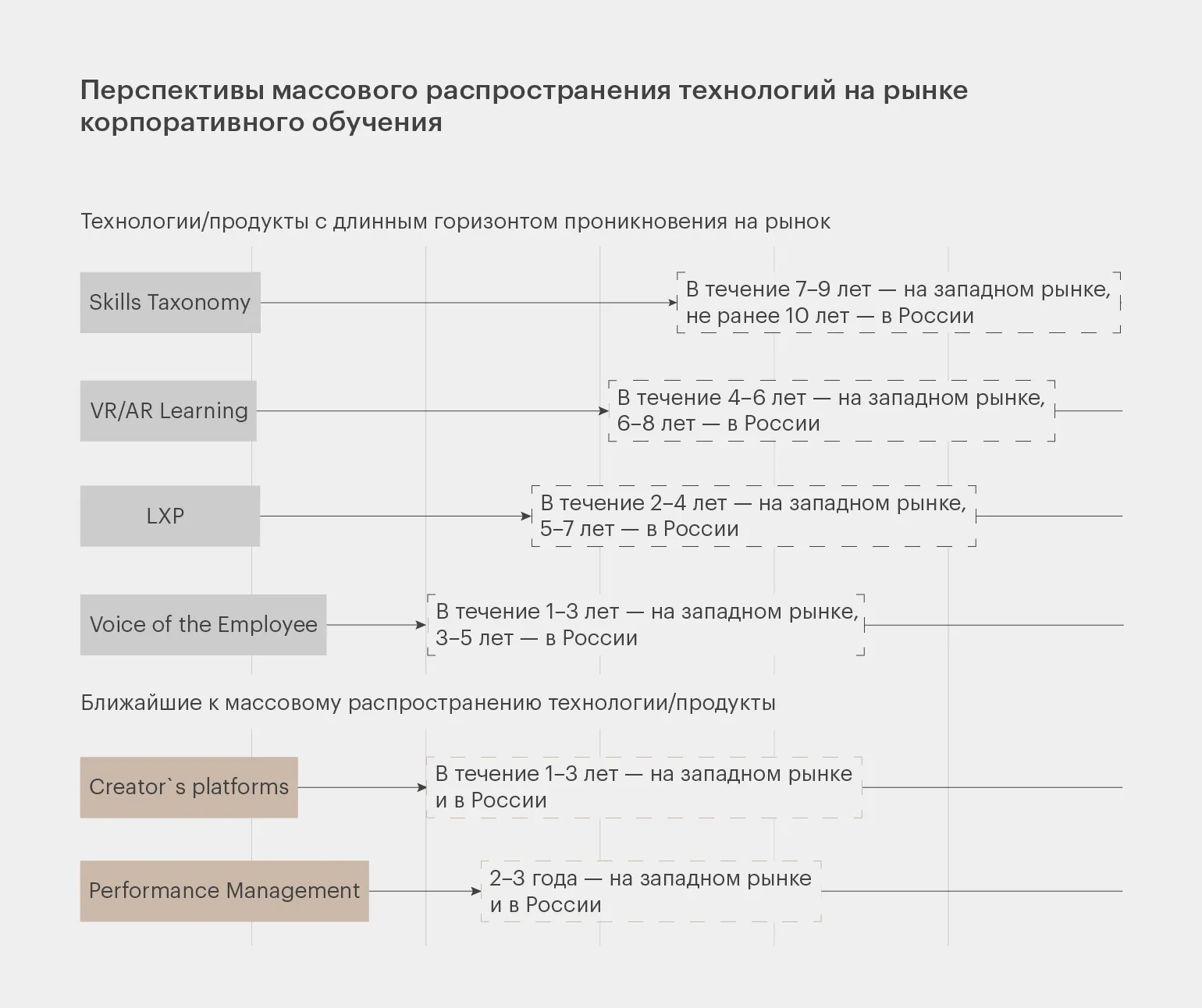
Technologies to Expect in the Coming Years
There are platforms that allow users to create animated videos, design elements, and online courses. These tools enable a company's internal experts to develop educational products without the need to be professional educators. This approach significantly reduces costs and accelerates the process of creating educational content, which meets the modern trend of using internal knowledge to create educational materials.
Course builders such as Articulate and Leenda initially attracted little interest from EdTech analysts, who considered them part of a small niche market. However, this changed when Articulate Global, a leading provider of SaaS solutions for online learning and corporate educational applications, raised $1.5 billion in funding. This event forced analysts to revise their forecasts. In 2020, the market for user-generated content creation platforms demonstrated more than double growth. At a recent HR Tech conference in Las Vegas, Josh Bersin, one of the most respected analysts in the field, highlighted this product category as one of the most promising for the future. Course builders are becoming a key tool for organizations seeking effective employee training and development.
Modern Russian companies are actively considering ways to scale the creation of educational content and digitize valuable employee knowledge. To achieve these goals, an EdTech product is needed that will ensure the convenient accumulation and tagging of expert knowledge, the creation of high-quality educational content, the management of communications during its development, and the ability to adapt this content to various tasks. This approach will effectively leverage accumulated experience and knowledge, improving educational processes and promoting employee development.
The expectation of a mass-market product in the field of user-generated content is becoming increasingly relevant. Platforms focused on the creation and management of such content have significant growth potential. The appearance of accessible and universal solutions on the market is likely to occur within the next year or three years at the most, including in Russia. We are currently witnessing experiments in creating integrated educational content management centers, and this area will continue to grow rapidly. This opens up new opportunities for users and creates conditions for improving the quality of education and interaction with content.
Competency and performance assessment systems play a key role in HR management. They enable a comprehensive analysis of employee skills and their effectiveness in performing work tasks after training. Such systems not only help monitor the level of professional training but also facilitate the creation of individual development paths for each employee. An important aspect is the ability to provide recommendations for internal vacancies that may utilize the skills acquired during training. This not only increases employee motivation but also promotes more efficient use of human resources within the company.
Systems that link training to specific competencies and key performance indicators (KPIs) are becoming an important tool for businesses. They enable early identification of how employee productivity and performance will improve as a result of training. After the training process is completed, it is possible to assess whether the planned results have been achieved. This makes it possible to measure the return on investment in training using business metrics, which is an important aspect for optimizing costs and improving overall company performance.
Expectations for a mass-market product are becoming increasingly relevant. Currently, successful examples such as Lattice and Culture Amp are already on the market. In the next two to three years, performance management systems will likely be integrated into distance learning platforms or standalone solutions for widespread use will emerge. This also applies to the Russian market, where the demand for such products is only growing. New technologies and approaches are expected to contribute to the development of effective tools for assessing and improving employee performance.

The Voice of the Employee is an important tool for management staff, which can also be useful for educational purposes. It allows not only to track employee opinions but also to identify areas for improvement, thereby contributing to a more effective work environment. Using this tool helps organizations adapt to change and increase employee engagement, which in turn can contribute to their professional development.
A feedback system based on regular targeted surveys tracks employee engagement and satisfaction. Using such systems helps to proactively identify the risk of employee dismissal due to dissatisfaction and take their wishes and suggestions into account. One of the most well-known leaders in this field in the Western market is Glint. Implementing this system allows companies not only to improve the work environment but also to increase overall productivity, which ultimately contributes to successful business development.
In the field of training, it is important to measure user satisfaction using modern systems. Early detection of dissatisfaction with training allows for timely changes, such as replacing the educational content provider or adjusting your own training materials. This contributes to improving the quality of training and increasing its effectiveness.
In the next one to three years, such services are expected to appear on the global market, and large businesses may begin developing them independently for their own needs. Mass-market products may appear on the Russian market within three to five years, although individual examples of their implementation can already be observed in some companies. This indicates a growing interest in innovative technologies and their application in various fields.
LXP is a system that integrates external content sources with a recommendation model. It serves as an additional add-on to the LMS, functioning as an API. This allows users to aggregate educational content from various sources, including both internal LMS resources and external platforms. This approach provides broader access to training materials and a personalized learning experience.
With LXP, employees can simultaneously interact with other learning platforms, such as Skillbox, within the corporate LMS. Based on their learning history, the system provides recommendations for additional courses and programs that may be useful for their professional development. This streamlines the learning process and makes it more personalized, which contributes to improved skills and productivity.
The importance of a comprehensive approach to employee training cannot be overstated. In addition to corporate training, each employee often takes courses on various platforms on their own initiative. Having the ability to view all necessary learning resources—courses, tests, webinars, and other educational activities—in a single, modern interface significantly simplifies the process. This integrated approach ensures a holistic and convenient user experience, which, in turn, promotes higher employee engagement in the learning process. A comparison with the use of disparate platforms shows that a unified system significantly improves the effectiveness of skills development.
LXP brings significant benefits to employers. Nearly every large company, in addition to its core distance learning system, uses additional platforms to address local and external challenges. This includes webinars and thematic conferences for both employees and the general public. Companies strive to make all training activities and educational content accessible in a single, user-friendly interface, which facilitates learning efficiency and knowledge integration. Universal learning platforms such as Degreed, Valamis, and Microsoft Viva are already appearing in the Western market. However, creating a similar universal LXP in Russia is a more complex task. Western corporations primarily use universal LMSs for employee training, which simplifies the development of a unified API. Meanwhile, Russian businesses often choose to create their own unique LMSs, which makes integration with various corporate systems labor-intensive. Furthermore, the Western market offers numerous content libraries that are easy to connect to. In Russia, similar products are either nonexistent or significantly lacking in content. Creating recommendation models is a complex and costly process, which, given the limited funding in the Russian market, is an additional barrier to the development of such technologies. Widespread availability of the product is expected in the coming years, given the high interest from corporate universities. The product is expected to be available within two to four years. In Russia, this process can take from five to seven years, due to market conditions and consumer demands.

Don't rush to distrust. Virtual and augmented reality technologies have been discussed in education for some time, but examples of their widespread use that are cost-effective and easy to implement remain rare. Most developments in this field require significant time and financial investment, as well as specialized equipment such as headsets.
In recent years, digital solutions have begun to emerge that simplify the development of educational content in augmented reality. One such tool is Strivr, which is designed for immersive learning. With Strivr, you can easily transform 360° videos into immersive VR courses by adding digital markers. Using this tool doesn't require a significant budget or third-party contractors—all you need is a Strivr subscription and a camera. This makes the creation of educational content more accessible and effective for organizations seeking to implement innovative teaching methods.
The expected time frame for the appearance of mass-market VR and AR products is four to six years in the Western market and six to eight years in Russia. Businesses are showing interest in these technologies because virtual and augmented reality offer significant benefits. They can improve user experience, increase customer engagement, and create new opportunities for learning and training. VR and AR also open up new horizons in marketing and advertising, allowing brands to interact with consumers on a deeper level. Investing in these technologies will provide a competitive advantage in a rapidly changing market.
- practicing and reinforcing mechanical skills (provided that the risks, complexity, or cost of traditional training outweigh the cost of developing a VR course);
- creating a "wow" effect in training.
Taxonomy is the science of the principles and methods of classification. In the context of professional activity, skill taxonomy refers to the systematization and classification of various skills and competencies. This allows for a clearer definition of the skills needed to perform specific tasks and achieve goals in various areas. Classifying skills helps better understand their structure and interrelations, which facilitates more effective learning and professional development.
In recent years, massive open online course (MOOC) platforms have seen rapid growth. The number of such platforms is constantly growing, but the content of courses within a single professional area can vary significantly depending on the provider. Learners may acquire different skills, even if the courses cover similar topics. Moreover, the same skills may be labeled differently in different courses. Currently, there is no unified system for tagging and unifying these skills, which creates difficulties for students, especially in digital professions. Developing such a system could significantly simplify the course selection process and improve the quality of education in this field.
Choosing the most suitable course for employees from a variety of providers and programs can be a challenging task for a T&D manager. This requires careful analysis and time to determine which specific competencies will be most relevant for the team. To optimize this process, it's worth focusing on clear selection criteria, such as the relevance of the course content, its format, the provider's reputation, and participant reviews. This way, the T&D manager can quickly find the most effective solution for employee development.
When assessing employees during the hiring process, a similar problem arises: a specialist with specific knowledge and skills is needed. However, each candidate may have a variety of certificates from various courses. How can you determine which ones truly possess the necessary skills and knowledge to solve the company's problems? An effective approach includes a thorough resume review, practical tests, and interviews, which helps determine the candidate's actual level of competence and the alignment of their experience with the company's requirements.
Skill taxonomy technology ensures the creation of uniform standards for naming and tagging skills, which helps unify processes in the HR system. This is especially important during the recruitment, onboarding, and training stages. Properly organizing skills helps improve recruitment efficiency and facilitates faster staff development in accordance with established standards.
This enables:
- unifying educational content from different providers;
- automating the search for candidates with the right skills.
EdCast was one of the first to implement innovative solutions for distance learning. Its SkillsDNA system is a next-generation platform that incorporates extensive classification and intelligent algorithms. These technologies enable the creation of competency models and their effective linking to recruitment, training, and interaction with external educational content. SkillsDNA optimizes the distance learning process, providing users with the necessary knowledge and skills for successful work in the modern world.
Expectations for the emergence of a mass product in the field of skills taxonomy are due to the complexity of developing a unified classification and the need to integrate this technology into learning management systems (LMS), talent management systems (TMS), and experience-based learning platforms (LXPs) from various providers. The need for such a solution is growing, and developers will most likely offer corresponding solutions within the next seven to nine years. In Russia, this process may take even longer, and mass adoption will not occur earlier than ten years.
Check out additional materials:
- Why EdTech services for corporate training are turning into a "zoo of solutions"
- The best EdTech startups in Russia and the CIS in 2021: HolonIQ Russia & CIS
- A selection of EdTech tools that have no complete analogues in Russia yet