
Contents:
- Create an employee onboarding plan
- Collect all the necessary information in one place
- Implement a mentoring program
- Develop a Telegram bot for support
- Organize a meeting for newcomers
- Gamify the onboarding process
- Automate feedback collection
- Experiment with educational formats
- Give a welcome pack, or "box" "Newbie"
Create an employee onboarding plan
An onboarding plan is an important document that describes each stage of a new employee's integration from day one. Key steps may include signing necessary documents, completing training courses, getting to know the team, and filling out an application. The content of an onboarding plan may vary depending on the specifics of the company and the new employee's position. Typically, it is developed by HR managers, recruiters, people partners, and immediate managers. Sofia Tarasova, people partner at ABBYY, emphasizes that having an onboarding plan makes the adaptation process more comfortable, transparent, and understandable for all participants. Properly organized onboarding helps increase employee engagement and reduce turnover, which is an important aspect of the successful functioning of any company.
Gather all the necessary information in one place
Olga Efanova, Corporate Training Manager at CROC, notes that creating a single entry point significantly simplifies the process for both the recruiter and the new employee. This can be organized as a folder in the knowledge base, a checklist, or a Google spreadsheet. It is important that this resource contains all the necessary training materials, schedule, contacts, and other important data that a new employee may need. A unified platform will facilitate more effective employee adaptation and improve their engagement in the work process.
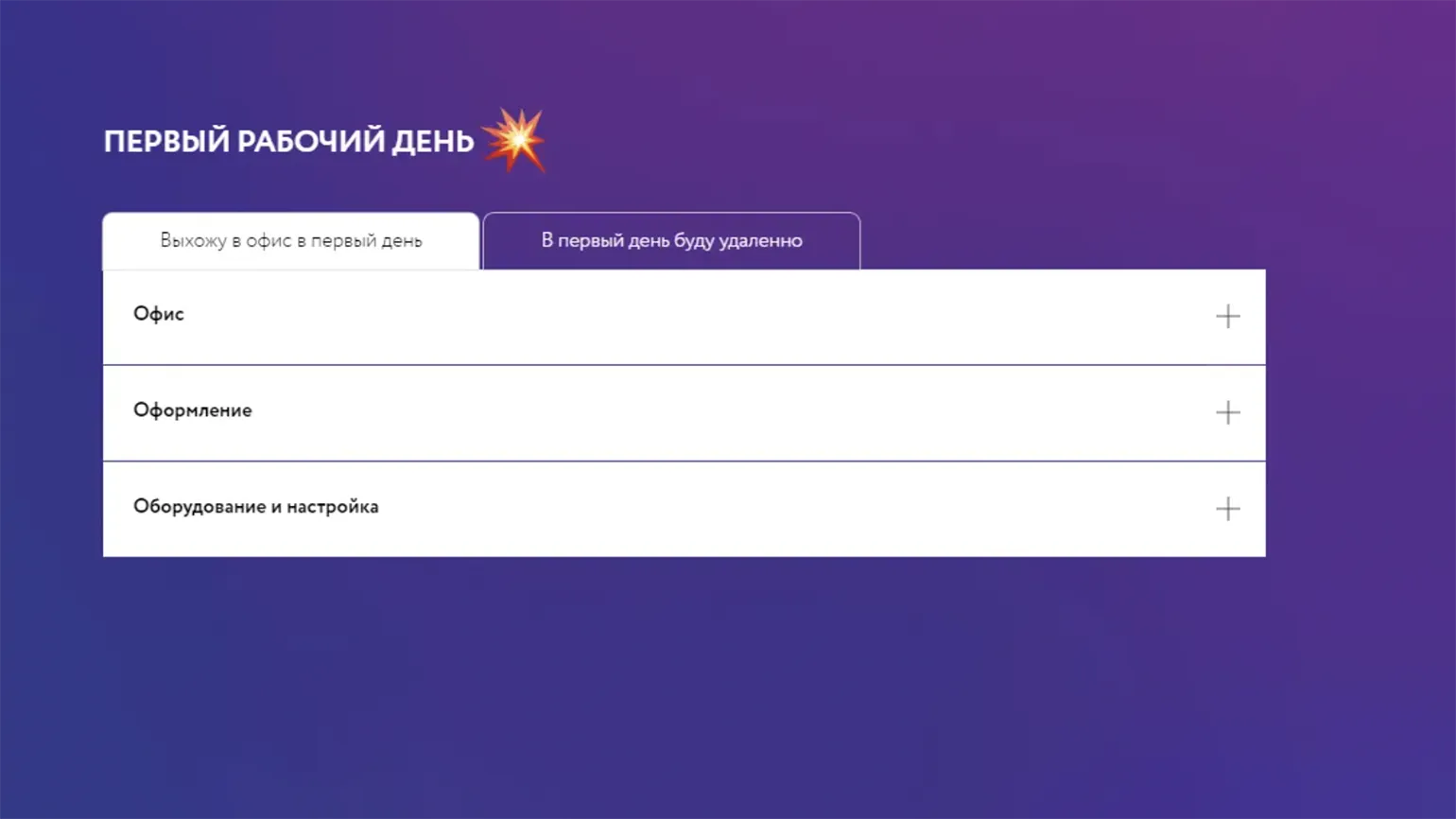
CROC developed a specialized landing page for newcomers that combines information content with an attractive design, explains Olga. On this website, users can review all stages of onboarding, download the Welcome Book, and install the Telegram bot, which we'll discuss later. The page is adapted for both office employees in different cities and for remote workers, providing each with individual instructions for a more comfortable start.
Implement a mentoring program
New employees can immerse themselves in company processes, get to know the team, and cope with stress with a buddy—an experienced colleague assigned to the new employee by their manager or HR manager. Yulia Malikova, HR generalist at Timepad, notes that it's best if the buddy represents another department: "When you work only in your own department, you don't always realize what others are doing. Imagine you work in sales, and your buddy works in development. This creates a unique experience that allows you to better understand the processes taking place within the organization." This approach not only promotes better interaction between departments but also increases overall team effectiveness.
Yulia emphasizes that mentoring benefits everyone involved. For managers and HR managers, it significantly reduces the workload, and new employees adapt more quickly and experience less stress. At the same time, mentors develop their management skills, which contributes to their professional growth. Mentoring becomes an effective tool for increasing productivity and improving corporate culture.
Mentoring within a company brings significant benefits, as evidenced by the experience of large organizations like Microsoft. According to managers, new employees who work with mentors demonstrate greater productivity and better interaction with colleagues compared to those who adapt independently. Furthermore, they feel more satisfied and happy in their new workplace. Mentoring not only helps employees learn quickly, but also helps build a positive corporate culture.

Read also:
Motivating employees to take on the role of mentor or buddy: effective strategies
In modern business, mentoring is an important tool for improving productivity and team development. To inspire employees to become mentors or buddies for newcomers, you need to use different approaches. Let's consider several effective ideas.
First, emphasize the importance of mentoring for personal and professional growth. Explain how this experience will help develop leadership qualities, communication skills, and increase self-confidence.
Second, create a reward system for mentors. This can include both tangible bonuses and non-tangible incentives, such as increased status in the team or the opportunity to participate in specialized events.
The third step can be training. Offer courses or training that will help employees develop the necessary skills for successful mentoring.
The fourth point is to create a culture of knowledge sharing within the company. Encourage employees to share experiences and practical tips, thereby creating an atmosphere of support and cooperation.
The fifth approach is to provide mentors with the opportunity to share their successes and achievements. This can be done through internal reports, blogs, or presentations, which will increase their motivation.
The sixth step is management support. By demonstrating your interest in mentor development, you create additional incentive for employees.
Finally, it is important to consider the individual interests and goals of each employee. Let them choose the direction they want to develop as mentors, which will make the process more personal and meaningful.
By using these strategies, you can not only motivate employees to become mentors but also create a more cohesive and productive team.
Develop a Telegram bot for support
Telegram has become an integral part of our daily lives, including the educational process. This messenger offers many advantages. One of the main ones is the ability to gain knowledge in a familiar and accessible environment. Users can learn without the need to install additional applications, anytime and anywhere, which makes learning more flexible and effective. Telegram provides a unique platform for information exchange, communication, and access to educational resources, which facilitates skill development and knowledge enhancement.
Telegram can serve as an effective tool for onboarding new employees. CROC's built-in chatbot provides valuable information and supports new hires, following a pre-designed scenario. On their first day, the bot familiarizes employees with the route to the office, office rules, and required documents. On the third or fourth day, it begins to deepen newcomers' knowledge of work tools and offers online courses. This approach allows HR managers to reduce routine tasks and minimize human error. Furthermore, chatbots provide the ability to collect feedback and statistics, allowing them to track the onboarding process and determine whether an employee needs additional assistance. For example, the bot can ask questions such as, "Are all your tasks clear to you?" Using Telegram for onboarding not only simplifies the adaptation process, but also increases its efficiency.

Read also:
Mass staff training in Telegram: effective strategies and approaches
Employee training in a modern business environment requires the use of innovative solutions. Telegram is becoming a popular tool for organizing mass employee training. The platform offers numerous opportunities for interaction and information sharing, making it an ideal solution for corporate training.
Using Telegram, you can create training channels and groups where employees can receive relevant materials, participate in discussions, and ask questions. The advantages of using Telegram include accessibility, ease of use, and the ability to quickly disseminate information.
Furthermore, Telegram allows you to integrate various content formats, such as text messages, video tutorials, audio files, and surveys. This variety of formats promotes more effective learning and increases employee motivation.
For successful staff training on Telegram, it is important to develop a clear course structure and regularly update the content. Using interactive elements such as quizzes and tests will help maintain participant interest and engagement.
Thus, mass training on Telegram is an effective and modern approach that not only allows for the rapid transfer of knowledge but also creates an active community for sharing experiences and maintaining corporate culture.
Organize a meeting for newcomers
Large companies actively hiring new employees organize special events for newcomers. At such meetings, newcomers can learn more about the company, meet colleagues from various departments, and learn about their work. For example, specialists from the HR department share information about policies, values, and corporate culture, while development employees talk about the technologies used in their work. Such events help new employees adapt and integrate into the team more quickly, which in turn contributes to the company's overall performance.
According to Olga Efanova, CROC holds an introductory event called the "Welcome Seminar." At this seminar, top managers conduct lectures in a dialogue format with new employees. The main goal of this event is to introduce newcomers to the company's management, as well as its values and internal processes. This allows new team members to adapt and integrate into the corporate culture more quickly, which in turn contributes to increased work efficiency and improved teamwork.
Gamify the onboarding process
Staff motivation during the onboarding program can be effectively managed using game mechanics. One approach is to reward employees for completing tasks, ranging from corporate merchandise to access to e-libraries. If a company has an internal store, implementing a corporate currency system can be a powerful incentive for employees, encouraging them to participate more actively in the onboarding process. This approach not only increases employee engagement but also helps build a positive image of the company as a caring employer.
The second approach is to integrate mandatory and routine information into a virtual game format. For example, the internal security course at CROC is implemented as an adventure game. Participants control a character who explores a virtual office, gaining knowledge and answering questions. As Olga Efanova emphasizes, employees often enjoy taking such courses, viewing them as entertaining. This approach promotes better assimilation of information and increases motivation for learning.

Study additional materials:
The introduction of gamification into the educational process can be effective and accessible. Gamification can increase student engagement and improve material acquisition. To quickly and cost-effectively integrate gamification elements into your learning, start by defining the goals and objectives you want to achieve. Use available online tools and platforms to create interactive tasks and quizzes. Consider using point systems, badges, and leaderboards to encourage student participation. It's also important to consider individual student preferences and skill levels to personalize the learning experience.
Create scenarios where students can apply their acquired knowledge in practice, for example, through role-playing games or project assignments. This not only makes learning more engaging but also promotes critical thinking and teamwork.
Regularly collect feedback from students and adapt gamification elements based on their preferences and performance. This approach will make learning more effective and engaging, and will help achieve the educational goals.
Automate Feedback Collection
Feedback is an important tool in the onboarding and training of new employees. Using feedback, you can effectively track newcomers' progress and adjust the training program if necessary. This also brings significant benefits for new employees: they become more engaged in the process, feel valued, and feel confident in their abilities. Proper use of feedback helps create a productive atmosphere where every employee can develop and achieve their goals.
Collecting feedback manually is time-consuming, so it makes sense to automate this process. Yulia Malikova recommends using Telegram chatbots for this purpose. On a set day and time, the chatbot sends questions to the employee and automatically records their responses in the database. The HR manager only needs to review the responses at a convenient time and analyze them. Automating feedback collection not only saves time but also improves the quality of the information received, which contributes to more effective HR management.
Experiment with educational formats
Onboarding programs typically consist of standard courses, including videos and lectures. However, in some cases, using non-standard formats can be more effective and attractive to new employees. Such approaches help better assimilate information and increase engagement. It's important to consider a variety of training methods to make the onboarding process more engaging and productive.
For Timepad, as for many service organizations, quickly acclimating new employees to the product is key. Timepad, which specializes in event planning, takes a unique approach: each new hire is required to independently organize and host an event for their colleagues. "It could be anything—even a house party," notes Yulia Malikova. In the near future, onboarding employees will have the opportunity to participate in organizing events for real clients, allowing them to gain practical experience and better understand user needs.
ABBYY uses a unique approach to training new developers: onboarding assessment. As Sofia Tarasova explains, new employees are assigned a set of disciplines to master in accordance with their role. This includes studying internal technologies, libraries, and the company's specific workings with these tools. However, the training process is not isolated: new hires receive support from a mentor, who then assesses their knowledge. "Such a program provides confidence that the software developer has the necessary skills to successfully complete their tasks," emphasizes Sofia. This approach promotes the effective integration of new employees into the team and improves the quality of work, which is an important aspect for the successful development of the company.
Give a welcome pack, or "newbie box"
A newbie box is a set of items necessary for work and related to the company. It mainly includes branded stationery, clothing, and useful items such as umbrellas and mugs. The contents of the box may vary depending on the department the employee works in, or the employee can choose their welcome pack from several available options. This creates a personalized approach and helps the new employee adapt more quickly to the team.
Creating a welcome pack for new employees is believed to be an effective way to convey corporate values, increase loyalty, and establish an emotional connection. The training and development department often participates in the process of creating such a pack. For example, a team can develop a special welcome book about the company that is given to new hires. This approach not only helps inform employees about the company's culture and mission but also facilitates their rapid integration into the team.