
Contents:
- Who took part in the study
- Advertising. OOO "My Class". INN: 6670530460. Erid: 2VtzqvsQMhW
- For which categories of employees is the training system usually built?
- Do companies take into account the age characteristics of employees during training?
- How do companies involve zoomers in training?
- What training formats do companies use most often?
- How do companies use AI in employee training?
- How do companies use AI to develop educational content?
- Who develops content for employee training?
- How willing are companies to cooperate with online schools?
- What platforms do companies use to train employees?
- How do companies evaluate the effectiveness of training?
- What are the key findings of the study?
- Who participated in the study?
- For which categories of employees do they usually build a training system?
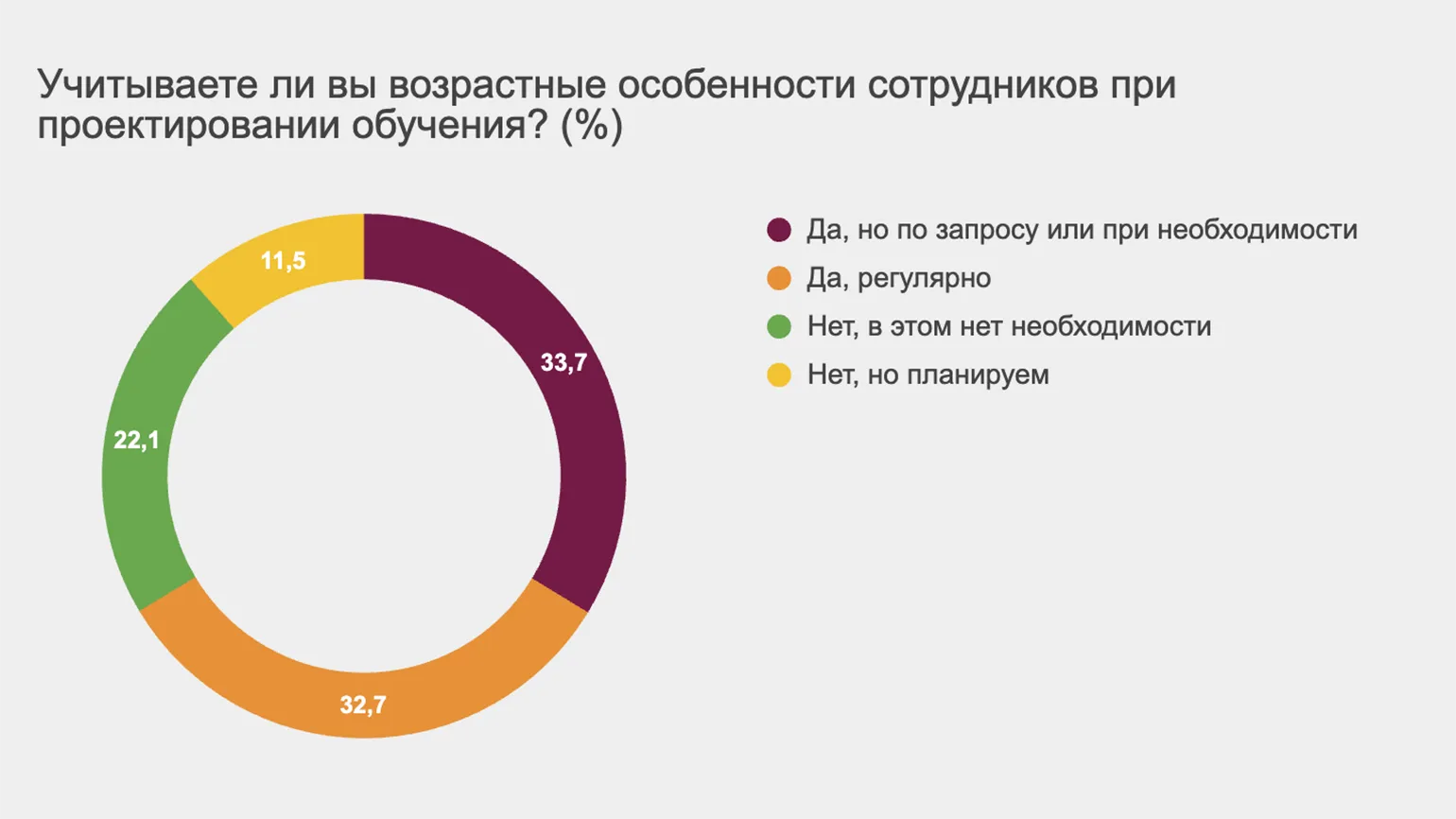
- Do companies take into account the age characteristics of employees during training?
- How do companies involve zoomers in training?
- What training formats do companies use most often?
- How do companies use AI in employee training?
- How do companies use AI to develop training content?
- Who develops content for employee training
- How willing are companies to collaborate with online schools
- Which platforms do companies use to train employees?
- How do companies evaluate the effectiveness of training?
- What are the key conclusions of the study?
Since 2022, the Digital Learning community has been conducting an annual study of the corporate training market in Russia. The purpose of the study is to identify key trends and monitor their changes over time. This article presents the results of the study for last year, allowing us to see the dynamics and changes in the field of corporate training.
On June 18, Pavel Bezyaev, leader of the Digital Learning community, presented the results of a new survey among Russian companies dedicated to employee training and development. Experts in corporate training and personnel development joined the event to discuss and analyze these results.
- Tatyana Galkina, Director of iSpring Academy.
- Valery Leontyev, CEO of Labmedia, an e-learning developer.
- Sergey Zamarayev, CEO of Courseditor, a company offering an online course designer and a learning platform.
- Elvina Sharafutdinova, Head of Marketing for the Training Business Unit at MTS Link.
Who Participated in the Study
A survey was conducted among participants in the Digital Learning community in May 2025. Representatives of 104 companies of various sizes completed the survey, which allowed us to collect valuable data on current trends in digital learning. The results of the study will help to better understand the needs of businesses and focus efforts on the development of effective educational programs.
- up to 100 people — 13.5%;
- from 100 to 1,000 people — 28.8%;
- from 1,000 to 3,000 people — 15.4%;
- from 3,000 to 5,000 people — 9.6%;
- from 5,000 to 10,000 people — 10.6%;
- from 10,000 people — 22.1%.
Respondents from various fields of activity took part in the study. The greatest representation is observed in the IT industry, which makes up 24% of the total number of participants. It is followed by manufacturing with 12.5%, retail with 10.6% and banks with financial services, covering 7.7%. A smaller share is occupied by the public sector, logistics and transport, the hotel and restaurant business, pharmaceuticals, and other industries.

Affiliate content is an important tool for promoting goods and services. It helps companies expand their audience, increase brand visibility, and build consumer trust. Affiliate content can include articles, reviews, recommendations, and other formats that inform and engage the target audience.
Creating high-quality affiliate content requires careful planning and an understanding of the target audience's needs. It should be informative, useful, and relevant to readers' interests. Optimizing the text for SEO is key to improving search engine visibility. It's important to use relevant keywords to help attract organic traffic.
Affiliate content also helps establish relationships between brands and their partners. Effective collaboration can lead to mutually beneficial results, including joint marketing campaigns and increased sales. It's important that affiliate content be honest and transparent to avoid undermining audience trust.
As a result, well-designed affiliate content can become a powerful tool for business growth, strengthening market position, and increasing consumer trust.
Schools and educational centers have the potential to increase their revenue by 30%. Learn how to do this effectively. Optimizing educational processes and implementing modern technologies will help attract more students and increase profits. Marketing and promoting unique educational programs also play a key role in improving financial performance. Don't miss the chance to learn strategies that will help your educational institution reach new heights.
Advertising. Moy Klass LLC. Taxpayer identification number (INN): 6670530460. Erid: 2VtzqvsQMhW
For which categories of employees do companies usually develop training systems?
The 2025 study raised the question of which categories of employees companies develop their training systems for. This study highlights the importance of a targeted approach to training, which allows organizations to tailor development programs to the specific needs of different employee groups. Understanding these categories will help companies allocate resources more effectively and achieve better results in the development of their personnel.
Most companies focus on training specialists, which accounts for 85.6% of the total number of respondents, as well as on the training of middle management, which is targeted by 80.8% of respondents. Approximately half of the survey respondents, namely 48.1%, pay attention to the development of top managers, while 43.3% of respondents train blue-collar workers and employees. In addition, 24% of respondents noted that their organizations provide training for service personnel. Thus, training employees at all levels is a key aspect of company development.
Do companies consider the age of employees in training?
The question of whether companies consider the age of employees when developing training programs is becoming increasingly relevant. Research shows that 66.4% of organizations adapt their training initiatives to the characteristics of different generations, doing so regularly or upon request. At the same time, only 22.1% of respondents believe that taking into account the age of employees is inappropriate. This highlights the importance of a personalized approach to learning, which can significantly improve the effectiveness of educational programs and employee satisfaction.
Respondents were also asked about new learning formats that could increase employee engagement among Generation Z employees—those born between 1996 and 2010. This is the first generation to grow up in a digital environment, which significantly influences their values, interests, and preferences. Surveys conducted by Skillbox, Skillfactory, and the Opportunity Accelerator show that young workers value not only high salaries but also work-life balance. They also prefer remote work, highlighting the need to adapt educational programs to the new demands and expectations of this generation.
iSpring Academy Director Tatyana Galkina notes that Generation Z requires a special approach to learning. To motivate them to actively participate, it's necessary to create conditions that will engage their interest and enable them to better understand the material. It is important to engage them in learning to make it not only informative but also engaging.

Reading is an important part of personal development and broadening one's horizons. Books, articles, and blogs provide unique opportunities to gain new knowledge and inspiration. It's important not only to read but also to analyze information and apply it in practice. In today's world, access to a variety of information sources has become easier, opening up new horizons for self-development. Choose quality materials that will help you deepen your knowledge and skills and enrich your inner world. Regular reading improves concentration and critical thinking, which are essential for successful living in the information age. Don't forget to share what you read with others, which can spark interesting discussions and the exchange of experiences. The "non-University" project provided valuable insights about Generation Z, also known as Zoomers. This generation, raised in the digital age, has unique perspectives on education, careers, and life in general. Zoomers seek practical experience and prefer alternative forms of learning, such as online courses and workshops. They value flexibility and the ability to manage their own time, making traditional education less appealing to them.
Generation Zers also actively use social media for information and communication, which influences their learning preferences and career choices. They seek opportunities for self-expression and strive for social change, making them more conscious consumers and employers. Understanding these characteristics helps better tailor educational programs and career initiatives to the needs of the new generation, ensuring they have the opportunity to develop and realize their potential.
Elvina Sharafutdinova of MTS Link noted that Generation Z, accustomed to modern and user-friendly mobile apps, often experiences discomfort when using corporate tools with outdated interfaces and designs typical of the early 2000s. This inconsistency in user experience can negatively impact employee motivation and engagement. Modern companies must consider these factors to improve the efficiency of their tools and ensure a comfortable working environment for younger generations.
Elvina highlighted another challenge affecting older generations: the "second screen" effect. This occurs when, while watching a training webinar on a laptop, a smartphone with constant notifications from social media, messaging apps, games, and streaming services is always nearby. As a result, educational content constantly competes for attention with numerous entertainment options, significantly complicating the learning and retention process.
A Digital Learning study found that 33.7% of respondents are actively implementing new, engaging training formats for younger employees. Furthermore, 35.6% of companies plan to develop and offer similar initiatives in the future. This demonstrates a growing interest in modern training methods that help improve employee effectiveness and motivation. The implementation of innovative training formats is becoming an important aspect of human resource development strategies in organizations.

Optimize your content for search engines to attract more visitors to your website. Try to use keywords that match the topic of your text. Make sure the structure and formatting of the text are easy to read. Regularly updating your content will help keep it relevant and improve search engine rankings. Use internal links to improve navigation on your site and increase the time users spend on pages. Don't forget the importance of unique text and its value to readers. This will attract organic traffic and improve the visibility of your resource online.
Read also:
Over the past 10 years, corporate training technologies and formats have undergone significant changes. With the development of digital technologies, companies have begun actively implementing online training, allowing employees to gain knowledge at a convenient time and from anywhere. The emergence of distance learning platforms and LMS (Learning Management Systems) has made the learning process more accessible and manageable.
Virtual reality and augmented reality have begun to be used to create interactive training programs, which has significantly increased employee engagement and improved material absorption. Microlearning, which consists of short, targeted training modules, has become a popular way to deliver information, allowing employees to quickly gain the knowledge they need without feeling overwhelmed.
Personalized learning, where programs are tailored to the individual needs and skill level of each employee, is also gaining importance. Data analytics and artificial intelligence have become important tools for assessing training effectiveness and identifying areas for improvement.
Thus, modern technologies have significantly changed approaches to corporate training, making it more flexible, interactive, and adaptive to business needs.
How Companies Engage Zoomers in Training
Tatyana Galkina suggested interesting training formats for young employees, among which interactive simulators stand out. Examples of such simulators include simulators of work in a coffee shop or pizzeria, which are intended for service personnel. This approach to training is understandable and accessible to young people, allowing them to master skills and learn from their mistakes in a safe environment. This helps employees become more confident when interacting with real clients, improving service quality and efficiency. Interactive training sessions not only promote professional growth but also build self-confidence, which is especially important for young professionals.
Sergey Zamarayev, CEO of Courseditor, believes that creating fundamentally new formats for engaging Generation Z is a challenging task. The key tools remain the same: microformats, video content, and training sessions. However, Sergey emphasizes not the formats themselves, but their implementation and the way the information is presented. As an example, he cites the online school "EGELand," which uses standard formats—webinars, long texts, and quizzes. However, the communication style with students is characterized by a lively and informal approach, allowing him to speak their language. Такой метод способствует не только вовлечению подростков в учебный процесс, но и помогает им лучше усваивать материал.
Читайте также:
Поколение Z не проявляет особого интереса к микрообучению и предпочитает получать знания через полноценные онлайн-курсы. Это поколение ценит глубокое понимание материала и предпочитает структурированные программы, которые позволяют углубиться в изучаемую тему. Полноценные курсы предлагают более широкий спектр информации и возможностей для практического применения знаний, что делает их более привлекательными для зумеров.
В ходе обсуждения была высказана точка зрения, что многие компании неправильно подходят к вопросу вовлечения молодых сотрудников. Валерий Леонтьев, CEO «Лабмедиа», отметил, что попытки привлечь поколение Z к обучению с помощью популярных методов, таких как геймификация, зачастую оказываются неэффективными. Это подчеркивает необходимость более глубокого понимания потребностей и мотиваций молодых специалистов для успешного их вовлечения в процесс.
Конечно, я готов помочь вам с редактированием текста. Пожалуйста, предоставьте сам текст, который нужно переработать.
Мы предполагаем, что молодому поколению, известному как зумеры, нравится определенный вид развлечений, и поэтому стараемся предоставить им разнообразные формы досуга. Мы предлагаем им игры и игрушки, полагая, что это будет способствовать их увлечению. На краткосрочной перспективе такие меры могут быть эффективными, так как людям в целом нравится развлечение. Однако существует риск, что избыточное количество развлечений может привести к перенасыщению, в то время как основная проблема мотивации остается нерешенной.
Спикер утверждает, что вместо внедрения поверхностных игровых механик в образовательный процесс, гораздо более эффективно интегрировать элементы игры в методические подходы. Он подчеркивает, что как дети, так и взрослые более доверяют методам вовлечения, основанным на честности. Важно установить четкие правила игры и придерживаться их, независимо от того, происходит ли это в традиционной корпоративной системе или в увлекательной геймифицированной среде. Это создает обстановку, в которой участники могут полностью погрузиться в процесс и максимально использовать возможности обучения.
Одним из эффективных способов вовлечения сотрудников в процесс обучения является система поощрений. Согласно исследованию Digital Learning, 38,5% опрошенных компаний применяют различные формы поощрения для сотрудников, успешно завершивших онлайн-курсы, или периодически организуют стимулирующие мероприятия. Однако в исследовании не были указаны конкретные методы мотивации, используемые организациями. Внедрение системы поощрений может значительно повысить интерес работников к обучению и улучшить их профессиональные навыки, что в свою очередь способствует общему развитию компании.
Согласно опросу, 17,3% компаний намерены внедрить систему поощрений для сотрудников. В 34,6% организаций обучение является обязательным, что исключает необходимость применения дополнительных методов мотивации.
Какие форматы обучения компании используют чаще всего
Респонденты Digital Learning уже на протяжении четырех лет отвечают на вопрос о соотношении очного, онлайн и смешанного форматов в обучении сотрудников. В условиях быстрого развития технологий и изменения потребностей бизнеса важно понимать, как эти форматы влияют на эффективность обучения. Очные занятия предлагают возможность непосредственного взаимодействия, тогда как онлайн-форматы обеспечивают гибкость и доступность. Смешанные форматы комбинируют преимущества обоих подходов, создавая оптимальные условия для обучения. Исследования в этой области помогают выявить лучшие практики и адаптировать стратегии обучения под нужды современных организаций.
В 2025 году наблюдается увеличение доли участников, которые предпочитают смешанное обучение, сочетая очные и дистанционные форматы. Этот показатель вырос с 60,8% в прошлом году до 70% в текущем. При этом менее четверти компаний (22%) четко разделяют очные и онлайн-программы обучения, что является снижением по сравнению с 26,8% в 2024 году. Этот тренд подчеркивает растущую популярность гибридных моделей обучения, что может быть связано с изменениями в потребностях сотрудников и стремлением компаний адаптироваться к новым условиям.
Доля организаций, которые полностью обучают персонал в онлайне, снизилась с 9,3% в 2024 году до 6,7% в 2025 году. Также уменьшился процент компаний, выбирающих исключительно очное обучение, который сократился с 3% до 1% за тот же период. Это указывает на изменения в подходах к обучению сотрудников, где смешанные форматы становятся всё более популярными.
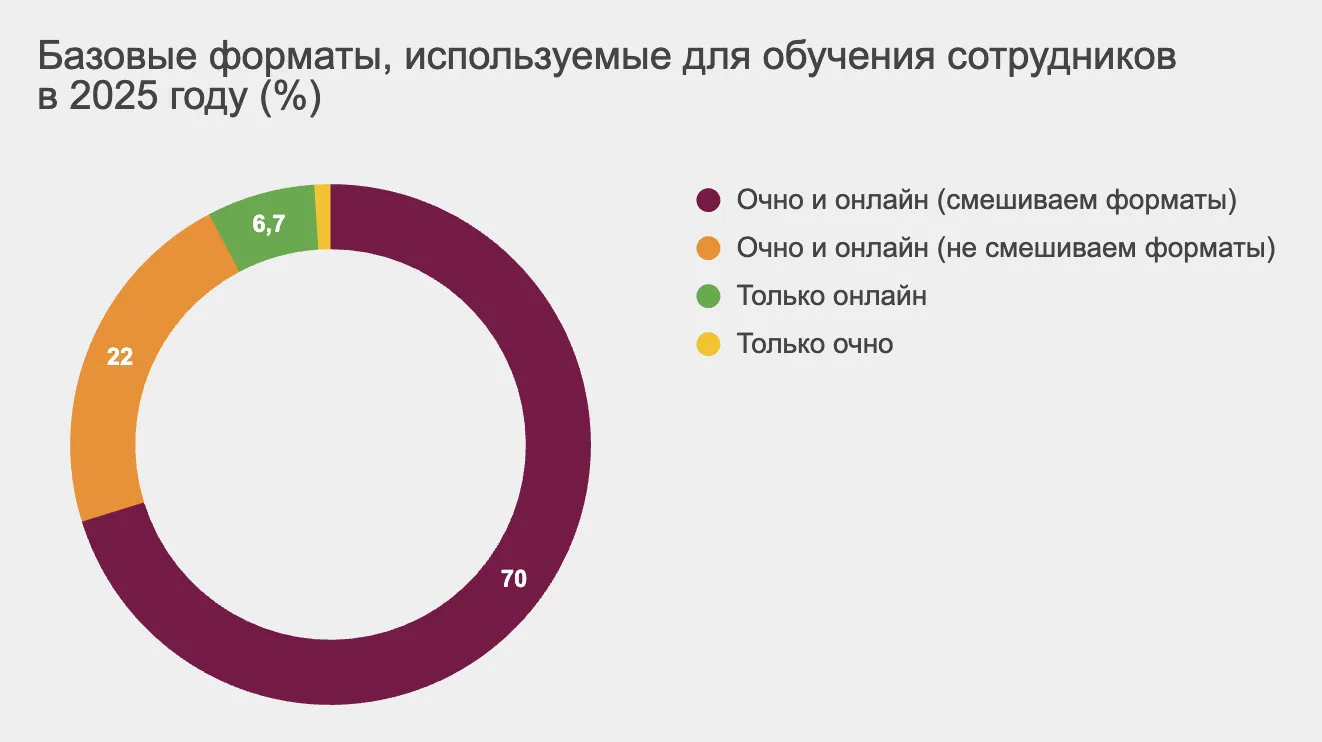
Павел Безяев отмечает, что текущие результаты опровергают прогнозы о том, что людям наскучил онлайн-формат и они вскоре вернутся к традиционным аудиториям. Вместо этого компании все чаще интегрируют очные и дистанционные форматы в рамках одной программы, что свидетельствует о гибкости и адаптивности современных образовательных подходов. Этот тренд подчеркивает важность комбинированного обучения, которое сочетает преимущества обоих форматов, предоставляя участникам более разнообразные и эффективные методы получения знаний.
Топ популярных форматов онлайн-обучения в 2024 году остался неизменным. На первом месте по-прежнему находятся следующие форматы:
- 84,6% — синхронное онлайн-обучение;
- 76,9% — видеокурсы;
- 72,1% — слайдовые курсы;
- 70,2% — курсы-лонгриды.
В настоящее время 62,5% организаций внедряют онлайн-программы смешанного обучения, которые сочетают синхронные и асинхронные форматы. Примерно 35,6% компаний применяют мобильное обучение, что свидетельствует о растущем интересе к обучению на ходу. Лишь 6,7% организаций используют образовательных чат-ботов, что указывает на необходимость дальнейшего развития этого инструмента в сфере обучения.
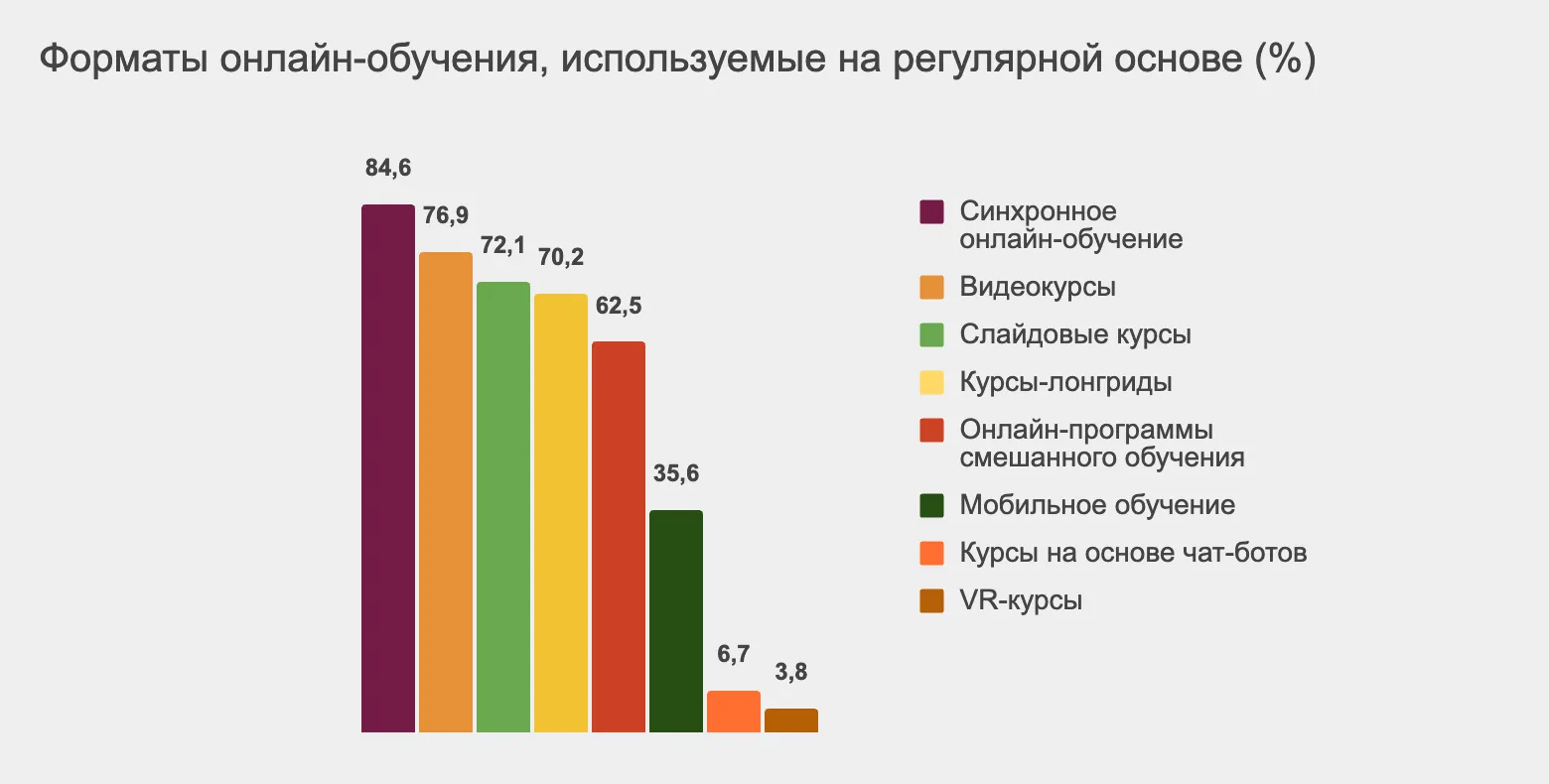
Доля VR-обучения сократилась с 6% в 2024 году до 3,8% в 2025 году. При этом обучение в дополненной реальности (AR) не было упомянуто ни одним из респондентов. Эльвина Шарафутдинова отметила, что технология VR проходит стандартные этапы принятия инноваций: от пика интереса к разочарованию, а затем к стабильному уровню эффективного использования. Спикер утверждает, что VR будет востребована в тех областях, где она приносит максимальную пользу, например, в медицинском образовании, где будущие хирурги могут тренироваться на виртуальных пациентах. Возможно, со временем использование VR в корпоративном обучении увеличится, особенно когда VR-очки и шлемы станут более доступными и недорогими.
Читать также:
Эксперты поделились рекомендациями по применению метавселенных в корпоративном обучении. Метавселенные представляют собой виртуальные пространства, позволяющие создавать иммерсивные обучающие среды. Использование таких технологий в обучении сотрудников способствует повышению вовлеченности и усвоения материала. Виртуальные симуляции и интерактивные задания позволяют работникам практиковать навыки в безопасной обстановке, а также взаимодействовать с коллегами в режиме реального времени. Кроме того, метавселенные обеспечивают доступ к разнообразным образовательным ресурсам и инструментам, что делает процесс обучения более гибким и адаптивным. Интеграция метавселенных в корпоративное обучение открывает новые горизонты для развития профессиональных навыков и повышения эффективности обучения.
Как компании используют ИИ в процессе обучения сотрудников
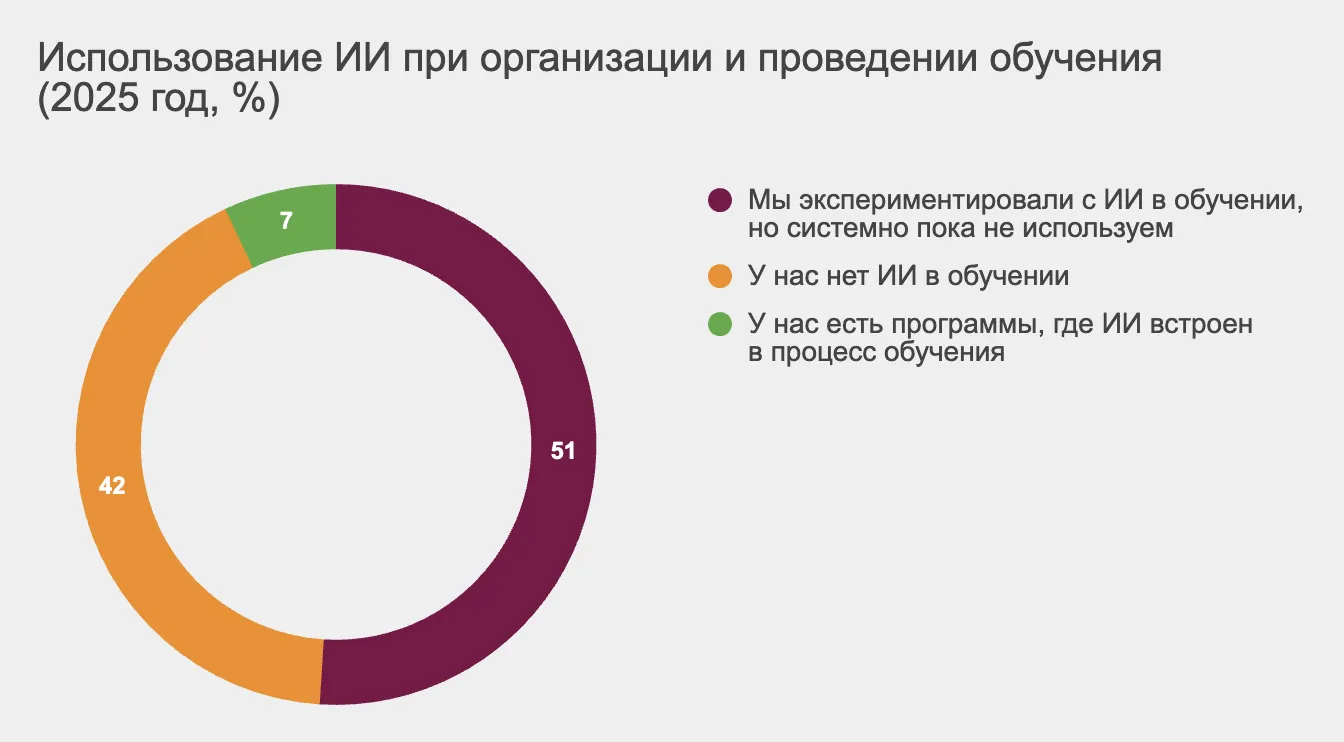
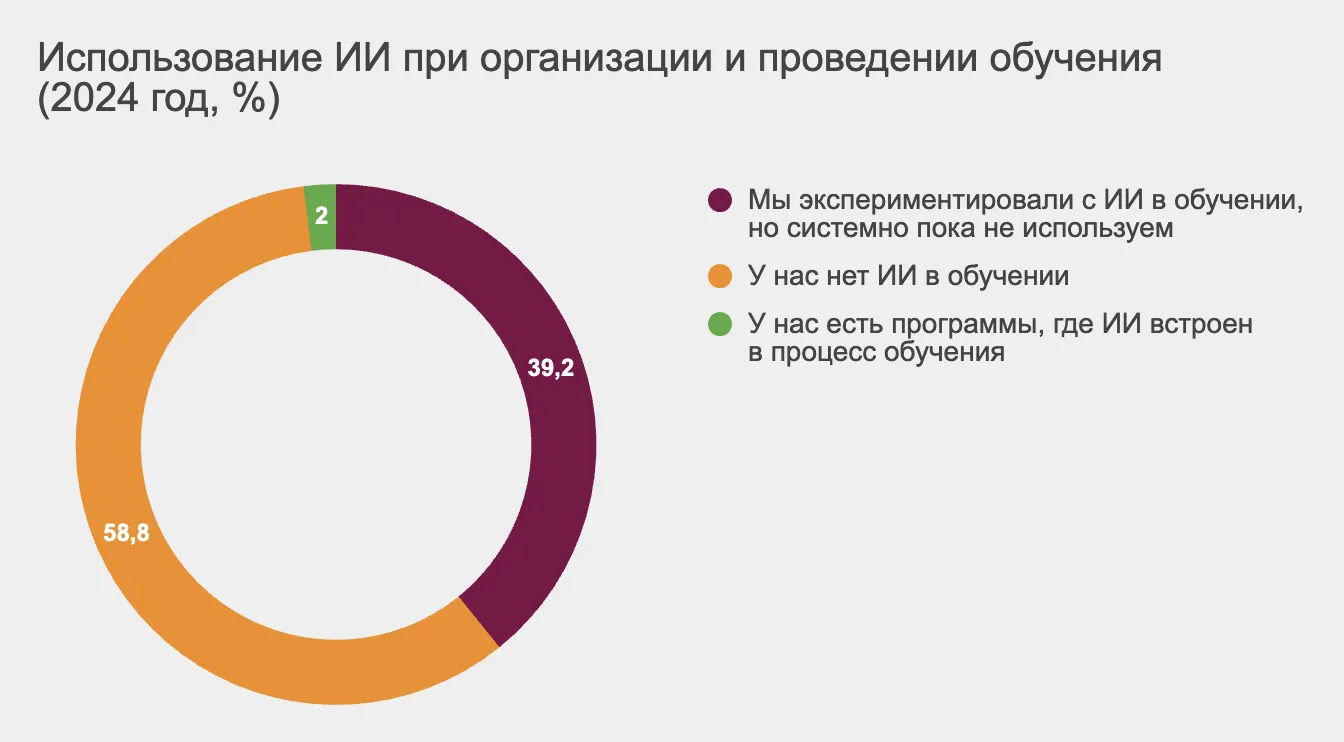
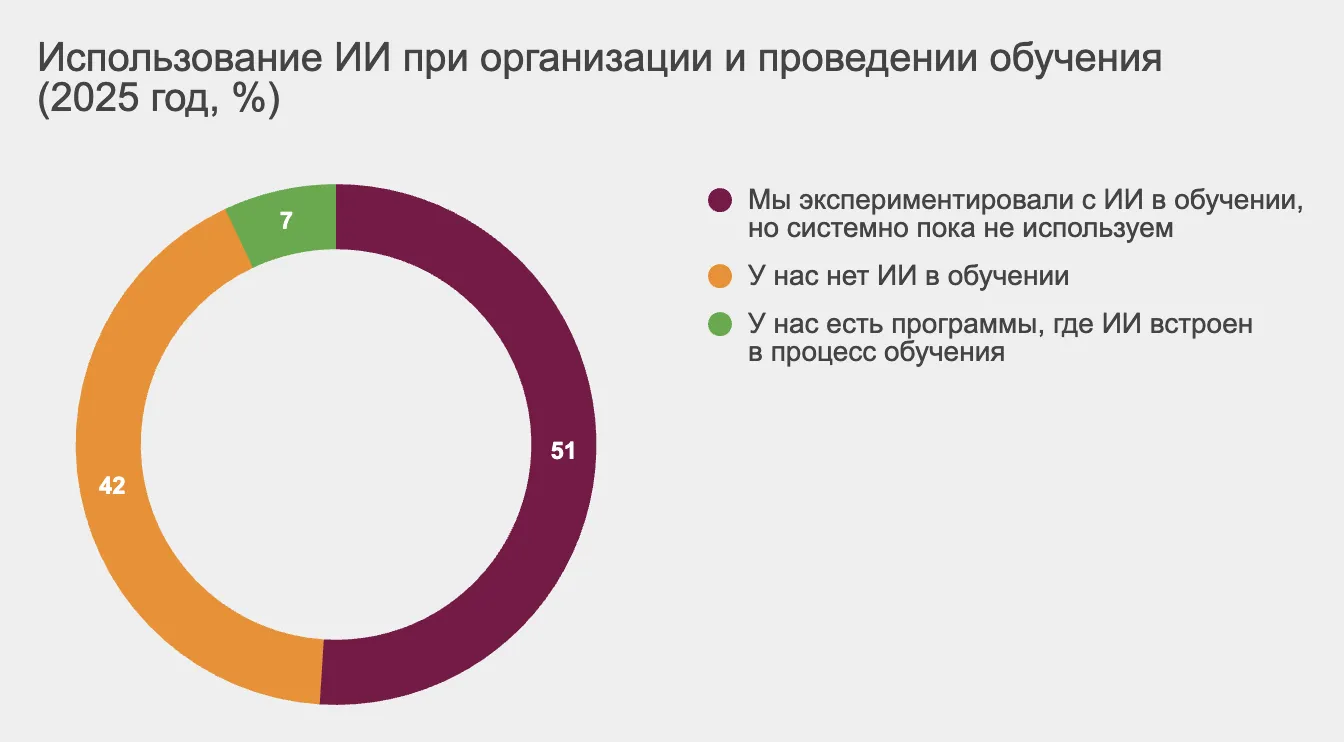
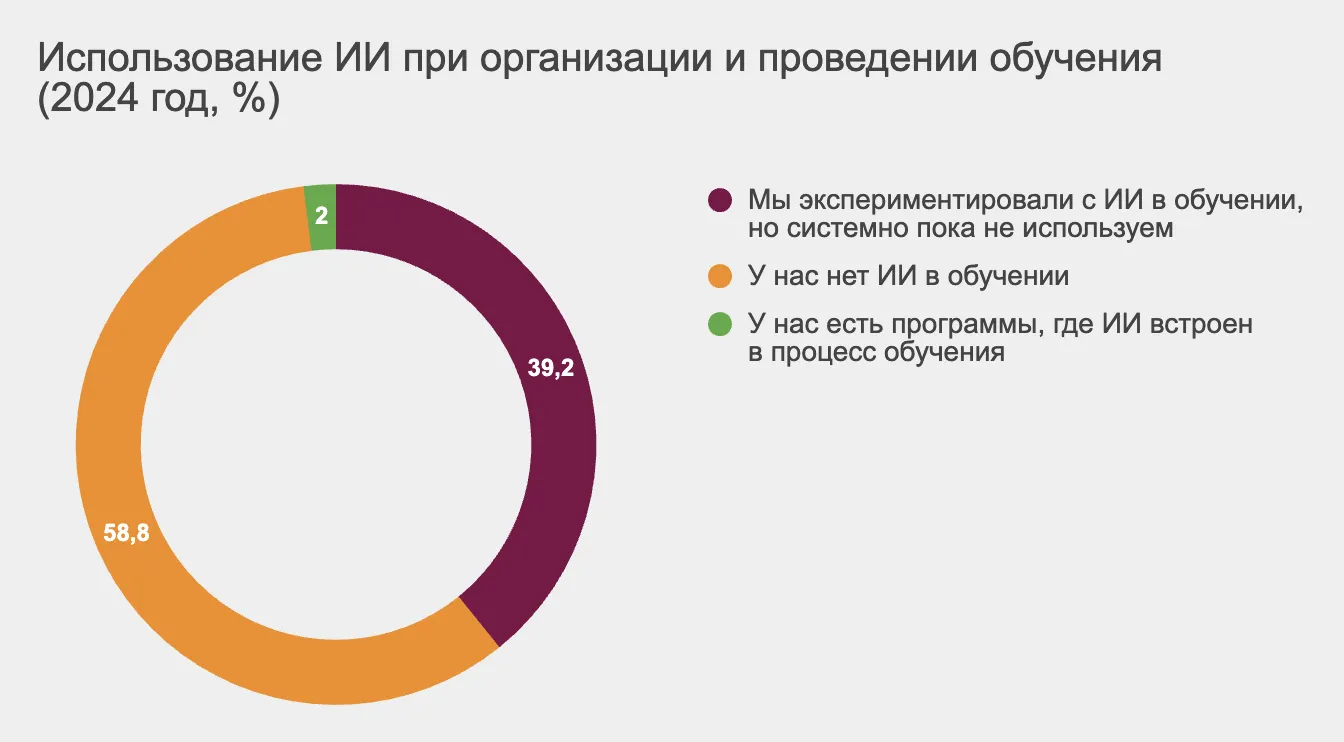
С 2023 года участники исследований начали активно обсуждать использование искусственного интеллекта в образовательном процессе. На начальном этапе только 13% респондентов отметили, что уже пробовали ИИ-инструменты в обучении. Однако в 2024 году этот процент возрос до 39,2%, а в 2025 году достиг 51%. Это свидетельствует о растущей популярности и принятии технологий ИИ в образовательной среде, что открывает новые возможности для повышения эффективности обучения и персонализации образовательного опыта.
За последний год доля компаний, систематически внедряющих искусственный интеллект в обучение сотрудников, увеличилась более чем в три раза — с 2% до 7%. Вместе с тем, 42% опрошенных организаций не применяют ИИ в своих учебных программах. Это свидетельствует о растущем интересе к технологиям ИИ в сфере корпоративного обучения, однако значительная часть компаний все еще не использует эти возможности.
This year, for the first time, participants shared their experience of using artificial intelligence in the educational process and described the functions that AI tools perform. The study's results demonstrated the diverse applications of AI in education. Many respondents noted that AI helps personalize the learning process, allows for tailoring materials to individual student needs, and improves interactions between teachers and students. Furthermore, AI-based tools are actively used to automate assessments, significantly saving teachers time. This study highlights the growing role of artificial intelligence in education and its potential to improve the effectiveness of the learning process.
- 24% — adaptive programs and content;
- 14% — AI trainers and simulators;
- 10.6% — assessment of the quality and effectiveness of training;
- 10.6% — AI assistants;
- 2.9% — AI mentors;
- 2.9% — AI tutors;
- 1% — AI coaches.
According to surveys, by 2025, 17.4% of companies plan to transfer the tasks of accompanying and supporting employees to artificial intelligence. This share is expected to continue to grow in the future.
How Companies Use AI to Develop Learning Content
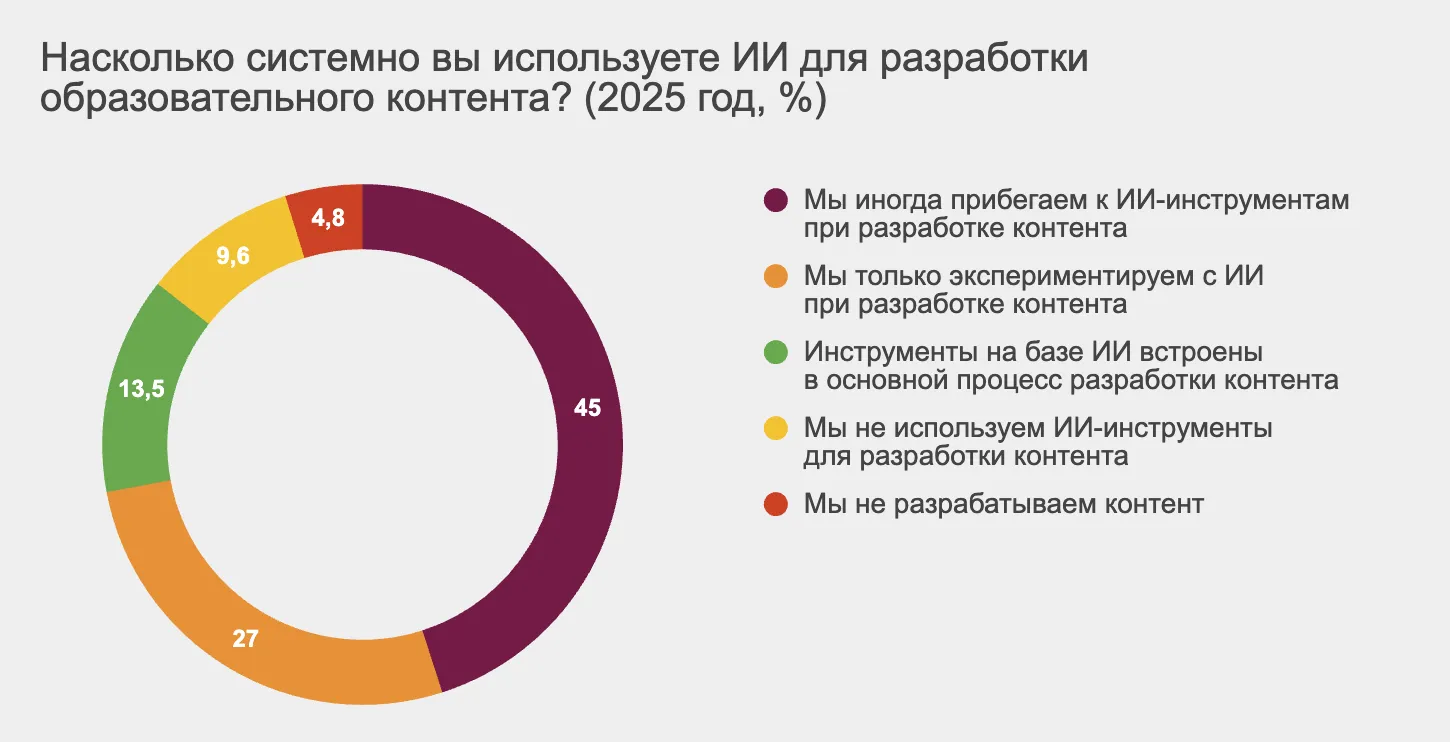
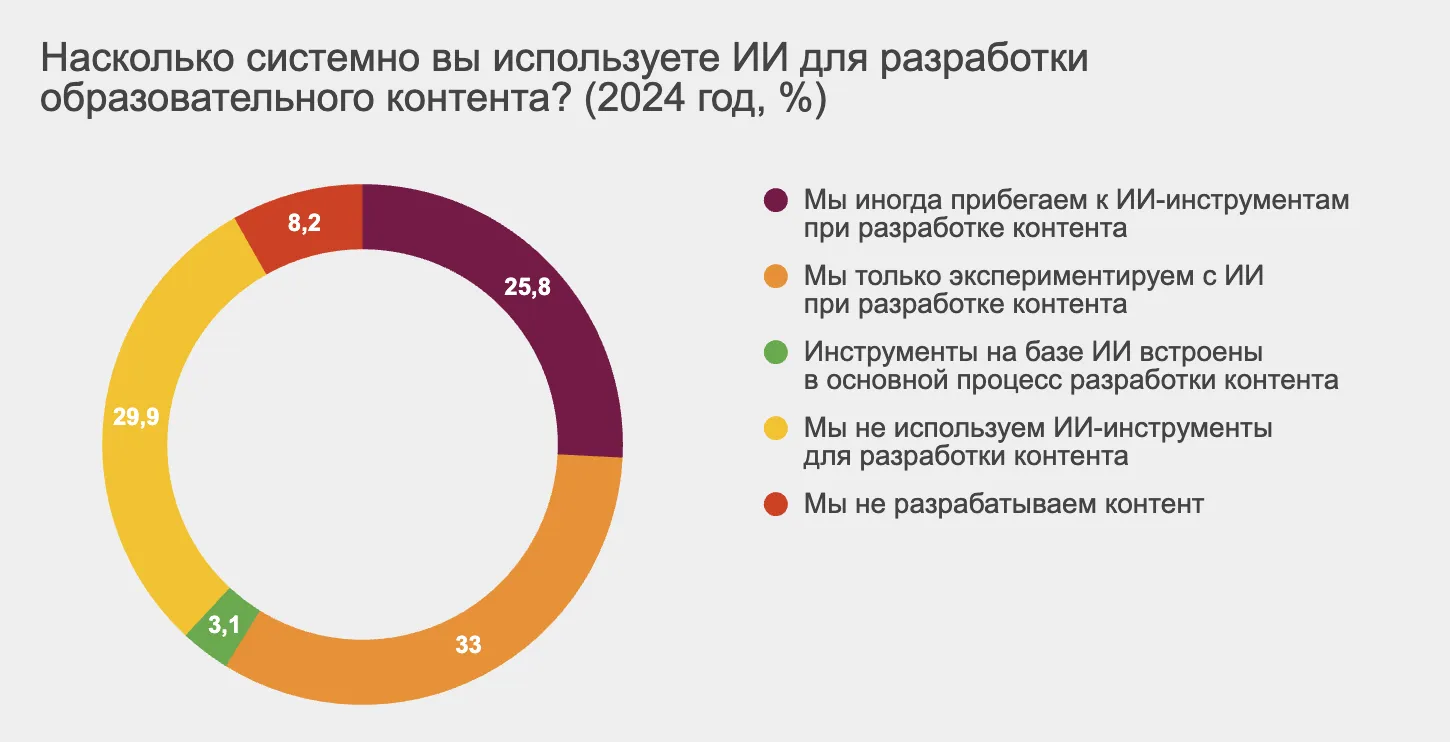
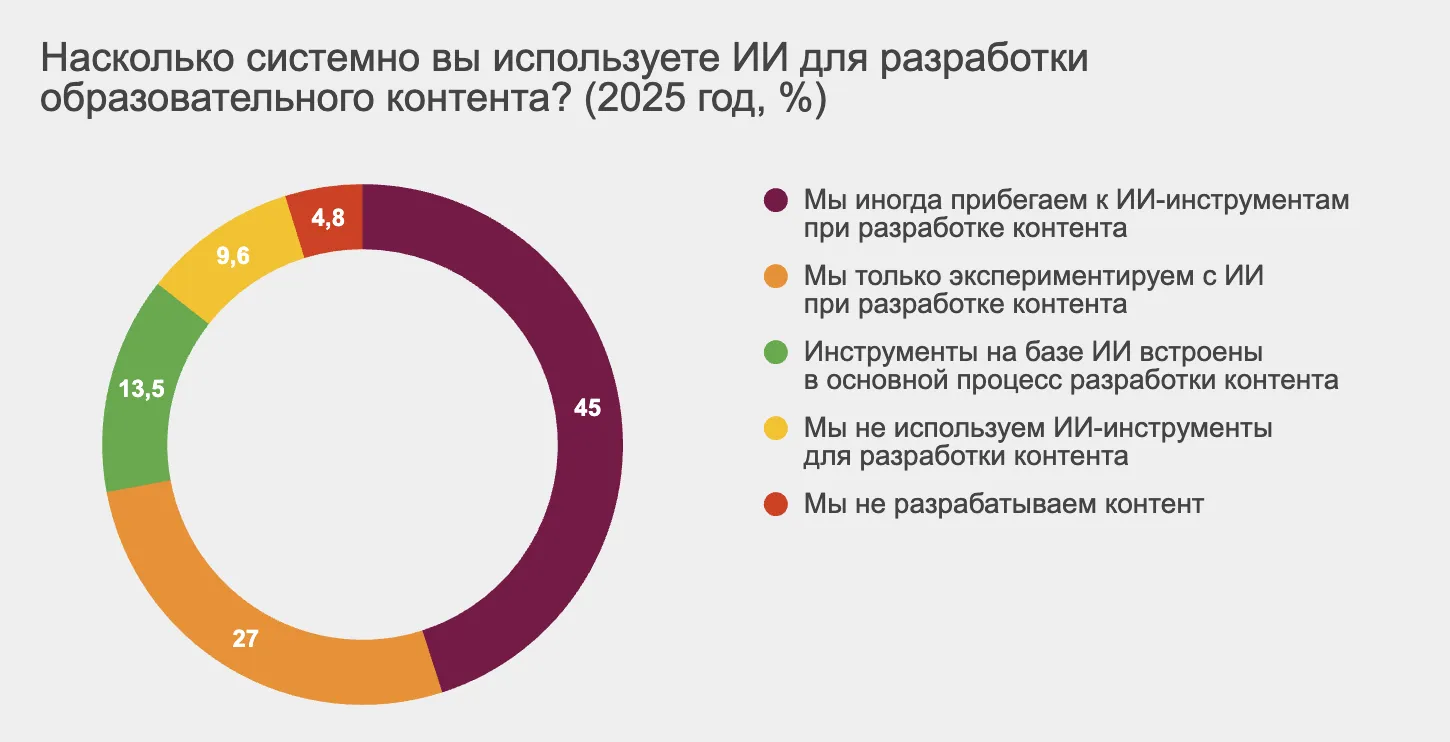
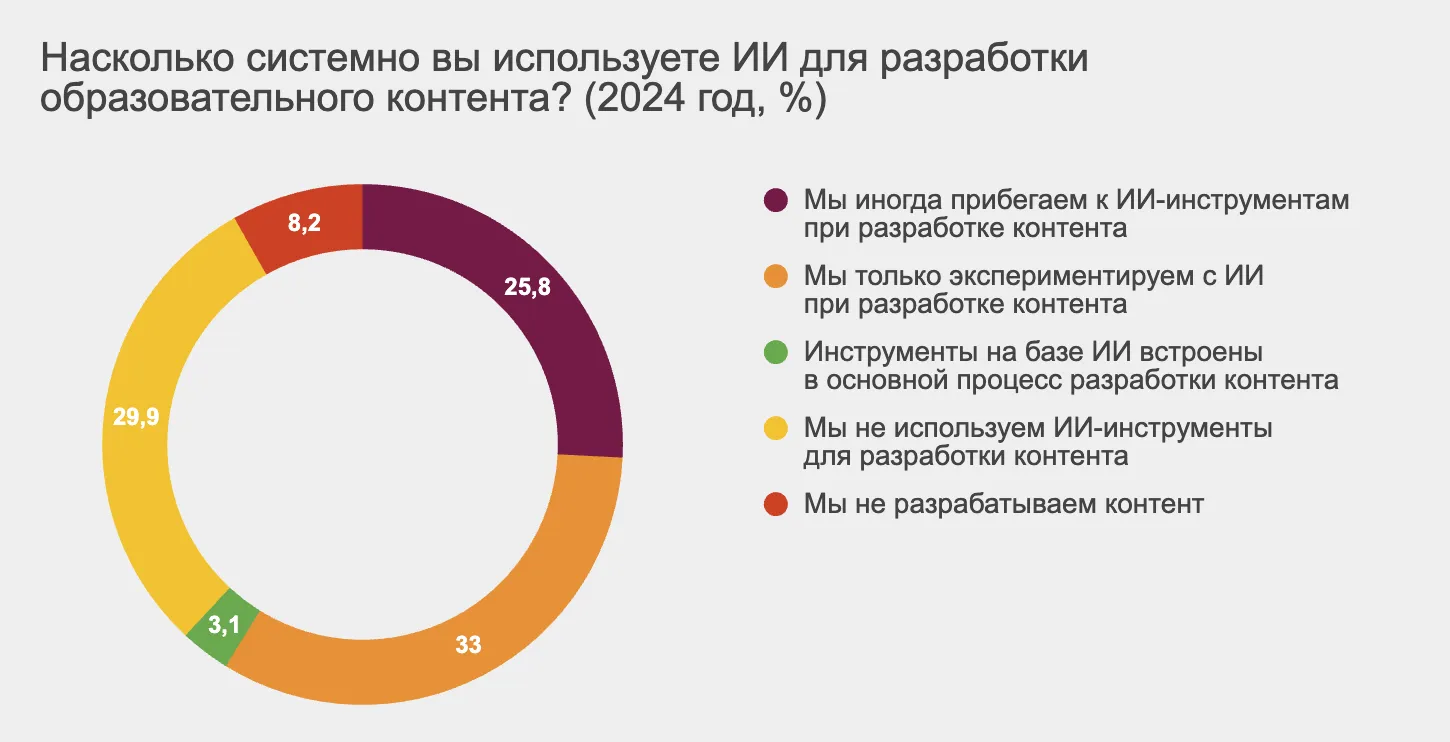
In recent years, there has been a significant increase in the use of artificial intelligence in corporate course development. The share of companies actively using AI tools increased from 3.1% to 13.5%. Almost half of respondents use AI periodically to solve specific problems, and 27% are just beginning to experiment with this new technology. However, only 9.6% of companies do not use artificial intelligence in content creation, which is significantly lower than last year's figure, when it was 29.9%. This trend indicates a growing interest in innovative technologies in the educational sphere.
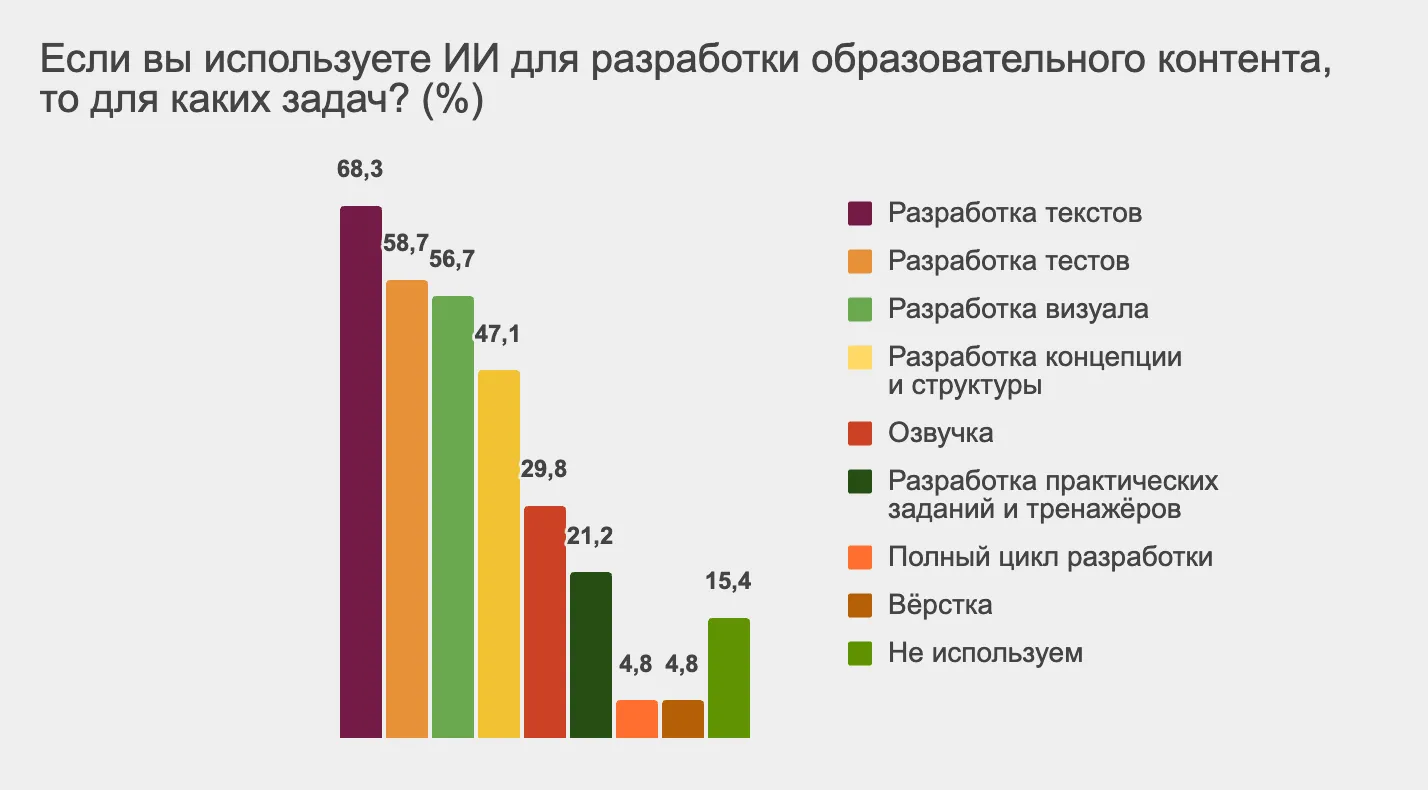
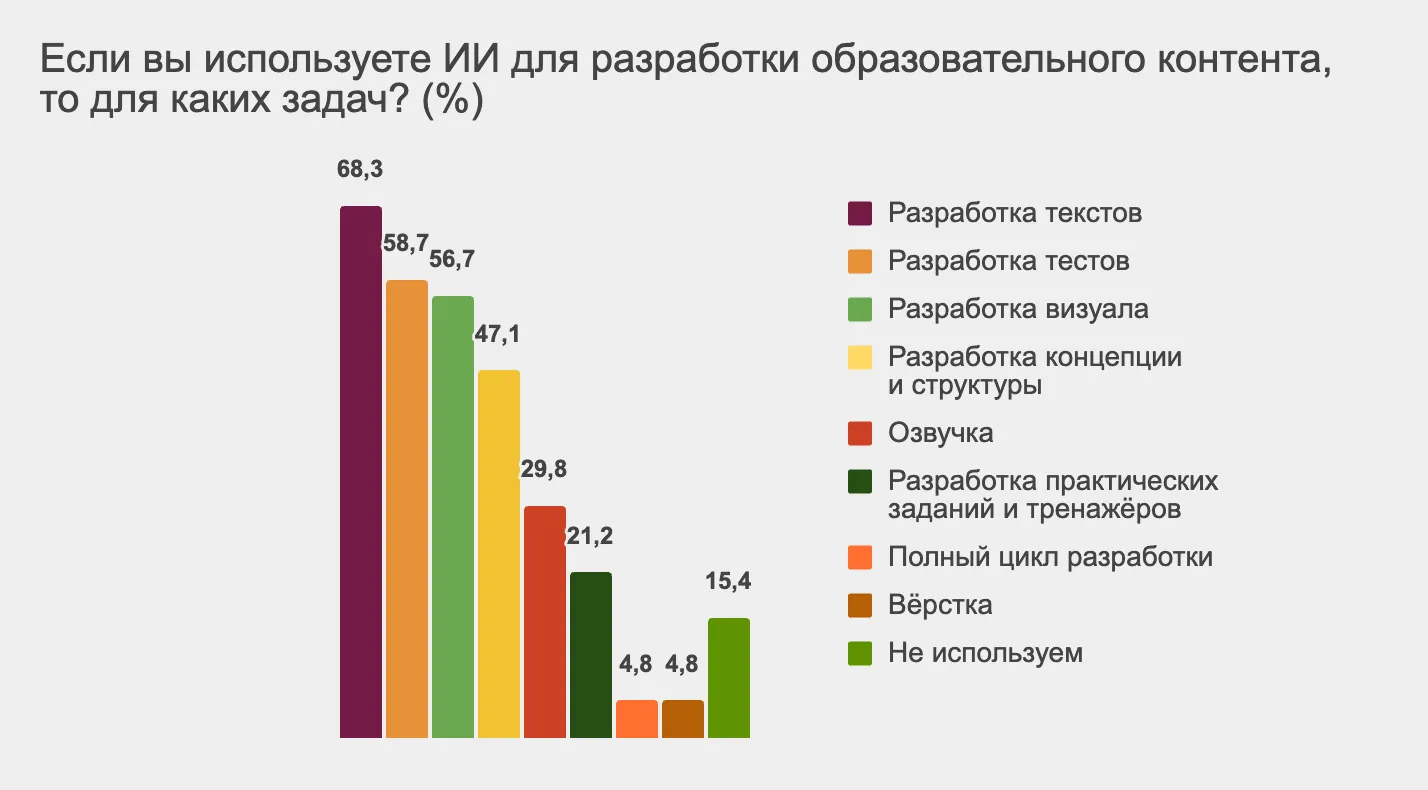
According to the survey, a significant number of participants use neural networks to create various materials for Courses. 68.3% of respondents generate text materials, 58.7% generate test assignments, and 56.7% generate visual elements. Almost half of the participants (47.1%) use artificial intelligence to develop the concept and structure of courses. 29.8% of respondents use AI technologies to read text aloud, and 21.2% to create practical assignments and simulators. Finally, 4.8% of participants noted that their companies integrate artificial intelligence into the full course development cycle. This highlights the growing role of neural networks in education and their importance for improving the quality of learning.
Sergey Zamaraev expressed the opinion that the next step in integrating artificial intelligence into the creation of educational content will be the automatic generation of videos for training courses. Elvina Sharafutdinova supported this forecast, noting that there is already a need for realistic digital avatars. Such avatars can significantly reduce the time and costs companies spend on recording video lectures with experts and teachers. The introduction of AI in educational technologies opens up new opportunities for improving the effectiveness of learning and streamlining content creation processes.
Reading is an important aspect of our lives. It helps develop thinking, improves vocabulary, and enriches knowledge. Regularly reading books, articles, and other materials not only contributes to personal growth but also improves the level of education. In the modern world, access to information has become much easier thanks to the internet. Reading online resources allows you to receive up-to-date information at any time. It is highly recommended to set aside time for reading to maintain mental activity and expand horizons. Remember to choose high-quality sources of information to ensure reliable and useful knowledge.
A Russian company has developed digital avatars for teachers, designed for employee training. This innovative technology improves the learning process, making it more interactive and personalized. Digital avatars can adapt to the needs of each learner, providing access to educational materials and resources at any time. Using digital avatars in corporate training helps increase employee engagement and improve the quality of information absorption. This development demonstrates the company's commitment to implementing modern technologies in the field of training and personnel development.
Tatyana Galkina noted that the main advantage of artificial intelligence tools is the automation of routine tasks. However, in her opinion, trusting neural networks to act as subject matter experts can be risky.
In our artificial intelligence training courses, we often refer to real-life cases and situations, which are analyzed by experts based on their experience. If we abandon this approach and flood the market with AI-based educational courses devoid of individuality, expert evaluation, and real-life experience, this will create serious problems for the quality of education. Educational programs must be rich in practical examples to ensure a deep understanding of the topic and the development of essential skills. Pavel Bezyaev noted that the problem of a lack of high-quality content existed even before the advent of generative AI. Previously, materials were often "pulled from the internet," and such courses without expert content provided no real value. Valery Leontyev added that artificial intelligence must earn the trust of learners. Currently, the knowledge that certain content was created by a neural network tends to reduce confidence in its quality. This underscores the importance of careful verification and selection of information to ensure the high educational value of materials.
Who Develops Employee Training Content
The question of whether companies develop training content in-house or purchase it from external providers has been discussed in surveys since 2022. The results have remained consistent over all these years: almost all companies (97.3% in 2025) prefer to create courses and programs in-house. This demonstrates a high level of internal expertise and the organizations' desire to control the quality and content of educational materials. Developing training content independently allows companies to tailor programs to their specific needs and goals, which ultimately contributes to increased training effectiveness and employee development.
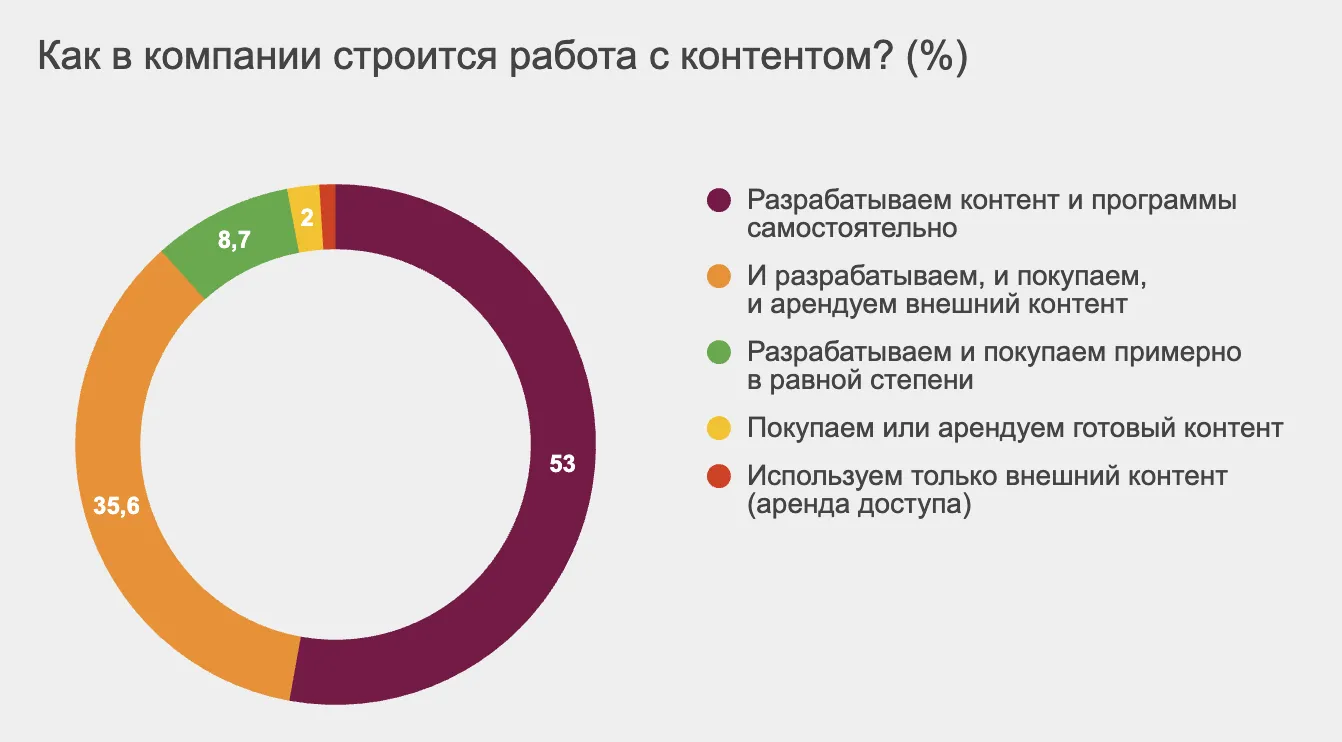
Pavel Bezyaev notes that this surprising result demonstrates the presence of content creation specialists not only in large but also in medium-sized and small companies. This confirms that any organization has the ability to develop high-quality content tailored to their specific needs and products. Content on general topics, such as soft skills, can be rented, and this is a common practice. However, it is often observed that companies from industries such as oil and gas and transportation create courses on leadership, time management, and emotional intelligence, confident in their own expert knowledge. This trend negatively impacts the educational content development market, as it leads to a distorted perception of real expertise in these areas.
Valery Leontyev noted that Labmedia develops custom e-courses and sells ready-made educational products. In his opinion, the versatility of soft skills courses is both their main advantage and disadvantage. This diversity allows for a wide range of topics and areas to be covered, but can also lead to a lack of depth in specific skills. It's important to find a balance between versatility and specialized content to maximize training effectiveness.
When selling generic courses, especially for the industrial sector, there's often a request for customization: "That's not suitable for us. It would be great to dress office workers in their work uniforms in the photos." This approach implies customization, which entails additional costs. It's important to understand that this issue applies not only to visual elements but also to course content, examples, and other aspects. This explains why ready-made courses, especially on neutral topics, are less in demand. A personalized approach is necessary to create relevant content that will meet the specific needs of a business.
Sergey Zamaraev explains that companies are seeking to reduce course development costs, seeing no need for additional investment in training. He notes: "Why order an expensive, beautifully designed course with gamification elements when my expert can simply compile the content and provide it to employees as a manual? In both cases, employees will gain the necessary knowledge, and there will be no significant difference in business results. We've been discussing the Kirkpatrick model for many years, but so far no one can accurately measure and prove that this particular course and its format actually impact business metrics."
This approach to training calls into question the effectiveness of traditional formats, and companies risk missing out on opportunities that higher-quality and innovative teaching methods can bring.
Sergey notes an interesting trend in the field of educational courses: despite the availability and low cost of ready-made solutions, companies prefer to develop their own courses from scratch. This may be due to a desire to maintain uniqueness and relevance to the specifics of their business. However, with the development of artificial intelligence, the situation may change. Neural networks are capable of generating courses, but not every company has sufficient expertise to evaluate the quality and reliability of the resulting content. In this context, Sergey Zamaraev believes that external training providers will play a key role in providing the necessary level of expertise and information verification, allowing companies to leverage the benefits of AI and ready-made courses more effectively.
Tatyana Galkina noted that a company's interest in external courses is directly linked to the development level of its training department and the current stage of business development. The maturity of the training department influences employees' readiness for new knowledge and skills, which, in turn, determines the need for external training. Therefore, it is important to consider these factors when planning educational programs and investing in staff training.
When launching training in a business, it is important to find a reliable partner with an extensive course library and the ability to quickly organize the training process. In such cases, a company can begin with ready-made courses. Furthermore, during periods of transformation, when the need arises for retraining or reskilling employees, a business may realize that it is difficult to cope with this task on its own. In such situations, it is advisable to commission the development of specialized courses from professionals. This will not only improve employee qualifications but also adapt their skills to current market demands.
How willing are companies to collaborate with online schools?
From 2022 to 2024, there was a steady increase in the share of companies using online courses and programs to train employees. However, in 2025, this figure decreased again from 7.2% to 5.8%. At the same time, the number of organizations integrating EdTech products into educational programs aimed at specific needs increased. The share of such companies increased from 13.4% to 18.3%. This indicates a growing interest in personalized educational solutions in the field of corporate training.
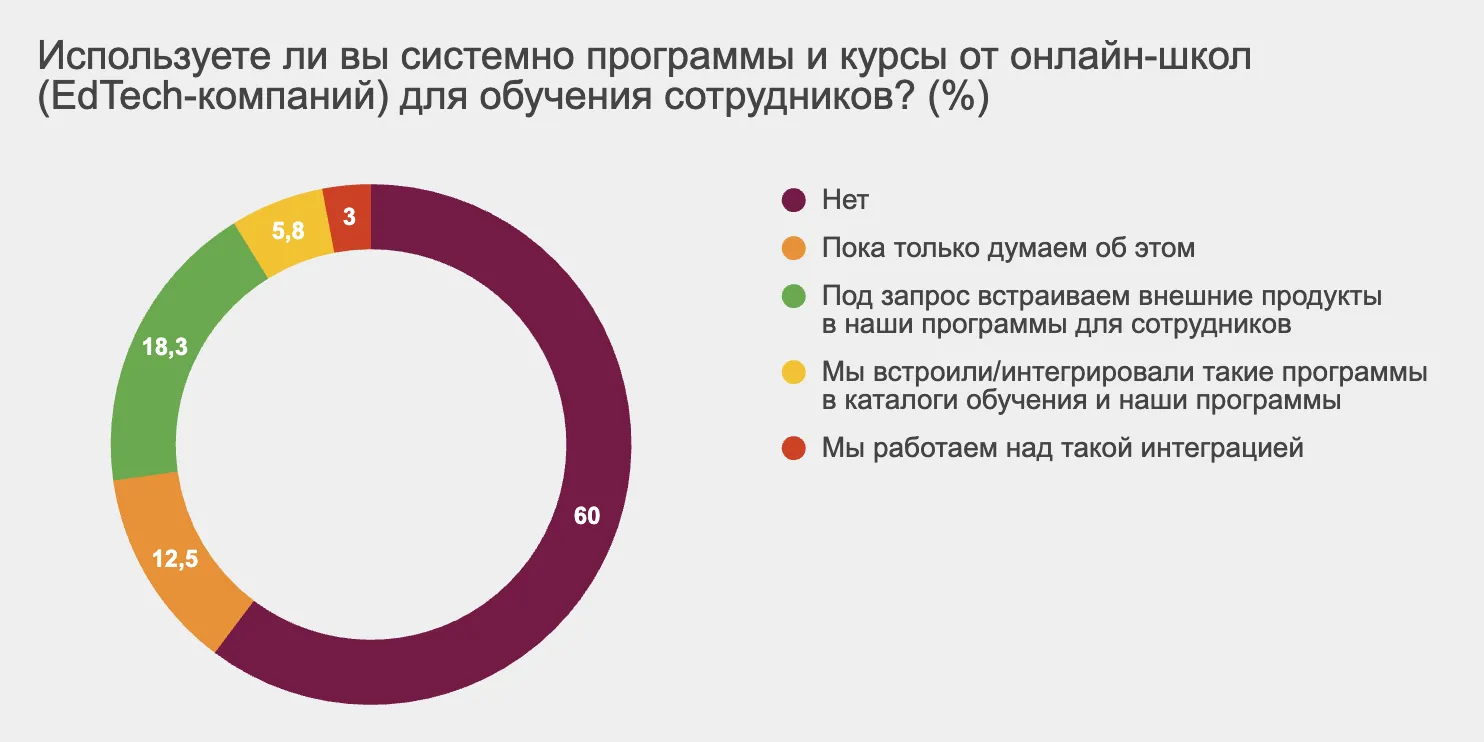
Valery Leontyev notes that the integration of online learning into the corporate sector is slow. This is due to companies' distrust of the quality of content offered by online schools. Many organizations associate online education with the infobusiness, which has a negative reputation. Furthermore, the cost of training is a significant barrier for companies. Although large enterprises can afford individual fees for training promising employees, mass adoption will only be possible if the cost of training one employee is reduced to 50 rubles and the course duration is reduced to a few hours instead of several months.
Tatyana Galkina noted that even within a single school, educational products can vary significantly in quality, which may discourage companies from collaborating with the EdTech sector. She also emphasized that organizations are reluctant to invest in training their employees in online schools. This is due to the fact that such expenses require time, including working time, and it is often unclear whether the new skills will benefit the company.

Read also:
Renting courses for corporate training: is it worth the investment in this format?
Corporate training plays a key role in employee development and improving company performance. Renting training courses can be an attractive option for organizations looking to improve their employees' skills without a significant financial investment. However, there are several important aspects to consider before making a decision.
The first thing to consider is the quality of the content. When renting courses, you need to make sure they meet the current requirements and standards of your industry. Pay attention to the experience of the instructors and reviews from other companies that have already used these courses.
The second point is flexibility in training. Renting courses often provides the option of choosing a format - online or offline. This allows you to adapt the training process to the needs of your team and the work schedule of your employees.
It is also worth considering the cost of renting the courses. While this may be a more cost-effective option compared to creating your own programs, it is important to calculate all the costs. Иногда аренда может оказаться невыгодной, если курс не приносит ожидаемых результатов.
В итоге, аренда курсов для корпоративного обучения может стать эффективным инструментом для развития сотрудников, если правильно подойти к выбору контента и формата. Оценивайте свои потребности и возможности, чтобы принять взвешенное решение.
Какие платформы компании используют для обучения сотрудников
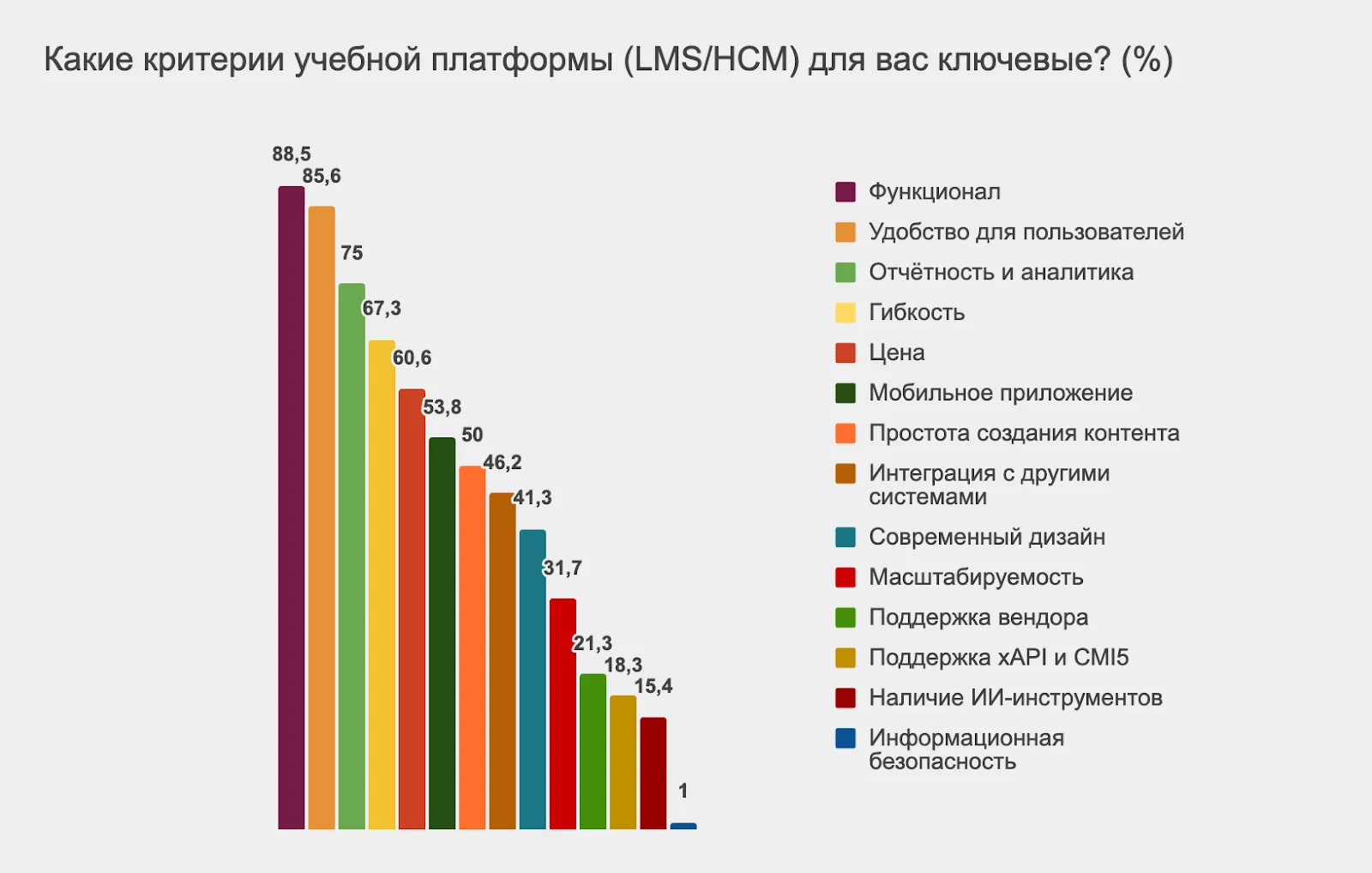
Опрос, проведенный среди компаний, показывает, что приоритеты в выборе платформ для обучения сотрудников, известных как LMS (Learning Management Systems), остаются стабильными на протяжении трех лет. В числе основных критериев, по которым организации выбирают LMS, находятся следующие:
- 88,5% — функциональность;
- 85,6% — удобство для пользователей;
- 75% — отчётность и аналитика.
В списке приоритетов пользователей на следующем уровне расположены такие факторы, как гибкость платформы, которую отмечают 67,3% респондентов, стоимость услуг, которую учитывают 60,6%, и наличие мобильного приложения, важное для 53,8% опрошенных.
Участники опроса значительно реже упоминают важность поддержки стандартов для отслеживания действий пользователей, таких как xAPI и CMI5, что отмечают только 18,3%. Также лишь 15,4% респондентов обращают внимание на наличие инструментов искусственного интеллекта, а всего 1% считает критически важной информационную безопасность платформы.
При обсуждении приоритетных функций, которые компании хотят развивать в LMS, участники чаще всего выделяли удобство интерфейса, которое отметили 55,8% опрошенных. Адаптивность и персонализация обучения заинтересовали 49% респондентов, а расширенная аналитика — 48,1%. Инструменты на базе искусственного интеллекта, в свою очередь, оказались менее актуальными, их упомянули лишь 23,1% участников. Это подчеркивает важность создания интуитивно понятного и адаптивного образовательного пространства, которое отвечает потребностям пользователей.
Изучение новых тем и получение актуальной информации — важная часть любого процесса обучения. Чтение разнообразных источников помогает расширить кругозор и углубить знания. Регулярное чтение статей, книг и научных работ способствует развитию критического мышления и анализу полученной информации. Не забывайте о важности систематизации знаний и их практического применения в жизни и работе. Обратите внимание на проверенные ресурсы, которые предлагают качественный контент и актуальные исследования. Погружение в новые материалы обогатит ваш опыт и поможет оставаться в курсе последних тенденций и достижений. Читайте также:
Определены ведущие компании на российском рынке LMS для корпоративного обучения. Эти платформы предлагают инновационные решения, которые помогают организациям эффективно обучать сотрудников, улучшая их навыки и повышая производительность. В условиях стремительного развития технологий и изменений в бизнес-среде, выбор правильной LMS становится критически важным для успешного корпоративного обучения. Лидеры рынка предлагают разнообразные функции, включая адаптивное обучение, инструменты для оценки и мониторинга, а также возможности для создания индивидуальных обучающих траекторий. Эти аспекты делают их решения привлекательными для компаний, стремящихся к повышению квалификации своих сотрудников и улучшению общей эффективности бизнеса.
Доля компаний, планирующих сменить корпоративную LMS в ближайшие 1–3 года, остается на уровне около 17%, как и в прошлом году. В 2024 году основными причинами для замены были изменение задач обучения, а также стоимость и качество поддержки платформы. В 2025 году ключевой причиной стало устаревание платформы. Сергей Замараев предполагает, что это устаревание в первую очередь связано с недостатками в UI/UX-дизайне корпоративных LMS. Улучшение пользовательского интерфейса и опыта становится критически важным для поддержки эффективного обучения и удовлетворенности пользователей.
Валерий Леонтьев подчеркивает важность понимания участников опросов о критериях выбора и причинах замены LMS. Ключевым аспектом является то, кто отвечает на вопросы и кто принимает решения в компаниях. По его мнению, служба безопасности часто отсекает 99% инициатив, что делает низкий рейтинг критерия безопасности LMS в опросе малозначимым. Это подчеркивает необходимость более глубокого анализа мнений и факторов, влияющих на выбор LMS, чтобы обеспечить обоснованные выводы и эффективные решения.
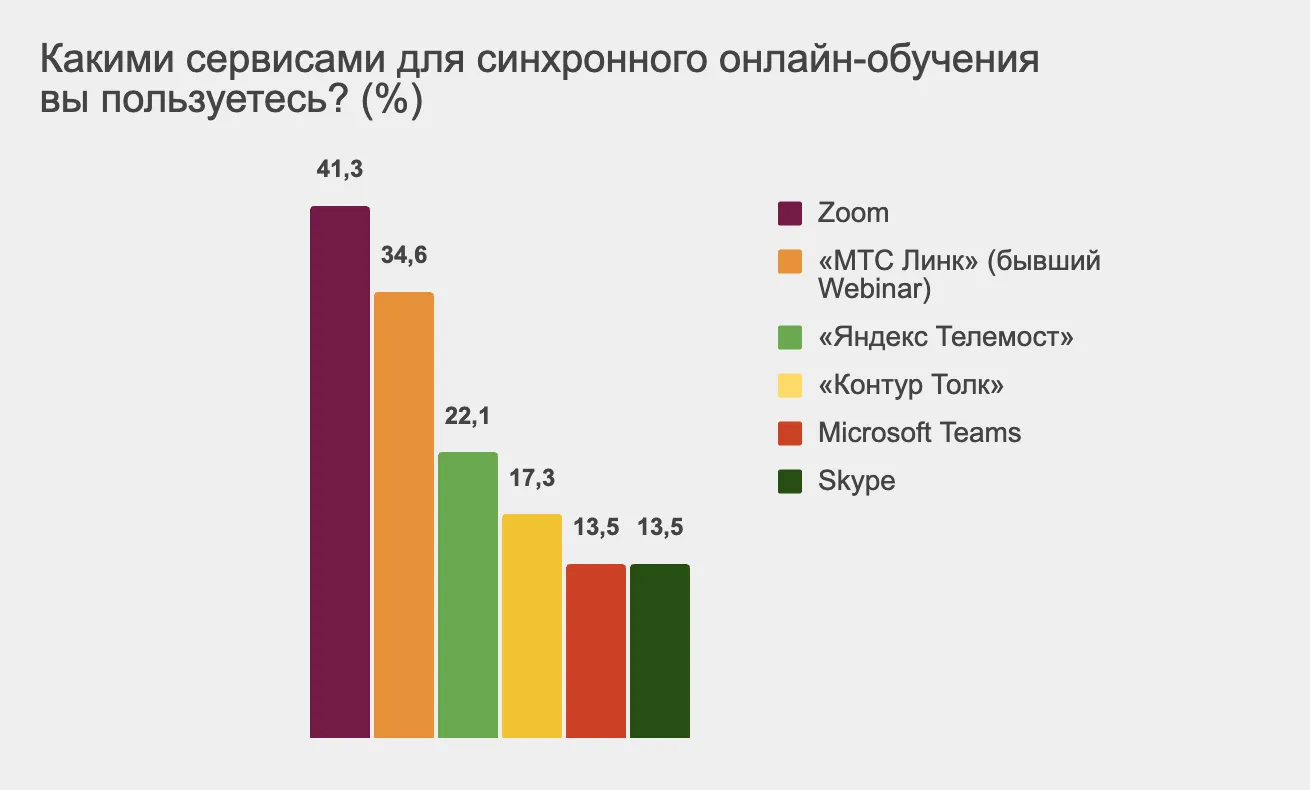
Среди онлайн-сервисов для синхронного обучения наибольшей популярностью по-прежнему пользуется Zoom, который выбирают 41,3% респондентов. Однако за последний год его доля снизилась с 50% в 2024 году. Российские платформы продолжают набирать популярность: «МТС Линк» занимает 34,6% среди опрошенных, а «Яндекс Телемост» — 22,1%. В этом году в рейтинг вошел и новый отечественный сервис «Контур Толк», который в 2024 году был упомянут 5% респондентов, а в 2025 году его доля возросла до 17,3%. Примечательно, что половина опрошенных использует два или более сервиса одновременно для онлайн-обучения.
Павел Безяев подчеркивает ключевые особенности текущей ситуации с образовательными платформами. Важно отметить, что образовательные платформы становятся все более востребованными среди пользователей. Они предлагают разнообразные курсы и программы, что позволяет каждому находить подходящий вариант для обучения. Актуальность онлайн-образования возрастает благодаря гибкости формата, который позволяет обучаться в удобное время и темпе. Кроме того, многие платформы внедряют инновационные технологии, такие как интерактивные задания и системы оценки, что значительно повышает качество образования. Эти изменения способствуют более глубокому усвоению материала и вовлеченности студентов. Таким образом, современные образовательные платформы продолжают развиваться, отвечая на потребности пользователей и изменяющиеся условия рынка.
- Компании зачастую используют целый спектр схожих инструментов для обучения сотрудников — по несколько LMS, по несколько специализированных сервисов для обучения и оценки. То есть остаётся проблема «зоопарка решений» вместо отлаженных экосистем.
- Новые узкоспециализированные сервисы для онлайн-обучения не работают над интеграцией с уже существующими и распространёнными платформами, а сами стараются превратиться в многофункциональную LMS, что, как отмечает Павел Безяев, только усиливает хаос.
- По-прежнему применяются устаревшие стандарты доставки образовательного контента и обмена данными — в первую очередь SCORM, появившийся ещё в 2000 году. А более новые стандарты, такие как xAPI, пока не пользуются популярностью.
Изучите дополнительные материалы:
Аналитики «СберУниверситета» выявили ключевые проблемы, с которыми сталкивается корпоративное обучение в России. Основные трудности включают недостаточную адаптацию образовательных программ к специфике бизнеса, отсутствие системы оценки эффективности обучения, а также недостаточную мотивацию сотрудников к участию в обучающих мероприятиях. Эти факторы значительно снижают результативность корпоративного обучения и ограничивают возможности компаний в развитии их кадрового потенциала. Улучшение этих аспектов может способствовать более эффективному процессу обучения и повышению конкурентоспособности организаций на рынке.
Как компании оценивают эффективность обучения
Недавние исследования указывают на то, что оценка эффективности обучения стала более важной для компаний в последние два года. В 2025 году большинство респондентов отметили, что для оценки знаний сотрудников используются тесты (87,5%). Кроме того, для измерения удовлетворенности сотрудников опытом обучения применяются анкеты обратной связи, а также метрики NPS и CSI (83,7%). Эти данные подчеркивают растущую значимость систематического подхода к обучению и его результатам, что позволяет компаниям повышать качество образования и вовлеченность сотрудников.
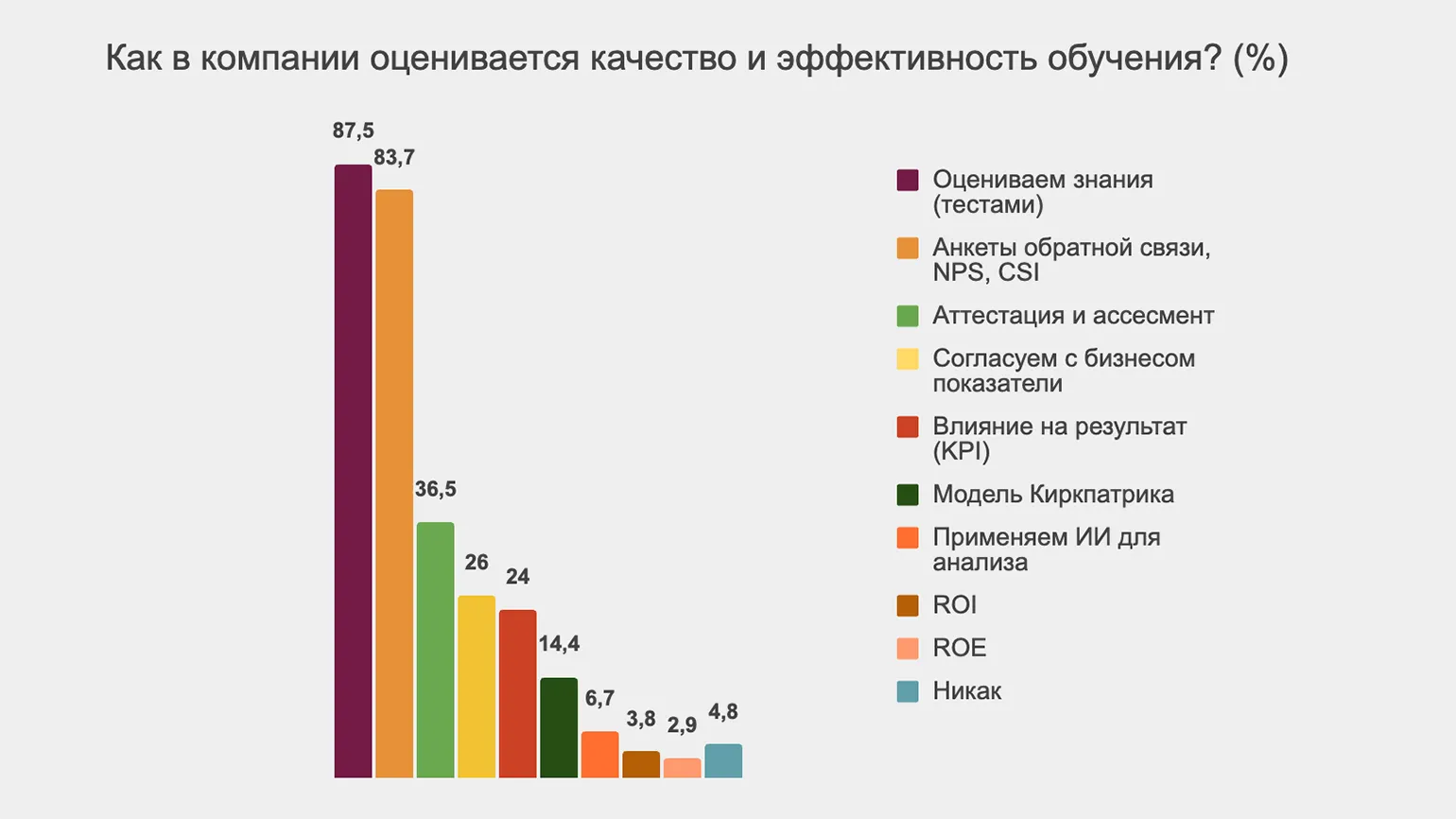
Согласно исследованиям, более трети участников (36,5%) отметили важность проведения ассесмента компетенций и аттестаций сотрудников. В 26% компаний эффективность обучения измеряется с использованием согласованных с заказчиком бизнес-метрик, в то время как 24% респондентов оценивают влияние обучения на ключевые показатели эффективности (KPI). Интересно, что в 2024 году доля компаний, применяющих модель Киркпатрика, увеличилась с 4% до 30%, однако в 2025 году она снова снизилась до 14,4%. В этом году также впервые была зафиксирована оценка эффективности обучения с помощью искусственного интеллекта — её упомянули 6,7% участников исследования.
Key findings of the study
In conclusion, Pavel Bezyaev noted that, overall, the situation in the corporate training segment has remained stable over the past two years. However, the introduction of artificial intelligence has significantly changed many processes, including the organization and delivery of training, as well as the creation of content and evaluation of its effectiveness. The founder of Digital Learning predicts that the reduction in costs for developing educational content associated with the use of AI will have a significant impact on this market.
Sergey Zamaraev noted that after significant changes in 2020 and 2022, the situation appears to have stabilized and has begun to resemble the pre-pandemic period. Despite the influence of artificial intelligence, the basic training formats and technologies remain unchanged – people continue to act as before. Tatyana Galkina supported this point of view, adding that it is necessary to strive for more adaptive educational programs. However, she also emphasized that fundamentally new approaches to solving the problem of "teaching a person to learn" are unlikely to appear in the foreseeable future.
Reworked text:
Read also:
- New AI agents can turn corporate online training into a fiction
- The most popular tools for engaging employees in corporate training have been named
- Heads of foreign IT companies have named priority areas for employee training
- Opinion: why convenience, not efficiency, has become the main thing in corporate training
- Opinion: "Corporate training is pure "infobusiness""
Who took part in the study
In May 2025, a survey was conducted among participants in the Digital Learning community. 104 companies of various sizes took part in the survey. The survey results will help better understand current trends and needs in the field of digital training.
- up to 100 people — 13.5%;
- from 100 to 1,000 people — 28.8%;
- from 1,000 to 3,000 people — 15.4%;
- from 3,000 to 5,000 people — 9.6%;
- from 5,000 to 10,000 people — 10.6%;
- from 10,000 people — 22.1%.
The study included respondents from various fields of activity. The highest representation is observed in the IT industry, amounting to 24%. Followed by manufacturing with 12.5%, retail with 10.6% and banks and financial services with 7.7%. Smaller shares are represented by the public sector, logistics and transportation, hotel and restaurant business, pharmaceuticals, and other industries. This wide range of participants allows for a more complete understanding of current trends and needs across different sectors.
For which categories of employees are training systems typically designed?
The 2025 study addressed the question of which categories of employees companies are designing their training systems for. This research highlights the importance of a personalized approach to training that takes into account the diversity of employee roles and needs. Effective training systems should be tailored to different categories of employees, including newcomers, experienced professionals, and managers, to ensure the maximum return on investment in personnel development. Training systems targeted at specific groups contribute to the development of skills, motivation, and retention of talent within the company.
Most companies focus on training specialists, who account for 85.6% of all respondents, and middle managers – 80.8%. Almost half of the study participants, 48.1%, are engaged in the development of top managers, and 43.3% – workers or employees. In addition, 24% of respondents reported that their organizations conduct training for service personnel. Training employees at all levels is a key factor in improving the efficiency and competitiveness of companies in the modern environment.
Do companies consider the age characteristics of employees in training?
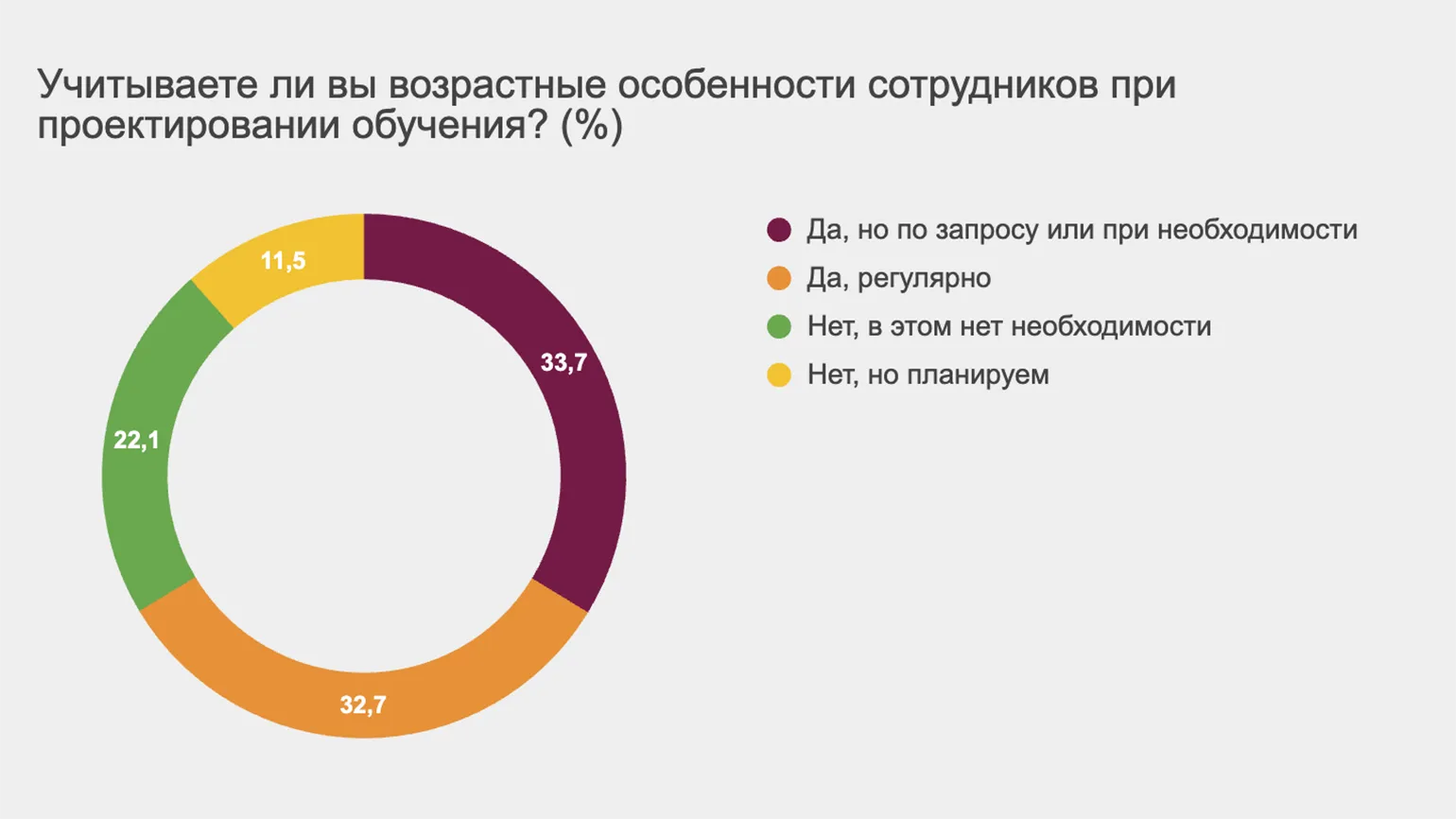
The question of whether companies consider the age of employees when developing training programs is becoming increasingly relevant. Research shows that a significant proportion of organizations, namely 66.4%, adapt training to the specific needs of different generations, both regularly and upon request. However, only 22.1% of respondents believe that taking age into account in training is not beneficial. This indicates a growing awareness of the importance of an individual approach in the training and development of personnel, which contributes to increased work efficiency and employee satisfaction.
The survey revealed which new learning formats they offer to engage Generation Z employees—young people born between 1996 and 2010. This is the first generation to grow up in a digital environment, which significantly influences their values, interests, and preferences. According to research by Skillbox, Skillfactory, and the Opportunity Accelerator, young professionals place particular emphasis on work-life balance, which is more important to them than a high salary. In terms of work formats, remote work is preferred. Adapting training programs and work processes to the needs of Generation Z can significantly improve training effectiveness and employee engagement.
Tatyana Galkina, Director of the iSpring Academy, notes that working with Generation Z is challenging. Effective engagement requires creating engaging and understandable content that will interest and engage them in the learning process. This requires a special approach and adaptation of methods to the modern requirements and preferences of young people.

Reading is an important part of personal and professional development. It helps broaden horizons, improve vocabulary, and increase literacy. Regularly reading books, articles, and research papers deepens knowledge and develops critical thinking. It's important to choose a variety of genres and topics to gain a diverse experience and new ideas. Reading not only entertains but also stimulates mental activity, which is especially important in today's information society. Stay up-to-date with new publications and choose literature that will help you grow and develop.
The "unUniversity" project provided valuable insights into the Zoomer generation, which are significantly influencing educational and career approaches. Born in the age of technology, Zoomers exhibit unique learning and information processing characteristics. They prefer interactive and hands-on learning methods, highlighting the need to adapt educational programs to their needs.
Furthermore, Zoomers value flexibility and the opportunity for self-expression, making it important to create individualized educational trajectories. Their desire for social change and sustainable development also requires educational institutions to integrate social responsibility and environmental issues into their curricula.
Analyzing the "non-University" experience, it became clear that successful engagement with Zoomers requires taking their preferences into account, ensuring access to modern technologies and relevant knowledge. This will not only improve the quality of education but also prepare young people for the challenges of the modern world.
Elvina Sharafutdinova of MTS Link noted that the younger generation, known as Zoomers, who are accustomed to modern and user-friendly mobile applications, often experience negative emotions when using corporate tools with outdated interfaces and designs typical of the early 2000s. This disappointment can significantly reduce employee interest in such tools and, as a result, their engagement in work processes. Updating interfaces and improving the user experience are becoming critical for increasing work efficiency and employee satisfaction.
Elvina identified another challenge that also affects the more mature generation: the "second screen" effect. This occurs when an employee, for example, is watching a training webinar on a laptop while their smartphone is nearby, distracted by notifications from social media and messaging apps, as well as games and streaming services. Thus, educational content competes for the user's attention with a multitude of entertainment factors, significantly complicating the learning process. To effectively address this challenge, it is necessary to develop strategies that help minimize distractions and increase engagement in learning.
A study on digital learning found that 33.7% of organizations surveyed are actively implementing new, engaging learning formats for young employees. Furthermore, 35.6% of companies intend to implement similar initiatives in the future. The introduction of innovative teaching methods helps to increase the effectiveness of the educational process and improve employee engagement.

Learn more about our content.
Over the past 10 years, corporate training technologies and formats have undergone significant changes. The emergence of new digital tools and platforms has significantly simplified the employee training process. Traditional methods, such as face-to-face classes, are now often supplemented by online courses and webinars, allowing training to take place at a convenient time and in a comfortable environment.
The development of mobile technologies has also impacted corporate training. Employees can learn on mobile devices, making the process more accessible and flexible. Virtual reality and augmented reality have begun to be used to create interactive training programs, immersing employees in the learning process.
Adaptive learning has become another important trend. Systems that use algorithms to analyze learners' progress and needs allow for personalized training, which increases its effectiveness. In addition, the use of big data and analytics helps companies evaluate the effectiveness of training programs and make improvements.
Thus, corporate training technologies and formats have significantly transformed, becoming more flexible, accessible, and focused on the needs of learners. This opens up new opportunities for upskilling employees and improving their productivity.
How Companies Engage Zoomers in Training
Tatyana Galkina gave an example of effective training formats for young employees, noting the use of interactive simulators. In particular, simulators of work in a coffee shop or pizzeria help train staff in the service sector. This training format is accessible and understandable for young people, as it provides the opportunity to learn from their own mistakes in a safe environment. This allows young professionals to gain confidence and be better prepared to interact with real clients. Interactive simulators promote a deeper understanding of work processes and increase employee readiness for real challenges.
Sergey Zamaraev, CEO of Courseditor, notes that creating fundamentally new formats for engaging a young audience, especially Zoomers, is a complex task. It's important to understand that the primary focus should be not so much on the formats themselves, but on the methods of their implementation and presentation. An example of a successful approach is the online school "EGELand", which uses traditional formats such as webinars, text-based longreads, and tests. However, the style of information delivery at this school is characterized by lively and informal communication, allowing it to speak to teenagers in their own language. This approach not only engages students in the learning process but also allows them to better absorb the material.
Reading is an important part of our lives. It not only develops mental abilities but also opens new horizons. Regularly reading books, articles, and scientific research helps improve vocabulary and critical thinking. Books allow you to immerse yourself in different worlds and cultures, as well as enrich your knowledge on topics of interest. The variety of genres and formats meets the needs of every reader, whether it's fiction, scientific publications, or educational materials. Reading helps not only with personal development but also with professional development, increasing competence and self-confidence.
Read also:
Generation Z, known as Zoomers, is less enthusiastic about microlearning and prefers full-fledged online courses for knowledge acquisition. They value a structured approach to learning, which allows for a deeper dive into the material and skill development. Full-fledged courses provide the opportunity not only to study theory but also to apply acquired knowledge in practice, making the learning process more effective and engaging.
During the discussion, it was suggested that many companies are misguided in their approach to engaging young employees. Labmedia CEO Valery Leontyev noted that attempts to engage Generation Z in learning using gamification, which is currently at the peak of popularity, often fail to yield the expected results. This highlights the importance of choosing the right methods and strategies to effectively engage young people in educational processes.
We often assume that Generation Z is interested in specific entertainment options and strive to provide them with a variety of leisure activities. At first glance, this seems to be a good idea, as many people enjoy being entertained. However, there is a risk that too much entertainment leads to oversaturation, leaving the real problem of motivation unresolved.
The speaker argues that instead of introducing superficial game mechanics into the educational process, it is much more effective to integrate games into teaching methods. In his opinion, both children and adults have greater trust in the methodological basis for engagement. It is important to establish clear rules for the game and adhere to them, regardless of whether training takes place in a traditional corporate system or in an engaging gamified environment. The key is honesty and transparency in the process, which promotes deeper engagement of participants.
One effective way to engage employees in the learning process is through a reward system. According to a Digital Learning study, 38.5% of companies offer incentives for employees who complete online courses or organize incentive events. However, the study did not specify the specific motivation methods used by respondents. Implementing a rewards system can significantly increase employee interest in training and enhance their engagement, which in turn contributes to the development of professional skills and improved performance. According to the survey, 17.3% of companies plan to implement a rewards system for their employees. At the same time, 34.6% of organizations make training mandatory, eliminating the need for additional incentives. It is important to note that creating an effective incentive system can significantly increase employee engagement and satisfaction, which, in turn, helps improve the overall results of the company.
Which training formats do companies use most often?
The issue of the ratio of in-person, online, and blended employee training has been discussed by Digital Learning respondents for four years in a row.
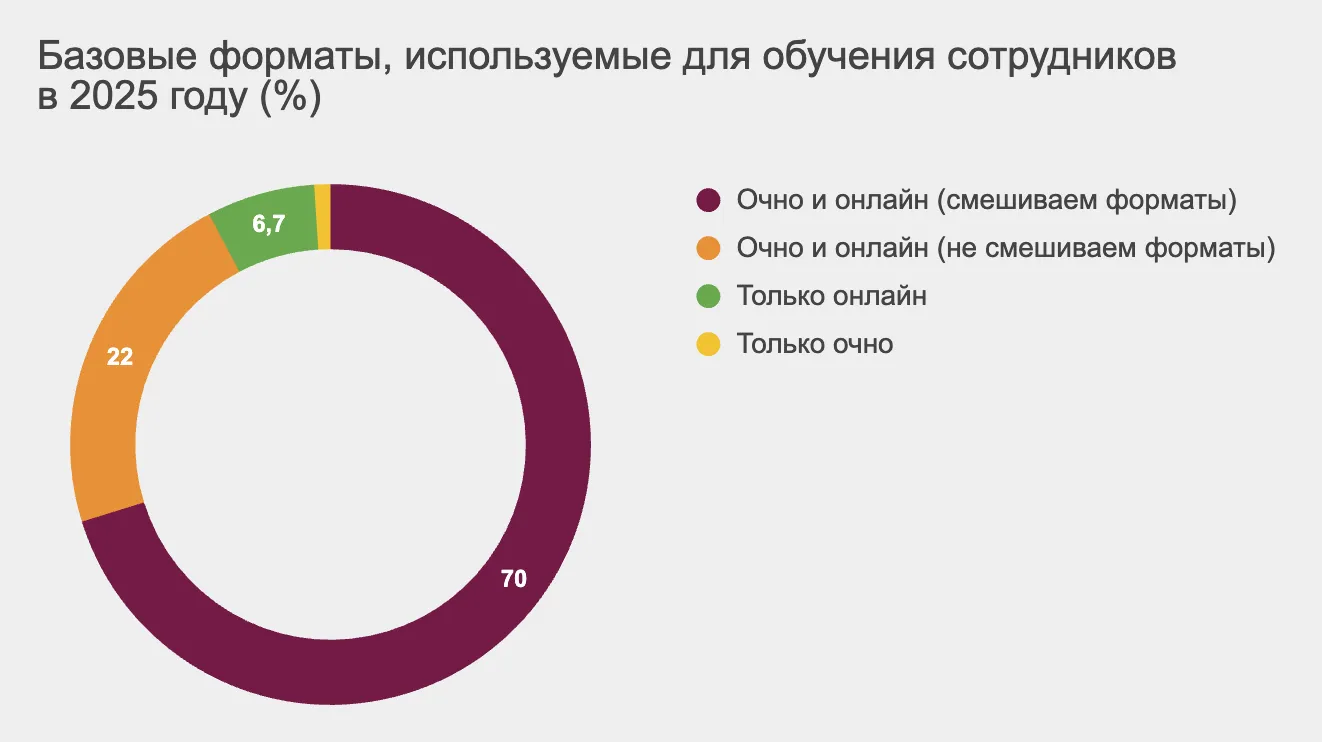
In 2025, there will be an increase in the share of participants who combine in-person and distance learning, increasing from 60.8% to 70%. At the same time, less than a quarter of companies (22%) clearly distinguish between in-person and online training programs, which is a decrease compared to 26.8% in 2024. Этот тренд указывает на растущую популярность гибридных форматов обучения, что может свидетельствовать о стремлении организаций адаптироваться к новым требованиям образовательного процесса.
Доля компаний, которые полностью переходят на онлайн-обучение своего персонала, снизилась с 9,3% в 2024 году до 6,7% в 2025 году. Также уменьшилось количество организаций, выбирающих исключительно очное обучение, с 3% до 1%. Эти изменения подчеркивают тенденцию к снижению интереса к традиционным методам обучения и указывают на необходимость адаптации образовательных программ к современным требованиям.
Павел Безяев отмечает, что текущие результаты опровергают распространенные прогнозы о том, что людям наскучил онлайн-формат и они вернутся к традиционным аудиторным занятиям. На самом деле, компании все активнее комбинируют очные и дистанционные форматы в рамках единой образовательной программы. Это свидетельствует о том, что гибридные модели обучения становятся все более популярными и востребованными в современном образовательном процессе.
Топовые форматы онлайн-обучения в 2024 году остаются неизменными. Лидирующие позиции по-прежнему занимают следующие варианты:
- 84,6% — синхронное онлайн-обучение;
- 76,9% — видеокурсы;
- 72,1% — слайдовые курсы;
- 70,2% — курсы-лонгриды.
Чуть меньшая доля, составившая 62,5%, относится к онлайн-программам смешанного обучения, сочетающим синхронные и асинхронные форматы. Примерно 35,6% компаний внедряют мобильное обучение, что свидетельствует о растущем интересе к этому формату. Лишь 6,7% организаций используют образовательные чат-боты, что указывает на их ограниченное распространение в текущих обучающих практиках.
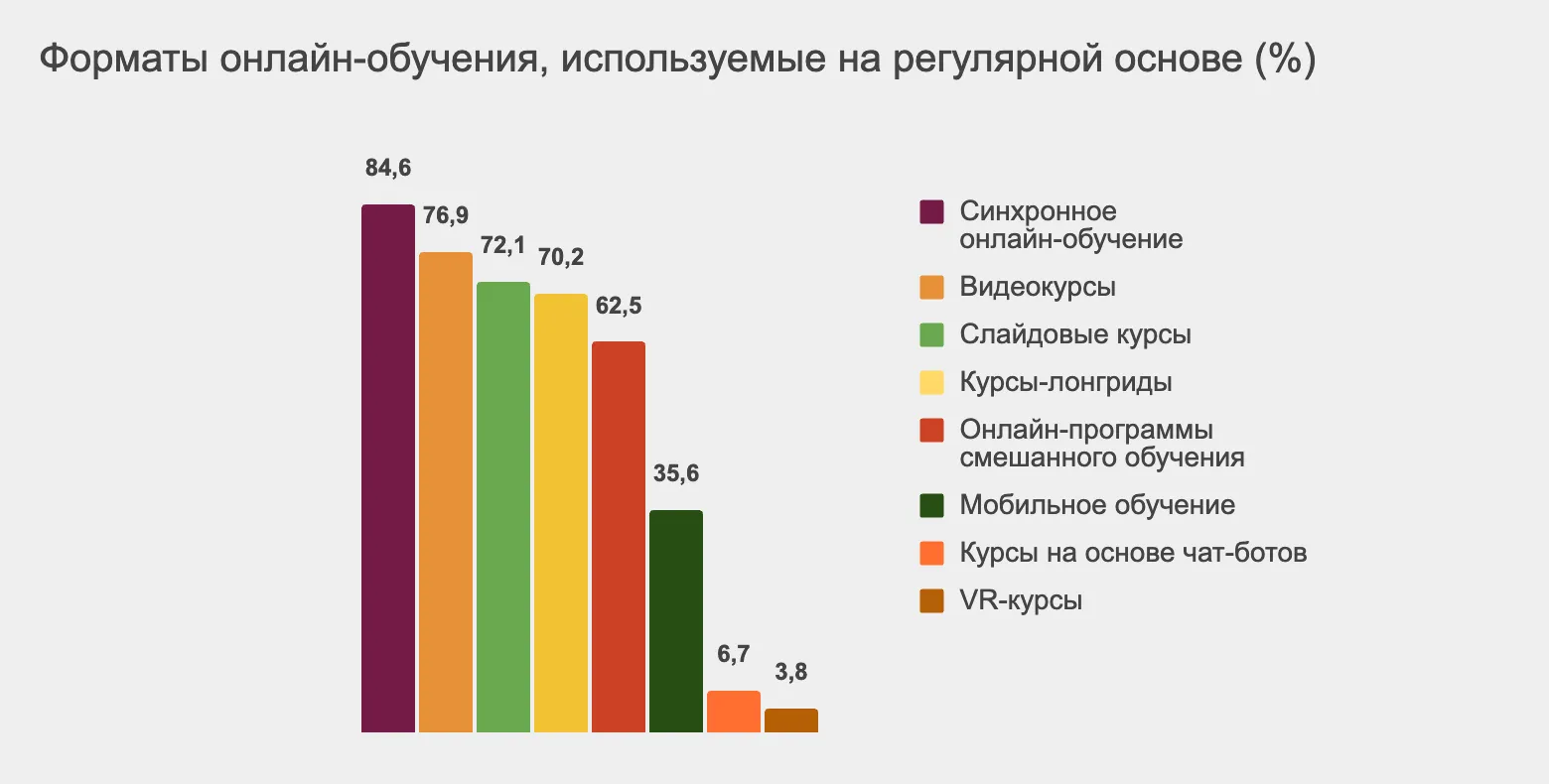
Доля VR-обучения сократилась с 6% в 2024 году до 3,8% в 2025 году. При этом обучение в дополненной реальности (AR) не упоминалось ни одним из опрошенных. Эльвина Шарафутдинова отметила, что технология виртуальной реальности проходит классические стадии принятия инноваций: от пика интереса до разочарования и, в конечном итоге, до плато эффективного использования. Спикер подчеркнула, что VR найдет свое применение в областях, где она демонстрирует наибольшую эффективность, например, в медицинском образовании, позволяя будущим хирургам тренироваться на виртуальных пациентах. Возможно, использование VR в корпоративном обучении расширится, когда стоимость VR-очков и шлемов снизится и они станут более доступными для организаций. Подобные изменения могут способствовать более широкому внедрению VR-технологий в образовательные процессы.
Читайте также:
Эксперты поделились рекомендациями по внедрению метавселенных в корпоративное обучение. Метавселенные представляют собой виртуальные пространства, которые могут значительно улучшить процесс обучения сотрудников. Использование технологий виртуальной и дополненной реальности позволяет создавать интерактивные и увлекательные обучающие программы. Это способствует более глубокому усвоению информации и повышает вовлеченность сотрудников.
С помощью метавселенных организации могут моделировать реальные сценарии, что позволяет сотрудникам на практике отрабатывать навыки и принимать решения в безопасной среде. Кроме того, такие платформы обеспечивают доступ к обучающим ресурсам в любое время и из любой точки мира, что делает обучение более гибким и доступным.
Внедрение метавселенных в корпоративное обучение также открывает новые возможности для командного взаимодействия и сотрудничества, позволяя сотрудникам работать над проектами в виртуальных командах. Это может привести к улучшению коммуникации и укреплению корпоративной культуры. Важно учитывать, что успешная реализация этих технологий требует тщательного планирования и адаптации образовательных программ под нужды компании и её сотрудников.
Как компании используют ИИ в процессе обучения сотрудников
С 2023 года участники исследований начали активно обсуждать использование искусственного интеллекта в образовательном процессе. В 2023 году только 13% респондентов сообщили о своем опыте работы с ИИ-инструментами. Однако в 2024 году этот показатель значительно увеличился и достиг 39,2%, а в 2025 году составил уже 51%. Это свидетельствует о растущем интересе и внедрении технологий искусственного интеллекта в обучение, что открывает новые возможности для студентов и преподавателей.
В течение года доля компаний, активно внедряющих искусственный интеллект в процесс обучения сотрудников, увеличилась более чем в три раза — с 2% до 7%. Тем не менее, 42% опрошенных организаций по-прежнему не используют ИИ в своих образовательных программах. Это свидетельствует о необходимости повышения осведомленности о преимуществах технологий ИИ и их внедрении в корпоративное обучение.
В этом году участников опроса впервые запросили информацию о том, как именно они используют искусственный интеллект (ИИ) в учебном процессе и какие функции выполняют ИИ-инструменты. Результаты исследования показали интересные тенденции. Участники отметили, что ИИ помогает в организации учебного процесса, предоставляет персонализированные рекомендации и ускоряет выполнение рутинных задач. Многие респонденты подчеркнули, что ИИ-инструменты значительно повышают эффективность обучения, улучшая усвоение материала и позволяя сосредоточиться на более сложных аспектах. Это исследование подчеркивает растущую роль ИИ в образовательной среде и его потенциал для трансформации традиционных методов обучения.
- 24% — адаптивные программы и контент;
- 14% — ИИ-тренажёры и симуляторы;
- 10,6% — оценка качества и эффективности обучения;
- 10,6% — ИИ-ассистенты;
- 2,9% — ИИ-наставники;
- 2,9% — ИИ-тьюторы;
- 1% — ИИ-коучи.
По данным опроса, в 2025 году 17,4% компаний планируют передать искусственному интеллекту задачи, связанные с сопровождением и поддержкой обучения сотрудников. Ожидается, что эта доля будет продолжать расти в будущем, что подчеркивает важность интеграции технологий в процессы корпоративного обучения. Использование искусственного интеллекта в этой сфере позволяет повысить эффективность обучения и обеспечить персонализированный подход к каждому сотруднику.
Как компании используют ИИ для разработки учебного контента
За последний год значительно увеличилась доля компаний, которые активно интегрируют инструменты искусственного интеллекта в процесс разработки курсов для сотрудников, с 3,1% до 13,5%. Почти половина опрошенных использует ИИ периодически для решения конкретных задач, в то время как 27% организаций только начинают экспериментировать с этой новой технологией. Всего 9,6% компаний не применяют искусственный интеллект в создании контента, что является значительным снижением по сравнению с прошлым годом, когда этот показатель составлял 29,9%. Интеграция ИИ в образовательные процессы позволяет повысить эффективность обучения и адаптировать материалы под нужды сотрудников.
According to the survey, a significant number of participants use neural networks to create various materials for courses. 68.3% of respondents generate texts, 58.7% generate test assignments, and 56.7% generate visual materials. Almost half of respondents (47.1%) use artificial intelligence to develop the concept and structure of courses. 29.8% use AI technologies to read text aloud, and 21.2% to create practical assignments and simulators. Only 4.8% of participants noted that their organizations have integrated artificial intelligence into the full course production cycle. The introduction of AI into the educational process opens up new opportunities for improving the quality and effectiveness of training.
Sergey Zamaraev expressed the opinion that the next stage of the implementation of artificial intelligence in the development of educational content will be the creation of videos for training courses. Elvina Sharafutdinova supported this forecast, noting that there is already a need for realistic digital avatars. Such technologies will allow companies to significantly reduce the time and cost of recording video lectures with experts and teachers, which makes them especially relevant in the conditions of the modern education market.
Rework the text, maintaining the main topic and avoiding unnecessary additions. Optimize it for SEO, although you can slightly expand the content. Make sure the text does not contain emojis or unnecessary characters, and does not include structured sections.
Read also:
A Russian company has developed digital avatars for teachers, designed to improve the effectiveness of employee training. These avatars allow you to create an interactive educational environment where each employee can interact with virtual mentors. The use of digital technologies in training facilitates better learning and increases employee engagement. The development of avatars reflects digitalization trends in corporate training and opens up new opportunities for professional growth and development. Tatyana Galkina noted that the main advantage of artificial intelligence tools is the automation of routine tasks. However, in her opinion, trusting neural networks to act as subject matter experts is risky. This can lead to errors and misunderstandings in complex situations that require deep knowledge and experience. The use of AI should be aimed at optimizing processes, not replacing human expertise in critical areas. In training in artificial intelligence, an important aspect is the use of real-life cases and situations that experts analyze based on their experience. Removing this element from courses, replacing them with dry theoretical materials without a personal perspective and real-life experience, can lead to serious problems in education. High-quality AI courses should combine theory and practice to ensure deep understanding and effective application of knowledge. Otherwise, course participants risk not receiving the necessary training to succeed in this field.
Pavel Bezyaev noted that the problem of a lack of high-quality content existed long before the advent of generative AI. Previously, information was simply borrowed from the internet, and such courses, lacking expert content, did not provide real value. Valery Leontyev added that artificial intelligence must earn the trust of learners. Currently, the knowledge that certain content was generated by a neural network rather reduces confidence in its quality.
Who develops content for employee training?
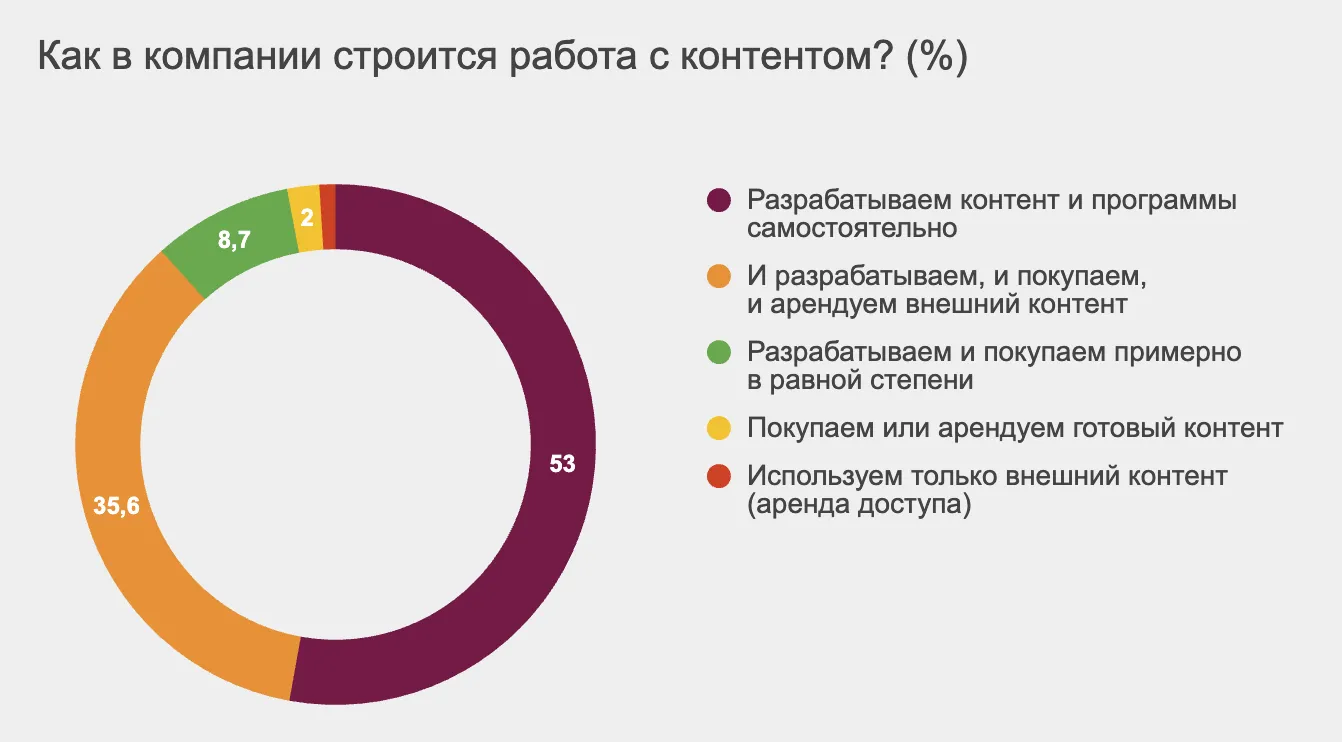
The question of whether companies develop educational content in-house or purchase it from external providers has become relevant since 2022. The answers to this question have remained unchanged over all these years: almost all companies (97.3% in 2025) prefer to create courses and educational programs themselves. This confirms the trend towards internal quality control and adaptation of training to the specific needs of organizations.
Pavel Bezyaev notes that the current results surprise him, as they indicate the presence of content creation specialists not only in large companies but also in medium-sized and small ones. He emphasizes that creating content in your field, given product and internal specifics, is not a problem. However, content on general topics, such as soft skills, is most often rented. Unfortunately, there is a trend for companies in industries such as oil, gas, transportation, and others to develop courses on leadership, time management, and emotional intelligence, confident in their in-house expertise. Pavel emphasizes that this negatively impacts the market for high-quality educational content development.
Valery Leontyev spoke about Labmedia, a company that develops custom e-courses and also offers ready-made educational products. The speaker noted that the versatility of soft skills courses is both their strength and weakness. This allows for a wide audience engagement, but can lead to insufficient depth on specific topics. It's important to find a balance between versatility and specialized knowledge to ensure the most effective training.
When selling general-purpose courses, especially to an industrial company, the question often arises: "That's not for us. We'd rather see office workers in specialized clothing." This indicates the need for customization, which entails additional costs. This factor can deter a purchase decision. In addition to visual aspects, this issue affects course content, the selection of relevant examples, and other elements. This is why ready-made courses, especially on neutral topics, often have lower demand. Customization allows for the creation of unique content that better meets the needs of the target audience, increasing its appeal and effectiveness.
Sergey Zamaraev emphasizes that companies strive to reduce the cost of developing training courses, not seeing the need for significant investments in training. He notes, "Why commission an expensive course with gamification elements when an expert can simply compile the materials and provide them to employees as a manual? In both cases, employees will gain the necessary knowledge, and the difference in business results will remain unnoticeable. We've been discussing the Kirkpatrick model for years, but we still haven't been able to accurately determine and prove how a specific course and its format impact key business metrics."
Sergey notes an interesting trend: ready-made courses are typically inexpensive, and companies could use them as a basis for internal training. However, most organizations prefer to create their own courses from scratch. Sergey suggests that this situation may change with the growing popularity of artificial intelligence. Neural networks can generate any course, but not every company has the expertise to verify the quality and reliability of such content. According to Sergey Zamaraev, external educational service providers should assume responsibility for ensuring a high level of training and verifying the generated material.
Tatyana Galkina noted that interest in external courses within a company is largely determined by the maturity of its training department and the current stage of business development. The maturity of the training department influences a company's ability to adapt to market changes and implement new knowledge, which, in turn, reflects the need for employee professional development. It's important to consider that different training needs may arise at different stages of a business's development, which also influences the demand for external courses.
When launching a business training program, it's important to choose a reliable partner. If such a partner has an extensive course library and the ability to quickly organize training, the company can begin with ready-made programs. In the event of a transformation, when the need for retraining or reskilling employees arises, the business may face difficulties in addressing this issue on its own. In such cases, it makes sense to commission the development of specialized courses, which will allow you to effectively cope with changes and prepare employees for new challenges.
How willing are companies to collaborate with online schools?
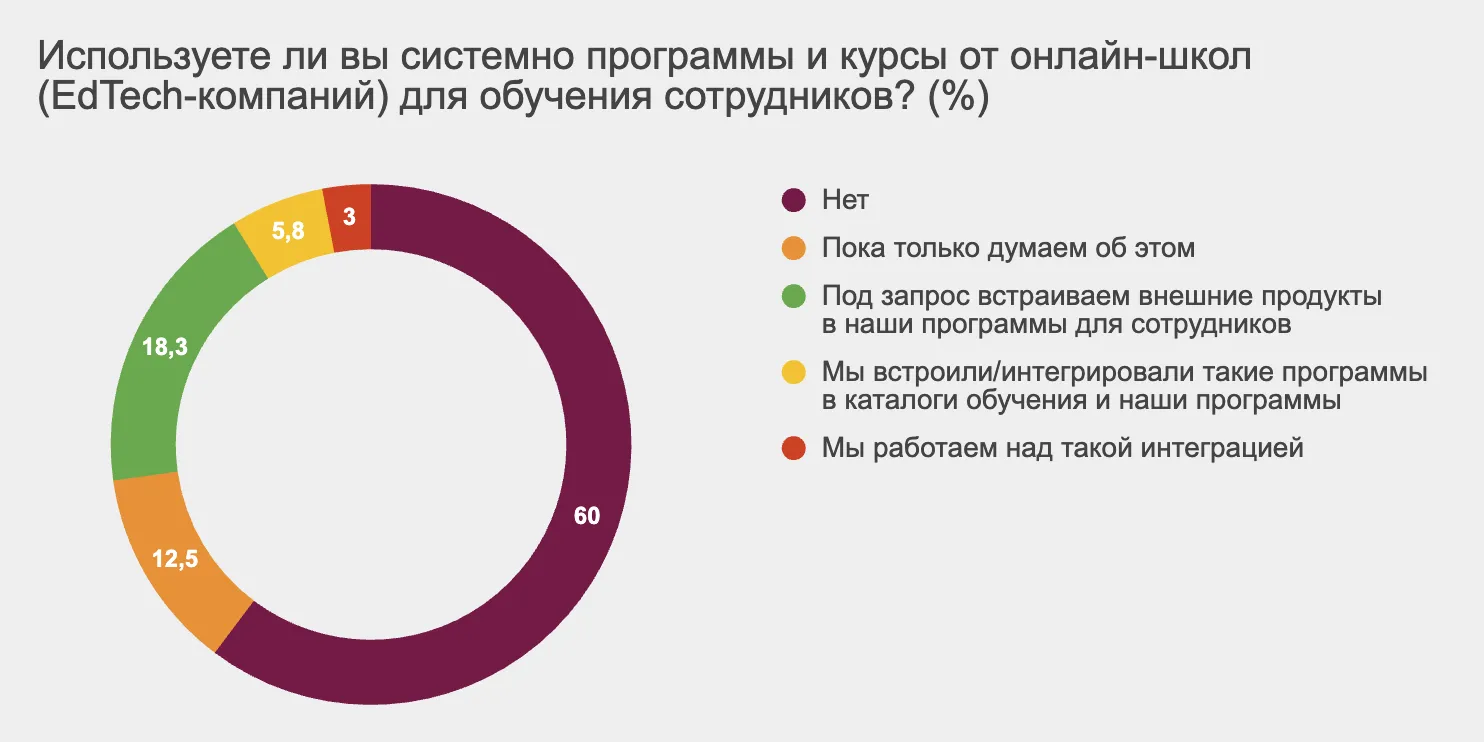
From 2022 to 2024, there was a steady increase in the share of companies using online courses and programs to train their employees. However, in 2025, this figure decreased from 7.2% to 5.8%. At the same time, the number of organizations integrating EdTech products into their curricula, focusing on specific needs, increased, increasing from 13.4% to 18.3%. This trend indicates a change in approaches to training and the needs of companies for adaptive educational solutions.
Valery Leontyev notes that the integration of online learning into the corporate sector is slow due to companies' lack of confidence in the quality of content provided by online schools. Many organizations associate online learning with the infobusiness, which doesn't always evoke positive connotations. Furthermore, corporate training often requires significant financial investments. Large companies can individually fund training for promising employees, but, according to Valery, the widespread use of online courses will only be possible if the cost of training per employee is reduced to 50 rubles, and the course duration is reduced to a few hours, rather than the current several months.
Tatyana Galkina noted that even within a single school, educational products can vary significantly in quality. This diversity can be alarming for companies and hinder their collaboration with the EdTech sector. She also added that many companies are reluctant to fund employee training at online schools. The main reason is that it requires a significant investment of time, including working time, and most often there is no certainty that the new skills acquired by the employee will be useful for the company.

Learn Also:
Renting Courses for Corporate Training: Feasibility and Benefits
Corporate training plays a key role in employee development and skills enhancement. Renting courses for training can be an effective tool for companies looking to improve their employees' skills. But is it worth investing in course rentals?
The advantages of course rentals include flexibility and accessibility. Companies can choose suitable programs tailored to their needs and quickly implement them into the training process. Renting courses allows you to save money on developing your own programs and provides access to up-to-date knowledge presented by experts in their field.
Renting courses also provides the opportunity to train employees in a convenient format: online or offline, making the learning process more convenient and effective. This is especially important in today's environment, where flexibility and adaptability are becoming key requirements for educational programs.
However, when choosing to rent courses, it is necessary to consider the provider's reputation, course content, and reviews from other companies. This will help to avoid ineffective investments and ensure maximum return on training.
As a result, renting courses for corporate training can be a profitable solution for companies wishing to improve the skills of their employees. The right choice and approach to training will help to achieve significant results in business development.
What platforms do companies use for employee training?
The survey shows that the priorities of companies when choosing an employee training platform (LMS) have remained unchanged over the past three years. The main criteria taken into account include the following aspects:
- 88.5% - functionality;
- 85.6% - user convenience;
- 75% - reporting and analytics.
In the list of users' priorities, platform flexibility occupies 67.3%, price - 60.6%, and the availability of a mobile application - 53.8%. These factors play a key role in platform selection, highlighting the importance of adaptability, accessibility, and user experience.
Survey participants were less likely to emphasize support for user activity tracking standards, such as xAPI and CMI5, at only 18.3%. Also less significant factors are the availability of artificial intelligence tools, which are noted by 15.4% of respondents, and aspects of the platform's information security, which are of interest to only 1%.
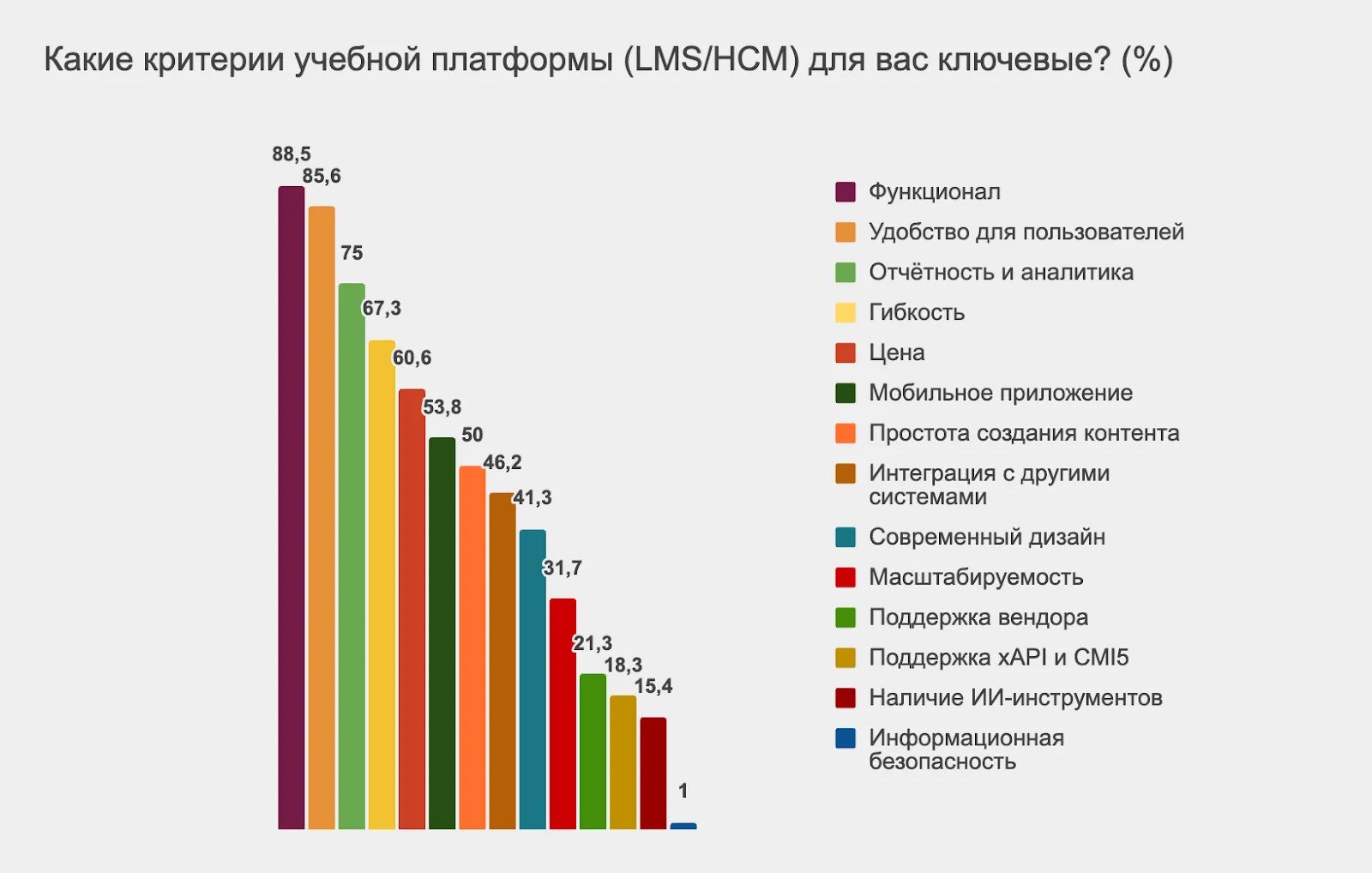
When asked about the priority LMS features that companies plan to develop, participants most often highlighted user-friendliness (55.8%), adaptability and personalization of learning (49%), and advanced analytics (48.1%). Artificial intelligence-based tools were less relevant for most companies, receiving support from only 23.1% of participants.
Reading is an important aspect of our lives, as it enriches our inner world and develops critical thinking. Books, articles, and other text materials allow us to gain new knowledge and expand our horizons. Regular reading improves concentration and memory, and helps us better understand the world around us. Therefore, it is important to find time for reading, choosing a variety of genres and topics that interest you. It is not only an engaging activity but also a way of self-development. Don't forget that reading can be a great way to relax and unwind.
Читайте также:
На российском рынке систем управления обучением (LMS) для корпоративного обучения определились лидеры. Эти платформы играют ключевую роль в оптимизации процессов обучения и повышения квалификации сотрудников. Компании все чаще выбирают эффективные решения для онлайн-обучения, что способствует улучшению качества профессиональной подготовки и адаптации новых сотрудников. Лидеры отрасли предлагают разнообразные функции, включая аналитические инструменты, возможность персонализации учебного контента и интеграцию с другими системами. Это позволяет организациям не только повысить эффективность обучения, но и сократить затраты на обучение.
Доля компаний, планирующих сменить корпоративную LMS в ближайшие 1–3 года, остается низкой и составляет около 17%, как и в прошлом году. В 2024 году основными причинами для замены LMS были изменения в задачах обучения, а также стоимость и качество поддержки платформы. В 2025 году на первом месте оказалась причина устаревания платформы. Сергей Замараев предполагает, что это устаревание в первую очередь связано с UI/UX-дизайном корпоративных LMS. Обновление интерфейсов и улучшение пользовательского опыта становятся ключевыми факторами для повышения эффективности систем обучения и удовлетворенности пользователей.
Валерий Леонтьев подчеркивает важность осознания того, кто отвечает на вопросы о выборе или замене LMS, а также кто принимает окончательные решения в компаниях. Он отмечает, что служба безопасности может отклонить большинство инициатив, что делает низкую оценку критерия безопасности LMS в опросах малозначимой. Понимание этих факторов критично для получения объективных выводов о предпочтениях и потребностях пользователей систем управления обучением.
Среди платформ для синхронного онлайн-обучения лидером остается Zoom, который используется 41,3% респондентов. Однако его доля снизилась с 50% в 2024 году. В то же время растет популярность российских сервисов, таких как «МТС Линк», который занимает 34,6% рынка, и «Яндекс Телемост» с 22,1%. Также стоит отметить новый отечественный продукт «Контур Толк», который в 2024 году начал упоминаться всего 5% опрошенных, а в 2025 году его популярность возросла до 17,3%. Половина респондентов заявила о использовании двух и более платформ для онлайн-обучения одновременно.
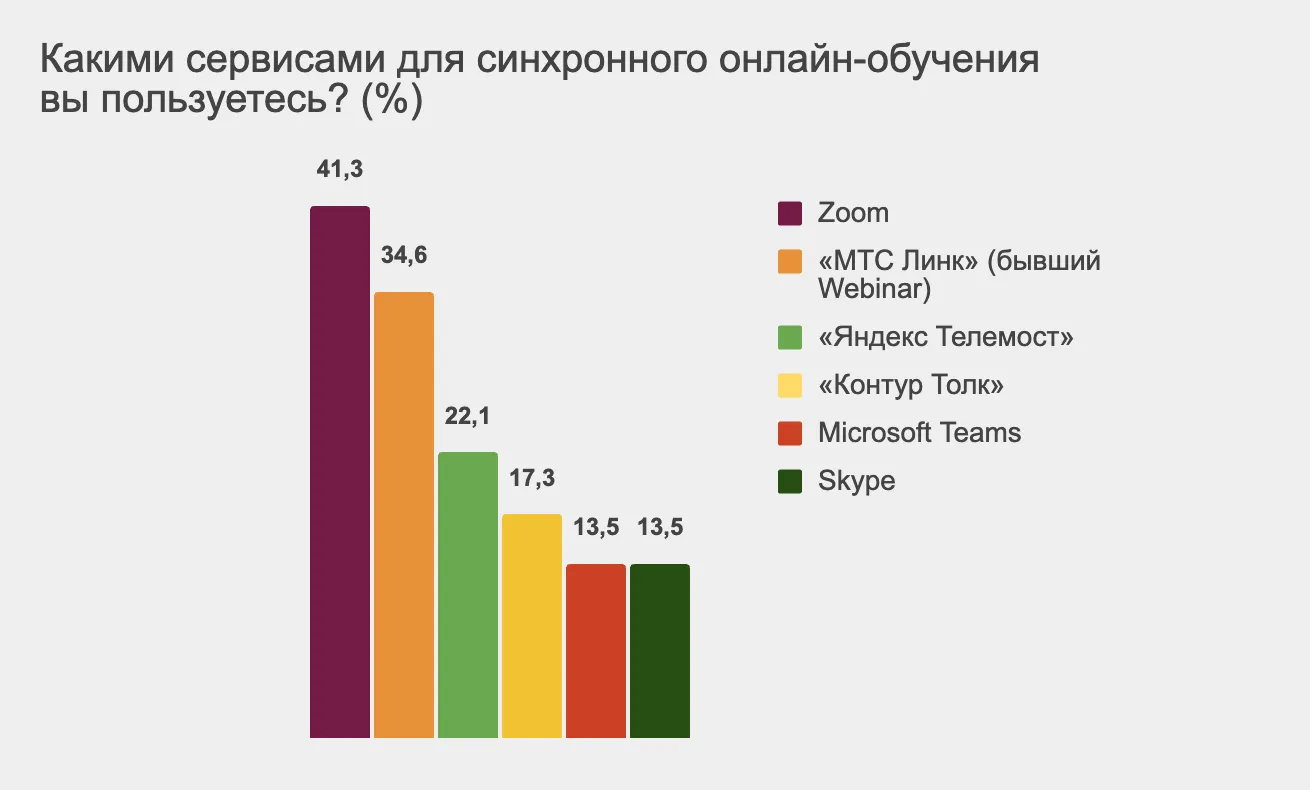
Ситуацию с платформами для обучения можно охарактеризовать несколькими ключевыми особенностями, как отметил Павел Безяев. Во-первых, наблюдается рост спроса на онлайн-образование, что связано с изменением потребностей пользователей и развитием технологий. Во-вторых, платформы предлагают разнообразные форматы обучения, включая видеолекции, интерактивные задания и вебинары, что позволяет адаптировать процесс обучения под индивидуальные предпочтения студентов. В-третьих, важным аспектом является доступность контента, что открывает новые возможности для обучения людей из разных регионов. Наконец, следует отметить, что качество материалов и квалификация преподавателей остаются определяющими факторами успешности образовательных платформ. Эти особенности делают онлайн-образование актуальным и востребованным в современном мире.
- Компании зачастую используют целый спектр схожих инструментов для обучения сотрудников — по несколько LMS, по несколько специализированных сервисов для обучения и оценки. То есть остаётся проблема «зоопарка решений» вместо отлаженных экосистем.
- Новые узкоспециализированные сервисы для онлайн-обучения не работают над интеграцией с уже существующими и распространёнными платформами, а сами стараются превратиться в многофункциональную LMS, что, как отмечает Павел Безяев, только усиливает хаос.
- По-прежнему применяются устаревшие стандарты доставки образовательного контента и обмена данными — в первую очередь SCORM, появившийся ещё в 2000 году. А более новые стандарты, такие как xAPI, пока не пользуются популярностью.
Читать также:
Аналитики «СберУниверситета» выявили ключевые проблемы, с которыми сталкивается корпоративное обучение в России. Эти проблемы препятствуют эффективному развитию сотрудников и снижению уровня их квалификации. Основные трудности включают недостаток адаптированных программ, отсутствие системного подхода к обучению и нехватку ресурсов для реализации современных методик. Также важным аспектом является игнорирование индивидуальных потребностей работников, что снижает мотивацию и вовлеченность в процесс обучения. Решение этих вопросов позволит улучшить качество корпоративного обучения и повысить профессиональные навыки сотрудников.
Как компании оценивают эффективность обучения
Исследования демонстрируют, что оценка эффективности обучения стала одной из ключевых задач для компаний за последние два года. В 2025 году большинство опрошенных отметили, что для оценки знаний сотрудников используются тесты (87,5%). Для измерения удовлетворенности сотрудников опытом обучения применяются анкеты обратной связи, а также метрики NPS и CSI (83,7%). Это подчеркивает растущую важность систематической оценки обучения для повышения качества работы и развития персонала в современных организациях.
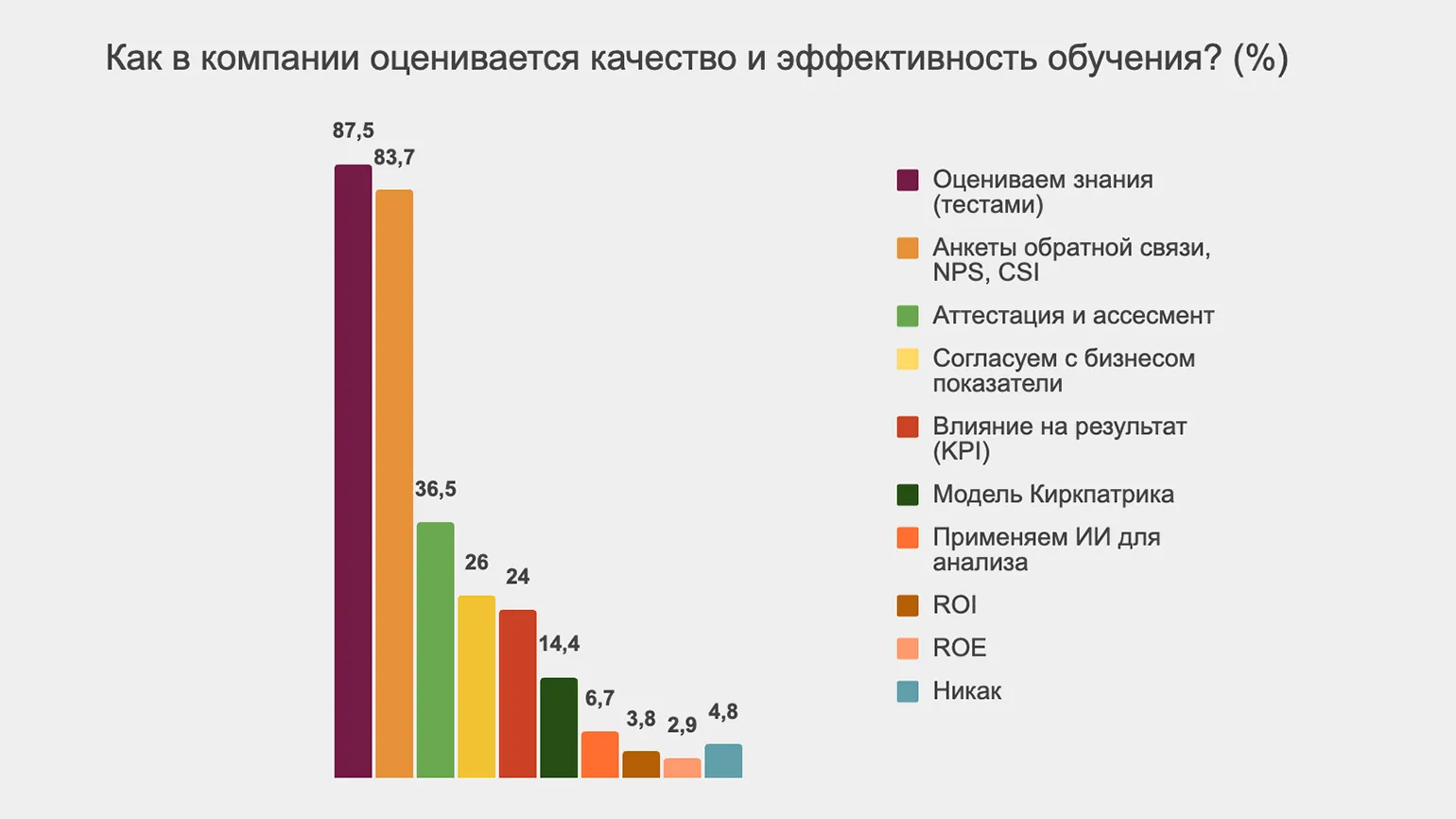
Более одной трети участников исследования (36,5%) отметили важность проведения ассесмента компетенций и аттестаций сотрудников. В 26% компаний эффективность обучения оценивается на основе согласованных с заказчиком бизнес-метрик, тогда как 24% участников фокусируются на том, как обучение влияет на ключевые показатели эффективности (KPI). Интересно отметить, что доля компаний, использующих модель Киркпатрика, в 2024 году резко возросла с 4% до 30%, однако в 2025 году она снова снизилась до 14,4%. В этом году в исследовании впервые появилась информация о применении искусственного интеллекта для оценки эффективности обучения, что упомянули 6,7% респондентов. Данные результаты подчеркивают актуальность и разнообразие подходов к оценке образовательных программ в современных организациях.
Какие ключевые выводы сделаны по итогам исследования
Павел Безяев подытожил, что за последние два года ситуация в области корпоративного обучения остается стабильной. Однако внедрение искусственного интеллекта существенно изменило многие аспекты, такие как организация и проведение обучения, создание контента и оценка его эффективности. Ожидается, что связанное с ИИ снижение затрат на разработку образовательного контента окажет заметное влияние на рынок корпоративного обучения.
Сергей Замараев отметил, что после значительных изменений в 2020 и 2022 годах ситуация стабилизировалась и стала напоминать период до пандемии. Несмотря на влияние искусственного интеллекта, ключевые форматы и технологии обучения остаются неизменными — люди продолжают использовать привычные методы. Татьяна Галкина также поддержала эту точку зрения, добавив, что необходимо развивать более адаптивные программы обучения. Однако принципиально новые решения для задачи «научить человека учиться» вряд ли появятся в ближайшем будущем.
Чтение является важным аспектом нашего обучения и развития. Оно не только расширяет кругозор, но и помогает улучшить навыки аналитического мышления. Книги, статьи и другие источники информации могут значительно обогатить наш опыт и способствовать личностному росту. Важно выбирать качественные материалы, которые помогут углубить знания в интересующих вас областях. Научные исследования показывают, что регулярное чтение позитивно влияет на когнитивные функции и способствует улучшению памяти. Поэтому не упускайте возможность читать и открывать для себя новые горизонты.
- Новые ИИ-агенты могут превратить корпоративное онлайн-обучение в фикцию
- Названы самые популярные инструменты для вовлечения сотрудников в корпоративное обучение
- Руководители зарубежных IT-компаний назвали приоритетные направления обучения сотрудников
- Мнение: почему в корпоративном обучении главным стало удобство, а не эффективность
- Мнение: «Корпоративное обучение — чистой воды „инфобиз“»