

Learn: Methodologist of educational programs
Learn moreIn this article you will get information about:
- where the "learning pyramid" was first published and how Edgar is connected with it Dale;
- why this theory is untenable;
- how widespread is the "Dale pyramid" in educational and popular literature;
- why it is still so popular.
If you are interested in learning, you are probably familiar with the concept of the "Dale pyramid", which states that a person remembers only 10% of what he reads, 20% of what he heard, 30% of what he saw, and 90% of the material he learned through practice. While the percentages can vary in different interpretations, the basic idea is that active learning through practical experience is the most effective. Despite the appeal of this theory, there is a serious problem: since its inception, not a single reliable study has been conducted to confirm these figures. This calls into question the reality of the claimed results and requires a more in-depth analysis of teaching methods to determine which approaches actually promote memorization and assimilation of information.
Where it all began
The history of the theory related to learning and information perception is complex and multifaceted. However, it can be argued that its roots go back in time, long before the American educator Edgar Dale began actively developing and popularizing this concept. Dale became a key figure in this field, but the theory itself was shaped by various thinkers and researchers, which makes its study even more interesting and meaningful.
In 2019, Ken Masters from Sultan Qaboos University conducted an in-depth analysis of the application of the Dale pyramid concept in medical education. The study found that a similar idea was first presented in an article by Charles Rhodes in 1906. This article states that "we remember one-tenth of what we hear, five-tenths of what we see, seven-tenths of what we say, and nine-tenths of what we do." Although Rhodes quotes this statement, he does not provide a source, suggesting that this belief may have existed for some time. This emphasizes the importance of active participation in the learning process to enhance retention.
In the 1950s, the National Training Laboratories (NTL) in the United States presented its interpretation of the learning concept as a pyramid. This model emphasizes different levels of knowledge and skill acquisition, emphasizing that learning effectiveness depends on the methods and approaches used in the process. The pyramid demonstrates how active participation and practical application of information contribute to deeper understanding and long-term retention of material.
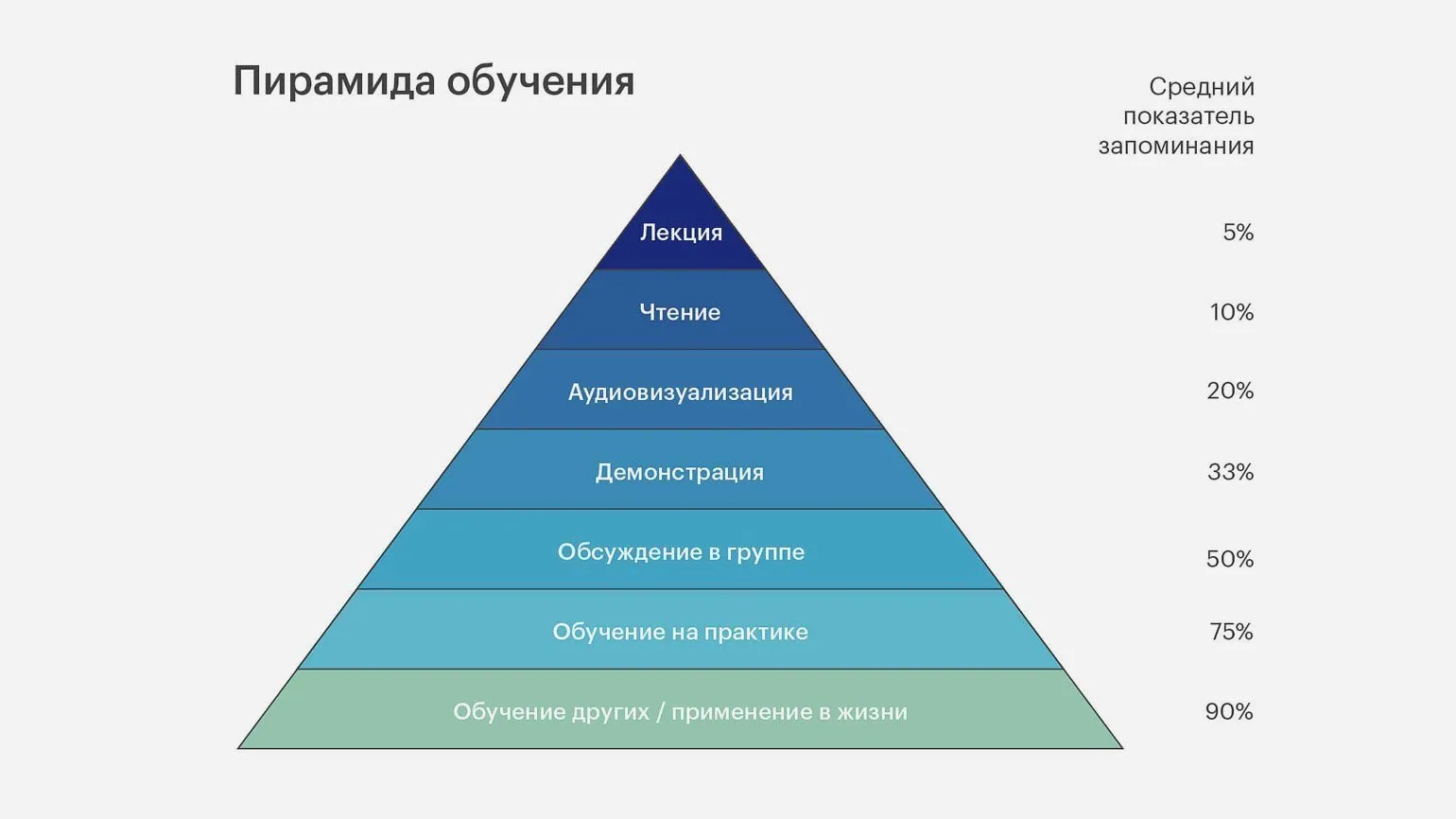
According to the organization, the percentages indicated were determined during the NTL study. However, detailed information about this study is unavailable.
It is unclear why Edgar Dale's name is associated with the pyramid. His book, "Audiovisual Methods of Teaching," first published in 1954, makes no explicit reference to this association. However, the work presents the concept of a "cone of experience," which illustrates various learning formats, arranging them from the most abstract to the most concrete. This cone lists the following levels: verbal symbols, visual symbols, pictures, audio recordings, radio, films, educational television programs, exhibitions, excursions, demonstrations, theatrical activities, simulations, and hands-on activities. This approach allows for a better understanding of how different teaching methods can influence the perception and assimilation of information.
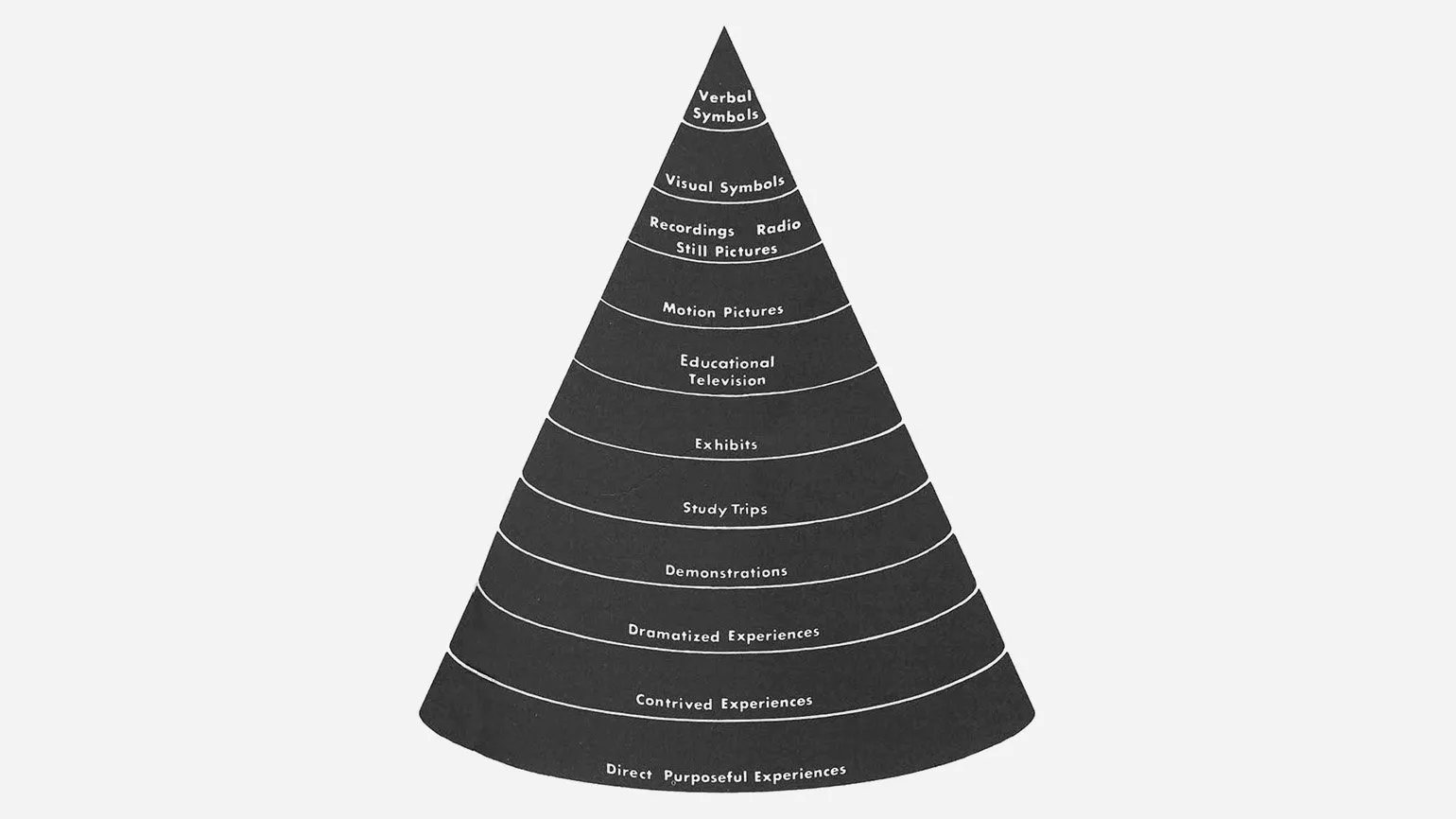
A search for "Dale's Cone of Experience" reveals many variations of the model, in which each type of learning material (text, presentation, film, and others) is assigned specific retention percentages. However, Dale's original concept did not include such a reference. The diagram did not address memorization issues and was created solely to clearly demonstrate the classification of learning material types.
In the third edition of his book, "Audiovisual Learning Methods," Dale added a section, "Some Possible Misconceptions," in which he emphasized that his classification of learning materials did not imply that certain forms of learning are more effective than abstract ones. However, as practice shows, his warning was not heeded.
The origin of the percentages in this myth is intriguing. Where do such precise values come from? Even if a study were to confirm this data, could its results be so perfect? This aspect remains an unsolved mystery. It is interesting that similar questions often arise in the history of mythology, opening up new horizons for analysis and interpretation.
Why the "learning pyramid" theory is untenable
This methodology is not universal and cannot be applied to all materials, which is confirmed by specific examples and evidence.
In her article, "What to Do About Declining Mathematics Scores in Canada," University of Winnipeg Associate Professor Anna Stokke identified an important trend. She noted that from 2003 to 2012, most Canadian provinces experienced a significant decline in student scores on mathematics tests taken after grade 8. This overall decline coincides with educational institutions' transition to curricula based on the concept of "experiential learning." This situation raises serious concerns and requires an analysis of the causes and the development of effective strategies for improving mathematics achievement in Canadian schools.
According to this concept, students should independently seek answers to questions, rather than simply receive ready-made algorithms and formulas from the teacher. This approach involves the development of critical thinking and the ability to learn independently. Key characteristics of this method include: active student participation in the learning process, stimulation of their curiosity and creativity, and an emphasis on the practical application of knowledge. This promotes a deep understanding of the material and the development of skills necessary for solving real-world problems.
- open-ended questions with multiple correct answers (e.g., "The solution to problem 37 is, what might its statement sound like?");
- drawing a problem-solving diagram;
- using a top-down approach, in which students work on complex problems even if they do not have the basic knowledge and skills;
- minimal writing.
Stock concluded that in teaching mathematics, children learn better when they are first explained the rules, provided with formulas, and have their attention focused on important principles. After this, practical reinforcement of knowledge begins. This approach promotes a deeper understanding of the subject and improves learning outcomes.
The effectiveness of the "learning pyramid" model was investigated by researchers James Lally and Robert Miller in the article "The Learning Pyramid: Is It Pointing Teachers in the Right Direction?" After analyzing various teaching methods, they found that each was effective in certain settings. No single method was clearly superior to the others, highlighting the importance of choosing an approach based on the context and learners' needs. This research raises pressing questions about how to optimally combine different methods to achieve maximum learning outcomes.
How Widespread Is This Myth?
Google "Dale diagram" or "Dale pyramid" to see many interpretations of the concept. Since its inception, no scientific experiments have been conducted to confirm its effectiveness. Despite this, the idea continues to be widely used in various fields. Ken Masters' analysis shows that 41 papers referencing the "Dale pyramid" were found in medical education articles published between September 2012 and April 2018 alone. This demonstrates the theory's popularity despite its lack of scientific support.
Masters has noticed a significant increase in references to learning pyramids in medical education literature since 2012. Even criticisms directed against the theory are sometimes used to support it. Researchers who recognize the shortcomings of the idea continue to include it in their research. This demonstrates that the learning pyramid concept continues to influence medical education despite criticism.
The learning pyramid is also discussed in popular self-help books. The financial success book Why We Want You to Be Rich by Robert Kiyosaki and Donald Trump features a key passage that emphasizes the importance of a systematic approach to learning and developing financial literacy. This concept helps readers realize that achieving success requires not only desire but also a strategic understanding of the processes involved in managing money. Understanding the structure of the learning pyramid can significantly accelerate the process of mastering the new knowledge and skills needed to achieve financial independence.
In 1969, a study in education revealed the effectiveness of various teaching methods. Based on the data, the "cone of learning" was developed, demonstrating that reading and lectures are the least effective ways to impart knowledge, while hands-on activities are the most effective. Methods that simulate real-world experience also show good results. It is surprising that the modern educational system continues to rely heavily on reading and lectures, despite the fact that the "cone of learning" concept has been available for over fifty years. This raises questions about the need to update teaching approaches and implement more effective methods that can significantly improve the assimilation of material and prepare students for real-life situations.
Rework the text with SEO in mind, maintaining the main topic and avoiding unnecessary additions. Ensure the text is clear and informative.
Reading is an important part of our lives, enriching our experiences and developing our thinking. Reading allows us to broaden our horizons, gain new knowledge, and improve our skills. Books, articles, and other sources of information can inspire and motivate. Reading also fosters imagination and critical thinking, making it an integral part of personal growth. Regular reading also has a positive impact on mental health, reducing stress and improving overall mood. Reading allows us to immerse ourselves in another world, helping us escape everyday worries and problems. Therefore, it's worth setting aside time for reading to reap all the benefits of this passion.
Incorporate reading into your daily routine and watch how it helps you become a more educated and happier person.
- "I am convinced that a human-centered school is one where children learn, not where they are taught."
- Inspiring films about teachers who changed the lives of their students.
- Droodles: what they are and how they help in learning.
- "Children are natural-born scientists." Why observations and experiments are more important than textbooks and tests
Educational Programs Methodologist
You will go through the full cycle of creating an educational product from scratch. Learn to design curricula for online and offline courses. Become a versatile specialist – you can launch your own project or get a job as a methodologist at a large company.
Find out more