
Contents:
- First: Who are Peter Honey and Alan Mumford?
- What learning styles do Honey and Mumford identify?
- How do Honey and Mumford's learning styles compare with Kolb's styles?
- To what extent is Honey and Mumford's learning styles classification scientifically valid?
- Why does Honey and Mumford's learning styles model remain popular?

Course with employment: "The Methodologist Profession from Zero to PRO"
Find out moreFirst things first: who are Peter Honey and Alan Mumford?
Peter Honey is a renowned British organizational psychologist and expert in corporate training. He began his career in large companies such as Ford Motor Company and British Airways. In 1969, Peter founded his own practice, focusing on consulting senior executives. His work has always been aimed at developing self-management and personnel management skills, which made him a sought-after specialist in his field. In February 2025, Peter Honey passed away at a mature age, leaving a significant mark on the field of organizational psychology and corporate training.
Alan Mumford is a colleague of Peter Honey and an expert in the field of personnel training and development. He has experience working with large companies, consulting with executives on improving training effectiveness and implementing development programs. Mumford applies modern methodologies and approaches to help organizations optimize training processes and achieve their goals.
In 1982, Honey and Mumford published "The Manual of Learning Styles," published by their own imprint, Peter Honey Publications. This publication became an important contribution to the field of pedagogy and learning psychology, offering readers a systematic approach to understanding different learning styles. The book has attracted the attention of educational institutions and professionals seeking to adapt their methods to the individual needs of students.
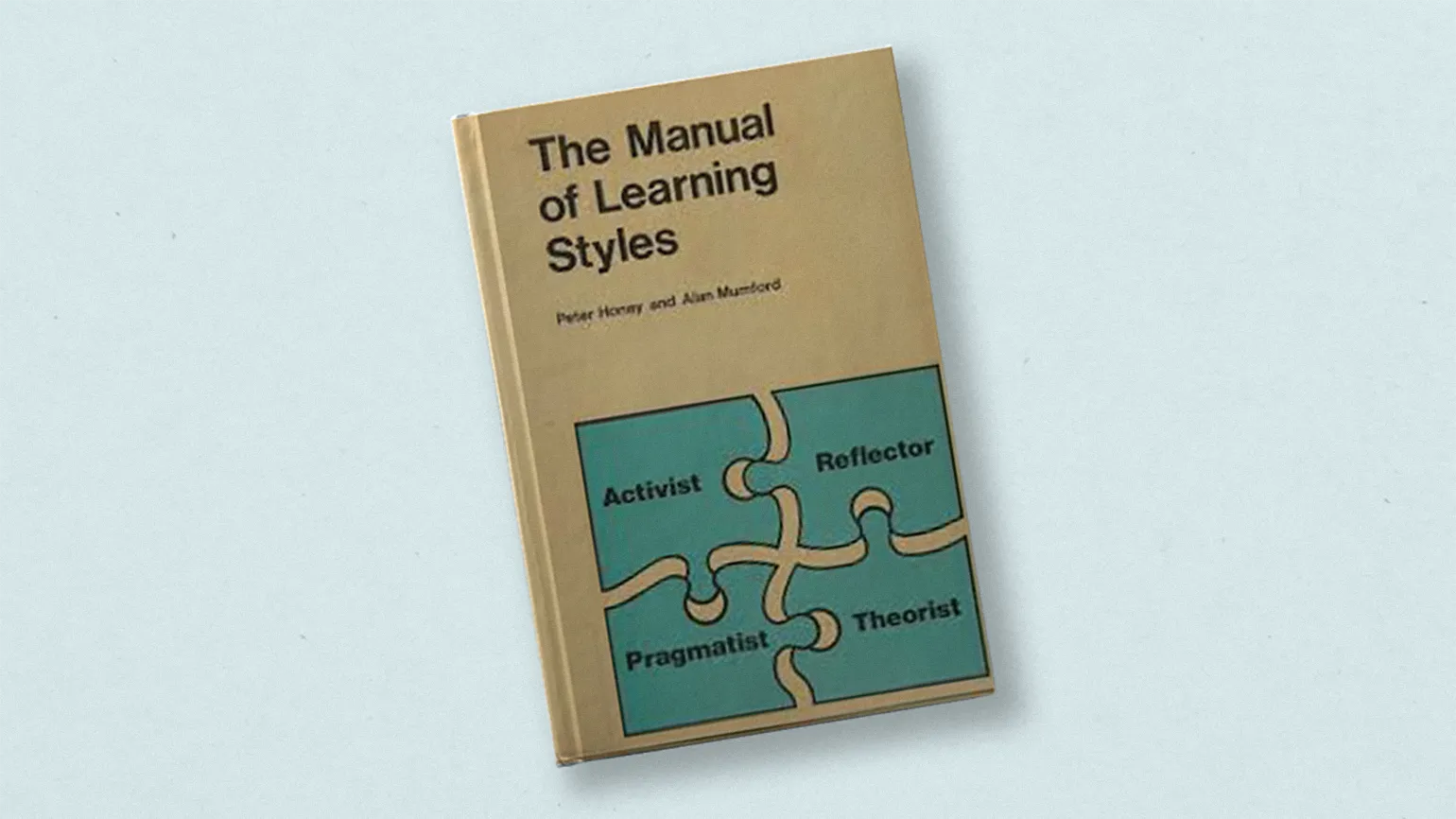
The book contains an 80-item questionnaire, a methodology for scoring responses, and an interpretation of the results. It presents various learning styles and approaches that correspond to each of them. Also included are practical recommendations for team leaders, mentors, and independent learners. These materials will help improve the learning process and increase work efficiency.
What learning styles do Honey and Mumford identify?
The Honey and Mumford questionnaire includes statements such as "I always seek new experiences" and "I often reject bold ideas because they are impractical." The questionnaire also includes the statement: "I carefully analyze available information before drawing conclusions." These statements help determine a person's thinking style and preferences, allowing a better understanding of their approach to learning and problem solving. The questionnaire is used in psychology and education to assess creativity, analytical skills, and openness to new ideas.
Survey participants must select the phrases they agree with. By analyzing the responses, one of four learning styles is determined that best suits individual preferences. This will help to better understand how a person perceives information and what learning methods are suitable for him.
- activist;
- reflector;
- theorist;
- pragmatist.
A person can exhibit a variety of preferences corresponding to several styles simultaneously, including two, three, or even four. In such cases, it is recommended to take into account the characteristics of all the manifested styles. This allows for a more accurate understanding of individual preferences and the creation of a harmonious image that reflects the person's personality.
Activists are people who learn through practical experience and strive for new experiences. They are ready to accept challenges and try everything new. Activists often act and then analyze the results of their actions. They quickly become engrossed in new challenges but can lose interest if the process drags on, leading to a shift to other activities. Sociability is a key trait of activists, and they prefer to be at the center of events, actively participating in various events and initiatives. Activists favor a variety of methods and strategies aimed at achieving social change. They actively participate in organizing events, running campaigns, and disseminating information to draw attention to important issues. Using social media, activists effectively engage with audiences and mobilize support for their initiatives. An important aspect of their work is creating communities that unite people with shared interests and goals. Activists also seek to collaborate with other organizations and groups to increase the impact of their actions and achieve sustainable results.
- gain new experiences;
- solve problems;
- work collaboratively with someone;
- take a leadership position.
Activists avoid participating in events that could damage their reputation or distract attention from their core goals. They try not to interact with organizations that promote ideas that contradict their principles. Activists also avoid conflicts and provocative situations that could lead to negative consequences for their movement. It is important for activists to focus on constructive dialogue and collaboration rather than confrontation. This helps them more effectively promote their ideas and attract supporters.
- Long lectures or explanations;
- Studying alone;
- The need to analyze large amounts of data;
- Following precise instructions.
People who prefer this learning style tend to be observational and reflective. They examine objects and phenomena from different angles, gathering all available information. Such individuals carefully consider all aspects of a situation and its possible consequences before reaching a conclusion or making a choice. In general meetings and during discussions, reflectors typically take an observant stance, listening carefully to the opinions of others before expressing their own. This approach allows them to gain a deeper understanding of the issues under discussion and form more informed judgments.
Reflectors are typically selected based on a number of factors, such as lighting efficiency, material, and construction. Optimal reflectors provide maximum reflectivity, which improves light distribution and increases overall brightness. It is important to pay attention to the type of material used: aluminum and plastic reflectors have their own advantages and disadvantages. It is also worth considering the reflector design, which can affect the direction and focus of the light. The choice of reflector should meet specific lighting requirements, whether for industrial, commercial, or domestic use. The correct choice of reflector not only improves the quality of lighting but also reduces energy costs, which is an important aspect for the sustainable use of resources.
- observe people and situations;
- analyze carefully;
- have enough time to think;
- independently manage the timing of the task.
Reflectors avoid direct sunlight, which can negatively affect their functionality and durability. They also try to minimize the impact of external factors such as rain and wind, which can cause damage. To ensure maximum efficiency, reflectors are positioned in conditions that promote the reflection of light onto the desired surfaces. In addition, it is necessary to consider the correct distribution of light to avoid the creation of shadows and faded areas. The use of reflectors in optimal conditions can significantly increase lighting levels and improve visibility.
- team management;
- lack of opportunity to prepare in advance;
- compressed deadlines and strict deadlines.
This learning style is typical for people who value understanding the theoretical foundations of any action. To achieve effective learning results, they need models, concepts, and facts that they can organize into a unified system. When solving problems, such individuals use a logical approach and are uncomfortable with subjective opinions, uncertainty, and frivolity. This approach to learning promotes deep understanding of the material and the development of analytical thinking, which is especially important in a professional environment.
Theorists prefer analysis and modeling, which allows for a deeper understanding of complex phenomena and processes. They emphasize the need to use scientific methods and approaches to develop theories that can explain observed facts. This not only helps expand knowledge in various fields but also creates a foundation for the practical application of theories in real life. Discussing theoretical foundations is important for forming sustainable concepts that can be tested and adapted in future research.
- have a model, system, or theory as a basis for practical activity;
- have a clear goal and adhere to a structure;
- analyze information and synthesize solutions;
- understand complex situations.
Theorists avoid unambiguous conclusions and categorical statements. They strive to analyze different points of view in order to more deeply understand the subject of research. This allows them to take into account many factors and nuances that can influence the results. In addition, theorists emphasize the need for constant rethinking of existing theories and models, which promotes the development of scientific thinking and critical analysis. This approach helps them avoid simplifications and stereotypes, which ultimately leads to a more complete and objective understanding of the phenomena under study.
- unstructured tasks;
- lack of a theoretical basis;
- the need to act intuitively.
Pragmatists strive for the practical application of new ideas and methods. They actively seek solutions to current problems and conduct experiments to find the most effective approaches. They are often impatient with lengthy discussions and the indecisiveness of their colleagues, as it is important for them to get down to business quickly. Pragmatists are practical and down-to-earth, which allows them to effectively cope with emerging challenges.

Pragmatists favor practical approaches and effective solutions. They strive for efficiency and tangible results, based on evidence and analysis. Their pragmatic approach allows them to adapt to changing conditions and find optimal ways to achieve goals. Pragmatists value experience and knowledge that can be applied in practice and draw on successful examples from the past. This approach promotes more rational and focused decision-making, making them valuable players in any field.
- acquire practically applicable knowledge;
- try something new in practice and receive feedback from an expert;
- use examples and models.
Pragmatists avoid uncertainty and abstract concepts, preferring practical and concrete solutions. They focus on results and act on facts, not theories. In their work, pragmatists strive for efficiency and rationality, which allows them to successfully solve real-world problems. This approach helps them develop strategies based on data analysis and experience, which leads to the achievement of goals. Pragmatists value the practical application of knowledge, which makes them indispensable in a rapidly changing world.
- excessive theory and, in general, information that is not practical;
- unclear instructions;
- unreasonable suggestions and unrealistic ideas.
How Honey and Mumford's Learning Styles Relate to Kolb's Styles
The authors of the Handbook of Learning Styles base their work on the concept of David Kolb, who identified four basic learning styles corresponding to the stages of the learning cycle. In 1976, the first version of the Kolb Learning Styles Questionnaire was presented. This questionnaire includes sets of words such as "sensing," "observing," "thinking," and "doing." Participants must rate each word on a scale of 1 to 4, indicating how much it matches their learning preferences. This approach helps better understand individual learning styles and adapt educational methods to improve the effectiveness of the learning process.
Honey and Mumford noticed that their initial approach was not clear to the employees they interacted with. As a result, they developed a questionnaire describing typical situations and actions familiar to managers. They also sought to simplify Kolb's scientific model, turning it into an accessible and practical tool for use in work.
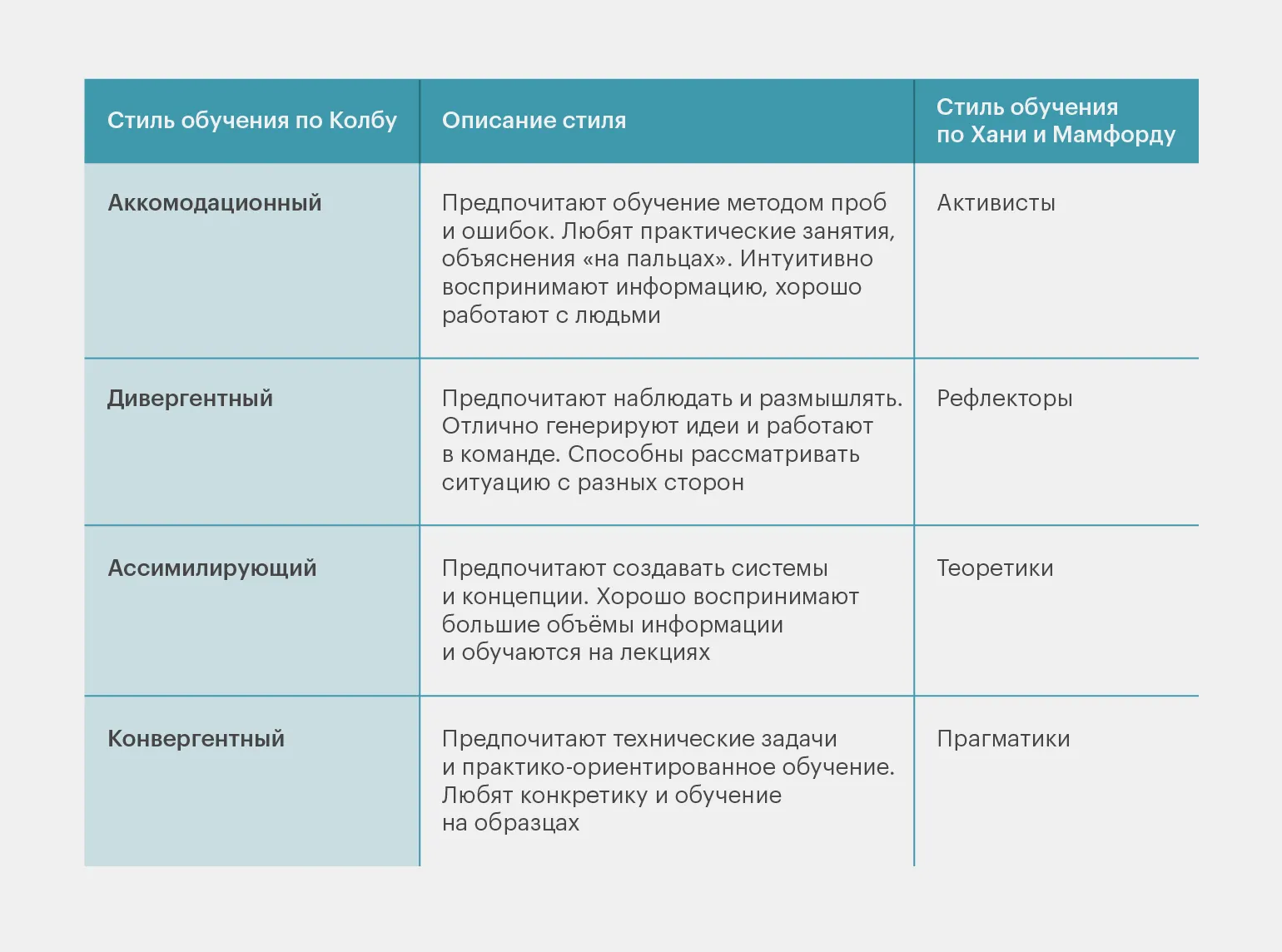
The learning styles proposed by Kolb, Honey, and Mumford have much in common. Both approaches emphasize different aspects of the learning process and describe how individual preferences and experiences can influence the perception and assimilation of information. These theories help understand how to adapt educational methods to achieve the best results. Studying the similarities between the learning styles of Kolb and Honey and Mumford can be useful for educators and students seeking to optimize the learning process.
To what extent is the Honey and Mumford classification of learning styles scientifically valid?
Despite its popularity, the Honey and Mumford model has significant shortcomings in terms of scientific validity. These limitations are characteristic not only of this model, but also of other concepts of learning styles. It is important to consider that the shortcomings can affect the effectiveness of using these models in the educational process. Therefore, when choosing a teaching approach, it is important to carefully analyze its scientific foundations and consider its potential limitations.
In 2004, British educational researchers conducted an extensive literature review of 13 popular learning style models. The study found that there was no reliable evidence to support the idea that selecting teaching methods according to student styles leads to improved learning outcomes. However, the researchers noted that different teaching tools vary in quality. Some models are based on a more robust scientific foundation and may be useful for educational practitioners. At the same time, other models are not recommended for use in student teaching or employee development. This underscores the importance of a critical approach to choosing teaching methods and the need to rely on proven scientific evidence.
The researchers highlight a fundamental problem with the Honey and Mumford model: it proposes using a simple tool of 80 statements to make decisions in a complex and multidimensional learning process. Currently, there is no convincing evidence that the use of this model actually improves learning effectiveness.
In 2006, corporate training consultant Will Thalheimer proposed an interesting experiment: he promised to pay a thousand dollars to anyone who could scientifically prove that creating a curriculum taking into account different learning styles actually improves student performance. Since then, the "prize" has increased to five thousand dollars, but no one has volunteered to participate in the experiment. This fact highlights the complexity and controversy of the topic of learning styles in educational practice, as well as the need for further research in this area.
The authors of the study, published in 2008, emphasize the need for a solid evidence base for the recognition of concepts as scientific. This includes the use of reliable and valid questionnaires, as well as randomized controlled trials on a sufficiently large sample. Honey and Mumford's model does not meet these criteria, as it is based on the authors' professional experience and Kolb's concept, which also has serious scientific validity concerns. Paul Kirschner, Professor of Educational Psychology at the Open University in the Netherlands and co-author of "Ten Steps to Integrated Learning," emphasizes several important aspects regarding the unscientific nature of the learning styles concept. First, learning styles are often determined based on self-reports, which calls into question their reliability. Self-diagnosis can be an unreliable method, as many people have difficulty in self-analysis and may provide less than honest answers. Second, even if a preferred learning style can be accurately identified, this does not guarantee that the chosen approach will be the most effective for a given individual. These arguments highlight the need for a more in-depth analysis of teaching methods and their impact on educational outcomes.
Why Honey and Mumford's Learning Styles Model Remains Popular
The academic debate about learning styles continues to attract the attention of both theorists and practitioners in the fields of education and corporate training. This is because understanding different learning styles can significantly improve the effectiveness of educational processes. Research shows that adapting teaching methods to individual student preferences promotes deeper learning and increased motivation. In today's educational environment, it is important to consider a variety of approaches to create the most comfortable and productive learning environment. Thus, interest in learning styles remains relevant, as they play a key role in the development of effective educational strategies.

In their "Handbook of Learning Styles," Honey and Mumford emphasize that their primary goal is not to gain academic recognition but to provide detailed, practical recommendations for people seeking to develop their abilities, as well as for those who help others in this process. These recommendations may be especially useful for educators, coaches, and mentors who want to effectively support the learning and growth of their students.
They appear to have achieved their goal. Their classification of learning styles is simple and understandable, making it appealing to students. This system helps people identify their learning preferences and navigate the educational process. As the authors of a 2004 review noted, information about learning styles provides students with a "learning vocabulary" that allows them to discuss their difficulties and preferences with tutors and teachers. It also facilitates more effective planning of the learning process, monitoring progress, and identifying areas for improvement. Understanding one's own learning styles thus becomes an essential tool for successful learning and development.
Learning style models provide solutions to complex problems such as motivation, engagement, achievement, and application of acquired knowledge. These approaches are especially relevant for those who have recognized the shortcomings of the traditional method, where the teacher simply imparts knowledge and the student absorbs it. Educators strive to find more effective teaching methods that take into account the diversity of student needs and inclinations. This approach helps create a more dynamic and adaptive learning environment that fosters the development of each student.
In their "Learning Styles Assistant's Guide," published in 2000, Honey and Mumford provide valuable guidance for managers training their teams. They describe how to identify learning needs, anticipate potential learning difficulties, form learning groups, and design and monitor individual development programs. These tips will help managers effectively organize training and develop the skills of their employees, which will ultimately lead to improved team performance and the achievement of business goals. However, the practical application of Honey and Mumford's model has its limitations. It is important to keep in mind that these authors' classifications represent rather broad generalizations. People's preferences often do not fit neatly into the framework of a single style and, as a rule, combine elements of various approaches. Furthermore, it is worth noting that these preferences can change over time, which makes their analysis and application in work more complex. Gathering people with similar learning styles in one group is a real-life challenge. Forming different groups based on styles, as well as developing and delivering training programs for each of them, requires significant resources and time. Given that the effectiveness of this approach has not been scientifically proven, its use becomes extremely inappropriate. There are recommendations for modifying teaching techniques, methods, and forms of activity, for example, during training sessions, depending on the learning style of each participant. However, a problem arises: it is difficult to accommodate the individual characteristics of all participants by preparing a suitable set of activities for each in advance. This requires additional effort and time for analysis and adaptation, which can hinder the learning process. It is important to find a balance between universal methods and an individualized approach to ensure maximum learning effectiveness for all participants. Choosing between Kolb's model and Honey and Mumford's model depends on personal preference. While the evidence base for these models may be limited, their concepts of learning styles can serve as useful tools for reflection during the learning process and for establishing productive dialogue with students. These models help to better understand individual approaches to learning and adapt educational strategies, which can improve the effectiveness of the learning process.
The Methodologist profession from scratch to PRO
You will improve your skills in developing curricula for online and offline courses. Master modern teaching practices, structure your experience, and become a more sought-after specialist.
Find out more