
Contents:
- The future is determined by technology and "green" trends
- Digitalization will not leave people without work
- Some skills and professions are becoming obsolete
- There will be more jobs in some places
- Soft skills are still important
- Most workers will need retraining
- Companies are focusing on training the workforce
- Employees will be trained primarily to work with AI
- Support is expected from governments vocational training
The future is determined by technology and "green" trends
According to the survey results, more than 86% of respondents agree that the implementation of advanced technologies will have a significant impact on business transformation in the next five years. A similar number of respondents expect changes associated with increasing access to digital technologies. At the same time, other factors, such as economic, environmental, and political, are perceived as less significant. For example, more than 80% of survey participants consider the implementation of ESG standards an important trend for business transformation, while 73% of respondents noted a slowdown in economic growth. Only 48% of respondents acknowledged the role of growing geopolitical differences as a factor influencing business as important. This highlights that technology and access to it are becoming key drivers of change in the business environment.

According to employer surveys, the main factors contributing to job losses are slowing economic growth, cited by 44.4% of respondents, problems with the supply of necessary materials or their rising costs, noted by 23.7%, and rising living costs among potential clients, cited by 19.3%. These aspects impact the labor market and could lead to significant changes in the employment structure.
Survey participants attribute the creation of new jobs to the implementation of ESG principles, the localization of supply chains, and the development of "green" processes in production. The introduction of new digital technologies and their increased availability are also expected to be contributing factors, as confirmed by 36.4% and 33.7% of employers, respectively. These changes are driving the transformation of the labor market and increasing business resilience in a rapidly changing economy.
Macrotrends Driving New Job Creation
In today's world, there are a number of macrotrends that are having a significant impact on the labor market and driving the creation of new jobs. These trends are shaped by various factors, such as technological progress, changing demographics, and global economic changes.
One key area is digitalization. The development of information technology and the automation of processes require IT specialists, leading to an increase in demand for programmers, data analysts, and cybersecurity specialists.
Environmental sustainability is also worth noting. Increased attention to environmental and sustainable development issues is creating new jobs in green technologies, waste management, and alternative energy.
An equally significant trend is the aging of the population. With the increase in the number of elderly people, the need for healthcare workers, social workers, and caregivers is increasing. This opens up new employment opportunities in healthcare and social services.
Thus, macrotrends such as digitalization, environmental sustainability, and population aging play a significant role in shaping new jobs and reshaping the labor market. Monitoring these changes will help both job seekers and employers adapt to new conditions and compete successfully in a dynamic economy.
Macrotrends that can have a neutral or negative impact on job creation are becoming increasingly important. These trends include process automation, the introduction of new technologies, and changes in consumer preferences. Automation reduces labor demand, particularly in traditional industries such as manufacturing and services. Technological innovations also lead to changes in the employment structure, creating new occupations but simultaneously reducing old ones. Furthermore, changes in consumer preferences can lead to changes in demand for certain goods and services, which, in turn, will negatively impact the number of workers in some sectors. It is important to consider that these macrotrends require adaptation on the part of workers and employers, which may cause additional difficulties in the labor market.
The World Economic Forum conducted the Future of Jobs Survey 2023, which provides up-to-date data on the state of the labor market and the prospects for occupational development in the coming years. The survey identifies key trends affecting employment, including automation, digitalization, and changes in employer needs. The results show which occupations will be in demand and which are at risk of disappearing, allowing professionals and employers to adapt to new conditions. It is important to monitor these changes to remain competitive in the labor market.
By 2027, structural changes, which include not only worker replacement but also job creation and layoffs, are expected to affect 23% of the workforce in companies participating in the survey. These changes will have the greatest impact in sectors such as media, entertainment, and sports, where 32% of employees will be affected. Significant changes are also expected in the public sector and the IT and digital communications sector, where this figure will be 29%.

Analyzing data from the International Labor Organization covering 820 million workers, the authors of the report concluded that there is a likely loss of 14 million jobs worldwide. These figures highlight the need to adapt the labor market to new conditions and challenges facing workers and employers.
Digitalization will not leave people without work
The majority of respondents do not associate the expected reduction in jobs with the introduction of digital technologies and artificial intelligence. From the point of view of respondents, new technologies, on the contrary, can have a positive impact on the labor market, creating new opportunities for employment and increasing the efficiency of work processes. Employers hope that technological innovations will help improve business performance and create new jobs in various industries.
Some technologies, such as artificial intelligence, raise controversial opinions. Approximately 25% of respondents believe that the implementation of AI will lead to job losses in their companies, while about 50% are confident that it will create new opportunities. The net effect of AI use is 25.6%, which indicates a predominance of optimistic views on its impact. Despite this, AI ranks 21st in terms of influence.
Top 10 Technologies Impacting the Labor Market
The modern labor market is undergoing significant changes due to the influence of new technologies. These innovations not only change approaches to task completion but also create new professions and skill requirements for specialists. In this article, we will consider ten key technologies that are having a noticeable impact on the labor market.
Artificial intelligence (AI) is becoming a key tool for process automation and data analysis. With its help, companies can optimize work processes, which leads to increased efficiency and cost reduction. This also creates a demand for specialists with AI skills.
Big Data plays a vital role in business decision-making. Companies are looking for specialists who can analyze and interpret large amounts of information, making this field one of the most in-demand in the labor market.
Cloud technologies allow businesses to store and process data with flexibility and convenience. Knowledge of cloud solutions is becoming essential for many professions, which is driving the growth of job openings in this field.
The Internet of Things (IoT) is changing the approach to interaction between devices and systems. Specialists who can integrate and manage IoT devices are becoming increasingly in demand.
Automation and robotization of production processes are significantly impacting employment dynamics. Workers must adapt to new conditions by mastering the skills of working with automated systems.
Cybersecurity is becoming critical in the face of the growing threat of cyberattacks. The demand for cybersecurity experts continues to grow, making this field a hot career opportunity.
Virtual and augmented reality (VR and AR) are finding applications in a variety of industries, from education to medicine. Professionals with knowledge of these technologies can expect a successful career.
Blockchain, a technology that ensures the security and transparency of transactions, is also opening up new horizons for professionals. Knowledge of blockchain technology is becoming important for the financial sector and other industries.
Mobile technologies continue to evolve, creating new business opportunities. Mobile app developers and UX/UI design experts are in demand more than ever.
Finally, 3D printing is transforming manufacturing processes, allowing for the creation of unique products and prototypes. Professionals with 3D printing skills can find their place in this rapidly evolving industry.
These technologies are not only shaping the new face of the job market but also creating new career opportunities. By mastering modern skills, workers can remain competitive and successful in their professions.
In 2023, the World Economic Forum's Future of Jobs study provided up-to-date data on the transformation of the labor market. According to the survey results, technology is significantly impacting professional skills and worker requirements. Automation and the introduction of artificial intelligence are changing the demand for certain professions, which in turn leads to the need for retraining and upskilling employees.
Furthermore, the study results highlight the importance of worker flexibility and adaptability in a rapidly changing market. The ability to master new technologies and adapt to change is becoming a key factor for success. The survey also identified trends in in-demand professions, notable among which are IT specialists, data analysts, and cybersecurity experts.
Thus, the World Economic Forum's data serves as an important indicator for employers and employees, emphasizing the need for continuous learning and adaptation to new working conditions.
In the 2022–2023 survey, respondents were more cautious in their assessment of the pace of automation compared to previous years. On average, they predict that automation will affect 42% of work tasks by 2027, while in 2020, this figure was predicted to reach almost 50% by 2025. The actual pace of automation, according to the survey data, also turned out to be modest: since 2020, the share of automated tasks in companies participating in the survey has increased by only 1%, reaching 34%. These results highlight the gradual adoption of automation in work processes.
Some skills and professions are becoming obsolete
In recent years, it has become clear that artificial intelligence can replace humans in some areas that require relatively simple mental work. Research shows that over the next five years, there will be a decline in demand for professions such as secretaries and clerks. These office workers, who perform narrow duties, include bank employees, postal workers, and cashiers. As technology continues to evolve, it is important to rethink the role of humans in work processes and adapt to new labor market conditions.

Based on the data obtained, the authors of the report suggested that by 2027 the number of administrative jobs worldwide will decrease by 26 million. The largest reduction, from 2.5 to 7.5 million vacancies, is expected in the following job categories:
- data entry operators;
- secretaries;
- accounting and payroll specialists;
- security guards;
- building custodians and housekeepers.
Some places will see an increase in jobs
According to surveys conducted among representatives of the education sector, the number of specialists in this field is likely to grow by 10% by 2027. Based on these estimates, the report's authors project the creation of approximately 3 million new jobs globally, primarily due to an increase in the number of teachers in vocational and higher education. The bulk of these new positions, the study indicates, will be concentrated in developing countries. This growth may be driven by the need to bridge the "skills gap," which involves training and filling skill gaps in various sectors. Education, therefore, becomes a key factor in addressing the shortage of skilled workers in the labor market. A significant increase in jobs in agriculture is expected, amounting to approximately 30%. This equates to approximately 3 million new jobs. Despite the varying opinions of employers, the report's experts believe that the increase in employment will also affect professions in other sectors that are difficult to automate. This applies in particular to construction, manufacturing, machine and mechanism repair, and logistics. Growing labor demand in these fields may be a response to changing labor market conditions.
Employers predict a 25–35% growth in digital occupations related to online marketing and sales. Up to 2 million new jobs are expected to be created in this field. This demonstrates the high demand for specialists who can effectively use internet technologies to promote goods and services. Amid the digital transformation of business, online marketing skills are becoming especially relevant, opening up new opportunities for career growth and development.
The report presents occupations with the largest projected job growth in absolute terms (in millions). Among them, three occupations are related to education, including higher education, despite persistent predictions of its possible collapse. This underscores the importance and relevance of the educational sector in the context of current changes in the labor market.
Occupations with the greatest job growth in the coming years represent an important aspect of the labor market. Given current trends and changes in the economy, certain professions will be in greatest demand. These include specialists in information technology, healthcare, ecology, and education.
The information technology field continues to evolve rapidly. Programmers, data analysts, and cybersecurity specialists will be needed to adapt to new technologies and ensure data security.
The healthcare sector will also need qualified specialists. Doctors, nurses, and specialists in rehabilitation and elder care will be in the spotlight due to population growth and an aging society.
Environmental professions are becoming increasingly relevant in light of global climate change. Sustainability specialists, ecologists, and renewable energy engineers will play a key role in achieving environmental goals.
Education also requires updating. Teachers, especially in STEM (science, technology, engineering, and mathematics) disciplines, will be in demand to train the next generation of professionals.
Therefore, choosing a profession with high growth potential will provide not only stability and prospects, but also the opportunity to make a significant contribution to society.
- Agricultural machinery operators;
- Truck and bus drivers;
- Vocational teachers;
- Mechanics;
- Business development specialists;
- Construction workers;
- Higher education teachers;
- Electrical engineers;
- Metalworkers, moulders, and welders;
- Special education teachers.
The authors of the report assigned this rating based on the survey results, applying them to an extensive database of the International Labour Organization.
The occupations listed are not directly related to digital transformation or the implementation of new technologies. However, they are widespread and will remain relevant for at least the next five years. With demographic growth in developing countries, an increase in the number of these occupations is observed. The increase in job opportunities for teachers and lecturers is primarily due to the increasing number of students. However, it is worth noting that this growth will not be observed everywhere, but only in regions with significant demographic growth. The following professions are expected to see increased demand in the near future. These professions are not considered common, and there is already a high demand for specialists in these fields. Professions with increasing demand in the coming years will meet the requirements of the modern labor market. In the context of rapid technological progress and economic changes, specialists in information technology, healthcare, ecology, and digital marketing will become especially relevant. The IT sector continues to evolve, and professions such as software developers, cybersecurity specialists, and data analysts will become especially in demand. Healthcare also requires new personnel, including nurses, doctors, and telemedicine specialists, due to increasing life expectancy and technological advances.
Environmental professions such as sustainability experts and environmental specialists will grow in popularity due to global climate change and the need to transition to a green economy.
Digital marketing will also grow, and specialists in SEO, content marketing, and digital analytics will become indispensable for businesses seeking effective online promotion.
Thus, professions focused on technology, health, and sustainability will be the most promising and in-demand in the coming years.
- AI and machine learning specialists;
- Sustainability specialists;
- Business analysts;
- Cybersecurity engineers;
- Fintech engineers;
- Data analysts and scientists;
- Robotics engineers;
- Big data specialists;
- Agricultural machinery operators;
- Digital transformation specialists.
For data analysts and engineers, as well as business analysts, the expected growth is 35%, which will lead to the creation of 1.4 million new jobs. For artificial intelligence specialists, growth is projected at 40%, which corresponds to 1 million new vacancies. These data highlight the growing demand for data analytics and AI professionals, opening up significant career opportunities in these fields.
Soft Skills Remain Important
The survey-based list of ten key skills for 2023 highlights the critical competencies needed for a successful career. These skills are relevant for specialists in various fields and will help improve competitiveness in the labor market.
- analytical thinking;
- creative thinking;
- resilience and flexibility;
- motivation;
- curiosity and continuous learning;
- technological literacy;
- reliability and attention to detail;
- empathy and active listening;
- leadership and social influence;
- quality control.
Employers often evaluate the skills of job candidates according to formal criteria. According to surveys, more than 71% of employers pay attention to the applicant's work experience, while almost 45% take into account the presence of a university degree. This highlights the importance of practical experience and educational preparation in employment.
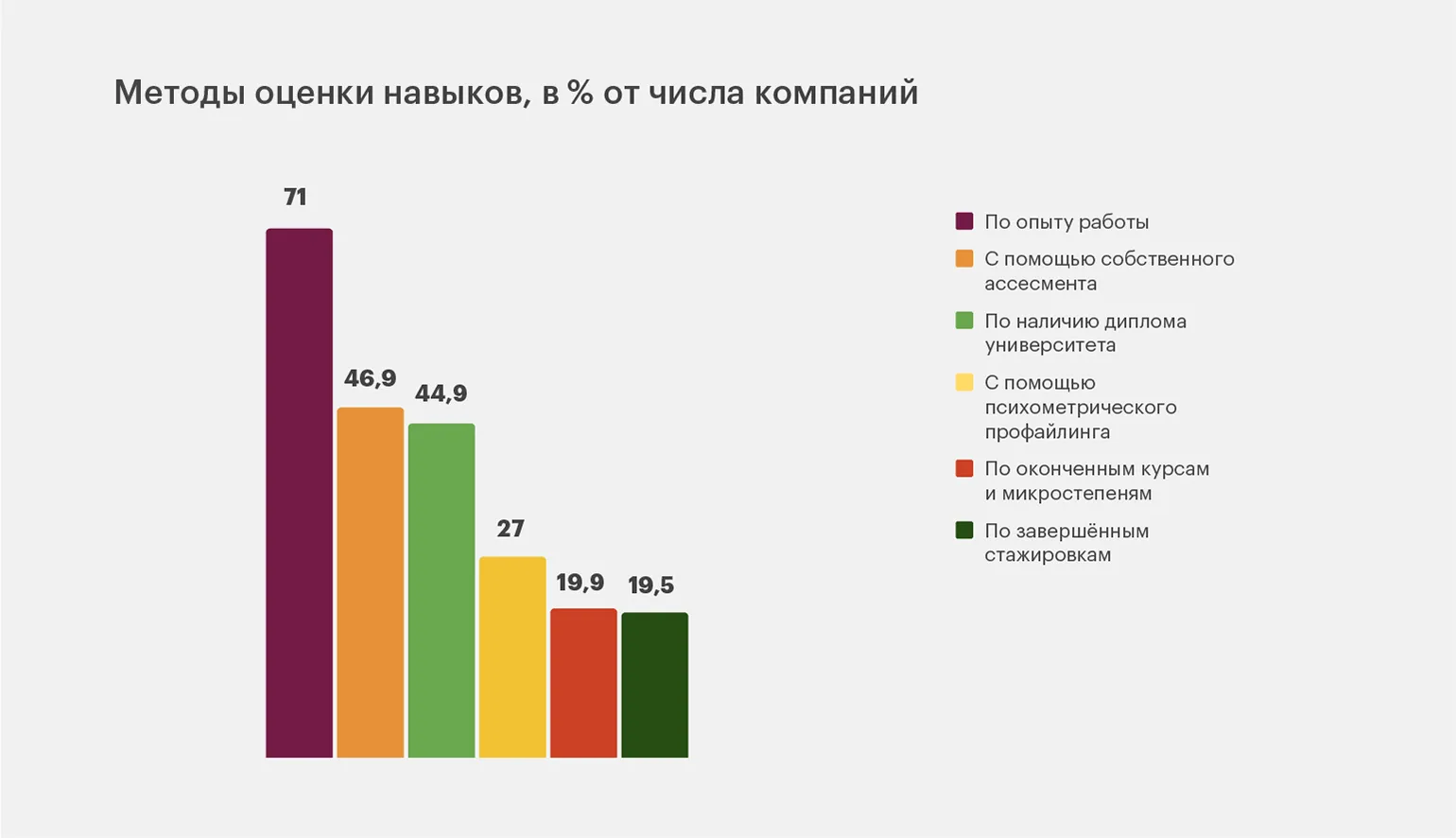
Average estimates vary by country. For example, more than half of companies in Austria take internship results into account, while in other European countries less than 5% of employers are interested in this indicator. When it comes to recognizing the results of short courses and microdegrees, the figure is 40% in Finland and 41% in Pakistan. Without further research, it is difficult to determine the reasons for these differences.
Most employees will need retraining
Employee reskilling, or their retraining for a new position, is becoming an important strategy for companies in the face of modern technological trends and the increasing importance of certain skills. According to survey respondents, six out of ten employees will need reskilling by 2027. It is also predicted that 44% of skills will require updating in the next five years. This highlights the need for continuous training and adaptation to changing labor market demands.
Employee surveys cited in the report show that 57% of workers seek training outside the company due to shortcomings in corporate programs. Another survey revealed a significant gap in training satisfaction between regular employees and managers: 36% of regular employees and 64% of managers are satisfied with their employer's offerings. This highlights the need to improve corporate training to increase its effectiveness and employee satisfaction.
In 2023, employers estimated the share of employees who had undergone necessary retraining at 41%. Based on their workforce development plans, it is not feasible to fully retrain everyone in need by 2027. This highlights the importance of a systematic approach to training and development, which in turn can impact the competitiveness of companies in a rapidly changing market.
Employee Reskilling Forecast for 2023–2027
In light of the rapid development of technologies and changes in the labor market, employee reskilling is becoming an important element of the HR strategy. From 2023 to 2027, the demand for reskilling programs that will help workers adapt to the new environment is expected to increase.
Organizations will invest in training to upskill employees, allowing them to remain competitive. Reskilling will cover both technical skills and soft skills, such as communication and time management.
Given the trends towards digitalization and automation, companies will need to not only implement new technologies but also train employees to use them. This will not only preserve jobs but also increase productivity.
The analysis shows that successful companies will be those that actively invest in the development of their employees, which will lead to increased satisfaction and reduced turnover. Employee retraining in 2023–2027 will be a key factor in the successful adaptation of organizations to market changes.
The calculation was conducted by the authors of the World Economic Forum report based on data on employee development strategies provided by respondents.
In 2023, the World Economic Forum conducted the Future of Jobs Survey, which provides up-to-date data on current labor market trends. This study highlights changes in professions, skills, and worker requirements in a rapidly changing economy. An important aspect is the need for workers to adapt to new technologies and automation, which is leading to a change in the employment structure. Survey participants identified key skills that will be in demand in the coming years, emphasizing the importance of continuous training and professional development. The study's findings also highlight the growing role of hybrid work and the importance of soft skills such as communication and creativity. Analyzing the Future of Jobs Survey 2023 data will help employers and job seekers better understand labor market dynamics and meet the demands of the future.
Companies Focus on Workforce Training
Survey participants are optimistic about their companies' HR prospects, placing a strong emphasis on employee development. They plan to promote, retrain, and retain talented employees, offering competitive salaries. Specifically, 48.1% of respondents intend to provide new career advancement opportunities, while 33.7% plan to implement reskilling and professional development programs. This demonstrates companies' desire to invest in their employees and enhance their professional value, which in turn helps strengthen their market position.
The shortage of candidates with the necessary competencies in the labor market is one of the main obstacles to successful business transformation. This opinion is shared by almost 60% of respondents. In a rapidly changing business environment, the availability of qualified specialists is becoming critical for achieving competitive advantages and implementing innovative projects. Therefore, companies need to actively invest in talent development and increase the attractiveness of their vacancies to attract the necessary talent.
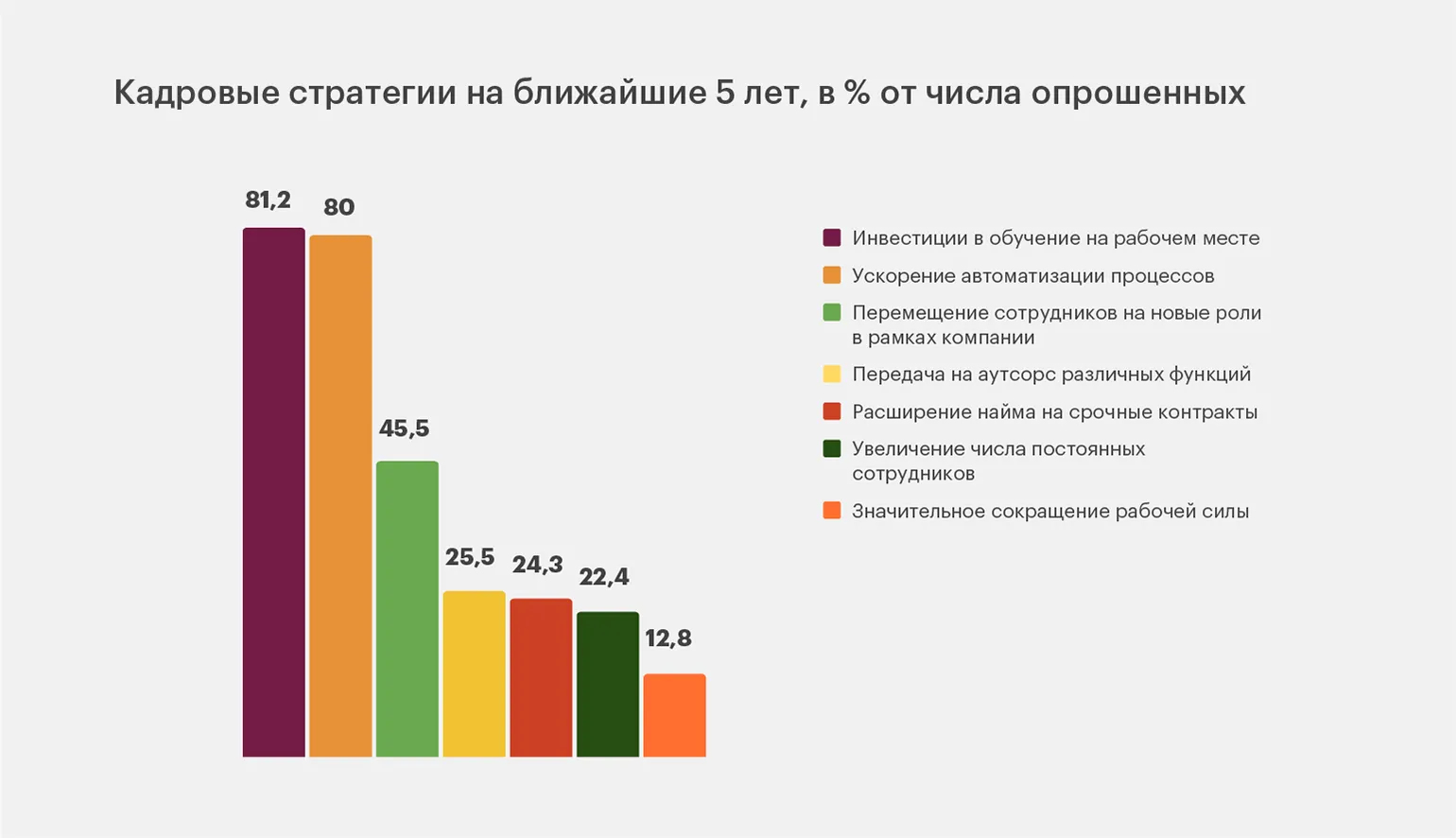
For more than 80% of respondents, investments in on-the-job retraining and process automation will be key HR strategies over the next five years. Furthermore, 45.5% of respondents noted the importance of relocating employees from declining positions to new, more promising roles. These approaches will help companies adapt to rapidly changing market conditions and improve team performance.
Companies will place greater emphasis on internal training rather than purchasing educational services from external providers, such as educational organizations and online course platforms. More than 80% of survey participants stated their intention to implement modern technologies for employee training and development. This will improve the effectiveness of educational programs and adapt them to the specifics of the company's work. Internal training not only contributes to the development of employee competencies but also shapes corporate culture, which in turn has a positive impact on the overall productivity of the organization.
Employees will be trained primarily in working with AI
In the coming years, employers plan to focus on training employees in the field of artificial intelligence and big data. These areas have become a priority, despite the fact that those surveyed in 2023 rarely mentioned them as the most important skills. Additionally, companies intend to invest time in other training topics that are not considered as relevant now but may impact business development in the future. Training in these areas will help employees adapt to rapidly changing conditions and improve organizational competitiveness.
Between 2023 and 2027, employers plan to focus on training employees in the key skills needed to succeed in a rapidly changing world. The focus will be on developing digital competencies, including mastery of modern technologies, analytical tools, and programming basics. Critical thinking and problem-solving training will also be important, enabling employees to effectively address new challenges.
Furthermore, employers will emphasize the development of interpersonal and teamwork skills, which contributes to a harmonious work environment and increased productivity. Resilience and adaptability will also be at the center of educational programs, as companies strive for a more flexible approach in an uncertain marketplace. Environmental literacy will also be an important focus, helping employees understand the importance of sustainable development and the implementation of environmentally friendly practices in business processes. : Employers will therefore strive to build highly skilled and adaptive teams prepared for the challenges of the future.
- AI and big data are 12 places higher in the ranking of priority areas for training than in the list of key skills of 2023;
- environmental protection is 10 places higher;
- design and user experience is 9;
- marketing and media is 6;
- leadership and social impact is 5;
- networks and cybersecurity is 5.
Observations show that the skills that employers most often mention in their training plans are of higher importance in the future. This indicates that these skills are perceived as key to professional development and success in the modern working environment. Thus, employers are not only emphasizing important skills but also investing in their development, which underscores their importance for sustainable company growth.
In 2023–2027, education companies will focus on developing analytical thinking, as noted by 59% of respondents. Artificial intelligence and big data are also becoming important priorities (57%), while creative thinking accounts for 47%. A similar trend is observed in the information technology and digital communications sector: 57% of organizations highlight artificial intelligence and big data, 49% emphasize analytical thinking, and 41% emphasize creative thinking. These areas are becoming key to ensuring competitiveness and innovative development in both industries.
According to a report by the World Economic Forum, employees choosing courses on the Coursera platform focus on hard skills such as programming, design, artificial intelligence, and data analysis. At the same time, soft skills, including analytical and creative thinking, receive significantly fewer hours of training. This indicates that employees do not attach much importance to these skills, despite the fact that companies view soft skill development as an important aspect. Thus, there is a gap between employee training preferences and the strategic goals of organizations.
Governments are expected to support vocational training
According to the survey, 45% of employers believe that the most effective step for the government to improve the labor market situation is funding professional retraining and upskilling programs. Other possible measures, such as changes in labor laws to simplify the hiring process, improving educational systems, and providing tax incentives, received fewer votes. This underscores the importance of investing in education and skills development, which in turn helps create a more competitive workforce.
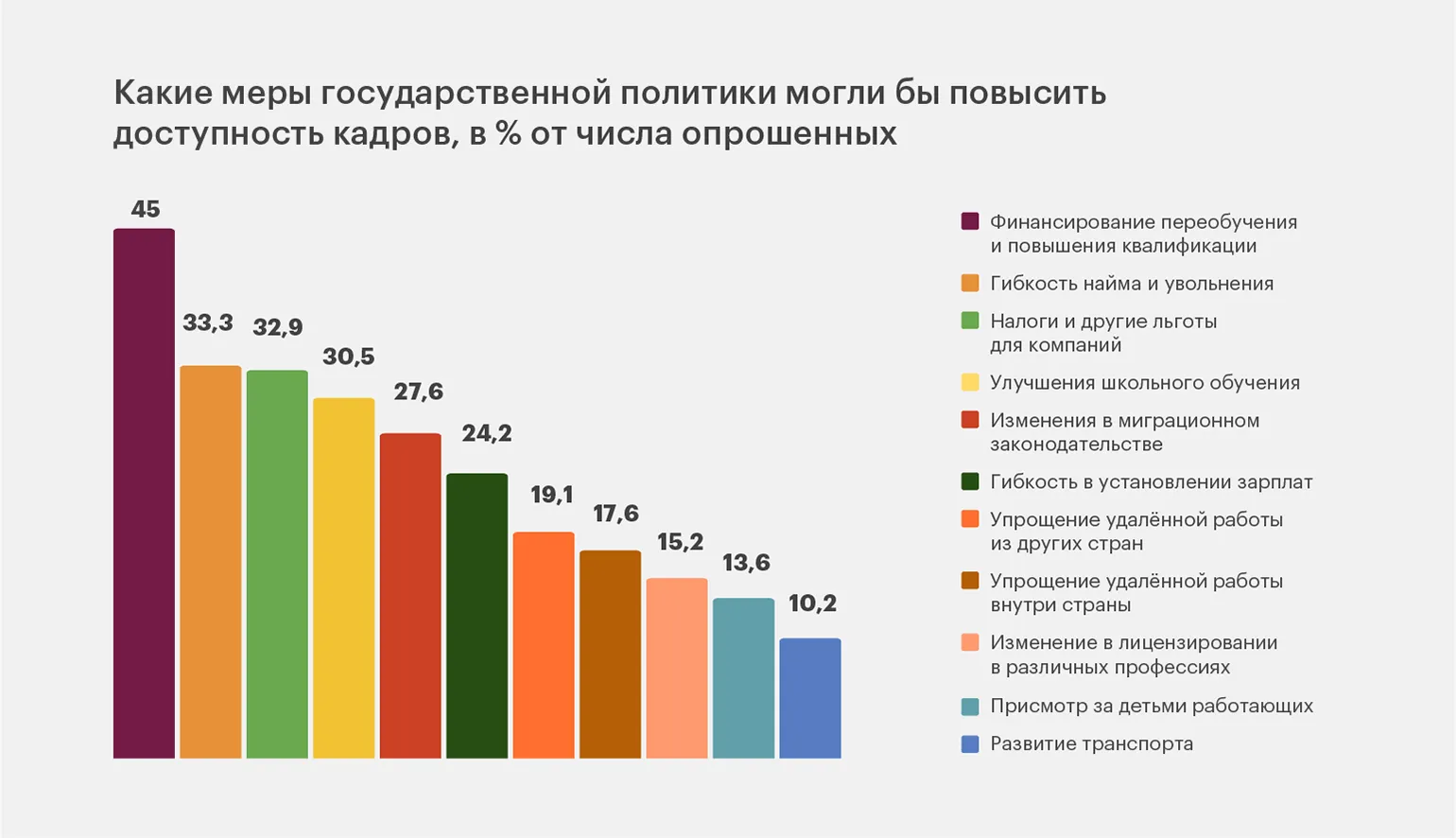
Some companies in various countries are looking to attract workers from abroad. In particular, a significant number of respondents from China, Indonesia, Germany, and the Philippines expect changes in immigration laws, which could create opportunities for foreign specialists. These changes can impact the labor market and facilitate the attraction of qualified personnel from other countries.
Check out our recommendations and useful materials. We offer up-to-date information and advice on the topics that interest you. Our content will help you gain a deeper understanding of the subject and find the right solutions. Don't miss the opportunity to expand your knowledge and improve your skills.
- Corporate Training - 2023: A Brief Overview of Trends from International Reports
- McKinsey experts reported on a skills revolution. What does this mean for education?
- The unpleasant truth: business does not see the value in the L&D function
- Learning culture in a company: what is it, why is it needed, and how to build it