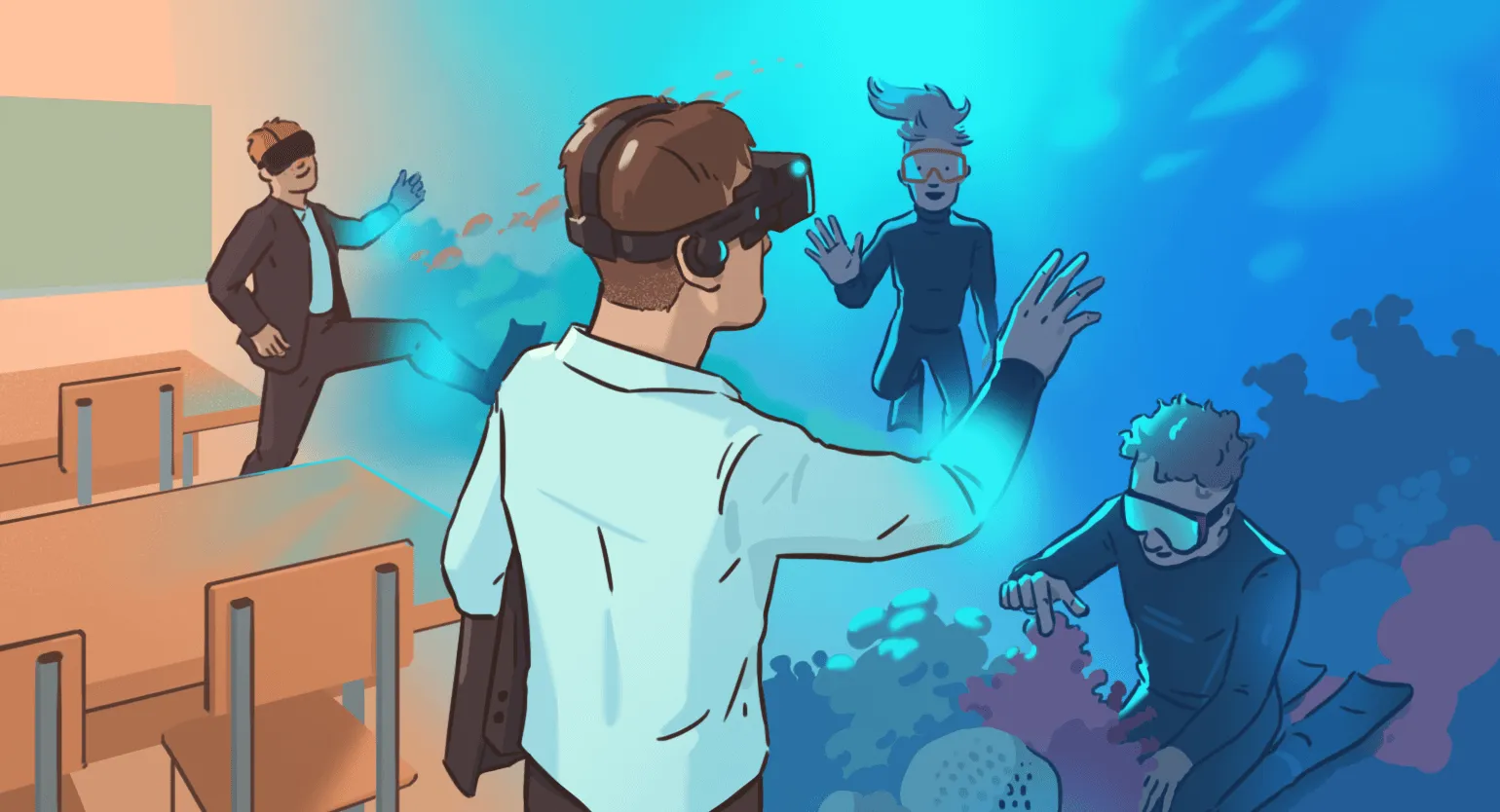
Contents:

Learn: Profession Methodist from scratch to PRO
Learn moreThe idea of using metaverses in education has been actively discussed for three years and is recognized as one of the key educational innovations in 2023. The first virtual school implementing this concept recently opened in Japan, but the mass implementation of metaverses in the educational process is still a long way off. Currently, elements of virtual reality in schools and universities remain rare. This suggests that it is premature to talk about designing educational programs in metaverses. However, given the rapid development of technology and its impact on the educational process, the future of metaverses in education may be closer than it seems.
Until 2021, online learning was perceived as a rarity. However, the pandemic radically changed this situation, forcing a wide range of people to switch to a new learning format. The concept of digital didactics has become an integral part of the educational process. The transition of learning to a virtual environment may happen even faster than we expect. Therefore, it is important to prepare for these changes in advance and adapt your teaching approaches to the digital era. Researchers Gustav Petersson and Guido Makransky from the University of Copenhagen studied the possibility of migrating traditional webinars and online trainings from the Zoom platform to augmented reality. They asked how such a transformation would impact the quality and effectiveness of group interaction and learning in general. Their work led to the development of a theory of collaborative learning in highly immersive environments, known as The Theory of Immersive Collaborative Learning (TICOL). This research paper presents the key ideas of this theory, which have the potential to change approaches to learning and interaction in the digital space. The TICOL study offers new perspectives on educational technologies and highlights the importance of immersive technologies in modern learning.
Learning in Standard Online Environments and in Augmented Reality: What's the Difference?
The authors of the theory explain that the standard online environment involves interaction with information and other users through computers and mobile devices. In this environment, content is displayed on flat 2D screens, which limits the view and reduces the level of immersion, that is, the degree of immersion in the virtual environment. In the professional literature, collaborative learning in such settings is referred to as CSCL (computer-supported collaborative learning). This concept emphasizes the importance of technology in learning and interaction, providing new opportunities for the learning process.
Extended reality (XR) is a concept that immerses the user in a virtual space. This term encompasses a range of technologies, including virtual reality (VR), augmented reality (AR), and mixed reality (MR). Each of these technologies offers unique opportunities for interacting with digital content and the real world, creating new opportunities for education, entertainment, and business. Augmented reality is used in a variety of fields, from gaming and education to medicine and architecture, revolutionizing the way we perceive and interact with information.
- Augmented reality (AR) overlays individual virtual elements onto the display of the real world that the user sees through a smartphone screen.
- Mixed reality (MR) involves the combination of real and virtual objects, as well as a more pronounced effect of real presence through the use of a VR headset or glasses. A variation of this technology is augmented virtuality (AV), when the user, while in a virtual world, can also see some real objects (such as their screen or keyboard) or people and interact with them.
- Virtual reality (VR) completely immerses a person in a digital environment. This technology is characterized by the highest immersiveness.

The article discusses technologies with a high degree of immersion, which involve the use of virtual glasses or helmets for immersive virtual reality. The authors introduce a new term, XRCL (extended reality-enabled collaborative learning), to describe the collaborative learning process in such XR environments. This approach opens up new horizons in the educational process, allowing participants to interact in a more engaging and interactive way. The use of XR technologies in education contributes to improved learning and increases student engagement.
According to Petersen and Makransky, their study represents one of the first attempts to thoroughly study the characteristics of learning in an extended reality environment and to create a theoretical model of this process.
Comparison of group learning in a traditional online format and in an immersive XR environment includes several key aspects. First, immersive technologies such as virtual and augmented reality provide deeper involvement of participants, which contributes to better learning. Second, an XR environment allows for a more interactive and dynamic learning process, where participants can interact with each other and with the learning material in real time. This not only improves communication but also develops teamwork skills. Thirdly, the use of immersive technologies allows for the simulation of various scenarios and situations, making training more practical and applicable to real-life situations. Thus, immersive XR environments represent a promising approach to group learning that can significantly improve its efficiency and effectiveness.
- What factors are specific to this environment?
- How can the effectiveness of group learning be improved using augmented reality?
- When will collaborative learning in an immersive environment be most beneficial?

Read also:
Virtual and augmented reality are becoming an integral part of the educational process in schools and universities. These technologies open up new horizons for learning, providing a deeper understanding of subjects and the development of practical skills.
The use of virtual reality allows for the creation of immersive learning environments where students can interact with 3D models and simulations. For example, biology lessons can include the study of human anatomy through virtual tours inside the human body, significantly simplifying the understanding of complex topics.
Augmented reality, in turn, helps integrate digital information into the real world. Using mobile devices, students can see additional materials, such as animations or explanations, superimposed on real objects. This makes learning more interactive and engaging, and promotes better retention of information.
The integration of these technologies into the educational process not only increases student engagement but also helps teachers adapt content to different learning styles. Thus, virtual and augmented reality are becoming powerful tools that contribute to the development of modern education.
Factors of Group Learning in Augmented Reality
The authors of the article identify three key groups of factors influencing group learning in augmented reality. These include pedagogical design factors, psychological aspects, and factors of group interaction. These elements play an important role in shaping an effective learning process and can significantly improve educational outcomes. The correct combination of these factors helps to create a more interactive and engaging learning environment, which is especially relevant in the context of modern educational technologies.
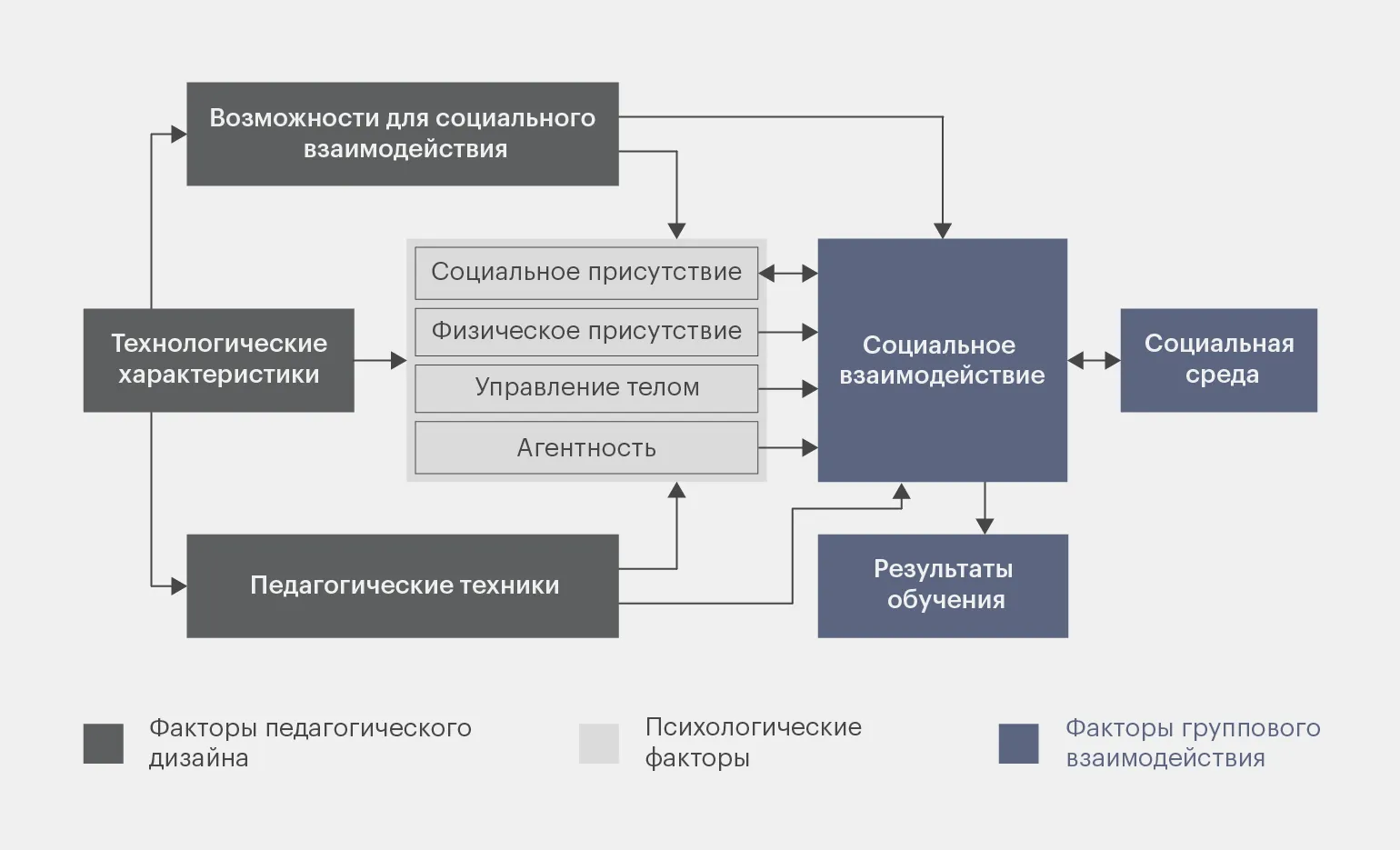
Petersen and Makransky demonstrated the relationship between various components of the instructional design of an XR environment in a diagram. According to their theory, factors related to instructional design influence psychological aspects and interactions within a group of learners. Psychological factors, in turn, also influence group interactions. Thus, there is an indirect effect of instructional design factors and psychological aspects on learning outcomes, which emphasizes their importance for an effective educational process.
In this article, we will examine in detail the key components of the Petersen and Makransky theories. These theories play a vital role in understanding various aspects of social and psychological processes. We will analyze the main ideas underlying these concepts and their significance for contemporary research. Petersen's theory emphasizes the relationship between individual and social factors, while Makransky's theory explores the influence of cultural contexts on human behavior. Both approaches provide valuable insights for studying the interactions of individuals in society and the formation of their identity. Understanding these theories can help in a deeper analysis of social phenomena and the development of effective strategies for their resolution.
This category of factors includes:
- Technological characteristics are the capabilities of hardware and software. These include sound and image quality, the user's field of view, the speed of the environment's response to their actions, the level of control over the avatar, the realism of the environment and its elements, and many other characteristics. They define the possibilities and limitations of designing learning in augmented environments.
- Opportunities for social interaction are non-cognitive factors that influence group interaction. For example, these could be tools for communication via user avatars or rules and instructions for students in augmented reality.
- Pedagogical techniques are the tools of instructional design used. For example, these include any designed group activities and student interaction scenarios during learning.
Psychological factors of learning in XR environments are crucial for a successful educational process. In virtual and augmented reality, psychological aspects manifest differently than in traditional educational environments and can significantly influence learning outcomes. Authoritative researchers such as Petersen and Makransky identify four key factors: social presence, physical presence, body control, and agency. These factors play a vital role in fostering effective learning in immersive settings, facilitating deeper engagement and comprehension.
Social presence is the perception that other participants in a digital interaction are real, living people. This perception plays a key role in building trust and increasing user engagement in online activities. Creating a genuine sense of social presence facilitates deeper interaction and improves the quality of communication in a virtual environment.
To assess users' perceived social presence in XR environments, researchers use questionnaires. Participants complete specially designed questionnaires that help elicit their perceptions of interaction in the virtual space. In addition, digital data is collected on user behavior, including recording eye contact and analyzing nonverbal communication. These methods provide a deeper understanding of how users perceive social interaction in augmented reality and what factors influence their experience.
The study results show that the social presence effect in augmented reality is significant and close to real interaction in a physical space. This suggests that users communicate in the digital environment much like they do in real life, employing active listening techniques and adjusting the distance between avatars based on their level of familiarity with the other person. This high level of social presence in augmented reality opens up new horizons for communication and interaction, making this format especially attractive to users.

The XR environment has the unique ability to instantly Changing users' avatars allows them to transform their representation in the virtual space. This aspect is of interest to researchers, as they cannot yet definitively determine how such changes affect communication. For example, if a conversation partner suddenly changes from a young Asian man to an older European woman, this can significantly change the dynamics of the conversation. Experts believe that this phenomenon is worth further research to understand its impact on interactions between people in XR environments.
Revised text:
Also explore:
Research shows that learning in virtual reality (VR) is more effective when the instructor avatar is visually similar to the learner. This finding highlights the importance of visual perception in the educational process, especially in virtual learning settings. Similarity between the instructor avatar and the learner helps create a more comfortable and trusting atmosphere, which improves information comprehension and interaction. Thus, the use of avatars that reflect students' appearances can significantly enhance the educational experience in a VR environment.
Physical presence is an important psychological factor in the context of augmented reality. This sensation allows the user to perceive the created environment as real, even while recognizing its artificial nature. The user can become immersed in events and interactions, creating the illusion that everything is happening for real. This effect contributes to increased engagement and emotional reactions to what is happening, making the experience of using augmented reality deeper and more meaningful.
The effect of physical presence in an XR environment manifests itself when users receive appropriate reactions to their actions, consistent with their experience and perception of reality. When participants experience this effect, they begin to behave more naturally and realistically in the virtual environment. This creates an immersive experience that enhances interaction with the content, making it more memorable and meaningful. Thus, a high-quality implementation of the physical presence effect is becoming a key element of successful XR applications, promoting deeper user engagement and improving the overall perception of digital technologies. Meta-analysis confirms that a high degree of immersion significantly enhances users' sense of physical presence. This allows learners to maintain the illusion of reality, enabling them to engage in environments far removed from everyday life. For example, they can explore other planets or dive to the ocean floor, opening up new horizons for learning and development. Such virtual experiences foster a deeper understanding of complex concepts and phenomena, making the learning process more effective and engaging. Body ownership is a key psychological aspect in XR environments. It is important for users to feel that the virtual body they interact with truly belongs to them. This sense of ownership enhances engagement and improves the overall VR experience. Understanding and controlling one's virtual self helps create deeper and more realistic interactions, which in turn positively impacts the perception of XR technologies.
The ability to provide learners with an avatar with physical characteristics significantly different from their actual body has attracted considerable interest from researchers. For example, avatars can have a different race, body type, or gender. Research shows that such changes can influence people's behavior, leading them to act in accordance with social stereotypes associated with the avatar's given characteristics. Furthermore, subjects using avatars representing different social groups demonstrate reduced bias towards these groups. This opens new perspectives in the fields of education and social inclusion, promoting a deeper understanding and acceptance of diversity.
Makransky and Petersen note that there is currently limited data on the impact of body control on collaborative learning in XR environments. However, researchers suggest that immersive digital environments can create favorable conditions for communication free from stereotypes. These environments can serve as a kind of simulator for developing empathy, which promotes more effective interaction and learning.

We are exploring whether it is possible to master soft skills in a virtual environment. In recent years, virtual simulations have become increasingly popular for training. They offer unique opportunities to develop skills such as critical thinking, communication, and collaboration. It is important to understand how technology can support the learning process and which methods are most effective for imparting these skills. We will consider the benefits of virtual simulations, their impact on learning, and how they help develop soft skills in a remote work environment.
The fourth psychological factor identified by the authors of the article is agency. This term, sometimes translated as "agentivity," refers to an individual's ability to act, make decisions, and influence the surrounding reality. Agency plays a key role in developing personal responsibility and self-confidence, allowing people to recognize their capabilities and actively participate in life. Developing agency contributes to improved psycho-emotional well-being and a higher quality of life, as it helps people overcome obstacles and achieve their goals.
The XR environment is unique in that it offers users a full range of auditory, visual, kinesthetic, and tactile responses to their actions. This creates an experience close to real-world interaction, but without the limitations of the physical world. Augmented reality allows students to explore and interact with the world around them within the capabilities of the technology used, as well as pedagogical design and principles of social interaction. For example, students can not only observe Niagara Falls but also, together, take a virtual flight over the Great Wall of China. Such an experience gives students much more freedom and opportunities for learning compared to simply viewing images on a flat screen.
The third category, according to Petersen and Makransky's classification, includes the following aspects:
- Social interaction - communication that occurs during academic (group exercises, discussions, sharing experiences) or extracurricular (coffee breaks, informal acquaintances) group activities. Interaction can also have a cognitive or socio-emotional dimension. In the first case, participants acquire knowledge or skills, and in the second, communication is aimed at developing group dynamics and strengthening ties.
- The social environment is the set of social ties between group members, that is, norms and values, roles and rules, ideals and beliefs of the group, its cultural characteristics. A favorable social environment is associated with a sense of community, openness and mutual trust.
- Learning outcomes are knowledge, skills, behavioral strategies and beliefs formed as a result of training.
The influence of various factors on the effectiveness of collaborative learning in augmented reality
Effective organization of group learning requires more than just gathering students in one place. It is necessary to create optimal conditions for interaction and assimilation of material. According to the conclusions of the authors of the article, the use of augmented reality technologies can significantly improve the quality of learning.
Augmented reality offers unique opportunities for engaging students, allowing them to interact with learning material in an interactive way. This promotes a better understanding of complex concepts and improves retention of information. The use of such technologies in the educational process can stimulate active student participation, which in turn leads to deeper knowledge acquisition.
The introduction of augmented reality into group learning opens new horizons for the educational process, allowing for tailoring learning to the individual needs of each student and creating a more engaging and productive learning environment.
Research shows that the quality of the organization of social interaction and the social environment directly affects the effectiveness of collaborative learning. As mentioned earlier, these components are influenced both directly and indirectly by factors such as pedagogical design and psychological aspects. It is important to take a closer look at how these relationships are formed. Effective collaborative learning requires the creation of a supportive social environment where participants can interact, exchange ideas, and develop together. Instructional design, which includes teaching methods and strategies, also plays a key role in shaping these connections, fostering deeper understanding and learner engagement.
The technological characteristics of the educational environment significantly influence the psychological aspects of the learning process. These characteristics shape the conditions in which knowledge acquisition occurs, facilitating student motivation and engagement. Proper use of technology can improve interaction between teachers and students, as well as increase the effectiveness of the learning process.

The quality of the interactivity of the XR environment and its ability to effectively convey the distances to objects, Sound effects and haptic feedback significantly impact the feeling of social presence. Expanding the field of view and supporting stereoscopic images, which create the illusion of volume in objects, as well as high-precision and speed tracking of user actions, play a key role in creating the effect of physical presence. These aspects are critical for creating immersive experiences in virtual and augmented reality, which in turn enhances user interaction and increases the level of engagement.
Effective body control depends on the quality of visual-motor synchrony. An important aspect of this process is the consistency of the avatar's appearance with visual and tactile perception. The better the alignment of these elements, the greater the sense of control over movements and actions.
The sense of agency increases with increased control over the avatar and the ability to influence the virtual environment. A key aspect is the user's ability to modify the digital environment and its objects. Also important is the speed of the environment's response to user commands, which directly affects the level of immersion and interaction in the virtual space. The greater the opportunities for changing the environment and the faster the reactions, the stronger the user's sense of control and involvement.
The environment in which social interaction occurs significantly affects its quality. The opportunities offered by this environment can directly or indirectly determine how effectively and productively people interact with each other.
Research shows that the influence of the environment on users is realized through two key aspects: sociability and hedonicity. The sociability of an environment determines how much it facilitates social and emotional interactions, while hedonicity reflects the degree of pleasure users receive from interacting with this environment. Popular social networks are examples of the successful implementation of these aspects. Scientists believe that elements of their communication can be effectively integrated into the development of XR environments. The creation of virtual zones for informal communication can also significantly increase the level of user engagement and satisfaction.
Social opportunities have an indirect effect on learning outcomes through psychological factors. An important aspect of the feeling of social presence is the extent to which the augmented environment can reproduce a communication experience close to the real one. The more realistic the interaction methods and the appearance and behavior of the avatars are, the more significant this influence becomes. Realistic recreation of social interactions helps improve student engagement and motivation, which in turn has a positive impact on their academic achievement.

Reworked text:
Explore additional materials on this topic.
Interactive learning is a methodology based on Active student engagement in the learning process. Instead of the traditional approach, where the teacher conveys information and students merely listen, interactive learning emphasizes interaction. The key feature of this approach is creating conditions for active student participation, which promotes deeper learning.
Interactive methods can include group discussions, role-playing games, case studies, and the use of technology such as online platforms and educational apps. These methods help develop critical thinking, communication skills, and collaboration.
This approach to learning not only makes the process more engaging but also contributes to the development of skills necessary for successful professional work. Interactive learning is suitable for various educational levels and can be adapted to the needs of a specific group of students. As a result, interactive learning is becoming an important tool in the modern educational process.
The authors of the article raise the issue of the relationship between opportunities for social interaction and a sense of physical presence. Effective communication in non-standard environments can help students perceive them as real. For example, in augmented reality settings, students can explore the impact of global warming on a coral reef, observing it in the present and future. They can then participate in a team-building activity at a virtual resort, further strengthening their social connections and interactions. Research shows that there is a direct link between opportunities for social interaction and body language. Specifically, in environments where students can use non-verbal communication, such as smiling and gesturing, there is a stronger effect of body language. This underscores the importance of creating conditions conducive to effective interaction, which, in turn, can improve educational outcomes. Supporting non-verbal communication in educational settings promotes deeper understanding and perception of information, as well as the development of social skills in students. In the field of augmented reality, there are many teaching methods that influence key psychological factors. For example, studying the structure of a car engine could be organized as a lecture, with students interacting in a virtual classroom through avatars. However, a more effective approach would be to transport students to a virtual auto repair shop, where they can assemble the engine in small groups. This approach increases interactivity, provides freedom of action, and promotes active communication, enhancing the sense of social and physical presence, as well as body control and agency. Using augmented reality technologies in education creates a more immersive and memorable experience, which in turn can lead to improved learning and increased student motivation.
Teaching methods and techniques play a key role in ensuring its quality, particularly through social interaction. The authors of the theory emphasize the importance of leveraging accumulated online learning experience to develop effective interactions within courses. For example, instructions and tasks that promote communication should be implemented, as well as roles in groups to increase participant engagement. At the same time, extended reality (XR) technologies offer unique opportunities that cannot be realized in traditional settings. XR platforms allow students to record how student avatars solve problems, and then students can rewind the recordings and analyze the process, paying attention to their actions and the behavior of their classmates. This promotes a deeper understanding of the learning process and the development of critical thinking. Thus, the integration of modern technologies and teaching methods can significantly improve the quality of the educational process.
The authors of the theory believe that, taking into account psychological factors, it is possible to significantly increase the level of social interaction and create a more effective social space for learning in extended reality compared to traditional online formats. This, in turn, should lead to improved educational outcomes. Augmented reality opens up new horizons for interaction between students and teachers, which facilitates deeper learning and skill development.
We present examples from Makransky and Petersen's research demonstrating how psychological factors influence learning outcomes. These examples will help identify situations in which it is appropriate to use augmented reality technologies to enhance the educational process. Understanding this influence can significantly improve curriculum design and make learning more responsive to student needs.
Social presence plays an important role in the educational process when students perceive that the benefits of collaboration outweigh the costs of organizing it. These costs include the technological difficulties students face, as well as the time and effort required to coordinate group activities and understand assignment instructions. Research shows that high levels of social presence do not always contribute to effective learning. For example, on social media, the level of interaction is high, but this does not guarantee cognitive benefits. It is important that educational platforms and tools not only facilitate interaction but also effective learning by providing students with the necessary resources and support to achieve their learning goals.

Read also:
Emptiness and pleasure: factors influencing the perception of digital educational
Digital learning environments are becoming increasingly important in modern education. Interacting with such environments can evoke both a sense of emptiness and enjoyment. It is important to understand what factors influence our attitudes toward online learning.
One key aspect is the quality of the content. If the materials do not meet expectations or are not interactive, this can lead to a feeling of emptiness. On the contrary, interesting and well-structured courses can evoke positive emotions and satisfaction with the learning process.
Another important factor is the usability of the platform. If the interface is difficult to perceive or navigation is difficult, users may experience frustration. User-friendly and intuitive platforms contribute to a more comfortable learning experience and increase satisfaction.
The social aspect also plays a significant role. Interacting with other learners and teachers can add an element of enjoyment to the educational process, creating community and support. Unlike isolated learning, collaborative participation in discussions and projects promotes deeper understanding of the material and positive emotions.
Therefore, to foster a positive attitude toward a digital educational environment, it is necessary to consider the quality of the content, the usability of the platform, and opportunities for social interaction. Optimizing these factors can significantly increase satisfaction and reduce feelings of emptiness among users.
Physical presence plays a key role in learning, especially when it is necessary to be aware of space and one's position within it, as well as to experiment with the world around them. Transporting learners to a virtual environment becomes especially beneficial when in-person learning may be limited. A virtual environment creates a safe space for exploration and experimentation, which facilitates a deeper understanding of the material. This approach also opens up new opportunities for interactive learning and collaboration among participants. The use of virtual reality and simulation technologies can significantly improve the effectiveness of the educational process and engage learners.
- dangerous (in a virtual environment, a visual and safe lesson can be held, for example, on first aid for chemical burns in a laboratory);
- too expensive (a class can virtually travel to a tropical jungle or the Far North to study the fauna of the region);
- not feasible at all (in augmented reality, it is possible to travel through the human body, visit a world with a special flow of time, fly into space, or dive to the bottom of the ocean).
Immersive virtual environments provide a safe opportunity to gain knowledge "from a first-person perspective," significantly increasing student engagement. They can stimulate discussion and in-depth interest in a topic much more effectively than traditional 2D images or video lectures. However, researchers emphasize that such activities require careful design. Students may be more interested in exploring the moon for fun than studying its physical characteristics in strictly structured exercises. Properly designed immersive activities can not only enhance comprehension but also make the learning process more engaging and productive.
The impact of body control on learning in augmented reality environments remains understudied. Many mental processes associated with this aspect remain hidden and unconscious to the individual. However, scientists suggest that body control may have an indirect effect on student behavior. Importantly, interaction with a virtual environment can contribute to improved learning, as students' active participation in the process can increase their engagement and motivation. Thus, further research in this area may reveal new horizons for optimizing educational processes using augmented reality technologies.
Researchers note significant potential in the ability to select an avatar with physical characteristics different from one's own. This approach can effectively help overcome bias and develop empathy and inclusivity. An interesting experiment demonstrated that participants dressed as Albert Einstein performed better on cognitive tasks than those using avatars of ordinary people. This underscores the importance of using avatars in educational and social contexts to enhance cognitive skills and broaden perceptual horizons.
Increased agency has a significant impact on learning, especially in situations where students need to coordinate actions and efforts to achieve educational goals. This most often occurs in settings where students have a certain degree of freedom to act independently. Research shows that a high degree of agency promotes increased interest in educational material and intrinsic motivation. At the same time, experts warn of possible risks: a complete lack of instruction and support from teachers can negatively impact learning outcomes. Therefore, it is important to find the optimal balance between freedom of action and the necessary support to achieve effective educational outcomes.
Reading is an important part of our lives, contributing to the development of thinking and enrichment of knowledge. It helps improve vocabulary, develop critical thinking, and broaden horizons. By devoting time to reading, you not only have fun but also have the opportunity to immerse yourself in new ideas and concepts.
Furthermore, reading books, articles, and research papers helps improve writing and communication skills. Research shows that regular reading has a positive impact on memory and concentration, which is especially important in today's world, where information flows at breakneck speed.
It's recommended to choose a variety of genres and topics to gain a more comprehensive understanding of the world. This will help you become more informed and open to new ideas. Don't forget to share your impressions and recommendations with others, so you can stimulate interest in reading and knowledge sharing.
- Experts explained how to use metaverses in corporate training
- At a British university, in-person classes will be taught by hologram teachers
- What is Edutainment: How to combine learning with entertainment
- Bank of America employees learn faster in virtual reality than in regular reality
- How to develop an interactive simulator for developing soft skills
The Profession of Methodologist from Scratch to PRO
You will improve your skills in developing curricula for online and offline courses. Master modern teaching practices, structure your experience, and become a more sought-after specialist.
Find out more