Contents:

Learn: The Art of Communication
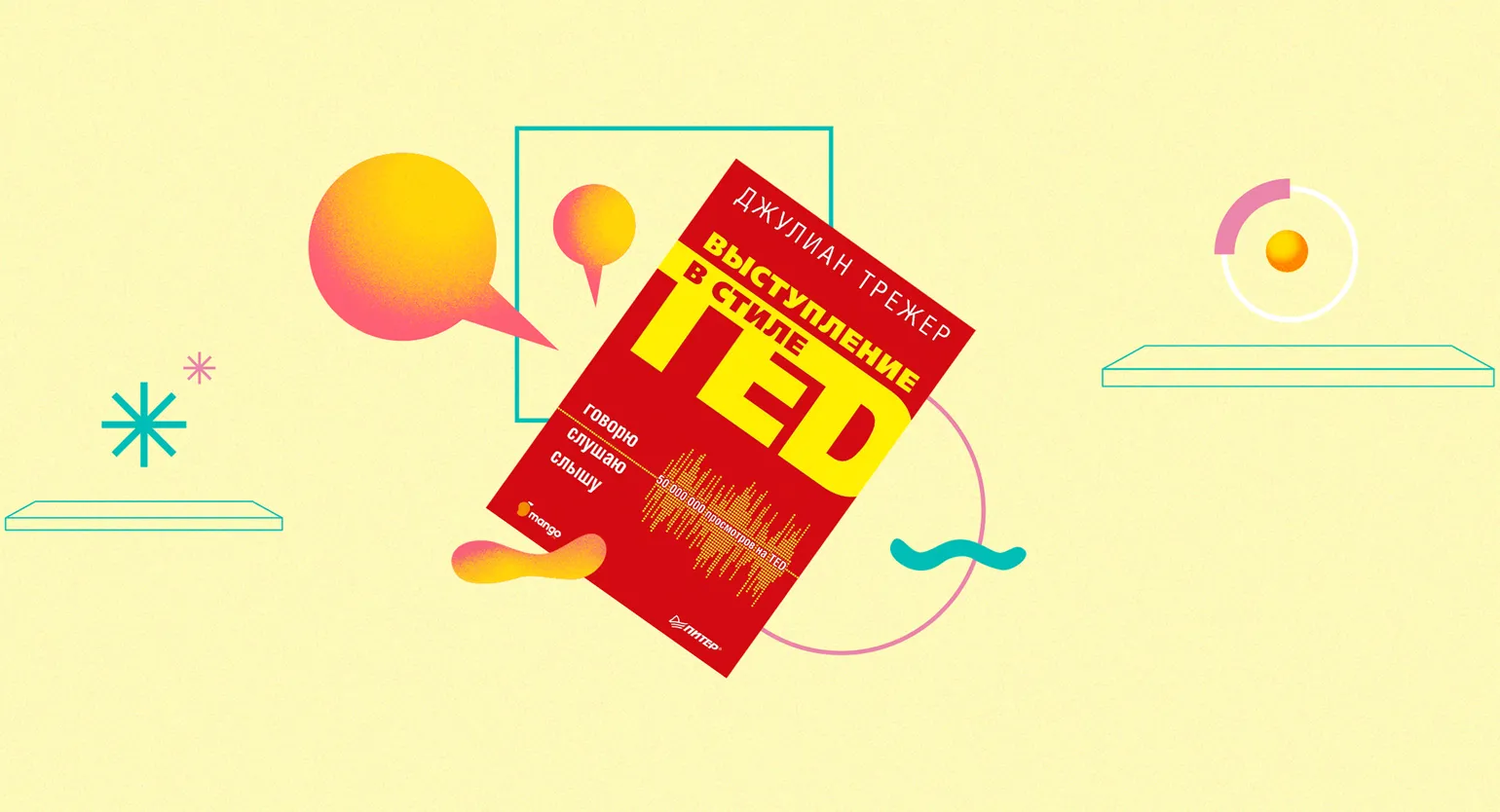
Learn MoreSound design and communication expert Julian Treasure emphasizes that the soundscape we experience in everyday life has a significant impact on our mood and productivity. In his book, The TED Talk: Speaking. Listening. Treasure's "I Hear" explores the role of sound in our lives, focusing on the importance of speech and its perception. Understanding sound elements and their impact on humans can help improve communication and create a more comfortable acoustic space, which is especially relevant in today's environment.
The author offers tips for creating a comfortable sound environment in a crowded office. He shares methods that will help you better hear the other person and convey your ideas effectively. This includes using acoustic solutions to reduce noise, developing active listening skills, and using clear and concise speech to better absorb information. Proper management of the sound environment contributes to increased productivity and comfort at work.
The book "TED Talk: I Speak. I Listen. I Hear" is published in Russian by Piter Publishing House and is available in both print and digital formats. The online service Smart Reading, which provides summaries of useful books, has prepared a summary of the author's key ideas. The full version of the summary can be read or listened to on the Smart Reading platform. This excerpt, published with permission, covers important aspects of public speaking preparation, including vocal warm-ups, gestures, speech planning, and technical nuances that will help make your presentation more effective and memorable.
Learning to Speak
The voice is a simple process: breath passing through the vocal cords. However, despite its simplicity, the voice is a powerful and subtle instrument. It has the power to persuade, inspire, and evoke a wide range of emotions, moving people to action. Using your voice correctly can significantly increase your influence and help convey your ideas to your audience.
In the process of communication, the manner of delivery plays as important a role as the content of the speech. Even the most brilliant idea can lose its significance due to poor presentation, while a talented speaker who expresses simple thoughts quickly connects with the audience. The key to a successful speech is your unique personality, charm, and the values that motivated you to deliver it. The ability to effectively interact with an audience and convey your ideas in a way that resonates is the key to successful communication.
To improve your vocal control, the author recommends several effective methods. First, focus on breathing exercises, which will help develop breath control and improve your voice delivery. Furthermore, regularly practicing articulation and diction will make your speech clearer and more understandable. It's also important to record your speech and analyze it to identify and improve any weaknesses. Reading aloud is a necessary step, as it promotes expressiveness and confidence in your voice. Finally, remember the importance of emotional tone in your speech, as this helps establish rapport with the audience and make your speech more memorable. All of these recommendations will significantly improve your vocal control and make it more engaging.
- learn to breathe deeply;
- take a few vocal lessons;

- record your speech on tape, analyze and consciously work on weak points;
- work on timbre (listen to your voice in different registers and try to get used to speaking not “from the throat”, but “from the chest”);
- listen to how your voice sounds in different poses (stand up straight and, stretching your neck forward, say your name; then lower your chin to your chest and say your name again; notice that the most beautiful and organic timbre occurs when the chin is parallel to the ground);
- practice semantic stress by pronouncing simple phrases with an emphasis on different words: “I'm going to work” (first the main word in this phrase is “I”, then “go”, and so on) - and with different moods (cheerful, sad, inspired, depressed);
- develop the habit of the ideal speaker's posture: the back is straight, the crown of the head stretches upward, as if tied to the sky with an invisible thread, chin parallel to the floor, body muscles toned, shoulders relaxed and down, feet firmly planted on the floor (you can imagine roots growing from the soles of your feet).
Preparing for a speech is an essential step to achieving success. Start with a clear understanding of the topic you will be speaking about. Research materials to gather relevant information and arguments that will support your point of view. Practicing your speech will help you feel more confident in front of an audience. Write down the main points and create an outline that will allow you to logically structure your speech. Don't forget about time: allow enough time for preparation to avoid rushing at the last minute. Pay attention to your audience, taking into account their interests and level of preparation. This will help you establish rapport and make your presentation more effective. It is also important to practice non-verbal communication skills, such as confident eye contact and an open posture. Prepare all the necessary materials in advance so that you can focus on the presentation itself.
- Think about your self-presentation: who are you, what are your values, why do you do what you do? A few phrases on this topic will help the audience tune in to your wavelength, and you will deliver a good performance.
- Set yourself up for generosity - your presentation is for the audience, not for the speaker. Good speakers strive not just to speak, but to teach their audience something valuable.
- Answer three questions: What do you want to achieve with your presentation? What do you expect from the audience? What does the audience expect from you?
- Outline the main idea of the presentation. It is necessary to be able to say only what is necessary and important, discarding everything unimportant. Choose one thesis for the presentation, but present it with all possible depth.
- Formulate it clearly and distinctly. Avoid cliches.
- Plan messages for all four types of listeners: Connectors (who enjoy making connections between people and phenomena and are interested in the reasons behind actions), Logicians (who enjoy facts, statistics, and expert opinions), Doers (who are interested in the practical details of implementation), and Experimenters (who look for hidden opportunities and unexpected applications of any idea).
- Make a plan for your presentation. First, write out all the points on separate sheets of paper, then analyze them, discard the unnecessary and irrelevant, and group the rest in a logical order. Take a photo of the resulting plan to avoid losing the results of your work. Or use one of the mind mapping services.
- Plan the plot development: first, unfold the big picture to the audience, then outline the details and summarize.

- Tell stories: they have enormous power over people who, for about 100,000 years of their history, had no written language and passed on everything they knew and could do orally. For your examples to be memorable, they must have at least the simplest plot. There are six classic plot arcs: rags to riches (the rise of the hero), riches to rags (the fall of the hero), the pit (fall, then rise), Icarus (rise, then fall), Cinderella (rise, fall, rise again), and Oedipus (fall, rise, and final fall). According to research by Project Gutenberg, the plot of approximately 20% of all literary texts follows the rags to riches arc. But the most popular arcs with readers are the Oedipus, the pit, and Cinderella.
- Rehearse. Repeat your speech in its entirety, with all the details, until you can confidently speak it from beginning to end.
- Monitor your speaking rate: the optimal frequency is from 100 to 200 words per minute.
- Divide your speech into semantic blocks of approximately equal duration. Come up with a break for each part. This will help you adapt your speech to different events where you will have different time available.
- If you want to remember your speech, use one of the mnemonic techniques - for example, imagine the speech as a route that goes through rooms with some objects. But speaking from memory is not necessary! Most speakers do not rely only on memory.
- Of the many auxiliary tools, the author recommends using presentations, cards with the main points of the speech written in large and clear letters, or a teleprompter located behind the audience (if this is technically possible at the chosen venue).
If you lose your train of thought during your speech, don't worry. Years of experience as TED speakers show that audiences respond to such moments with support and encouraging applause. People are willing to wait patiently for you to get back on track. It's important to maintain confidence and continue, as these moments can make your talk even more human and memorable.
When using a presentation for public speaking, it's important to have a secondary screen. This will avoid the awkward situation of having to read your own slides with your back to the audience. The optimal solution is to place your slide on a smaller screen so you can focus on your presentation while the audience sees the same slide on a larger screen. This way, you can maintain eye contact with your audience and create a more engaged atmosphere during your presentation.

To create effective slides, avoid overloading them with text and lists. An optimal slide should contain only 1-3 keywords and a striking image. You can explain the rest verbally, which will make your presentation more dynamic and memorable. Brevity and visual expressiveness will help hold your audience's attention and convey the main idea.
To create effective slides, it is necessary to adhere to a unified style, using a single font family. It is also important to maintain consistency in font sizes and colors. This will help make the presentation more professional and appealing to the audience. Consistency in visual elements promotes better perception of information and increases the memorability of your content.
The gestures of American actors trained in the Michael Chekhov system include five basic gestures: pushing, pulling, lifting, throwing, and tearing. Each of these gestures can be performed in six directions—up, down, left, right, forward, or backward—and vary in intensity. This diverse set of gestures allows actors to convey six key motives that drive their characters: "I want - I reject"; "I give - I take"; "I stick to my guns - I yield." Mastering this technique helps actors more accurately and emotionally convey their characters' states and intentions, making their performances more expressive and memorable.
You'll certainly want to use common gestures to communicate more effectively. For example, pointing a finger can signal that you're accusing someone. Two raised hands with open palms demonstrate your desire to surrender or reassure the other person. One hand under your chin and the other on your chest suggests you're pondering or calculating something important. Energetic and erratic gestures can indicate a desire to change the subject. Wide, open gestures or hitting an invisible table can express strong emotions, such as love or hate. Using these gestures will help you better convey your thoughts and feelings to others, making your communication more expressive and understandable.
When using a handheld microphone, hold it four fingers' distance from your chin. Maintain this distance even when turning or using gestures. Proper microphone positioning will ensure high-quality sound transmission and make your presentation more professional.
Video your rehearsal and highlight aspects of your gestures that could be improved. This will help you analyze your presentation and make the necessary adjustments to improve communication effectiveness. Pay attention to your hand movements, their coordination with your speech, and emotional expressiveness. Improving your gestures will make your presentation more engaging and memorable.
The author recommends avoiding speaking at a lectern. It is best to move slowly around the stage, staying in its center. It is best to come to the forefront for the most emotional moments of the presentation. This will create a closer connection with the audience and make the presentation more dynamic and memorable.
Use the peculiarities of time perception to enhance the effectiveness of your presentation. Most people who read left to right perceive the past on the left and the future on the right. In Arab countries and Israel, where reading occurs right to left, the perception is different. For the Chinese, the past is located at the top and the future at the bottom. You can apply these aspects to your delivery, demonstrating the transition from past to future, from problem to solution, through your gestures and movements. It is also important to remember that the audience views you from different angles: their "right" corresponds to your "left." By taking these nuances into account, you can significantly enhance the visual perception of your message and make it more memorable.
When choosing a venue for your event or evaluating a location where you've been invited to speak, it's important to consider all the details that shape the atmosphere. Consider easy access and navigation within the space, as well as the availability of parking for guests. Consider adequate seating arrangements and a reasonable schedule with breaks for rest and refreshments. A comfortable room temperature also plays a significant role. Don't forget to clarify the event's dress code. If you have a personal rider, send them to the venue in advance to ensure all your requirements are met. This will create a positive impression for both you and the attendees.
Discuss all projection and audio equipment requirements with the event organizers. Ensure that software versions are compatible. It is recommended to communicate directly with the technical specialists who support the venue. This will help avoid misunderstandings and ensure the smooth operation of the equipment during the event.
Before the event, it is important to test the sound, lighting, and screen projections. This will ensure high-quality perception of information and create the right atmosphere for participants. Make sure all equipment functions correctly and meets technical requirements. Proper sound and lighting settings will help avoid problems and make the event more professional.
When transporting equipment or props for presentations, it is important to always have duplicate copies of the necessary items. Create a backup in case any of your usual equipment gets lost or breaks. This will help avoid unexpected situations and ensure the smooth running of your presentation. Advance planning and preparing backup solutions make the preparation process safer and more efficient.
Always carry spare batteries, necessary cables, and chargers. Save a backup copy of your presentation both on a flash drive and in the cloud to avoid problems if your laptop crashes. Discuss the start and end times of your presentation with the organizers. It is recommended to use a countdown timer to effectively manage time and stick to the planned schedule.
TED speakers can see a timer projected directly on the stage, which makes it convenient during the presentation. We recommend using the timer built into the Mac Presenter View program. You can also create your own timer or download a countdown timer for PowerPoint from the Internet. This will help organize your presentation time and make it more structured.
Check with the organizers if there are planned questions after your talk or if you need to leave the stage immediately. This will help you better prepare and manage your time wisely.
Spend a few minutes preparing for your talk. Find a quiet place where you will not be distracted so you can focus on your thoughts and ideas. This will help you better organize your thoughts and increase your confidence before going on stage. Preparing in solitude promotes a deeper understanding of the topic and improves your presentation skills.
Warm up by thoroughly stretching in different directions. Shake your arms and legs to activate your body. Turn your head left and right several times, stretching your neck as much as possible. Make a "brrrr" sound with your lips to loosen up your face. Make an "ahhh" sound, starting from the lowest register and moving up to a high register, and then back down. Say tongue twisters to activate your tongue and improve your diction. Take a deep breath in and out. Raise both arms up, like winners do, and don't forget to smile to lift your spirits. These simple exercises will help you prepare for a speech or an important meeting.
Prepare for your speech, pay attention to your audience. Make sure you are heard. Make sure your speech is clear and persuasive, and consider the interests and needs of your listeners. This will help you establish contact and convey information effectively.
Read also:
- How to keep the attention of webinar participants
- 5 tips for an expert who wants to convey knowledge to a wide audience
- Storytelling in education: just a trendy thing or a really useful thing?
The Art of Communication
You'll find your own communication style, learn to defend your position in dialogue, and find common ground with your team and partners. You'll be able to effectively present your product, increase sales, and achieve your business goals.
Find out more