Contents:

Course with employment: "Profession Methodist from scratch to PRO»
Learn moreHow this instructional design model came about and who are Morrison, Ross and Kemp
The instructional design model, developed by American experts, was first presented by Jerrold Kemp in 1985 in the book "The Instructional Design Process". In the mid-1990s, Kemp updated his model in collaboration with colleagues Gary Morrison and Stephen Ross. In 1995, a key work describing this model was published under the title "Designing Effective Instruction". Since then, this methodology has become known as the "Morrison, Ross and Kemp model", although it is sometimes called the "Kemp model". This model is an important tool in the field of instructional design, offering a structured approach to developing effective educational programs.
This instructional design method arose against the backdrop of growing interest in interdisciplinary approaches in the social and economic sciences. In the preface to the third edition of Designing Effective Instruction (2001), the authors emphasize the importance of integrating knowledge from various disciplines to create more effective educational programs. An interdisciplinary approach not only broadens horizons of understanding but also prepares students to solve complex problems in the real world. This approach promotes the development of critical thinking and collaboration skills, which are key elements of modern education.
The model described in this book is eclectic, drawing ideas from various disciplines and instructional design methods. We believe that there is no single correct approach to solving educational problems. Therefore, our model integrates both behavioral and cognitive approaches, which allows us to maximize the strengths of each. This provides a more flexible and adaptive solution for educational processes, taking into account the diversity of student needs.
The Morrison, Ross, and Kemp model illustrates two key trends defining contemporary instructional design: problem-based learning and a student-centered approach. These trends emphasize the active involvement of students in the learning process, which promotes a deeper understanding of the material and the development of critical thinking. Problem-based learning focuses on solving real-world problems, making learning more relevant and practical. A student-centered approach, in turn, takes into account the individual needs and interests of students, contributing to a more flexible and adaptive educational environment. These principles help educators develop effective educational programs that meet modern student demands and expectations.
The creators of this model emphasize that their goal was to develop a universal tool for designing educational processes. This tool is suitable for school education, higher education institutions, corporate training, and military and medical personnel training.
The model's authors offer a nonlinear and flexible approach, allowing instructional designers to adapt it to various educational needs. Importantly, the model maintains its internal logic. Even if the instructional designer skips some design stages for external reasons or due to content specifics, this will not disrupt the overall structure. This approach ensures the sustainability and effectiveness of the educational process, allowing for easy changes and adjustments.

To improve visibility in search engines and attract your target audience, it is important to create high-quality and unique content. Make sure your text contains keywords that are relevant to the topic. Remember to keep information relevant and useful to readers. Regularly updating content will help retain audience interest and improve page rankings. Optimize headings and subheadings to attract attention and convey the essence of the material. Don't forget about internal and external linking, which improves navigation and increases user time on the site. Include a variety of content formats, such as images and videos, to make the material more engaging and informative.
Read also:
The history of instructional design spans a wide period, from seminal works such as the "Great Didactics" to modern online learning methods. Instructional design as a field of knowledge has been shaped by various educational theories and practices. In the 16th and 17th centuries, Josef Comenius laid the foundations of a systems approach to learning, emphasizing the importance of organizing the learning process. Since then, instructional design has evolved, adapting to changes in society and technology. In the 20th century, with the development of psychology and cognitive science, new approaches to learning emerged that focused on the individual characteristics of learners and their needs.
With the transition to digital technologies in the 21st century, instructional design began to include elements of online learning, which opened up new horizons for the educational process. Modern methods, such as blended learning and adaptive systems, allow for the creation of more effective and personalized educational programs. Thus, the history of instructional design is a dynamic process that continues to evolve and adapt to modern requirements and challenges.
What components does the design process consist of according to the Morrison, Ross, and Kemp model?
The Morrison, Ross, and Kemp model is based on key elements of instructional design, such as learner characteristics, learning goals, teaching methods, and assessment of results. When developing a curriculum, an instructional designer must answer four key questions:
- Who is the curriculum being developed for?
- What results should students demonstrate upon completion of the learning?
- How is knowledge best acquired or desired skills developed?
- How can the level of knowledge and/or skills acquired as a result of the learning be determined?

The authors of the model emphasize that the basic, interconnected elements are necessary for designing any curriculum. However, to create effective learning, these are not enough. It is important to consider the other components that together form the Morrison, Ross, and Kemp model. This model offers a comprehensive approach to course development, ensuring the integration of various aspects of the educational process to achieve maximum learning effectiveness.
Before starting to design a curriculum, it is important to determine the purpose for which it is being created and find out whether training is really necessary. Let's consider a corporate example: customer service agents are not handling customer inquiries as well as management expects. In this situation, management may conclude that training is necessary. However, an analysis of the causes of poor performance may reveal that the problem lies not in a lack of knowledge or skills, but in the use of outdated equipment or organizational difficulties within the team that are hindering effective work. Therefore, before implementing training programs, a thorough situational analysis should be conducted to identify the real causes of the problems and make informed decisions. At this stage, the authors of the model recommend conducting a user needs assessment, and if the problem is known in advance, a goal analysis should be performed. This will help clearly define the purpose of the program being developed. Methodologies for needs assessment and goal analysis are described in detail in the book "Designing Effective Training." These processes play a key role in creating effective training programs and ensure that training objectives align with the needs of the target audience.

Also recommended reading:
It is important for a methodologist to correctly compose a brief for the client to ensure effective cooperation and achieve the set goals. Start by defining the key aspects of the project, including the goals, target audience, and basic requirements. Ensure the brief clearly outlines the expected deliverables, deadlines, and budget.
It is important to ask the client clarifying questions to fully understand their needs. This will help avoid misunderstandings and ensure more accurate completion of the assignment. Don't forget to discuss the format and working methods to establish comfortable conditions for interaction.
After preparing the brief, communicate regularly with the client, updating them on the project progress and promptly responding to possible changes. This approach will allow you not only to create a high-quality product but also to establish long-term relationships with the client.
By following these recommendations, the methodologist will be able to work effectively with the client and achieve successful results in their projects.
Having identified the training need and its goals, it is important to gather information about the characteristics of the learners, which can significantly affect the effectiveness of the educational program. Morrison, Ross, and Kemp identify three key types of characteristics that need to be taken into account. These characteristics may include knowledge level, motivation to learn, and individual learning styles. Understanding these aspects will allow the program to be tailored to best meet the needs of students and promote successful learning. This, in turn, will improve the overall effectiveness of the training and help achieve the stated objectives.
- General information (gender, age, work experience, level of education);
- Initial competencies (specific knowledge, abilities, and skills necessary for the planned training);
- Learning styles (how exactly the target audience prefers to learn).
The authors note that adapting a program to students' learning styles may not always justify the investment of time and resources. Therefore, it is recommended that the instructional designer approach audience research flexibly and taking into account practical experience. For example, for training accountants, it is more important to know how many years they have worked in accounting and what courses they have taken previously than to define them according to Kolb's classification of learning styles. This approach will help more effectively tailor the educational process and achieve better results.
Learning content, which answers the question "What are we teaching?" directly depends on the learning objectives and meets specific needs. This content determines all other elements of the educational program. According to experts in the field of course design, content selection is a key step. It is on this foundation that further collaboration with a subject matter expert will be built, allowing for the creation of more effective and targeted educational solutions.
The Morrison, Ross, and Kemp model offers an effective approach for identifying the necessary content in an educational program and developing a content structure. The instructional designer applies appropriate analytical methods to determine which elements should be included in the learning. This process includes assessing the needs of the target audience, formulating learning objectives, and selecting assessment methods. This approach ensures the relevance and effectiveness of the educational process, improving its quality and effectiveness. English: Using the model allows you to create a comprehensive and logically consistent program that meets the needs of students and the modern labor market.
- The topic method is suitable for curricula focused on the transfer of theoretical knowledge: facts, concepts, rules, principles, and so on;
- The process method is used when students need to master a clear sequence of steps to solve a problem (for example, varnishing a wooden stool or writing a resume);
- The critical incident method is used when training is also aimed at teaching students to solve a problem, but it is impossible to identify a specific sequence of steps because the conditions of the problem are changeable and depend on various factors (for example, passing an interview, closing a deal with a client, or resolving a conflict in a team).
According to the experience of the authors of the models, for the effective design of most programs it is necessary to use at least two of the listed methods. This allows you to achieve higher quality and more sustainable results, ensuring a comprehensive approach to software development. Using multiple methods facilitates better requirements analysis and increases the likelihood of successful project implementation. Learning objectives, or intended learning outcomes, define what a student should learn by completing a specific stage of a curriculum. Clearly stated learning objectives serve three key functions: first, they facilitate the selection of the most effective instructional strategies, methods, and tools; second, they establish criteria for assessing learning outcomes; and third, they guide the student by outlining the knowledge and skills they will acquire during the learning process. This approach not only improves the quality of the educational process, but also promotes a deeper understanding by students of their goals and objectives in learning.

Learning goals are typically divided into three key categories, or domains. These categories help structure the educational process and determine learning priorities. The first category includes cognitive goals related to the development of mental abilities, critical thinking, and analytical skills. The second category encompasses emotional and social goals aimed at developing values, communication skills, and collaboration. The third category concerns psychomotor goals, which are associated with the development of physical skills and motor coordination. Grouping learning objectives into these areas facilitates more effective program planning and allows teachers and students to clearly understand what needs to be achieved during the learning process.
- A cognitive learning objective is related to the acquisition of knowledge and intellectual development;
- A psychomotor learning objective relates to practical actions, motor coordination, and tool use skills;
- An affective learning objective means developing an attitude toward the surrounding world and people, and affects students' feelings and emotions.
Bloom's taxonomy is widely used in developing learning objectives in the cognitive area. This methodology helps to systematize and classify learning levels. In addition, the ABCD model proposed by Robert Heinich, Michael Molenda, James Russell, and Sharon Smaldino in their book, Instructional Materials and Technologies for Learning, has also found wide use among methodologists and instructional designers. This model allows for the clear formulation of learning objectives, taking into account the audience, behavior, conditions, and success criteria. Using both Bloom's Taxonomy and the ABCD Model helps create more effective educational programs and materials.
When presenting information on a learning topic, a subject matter expert may not always follow the optimal sequence from an instructional design perspective. It is important to reconsider the structure and order of content components to facilitate the process of assimilation of the material for students and ensure the achievement of the set learning objectives. Proper organization of information promotes better understanding and memorization, which ultimately improves learning outcomes.
The authors of the model offer various approaches for determining the correct sequence of material presentation. In particular, George Posner and Kenneth Strike identify three strategies that can help in structuring information. These strategies allow you to organize the learning process more effectively, ensuring logical sequence and clarity of presentation. Correct application of these approaches contributes to better perception and assimilation of the material.
- Empirical - the order of presentation of the material reflects how the objects being studied exist in the real world and what properties they have, how certain events and phenomena occur (or occurred). In this way, you can construct a story about a historical event - from its antecedents to its consequences, about the structure of a plant - from the flower to the roots, about apple varieties - from the sweetest to the sourest, and so on.
- Conceptual sequencing is built on the relationships between ideas and concepts. Posner and Strike suggest the following order: from general to specific, from simple to complex, from concrete to abstract.
- A learner-related strategy assumes that the sequence of material depends on the characteristics of the student: first, what is familiar, most interesting and familiar to the student, corresponding to his level of knowledge and skills, is presented.
Charles Reigeluth offers a number of strategies for organizing material in his elaboration theory. These include a conceptual approach, a theoretical framework, and a method of simplifying conditions. These strategies help to effectively structure information and improve the perception of materials. You can find more detailed information about each of the strategies in a separate article.

Find out more:
Course structure: types and tips for choosing the optimal one
When creating a course, an important aspect is its structure. There are various formats for structuring educational material, and the right choice affects the effectiveness of training.
Popular types of course structure include linear, modular, and blended. A linear structure implies a sequential study of topics, which is convenient for those learning new material. A modular structure allows for dividing a course into separate units, allowing for the material to be studied in a convenient order. A blended structure combines elements of both models, making the course more flexible and adaptable to different learning styles.
When choosing a course structure, consider the target audience, learning objectives, and the nature of the material. It is important that the structure facilitates better assimilation of knowledge and skills. Identify key topics and break them into logical units, which will help avoid information overload and make the learning process more effective.
A properly structured course not only simplifies the learning process but also increases learner motivation, allowing them to approach the material more consciously.
Morrison, Ross, and Kemp argue that learning strategies need to be developed at two levels. At the first level, the instructional designer selects the learning environment and the general format for presenting content. It is important to determine whether the course will be an online course, a lecture series, an in-person training session, a hands-on lab session, or virtual reality lessons. The correct choice of learning format impacts the effectiveness of material acquisition and student satisfaction.
At the second level, it is necessary to identify specific teaching strategies and methods that will help the student achieve each learning objective. To optimally select strategies, it is recommended to use David Merrill's expanded matrix, an example of which is available in the public domain. In this matrix, different types of content, such as facts, concepts, and procedures, are related to the actions the student must perform, whether memorizing information or applying it in practice. This approach promotes more effective learning and allows for better tailoring of learning materials to student needs.
At this stage, it is important to carefully consider how to optimally present learning materials to students. Researchers Morrison, Ross, and Kemp identify three key aspects that must be taken into account. These aspects will help create an effective educational process that promotes better information acquisition and increases student engagement. Proper organization of educational content, selection of appropriate formats, and use of modern technologies can significantly improve the quality of learning and ensure accessibility for all students.
- Engaging students at the very beginning of learning, which also provides an understanding of what to expect during the learning process, is achieved by adding pre-tests, lists of learning objectives, content summaries, and a schematic representation of the learning structure before courses, modules, and individual lessons.
- Assistance in navigating educational materials. The authors of the model consider how to use different text structures and typography for this purpose (for example, a clear hierarchy of subheadings, highlighting key ideas, and so on).
- Visualization of educational content is the appropriate use of diagrams, infographics, illustrations, and other visual content that will help the student understand and remember the material.

Read also:
The principles of multimedia learning play a key role in the creation of effective digital educational content. These principles help optimize the process of information perception and increase learner engagement. It is important to consider that multimedia content should be harmoniously integrated, combining text, images, video, and audio. This contributes to a deeper understanding of the material.
Among the main principles of multimedia learning, the principle of multichanneling stands out, which involves the use of various methods of presenting information. This allows for the use of different channels of perception, which improves memorization and knowledge acquisition. Also important is the principle of cognitive load, which emphasizes that the content should not overload the learner with redundant information. Each element should be purposeful and contribute to the achievement of learning goals.
In addition, it is worth paying attention to the principle of relevance, according to which multimedia elements should be relevant to the content. This helps create a coherent and logical presentation of information, making it easier to digest. Using interactive elements such as quizzes and assignments also promotes active learning and increases motivation.
Creating digital learning content with these principles in mind not only improves the quality of education but also makes the learning process more engaging and effective.
In the previous step, the instructional designer identified the most effective methods for delivering learning materials to students. Now it's important to focus on preparing the content itself. This includes creating presentations for in-person lectures and online webinars, recording videos for self-study, printing handouts, and developing questions and cases for group discussions. High-quality content preparation plays a key role in the success of the educational process and helps provide students with the necessary resources for deep learning.
When choosing assessment tools, it's important that each one meets the specific learning objective that needs to be measured. Traditional multiple-choice or enter-the-answer tests are suitable for testing understanding and retention of knowledge. However, achieving more complex learning goals requires more advanced methods, such as creating a portfolio of work over a specific period or completing project assignments. This approach allows for a more in-depth assessment of students' mastery of the material and skill development.
It is important to note that different assessment methods should be used at different stages of learning. Each of these methods may be most effective depending on the specific stage of the educational process. Using appropriate assessment formats promotes a deeper understanding of the material and allows for better tracking of student progress. It is important to tailor assessment methods to learning objectives to ensure maximum effectiveness and support for students in their learning.
- Formative assessment focuses on student progress throughout a programme and provides feedback on what is going well and what needs improvement;
- Summative assessment helps to record student performance at the end of a specified period, at the completion of a course or its component (for example, a separate module);
- Confirmatory assessment is used at least several months after the completion of training to find out whether students have lost the knowledge and skills they have acquired, whether they are still relevant, or whether additional training is needed.

Dive into interesting articles and useful materials on our website. We offer a variety of topics to help you expand your knowledge and improve your skills. Don't miss the opportunity to read the latest news and useful tips. Follow updates and stay up to date with the most interesting events. Read also:
Assessing knowledge in an online course: 4 effective methods without the involvement of teachers
In an online learning environment, it is important to find ways to assess student knowledge. There are various methods that allow you to assess the level of assimilation of the material without the need to involve teachers. Let's consider four effective methods.
The first method is automated tests. They allow you to create multiple-choice questions that students can take at any time. Test results are automatically recorded, which simplifies the assessment process.
The second method is practical assignments. Students can complete projects or cases that demonstrate their skills and knowledge. These assignments can be assessed according to pre-established criteria, which makes the process objective and transparent.
The third method is participation in forums and discussions. Students can share their thoughts and ask questions on online platforms. The activity and quality of their participation can serve as indicators of their level of understanding of the material.
The fourth method is self-assessment. Students can use various resources for self-assessment, which allows them to independently assess their knowledge and identify areas requiring further study.
These methods not only help assess knowledge but also contribute to a deeper understanding of the material, which is a key aspect of successful online learning.
How the elements of the model relate to each other
The Morrison, Ross, and Kemp instructional design model consists of nine key components that represent the foundation of an effective educational process. This model is visualized as an oval, with the organizational processes and elements that accompany the design located on the outer border. These include work planning, project management, available resources for the instructional designer, and the implementation of the developed program. The middle ring contains methods for assessing the quality of the program and mechanisms for its refinement, which emphasizes the importance of continuous improvement of educational content. This approach ensures high learning efficiency and allows programs to be adapted to the changing needs of students and the educational environment.
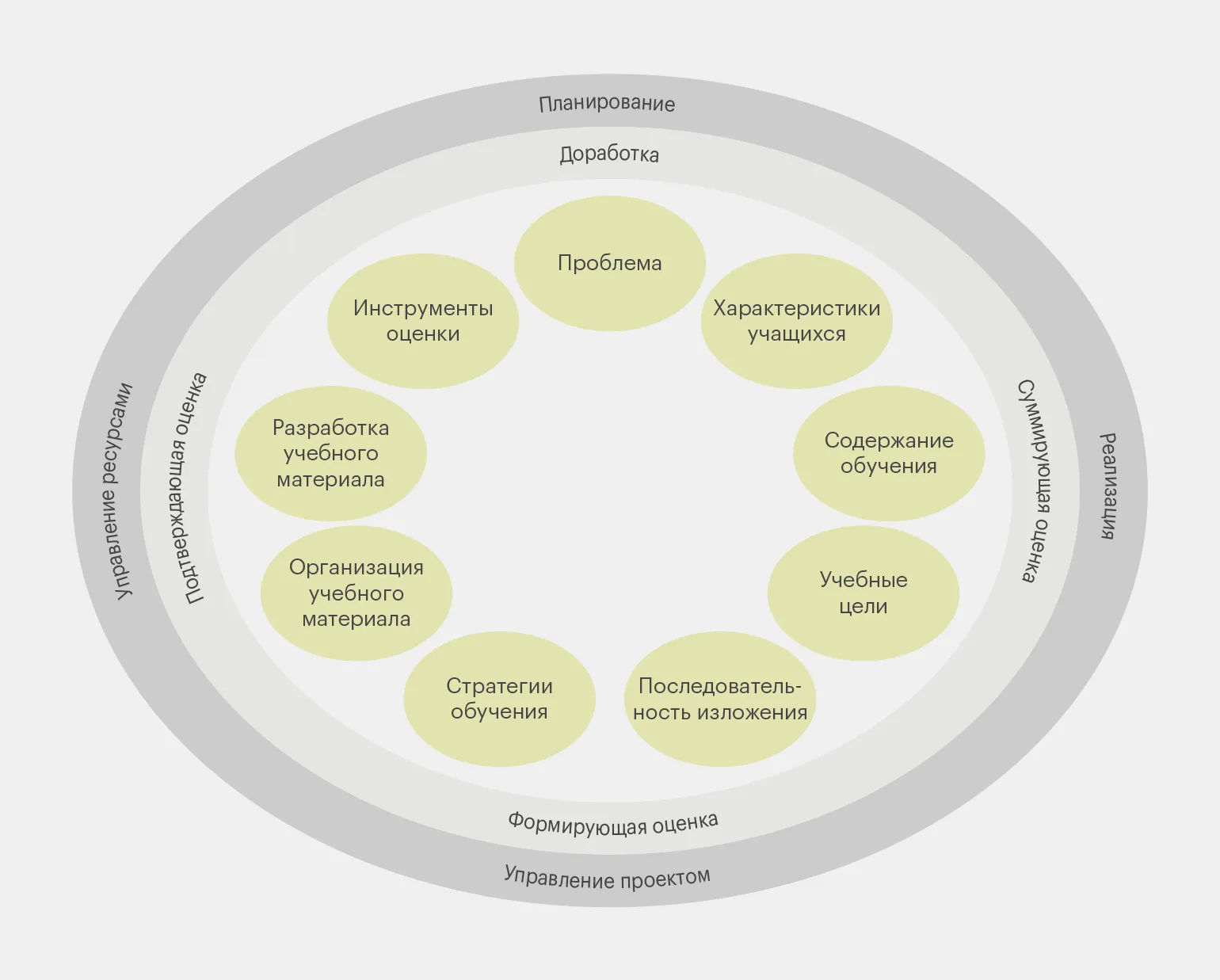
The authors of the model argue that the arrangement of components in the diagram and the lack of arrows or lines between them indicate that the model does not imply a strict sequence of steps in the instructional design process. While it is logical to start with defining the problem and move clockwise, it is also reasonable to develop assessment tools immediately after formulating learning objectives and then move on to creating instructional materials. This approach allows for flexibility in adapting to changes and better addresses learner needs.
Morrison, Ross, and Kemp emphasize that some stages of instructional design can be omitted. For example, identifying client problems and analyzing learners are key when developing a new program. However, if an instructional designer is creating a course for an existing audience, there may be no need for in-depth research. In addition, when working collaboratively with a trainer or teacher, some tasks can be distributed: for example, the development of instructional materials and assessment tools can be performed by a colleague. This allows you to optimize time and budgets, making the course creation process more efficient.

Read also:
A corporate course can do without preliminary research for several reasons. Firstly, having clearly defined goals and objectives allows you to quickly adapt the training program to the needs of the company. Secondly, experience from previous courses and employee feedback help create effective content without additional research. Thirdly, the rapidly changing business environment requires rapid training implementation, making lengthy research impractical. Finally, the use of ready-made materials and methods that have been tested in practice saves time and resources while ensuring high-quality training.
Why the Morrison, Ross, and Kemp Model Didn't Become Popular
The Morrison, Ross, and Kemp model represents a significant step in the evolution of instructional design. It builds on core elements such as learners, goals, methods, and assessment, allowing for a focus on the real needs of the client and the characteristics of students. The model incorporates continuous assessment of the quality of the educational process and iterative program improvement, thereby creating a comprehensive and learner-centered experience. This approach promotes more effective learning and the development of skills that meet the demands of modern society.
Its most effective application is in corporate training design. In this process, the instructional designer immerses themselves in the context, studying the needs and characteristics of the target audience. Continuous feedback allows them to improve the program and adapt it to the specific needs of employees. This results in highly effective training, which contributes to the company's development and the professional development of employees.
Marina Kharakhordina, Academic Director of Universal University, notes that although she has not applied the model in its classical sense, she is receptive to the basic idea of a cyclical design process. This means that the creation of an educational program should not follow a strictly defined algorithm. Instead, it is important to be able to make changes and work in small iterations. This approach most accurately reflects real practice in the educational environment.
The Morrison, Ross, and Kemp model has not gained widespread popularity among training designers either in Russia or abroad. The main reasons for this are its cumbersome nature and high cost. This model requires more resources and effort to implement compared to more widespread and accessible analogues. This makes it less attractive for educational institutions and companies striving for effective and cost-effective training.
Foreign experts highlight a number of difficulties associated with the practical application of this model. In particular, the authors of the knowledge base of the educational platform Coursensu.com emphasize the following aspects:
- The large number of components of the model hinders the quick and inexpensive production of courses. Simply put, the application of the model is hampered by the eternal problem of lack of time and resources - everyone knows how important it is to conduct research when designing, but in reality, very few can afford it in full.
- The model is complex for novice instructional designers, especially when time for development is short, and the learning objectives are not entirely clear.
- There is a risk that the learning materials developed using this model will be overloaded and too difficult to understand. This can happen if the instructional designer is too meticulous in developing every aspect of the program in accordance with the model - and it is very detailed. There is a risk that it will be very difficult to effectively integrate all the elements into the final material.
- When a program is designed for a heterogeneous target audience with diverse characteristics, using a model is impractical—the amount of work will be too great.
The authors of Coursensu.com emphasize that strict adherence to an educational model can negatively impact the creative process, limiting the development of an engaging and adaptive learning experience. It is important to find a balance between the model's structure and flexibility, which contributes to the creation of an optimal learning environment. This approach not only preserves learning effectiveness but also develops the creativity necessary for successful knowledge acquisition.
It is important to remember that flexibility in educational program design must be balanced. Experts from the Digital Learning Institute blog emphasize that excessive freedom in approaches can lead to a loss of structure and, as a result, to chaos in the development process. This is why this model is primarily suitable for experienced instructional designers, while newcomers often struggle to determine where a strict adherence to the established structure is necessary and where creativity is acceptable. Training and practice will help newcomers better navigate these nuances, which in turn will improve the quality of their work and the effectiveness of the educational materials they create.
Critics argue that the main problem lies not in the model itself, but in the education and training market's need to quickly and cost-effectively create new products. The Morrison, Ross, and Kemp model in its original form is accessible to only a few instructional designers. However, if there is an opportunity to apply it, it really justifies itself.
The profession of Methodologist from scratch to PRO
You will improve your skills in developing educational programs for online and offline courses. Master modern teaching practices, structure your experience, and become a more sought-after specialist.
Find out more