Contents:
Practical course: "Online course producer from scratch to PRO"
Find out moreTPACK: what is this model?
Model TPACK is an effective approach to integrating technology into education by identifying key knowledge areas necessary for this process. It serves as a framework for educators and methodologists, providing them with structured guidance. Developed through a five-year study of teacher professional development in higher education by researchers Punya Mishra and Matthew Koechler of the University of Michigan, the TPACK model emphasizes the integration of pedagogical, content, and technological knowledge. This makes it an essential tool for creating innovative and effective educational practices.
The framework is based on the concept of pedagogical content knowledge, developed in the 1980s by Professor Lee Shulman of the Stanford Graduate School of Education. This concept emphasizes the importance of combining subject content and pedagogical methods to more effectively convey knowledge to students. Understanding pedagogical content knowledge contributes to the improvement of educational practices and the quality of teaching in various fields.
A scholar who has studied teaching practices for a long time argued that pedagogy and subject knowledge are often perceived as separate domains. He emphasized that teachers can only succeed in their own subject area; there is no universal "successful teacher," but one can identify successful teachers of, for example, mathematics. Achieving this level requires mastering the concept of pedagogical content knowledge, for which there is currently no established translation into Russian. This term is sometimes translated as "pedagogical content knowledge" or "knowledge of learning content." It implies a deep understanding of how to clearly explain educational topics in one's field, using appropriate examples and analogies, as well as an awareness of the biases and difficulties students may face. Understanding these aspects is key to effective teaching and successful interactions with students. Punya Mishra and Matthew Koehler concluded that the situation with technology in education is similar to other aspects of teaching practice. Training teachers to use technology does not always lead to its effective use in the teaching process. It is important not only to train teachers to work with new tools but also to ensure that these technologies are aligned with the specific educational goals and needs of students. Therefore, it is necessary to consider the integration of technologies taking into account the context in which they will be used and adapt them to the specifics of the educational process.
- The rate of change in the technological landscape is too high, and new programs quickly become irrelevant - this means there is a risk that teachers will waste time learning what they will not use in practice.
- There is no need to study the full functionality of a specific service if it is not needed for learning design.
- Studying any technology without understanding the content and context leads to the formation of generalized solutions for learning design that are difficult to put into practice.
The TPACK model emphasizes the importance of the relationship between pedagogical methods, educational content, and the technologies used in the educational process. The main focus is on context, which plays a key role in the design of effective learning. Let's take a closer look at all the components of this model.
The framework includes seven key knowledge areas necessary for teaching. Of these, three are basic and four are derivative. These areas of knowledge are in the context of both students and their mentors, which emphasizes the importance of interconnectedness in the educational process.
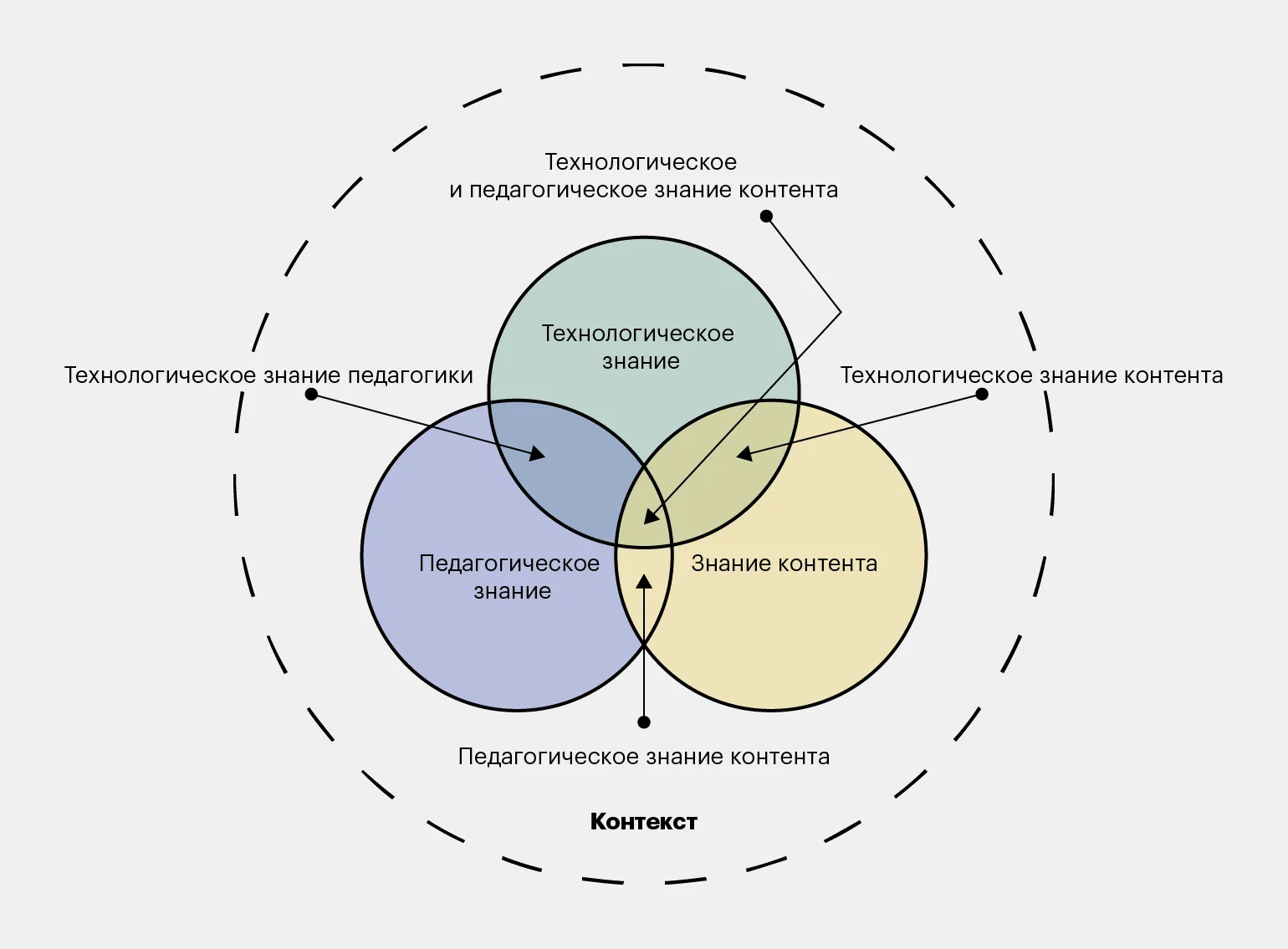
The three key areas of knowledge that a teacher must possess include subject content, teaching methods, and student understanding.
Content knowledge implies a deep understanding of the topics they teach. This allows the teacher to confidently and competently answer student questions and provide them with high-quality material.
Teaching methods encompass a variety of approaches and strategies that help make the learning process more effective and engaging. The teacher must be able to adapt their methods depending on the level of preparation and interests of students.
Understanding student characteristics includes knowledge of their needs, learning styles, and motivation. This knowledge helps the teacher create a supportive and inclusive educational environment conducive to successful learning.
Thus, the combination of these three areas of knowledge is the foundation of successful teaching and contributes to the creation of a high-quality educational process.
- Content knowledge is knowledge of the subject area being taught. Naturally, teachers must themselves have an excellent command of the subject they teach—be aware of the basic facts, concepts, theories, and principles of working with knowledge.
- Technological knowledge is knowledge of how to use them. This can refer to both standard technologies and advanced ones (such as distance learning systems and specialized software). Scientists also include the ability to quickly master new technologies in technological knowledge.
- Pedagogical knowledge is knowledge of the principles and methods of teaching people, various concepts of instructional design, learning theories, curriculum design models, classroom organization, group work, and so on. Let us emphasize: this does not necessarily mean knowledge of classical pedagogy as such (that is, how to teach children), it may imply knowledge of andragogy if the teacher teaches adults.
These aspects are obvious and understandable for every teacher and methodologist. At the intersection of three areas of knowledge, according to the developers of the TPACK model, four new areas are formed.
- Pedagogical knowledge of content.
Knowledge of pedagogical methods and techniques suitable for specific educational content is key to successful learning. It is important to be able to present the material in a convenient and understandable form for students. Simply possessing knowledge of your subject or general principles of pedagogical design is not enough. The teacher must understand what difficulties students may encounter in memorizing and perceiving the material, as well as know how to overcome these difficulties and what prejudices students may encounter. For example, teaching history and mathematics require different approaches due to differences in challenges, biases, and delivery methods. Ultimately, the ability to integrate subject matter knowledge and pedagogy is essential to ensure effective learning.
- Technological Content Knowledge.
Understanding the technologies used to teach specific subjects is a key element of an effective educational process. Technologies can both limit and expand learning and teaching opportunities, transforming approaches to learning. The TPACK model emphasizes the uniqueness of this area, distinguishing it from separate knowledge of subject matter and technology. Effective use of technology in education allows for the creation of more flexible and interactive teaching methods, which promotes deeper assimilation of material and increases student engagement.
- Technological Knowledge of Pedagogy.
Knowledge of technologies and their capabilities plays a key role in organizing effective learning and teaching. It is important to understand how technologies transform these processes. For example, it is necessary to study which tools are most suitable for learning activities, how to adapt pedagogical models to specific technologies, and what methods exist for recording academic performance using new technologies. Mastering these aspects allows teachers to create a more interactive and personalized learning environment, which, in turn, contributes to improved learning.
- Technological and pedagogical knowledge of content.
Synthetic knowledge combines technology, pedagogy, and content, forming a new approach to learning. It includes an understanding of the principles of visualizing educational material using modern technologies, as well as the effective use of these technologies to implement pedagogical methods when teaching specific topics. It is also important to consider which topics are the most difficult to learn and how technology can facilitate this process for students. The use of technology not only allows for the reinforcement of existing knowledge but also contributes to its deepening and expansion. This approach creates a more interactive and productive educational environment.

Read also:
There is a lack of evidence-based approach in our daily practice as teachers. This creates obstacles to the implementation of effective teaching methods and assessment of results. Applying evidence-based strategies can significantly improve student outcomes and enhance the quality of the educational process. It is important to integrate evidence-based practices into the classroom to ensure greater student learning and skill development. An evidence-based approach to education promotes more informed teaching choices and allows teachers to make informed decisions based on facts and research.
The classical approach to teaching emphasizes the content of the curriculum. In contrast, the TPACK model emphasizes the dynamic interaction of all knowledge areas. Each influences the others, emphasizing the importance of integrating technology, pedagogy, and content to achieve effective learning.
It is not enough for teachers to simply develop lecture plans and assignments for students. They must also determine which pedagogical techniques and technologies will be most effective in helping students master the material. It is important to consider which approach - the classical or flipped classroom - will be more appropriate in a given situation, as well as what digital tools can be used to enhance learning in each of these approaches. This will create an optimal learning environment that promotes deeper understanding and knowledge acquisition by students.
The model in question is not limited to just seven knowledge areas. It also takes into account the context - the various circumstances and constraints that influence the design and teaching process. It is important to consider the availability of software, the quality of the internet connection, the general level of technical literacy of students, as well as legal aspects. These factors play a key role in creating an effective learning environment and improving the quality of learning.
Ignoring context when developing an educational program can lead to a lack of expected results. For example, if students are asked to complete a complex animated online simulator to practice skills at home, but do not take into account that some of them may have poor internet quality, this may result in part of the group being unprepared. Thus, context plays a key role in transforming the designed educational solution and its effectiveness.
The principle established by the authors of the TPACK framework is that teachers and methodologists should master technology through practical application, creating educational content. It is important that they simultaneously utilize their knowledge of the subject matter, pedagogical approaches, and technologies. This approach promotes more effective learning and helps integrate modern technologies into the educational process, improving the quality of learning and student engagement.
To effectively implement the TPACK model in curriculum development, it is useful to refer to the checklist proposed by specialists from the University of Calgary. These questions will help identify how technology, pedagogical methods, and subject content can be integrated to enhance the learning process and increase student engagement. It is important to consider how each of these components interacts with one another, as well as how they can be adapted depending on specific educational goals and context. Using TPACK in curriculum design helps create more holistic and effective learning experiences, which in turn can lead to improved learning outcomes.
- How does what you know about the content (subject area) influence the teaching approaches you plan to use, and vice versa?
- How does what you know about the content influence the technologies involved in teaching, and vice versa?
- How does your knowledge of instructional design influence the tools and technologies used in teaching, and vice versa?
- How do all three areas of knowledge (technology, pedagogy, and content) interact in the instruction you deliver?
- If you need to make changes to the content of a lesson (content), how will this affect the technologies used and the principles of instructional design, what will need to be changed in them?
- If you want to introduce a new technology tool or remove an old one, how will this affect the structure or plan of the lesson (content and pedagogy)?
- If you want to try a new pedagogical technique, should you change Something about technology tools or content?
TPACK is a framework for changing educators' attitudes toward the use of technology in the educational process. This model is sufficiently universal and abstract that it can be easily integrated into curriculum development practices. This is especially useful for beginning teachers and those just learning how to design courses. Meanwhile, for a more detailed study of specific steps and methods for using technology in teaching, the SAMR model offers clear recommendations and approaches.
Reading is an important part of our lives. It not only broadens our horizons, but also promotes the development of critical thinking. In today's world, where information is available in huge volumes, it is important to be able to choose quality sources. Reading books, articles, and research papers helps deepen knowledge and generate new ideas. Furthermore, reading improves concentration and memory, which is especially helpful in a rapidly evolving information environment. Don't forget that regular reading promotes personal growth and self-improvement. Choose literature that interests you and read every day to enrich your inner world.
Technology is indeed having a significant impact on education, but the question arises whether the expectations for its implementation are too high. On the one hand, digital tools and online resources provide new opportunities for learning, making it more accessible and diverse. Students can access information and educational materials anytime and from anywhere, which facilitates the individualization of the learning process.
On the other hand, not all educational institutions and teachers are able to effectively integrate technology into the educational process. Issues with content quality, technical failures, and insufficient teacher training often arise. This can lead to frustration among students and their parents.
Thus, although technology has the potential to transform education, its successful implementation depends on many factors, including the readiness of the educational system for change and the level of preparation of teachers. The results of integrating technology into education should be assessed taking these aspects into account.
SAMR: What is this model?
SAMR is a framework for teachers and methodologists that describes four levels of technology integration into the educational process. The name of the framework is an acronym consisting of the first letters of these levels. SAMR helps assess how technology can change the approach to learning, from replacing traditional methods to reimagining the use of technology to achieve new educational goals. The implementation of SAMR in educational practice contributes to more effective and innovative learning, which is important in the modern world, where technology plays a key role in the educational process.
- Substitution - substitution.
- Augmentation - accumulation.
- Modification - modification.
- Redefinition - transformation.
The author of the SAMR model, Ruben Puentedura, founder of the consulting company Hippasus, began researching the principles of using technology in education during his time at Harvard University. He was developing methods for integrating technology into undergraduate science curricula. During his research, Ruben noticed that some existing digital learning tools were indeed capable of changing the educational process, but the question remained whether this was due to the characteristics of specific tools or to the practices used to implement them. This prompted him to explore the topic in more depth, which ultimately led to the creation of the SAMR model in 2013, which helps educators evaluate and improve the use of technology in teaching.
This model is suitable for designing various learning activities and evaluating their effectiveness. It also allows for the analysis of the level of technology integration into the educational process.
The SAMR model describes levels of technology's impact on learning, organized by increasing complexity and degree of transformation. It is divided into two main components: the "Enhancement" component, which includes the "Substitution" and "Accumulation" levels, and the "Transformation" component, which includes the "Modification" and "Transformation" levels. This framework helps us understand how technology can improve the educational process, from simply replacing traditional methods to fundamentally changing approaches to teaching.
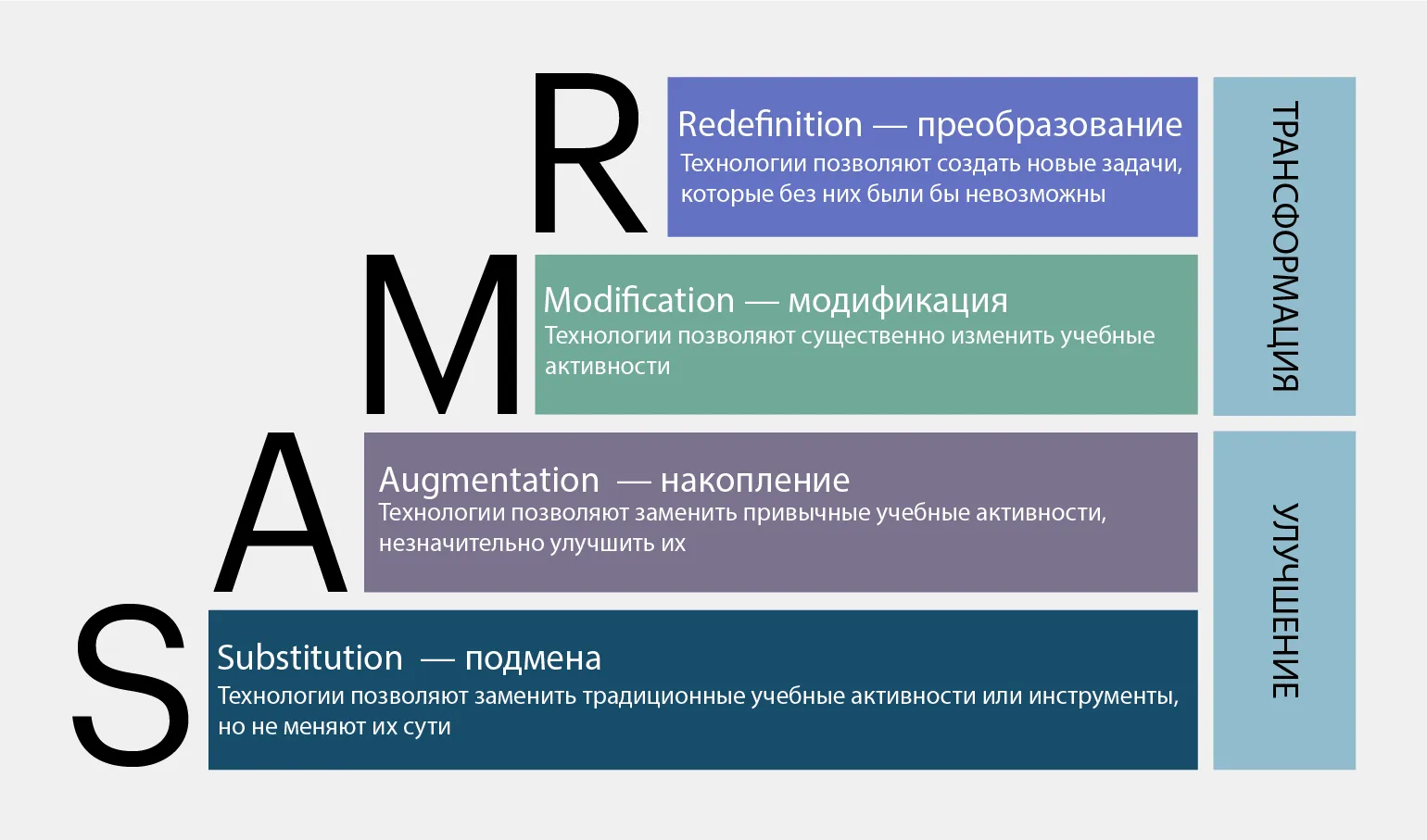
At the "Substitution" stage, technology replaces traditional methods and tools without significantly altering the learning process. For example, a teacher may ask students to read e-textbooks instead of paper ones or use electronic boards instead of wooden ones. Despite the introduction of technology, the learning process itself remains unchanged.
The "Accumulation" level is distinguished by the implementation of digital teaching methods that replace traditional approaches. In this context, technology not only introduces small functional changes but also significantly improves the learning process. For example, students taking tests on online platforms receive instant feedback on their results, which optimizes learning. Teachers also find it easier, as they do not need to waste time grading paper tests. This approach allows them to focus on deeper interaction with the material and individual support for students.
The third level, "Modification," involves changing the design of the learning activity or its objectives using technology. At this stage, the developer or instructor abandons traditional methods. For example, a training session previously held in the classroom is now conducted online, with participants divided into mini-groups in separate virtual rooms. Communication occurs via chat, and questions are answered in real time. This creates a new experience for both learners and training providers, opening up new opportunities for interaction and engagement.
The "Transformation" level represents a significant shift in learning activity. At this stage, pedagogical challenges become possible that cannot be addressed using traditional methods and tools. For example, virtual reality technologies make it possible to organize educational excursions to exotic locations, such as the Amazon rainforest, creating a sense of presence and engagement unachievable through traditional videos. Collaborating on projects and sharing experiences with students from other countries via social media significantly increases collaboration, develops communication skills, and fosters openness to cultural differences. Thus, the use of innovative technologies in education not only enriches the learning process but also develops new competencies in students.
It is important to understand that the SAMR model is not a pyramid that must be overcome. This means that educational institutions are not required to strive for the highest level of "Transformation." The levels of technology implementation within this model do not indicate the quality of their use, but rather describe the available options for choosing appropriate tools to solve specific problems. The effectiveness of technology in education is determined not only by its level of implementation but also by how it is used in practice.
Unlike TPACK, the SAMR model does not emphasize the relationship between technology, content, and pedagogical methods. While SAMR demonstrates approaches to integrating technology into the educational process, at higher levels it emphasizes that technology can fundamentally transform learning activities. This change can lead to deeper student engagement and improved learning outcomes. It is important to understand how the use of technology can not only complement but also transform the approach to learning, making the SAMR model relevant to modern educational practices.

Read also:
The principles of multimedia learning are the basis for developing effective digital learning content. These principles take into account different ways of perceiving information, which makes learning more accessible and engaging. It's important to use text, images, audio, and video in a harmonious combination to facilitate the assimilation of material. Proper distribution of elements helps avoid information overload and maintains learners' attention. Effective multimedia content should be tailored to the target audience, making it more relevant and engaging. It's also important to consider keywords and phrases to improve SEO, making learning materials easier to find online. Using multimedia elements not only enhances understanding of the topic but also promotes critical thinking and creativity in learners. When beginning to use technology in learning activities, it's important to clearly define your purpose. You should analyze how each activity in your program aligns with the various levels of the SAMR model. Ask yourself key questions: How can technology enhance learning? How can it transform traditional teaching methods? What are the benefits of integrating technology into the learning process? This approach will help you optimize educational practices and improve the effectiveness of learning.
- How can traditional methods and tools be replaced with digital ones (the "Substitution" level)?
- Can traditional methods and tools be replaced while improving the student experience (the "Accumulation" level)?
- Which technology in your task significantly transforms the learning activity (the "Modification" level)?
- Which technology transforms the activity so much that it allows you to achieve results that are impossible using traditional means?
When analyzing the level of technology integration in the educational process, it is important to determine what level you are aiming to reach and why. The integration of technology into education can significantly improve the quality of students' educational experience.
Choosing the optimal level of technology will improve interaction between teachers and students, make learning more accessible and personalized. Students will be able to access educational materials anytime and from anywhere, which contributes to a more flexible approach to learning.
The use of modern technologies, such as online courses, interactive platforms, and virtual reality, can improve student motivation and engagement. This not only enriches education but also prepares students for the demands of the modern labor market.
Therefore, the pursuit of a high level of technology integration in education is justified, as it brings significant benefits to both students and educational institutions, creating the conditions for a higher-quality and more effective educational process.
Effective integration of technology into the educational process does not always require achieving the "Transformation" level. Often, the optimal solution for a specific problem can be found at the "Substitution" level or even within traditional teaching methods. It is important to keep in mind that the choice of technologies should be consistent with the learning goals and needs of students, and not strive to use the latest solutions for the sake of technology itself.
Read also:
Designing collaborative learning in metaverses requires a careful approach and the use of modern technologies. First, it's important to define the learning goals and objectives, taking into account the specifics of the virtual environment. It's crucial to create interactive and engaging elements that will encourage active user participation.
The use of 3D models, virtual classrooms, and gamification can significantly enhance the learning process, making it more engaging. It's also worth considering personalization options so that each participant can tailor the process to their needs and interests.
The importance of analyzing and evaluating learning outcomes should not be overlooked. Regular feedback will help adjust the learning process and ensure its effectiveness.
Finally, creating an effective collaborative learning system in metaverses requires the integration of technologies, smart content design, and continuous monitoring of results. This will not only improve the quality of education but also create a unique educational environment that promotes the development of the skills and knowledge of participants.
What are the similarities and differences between the TPACK and SAMR models?
The TPACK and SAMR models have more in common than it might seem at first glance. Both models focus on the use of technology in the educational process, emphasizing the importance of the participation of all participants. They take into account the context and availability of technology, offering a wide range of opportunities for its integration. At the same time, each of the models leaves educational program developers the freedom to choose the tools that most effectively solve pedagogical problems. This allows for flexibility and adaptability in learning, which is a key aspect of modern education.
The differences between the TPACK and SAMR models lie in their approaches to integrating technology into the educational process. The TPACK model provides a deep understanding of the possibilities of technology, emphasizing the synergy of pedagogy, technology, and educational content. However, it does not offer specific steps for implementing these principles. In contrast, the SAMR model is more accessible and practical, serving as a guide for integrating technology into education. In practice, both models can be used: TPACK as a theoretical foundation, and SAMR for specific stages of educational program development. It is important to remember that technology should not be an end in itself, since its use does not guarantee the achievement of high-quality educational results.
Online course producer from scratch to PRO
You will learn how to launch profitable courses and webinars with minimal investment. You'll understand how to turn existing EdTech projects into profits and make money from online learning.
Learn more