Contents:

Course with employment: "The Profession of Methodologist from Zero to PRO"
Find out more
With over 8 years of experience in the field of education, I have been teaching and providing methodological work at such educational institutions as the Moscow State Linguistic University, the A.S. Pushkin State Institute of the Russian Language, as well as the First Media Academy Institute and Skillbox. I am currently a higher education methodologist at Netologia. My experience includes developing educational programs and courses, allowing me to effectively combine theory and practice in teaching.
Skillbox Media provides high-quality photos that are ideal for a variety of projects. Our collection includes a variety of images suitable for use in marketing, advertising, and websites. Each photo reflects a professional approach to visual content creation and can be a great addition to your materials. By choosing images from Skillbox Media, you not only receive aesthetically pleasing content but also the opportunity to enhance the perception of your brand. Explore a wide selection of styles and themes to help you communicate your idea effectively to your target audience.
What are Mind Maps?
A mind map, also known as a mental map, mind diagram, or thought map, is an information visualization technique that illustrates the systematic relationships between a whole and its parts. A mind map is formed around a central idea, concept, or problem, from which branches with related ideas diverge. Mind maps are an effective tool for structuring a variety of material, including literature lists, curricula, and projects. Using mind maps helps improve information comprehension, promotes creative thinking, and facilitates the organization of thoughts.
The mind mapping technique, known as a mind map, was popularized by British psychologist Tony Buzan, who presented it on a television show in 1974. However, the origins of this method date back to the 3rd century AD, when the Greek Neoplatonist philosopher Porphyry used a graphical tree diagram in his commentary on Aristotle's Categories. Mind maps allow for the effective structuring of information, improving the memorization and comprehension of complex concepts. This method finds application in various fields, including education, business, and personal development, due to its ability to visualize ideas and the connections between them.
She has eight years of experience in education. During her career, she has taught and provided methodological support at such educational institutions as Moscow State Linguistic University, the Pushkin State Russian Language Institute, the First Media Academy, and Skillbox. She is currently a higher education methodologist at Netology.
Skillbox Media is a platform offering high-quality educational materials and courses. Our goal is to help users develop skills and knowledge in a variety of fields, including marketing, design, programming, and more. We strive to provide access to relevant information and practical exercises so everyone can improve their competitiveness in the job market. We provide the professional support and resources you need to achieve your career goals.
What are the benefits of mind mapping?
Mind mapping is a well-researched tool, the effectiveness of which in the learning process has been confirmed by both scientific research and the practical experience of many users. This approach helps structure information, improves memorization, and promotes the development of critical thinking. Using mind maps, you can visualize the connections between ideas, which makes the learning process more flexible and productive.
Meaningful learning is a process that is fundamentally different from rote memorization. Unlike rote learning, meaningful learning emphasizes a deep understanding of the material being studied. This approach allows not only for the assimilation of information but also for the establishment of connections between different subjects and phenomena. Meaningful learning facilitates the integration of new information with existing knowledge, making the learning process more effective and long-lasting. This teaching method helps develop critical thinking and analytical skills, which are important in the modern educational context.
Creating a mind map, which reflects the connections between ideas, is an excellent fit for modern teaching methods, as confirmed by research by scientists from King's College London. They do not call for a complete abandonment of traditional methods such as note-taking, but emphasize that visual representation of the relationships between topics significantly improves the effectiveness of university learning and makes it more meaningful. The use of mind maps can help students better absorb material, develop creative thinking, and improve information retention. This approach promotes a deeper understanding of subjects and helps organize knowledge, which ultimately has a positive impact on academic success.

Read also:
Robert Gagné's approaches to teaching are based on nine key events that contribute to effective learning. These events form the basis for developing curricula and methods aimed at improving the assimilation of material. Gagné emphasizes the importance of motivating learners, clearly presenting information, and providing opportunities for practical application of knowledge.
The first step is to capture students' attention, which helps generate interest in the topic. Then, it is necessary to communicate learning objectives so that students understand what they should learn. The third stage involves recalling previous experiences, which helps connect new knowledge with existing ones.
Next, new information is presented, which should be structured and easy to understand. This is followed by providing opportunities for practice, which helps consolidate new skills. The sixth event concerns feedback, which helps students understand their mistakes and improve their performance.
The seventh event involves assessing the assimilation of the material, which allows for the level of understanding of the topic. The eighth is stimulating the transfer of knowledge to new situations, which facilitates the application of what has been learned in real life. Finally, the ninth event is maintaining student interest and motivation throughout the learning process.
These nine events are essential for creating an effective learning environment and can significantly improve the quality of teaching. Using Gagné's approaches allows educators to develop more structured and focused curricula that promote deep knowledge acquisition.
Diagrams significantly improve the process of memorizing information, says researcher Martin Davis from the University of Melbourne. According to him, the human brain perceives data more effectively when it is presented as individual blocks, rather than as continuous text. The use of visual elements such as diagrams makes it easier to analyze and assimilate information, making them a valuable tool in the educational process and in professional work.
A study conducted by scientists at Barts and the London School of Medicine and Dentistry confirms the effectiveness of using mind maps in learning. Medical students using this method were able to recall 10% more of the studied material after a week compared to students in the control group. This suggests that mind maps can significantly improve the quality of memorization and assimilation of information, which is especially important in medicine, where the volume of knowledge is vast and constantly updated. Using visual tools such as mind maps can help students organize information more effectively and improve their learning outcomes.
Read also:
Effective Methods for Long-Term Information Retention by Students
Remembering information is an important aspect of the learning process for students. To ensure long-term knowledge retention, it's worth using several proven methods. One such approach is active review of material. Regularly reviewing information at different time intervals helps consolidate it in long-term memory.
Associations and visual imagery are also worth using. By associating new information with already known facts or creating vivid mental images, students can significantly facilitate the memorization process. Another useful method is the use of mnemonic devices, such as acronyms or rhymes, which make information more accessible and memorable.
It's also important to create a favorable learning environment. A comfortable and quiet place, sufficient time, and minimizing distractions contribute to more productive information retrieval. Additionally, active participation in discussions, group activities, and sharing material with others also significantly enhance understanding and retention.
Don't forget the importance of regular rest and recuperation. Quality sleep and breaks during study help improve concentration and facilitate better information absorption.
By following these methods, students will be able to effectively memorize the material and use it in the future.
Mind maps allow you to visually structure broad topics, breaking them down into subtopics and microtopics. This is an effective tool for organizing large-scale projects, allowing you to break them down into specific tasks and simplify the planning and execution process. Using mind maps improves understanding and information absorption, and also increases work productivity.
Chuck Frey, founder of The Mind Mapping Software blog, which focuses on mind mapping tools and techniques, regularly conducts surveys among his audience. When asked about the most significant benefit of using mind maps, most respondents noted that mind maps facilitate a deeper understanding of complex projects and problems. Mind maps are an effective tool for visualizing information, which helps facilitate analysis and decision-making.
How to Create a Mind Map
Mind maps can be created on a variety of platforms, including whiteboards, tablets, and paper. However, a standard A4 sheet of paper may not be sufficient to fully express an idea. In addition, corrections and changes are difficult to make in paper format. For convenience, using sticky notes of different colors will help clearly visualize ideas at different levels of the diagram. Self-adhesive narrow tabs are useful for indicating connections, especially if you are working with a mind map on a wall, or a marker if using a whiteboard. Visualizing information using mind maps makes it easier to understand complex concepts and promotes more effective communication of ideas.
There are many digital services offering convenient tools and ready-made templates for creating mind maps. These platforms allow users to easily visualize ideas, structure information, and organize thoughts. Using such services significantly simplifies the process of creating mind maps, making it accessible even for beginners. User-friendly interfaces and a variety of templates allow you to quickly adapt maps to your needs, which is especially useful for students, professionals, and teams working on projects. Choosing the right mind mapping tool can significantly improve work efficiency and enhance understanding of complex concepts.
- MindMeister,
- Miro,
- XMind,
- MindMup,
- Mind42 and others.
The advantage of online content editing services lies in their ability to make changes quickly and accurately. Users can add notes, footnotes, images, and links to additional materials, significantly improving the quality of their work. These services typically offer free access with a limited set of features or provide a free trial period, allowing users to evaluate their capabilities before purchasing the full version.
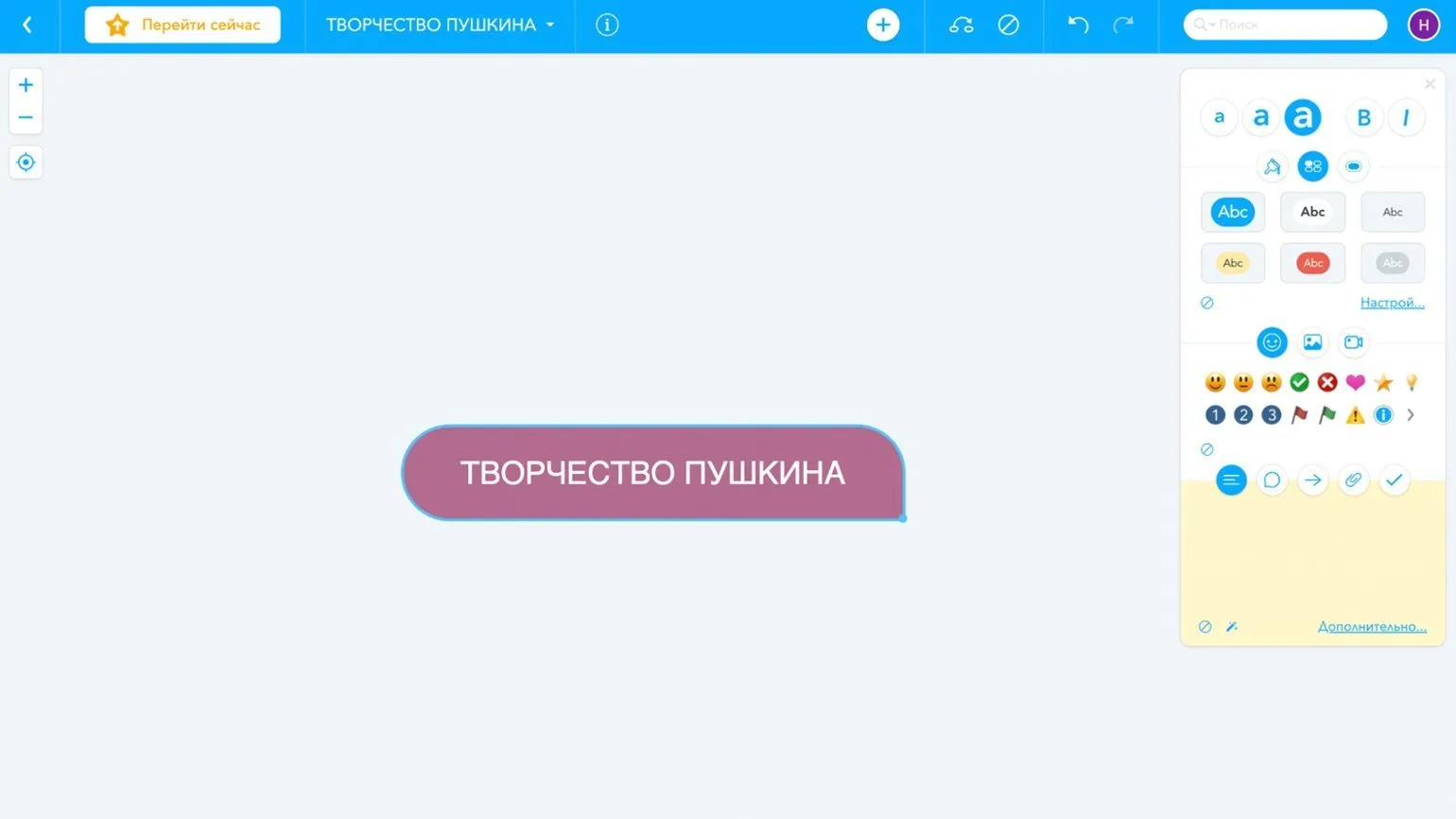
A mind map, regardless of the method used to create it, will always have a tree structure reflecting the hierarchy of its elements. Let's look at how such a structure is formed using the MindMeister service, using a simple map classifying the works of Alexander Pushkin as an example. This tool allows you to visually organize information, simplifying its perception and memorization. Structuring data with mind maps helps you better understand the connections between different works and their thematic areas.
The main idea, theme, problem, or title of the project should always be the focus. It is recommended to highlight this element in a bright color and large font. In this case, the key emphasis is on "Pushkin's Works." This immediately attracts attention and facilitates the perception of information, which is an important aspect of effective content design and presentation.
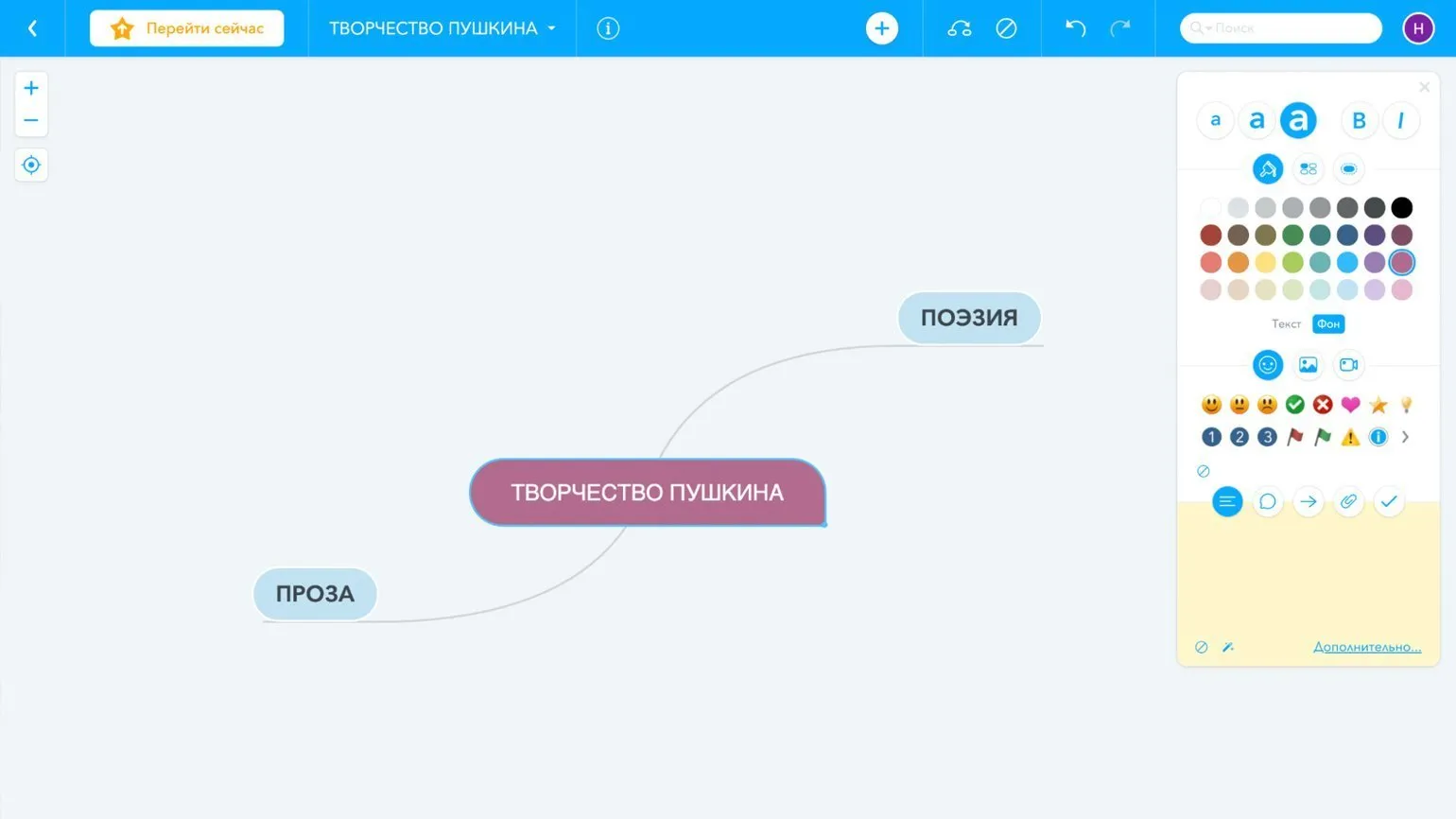
Let's move on to the first level - key categories, subsections, and chapters that are related to the main topic. It is recommended to use short titles of 1-2 words for such categories. It is also advisable to add images that reflect the content of each category. This will improve the perception of information and increase its attractiveness for users.
How to use mind maps in teaching
Mind maps are a powerful tool whose capabilities depend solely on your goals and creativity. Let's look at several examples of how this method can be useful for teachers, trainers, coaches, and methodologists. Using mind maps helps visualize information, simplifies understanding of complex concepts, and facilitates the effective organization of the learning process. This method makes it easy to identify dependencies between subjects, plan lessons, and develop individual learning paths. Diagrams also help activate thinking and increase engagement among learners, making them indispensable in modern educational practice. Introduce students to mind maps and encourage them to use them to collect and organize information (e.g., when preparing reports, essays, and term papers). Mind maps are also effective for taking notes during lectures and highlighting important points from books. Mind maps can be helpful when creating a curriculum: they allow you to conveniently structure a list of topics and tasks, as well as a list of teaching materials and auxiliary tools. When teaching a foreign language, you can place a new word in the center of the diagram and associate it with associated words or corresponding synonyms/antonyms. Or, indicate the topic in the center (for example, "Shopping" or "Travel"), and arrange related words and expressions on the "branches." In a history lesson, a historical event can be in the center of the map, surrounded by the causes, development of events, and results. Mind maps can be used in a similar way in literature lessons: for example, when analyzing a story's plot or character development.
Read also:
- Droodles: what they are and how they help in learning
- How metaphorical maps can be useful for teachers and trainers
- How drawing is used during non-artistic activities
- CRAFT/ED: what is this tool for educational designers?
- What is a Learning Journey Map and how to use this tool
Methodologist Profession from Beginner to Advanced
You will develop your skills in developing curricula for online and offline courses. You will master modern teaching practices, structure your experience, and become a more sought-after specialist.
Find out more