
Contents:
On September 17-18, the online conference "Solyanka" was held, organized by the HR-Kitchen community. Yana Adrianovskaya, leading specialist in the development of training solutions at BTG Consult, spoke at the event. She discussed why efforts to make training more attractive and interesting for employees do not always lead to the expected results. Yana also shared practical recommendations for the correct implementation of creative approaches in the training process. These tips will help companies effectively develop employee skills and increase their engagement in training.
What is commonly understood as creative solutions in training?
Corporate training often uses creative approaches based on the speaker's experience. These methods help make the learning process more effective and engaging. Creative solutions include interactive training sessions that promote active participant engagement. Gamification elements, which make training more dynamic and memorable, are also popular. It is important to use a variety of formats, such as video content, simulations, and group discussions, to accommodate different learning styles and increase employee engagement. Effective corporate training requires not only an innovative approach but also adaptation to the needs of a specific team.
- They introduce a character who explains theoretical material, asks questions, and provides guidance to the student during assignments;
- They turn to pop culture themes (most often, well-known film epics) to "package" the educational content;
- They use memes and other humor.
Yana Adrianovskaya notes that the proposed training options do not have any serious drawbacks. They are understandable and familiar to both developers and participants. However, creative elements sometimes prove less effective than course creators expected. In some cases, they can even negatively impact the learning process and outcomes. It's important to recognize that traditional approaches may be more effective in certain situations, and designers should carefully consider which elements truly enhance learning.
A course provider is developing a lean manufacturing course for employees of a manufacturing company, primarily women over 50. The course topic is specific and challenging to understand, so the provider is considering using the Harry Potter universe to present the training materials, believing this will attract participants' attention. However, this strategy may prove ineffective. The audience will likely misunderstand the references to the boy wizard and ignore them, or, worse, perceive the course as childish and frivolous. It is important to consider the interests and perceptions of the target audience to ensure effective training and employee engagement.

Also check out:
Humor in serious courses can be very beneficial. It helps create a more relaxed atmosphere, promotes better learning, and increases participant engagement. Properly chosen jokes can make training more memorable and also reduce stress levels in listeners.
A methodologically correct approach to humor involves understanding the audience and context. Jokes should be appropriate, not offensive, and relevant to the course topic. Using humor in the right places helps make complex topics more accessible and interesting. It is important to remember that humor should support the main idea, not distract from it. Thus, the skillful use of humor can significantly improve the effectiveness of training and make courses more attractive to participants.
What is important to consider when developing creative solutions
To successfully implement creative elements of a course or training, the speaker recommends considering three main aspects of training. These components will help ensure maximum effectiveness and engagement of participants, as well as contribute to the achievement of the set goals. It is important to correctly integrate these elements to create a harmonious and productive learning space.
- Learning objectives. When creating characters, a story, or a design style, it's important to remember that you're not developing an advertising campaign (which should primarily attract attention) or entertaining content, but rather designing a learning experience. And in learning, all components should work toward achieving the learning objectives (remember: this follows from Richard Meier's principle of coherence). Adding elements simply for the sake of "making it more fun and prettier" won't achieve the desired result.
- Characteristics of the target audience. You need to understand what excites the trainees, what interests them, makes them laugh, and what evokes an emotional response. Socio-demographic characteristics are also, of course, important to consider. References to the world of Harry Potter are unlikely to attract older employees, but they may work well for millennials and early-Zoomers. But, as the speaker notes, there are always exceptions, so the target audience must be carefully studied—otherwise, it will be impossible to make the training effective and engaging.
- Specifics of the training topic. Inventing characters or connecting educational content to, say, a fantasy universe isn't appropriate for every topic. Understanding the story the developers have packaged the course in or deciphering pop culture references also requires some mental effort from the student. And if the course topic is complex, then unnecessary elements can cause cognitive overload and not contribute to understanding the material, but hinder it.

Read also:
Creating and packaging educational content for a mixed-age audience requires a special approach. To achieve maximum effectiveness, several key rules must be followed. First, it's important to adapt the material to different levels of comprehension. This can be achieved by using a variety of formats and presentation styles. Second, consider the interests and needs of different age groups to make the content relevant and engaging. Third, use visual elements—graphs, diagrams, and images—to help students better absorb the information. Fourth, create interactive tasks and exercises that encourage active participation and increase motivation for learning. Finally, don't forget about regular feedback to evaluate the effectiveness of the content and make any necessary adjustments. By following these rules, you can create high-quality educational material suitable for a mixed-age audience.
According to Yana Adrianovskaya, creative solutions in learning are not just entertainment or visual effects, but effective methodological tools that facilitate the interesting and understandable presentation of information. They motivate students to apply new knowledge in practice. Such creative solutions include not only the use of characters and pop culture references, but also innovative learning formats, interactive mechanics, and a well-thought-out sequence of material presentation. These elements help create an engaging learning environment that promotes deeper knowledge acquisition.
How Creative Solutions Support Learning
Yana Adrianovskaya argues that effective creative solutions in learning fulfill at least one of three key functions. These functions help improve the educational process, promote student engagement, and make learning more interactive. Developing creative approaches allows you to adapt materials to different learning styles, which improves the quality of education and student engagement.
The information students receive in a course may initially seem abstract and difficult to understand. To make new concepts more understandable and accessible to the target audience, it is important to connect them to students' personal experiences. This will help improve your perception of the material and enhance its assimilation.
According to cognitive psychology, the human brain structures information about the surrounding world through cognitive schemas. This means that it connects various facts, concepts, symbols, and images, organizing them into a logical system. When receiving new information, the brain instantly classifies it, integrating it into existing schemas. This process ensures the constant updating and refinement of cognitive structures, which contributes to better understanding and memorization of information.
When a person encounters completely unfamiliar information, for example, when starting to study a new topic, their brain experiences a significant cognitive load. In such a situation, it must not only determine how new data relates to already known concepts but also, possibly, create an entirely new mental structure for processing it. This process requires time and effort, as a person strives to integrate new information into existing knowledge and skills.
Reading is an important part of our lives, and it contributes to the development of thinking, broadening horizons, and improving communication skills. Books, articles, and other forms of written content will enrich your vocabulary and help you gain a deeper understanding of the world around you. Regular reading also improves concentration and attention, which has a positive impact on all aspects of life. Reading also promotes emotional development and allows you to better understand the feelings of others. It is important to choose a variety of genres and topics to make the reading process even more engaging and rewarding. Cognitive theories are an important tool in teaching and learning. They help us understand how people perceive, process, and store information. Let's look at four key cognitive theories that will be useful for educators and trainers. The first theory is constructivism. It states that knowledge is created by students through active interaction with the environment and other people. Teachers should create conditions for independent information search and problem solving, which contributes to a deeper understanding of the material. The second theory is the theory of multiple intelligences. According to this theory, each person has several types of intelligence, such as linguistic, logical-mathematical, musical, and others. Understanding these different intelligences allows educators to adapt their teaching methods to meet the needs of each student.
The third theory is cognitive load. It focuses on how the amount of information presented to students can affect their ability to learn. It is important to consider cognitive limitations and present information in a user-friendly format to facilitate knowledge acquisition.
The fourth theory is social learning. This theory emphasizes the importance of interaction and observation of others in the learning process. Educators can use group activities and collaborative projects to develop collaboration and sharing skills among students.
Application of these cognitive theories in teaching will help improve the effectiveness of the educational process and create a more comfortable environment for students. Understanding the mechanisms of learning allows teachers to develop more effective methods and approaches that promote deep knowledge acquisition. Yana Adrianovskaya argues that this task will be simplified if specific examples and visual analogies relevant to the context of students' lives and work are integrated into the learning process. The speaker proposes various approaches for implementing these ideas.
- Immersing students in context. For example, the topic of phishing protection can be presented not through a standard explanation, but through experience: a student employee receives a series of emails and must distinguish safe content from malicious content without falling for the scammers' tricks. This way, the employee will learn from their mistakes and receive feedback. And when they subsequently receive theoretical information, the new knowledge will be directly linked to the cognitive schema: "This is what I need to remember to avoid accidentally leaking my data to attackers."
- Visualization can also help build a bridge between new information and existing experience. For example, you can design a course on effective communication as an interface for email, instant messaging, or another application that the student frequently interacts with in their work. This familiarity will make it easier for them to connect new knowledge to the "shelf" on which it should be placed.
- Audio is sometimes more effective than text or visual images. The speaker gives the example of a course for salespeople on handling customer objections. Of course, dialogues between dissatisfied customers and a salesperson can be presented in text, but if you prepare audio recordings of customer phrases, the employee will recognize the proposed situations by their typical intonations and will be able to relate them to their own experience much more quickly.
In the example of a lean manufacturing course for company employees, Yana Adrianovskaya suggested replacing references to Harry Potter with a cooking metaphor more accessible to women over 50. In this context, as in manufacturing, process optimization and efficient use of resources are critical. It is essential that all necessary ingredients are on hand, time spent on various culinary operations is used effectively, and excess food does not have to be thrown away. This approach will create a more understandable and practical connection between theory and the realities of everyday life, making the training more accessible and relevant.
As the speaker argues, it is important to understand that creativity in methodological tasks does not consist of searching for the most original idea that has not yet been voiced. The key aspect is to find a solution that meets the learning objectives and course topics, and that will be perceived by the target audience. This approach ensures that the content is relevant and effective for learning.

Read also:
Getting students' attention and creating memorable learning content are important aspects of effective learning. There are several strategies that can help make the learning process more engaging and productive.
The first method is using interactive elements. Incorporating surveys, quizzes, and game-based tasks into the learning process promotes active student engagement and increases interest in the material. Such elements not only make lessons more lively but also help students better absorb information.
The second method is data visualization. Using graphs, charts, and illustrations helps students better understand and remember information. Visual elements promote associations and facilitate the perception of complex concepts.
The third method is integrating real-world examples. Using practical situations and real-life cases makes the learning material more relevant and interesting. Students perceive information more easily when they see its application in real-world settings.
The fourth method is creating group assignments. Teamwork promotes the exchange of ideas and opinions, which not only develops communication skills but also makes the learning process more dynamic. Group assignments encourage students to engage with the topic in greater depth.
The fifth method is the use of technology. Using educational platforms, mobile apps, and videos can add variety to the learning process. Technology significantly expands learning opportunities and makes it more accessible and engaging.
These methods can increase student engagement and make learning content more memorable and effective.
After learning new information in a course or training session, it's important to consolidate the knowledge. For this, the speaker emphasizes, two key elements are necessary: a visual image or specific concept, and an emotional response. These components contribute to deeper understanding and long-term retention of the material. Emotions make the learning process more effective by helping to connect new knowledge with personal experience, which in turn enhances its retention.
Cognitive sciences emphasize the importance of visual and verbal components in the learning process. According to Allan Paivio's dual coding theory, information is remembered more effectively when it is presented in both verbal and visual form. Concrete concepts that are easy to visualize are absorbed much faster than abstract ones. Importantly, visual and concrete associations with the material being studied can serve as a basis for its consolidation in memory and also facilitate subsequent recall. Using such associations in educational processes can significantly enhance the level of information absorption and improve learning outcomes.
Emotions play a key role in the learning process, giving it personal meaning. Events and facts that evoke an emotional response are remembered significantly better. Positive emotions contribute to increased learning engagement, which, in turn, directly affects learning success. Creating a positive emotional background in the educational process can significantly improve results and help students achieve their goals more effectively.
Including an emotionally charged and imaginative component in a course promotes deeper student engagement. This approach makes it easier to remember information and helps to better absorb the material. Emotions and images not only make learning more interesting but also enhance long-term retention, which is a key factor in the educational process.

Read also:
When designing corporate training, it is important to consider the emotions of participants. Emotional intelligence plays a key role in the learning process, as positive emotions promote better retention, while negative emotions can hinder learning. To create effective training programs, it's essential to consider the emotional needs of employees. First, it's important to create a safe and supportive environment where participants can openly express their thoughts and feelings. This will help build trust and increase engagement. Second, it's important to use a variety of training methods, such as interactive activities, group discussions, and role-playing, which can evoke positive emotions and increase interest in the material.
It's also helpful to include feedback elements so participants can share their emotions and reactions to the training. This will not only improve the quality of the program but also allow you to tailor the training to the specific needs of the group. It's important to remember that emotions influence motivation and information comprehension, so considering them in the corporate training design process is essential for achieving successful results.
Yana Adrianovskaya recommends using a visual and associative language that will resonate with your audience throughout the course. This applies to slide design, interface elements, additional materials, and character images, if present. Applying a consistent style helps create a harmonious experience and increase participant engagement.
The speaker cited the "Suffering Methodology" course, created by the BTG Consult methodologists, as an example, which borrowed the style of the well-known "Suffering Middle Ages" project. Analysis showed that the visual images and memes used in the course evoke a positive response from the audience. This means that such elements can effectively serve as "anchors" for memorizing educational material, promoting better assimilation of information.
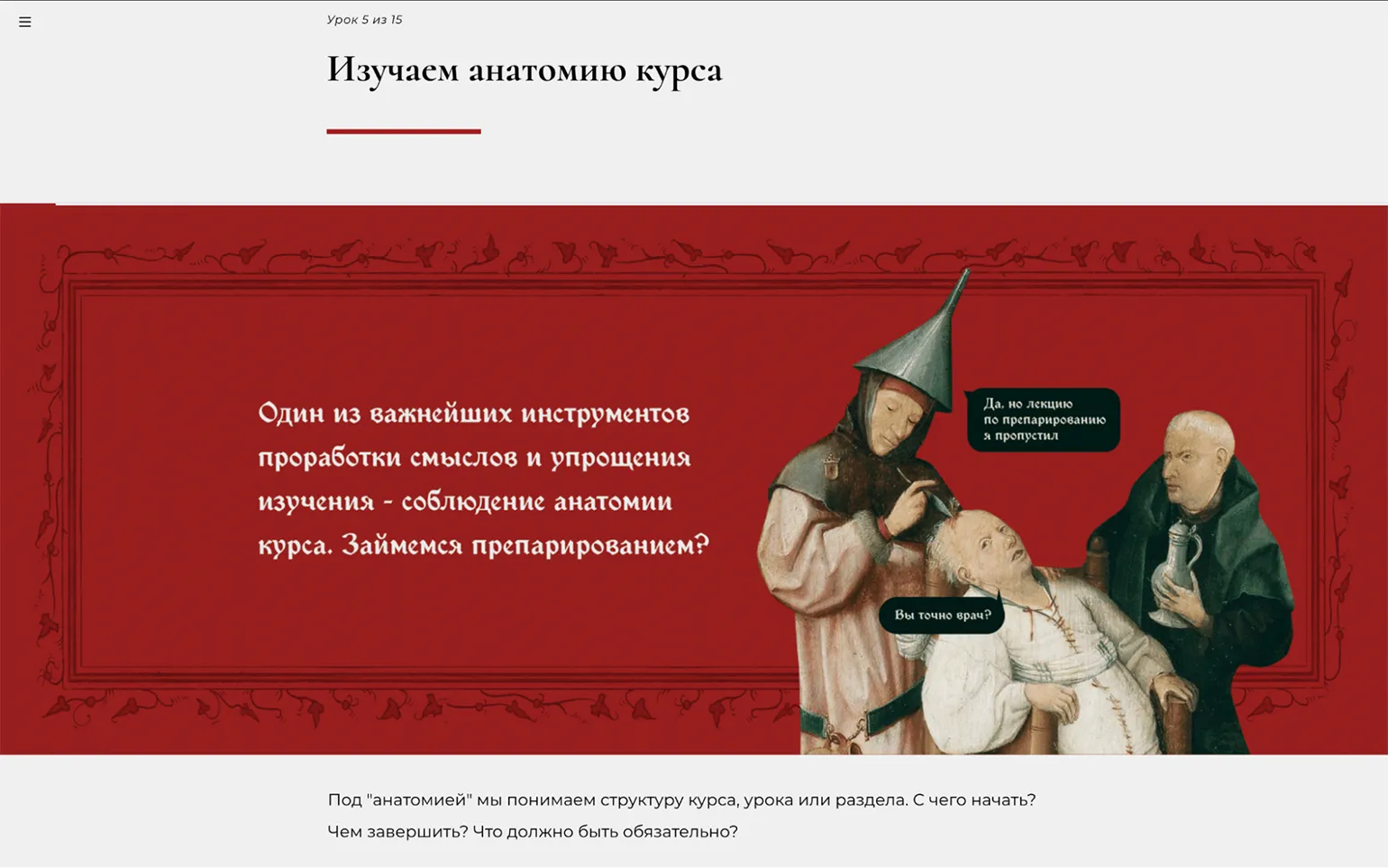
Yana presented additional ideas.
- If the target audience is into sports, the image of "red cards" can help them remember, for example, a set of rules that must not be broken;
- If course participants live in a big city and ride the subway, information about a sequential process can be visualized as moving from station to station;
- Phrases and images from advertising from the 1990s and 2000s can evoke recognition and an emotional response in millennial employees.
It is important to motivate employees to learn, as well as help them absorb new information. Learning faces competition for attention, as people are distracted by content from instant messengers, social networks, and streaming services. The speakers emphasize the need to create an enjoyable, comfortable, and engaging learning process. This allows students to engage with learning materials and motivates them to complete the course. Effective teaching methods not only promote knowledge acquisition but also improve overall employee productivity. Yana Adrianovskaya offers three key tips for educational program developers aimed at maintaining and enhancing student motivation. First, it's important to create interactive and engaging materials that stimulate student interest and active participation. Second, it's essential to consider the individual needs and preferences of students, adapting content to different learning styles. Third, regular feedback and support from instructors play a critical role in maintaining motivation, helping students feel like they're making progress and achieving their goals. By following these recommendations, developers can significantly improve the educational process and increase student engagement.
- The course itself should be aimed at being interesting and easy to understand.
- It's worth adding elements that evoke an emotional response – this is where storytelling with characters resembling the students, solving problems they can relate to, and stories that include intrigue, challenge, or a sense of nostalgia come in handy. If appropriate, you can also include gamification elements: points, bonuses, achievements, and other mechanics.
- It is important to regulate the cognitive load of students during the learning process, especially long-term ones - dose information, give them the opportunity to rest and relax a little after difficult thematic blocks, so that they conserve energy until the end of the course.


Reading is an important aspect of our lives, and it opens up many opportunities for us. It helps develop thinking, broaden horizons and improve literacy. In addition, reading helps to enrich vocabulary and helps to better understand the world around us. Regularly reading books, articles, and other materials can significantly impact our education and personal development. To get the most out of your reading, choose a variety of genres and topics that interest you. Don't forget to share your impressions of what you read and discuss books with others; this will help deepen your understanding of the content and develop critical thinking.
- 3 Marketing Tools to Help Maintain Engagement in Learning
- 7 Conditions That Ensure Course Completion and the Application of New Skills in the Workplace
- How to Create Engaging Learning Activities with Yu-Kai Chou's Octalization
- SURE: A Formula for Developing Learning Content That Encourages the Application of What You Learn