

Learn: The Profession of Methodologist from Scratch to PRO
Find out moreResearch has shown that 20 minutes after memorization, students remember only 60% of the studied material. After nine hours, this figure drops to 40%, and after a month remains just above 20%. This pattern is known as the Ebbinghaus forgetting curve. Understanding this curve is important for optimizing the learning process and increasing the effectiveness of information memorization. Using repetition and active learning methods can significantly improve the results of memorization and knowledge acquisition.
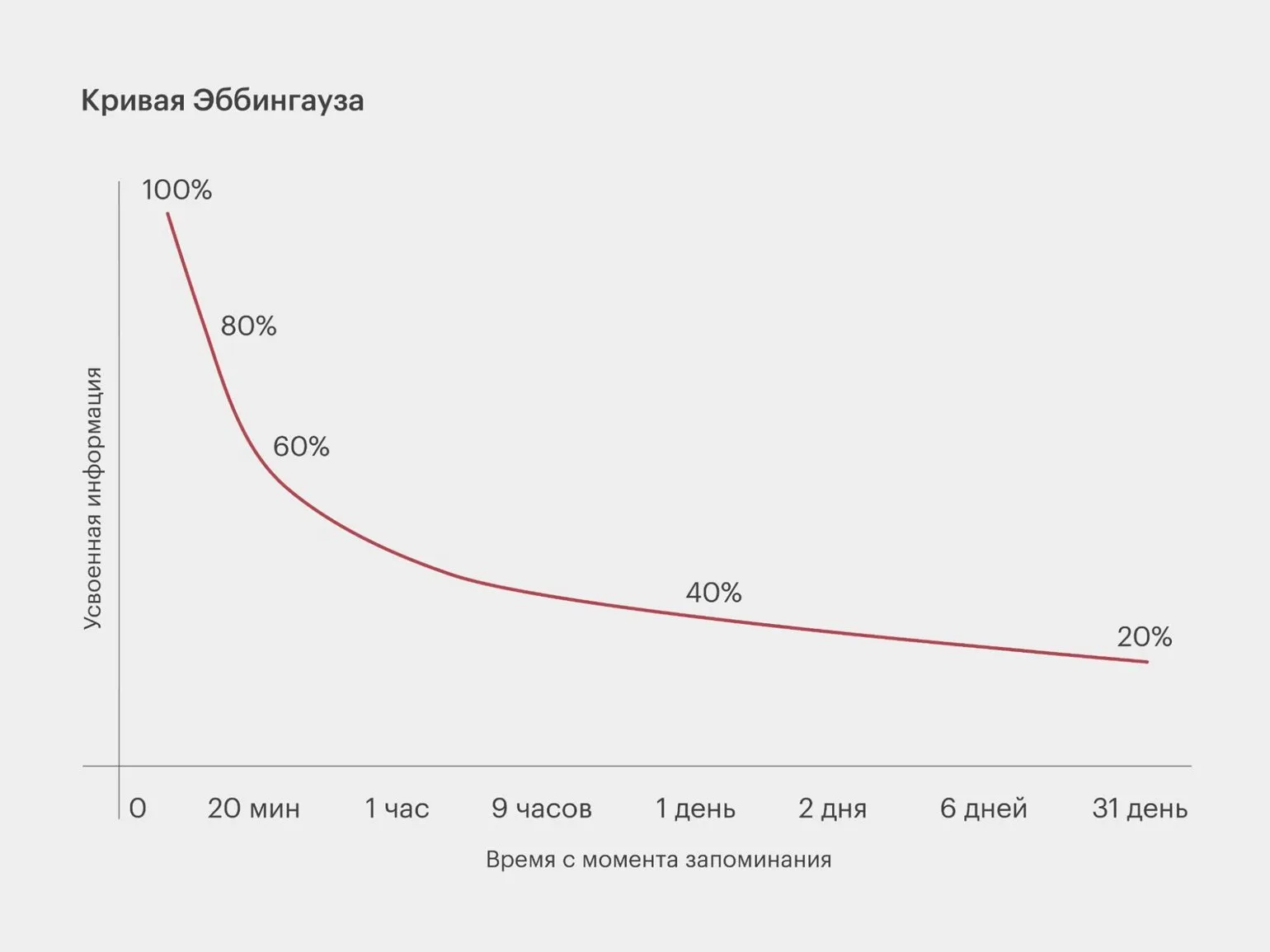
Research shows that the greatest loss of information occurs immediately after memorization, when about 40% of the information is lost, and only 60% remains. Without regular repetition and reinforcement of knowledge, we cannot retain information even for a short period of time. Effective repetition and active learning methods help minimize these losses and promote better memorization. Regular reinforcement of what has been learned improves long-term memory and increases the level of knowledge acquisition.
The scientist compared the results of his experiments on memorizing nonsense syllables and memorizing a coherent text taken from Byron's poem "Don Juan." The study showed that the poem is forgotten more slowly than a set of nonsense syllables. However, the forgetting curve in both cases was similar: significantly less memorized material was recalled over time. This information underscores the importance of structure and meaning in the memorization process, which may be useful for improving learning and memorization methods.
Should we trust the results of experiments conducted over a hundred years ago? Many of these studies are poorly documented, making it difficult to assess their validity in the modern context. There are examples, such as the "Dale Pyramid," where the theories of past scientists have reached us with distortions. However, many practitioners today continue to rely on this data, raising questions about the reliability and relevance of such conclusions. It is necessary to critically analyze the legacy of the past and conduct new research to determine which of the old theories are still applicable in the modern world.
Learning through practice is often more effective than theoretical knowledge. Practical experience allows for better absorption of material and its application in real-world situations. This is due to the fact that during practice, active interaction with information occurs, which promotes deep understanding and retention. Many specialists and experts in various fields confirm that skills acquired through practical activities significantly improve the quality of work and increase self-confidence. Thus, practice becomes an important element in the educational process, allowing not only to develop professional skills but also to develop critical thinking.
The validity of Ebbinghaus's conclusions is confirmed by modern research, underscoring the relevance of his work. In 2015, Dutch scientists Jaap Murr and Jori Dros conducted an experiment that demonstrated results close to the concept proposed by Ebbinghaus. In their conclusion, the researchers noted the German scientist's innovative approach: as early as 1880, he used mathematics and statistics to substantiate his findings and set new standards for conducting psychological experiments. This demonstrates the significance of Ebbinghaus's work in the context of psychology and science in general, emphasizing his contribution to the development of memory research methodology. The scientific community has long debated the connection between the forgetting curve and the perception of significant events. A number of studies have introduced the concept of "flashbulb memories," which refers to vivid recollections of moments when a person first learned of something unexpected, such as a terrorist attack. Research has shown that, although people believe they remember the details of important events perfectly, these details actually fade from memory over time. This discovery highlights the complexity of the memory mechanism and the importance of revisiting information for its retention.
Why Forgetting Is Actually Beneficial
The human brain has amazing abilities, but its ability to remember and recall specific information has its limits. Forgetting is actually a beneficial aspect of mental functioning. An analogy can be drawn with the functioning of a computer: when the device’s memory is full, its performance decreases and it needs to free up space. The brain carries out this “self-cleaning” automatically, removing information from memory that is not necessary. Thus, forgetting can be seen as a form of cognitive hygiene that promotes the effective functioning of mental processes.
One common problem is that sometimes we are unable to recall important information that should be kept in memory, such as topics studied. This can hinder the learning process and knowledge retention. It is important to find effective methods for memorizing and organizing information to facilitate its retrieval at the right time. Optimizing memory and using various memorization techniques will help improve the assimilation of material and increase overall productivity.
There is an opinion that the introduction of the Unified State Exam (USE) has negatively impacted the quality of education in schools. Various aspects of this problem are discussed, including changes in teaching methods and an emphasis on exam preparation instead of in-depth mastery of subjects.
Some experts argue that the USE forced teachers to focus on formal criteria, which could lead to a decrease in student interest in the learning process and a reduction in creative learning. At the same time, other researchers note that standardized exams contribute to an increase in knowledge and facilitate university admission.
Thus, the question of the impact of the USE on the quality of school education remains relevant and requires further analysis.
Human memory is divided into working memory and long-term memory. Working memory has a limited capacity and is used by the mind to perform specific tasks. An example of this is when a student memorizes material for an exam, but after taking it, quickly forgets almost everything they learned. For information to be retained long-term, it must be transferred to long-term memory. Thanks to this mechanism, many adults can easily recite works such as Lermontov's "Borodino" by heart. Proper use of memorization and repetition techniques can significantly improve the process of transferring information to long-term memory.
Knowledge of memory and the theory of the forgetting curve can significantly improve the process of memorization. Understanding these concepts allows us to develop effective learning and memorization methods. The forgetting curve, proposed by Ebbinghaus, shows how quickly we lose information without repetition. Using this theory, one can apply techniques such as active repetition and spaced learning, which promote deeper assimilation of the material and its long-term retention. Thus, understanding the mechanisms of memory and applying the theory of the forgetting curve can significantly improve the effectiveness of information memorization.
How to remember information for a long time
Ebbinghaus not only developed the forgetting curve, but also identified the key factors influencing memory. By taking these aspects into account, the process of information delivery can be optimized, which will help students assimilate the educational material more effectively. Correct application of these principles contributes to improved memorization and long-term retention of knowledge.
Proper structure of the material greatly facilitates the process of its assimilation by students. When information is presented clearly, logically, and meaningfully, students will be able to remember and understand the main concepts more easily. Effective organization of educational content promotes better learning and improves the quality of knowledge assimilation.
Create associations between the material being studied and what students already know. It's important to place theoretical knowledge in a context that's relatable and understandable. This could be related to popular culture or everyday life. Teaching adults makes this task much easier, as they already have extensive experience and knowledge that can be used to explain new concepts. Complex ideas are best illustrated with simple examples to help students better absorb and understand the material.

Simple repetition will help students remember information effectively. The optimal time to review learned material is 20 minutes after first learning it. Research shows that this is when a significant decline in memorization occurs, according to the forgetting curve. Regular repetition during this period promotes deeper assimilation of information and helps prevent rapid forgetting.
Although some information will still be forgotten after each session, the process of knowledge loss slows. This memorization technique is based on the spaced repetition method, which involves reviewing material at gradually increasing intervals. For example, the first review could occur after 20 minutes, then after an hour, then after three hours, one day, three days, a week, and so on. This approach promotes more effective assimilation of information and improves long-term memory. Using spaced repetition optimizes the learning process and promotes a deeper understanding of the material being studied.
Testing the hypothesis about the benefits of spaced repetition in cognitive psychology began in the 1970s. Researchers Thomas Landauer and Robert Bjork gathered a group of psychology students to evaluate how effectively they remembered the association between a person's photograph and their name. The results confirmed the hypothesis: gradually increasing the repetition intervals promoted long-term retention of the information. This finding has significant implications for educational methods and the development of effective learning strategies. Spaced repetition can enhance learning outcomes by improving memory and knowledge retention.
This technique is often considered in the context of memorizing facts, words, and formulas. However, the effectiveness of this approach when learning more complex information that requires deep analysis and reflection remains unclear. Applying this technique to more complex concepts requires further study and analysis to determine how useful it can be in such cases.
The term "overlearning" describes the process of continuing to practice a skill even after it has been fully mastered. For example, if you've been practicing three-point shots on the basketball court for an hour, an additional 15 minutes of practice will help you better reinforce the skill. Overlearning not only improves the skill but also boosts self-confidence, which is especially important in a competitive environment. Regular practice beyond the required time helps build stronger neural connections, ultimately making the skill more automatic and resilient to stressful situations. Overlearning is actively studied in the context of developing motor and visual skills. However, its impact on information acquisition remains less well-studied. Research shows that overlearning can be more effective when learning foreign languages or memorizing facts, as it involves higher cognitive functions. For best results, it's recommended to spend more time on exercises aimed at reinforcing the material covered. This will allow you to maximize the potential of superlearning and improve the learning process.
Read also:
- 30 rules of learning psychology that every teacher would do well to know
- 10 principles of effective learning and teaching
- Microlearning: the pros and cons of short formats in education
- Andragogy: why adults should be taught differently than children
Profession Methodologist from scratch to PRO
You will improve your skills in developing curricula for online and offline courses. Master modern teaching practices, structure your experience, and become a more sought-after specialist.
Find out more