Contents:
What competitions work well in training and development?
In recent years, there has been a steady trend in corporate training towards the introduction of non-standard and highly engaging formats. One such format is a competition, which promotes active participation of employees and increases their level of motivation. Competitions not only stimulate team spirit, but also allow for the development of creative skills, which makes training more effective. Integrating competitions into corporate training helps companies achieve better results and improve overall team productivity. Corporate competitions fall into three main categories: professional, team, and innovative. However, not all of them can serve as effective training tools. Of these types, professional and innovative competitions offer the greatest potential for employee training and development. Professional competitions help develop specific skills and knowledge, while innovative ones offer new approaches and ideas that foster creative thinking and improve work processes. Professional competitions play an important role in identifying the best specialists in various fields. These events allow for the evaluation of not only professional skills but also the performance of participants. Popular competitions include such nominations as "Best Marketer of the Year," "Best Employee of the Month," and "Sales Leader." Participation in such competitions helps increase employee motivation, develop their careers, and strengthen the company's reputation in the market.
Innovative competitions are organized to address current challenges facing the company. This category includes project competitions, the implementation of which can significantly contribute to business development. Participation in such competitions allows you to attract new ideas and approaches, which contributes to the company's competitiveness and improves its position in the market.
Team competitions help strengthen corporate culture, increase team cohesion, and create a comfortable atmosphere within the company. For example, a children's drawing competition for Children's Day or choosing a winner in the "Heart of the Office" category are important events for HR, but they are not related to training. Such activities help develop team spirit and employee engagement, which in turn has a positive impact on the overall productivity of the company.
For a competition to be truly developmental, several key aspects must be considered. First of all, it is important to clearly define the goals and objectives of the competition. This will help create a structure conducive to the development of participants and the enhancement of their competencies.
Furthermore, it is necessary to provide access to high-quality resources and information that will help participants better prepare and demonstrate their skills. Organizing feedback is also important, as it allows participants to learn about their strengths and weaknesses, as well as receive recommendations for improvement.
Creating a favorable atmosphere for participation is equally important. The competition should be inclusive and conducive to collaboration, which will allow participants to exchange experiences and ideas.
It is also worth considering the possibility of involving experts and mentors who will be willing to share their experience and help participants develop. This can significantly enhance the level of the competition and its educational value.
Ultimately, to create a truly developmental competition, it is necessary to take a comprehensive approach that takes into account the interests and needs of the participants, and promotes their growth and development.
- Clearly define the learning goal and design each stage of the competition in accordance with this goal;
- Select one to three competencies that are expected to be developed in participants through the competition. No more than three is recommended, otherwise there will be dispersion;
- support the competition with some other related training events.
What corporate training objectives can a competition solve?
Competitions not only have a dynamic format, but also a significant effect they have on participants and spectators. Effective competitions attract attention, stimulate interest, and create a unique atmosphere of engagement. They promote the development of creativity and team spirit, and also allow participants to demonstrate their talents. Participation in competitions can be an excellent way to increase brand visibility and strengthen its image.
A competition is an effective tool for solving both specific problems in the educational process and for achieving strategic goals. This format helps develop both professional and technical skills (hard skills) and soft skills (soft skills) of employees. Participation in competitions contributes to advanced training, stimulates creativity and teamwork, which in turn improves the overall performance of the organization. Using competitions in training allows us not only to solve current problems but also to create a sustainable system of professional development within the company.
Solving a point problem is an important aspect in various fields, such as mathematics, physics, and computer science. Point problems can arise in the context of differential equations, optimization, or data analysis.
To effectively solve a point problem, it is necessary to clearly define the problem conditions, including initial and boundary conditions. Then, an appropriate solution method should be selected, which can include numerical or analytical approaches.
For example, in the case of differential equations, the Runge-Kutta method can be used to find a numerical solution. It is also important to analyze the obtained results to ensure their correctness and applicability.
Efficiently solving point problems requires not only mathematical knowledge but also skills in programming and the use of specialized software. This allows you to automate the solution process and improve the accuracy of the results.
Thus, point problems play a key role in many scientific and practical applications, and their solution requires a comprehensive approach and detailed analysis.
The training department of the Ilyinskaya Hospital in Moscow held a competition among call center operators to test the speed of searching for information in an internal database. Participants had 20 minutes to find answers to questions based on real-life work situations. This event provided the operators with the opportunity to improve their data search skills and refresh their knowledge of correct actions in complex work situations in a safe environment. Thus, the competition contributed to improving the quality of patient care and the efficiency of the call center.
Solving a strategic problem is a key element of successful organizational management. In this example, we will consider the steps that help achieve these goals. First, you need to clearly define the goal you want to achieve. This could be increasing sales, expanding the market, or improving service quality. Next, you should analyze the current situation to identify the strengths and weaknesses of your company, as well as the opportunities and threats that may affect the implementation of your strategy.
The next step is to develop a strategy that includes specific actions and resources needed to achieve the goals. It is important to establish clear deadlines and responsibilities for each stage. After this, the strategy should be implemented, continuously monitoring the results and adjusting actions based on changes in the market and within the company.
Regular monitoring and analysis of results will help you understand how effectively the strategy is being implemented and what adjustments may be needed to achieve the desired results. It is also important to involve employees in the process so that they understand their role in implementing the strategy and are motivated to achieve common goals.
Solving strategic challenges requires a systematic approach, attentiveness, and a willingness to adapt. This will help your organization not only achieve its goals but also establish a sustainable position in the market.
Miele has implemented a model of five key competencies: responsibility, efficiency, teamwork, initiative, and customer focus. This project covers the company's divisions worldwide and affects around 20,000 employees. The implementation of this model is aimed at improving work quality and enhancing collaboration within teams, which contributes to overall productivity and customer satisfaction. Miele strives to create an atmosphere in which each of these competencies is actively developed and integrated into the corporate culture.
As part of this large-scale initiative, the Miele STARS 2020 competition was organized and ran for an entire year. The training department managed to attract 80% of the company's employees to participate. The essence of the competition was that each employee demonstrating qualities corresponding to five key competencies could earn points, called "stars," from their colleagues. Stars accumulated over the course of the year, and eight winners were selected at the end. Points were calculated in a special app in real time, ensuring transparency and participant engagement. A portion of the accumulated stars could be exchanged for prizes and gifts from the company. The competition's success was made possible by the active participation of 80% of employees from various cities and countries, which contributed to the creation of a unified corporate culture and the strengthening of team spirit.
The Ilyinskaya Hospital case demonstrates the successful application of professional and technical skills in the medical field. At the same time, the Miele competition emphasizes the importance of soft skills, such as communication and teamwork. Both examples highlight the need for a harmonious combination of technical competence and interpersonal skills to achieve high results in their field.
An example of the development of professional and technical skills is the "Best in Profession" competition held at Sberbank in 2007. Employees from 78 bank branches participated in this competition. One of the key stages of the competition was an online test that tested the participants' professional knowledge. Questions covered financial and economic terminology, lending, the company's products, and its history. Preparation for the competition helped improve the employees' qualifications and deepen their knowledge in these areas. This approach not only develops professional skills but also increases the overall competitiveness of employees in the labor market.
Competitions focused on presenting company development projects or solving specific work problems effectively foster both hard and soft skills. Participation in such competitions helps develop skills in searching for and organizing information, analyzing data, and generating solutions. Participants also improve their presentation and argumentation skills, which are essential in professional work. These competitions not only promote personal growth but also enhance participants' competitiveness in the labor market, making them particularly attractive to young people and professionals seeking career advancement.
Metalloinvest organized the "Best Manager" competition, aimed at optimizing its freight flow system. The event was attended by 240 mid-level managers, who received initial data for their work. Participants were divided into small teams and worked together to solve a real business problem. Upon completion, the teams presented their solutions to a panel of judges, who assessed not only the quality of their proposed approaches but also the level of their project presentation. This competition was an excellent opportunity to develop management skills and implement innovative solutions within the company.
Knowledge management is one of the key tasks of the training and development department. According to the 2018 Panopto Workplace Knowledge and Productivity Report, large companies in the US lose approximately $47 billion due to ineffective knowledge and experience sharing among employees. With the growing popularity of remote work, this problem is becoming even more significant. Effective knowledge management systems can significantly increase productivity and reduce financial losses associated with a lack of information and insufficient communication within the team.
The professional skills competition helps identify hidden knowledge and organize the exchange of best practices among specialists. This event contributes not only to the development of professional skills but also to the improvement of the overall qualifications of participants. Participants have the opportunity to demonstrate their skills, receive feedback, and learn from their colleagues, which in turn contributes to improving the quality of work in their field.
In 2021, the Skillbox Methodology Department organized a professional skills competition, the purpose of which was to identify best practices among methodological teams. The competition categories were developed based on the most relevant topics for methodologists, including "Best Project with a Non-Standard Methodology," "Best Practice in a Course," and "Best Project for Improving Course Quality." This event facilitated the exchange of experience and the introduction of innovative approaches into the educational process.
The competition mechanics include a presentation of participants' projects to the entire team of methodologists. The evaluation process takes into account recommendations for scaling ideas at the company level, meaning that each participant was required to consider this aspect. Video recordings of the project presentations will be posted in a database, allowing employees to access them at any time. The competition facilitated the exchange of experiences and best practices within the team.
In 2020, Pyaterochka held a professional excellence competition, which became a significant event in the world of retail. The competition lasted three months and consisted of four stages, attracting 200,000 participants. This event not only helped identify the best specialists but also served as a platform for sharing experiences and improving employee skills. Participants had the opportunity to demonstrate their skills and knowledge, which ultimately contributed to improving service quality and raising operational standards within the company.
The third and fourth stages of the competition focused on identifying best practices in store management. Participants participated in an online game that simulated store operations. Teams of competitors ordered products, managed inventory, hired employees, and solved problems. During the game, they encountered various business cases and ultimately presented the results of their work. This format contributed to the development of practical skills and a deeper understanding of business processes in the retail sector.
Initially, teams from the company's regional divisions participated in the competition. In the third stage, several of these teams merged into one, facilitating the exchange of ideas and accumulated best practices. Competition moderators recorded the most successful solutions, ideas, and findings, which were then compiled into recommendations. These recommendations are now being actively implemented across all company departments, helping to improve processes and increase operational efficiency.
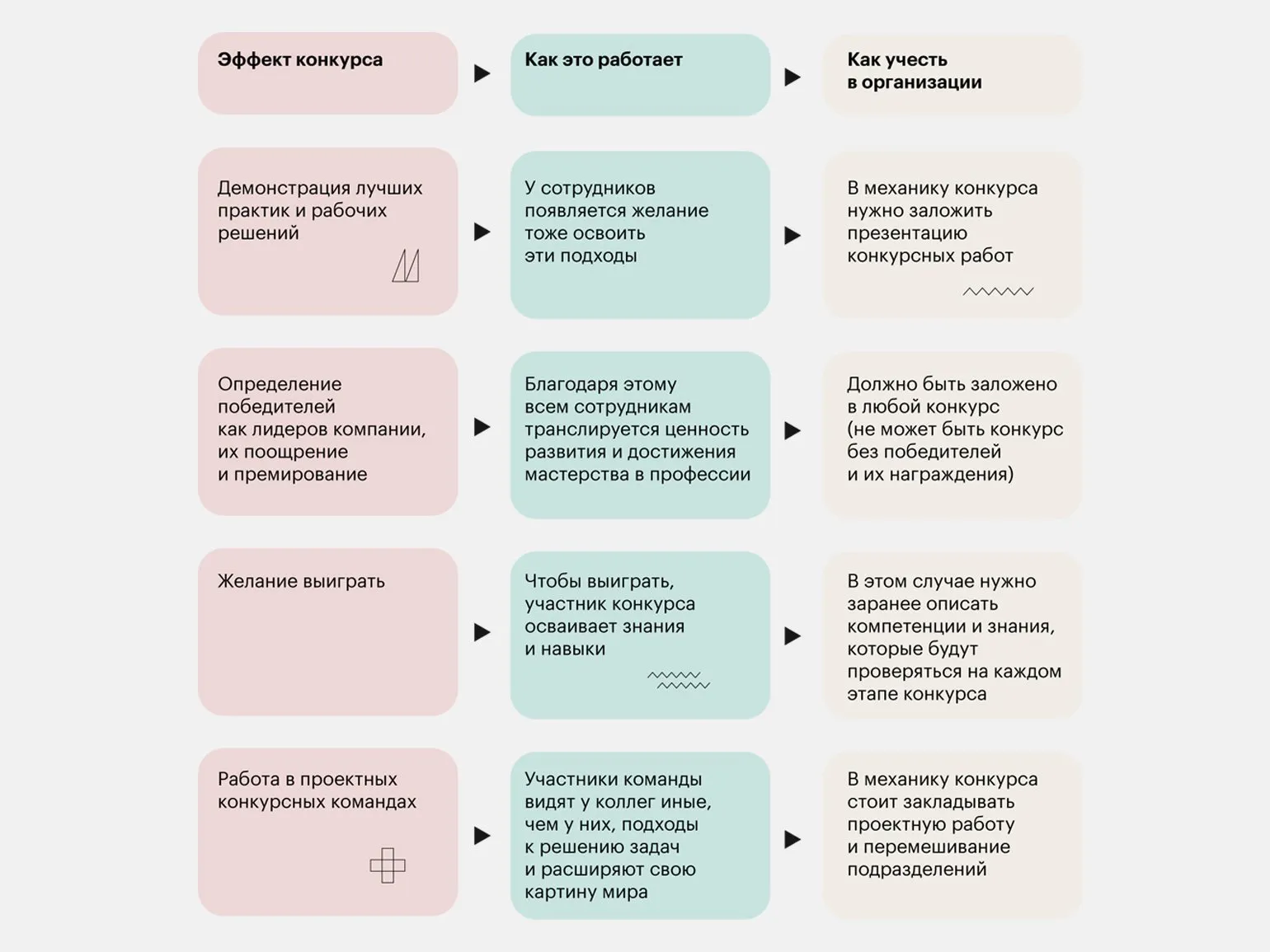
Modern trends in corporate training demonstrate a shift from a prescriptive and mandatory format to a product-based approach. This change presents learning and development departments with an important task: engaging and motivating employees by fostering their internal need for learning. This approach promotes greater employee participation in educational processes and increases the effectiveness of knowledge acquisition. It is important to create conditions in which employees are not only interested in training but also see its value in their professional activities.
The professional skills competition helps to achieve goals in this area. Details of its impact are presented in the table.
Corporate negotiation tournament, organized online in 2020 by the confectionery The Pobeda factory's competition is a shining example of the effective use of digital technology to enhance employee professional skills. The competition participants included employees whose job responsibilities require negotiation skills, including branch directors, key account managers, lawyers, and procurement managers. This approach not only fosters individual competencies but also strengthens team spirit, which ultimately has a positive impact on the company's performance.
Before the tournament, training webinars with business coaches were organized. These webinars could have been held without the tournament, but the upcoming competition significantly increased employee interest in learning. The tournament became a natural extension of the training process, providing participants with the opportunity to put into practice the skills they had acquired with the help of business coaches. Details of this case are presented in a separate article.
Organizing a corporate competition can be an engaging and effective way to build team spirit and increase employee motivation. If you haven't yet had experience with such events, follow these step-by-step instructions for a successful competition.
Start by defining the purpose of the competition. A clearly defined goal will help you choose an appropriate format and theme. Then select a team to organize the event. This could be your colleagues interested in developing corporate culture.
Next, develop the concept of the competition. Consider the interests of employees and choose a format that will be as engaging and accessible as possible. This could be a sports competition or a creative contest.
Next, create the rules of the competition. They should be clear and understandable for all participants. Make sure the rules promote fair and healthy competition.
Then choose a date and time. Make sure the day does not coincide with important corporate events or holidays. We also recommend booking the venue for the competition in advance, if necessary.
Don't forget about prizes for the winners. The prize fund should be attractive and motivating. This can include not only a monetary reward but also valuable gifts that will be of interest to your colleagues.
Finally, promote the contest among your employees. Use internal communication channels such as newsletters, the corporate portal, or meetings to draw attention to the event and motivate participation.
By following these steps, you can organize a corporate contest that will not only be exciting but also useful for team building.
Reading is an important aspect of our lives, enriching knowledge and broadening horizons. It promotes the development of thinking, improves vocabulary, and increases concentration. Reading books, articles, and other materials helps us stay informed, develops critical thinking, and forms our own opinions. In today's world, where information is available in any format, it is important to choose quality sources and devote time to reading. This is not only useful but also enjoyable, as immersion in the world of literature allows us to experience new emotions and inspiration. Don't forget to devote time to reading to constantly develop and gain new knowledge.
- How to teach negotiation skills using an online tournament
- Development marathons in corporate training: what kind of format is this?
- How to design corporate training programs
- Why and how to develop teachers from among your employees
- Why companies invite lecturers who are astronauts and art historians
Training and Personnel Development Manager
You will learn how to build corporate training programs for employees and evaluate their effectiveness. You will be able to start a career in the HR department and implement a working personnel development system in the company.
Find out more