
Contents:
- Game development industry experts also talk about the benefits of localization as a marketing tool.
- Rules for competent localization for developers
- The Skillbox editorial team also asked experts about what else the secret to successful localization might be.
- The best languages for game localization
- To summarize

Learn: Profession Narrative Designer
Learn MoreLocalization is a key aspect of game development, as it provides access to new potential markets for PC and console game creators. While localization is often considered a non-marketing activity, this notion is refuted by the activity of Chinese users on the Steam platform. Localized versions of games allow developers to not only expand their audience but also increase sales, making this process an integral part of a successful international expansion strategy. By paying attention to linguistic and cultural nuances, developers can significantly improve the player experience and increase engagement, which in turn impacts the overall popularity of the game.
If a game title isn't localized into Chinese, more than a million users on the platform won't be able to find it in recommendations or on the main storefront. If a studio decides to localize its game into Chinese, it will have to compete not with 34,000 other games, but with only 6,000, as not all developers prioritize localization into this language. Translating into Chinese significantly increases the chances of attracting an audience and success in one of the largest gaming markets in the world.
Last year, Nimdzi Research released an informative chart visually demonstrating the popularity of various languages on Steam from 2019 to 2020. This graph allows users and game developers to better understand the language preferences of the platform's audience, which can be useful for localizing games and adapting content for the international market.
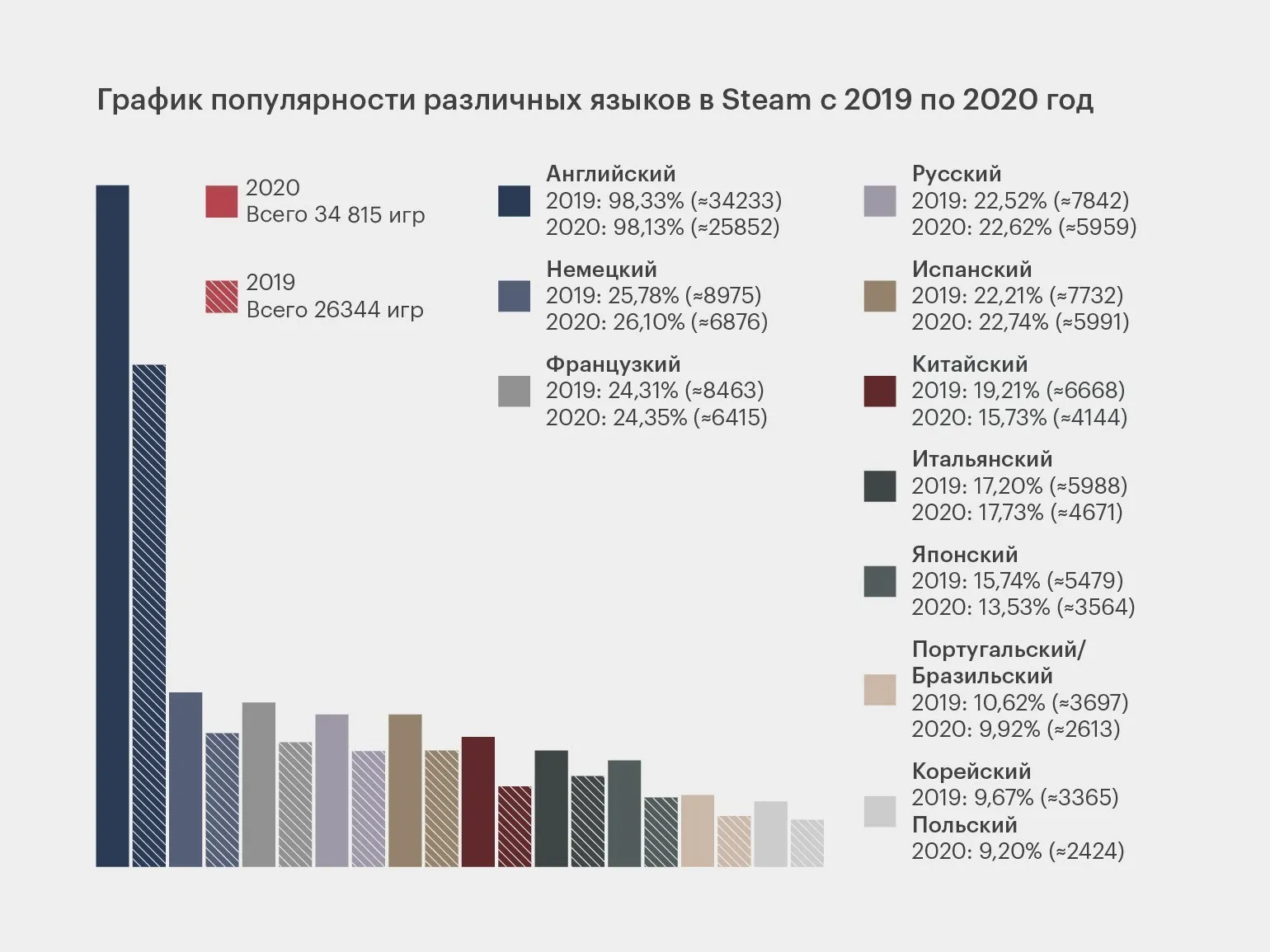
The analytical agency noted that the share of Russian and Simplified Chinese has increased, while Korean has displaced Polish from the top ten most popular languages.
Game development industry experts also talk about the benefits of localization as a marketing tool.

The lead translator of Pathologic and Pathologic 2, and previously involved in the translation of Disco Elysium for Testronic, Alfina has extensive experience in video game localization. Her work in the field of translation helps create high-quality content that allows players to more deeply understand the plot and atmosphere of games. Professionalism and attention to detail make her an indispensable specialist in the localization industry.
Alfina emphasizes that the success of content localization largely depends on the temperament of the target audience. However, statistics show that adapting a product into multiple languages often leads to a significant increase in sales. Localization helps establish a deeper connection with customers, making the product more accessible and appealing to different cultures and language groups.
There are many opinions on this matter, and much depends on the specific game. This article mentions that localization into language X can increase sales in a given market by 20-30%. However, caution should be exercised with this data, as it is provided by the translation company, which may have an interest in inflating the numbers to attract new customers. Proper localization can significantly impact a game's success, but an accurate assessment requires considering various factors, such as the game genre, target audience, and market competition.
Localizing content into Russian contributed to a 22% increase in sales in the Russian-speaking market. However, the analysts relied on percentages, not absolute figures. Furthermore, it is unclear whether only purchases from Russia or also from other countries where Russian localization is relevant were taken into account. This creates uncertainty in data interpretation and requires a more in-depth analysis to accurately assess the impact of localization on sales.
In business, there is a common belief that effective localization can increase sales in relevant markets by 10%. However, attitudes toward localization vary by region. For example, Europeans tend to be more open to using English, while Chinese consumers are just as demanding of localization as Russians. This underscores the importance of adapting content and marketing to the cultural and linguistic characteristics of the target audience to achieve successful sales in international markets.
Game localization is an important aspect for developers, as it opens up new markets and increases audience reach. However, in some cases, such as smaller, text-heavy games where the plot and dialogue do not play a central role in the gameplay, localization may not be as beneficial. Alfina emphasizes that in such situations, developers must carefully evaluate the costs and benefits of adapting content for different languages.

The head of localization at Social Quantum plays a key role in ensuring the adaptation of products and services for different markets. This specialist is responsible for coordinating the translation and localization of content, which includes not only text but also graphics, interfaces, and user manuals. The manager's primary responsibility is to ensure high-quality localized content that is culturally and linguistically relevant to the target audience. Effective localization helps the company expand its presence in international markets and improve user experience. Key skills for this position include language skills, project management, and the ability to work with interdisciplinary teams. Consequently, a successful Localization Manager at Social Quantum contributes to the company's strategic goals.
Mikhail Gorbunov is convinced that high-quality localization of a successful game significantly increases its sales, especially if the game genre is in demand in the developer's target market. Proper translation and adaptation of content helps attract the target audience, improving the game's perception and increasing its popularity. Localization not only involves translating the text but also takes into account cultural specifics, making the game more appealing to local players.
Positive growth of your product is only possible with a comprehensive approach, including a high-quality game, competent localization, effective marketing, and active engagement with the audience. Investing in only one or a few components will not ensure the desired result. To achieve success, it is important to ensure a harmonious combination of all these elements, which in turn will maximize efficiency and increase your product's market appeal.
Profit must cover translation costs, otherwise localization loses its value. A well-chosen market entry strategy and strong target audience interest in your project will ensure a positive financial result. Optimizing translation costs and adapting content to user preferences will help maximize the potential of localization, which will ultimately lead to increased profits.
Gorbunov believes that the best results are achieved when working with mobile casual and hyper-casual games. These genres attract a wide audience due to their simplicity and accessibility, making them ideal for development. Casual mobile games are easily digestible, while hypercasual titles offer instant entertainment, which helps drive user retention. In today's highly competitive market, focusing on such projects allows developers to effectively attract and retain players. Small volumes and simple texts ensure affordable and fast localization. This eliminates the need to spend time carefully selecting languages, allowing you to simply work within your available financial and technical resources. When planning localization, it's important to consider that even small projects can have a significant impact on expanding your audience and improving the perception of your content. Therefore, a wise approach to choosing languages and optimizing the localization process will help you effectively reach target markets.

The founder of the Gamelocalization school and a manager at the game localization studio Levsha, I am engaged in professional video game localization. My work is aimed at improving the player experience through high-quality translation and adaptation of content. At the Gamelocalization School, I teach new localization methods and technologies, sharing my knowledge and experience with industry professionals and newcomers alike.
Anton Gashchenko expressed support for his colleague.
Many of us have encountered advertisements for game projects in which the player is asked to move elements to save the hero from drowning. Even such simple mechanics contain minimal text, which helps the user quickly understand the game's essence. If a gamer is interested, they download the app from the App Store or Google Play and spend time immersed in the engaging gameplay. In this context, convenience becomes important: if a game offers an enjoyable gaming experience, high-quality sound, and easy-to-understand text, the player is more likely to stay. This creates conditions for in-game purchases, as playing in one's native language is always more comfortable and enjoyable.

Mikhail Gorbunov is a well-known figure in the Russian arts, possessing multifaceted talents. His career spans various fields, including acting, television, and the music industry. Gorbunov became popular thanks to his unique style and inimitable charm, which allowed him to win the hearts of viewers. With each new project, he demonstrates his high skill and dedication to his craft, making him a prominent figure in the Russian cultural scene. Thanks to his experience and professionalism, Mikhail Gorbunov continues to inspire a new generation of artists and delight fans with his work. Localizing large-scale projects for PC and consoles presents a number of challenges. Gorbunov notes that the translation process is significantly more challenging for developers of such games. Large titles require localization for both text and voiceover, significantly increasing the amount of work. This makes the localization process more costly and labor-intensive, requiring a careful approach to ensure high-quality translation and adaptation of content for different regions. Source texts can reach tens, hundreds of thousands, and in some cases, millions of words. In such situations, careful consideration of all arguments and counterarguments is essential. This not only ensures high-quality content but also increases its visibility in search engines. High-quality processing of long texts improves the readability and comprehension of information, which in turn increases audience engagement.

Anton Gashenko is a specialist with deep knowledge and experience in his field. His professional activity covers many aspects, including data analysis, strategic planning and implementation of innovative solutions. Anton actively applies modern methods and approaches, which allows him to achieve significant results. His experience allows him to find optimal solutions to complex problems. Anton Gashchenko also shares his knowledge through publications and participation in professional events, which contributes to his reputation as an expert in his field.
Gashchenko discussed the localization of large-scale projects for PC and consoles. The importance of high-quality localization in the gaming industry cannot be overstated, as it directly impacts the perception of a game by users from different regions. Effective localization helps create a deeper connection between players and the game content, which in turn can increase sales and expand the audience. Gashchenko emphasized the need to consider the cultural characteristics and preferences of the target audience, which is a key aspect of successful localization.
Game localization plays a key role in expanding the audience and increasing interest in projects. For example, in the case of Disco Elysium, many players noted that playing in English was difficult due to complex structures and rare vocabulary. The introduction of Russian localization significantly simplified the game's accessibility for Russian-speaking users. The involvement of professionals such as Alfina and Volga not only improved the quality of the translation but also increased the game's popularity among a wider audience. Thus, high-quality localization is becoming a key success factor, contributing to the attraction of new players and increased sales.
If we delve deeper into the topic of culturalization for the market, it becomes clear that it is a broad and multifaceted subject that requires a more detailed discussion. Culturalization plays a key role in adapting products and services to the needs and expectations of different target audiences. This is an important aspect to consider when developing marketing strategies and introducing products to new markets. Researching cultural characteristics allows companies to create more effective communications and strengthen customer relationships. It is important to remember that proper culturalization can significantly impact business success on a global scale.
The expert asserts that localization plays a key role in the commercial success of a game. Proper translation and adaptation of content for different regions allows for the most effective communication of the game's message to the target audience. Localization involves more than just text translation; it also incorporates cultural aspects, making the product more appealing to players worldwide. Games that take into account local characteristics and preferences have a significantly higher chance of success internationally. Therefore, high-quality localization is a key factor in increasing sales and popularity.
Localization is more than just translation and voiceover. It is a complex set of activities aimed at attracting users and increasing sales. Experts emphasize that localization involves not only text adaptation but also a multitude of other factors necessary for the successful launch of a product in a new market. This requires a deep understanding of cultural characteristics, target audience preferences, and market specifics. Localization is a key element of strategic marketing, playing a significant role in user perception.
All three experts are confident that translating video games into the target audience's native language increases sales and profits, ultimately recouping the costs and efforts of developers. This is logical, as users prefer to enjoy their favorite games in their native language, avoiding the difficulties associated with the language barrier. Accordingly, the likelihood of purchasing a game increases if it's available in the native language. This approach not only improves the user experience but also expands the market by attracting a new audience.
Rules of Effective Localization for Developers
Translating a game into specific languages is an important stage in development, both for large studios and small indie teams. Consider several key aspects that will help make this process more efficient. Choosing the right languages for localization can significantly expand your game's audience and increase its popularity in the international market. Pay attention to the cultural characteristics of target regions to ensure that the adaptation of content is as relevant and appealing as possible for players. It's also worth considering technical aspects of localization, such as text restrictions, date formats, and unique interface elements. It's important to plan translation in advance and incorporate it into the overall development strategy to avoid delays and misunderstandings. High-quality localization not only improves the perception of a game but also contributes to its success in various markets.
Start translation work as early as possible. This will avoid rushing and improve the quality of the final product. Planning the translation in advance promotes a deeper understanding of the context and improves the accuracy of information conveyed. Furthermore, starting early allows you to consider cultural specifics and adapt the text to the target audience. Don't forget the importance of reviewing and editing the translation to ensure its compliance with the original and high standards. Timely attention to translation will help you achieve better results and increase the effectiveness of communication.
Don't localize a game carelessly or simply to meet formal requirements. Translate your title's Steam page and adapt the game's demos for international users to ensure maximum audience reach. A high-quality translation into gamers' native languages can play a key role in the purchase decision of your game. Devote time and resources to creating localized content to attract more players and increase sales.
Change your approach to localization, moving away from the traditional EFIGS model. Modern market demands require a more flexible and adaptive approach to content translation and localization. It is important to consider the cultural and linguistic characteristics of the target audience to ensure a high-quality perception of information. Use innovative technologies and methods to optimize the localization process and increase its efficiency. This will not only improve the quality of translation but also make your content more appealing to users.
Previously, game developers adhered to the EFIGS principle for localization, which includes English, French, Italian, German, and Spanish. At this stage, the localization process was considered complete. However, current market trends require a reconsideration of these outdated standards. To achieve wider coverage, especially on the PC platform, studios should consider translating into additional languages. In particular, Chinese is becoming increasingly significant, as evidenced by a study by Nimdzi Research. Before choosing languages for localization, it is important to thoroughly analyze the target market and not rely solely on the EFIGS system.
When creating visual novels, it is important to carefully calculate the expected profit and expenses. Analyzing financial indicators will help understand the project's success. The main expense items include development, design, voice-over, and marketing. It is necessary to take into account employee salaries, software, and possible product promotion costs.
On the other hand, to determine potential profit, it is worth analyzing the target audience and market trends. Proper pricing and marketing strategy can significantly increase revenue. Using distribution platforms and active participation in the developer community will also help increase the visibility of the project.
Therefore, a detailed financial calculation will not only minimize risks but also significantly increase the chances of a successful visual novel launch.
When developing a visual novel or text game, the costs of high-quality localization can exceed six figures in US dollars. Therefore, the primary question a studio should consider is: how many copies can we sell in the new language, and will this move result in losses? Properly assessing potential sales and translation costs will help avoid financial risks and optimize localization investments. Crowdsourcing is an effective method of attracting resources and ideas from a wide audience to solve various problems. This approach allows companies and organizations to leverage collective intelligence, which can significantly accelerate the innovation process and improve the quality of the final product. It's important to understand that crowdsourcing not only facilitates the generation of new ideas but also creates an active community of users interested in the project's development. Crowdsourcing initiatives can lead to significant time and cost savings, as well as increased customer and partner engagement. Consider incorporating crowdsourcing into your strategy to reap the benefits of this powerful tool.
Crowdsourcing is a method of engaging people in a project to perform translations or other tasks on a voluntary basis. This approach is especially useful for studios with limited budgets or for those seeking to localize a game into uncommon languages. One of the most popular resources for crowdsourcing localization is Localizor. However, it's important to keep in mind that your project may not attract a sufficient number of volunteers, and the translation quality may be inferior to automated systems like Google Translate. Therefore, before using crowdsourcing, it is worth carefully considering the strategy and target audience to ensure the required level of localization quality.

Editorial Skillbox also asked experts about other secrets to successful localization.

Anton Gashenko is a name that is familiar to many. His work covers various areas, including business, technology, and social initiatives. Anton is actively involved in the development of innovative solutions and the implementation of modern technologies, which makes him a prominent figure in his field. His approach to work is based on a commitment to quality and efficiency, which yields significant results. Anton Gashenko also actively shares his experience and knowledge, which contributes to the development of the community and inspires others to achieve great things. It is important to note that his projects are aimed at improving quality of life and optimizing processes, which makes his contribution especially valuable. Anton recommends analyzing competitors' games in a similar genre. This will allow you to create a list of languages that may be relevant for your product. For research, he suggests using specialized websites that can provide download statistics and other important data on games in the same genre. This approach will help optimize your product and increase its competitiveness in the market. If your game has already been released, it is important to analyze the platforms it is used on. Don't forget the importance of soft launches for successful promotion. It is important to remember that simply localizing a product will not ensure its success if it lacks attractive ideas and elements that can interest users. Focus on the story and gameplay, which should be engaging for your target audience. Don't forget about conducting surveys to help collect data and determine the optimal set of languages for localizing your product.

Alexandra Alfina Golubeva is a name that embodies talent and creativity in her field. She is known for her achievements and contribution to the development of various projects. Alfina has a unique ability to find original solutions and inspire others to new ideas. Her work is distinguished by its high quality and attention to detail, making her a sought-after specialist. Thanks to her experience and professionalism, Alexandra Golubeva continues to make a significant contribution to her field, attracting the attention of both colleagues and clients.
Alfina advises relying on market trends and sales forecasts. It is important to consider countries where audiences are particularly interested in the developer's franchise. This will allow you to more accurately assess the potential and success of the business, as well as adapt your marketing strategy to achieve maximum results.
The expert emphasizes the importance of factoring in additional expenses.
It is important to consider all associated costs that may arise during the localization process. It is necessary to consider whether the creation of new fonts and localization of images will be necessary. It is also worth considering voiceover and the need to add variables to the game code for Russian counting forms or Spanish genders if the source text is in English. Furthermore, it is important to organize the localization process and, possibly, assign a specialist to create a localization kit. These hidden costs can significantly increase a project's overall budget.
Localization, compared to other development costs, is a relatively inexpensive part of the process. Publishers often offer localization services, making this stage even more affordable. Therefore, when in doubt, it is best to choose the "do" option and not miss the opportunity to adapt the product for different markets.

Mikhail Gorbunov is a well-known figure in the world of art and culture. He became popular due to his unique approach to creativity and ability to inspire people. Gorbunov is actively involved not only in artistic endeavors but also in social work, making him a significant figure in modern society. His works reflect deep emotions and relevant themes, allowing viewers to see the world around them in a new way. Mikhail Gorbunov continues to develop as an artist and public figure, bringing new ideas and perspectives to cultural life.
Gorbunov supports Alfina's opinion and recommends conducting market research to determine the popularity of the gaming genre in various regions. It is also important to assess the target audience's solvency, which will help in the further development and promotion of games.
The Indian and Indonesian markets have large user populations, but the level of paying audience remains low. Therefore, to successfully make money in these regions, your game must be highly popular and appealing.
There are also counterexamples: many believe that since the Dutch and Scandinavians speak English well, and the populations of these countries are small, localizing games into their languages is not worthwhile due to the high costs. However, it's worth considering that the Dutch and Scandinavians are true patriots and have a high income. This is why they actively support those developers who decide to release their products in their native languages. Localizing games into Dutch and Scandinavian languages can be key to success in these markets, allowing developers to attract a loyal audience and increase sales.
When planning the localization of your game for a specific market, it's important to determine the costs of the process in advance. If the expected profit from a localized version of the game allows you to recoup the investment within a few months, then the translation is truly worthwhile. This will help you expand your audience and increase sales revenue.
The Best Languages for Game Localization
The relevance of languages for localization continues to be an important topic. The outdated EFIGS principle does not cover all modern needs, and for effective language selection, more recent and accurate data should be used. Localization must consider not only language preferences but also the cultural characteristics of the target audience to ensure maximum effectiveness and appeal.
Chris Wright, head of publishing at Fellow Traveller, emphasizes that his company focuses on languages that provide access to the largest and most promising video game markets. While the company also translates into popular languages such as French and German, which are part of the EFIGS system, Wright identifies five languages that offer new opportunities for game developers. These languages play a key role in expanding the audience and increasing sales, which makes them a priority in the localization strategy.
- Simplified Chinese;
- Japanese;
- Traditional Chinese;
- Russian;
- Brazilian Portuguese.


Anton Gashenko is a professional in his field. His experience and knowledge allow him to successfully solve problems of varying complexity. Anton is actively developing his skills and always strives for excellence. He follows new trends and applies modern technologies in his work. Thanks to this, his projects are distinguished by high quality and efficiency. Anton Gashenko also shares his knowledge with colleagues, which contributes to a productive work environment. Anton Gashenko asserts that English is the "language of the world," but with the growing number of Chinese speakers, the expert believes it may soon overtake it. Gashenko also emphasizes the importance of the EFIGS system, as audiences speaking these languages have high purchasing power and actively spend money on games. Asian languages continue to gain popularity. Previously, the emphasis was on simplified and traditional Chinese, as well as Korean and Japanese. Currently, Vietnamese, Thai, Indonesian, and Malay are being added to this list. These languages are becoming increasingly relevant in global communication, business, and culture, opening up new opportunities for study and knowledge exchange. Interest in Asian languages is also growing due to expanding economic ties and cultural exchange between countries. Games are very popular among residents of Malaysia. In early 2020, while in Kuala Lumpur, I was struck by the sheer volume of mobile MOBA advertising. Their collaboration with a mobile phone manufacturer was particularly notable. During this trip, I visited a localization company, where I was openly informed about the rapid growth of the country's gaming market. Experts note that interest in games continues to grow, opening up new opportunities for developers and investors in this segment.

Alexandra Alfina Golubeva is a name that has become famous thanks to significant achievements in her field. She has established herself as a professional capable of bringing new ideas and solutions. Golubeva is actively involved in various projects, which confirms her high level of competence and commitment to business. Alexandra's work attracts interest and respect from both colleagues and the general public, making her a prominent figure in her field.
Alfina supports Gashchenko's opinion and emphasizes that Asian languages are key to title translation in the modern context. This area is becoming increasingly relevant as the demand for high-quality translation of content from Asian languages grows. Proper title translation not only aids localization but also expands audience reach, which in turn facilitates successful promotion in the international market.
Chinese, Korean, and Japanese play a key role in the localization process. In the modern world, their importance is growing, displacing less significant European languages such as Italian. Successful localization of products and services into these languages allows companies to enter East Asian markets, significantly expanding their audience and increasing their competitiveness. It's important to consider the cultural context when working with these languages to ensure effective engagement with the target audience.
The EFIGS system lacks support for Portuguese, which is particularly relevant for the Brazilian market, as well as Russian. However, it's worth noting that my sample may be biased, as I'm only familiar with projects that haven't ignored Russian. However, I have encountered localization packages that include English, Chinese, German, Portuguese, and Russian. It's important to understand that publishing games in China is a complex process due to strict censorship. Furthermore, Japanese players often dislike Western games, forcing developers to turn to specialized Asian publishers who offer both localization and assistance with entering local markets. This practice is considered very useful for the successful promotion of games in Asia.


Mikhail Gorbunov is a well-known figure who has made significant contributions to various fields. His achievements and influence on modern society leave no one indifferent. Gorbunov has established himself as a professional capable of solving complex problems and inspiring others. His work is characterized by a high level of responsibility and striving for excellence. Mikhail continues to actively participate in public life, sharing his experience and knowledge with young people. This approach fosters the development of new ideas and initiatives, making him a key figure in his field.
Gorbunov emphasizes the importance of the EFIGS standard, which should not be ignored. Translating content into these languages will significantly increase the commercial appeal of gaming titles. Furthermore, the expert recommends expanding this list to include Chinese, Korean, and Japanese, which will expand the audience and increase sales potential.
The Asian gaming market demonstrates a huge turnover and attracts a huge number of players. In monetary terms, it has already surpassed Western markets. However, competition for player attention and funds in this market is also significantly higher.
Promising markets are not limited to these regions. Expert Gorbunov recommends paying attention to countries where developers have high sales rates, but at the same time, content localization into the native languages of this audience is lacking. This creates unique opportunities for business growth and expansion, as translating and adapting a product can significantly increase its appeal and accessibility to new users.
GamesIndustry reports that Hooded Horse publisher Tim Bender analyzed changes in wishlist rates for games on Steam before and after localizing a title and its store page. The study's results show that localization can significantly impact player interest and increase game visibility on the platform. This underscores the importance of adapting content for different language groups, which in turn can lead to increased sales and audience engagement. Proper localization not only improves the perception of a game but also contributes to the formation of a wider fan base.
German and French play a significant role in the wishlisting process. I estimate that 60-65% of games added to wishlists by native speakers of these languages even without localization. This means that localization only contributes to 35-40% of add-ons. As a result, high-quality localization can lead to an increase in interest in a game by approximately 50% in each specific country.
In Spain, more than half of wishlist additions are due to game localization, indicating a 100% increase. In East Asian countries, over 90% of players became interested in games thanks to translations into their native language. These data highlight the importance of localization in attracting audiences and increasing interest in video games. Localization not only improves the user experience but also contributes to sales growth, making it a key element of game development strategy.
GamesIndustry published a commentary by Tim Bender, a representative of publisher Hooded Horse. He analyzed the change in wishlist additions before and after title localization, as well as updates to their Steam pages. Bender noted that localization and page content improvements significantly impact user interest and increase the likelihood of wishlisting games. This highlights the importance of quality localization and marketing for successful international gaming.
German and French play a significant role in increasing game popularity. I estimate that around 60-65% of native speakers of these languages would wishlist a game even without localization. This indicates that localization contributes to around 35-40% of wishlist additions. As a result, quality localization can lead to a significant increase in interest in games, reaching a 50% increase in each specific country.
In Spain, more than half of new wishlist additions are due to game localization, representing a 100% increase. In East Asian countries, over 90% of players became interested in games thanks to their native language translation. This highlights the importance of localization for engaging audiences and increasing interest in games across various markets.
Martin Lindell, advisor to Embracer Group and former representative of Raw Fury, shared his opinion. He emphasized the importance of a strategic approach to developing gaming projects and emphasized the need to adapt to changing market conditions. Lindell emphasized that success in the gaming industry requires not only creativity but also a thorough analysis of the target audience. He also emphasized the importance of interacting with players, which allows for a better understanding of their expectations and preferences. Translation into Brazilian Portuguese played a key role in Kingdom's growth. Also significant is the translation into Turkish, which is ideal for games with Arabic themes. Japanese, which is well suited for games on the Switch platform, should not be forgotten. Diversity of language versions helps expand the audience and increase the appeal of games in the international market. The expert's comments about PlayStation and the Turkish language are significant. In Turkey, gamers prefer console gaming, making the localization of games and add-ons a profitable investment in terms of both time and money. Given the growing interest in PlayStation among the Turkish audience, adapting content into the local language is becoming a key factor in the success of games in this market. Localization not only increases accessibility but also promotes deep immersion, which can significantly boost sales and strengthen brand equity.
To Sum It Up
Localization isn't simply about selecting regions with the largest number of users. It also involves carefully researching and targeting areas with a lower-than-average percentage of English speakers. Successful localization requires taking into account the cultural and linguistic characteristics of each region. This will ensure a deeper connection with users and increase engagement. The right approach to localization helps expand your audience and improve the user experience, which in turn contributes to international business growth.
Translating into specific languages can significantly increase sales compared to translating games using the EFIGS system. This explains why localization is a more complex process than it might seem at first glance. The right approach to translating and adapting content allows you to reach a wider audience and increase interest in your game. It is important to take into account the cultural characteristics and preferences of the target audience to make the product more attractive and successful in the market.
Profession Narrative Designer
You will learn from scratch how to create scripts for games, invent characters, write dialogues and convey ideas through gameplay. You can earn money in game development and implement the gaming project you've always dreamed of.
Find out more