
Contents:

Thinking about a new profession, but don't know where to start? Find out what suits you: IT, design, game development, management or marketing. Take a free career guidance course.
Learn moreNotes are an essential tool in the learning process, whether at university, in online courses, or during webinars and lectures. They promote better memorization of information and increase the effectiveness of the learning process. Properly written notes not only help organize thoughts but also highlight key points, which significantly facilitates subsequent review of the material and preparation for exams. Using note-taking in learning allows students to more deeply understand the material being studied and learn it better.
A note-taking, derived from the Latin word "conspectus", is an overview or summary of a text, be it a lecture, lesson, or book. Notes concisely and clearly record the main ideas, key points, and important questions, which allows you to quickly absorb information and remember it effectively. This approach promotes better understanding of the material and simplifies preparation for exams or other forms of knowledge assessment. Note-taking is an essential tool for students and professionals, as it helps organize thoughts and systematize information.
Taking down lecture dictation may seem simple, but in practice, it has its own nuances. Simply copying large volumes of text into a notebook is not helpful. For notes to be truly useful and easy to use, it is necessary to master proper note-taking techniques. This art is not usually included in school and university curricula, but it can be learned independently using several effective strategies. Properly structuring information, highlighting key points, and using your own wording will help create high-quality notes that are easy to understand and use later.
We launched the "How Are You?" Telegram channel, where we share useful information on self-development, psychology, and effective learning and career building methods at any age in a convenient format. Subscribe and stay up-to-date on relevant topics that will help you develop and achieve your goals.
The Benefits of Notes
Notes play an important role in the learning and retention process. They help you structure material, highlight key points, and remember main ideas. Taking notes improves concentration during study and makes it easier to review the material you've studied. Notes can also serve as a useful resource for future review, allowing you to quickly refresh your knowledge and prepare for exams or other tests. Effective note-taking not only helps you remember information but also understand it more deeply, which ultimately leads to better learning and the development of analytical skills.
To remember information more effectively, it's important to understand that reading only activates short-term memory. Writing information down helps transfer it to long-term memory and enhances visual memory by engaging in motor activity. This makes the memorization process deeper and more reliable.
Taking notes is an effective tool for quickly refreshing information and finding answers to urgent questions. It helps save time, as you don't need to rewatch lectures or reread books. Simply flip through a notebook with the main points to quickly access the necessary information. Taking notes promotes better assimilation of the material and facilitates the process of preparing for exams or tests.
Focusing on the subject of study significantly improves the effectiveness of information absorption. When you take notes, your brain doesn't simply perceive information; it actively processes it. This allows you to delve deeper into the lecture content and analyze the material. You begin to look for examples from your own life, which makes the learning process more active and engaging. Such knowledge is easier to apply in practice, which contributes to a better understanding and memorization of the educational material.
Enrich your knowledge on a specific topic and study it in greater depth when necessary.
Where to take notes
Whether to write down information by hand in a notebook or electronically on a computer is an important choice that depends on individual preferences and goals. Both methods have their advantages and disadvantages. Handwriting promotes better memorization and comprehension of the material, as the writing process activates different areas of the brain. At the same time, electronic devices offer convenience, the ability to quickly search and store large amounts of information.
When choosing between these methods, it is worth considering how exactly you plan to use what you have written down. If it is important for you to retain information long-term and you enjoy the physical process of taking notes, you may want to choose a notebook. However, if portability and access to your notes at any time are important to you, it is better to choose electronic notes. Ultimately, the choice depends on your personal preferences and learning style.
Research, including work by Princeton University, confirms that handwritten note-taking significantly improves learning and retention of course material. Students who take notes by hand are able to recall more information later compared to those who use a laptop. Furthermore, working on a computer increases the risk of distractions: many students start checking email, playing games, or viewing other links, which negatively impacts concentration and learning. Therefore, handwritten note-taking is a more effective learning method, promoting better retention and comprehension of information.
Typing is significantly faster than handwriting, allowing you to create more detailed notes. When choosing a note-taking format, consider your objectives and convenience. If your goal is to build a knowledge base on a specific topic, an electronic format is preferable. However, if your primary goal is to memorize and comprehend a large amount of information, handwriting is recommended.
Note-taking principles
There are a number of basic rules that will help you take notes correctly. First of all, it is important to highlight key points and ideas to make the process of memorizing information easier. Use a structured approach: divide the material into logical blocks, use headings and subheadings. This will make the notes easier to perceive.
Use abbreviations and symbols to speed up writing, but remember to keep them clear. Also, try to write in your own words, this way the information is better absorbed. Review your notes regularly to reinforce your learning. Don't forget about visual elements: diagrams and pictures can significantly enhance your understanding of complex topics. Taking proper notes will not only improve your academic performance but also make the learning process more effective.
Note-taking requires focusing on key points. This is one of the most important aspects of effective learning. Don't write down every word your instructor says. This approach quickly leads to fatigue, both physical and emotional. Instead, focus on the main content and highlight important ideas. This will not only improve your retention of the material but also make it easier to analyze and understand your notes in the future.
To maintain engagement, several strategies are necessary. First, it's important to actively engage with your audience by responding to comments and questions. This creates a sense of participation and importance. Second, update the content regularly to keep it relevant and interesting. Use a variety of formats, such as articles, videos, or infographics, to appeal to different audiences. Consider your audience's interests and preferences, tailoring your content to their expectations. Finally, analyze the results of your efforts to understand what works best and what changes can improve engagement.
- Listen to the speaker's entire sentence, absorb the information, and distill it down to its most important points. Write down the words and concepts that best reflect the topic: names, dates, connective tissues, and examples.
- Try to summarize the gist of the story in your own words, without going into detail.
- Avoid writing down what you already know; focus on new information first. For example, if you know that the first manned landing on the moon took place in 1969, there's no point in writing it down.
- If you're taking notes on a book, resist the temptation to rewrite the entire thing. Read the entire chapter, section, or subtopic first: this will help you get the big picture and highlight only what's truly important.
Condensate. The instructor often speaks faster than the student can write. Therefore, it's important to develop the skill of quickly reducing information. Use abbreviations and symbols to speed up the note-taking process. Also, try to highlight key points and ideas to make it easier to reconstruct the full meaning of the lecture later. This will not only save time but also improve the quality of your notes.
- Consider how to abbreviate key terms and frequently repeated words. For example, "zn" instead of "znachit," "f-ya" instead of "f-ya." Write abbreviations: CA — "target audience," ROP — "head of sales."
- Use symbols: the arrow → instead of "therefore," ↑ — instead of "increase," + as "positive."
- Write numbers as signs.
Create a unique notation system that is convenient for you. To easily decipher your notes in the future, it is recommended to make a key at the beginning or end of the notebook. Include all the symbols used and their meanings. This will help maintain order and simplify the process of finding the information you need.
Structuring information is a key element for improving the readability and comprehension of the text. To make notes more understandable and easier to read, it is important to use clear emphases and logical organization of the content.
Start by highlighting the main topics and subtopics so that readers can quickly find the information they need. Use subheadings to break the text into logical blocks. This will help not only users but also search engines better index your content.
Use lists and bullet points to highlight key points. This will make the text more visually appealing and easier to digest. Try to avoid long paragraphs – break them into shorter, clearer sentences.
Don't forget about keywords that will help with SEO. Include them naturally throughout the text while maintaining readability. It's also helpful to add internal links to other pages on your site to improve navigation and increase user time on the site.
When writing your text, keep your target audience and their interests in mind. This will help create more relevant and engaging content. Focus on relevant issues and problems that may interest your readers.
Finally, structuring information and emphasizing key points not only makes the text easier to understand but also helps it rank better in search engines.
- Add dates, write down lecturers' names, and number pages.
- Highlight the main parts of your notes: course title, topic, headings, subheadings, definitions, keywords, conclusions, and make lists.
- Write on one side of the sheet of paper, and each new idea on a new line, dividing it into paragraphs. Leave spaces between lines; you can add your notes there later.
Visualization of information and the use of graphic elements play a key role in the perception of content. Graphics help make the material more accessible and understandable, attracting the attention of readers. Properly designed visual elements, such as images, infographics, and diagrams, enhance audience engagement and facilitate better information absorption. Effective visualization not only enriches the text but also improves its SEO ranking, as search engines consider the quality and diversity of content. Incorporating graphics into your content can significantly increase its appeal and value to users.
- Include tables, charts, graphs, formulas, frames, and pictures in your notes. These cues stand out from the text and are easier to remember.
- Symbols—arrows, exclamation and question marks, notes: ! — "important," N.B. — "pay attention!"
Use colors to improve text perception. Use colored markers or pens to highlight key terms, main points, important questions, and examples. This will help you absorb information more easily and quickly find the fragments you need. Highlighting with color promotes better memorization and comprehension of the material, which is especially important when studying or preparing for exams.
When taking notes, it is important not to overdo the use of colors so that they do not become too bright and do not distract from the essence of the material. Excessive colors can make it difficult to perceive information and identify key points. It's best to use two or three primary colors to highlight important aspects while maintaining clarity and structure in your notes.
Rereading notes is an important process that promotes better retention of the material. Despite the difficulty of finding time for this activity, it is recommended to repeat it several times. Regularly studying notes helps consolidate knowledge and improve your understanding of topics. Pay attention to key points and highlight main ideas to facilitate memorization.
- Immediately after the lecture, before it fades from your mind, correct mistakes, fill in gaps, and complete unfinished sentences.
- Within 24 hours after the lecture: this will consolidate everything you heard and studied. New details may come to light that you missed or did not understand during the first reading.
- Before the next lecture. Spending 10-15 minutes will refresh your memory of important points and definitions, which will help you better absorb the new material.
Summarize after each topic or lecture. Write a short summary of all your notes. It is important to answer the questions: “What did you learn? What was discussed in this section? What was the most important?” These reflections activate your brain and help you better absorb the material. If anything remains unclear, be sure to return to it: use a search engine, consult with your teacher or classmates, or consult additional sources. This approach promotes a deep understanding of the topic and improves memorization of information.
Note-taking Methods
There are many note-taking techniques, and in this article we will consider new approaches that have already proven effective. These methods combine creativity with a focus on key points, structuring information and facilitating review. Using these techniques promotes better knowledge retention and increases the productivity of the learning process. Developed by Professor Walter Pauk of Cornell University in the mid-20th century, this method is an effective information processing technique. It involves recording only key points and analyzing large volumes of data. The basic concept is to divide a page into several meaningful blocks, which helps structure the information and facilitate its absorption. This approach promotes a deeper understanding of the material and helps you remember important details effectively.
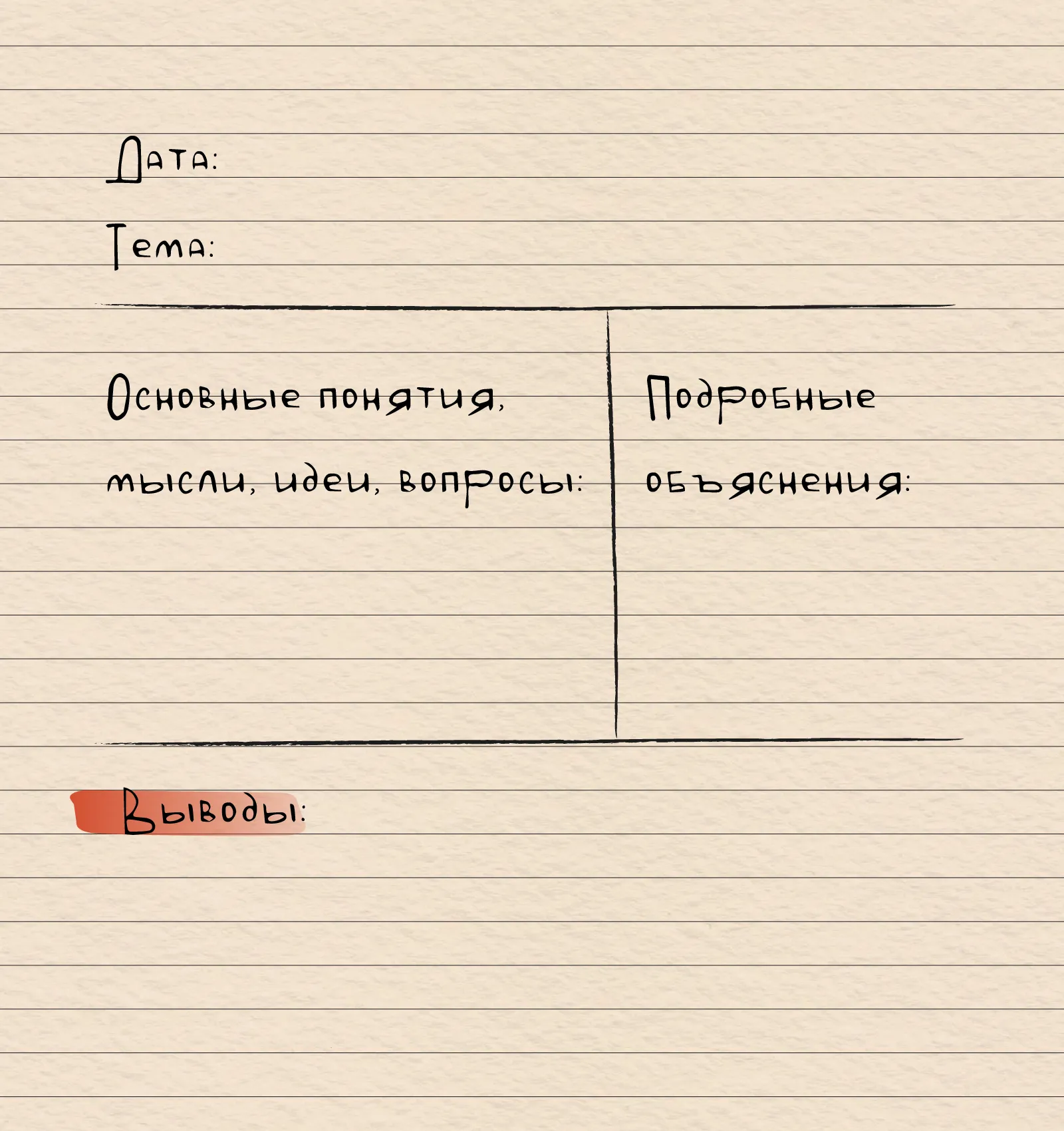
First, take an A4 sheet of paper or a regular notebook sheet. Then carefully divide it into two parts.
- Write the title and date at the top.
- Draw a vertical line: make the left column narrow; this will contain the main points and questions. Make the right part twice as wide; this is where you will write detailed explanations of the concepts from the left column. Leave a small space between sentences to add something, if necessary.
- Separate the bottom block (5-6 lines) with a horizontal line; there, within 24 hours after the lecture, write down in your own words brief conclusions or the most important idea from the columns above.
You can download and print ready-made templates to simplify the process of creating documents and presentations. These templates will help you save time and effort, ensuring a professional look for your materials.
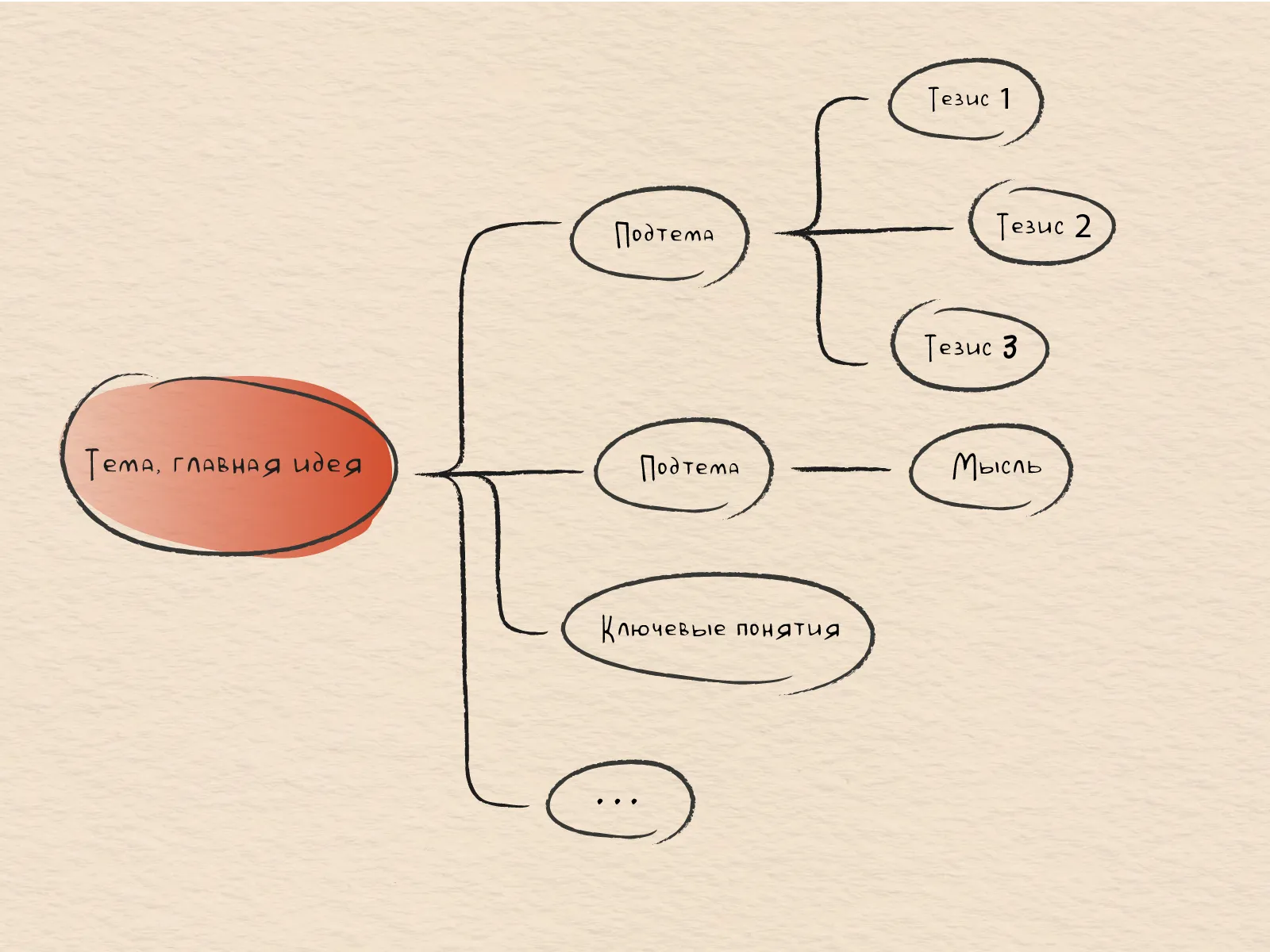
The second most common method of organizing information is mind maps, also known as intelligence maps. This approach allows you to visualize information using a tree structure, where the central element represents the main topic, and branches containing key points and ideas diverge from it. Using mind maps not only helps you remember the material better but also organize your thoughts, which significantly facilitates the process of learning and analyzing information. This method is especially effective for brainstorming, project planning, and exam preparation, as it promotes a deeper understanding and memorization of the material being studied.
Place the main concept or key idea in the center of the page, highlighting it with a frame or circle. During the lecture, add related blocks to this core, such as words, associations, drawings, and thoughts. Distribute these "branches" in different directions. This approach to note-taking helps structure complex information and improve its memorization.
Tony Buzan, the author of this technique, has published a book that describes the method in detail. In this book, readers will find practical recommendations and strategies for effectively using the technique developed by Buzan. It covers key aspects of the method, including its application to productivity and memory enhancement. Buzan offers a unique approach to learning and self-improvement, making his book a valuable resource for anyone seeking to develop their skills and achieve their goals.
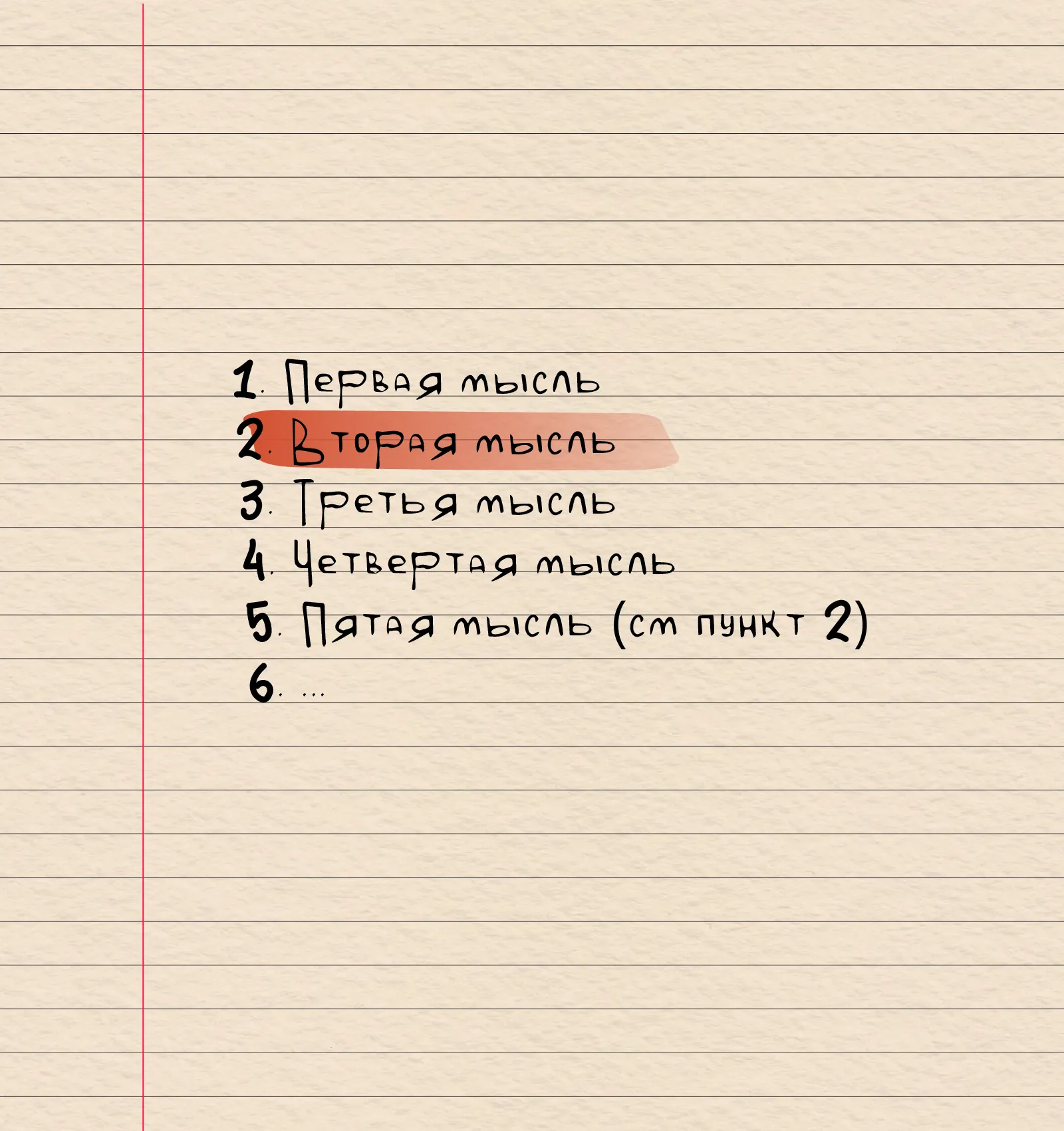
This technique is similar to traditional note-taking, in which you write down everything the lecturer says. However, the key difference is that each sentence or point should be written on a new line and numbered sequentially. This approach will help avoid confusion when reading your notes. To establish connections between different parts of the text, it's recommended to make notes by referring to other sentences (for example, next to sentence #5 you could write "See #2"). This will improve comprehension and make it easier to navigate your notes.
This type of notes is a familiar format that makes information easy to digest. It's ideal for long lectures where the instructor can freely move from one idea to the next. This approach allows students to better follow the lecturer's train of thought and makes it easier to remember key points. Taking notes in this format promotes more effective learning and improves the level of material absorption.
The flow method, or free association method, was developed by Canadian writer and coach Scott Young. He emphasizes the importance of active participation in the learning process. Instead of simply listening to lectures, you should develop your own ideas and associations. This approach not only allows for better retention of information but also significantly enhances learning by promoting a deeper understanding of the material. Using the flow method can significantly improve critical thinking skills and creative problem-solving.
The method involves writing down only the key points presented by the lecturer. Afterwards, it's important to reflect on the information received and record your thoughts and comments. Notes can be written in a convenient format: tables, diagrams, drawings, or mind maps, or a combination of different approaches. This method promotes better assimilation and memorization of the material, and also helps to understand how to apply the acquired knowledge in practice.
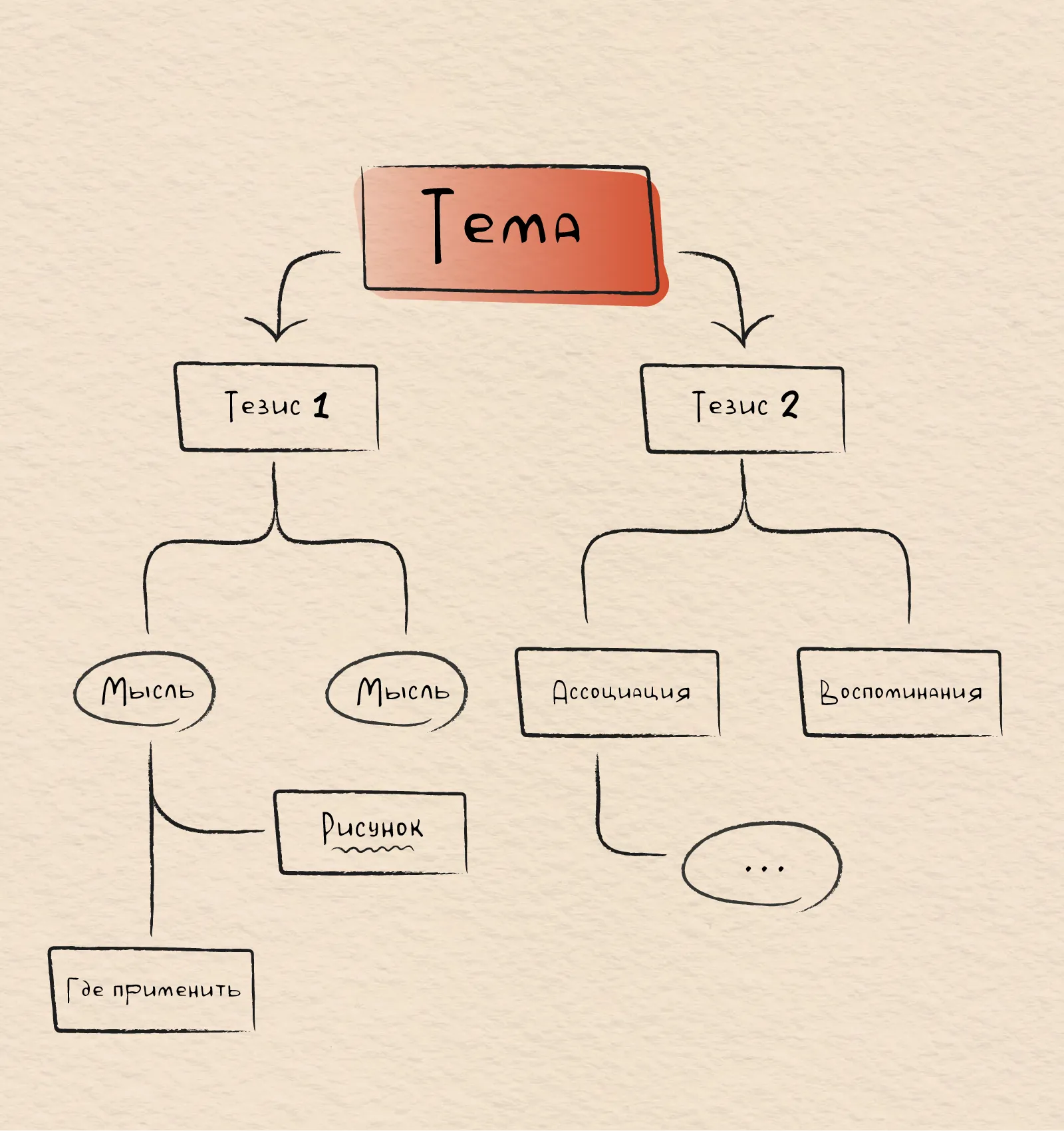
This method is suitable in cases where there is no need for precise reproduction of information or creation of a knowledge base. More detailed information on this approach can be found in Scott Young's instructions. This approach allows for the effective absorption and processing of information, making it a useful tool for learning and self-improvement.
The method involves systematically presenting points from the general to the specific. Start by selecting four or five key points from the lecture. In the upper left corner, write the main concept or theme. Then, using indentation, add subtopics to each main theme. Attach more detailed points or ideas to the subtopics. The result is a structured list with several levels of nesting. You can use arrows, numbers, letters, or dots for bullet points. Such notes will look organized and will help you better understand the material.
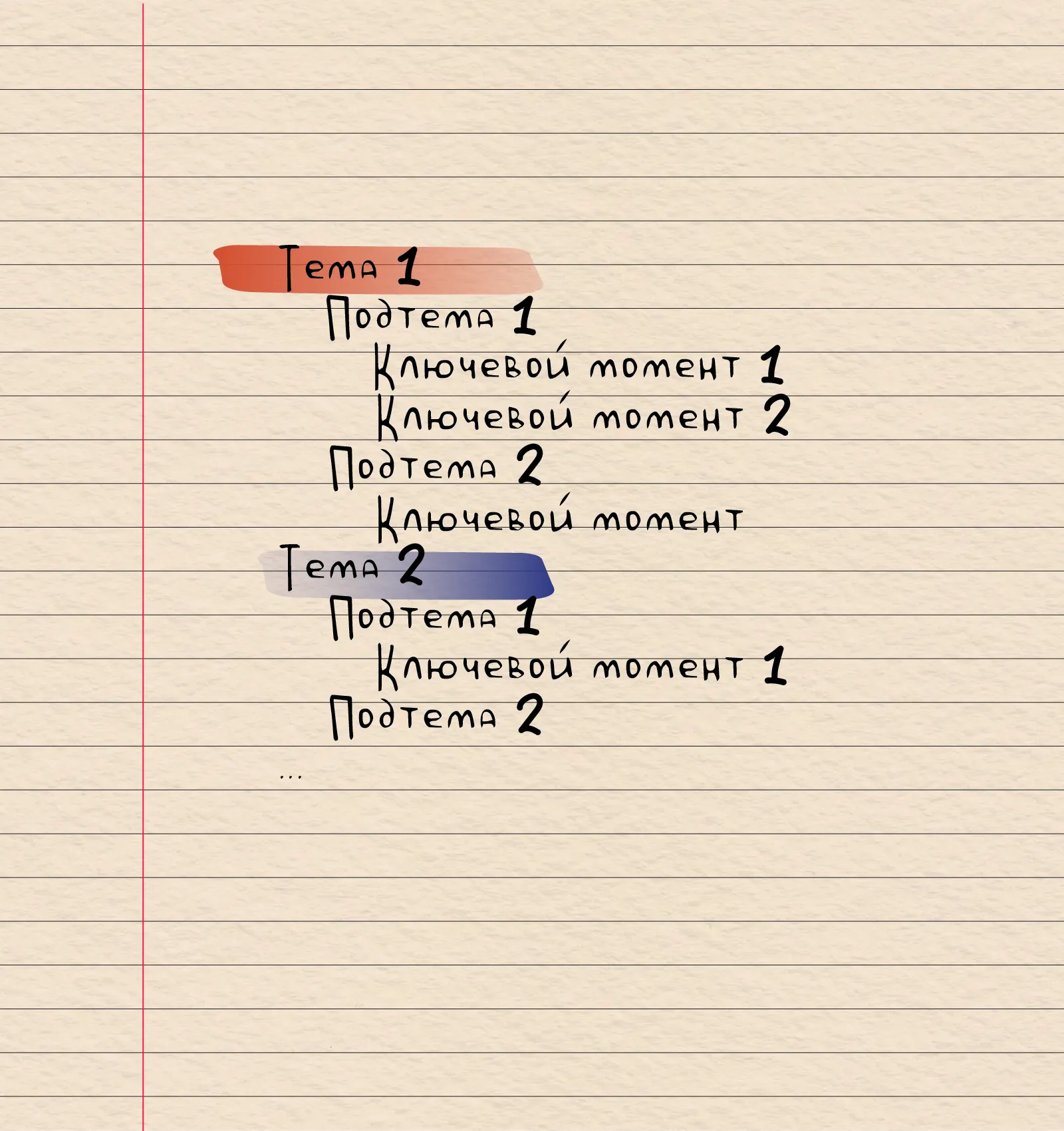
The advantages of this method are the high-quality organization of notes, which ensures their easy viewing and editing. It also allows you to effectively track the relationship between elements, which contributes to a more in-depth analysis of information.
The main idea is to organize content by placing each thematic block in separate "boxes". This improves the perception of information and facilitates easier navigation. Dividing content into boxes helps users find the information they need faster and makes the material more structured. This approach also has a positive effect on SEO, as it simplifies page indexing by search engines. Arranging information in boxes helps retain the reader's attention and improves the overall effectiveness of the content.
Create several squares or rectangles on the page, placing them randomly to avoid a strict table. In each element, place the main topic and key ideas, phrases, and words related to it. This will help visually structure the information and highlight important aspects. Appropriate design will make the content more appealing to readers and improve its comprehension.
Using boxes in information presentation has many advantages. They make visual material easier to perceive, directing attention to specific aspects of the topic. Thanks to this approach, facts are not mixed together, which promotes better memorization. This method is especially effective when learning foreign words, dates, historical events, and biographies of famous people. In addition, boxes help in comparing different concepts, which makes them a universal tool for organizing and presenting information.

Explore different note-taking methods, choosing the right ones for each task and subject. Experiment with different techniques: combine several approaches, adapt existing methods to your needs, or develop unique ones. An important aspect is the effectiveness of the chosen method - the information should be easy to digest and stay in the memory for a long time.
How to make money in IT
Take a simple test to understand which direction in IT suits you best. Master Python and Java, mobile and web development, data analysis, neural networks, testing, and cybersecurity. Write your first programs and create a personalized career plan to get started in IT.
Find out more