Contents:
- What is the Karpman Triangle
- What happens to the participants in the triangle
- The Victim in the Karpman Triangle
- The Aggressor in the Karpman Triangle
- The Rescuer in the Karpman Triangle
- The Karpman Triangle in Different Types of Relationships
- How to Get Out of the Karpman Triangle
- Should You Rely Completely on the Karpman Model?

Free test: which digital profession is right for you? Find out the answer in 15 minutes and try your hand at a new specialty.
Learn moreFrom this article you will learn:
- What is the Karpman triangle and why this concept is so popular;
- What happens to the participants in the triangle;
- Why the Victim is afraid to save himself herself;
- Is it difficult to become an Aggressor;
- What's the catch for Rescuers;
- How role models from the Karpman triangle can be played out in relationships with people;
- How to get out of it;
- Should we rely entirely on the Karpman model?
What is the Karpman Triangle?
The Karpman Triangle, or drama triangle, is a psychological model of human interaction in which there are three roles: Victim, Rescuer, and Aggressor. This concept was formulated by psychotherapist Stephen Karpman, who wrote an article in 1968 entitled "Fairy Tales and Script Drama Analysis."
The vertices of the triangle are the social roles that the participants in such a scenario unconsciously assume. Moreover, during the interaction, people trade one role for another.
People may engage in such relationships because they find it beneficial, convenient, or because they're used to it. However, psychologists believe that building relationships based on this model is unsafe. Karpman himself was sure that awareness of these roles helps to avoid getting into the triangle or to get out of it in time.
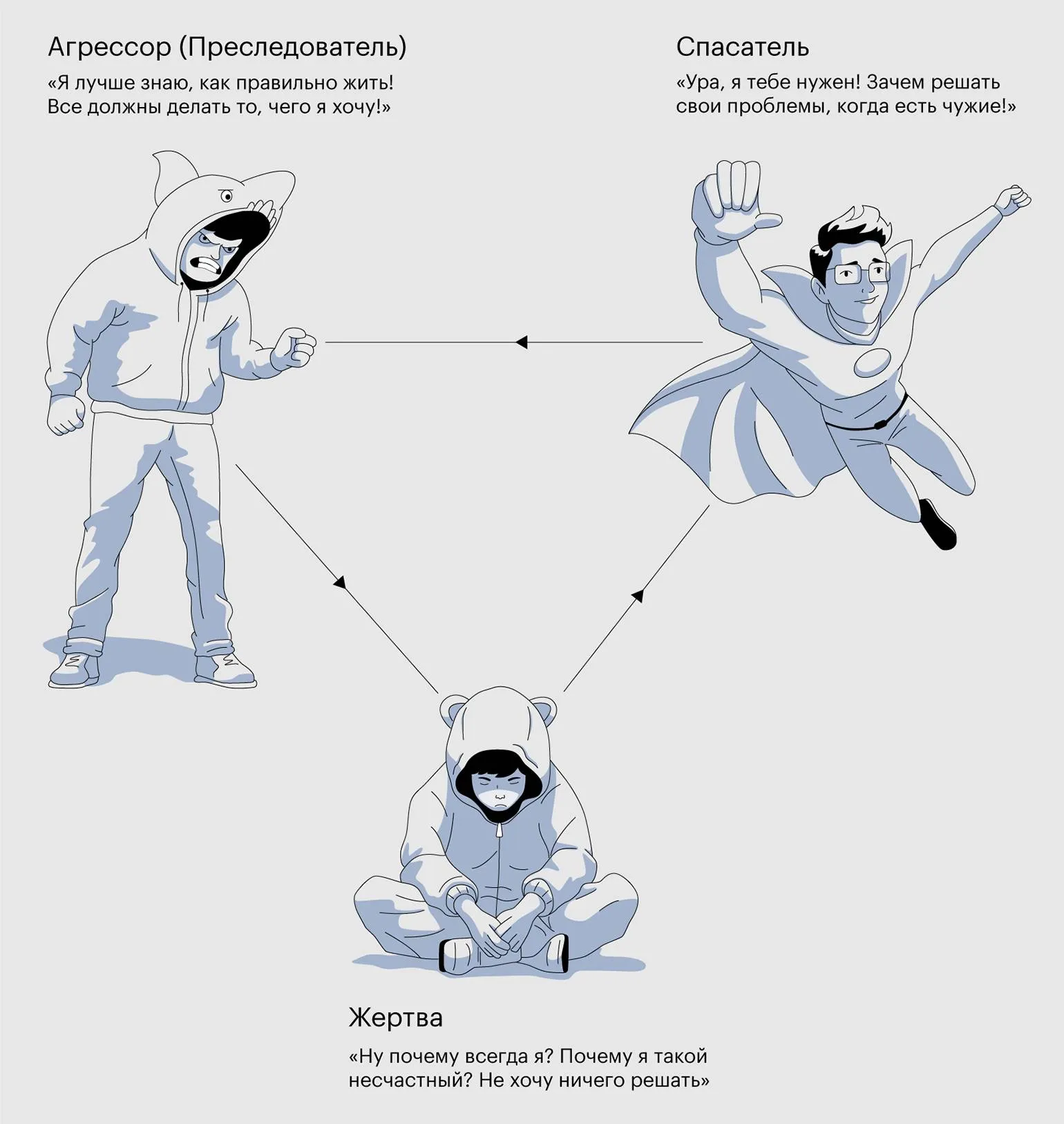
The drama triangle as a social and psychological model is used primarily In transactional analysis, it is an approach to psychotherapy that focuses on exploring a person's thoughts and behavior through their interactions with others.
What happens to the participants in the triangle
Let's consider the three main characteristics of relationships in a triangle.
Destructive patterns are reinforced in it that prevent healthy relationships from developing, and we are not only talking about romantic relationships, but also about friendships, parent-child relationships, and even work relationships.
Karpman, in his book "Life Free from Games," divides social games of this kind into three types according to their intensity, warning that the consequences in advanced cases can be fatal:
"Third degree games are extremely destructive, they cause direct harm to a person's health, ending on the operating table, bankruptcy; in court, prison, injury or even worse..."
Because the participants do not allow each other to escape the script and move from role to role. And in the triangle, codependent and dependent relationships arise, in which people become entrenched in a specific type of behavior aimed at creating drama and emotional swings.
Karpman himself gives the example of dysfunctional families who "deny that they are playing a game, ignoring the presence of any problem." If one family member talks openly about such games, the other members of the triangle may ostracize them or begin to intimidate and threaten them.
According to Karpman, leaving the triangle does not mean breaking off the relationship. If a person leaves a specific triangle, but does not say goodbye to the role they have taken on, they will constantly find themselves in similar relationships. Therefore, it is necessary to master new skills: support, sincerity, responsibility, conflict resolution.
* * *
In everyday life, we constantly encounter destructive games, but we cannot always recognize them. It is quite easy to fall into the Karpman triangle, especially if there is a codependent relationship in the background. In them, a person is constantly dependent on the behavior of another (for example, living with an alcoholic husband) and at the same time trying to “save” him.
The Victim in the Karpman Triangle
A person playing the role of the Victim, according to Karpman, "demonstrates their helplessness and inability to cope with difficulties on their own." The Victim constantly talks about the catastrophic nature of the situation they are in, and their only strategy for solving problems is to wait until someone comes and does it for them.
A Victim in a broad sense is a person who has lost important values due to the influence of another person on them. And we are not only talking about material values, but also internal ones. The Victim in the Karpman Triangle is a classic "damsel in distress".
A simple example. Princess Fiona from Shrek doesn't want to stand up for herself and doesn't choose anything on her own. She lies around all day, staring at the ceiling, blaming everyone around her, and waiting for the handsome prince to come and rescue her. She is the Victim, playing her role in the triangle.
She might even want to leave the tower, but in her thoughts she constantly runs into a certain "but": "Yes, I can try, but the world is unfair, the tower is too big, I'm too weak, and anyway, today is Thursday, and you don't start such things on Thursday."
Eric Berne, Karpman's student, calls this the "Why Don't You..." - "Yes, But" game in his book "Games People Play." The Victim always has arguments against that block his path to an independent solution to the problem.

What is the difference from a person who just got into The tower and who is miserable there? First and foremost, the narrowness of the range of options. Where a person, in the moments between "everything is terrible," might decide to escape the tower, stop waiting for the prince, or defeat the dragon themselves, the Victim will expect someone from the outside world to decide everything for them. Quite often, such behavior can be, for example, a consequence of overprotection on the part of the Victim's parents when she was a child.
The main signs of a Victim:
- Blaming the whole world for her own troubles;
- Constantly expecting someone to solve all her problems - both external and internal;
- Self-deprecation as a form of defense;
- a tendency to manipulate through passive aggression;
- a morbid tendency toward escapism—the desire to escape reality into dreams of a Savior.
The Victim really does feel bad in their role—they are genuinely hurt, sad, lonely, and waiting for their Savior. But at the same time, they have their own benefit—they can endlessly shift responsibility onto someone else, demonstrating infantilism and helplessness. Of course, this is not a villainous calculation, and not even always conscious behavior. And not every person in trouble "plays" the role of the Victim - he may genuinely lack the resources to cope.
The Aggressor in the Karpman Triangle
Remember the cartoon "Tom and Jerry"? Tom runs after Jerry, trying to catch him and eat him; drops objects on him, sets traps, threatens him. Tom acts as the Aggressor, and Jerry, of course, is the Victim.
But Tom has been fooled. He is immobilized - and now Jerry is up to all sorts of mischief, pouring boiling water on the cat and trying to pinch his tail with a mousetrap. The roles have reversed: now Jerry is the Aggressor. The psychological game has taken a different turn.
This example clearly demonstrates how one role can flow into another. Transactional analysis, which both Karpman and his teacher Eric Berne used, often refers us to play models and fairy tales. And in games, as we know, you can gape in one round, and in the next — already become the driver.

The Aggressor (or Persecutor) is a character who dominates and suppresses. They yell, pressure, create scandals, and intimidate the Victim. They fear their own weakness and escape thoughts of it by suppressing another weaker person. At the same time, in another situation, when he could be attacked in response, he can easily turn on the Victim himself - arm himself with passive aggression, demonstratively drown in self-abasement, provoking the interlocutor to feel sorry for him, and in the same way ask him to save him.
The Aggressor does not accept responsibility: he is sure that he was forced to be decisive, uncompromising and even cruel.
The key signs of the Aggressor are approximately as follows:
- a tendency to dominate another with the help of active aggression (shouting, direct pressure, threats);
- Designating oneself as standing higher in the hierarchy ("I am stronger, I am more important, I am smarter");
- Sharing one's desires and goals as a higher priority than the desires and goals of the Victim;
- A pronounced tendency to control another;
- Asserting power as a way to protect one's own vulnerability or inadequacy.
Important! Conflicts and quarrels are normal in themselves, and not everyone who gets emotional and starts shouting fits the role of the Aggressor. The Karpman Triangle is not called dramatic for nothing - such a situation arises when there are no options other than choosing exaggerated game roles, and outside of these roles, a person feels uncomfortable and does not know how to behave and what to do with their desires.
The plot of an uninteresting movie: Tom pulled the tail out of the mousetrap without falling into the state of the Victim, did not chase Jerry and decided to just take care of himself.
The Rescuer in the Karpman Triangle
Remember the movie "What Men Talk About?"? There's a scene where one of the characters, Kamil, is asked to help an old woman cross the road to do a good deed and close the gestalt on the matter. Part of the sketch revolves around the idea of someone trying to help the old woman. She screams that she doesn't need to cross the road at all, but the noble helper doesn't listen. He needs to be a good man and check the box next to that item! Meet the Rescuer.
In his own eyes, the Rescuer is the same handsome prince who ran to the tower with his sword at the ready. He came, defeated the dragon, and carried the Victim out in his arms. In a healthy scenario, everyone calms down at this point, the hero receives gratitude or nothing at all, and everyone moves on without engaging in dramatic role-playing. But the Rescuer is plugging a hole inside himself: he's greedy for approval and looks for ways to prove he's a good person.
Perhaps there's no dragon. Perhaps the Victim no longer even wants to be a Victim. But the Rescuer is relentless—doing good allows him to feel proud of himself and like a warrior of light, so he can begin to manipulate and even turn into an Aggressor, convincing the Victim that she can't cope without him. And the Rescuer, as we remember, also runs from responsibility.
By solving other people's problems, he pushes his own aside, but this no longer looks like childishness, but like a heroic path. The need to be a Rescuer is a legitimate way to receive a dose of love and approval. If a person is inclined to choose this role, they likely don't quite understand how to praise themselves. They endlessly collect approval from others and don't feel significant without it. This is why it can be unbearable to be around a Rescuer - his need for approval is never satiated, and for its sake he is ready to constantly seek out Victims who feed him with gratitude and attention.
A Rescuer can be identified by the following signs:
- a tendency to devalue the Victim, presenting them as a helpless child, unable to cope with something on their own;
- affirming their own value in helping others (sometimes uninvited and not so necessary);
- endless search for approval and gratitude from the Victim or others;
- escaping reality by solving other people's problems and glorifying such behavior in your own eyes and the eyes of others.
Important!! If you have the need and ability to help someone and make the world a little better, this does not make you a Savior. In the drama triangle, the Rescuer essentially doesn't see and doesn't want to see the Victim as an adult; rescuing them, whether requested or not, is an ego boost, not true altruism.
The Karpman Triangle in Different Types of Relationships
If someone tends to choose dramatic roles in social interactions, which are united by the Karpman triangle, this will manifest itself in one way or another in a wide variety of relationships, from romantic to business.

What does it look like? Let's look at some examples.
1. Anton is the director of a large company. He comes to work - and there, as it seems to him, again no one is doing anything, all the processes are slow, half of the reports have not been submitted. Anton gets angry and calls everyone to a meeting. For an hour, he yells and pressures his subordinates, threatening to fire them all. Anton is now a typical Aggressor, trying to cover up his own incompetence as a boss, feeling powerless and hiding it behind anger.
"You will do everything the way I want!" Anton yells, feeling satisfied because he has scared everyone enough that his Victims will now run to solve his problems.
2. After the planning meeting, a friend who works with Anton comes up to him and tries to convey to him that it was too much. Anton is ashamed, he feels guilty and switches to Victim mode. Now he spends an hour complaining to his friend about how bad everything is, how unhappy he is, and how everyone around him is to blame for his troubles. The friend assumes the role of the Rescuer, comforts him for a long time, and then spends the rest of the day running around the office unsolicited and unnecessarily, taking on a mountain of extra work just so Anton isn't left alone in trouble. Spoiler: he can't handle the work, and it becomes just a show of activity. Then the friend takes it out on Anton, switching to the role of the Aggressor.
3. Anton comes home, where his wife meets him. He is tired, exhausted, and feels helpless after such a day. The man begins to complain about his bad day. The wife assumes the role of the Rescuer: she takes the money she saved, throws her husband a romantic dinner with expensive dishes, and tries to solve all the problems in the house herself. The next day, she regrets that she spent too much money in a fit of rage and takes it out on her husband—she is now the Aggressor, and Anton is once again the Victim. After a couple of days of such arguments, he begins to get angry in response - they switch roles.
4. Anton and his wife have been angry at each other for a whole week and do not talk. And then Anton's mother calls. Happy that he can get support, Anton begins to complain to his mother about everything - again entering the Victim mode. But his mother enjoys the role of the Aggressor. She begins to put pressure on him, sarcastically about his weakness and tearfulness. As a result, Anton gets angry, yells back, taking over the role of the Aggressor, and hangs up.
* * *
So, our fictional character has lived a very sad week. Note that he suffers in all roles and gets into conflict situations literally every day. Anton, who grew up with an authoritarian, aggressive mother, developed a whole set of unhealthy patterns and doesn't know how to break free from them. And this only increases the pain and conflicts with those around him.
To see where in ourselves and in the people around us it is not reason that speaks, but pain that distorts behavior, breaks relationships and causes even more trauma. And when we get out of the dramatic scenario, it allows us to interact with others in a more ecological and careful way and feel much better.
Exit from the Karpman Triangle
By the way, how to get out? Let's say you recognized yourself - what to do?
The Karpman Triangle is based on codependency and the fear of taking responsibility, recognizing the reality in which you actually find yourself. Therefore, the first step is accepting what is happening as a problem.
It sounds easy, but in reality it is scary. When a participant in the drama triangle begins to realize reality, he is covered with all the suppressed emotions. They experience pain, anger, disappointment, and fear of losing people who are important to them. Since they are faced with the need to separate from others and establish boundaries, those who previously found them comfortable may leave them. There is a possibility that, after attempting to establish boundaries in their interactions with different loved ones, such a person may experience a complete change of environment.
- The next important point is self-observation and identifying habitual patterns, rethinking your role, and developing new, sustainable ways of interacting. Such a person will need to learn to express their feelings, desires, and fears directly, accept their emotions, and work through accumulated trauma.
- If possible, you need to find a good psychotherapist who will help you get through this period, not get lost, and not give up. If this is not possible, you should turn to a supportive environment (friends, family), who will help you not get scared and not stop on the path to self-discovery.
It is important to understand that you are not dragged into a triangle by force - it is created voluntarily - so you will have to give up the benefits that dramatic roles provide. This can lead to a crisis and a lack of understanding of how to now interact with yourself and with people. But gradually, confidence, unconditional love for oneself and the ability to independently go towards the realization of one's desires, without looking back at those on whom one depended, arise.
Should one completely rely on the Karpman model?
The Karpman triangle remains a model that many researchers refer to when studying the topic of codependency and how to overcome it. This is an elegant diagram that can be used to track the moments when the social games a person plays begin to feed their insecurity, powerlessness, fear, and helplessness.

- For a thorough analysis of the problem, it is advisable to consult a specialist. Not everyone has enough balance, determination, and understanding of what is happening to avoid falling back into denial after finally attempting to comprehend reality. Not everyone has the strength to cope with a crisis, even if they have managed to see the problem. Don't be alone—seek reasonable help.
- Start with yourself. First of all, pay attention to your boundaries and adjust your own behavior - and this alone will shift the positions of those around you who will continue to try to play dramatic roles.
Free test: which digital profession is right for you?
IT, design, marketing or management? Find out the answer in 15 minutes. And then try your hand at a new specialty for free.
Find out more