Contents:

Learn: The Profession of a Methodologist from Scratch to PRO
Find out moreHow Instructional Designers Will Interact with GAI
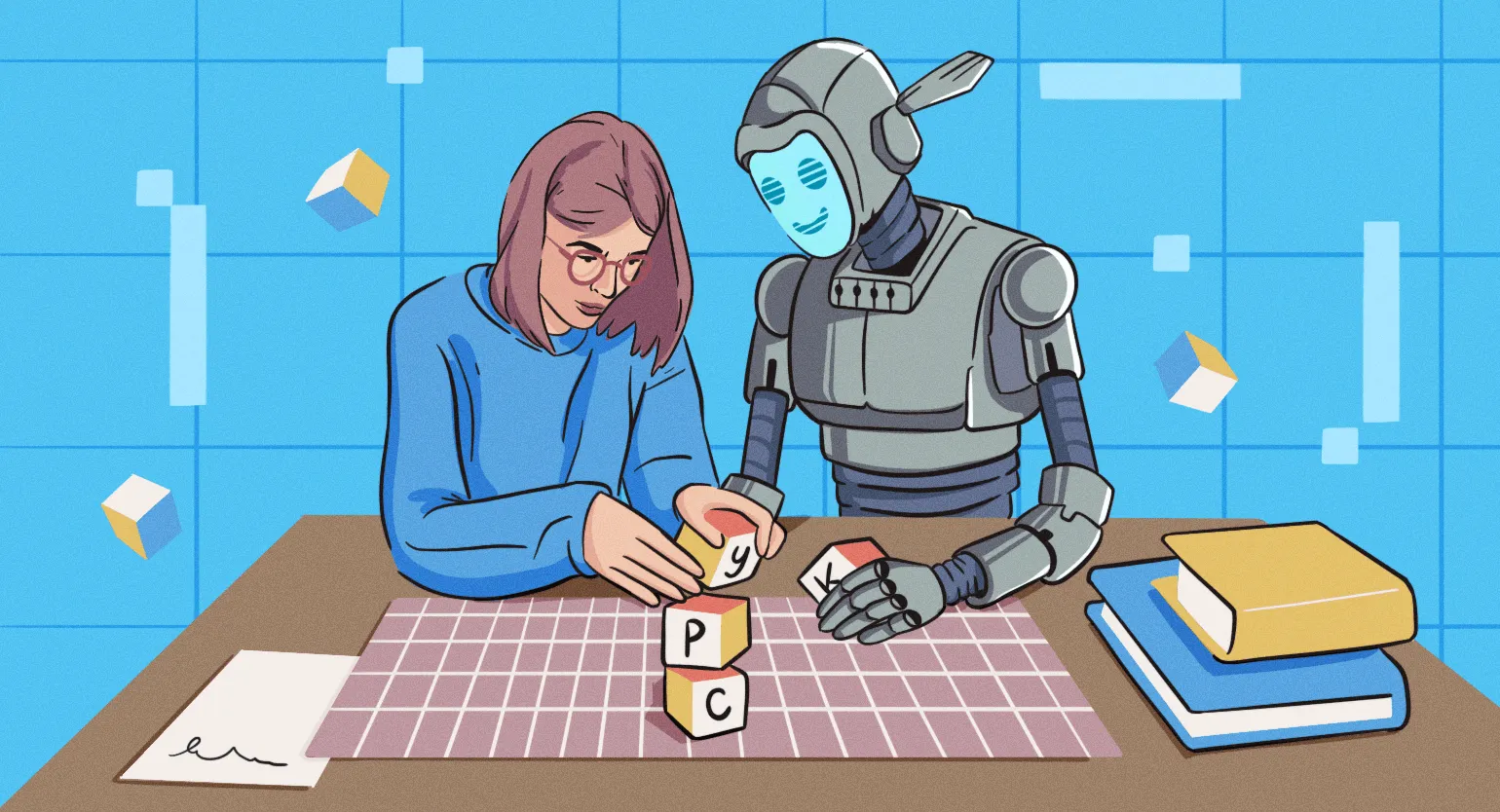
Philippa Hardman explains how instructional designers will interact with generative artificial intelligence before presenting a list of new and updated skills. The expert identifies two main models that define this interaction.
The first model is delegation. In this model, artificial intelligence is assigned the role of assistant, and humans are the creator. For example, when developing an educational course, a neural network can handle content creation, processing information from experts, translations, and analyzing student data. The methodologist, meanwhile, focuses on developing ideas, strategic planning, and interacting with stakeholders. This organization of work significantly accelerates the process and increases its efficiency.
The second model of interaction is partnership. In this model, artificial intelligence acts not only as an implementer but also as an advisor and partner, consulted at every stage of development. As an example, the author of the article describes the process of creating an educational course using the ADDIE model. This model includes five key stages: analysis, design, development, implementation, and evaluation. Partnership with artificial intelligence at each of these stages helps improve the quality of content and make it more adaptive to student needs. The use of AI in this context enables deeper data analysis, optimization of learning materials, and the creation of interactive elements, which ultimately contributes to more effective learning.
- At the analysis stage, generative artificial intelligence (GAI) will help gain insights from large volumes of data and suggest options for learning goals, while the instructional designer will conduct in-depth interviews, select and refine problems and goals.
- At the design and development stage, the instructional designer will be able to generate ideas for the program and learning activities in dialogue with GAI.
- During the implementation and evaluation stage, the instructional designer will receive feedback and, together with the neural network, will come up with ways to refine the course.
Philippa Hardman emphasizes that partnership is the most effective strategy for interacting with generative artificial intelligence (GAI), as confirmed by new scientific research. This approach undoubtedly influences the skill set required by instructional designers and instructional designers. In the context of rapid technological development, it is important to adapt educational methods and develop collaboration between specialists in the field of education and artificial intelligence. This will not only improve the quality of the educational process, but also prepare teachers for the challenges associated with integrating the GII into curricula.
What skills will the GII change for instructional designers?
Hardman reports that the good news is that the role of instructional designers will remain intact in the future. However, virtually all skills required for this profession will be subject to change. We will consider which skills will be affected below.
Instructional designers have a deep knowledge of key learning theories such as behaviorism, cognitivism, and constructivism. They are also well-versed in design models and other aspects necessary for developing effective courses. This knowledge allows them to create educational programs that take into account the peculiarities of perception and assimilation of information by students, which in turn helps to improve the quality of the educational process.

In an era where artificial intelligence is taking center stage in various fields, deep knowledge is becoming essential. A superficial knowledge of theory is no longer sufficient. It's crucial not only to understand basic concepts but also to delve into the details to correctly interact with neural networks. The ability to give precise instructions and expertly evaluate the quality of AI responses is becoming critical. This is the essence of the partnership between humans and generative AI: artificial intelligence takes on both creative and routine tasks, while humans require experience and the ability to distinguish high-quality results from mediocre ones. Thus, successful collaboration with AI is based on an understanding of one's knowledge and skills, which will allow one to maximize the potential of technology.
Educational designers have mastered data-driven skills, including audience analysis, course auditing, and testing the effectiveness of educational products. Neural networks will significantly simplify these processes by automatically processing data and providing valuable insights for improving educational programs. The use of artificial intelligence technologies in instructional design will open up new opportunities for optimizing the learning process and improving the quality of educational content. Educational program developers should not rely entirely on assistants, as they need to master specialized tools for generating tasks for artificial intelligence. It is also important to be able to analyze the results and draw conclusions based on the information obtained. The key is the ability of developers to independently decide how to effectively use this data to create personalized and targeted learning. This will improve the quality of the educational process and adapt it to the individual needs of students.

Read also:
Experience Will Become Key to Learning: How Artificial Intelligence Will Make Learning Truly Personalized. With the advancement of AI technologies, we are witnessing significant changes in the educational landscape. Artificial intelligence enables learning materials and methods to be tailored to the needs of each student. This leads to deeper understanding and retention of information, as learning becomes more interactive and focused on the individual experience. As a result, a focus on experience, not just content, opens new horizons for the effectiveness and efficiency of the learning process. The integration of AI into education facilitates the creation of unique learning paths that take into account the knowledge level, interests, and learning style of each student.
Generative AI can assist with creative aspects, but strategic planning remains the responsibility of humans. Human strategic thinking is essential for creating a complete learning ecosystem. It is important to be able to identify optimal tools and effectively combine different approaches and capabilities to ensure a unified and harmonious educational experience.
Critical thinking is an essential skill for instructional designers, as it is necessary for assessing the quality and relevance of content created using generative artificial intelligence. It is important for instructional designers to be able to analyze and interpret AI output to ensure it meets educational goals and standards. Furthermore, developers must actively work to increase trust in AI, as many people remain skeptical about the results it provides. The ability to critically evaluate information and develop trust in technology plays a key role in the successful integration of AI into the educational process.
A recent study by Philippa Hardman among fellow instructional designers revealed interesting results. Professionals are wary of generative artificial intelligence (GAI), despite its potential for effective application in experienced hands. At the same time, educational designers tend to attribute the successes of the GII to human merit, while human failures are often explained by the shortcomings of neural networks. This highlights the importance of understanding the role of humans in the use of technology and the need for optimal interaction between humans and artificial intelligence to achieve better results.
Read also:
An interesting question: will people be interested in training developed with the help of artificial intelligence?
Dr. Hardman emphasizes the importance of a new skill—prompt writing, which involves clearly formulating queries to elicit the desired results from generative artificial intelligence (GAI). While this may seem simple at first glance, in practice, writing effective prompts has become a true art. This process requires creativity and precision, significantly changing the way instructional designers approach their work. The ability to formulate prompts is becoming a key element in creating high-quality content and educational materials, which, in turn, increases the effectiveness of interactions with GAI.
Content creation remains an important task for instructional designers, but their roles are evolving. They now often act as curators and developers of AI-generated content, rather than solely creating materials from scratch. The focus is on engineering skills that enable effective management of AI content generation. Furthermore, it is important to employ critical analysis and evaluation to ensure the finalized material meets educational goals. With these changes, instructional designers can significantly improve the quality of educational content and make learning more effective.
Developers have traditionally served as managers, overseeing the entire development cycle of educational products and projects. Today, a new component is being added—interaction with neural networks. This requires specialists to be able to distinguish which tasks can be entrusted to team members and which are best accomplished using generative AI. A deep understanding of both the tasks themselves and the specific workflows of all participants is essential. This knowledge will enable the effective integration of new technologies into development and the optimization of workflows.
Philip Hardman emphasizes that changes for instructional designers will occur on two levels. The first is practical, requiring a rethinking of knowledge, skills, and tools for work. The second is psychological, associated with the need to adapt to new conditions. Partnership with generative artificial intelligence (GAI) implies that developers will have to cede some control over the process of creating educational courses to neural networks. This will lead to a blurring of the boundaries between human and machine capabilities, which will fundamentally change the approach to educational design.
Recognizing these blurred boundaries and changing ideas about our roles, responsibilities, and key skills represents a significant step for instructional designers and the entire workforce. According to Philippa Hardman, this is an important existential moment that requires a rethinking of approaches to learning and professional development. Instructional designers must adapt to new realities to effectively cope with changes in the educational environment and meet the modern demands of the labor market.
The Profession of Methodologist from Scratch to PRO
You will improve your skills in developing curricula for online and offline courses. Master modern teaching practices, structure your experience, and become a more sought-after specialist.
Find out more