
Contents:

Learn: Producer of online courses with zero to PRO
Find out moreMethods of educating adult Russians
Researchers analyzed the results of the "Sample Survey of Population Participation in Continuous Education" conducted by Rosstat in 2020. More than 231 thousand respondents aged 15 and older took part in this survey, but the final analysis only took into account adults, which amounted to over 215 thousand people. The next survey is planned for 2025.
During the study, respondents were interested in the educational practices they used over the past 12 months. The results showed that a significant portion, almost 60% of Russian citizens over the age of 18, did not engage in education over the past year. 27.7% of respondents reported participating in one of three forms of educational activity. Self-education was engaged in by 26.4% of respondents, with the most popular (14.3%) being watching or listening to educational content. The researchers also included learning new things with the help of friends, colleagues, and family members, studying professional literature, visiting museums with a guide, and participating in educational events. 22% of respondents attended additional educational programs and vocational training programs (in other words, continuing professional education, corporate training, and other career-oriented training). However, the most popular option (recognized by 11.4% of participants) was mandatory occupational health and safety training, a standard course for all employees. Only 3.5% participated in one-time events (trainings, master classes, professional internships), and even fewer participated in advanced training programs for specialists and blue-collar workers—2.6% and 1.5%, respectively.
Only 11.2% of people combined two types of educational activity: taking advanced training courses and engaging in self-education. This underscores the importance of a comprehensive approach to training and professional skills development. The combination of formal and informal education can significantly increase competitiveness in the labor market.

The authors of the study conclude that in 2020 In 2015, educational practices, including self-education, were limited in prevalence. However, there is a trend that economically active adults, whether employed or studying, more often engaged in self-education that was not directly related to their primary professional activity. This indicates a desire to develop and expand knowledge outside the usual sphere.
What are the motives for study?
Researchers have identified a number of activities aimed at improving qualifications and personal growth as educational practices that contribute to the development of human capital. These activities include trainings, seminars, advanced training courses, as well as mentoring and mentoring programs. They help not only develop professional skills but also form the key competencies necessary for successful adaptation in a rapidly changing world. Improving educational practices plays an important role in the formation of a competitive talent pool and increasing overall productivity.
- advanced training and professional retraining;
- development of professional skills on the job under the guidance of a mentor;
- professional trainings, seminars, conferences, master classes, internships;
- study of foreign languages;
- development of IT skills;
- independent study of professional literature.
Some of these activities relate to additional professional education, while others can be classified as self-education. During the year preceding the statistical survey, 19.5% of economically active respondents were engaged in such activities.
The study shows that the initiative for training in most cases comes from employers. Russians, as a rule, show personal interest in learning foreign languages and developing IT skills. These are the courses they are most willing to spend money on, as evidenced by the data: 81.2% of Russians paid for foreign language courses, and 43.2% for IT skills courses.
According to the survey, training initiators make up a certain percentage of the total number of respondents. This information can help understand who plays a key role in employee training and development. Analysis of this data allows us to identify trends in the initiation of training programs and determine which groups or individuals most often act as initiators.
The involvement of Russians in educational practices plays a key role in the formation of human capital. Modern research shows that active participation of citizens in educational initiatives contributes not only to personal development but also to the overall progress of society. The importance of lifelong education and self-development is becoming especially relevant in a rapidly changing world, where knowledge and skills are becoming key factors of competitiveness. Educational practices that span various levels and modes of study help Russians adapt to new challenges and opportunities in the labor market. Investments in education not only enhance the individual value of each person but also serve as the foundation for the country's sustainable socioeconomic development. People's motivation for learning is often expressed in general terms, such as "acquiring new knowledge" and "achieving better results at work." However, more specific reasons, such as a desire for a higher salary, finding a new job, or career advancement in their current position, are less common. Understanding these motives can help organizations create more effective training and development programs that meet the real needs of employees.
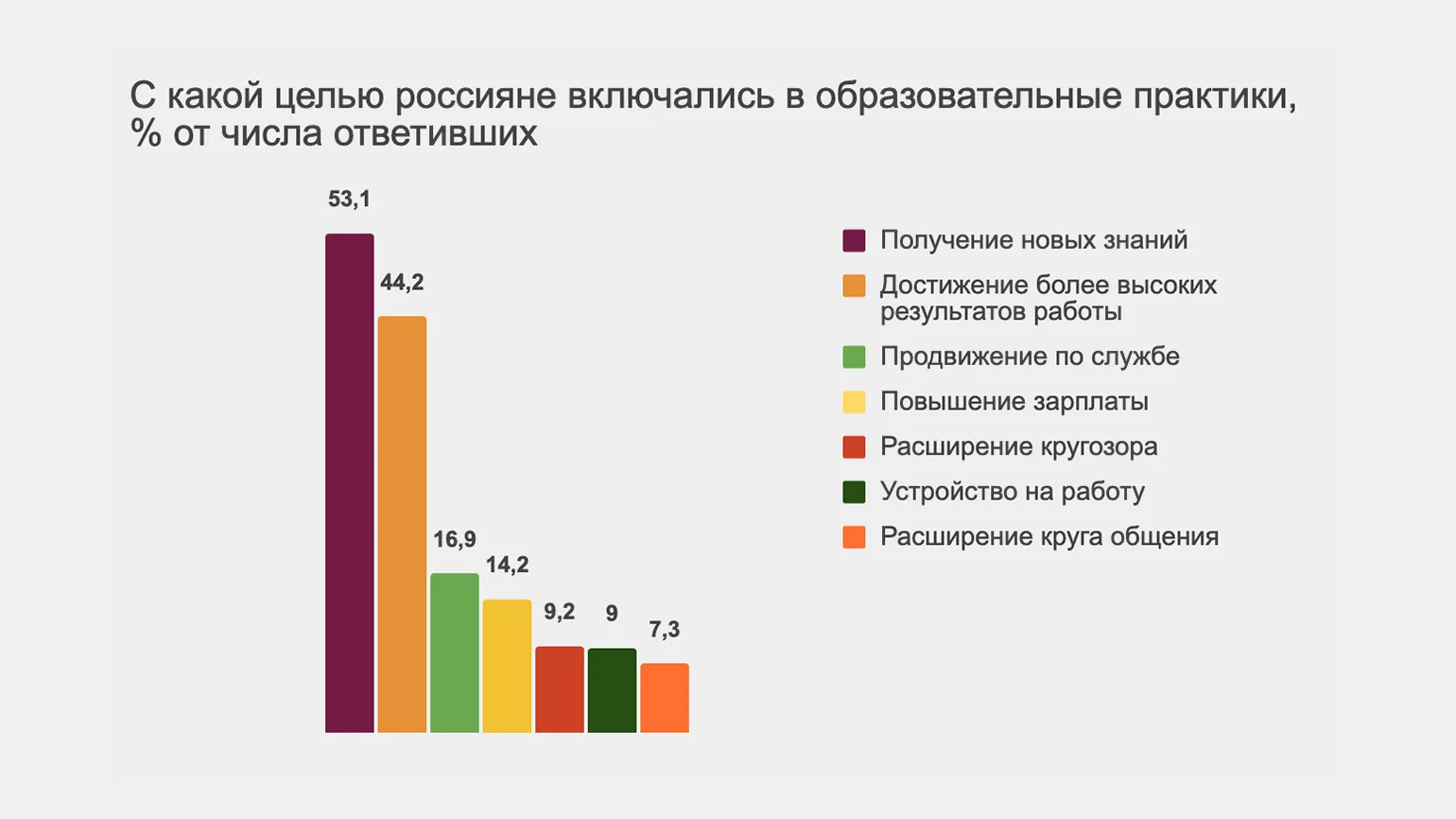
The distribution of motivation for learning varies depending on the type of learning. For example, learning foreign languages is associated with expanding one's horizons and social circle, as noted by 25.8% and 20.8% of respondents, respectively. At the same time, upgrading skills is undertaken for career advancement in 18–21% of cases. However, training as a way to increase wages is mentioned less frequently. Among those who improved their skills, only 16.5% of specialists and 18.9% of workers indicated that their goal was to increase income.
The authors emphasize that, according to statistical observations, Russians rarely perceive the time and money spent on training as an investment. Motivations related to career advancement or increased income, such as promotion, finding a new job, or salary increases, were not the determining factors for either the types of training initiated by employers or those chosen by respondents themselves. Thus, in 2020, Russians did not view training as a means of gaining career or financial advantages. This suggests the need to reconsider attitudes toward training and develop a more proactive approach to professional development and professional development.
Who invests in their human capital most often?
>To analyze the factors influencing participation in educational activities that promote career advancement, the authors consider various characteristics of respondents. These characteristics may include level of education, professional experience, age, gender, as well as motivation and goals related to career development. Understanding these factors helps us identify which aspects of educational activities are most attractive and useful to respondents, and helps develop effective strategies for increasing engagement in such activities.
- gender and age;
- place of residence (city or village);
- level of economic development of the region;
- industry of work and whether it requires mandatory regular training;
- place of work (legal entity or individual entrepreneur);
- presence of education in a specialty and general level of education, professional status.
This part of the study presents findings that reflect trends in the field of continuing education. The analysis showed that with the age of the participants, the likelihood of investing in their own education in the past year decreases. In addition, an important factor is the professional affiliation of the respondents: managers are four times more likely to participate in educational programs compared to unskilled workers. Thus, it can be concluded that managers are more active in training than ordinary employees.
The frequency of training is associated with a number of key characteristics. People who regularly engage in training have the following qualities:
- they have a higher education or education in their field of work;
- they live in cities and in economically developed regions;
- work in an industry where regular training is required.
Research shows that professional skills and knowledge are primarily developed by those for whom this is a prerequisite for a successful career. Thus, investing in training and advanced training becomes a key factor in achieving professional goals.
Investments of this kind are only advisable for those who occupy significant positions in the industrial relations system. They require a deep understanding and a strategic approach, which is available to a limited number of specialists. Thus, high-ranking positions provide not only access to resources but also the opportunity to make informed decisions, which increases the chances of successful investments.
Research shows that a significant portion of Russians do not participate in educational practices that contribute to the development of human capital. As of 2020, this was precisely the social norm in Russian society. Expecting the population to actively engage in lifelong learning on their own seems unrealistic.
How relevant are the findings of this study today?
The situation with adult education has certainly changed since Rosstat conducted the statistical survey. Survey participants shared information about their education over the previous year, but then the world faced the COVID-19 crisis, which led to a sharp increase in interest in EdTech. During this time, large-scale government projects such as "Employment Promotion" and "Digital Professions" were implemented, and numerous online higher education programs were launched. This was intended to promote increased involvement of adults in educational processes. As a result, we can expect that Rosstat data will soon reflect these changes, showing an increase in the number of students in the new realities.

We will be able to confirm this, When the next wave of statistical surveys will be completed. Such extensive data has not been collected since the large-scale study on adult learning was conducted in 2020. However, numerous small surveys conducted over the past four years suggest that the findings of that study remain relevant.
Less than half of adult survey respondents report participating in additional education or self-education. According to a 2021 study by the Russian Public Opinion Research Center (VTsIOM), only 28% of respondents reported training in the past year. In the 2024 surveys by Rabota.ru and Talantist, this figure was 40%. In a recent study by SuperJob, the proportion of those who had completed training was 47%. These data highlight the low level of adult activity in additional education and self-development, which may negatively impact their professional skills and career prospects.
In recent years, there has been an increase in interest in adult educational services. According to VTsIOM, 28% of Russians noted that they began to study more in 2022. Moscow Credit Bank recorded a twofold increase in purchases in the "Education" category among its clients, and MTS Bank noted a tenfold increase in transactions for online education among users over 60. These trends highlight the growing demand for educational programs and courses, demonstrating Russians' desire for self-development and professional development.
Despite changes in the adult education sector, the situation has not changed dramatically. The increase in the number of transactions is not always accompanied by an increase in spending: the average check remains low. According to a survey conducted by Tiburon Research in the spring of 2024, approximately 50% of participants stated that they purchased courses costing no more than 20,000 rubles. This underscores that even with increasing interest in learning, financial investment remains limited.
When it comes to developing IT skills, Russians are typically willing to invest up to 100,000 rubles per year. However, it is worth noting that the survey was conducted among those who initially expressed an interest in long-term training. In the more general context of continuing education, the results of a survey by the Talantist project at the end of 2023 indicate that approximately 50% of Russians would prefer to study for free or at their employer's expense. At the same time, only 13% of respondents are willing to finance their own education. This indicates that many Russians are seeking accessible and supported options for professional development.
Since 2020, adult education has not become more focused on developing human capital. Students still do not perceive education as an investment in their future. In a 2022 SuperJob survey, increasing income was one of the least frequently cited reasons for education. According to a 2023 Skyeng survey, the primary motivation for education was often fear of being fired or other potential problems. When Russians are asked about ways to increase their income, obtaining additional education is mentioned in only 8% of cases, according to a 2023 AlfaStrakhovanie survey. This highlights the need to change the perception of education as an important tool for improving financial stability and career advancement. Russian adults, even when striving for self-improvement, often limit themselves to the most basic learning formats, such as reading professional literature or watching educational videos. This is confirmed by the results of a 2023 survey conducted by GeekBrains. It found that respondents considered formats closer to traditional education, such as professional development courses, online courses, and individual lessons with instructors, to be the most effective. However, the number of people actually engaging in these formats was two to four times lower than expected. This highlights the need to find more accessible and motivating methods of self-development for adults.
Online Course Producer from Scratch to PRO
You will learn how to launch profitable courses and webinars with minimal investment. You'll understand how to turn existing EdTech projects into profits and make money from online learning.
Learn more