

Course with employment: "The Profession of a Methodologist from Scratch to PRO"
Find out more
A summary is a concise summary of information that allows you to quickly get acquainted with the main aspects of a topic. It includes key facts, data, and conclusions that can be useful for understanding the subject. This format is often used in research studies, reports, and documentation, allowing the reader to quickly obtain the necessary information without having to delve into the details. A quick reference helps save time and facilitate the information search process, which is especially important in today's information overload.
Renata Gizatulina is the founder and curator of the LLLab project, and a recognized expert in the field of lifelong learning skills. She is the author of the Telegram channel "Art of Education by LLLab.eu", where she shares valuable knowledge and methods for effective lifelong learning. Renata actively promotes ideas about the importance of continuous education and skill development in the modern world.
LLLab (Lifelong Learning Lab) is a community of professionals committed to the concept of lifelong learning. We are a laboratory that develops and tests lifelong learning methods. LLLab offers a course "Innovations in Education", designed for those who strive to develop, test, and implement modern technologies and methods in their educational projects. Our program is aimed at supporting professionals in creating effective and relevant solutions for education, allowing them to remain competitive in a rapidly changing world.
In this article, you will gain information on how to properly organize your content to achieve the best results in search engines. We will cover key aspects of SEO optimization, including keyword selection, meta tags, and heading structure. We will also discuss the importance of quality content and its impact on search engine rankings. Read on to learn how to improve the visibility of your website and attract your target audience.
- What is innovation and why is it needed;
- How to apply innovation;
- What is a thinking culture (Run - Change - Disrupt);
- How to develop innovation;
- What are the principles that an innovator should follow.
Innovation in education covers many aspects and areas. Different segments of the education sector—academic, corporate, informal learning, and EdTech—have unique standards and approaches to innovation. There are no universal "dogmas" in innovation, allowing each segment to develop according to its own needs and challenges. Innovative solutions can range from new educational technologies and methodologies to changes in curriculum structures and learning formats, which contribute to a more effective and adaptive educational process. In the education market, there are no clear guarantees of innovation success. Innovation in education is not only about successful change but also the ability to adapt, show courage, make mistakes, and learn from them. However, there are a number of principles that can be identified based on successful examples of innovation in education. In this article, we will discuss these principles and their application in the context of modern education.
What is innovation and why is it needed?
The Russian educational market currently exhibits great potential. On the one hand, there are many qualified specialists, and on the other, there are various niches for development. This creates unique opportunities for the implementation of innovative solutions based on accumulated experience. The current situation is ideal for using knowledge and skills to create new educational products and services that can significantly improve the quality of education and meet the needs of modern society.
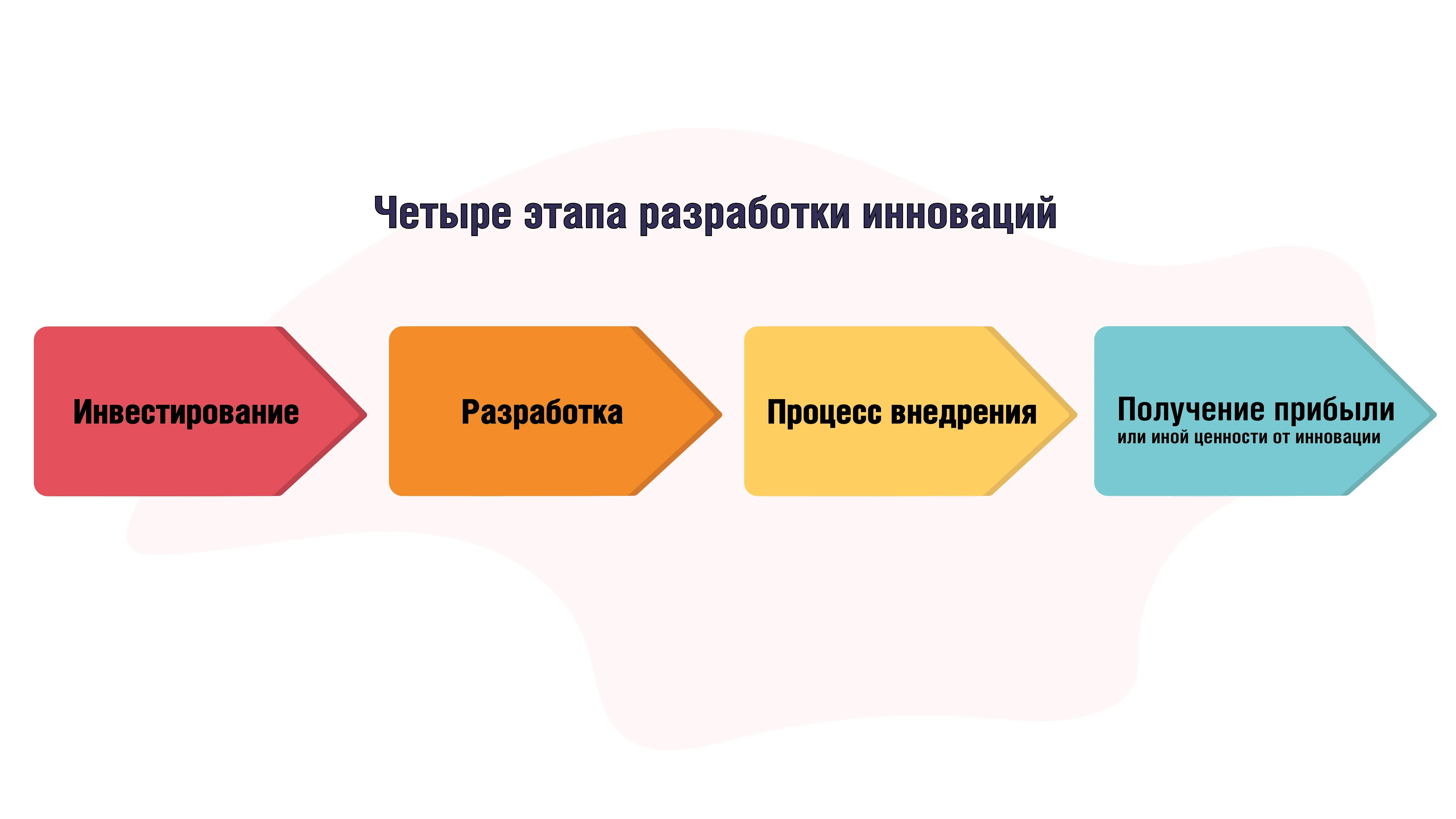
Innovation is the process of investing in new knowledge and ideas, as well as their implementation with the aim of creating additional value for business. These changes can significantly increase a company's competitiveness by opening up new opportunities and improving existing processes. An innovative approach allows organizations to adapt to changes in the market and meet customer needs, which in turn contributes to their growth and development.
Investing in companies is not always associated with financial costs. We focus on driving innovation and supporting our employees in generating new ideas. In this process, we ask ourselves important questions: What new directions could benefit our organization? How can we create an environment that fosters creativity and initiative? What are the potential risks and benefits of implementing these ideas?
- How can the educational process be improved?
- How can the educational product be improved?
- Is it worth creating an entirely new product?
The innovation development process includes stages ranging from investment to understanding the end result, which brings additional profit or other value. This process is divided into four key stages. Each of them plays an important role in the successful implementation of innovative ideas and allows for the effective management of resources to achieve the desired result.
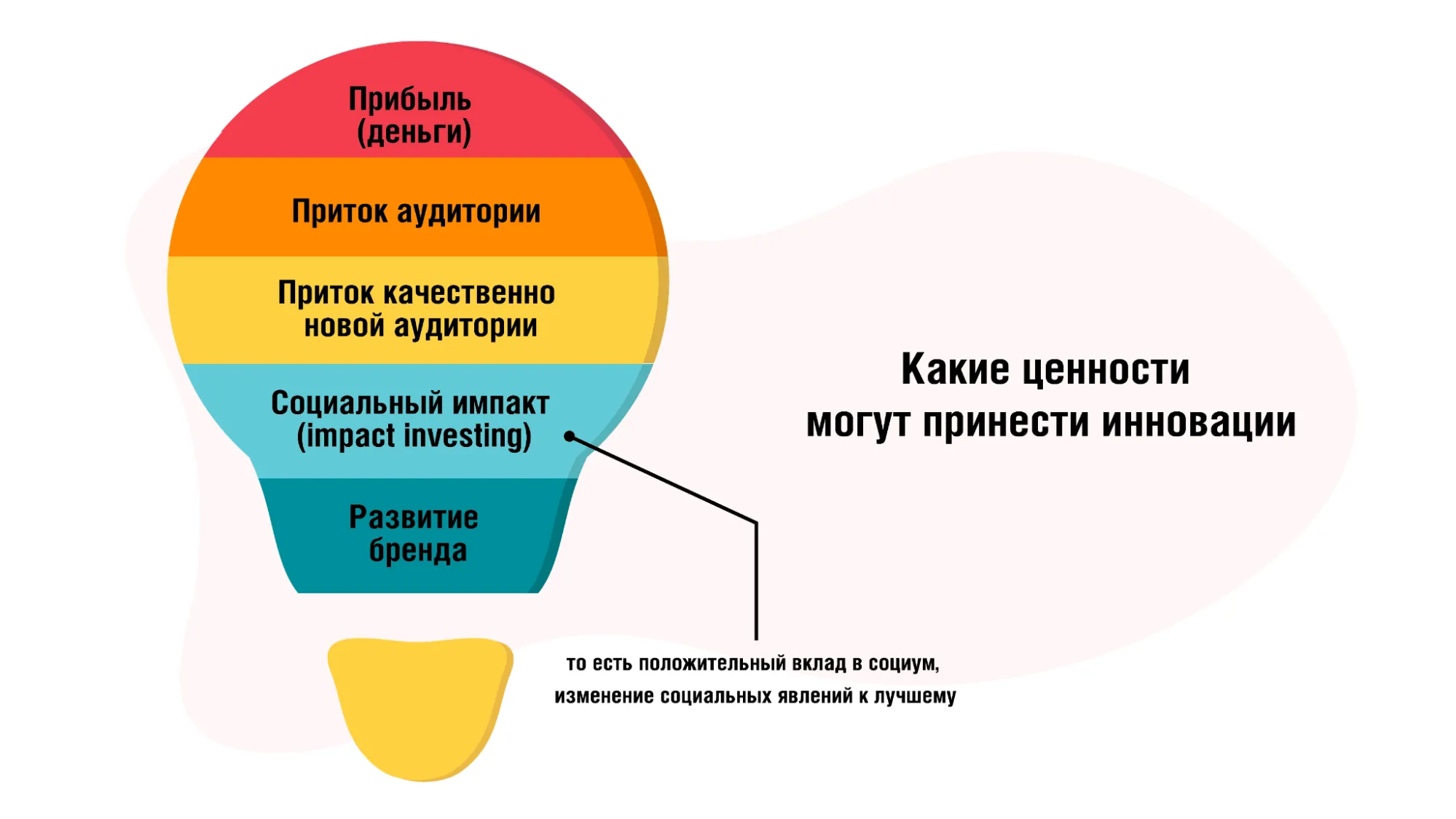
Innovation does not always manifest itself in radical changes, with completely new products or processes appearing on the market. Incremental changes to existing products, processes, or strategies, as well as continuous improvement, are equally important forms of innovation. These incremental improvements can significantly increase the efficiency and competitiveness of companies, facilitating their development and adaptation to changing market conditions. Innovation, whether radical or evolutionary, plays a key role in ensuring sustainable growth and business success.
How to Apply Innovation
To determine what innovation your company is ready for, you need to focus on three key areas. These areas will help you assess current capabilities and potential areas for implementing new technologies and ideas. By analyzing these aspects, you will be able to more clearly formulate an innovation development strategy, which in turn will increase your company's competitiveness in the market.
The first area requiring attention is the mindset of the organization's employees and leaders. Without the right mindset, the implementation of innovation and effective change is significantly hindered. For a successful transformation, it is important to develop openness to new ideas and a willingness to adapt. This will not only improve work processes but also increase the overall productivity of the team.
The second area is focusing on what specific actions need to be taken to achieve the desired results. It is important to identify the key aspects requiring change in order to effectively direct your efforts and resources toward improvement. Correctly choosing change directions contributes to the successful achievement of goals and increased overall effectiveness.
The third area is the scale of effort, which involves assessing the breadth and depth of changes required for the company. It is important to determine whether you have sufficient resources to implement the planned changes.
Let's consider three types of thinking culture: Run, Change, and Disrupt. Each of these types offers its own opportunities for innovation. Run focuses on optimizing existing processes and increasing efficiency, which allows for small but significant improvements. Change emphasizes adaptation to new conditions and the introduction of new working methods, which facilitates the evolution of business processes. Disruption, in turn, involves radical changes and the implementation of revolutionary ideas that can fundamentally change the market. Studying these types of thinking will help identify the potential for innovation and implement them in practice.
For the first time, clear criteria for distinguishing between the three thinking cultures were formulated by the consulting company Gather. Later, businesses adapted this model, combining the three types into the concept of "trimodal process organization," in which all three types of thinking cultures are simultaneously present in a company. In Russia, this model is actively used at Sberbank.
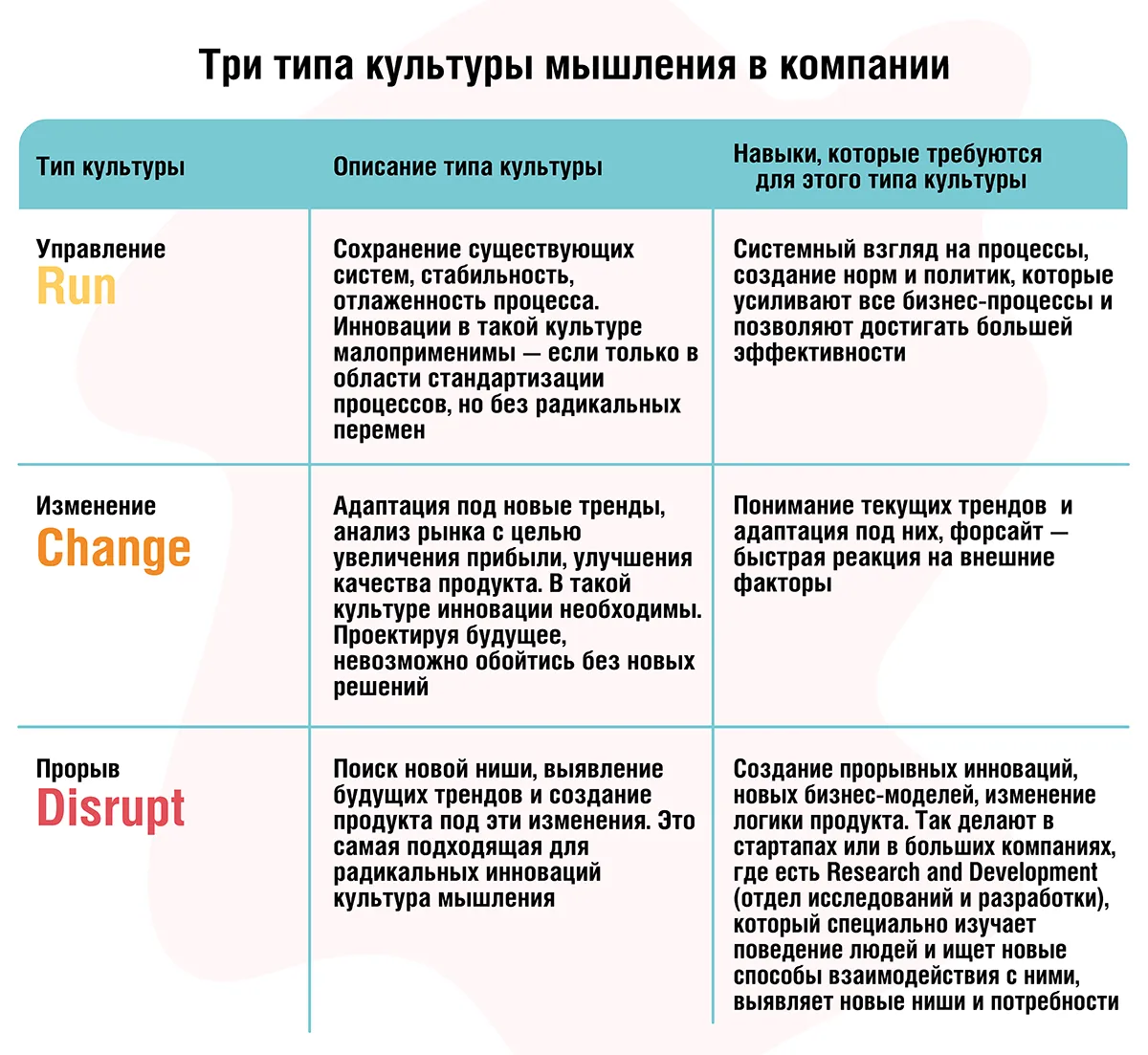
In every company, two key processes occur simultaneously: management and change. However, breakthrough, radical changes do not occur in all organizations. This is most often achieved by large companies or, conversely, startups that possess the necessary resources and flexibility to implement innovation. It's important to understand that successful transformations require not only strategic thinking but also a willingness to take risks. Several interesting examples of innovation can be identified across different cultures. Each culture brings unique approaches and ideas that foster the development of new technologies and methods. For example, Japanese culture emphasizes teamwork and continuous improvement, leading to the creation of high-quality products and efficient processes. Scandinavian countries are committed to sustainable development and environmental innovation, with an emphasis on green technologies and renewable energy sources. Western culture, particularly in the United States, is actively developing startups and entrepreneurial initiatives, creating an environment conducive to the implementation of cutting-edge technologies and creative solutions. These examples show how diversity of thinking and approaches to innovation can enrich the global community and contribute to progress across fields.
- RUN
In organizations or departments where change is rare, standardization and management based on established norms and policies become key tasks. This approach is typical for conservative educational institutions, such as schools and universities, where curricula remain stable for several years. In such systems, emphasis is placed on maintaining tradition and order, which helps ensure the predictability and quality of the educational process.
- CHANGE
The education market is experiencing significant changes as a result of the pandemic. In 2019, the traditional educational environment, be it a university or a school, functioned according to established processes. However, in 2020-2021, under the impact of the coronavirus, the education system was forced to adapt by implementing Change thinking. As a result, much of the education sector now operates within a Change paradigm, responding to intense external pressure. These changes open up new opportunities for the implementation of innovative teaching methods and digital technologies, enabling improvements in the quality of education and adaptation to student needs.
Many educational institutions, including schools and universities, were developing innovative learning design methods even before the pandemic. One striking example is the Interdisciplinary School in London, which uses a "Challenge-based learning" approach, where all topics are focused on solving real-world problems. For example, when researching obesity among schoolchildren, students study anatomy, biology, sociology, and other disciplines to gain a deeper understanding of the issue and develop effective solutions. While the curriculum and subjects remain largely unchanged, the teaching methods are undergoing significant changes, focusing on the practical application of knowledge. This approach fosters critical thinking and interdisciplinary collaboration skills in students, which is especially relevant in today's environment.
Education requires constant development and innovation. A key aspect of this process is creating a culture of change that will enable educational institutions to effectively adapt to new conditions. The constant introduction of changes and innovations into the educational process contributes to the improvement of the quality of education and the preparation of students for the challenges of the modern world.
- Breakthrough (DISRUPT)
Skyeng presents a new product, Skysmart, which significantly differs from traditional methods of language teaching. Skysmart is an innovative adaptive learning platform designed to improve the educational process. It offers users personalized solutions that adapt to their level of knowledge and learning pace. This makes language learning more effective and convenient.
An interesting example of an innovative approach to education is TUMO BOX, designed for teenagers. This unique "box" is installed in rural areas and provides an opportunity for both children and adults to develop in the fields of design and technology. TUMO BOX contains everything necessary for mastering these skills. This technology represents a fresh approach to educational methods, offering accessible resources for learning and development in a limited infrastructure. Adaptive learning methodologies that can guarantee 100% effectiveness have not yet been developed. It is unclear whether modern technology can completely replace teachers and in what aspects this might occur. Humans remain an essential element in the educational process, although certain functions can be automated. However, what exactly can be automated has not yet been determined. It is important to study the educational context, predict its development, and design new approaches. Learning processes must be viewed as an experiment to identify the most effective methods and tools. Modern education, including online formats, as well as traditional schools and universities, requires innovation. Private educational institutions are especially active in seeking new approaches and are not afraid to implement modern technologies. This allows them to stand out in a competitive market and attract more students. The use of innovations in the educational process contributes to the improvement of the quality of learning and the enhancement of interactions between teachers and students, which in turn creates additional benefits for educational institutions.
Innovations are most often applied in two main areas: improving communication between people and optimizing organizational processes. These areas play a key role in increasing work efficiency and establishing closer ties between participants. Innovative communication solutions facilitate the faster exchange of information and reduce interaction barriers, while improved organizational processes help improve resource management and increase productivity.
Innovations in the field of human communication continue to evolve, significantly changing the way people interact. Modern technologies such as video calls, instant messaging, and social media have made communication more accessible and faster. Messaging platforms such as WhatsApp and Telegram allow users to instantly exchange text messages, photos, and videos, breaking down geographic barriers.
Virtual meetings and webinars are becoming the standard for business and education, providing the opportunity for real-time communication, regardless of the location of participants. Artificial intelligence and machine learning are also contributing to improved communication, offering automated support systems and chatbots that help users find the information they need faster and more conveniently.
Furthermore, the development of augmented and virtual reality technologies is opening new horizons for interpersonal communication, creating immersive experiences that allow people to interact in interactive environments. These innovations not only improve the quality of communication but also foster deeper connections between people, regardless of distance.
Teachers Pay Teachers is one of the fastest-growing startups in the edtech space. This online platform allows teachers to share their useful materials and best practices, enabling other educators to use them for both paid and unpaid use. This way, teachers can earn money from the innovative methods they've implemented in their teaching. Essentially, Teachers Pay Teachers is a marketplace for professional educational solutions, facilitating the exchange of experiences and resources within the educational community.
The idea for this platform arose from the founders' observations of a lack of opportunities for educators from different countries and subject areas to share experiences. This startup responded to this community demand by offering a platform for interaction and collaboration between educators, allowing them to share knowledge, methods, and practical experience.
In the near future, many marketplaces are likely to appear in Russia. These platforms have significant potential, as they allow for the use of ready-made solutions and the developments of other users. Marketplaces are becoming a convenient tool for businesses, providing access to a wide range of goods and services, which contributes to the development of e-commerce in the country.
The startup idea is to automate bureaucratic processes in public schools. Teachers are often overloaded with routine work, which distracts them from their core business – teaching students. Developing software or a platform that simplifies documentation, academic performance tracking, and interaction with parents will significantly reduce the workload. As a result, teachers will be able to devote more time to preparing lessons and communicating with students, which will impact the quality of education. Automating these processes will not only improve the working environment for teachers but also create a more efficient education system as a whole.
Process innovations play a key role in increasing the efficiency and competitiveness of organizations. The implementation of new technologies and management methods allows for the optimization of work processes, reduction of costs, and improvement of the quality of products or services. The use of automation and digitalization of processes helps speed up task completion, minimize errors, and increase customer satisfaction. The use of analytical tools and data management systems enables more informed decision-making and prompt responses to market changes. Innovative approaches to processes enable companies to adapt to new conditions and maintain leadership in their industries.
Knewton has created innovative adaptive learning technology that enables personalized learning. The platform includes various tools and resources that provide a personalized approach to each student. Using data analysis and machine learning algorithms, Knewton adapts content and teaching methods based on the knowledge level and needs of users. This improves the effectiveness of learning and makes it more accessible to all categories of students.
Knewton's technology uses statistical methods, machine learning, and psychometrics to create a personalized learning experience. It analyzes student behavior and preferences in real time, allowing it to tailor educational content to their individual needs. This approach makes learning more effective and targeted, leading to improved outcomes and increased student motivation. Knewton aims to make the educational process as adaptive and comfortable as possible for every student.
In Russia, native educational platforms such as Skyeng and Yandex Praktikum are successfully operating. However, this area still has significant potential for innovation and experimentation, opening up new opportunities for the development of online education.
The amount of resources a company is willing to invest in innovation determines the scale of achievable results. Innovations can be classified into various categories depending on their scale.
- Internal System
Teacher training and onboarding—the process of adapting employees to a digital product—as well as interaction with partners and clients are key aspects of the successful implementation of educational technologies. An effective onboarding program ensures rapid adoption of new tools and methods, which contributes to improved learning. Establishing strong relationships with partners and clients also plays a vital role in achieving shared goals and increasing user satisfaction.
- Student Learning Experience
The learning environment is the space where students can interact with educational materials and with each other. This platform hosts the registration process, which is the starting point for students. Once registered, they gain access to various learning resources and marketing messages aimed at their development. Completion of training occurs through employment or exams, which allow the level of acquired knowledge and skills to be assessed.
- Specific Program
Working within a program or product line involves participating in the development and implementation of strategies aimed at achieving specific goals. This may include project management, team coordination, and client engagement to ensure successful completion of tasks. Participation in such initiatives allows you not only to deepen your professional knowledge, but also to develop teamwork skills, increase process efficiency, and improve the quality of the final product.
How to Develop Innovations
The innovation process goes through several stages: from in-depth research to the implementation of new solutions.
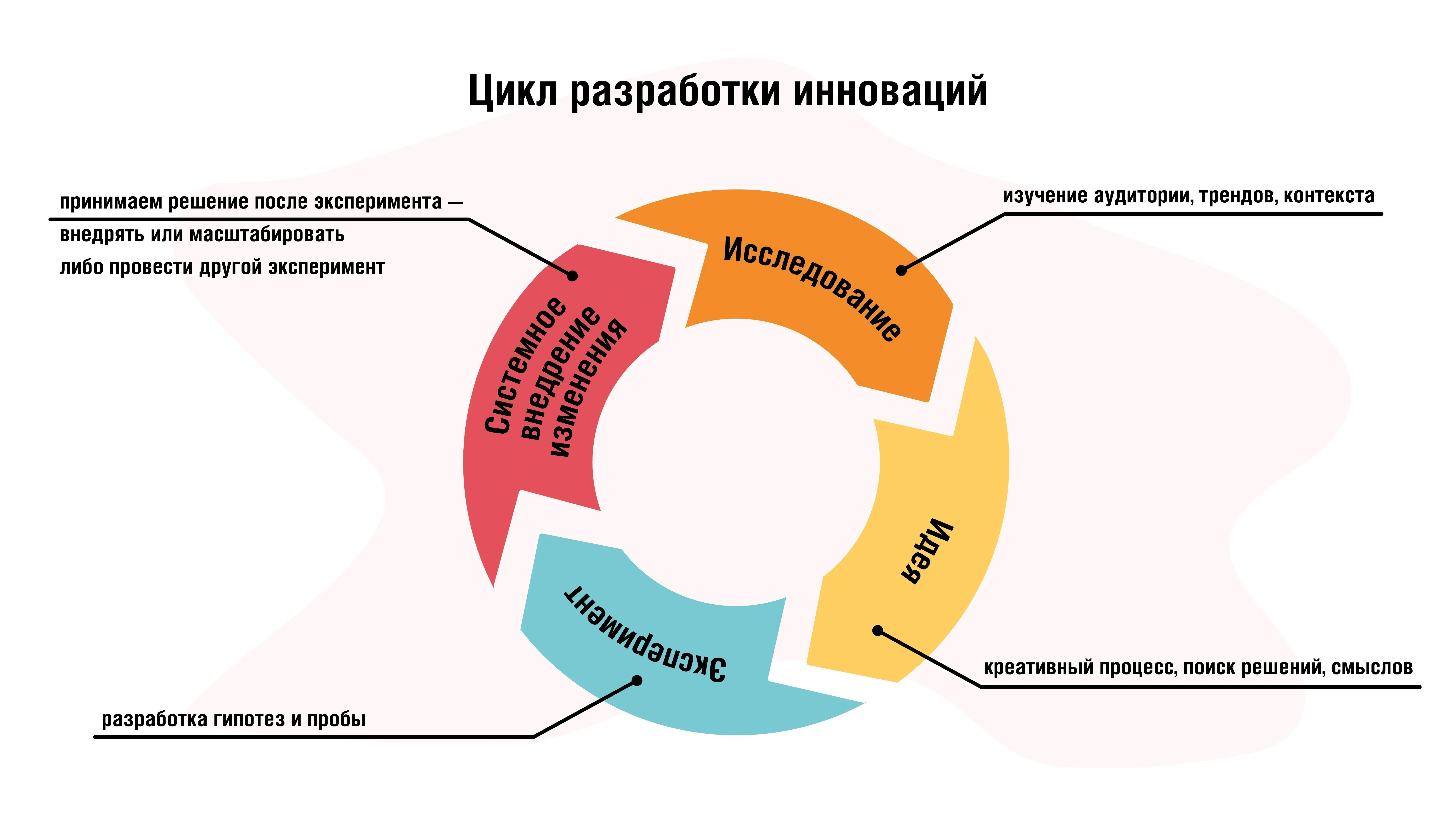
In the process of implementing this cycle, important skills include product thinking, creativity, teamwork, critical thinking, and effective communication. These competencies contribute to the successful completion of tasks and the achievement of goals. Product thinking helps focus on user needs, creativity enables the development of innovative solutions, and collaboration and communication ensure effective interaction between team members. Critical thinking facilitates the analysis and evaluation of information, which is key to making informed decisions. Developing these skills significantly increases your chances of success in any project.