

Course with employment: "The profession of a Methodologist from scratch to PRO"
Find out moreGrowing pains
According to a joint study by Netology, EdMarket and Talentech, By the end of 2023, the Russian online education market is expected to reach 60 billion rubles. There's a high probability that actual figures will exceed analysts' forecasts, as the estimate was conducted before the pandemic and the transition to distance learning. These events significantly accelerated digitalization across all sectors, and the EdTech sector found itself in an advantageous position. In 2020, educational products became particularly popular, attracting millions of new users. Traffic to the Uchi.ru platform increased sixfold, reaching 3 million daily users. This demonstrates growing interest in online education. Furthermore, educational startups have attracted the attention of investors: for example, Algorithmika recently successfully raised $10 million to further develop its product and expand its franchisee network. Growing interest in online education is opening up new opportunities for investment and technology development in this field.
The EdTech market in Russia is experiencing significant growth, reaching 30-35%, according to estimates by Maxim Spiridonov, CEO of Netology Group. The results of leading companies in this field are also impressive. In 2020, Skyeng increased its revenue by 141% compared to 2019, Skillbox by 255%, and Yandex.Practicum demonstrated growth of 813%. To correctly interpret this data, it is important to consider that the share of online education in Russia has traditionally been low, amounting to less than 10%. The explosive growth of 2020 is largely due to the low base effect, which highlights the potential for further development of online education in the country.
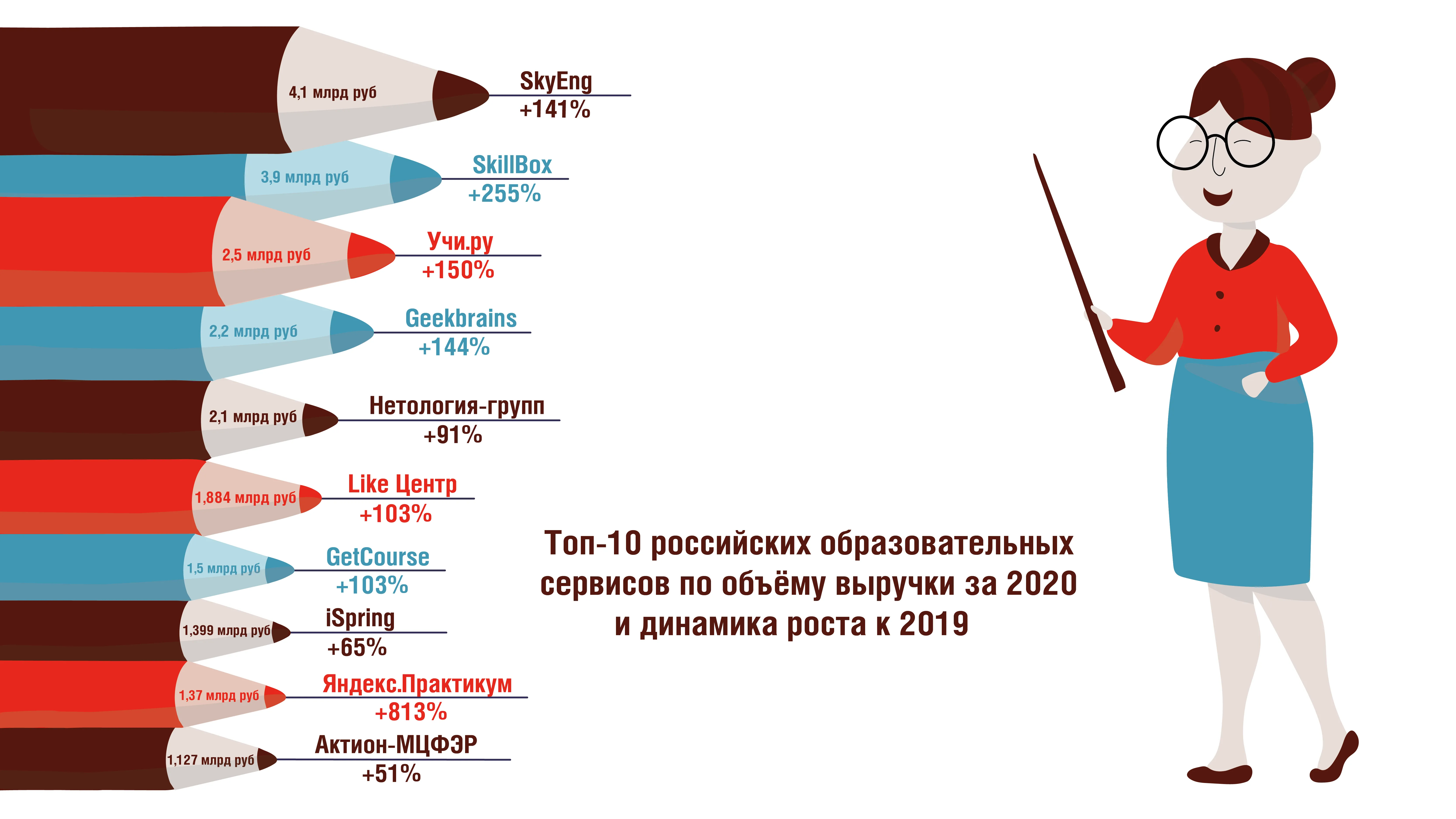
This effect is Temporary in nature. To maintain the growth momentum achieved in 2020, Russian EdTech needs to overcome its current "growing pains"—problems that have long existed but have become particularly pressing during the pandemic. Problem No. 1 is that many users are having difficulty finding quality information online. This may be due to the sheer volume of content that doesn't always match their search queries. Search results are often irrelevant, and users waste time browsing irrelevant materials. To address this issue, it's necessary to use more precise keywords and filters, as well as rely on trusted sources of information. Furthermore, it's important to optimize content so it's accessible and understandable to the target audience, which will increase its value and simplify the search process.
It's a Matter of Technology
In Russian EdTech, content plays a key role, encompassing programs for preschoolers, schoolchildren, and adults. There are courses for those seeking to improve their skills, as well as for those changing careers. Programs are aimed at top and mid-level managers. However, the communication component remains underdeveloped. During the lockdown, teachers and tutors had to create learning processes by combining various platforms such as Zoom, WhatsApp, and Discord, which complicated lessons and reduced their effectiveness. Improving communication tools in EdTech is a necessary step to improve the quality of education.
In 2020, the issue of distance learning has become relevant for everyone. Previously, some might have avoided the topic, but now the distance learning format evokes either excitement or negative emotions. Skillbox CEO Dmitry Krutov emphasizes that many parents are expressing dissatisfaction because educational institutions were unprepared for the transition to remote learning. This has led to significant difficulties for both students and teachers. The transition to remote learning requires new approaches and technologies, creating a need for advanced teacher training and the adaptation of curricula. Rostelecom and Mail.ru Group have begun addressing the issue of integrating modern technologies into the educational process. Since late 2020, they have been actively developing the Sferum platform for learning and communication. This platform, based on VKontakte technology, aims to unite students, teachers, and parents, and potentially replace foreign services in the educational sector. This year, schools in fifteen Russian regions will begin testing this innovative platform. Communications is not the only area in which EdTech is experiencing a technology shortage. The online education format also raises concerns among many. It is most often compared to traditional learning, which includes hands-on activities such as museum tours or chemistry and physics experiments, as well as crucial nonverbal communication between teacher and student. To bridge this gap, the industry is actively implementing innovative solutions, including augmented and virtual reality (AR and VR). These technologies create more interactive and engaging educational environments, which promotes better learning and improved interaction between participants in the learning process.
In August 2020, the analytics company HolonIQ forecast that global spending on educational technology will reach $404 billion by 2025. According to Accenture, $6.3 billion will be spent on virtual and augmented reality in education in 2021. These data highlight the growing importance of technology in learning and the need to integrate it into educational processes to improve learning effectiveness and student engagement.

With the development of virtual New opportunities for integrating online and offline learning are opening up. Instead of competing with each other, these formats can be effectively combined within a single program, a concept known as blended learning. This approach combines the benefits of traditional learning with the flexibility of online formats, creating more effective and interactive educational methods. Blended learning is thus becoming a promising solution for modern educational institutions seeking to improve the quality of instruction and adapt to student needs.
Virtual reality (VR) and augmented reality (AR) technologies won't be able to completely bridge the gap between online and offline learning in the next few years. Currently, they can only complement courses by visualizing content. There are currently no readily available devices on the market that can provide a full immersive experience and facilitate group interaction. To achieve this, it's necessary to increase the speed and bandwidth of internet connections to handle complex visual content, according to Vladislav Lobanovsky, project manager at Varwin, a company that develops VR solutions for businesses.
The development of virtual and augmented reality technologies will open up new horizons in education, but their full implementation will require time and significant infrastructure improvements.
Evgeny Lebedev, Marketing Director at Yandex.Practicum, is convinced that a complete transition of education to online is impossible. Some aspects of learning are easier to achieve offline. Furthermore, there are professions that are difficult to master online, such as hairdressing, carpentry, and piloting. We will likely see a situation similar to e-commerce, where some functions will be performed online and others in person. Blended learning formats will emerge in areas where needed.
Problem number two is a lack of information. Many users face difficulties due to a lack of necessary data, which complicates the decision-making process. This can lead to the wrong choice of products or services. To address this issue, it is important to provide access to quality information and resources that will help people better navigate the issues that interest them. Furthermore, using clear and understandable formats for presenting information can significantly improve perception and understanding. It is also important to consider the needs of the target audience to ensure the proposed solutions are as effective as possible.
Market Consolidation
Between 2015 and 2020, the Russian EdTech market attracted the attention of major players. These companies began developing their own educational technologies and actively investing in existing startups. Today, the balance of power in this area is as follows:
- Mail.ru Group. In 2020, the company invested 3.75 billion rubles in the Uchi.ru platform, receiving a 25% stake. In addition, Mail.ru Group owns 100% of GeekBrains, 70% of Skillbox, 18% of SkillFactory, and almost 12% of Algorithmika.
- Yandex. It is primarily developing its own platform, Yandex.Practicum.
- Sber has begun to explore the EdTech niche by launching its own digital platform for schoolchildren, SberClass. In addition, the bank has its own corporate university.
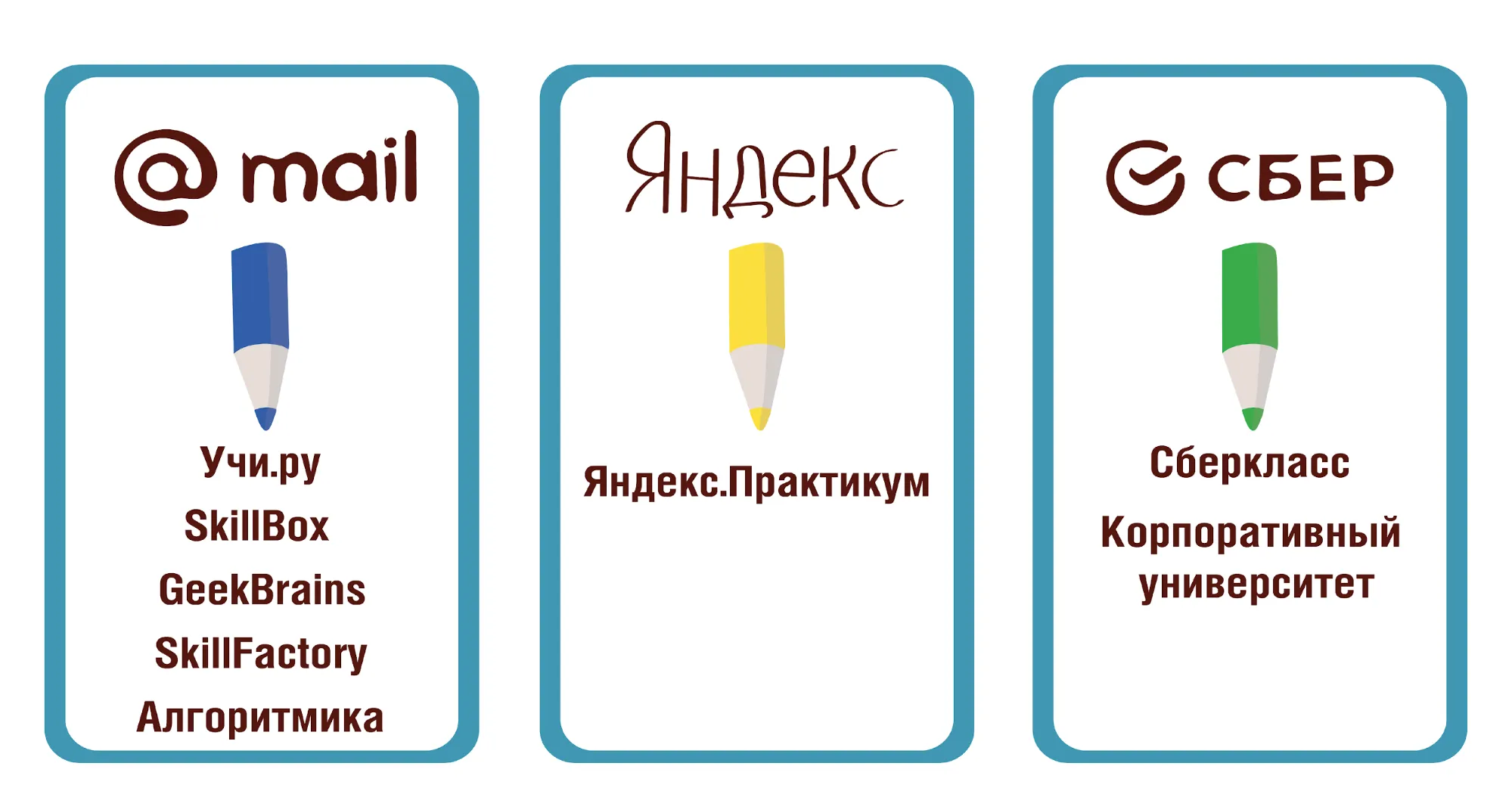
Training products are increasingly integrated into the brand ecosystem, along with services such as Food delivery and online cinemas. This expands access to educational resources to a wider audience, allowing more users to learn about them and take advantage of their benefits. However, such integration also creates certain challenges for companies that are not part of existing ecosystems, limiting their ability to attract customers and compete in the market.
Large companies have ample resources to attract the best teachers and methodologists from startups. In 2021, the EdTech labor market worsened, and even established players faced a talent shortage. Alexey Polekhin, Program Director at Netology, attributes this to the ambitious plans of many companies, which are targeting significant growth of two to three times. As a result, competition for talented specialists has become fiercer, complicating the process of finding and hiring qualified personnel.
Talent competition is just one of the many challenges facing EdTech startups. Ilya Parshin, CEO of Uchi.ru, emphasizes that as the educational process digitalizes, schools often continue to collaborate with established companies. This creates significant challenges for new market players seeking to gain the trust and attention of educational institutions. To compete successfully, startups need to develop unique offerings and demonstrate their advantages to attract customers and change established habits.
Problem number three is that many users have difficulty finding the information they need. This may be due to poor search engine optimization, which hinders accessibility. It's important for text to be structured and include keywords that match user queries. This not only improves search engine visibility but also helps readers quickly find what they really need. Solving this problem requires careful analysis and content editing to ensure it's as useful and informative as possible.
We Need to Change the System
Experts identify systemic problems as the main obstacles to EdTech development. Alexey Polekhin from Netology emphasizes that different online schools use different approaches to teaching, even if courses have the same titles. Currently, there are no uniform standards or common exams for online learning. Polekhin also notes that the government will likely work actively to standardize this sector in the near future.
Dmitry Krutov of Skillbox emphasizes the importance of collaboration between private players and government agencies in EdTech. He notes that in 2020, public educational organizations began actively engaging with private platforms. Previously, two years ago, such an exchange of views was impossible, but now the participants have gathered around the negotiating table to jointly develop strategies aimed at improving the accessibility and quality of online education.
Alexander Laryanovsky, Managing Partner of Skyeng, emphasizes that one of the main problems in education is the incorrect distribution of responsibility. In both traditional schools and online platforms, students often believe that the educational institution is responsible for their success. However, schools cannot guarantee high results, as it is impossible to force students to study effectively. It's important to recognize that successful learning requires active participation and responsibility on the part of the students themselves.
The revenue share model is an effective solution already successfully used in various business sectors, including advertising. In this model, the client pays for the clients attracted, not for broadcast time or advertising space. Alexander notes that a similar shift is expected in the education sector, as this is the fairest method of payment for services provided. This approach will create more transparent and mutually beneficial relationships between educational institutions and their clients, ultimately improving the quality of education and accessibility of knowledge.
The platform will make money not from lectures, but from the increased income of its clients after training. EdTech will be able to claim a share of the difference between earnings before and after the courses. However, at present, this is only a theoretical concept, as no educational company has implemented such a model.