Contents:
Learn: Producer of online courses from scratch to PRO
Learn moreWhat technologies can act as tutors
Educational platforms with adaptive learning simulators offer unique opportunities for personalizing the learning process. These platforms can tailor educational content to the individual needs of users, which helps improve the effectiveness of material assimilation. An important addition to such platforms are "smart" chatbots based on generative neural networks, which act as assistants. They provide support to students, answering questions and providing information in real time. Such technologies significantly improve the quality of education and make learning more accessible and personalized.
Adaptive educational platforms function based on the analysis of digital data about the user, including their current level of knowledge, the difficulties they face, and the pace of learning. These platforms automatically select tasks that meet the needs of each student. For example, if a user successfully solves several problems in a row, the system will suggest more challenging tasks for further development. If errors are made, the program will offer to review the material covered or move on to simpler tasks to consolidate knowledge. This approach allows for the learning process to be tailored as effectively as possible to the individual characteristics and needs of each student, significantly improving the quality of education. Digital assistants in the form of chatbots can not only expand the functionality of adaptive platforms but also act as standalone solutions. Users interact with these bots as if they were human interlocutors, communicating via text messages or voice commands. This functionality can take the form of a familiar dialog box familiar from various online services, enhanced with a visual avatar, or presented as a realistic human character with a voice and facial expressions, created using neural network technologies. Chatbots are becoming an increasingly important tool in customer service, automating business processes, and improving user interactions.
Detroit Test is a chatbot from Skyeng that Helps determine your level of spoken English proficiency. It allows users to assess their English communication skills, receiving feedback and recommendations for further improvement. This tool is ideal for those who want to improve their language skills and confidence in communicating in English.
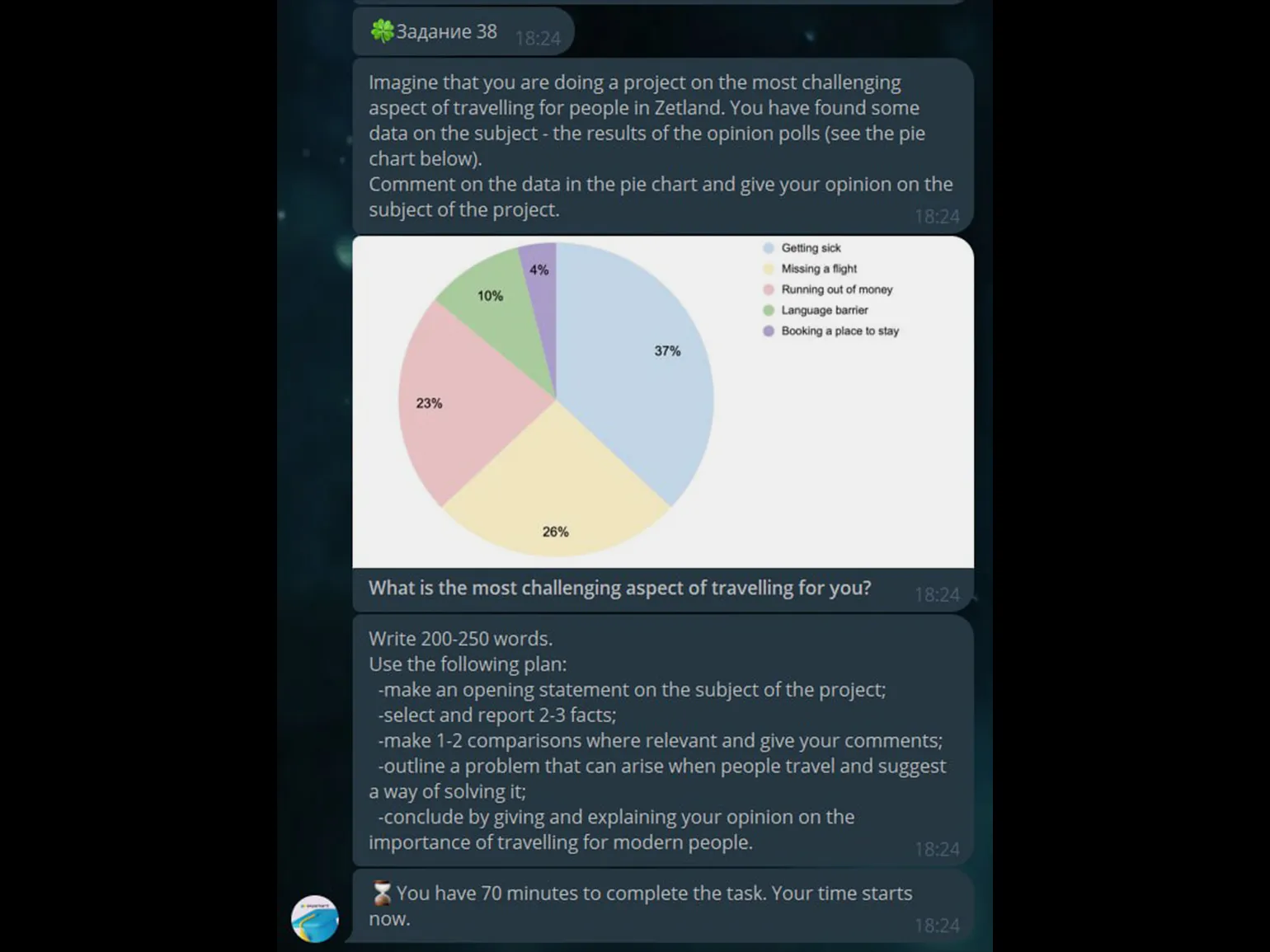
Chat-bot "Skysmart AI USE Expert" provides tasks on oral and written parts of the Unified State Exam in English. It instantly checks your answers, which allows you to effectively prepare for the exam.
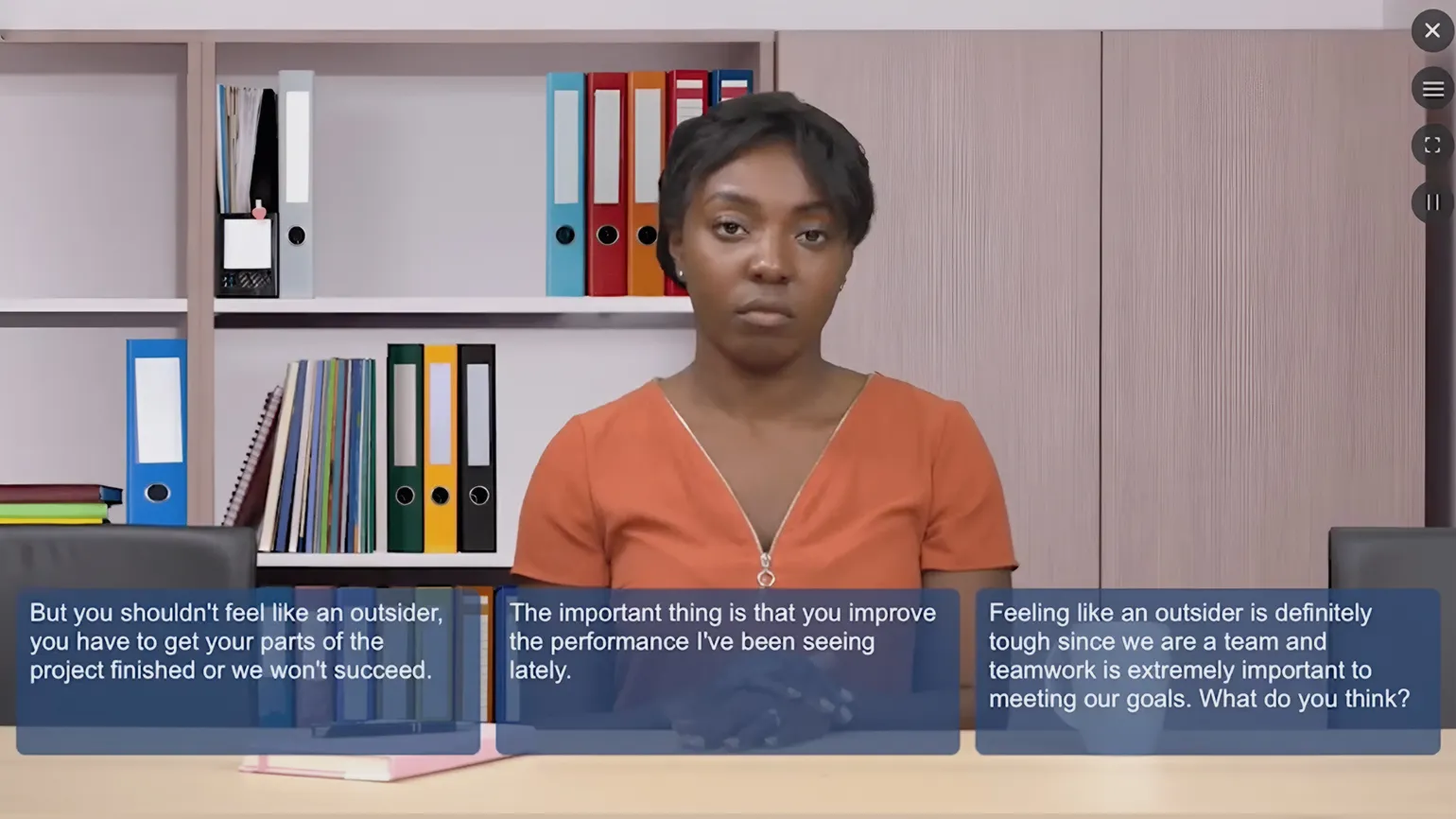
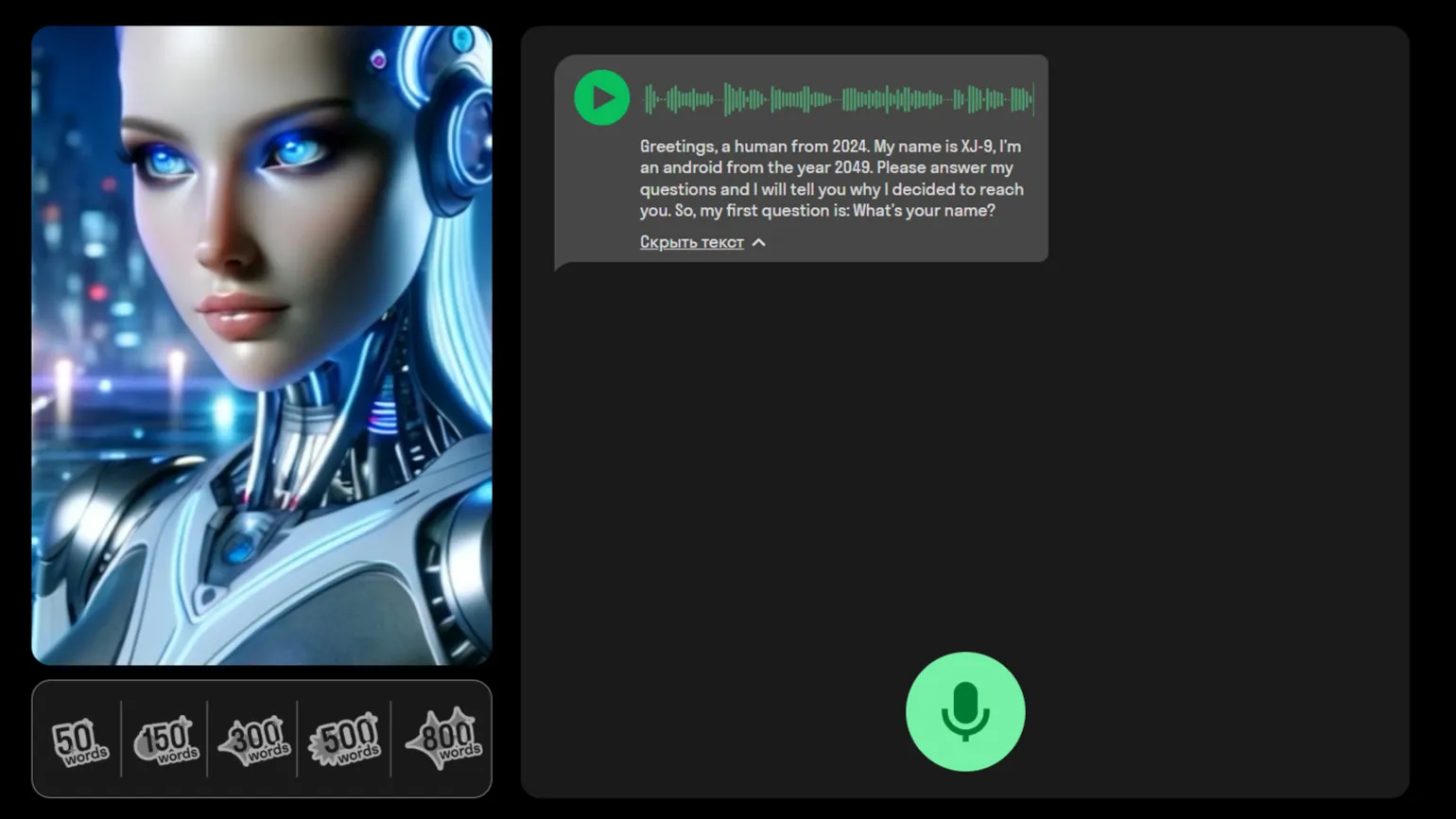
This is a dialogue simulator based on artificial intelligence, which uses technologies from the American gaming simulator SkillGym. In this simulator, the user is given the opportunity to interact with a character created based on an actor's image. The character demonstrates realistic reactions, adapting to the user's actions. This provides a unique communication experience and helps develop interaction skills in various situations.
Artificial intelligence in education has become an important tool, capable not only of explaining educational material but also of providing assignments for independent work and checking their completion. In 2023, significant progress is being made in this field, thanks to the emergence of services such as ChatGPT and similar solutions based on generative language models, including Google's Gemini and YandexGPT. These technologies open up new possibilities for creating educational bots that can adapt to student needs and improve the learning process.
The tools mentioned above are known as AI tutors, AI tutors, and AI assistants. Today, such technologies are most actively used on educational platforms focused on teaching children mathematics and computer science, as well as foreign languages for all age groups. Ivan Illarionov, Director of Development for the Samoletum educational vertical, part of the Samolet Group, explains this trend. He notes that algorithmic subjects like mathematics and computer science represent a "low-hanging apple" for creating subject-specific AI assistants, as developing them for these disciplines is significantly easier. However, creating AI tutors for more abstract subjects is also possible. For example, Samoletum successfully developed an AI tutor for social studies. This confirms that AI technologies can effectively adapt to various educational fields, expanding learning opportunities. Mastering a foreign language involves many systematic actions. This process requires regular practice of grammar rules and vocabulary memorization exercises. Effective language learning is based on an algorithmic approach that helps structure learning and achieve results.
Read also:
AI assistants in education have made significant progress. They are able to adapt educational material to the individual needs of students, providing a personalized approach to learning. AI also helps automate routine tasks, such as checking homework and grading tests, allowing teachers to focus on more important aspects of teaching.
Furthermore, modern AI technologies can analyze student performance and offer recommendations for improvement. They also facilitate the creation of interactive and engaging learning materials, making the learning process more effective. The use of AI assistants in education opens up new opportunities for students and teachers, improving the quality of the educational process.
Thus, AI assistants are becoming an integral part of the educational environment, increasing its accessibility and effectiveness.
Are AI Tutors Really Beneficial?
The effectiveness of AI tutors compared to human tutors has not yet been extensively scientifically studied. However, the results of an American experiment show that a combination of group math lessons with a tutor and individual lessons on an adaptive online platform can lead to significant gains. Moreover, this approach is more cost-effective than lessons with a tutor alone. The use of AI tutors opens up new possibilities for learning, allowing students to receive personalized recommendations and adapt to their level of knowledge. This makes the learning process more effective and accessible to a wider range of students.
In the American experiment, students worked in groups, which allowed the tutor to devote more individual attention to each child. This was made possible by the adaptive platform, on which some assignments were completed independently. While a tutor worked with one group, other students worked on the platform, and then they switched. This approach promotes more effective learning and the development of self-regulation skills in students.
This approach significantly reduces the number of meetings with a tutor while maintaining a high level of learning effectiveness. A subscription to an adaptive platform, combined with less frequent tutoring sessions, can be more cost-effective than regular individual lessons. As a result, this learning model helps reduce reliance on tutoring, making the learning process more accessible and efficient.
Scientists from China conducted a study on the effectiveness of educational assistant bots, analyzing 24 studies in this field. The results showed that the use of such bots can positively impact student academic achievement. However, the researchers also pointed out several important nuances that should be considered.
- Over time, the positive effect of using bots decreases.
- Such tools have a noticeable positive effect only on adult learners, and no statistically significant improvements were found among schoolchildren.
A second explanation may be related to the fact that children are not always able to clearly formulate their written requests to the chatbot and fully understand its responses. This is especially true in cases where the use of mathematical terminology is required. This was noted by American expert in the field of mathematics education Dan Mayer. Understanding and applying mathematical concepts can be difficult for children, which can hinder interaction with educational technologies.
A review published in May 2023 analyzed studies on less sophisticated bots than those currently available. The development of tools based on generative neural networks is proceeding rapidly. Today, it is possible to communicate with smart bots by voice, which is much more convenient for children compared to text correspondence. Whether this simplifies communication during math lessons remains an open question, but it's clear that this form of interaction is highly effective for learning foreign languages.
Modern technologies offer students unique learning opportunities using chatbots. These tools can engage in dialogue, detect speech errors, provide wording recommendations, explain grammar rules, and check spelling. Anton Makarov, Academic Product Manager at Skyeng online school, emphasizes the importance of such solutions in the educational process. Using chatbots significantly improves the quality of learning and allows students to develop language skills, making the learning process more effective and interactive.
The speaker notes that AI products still face challenges in creating personalized programs for users. However, he is confident that solving these problems is only a matter of time. Modern AI tools are already capable of identifying each student's weaknesses more effectively and cost-effectively and adapting content to their needs compared to traditional tutors. Ivan Illarionov argues that artificial intelligence can effectively prevent pedagogical neglect by acting proactively. AI assistants can quickly fill in students' knowledge gaps, for example, helping C-grade students reach the level of B-grade students. Thus, the introduction of AI-based technologies into the educational process can significantly improve the quality of education and adapt it to the individual needs of each student. AI tutors can already seriously compete with traditional teachers, but the situation is not so clear-cut. Despite impressive advances in artificial intelligence, certain limitations exist that prevent them from completely replacing human teachers. It is important to consider that human contact and a personalized approach remain key factors in the educational process. Nevertheless, AI tutors offer many advantages, including accessibility, adaptive learning, and the ability to work at any time. The prospects for the development of such technologies are encouraging, and we will likely see their more active implementation in educational systems in the future.
Disadvantages of AI Tutors Compared to Human Tutors
Experts at the Thomas B. Fordham Institute in the United States, having analyzed numerous sources, concluded that AI educational services provide tangible benefits only to the most motivated students. As an example, the researchers cited data collected from nearly 6,000 users of Khan Academy, a popular American platform for studying school subjects. It turned out that only 11% of users are willing to follow recommendations and use the platform for 30 minutes a week. The remaining users do not demonstrate the same activity. However, it is these 11% of the most motivated students who demonstrate better academic results than the rest. This study highlights the importance of motivation in using educational technologies and their impact on academic success.
The effectiveness of using digital learning resources, including AI tutors, depends largely on the level of self-organization and diligence of students. Children and adolescents who are able to extract maximum benefit from traditional textbooks demonstrate high motivation to learn. However, such students, unfortunately, are not numerous. This confirms the need to create more adaptive and intuitive educational tools that can support all students, regardless of their initial level of self-organization.
Children often struggle with self-organization, which complicates their learning using automated systems. Successful mastery of the material requires adult supervision. However, it is worth noting that not all adults are equally capable of learning effectively on their own. Olga Rebko, an English tutor, emphasizes the importance of support and guidance during the learning process.
Anton Makarov shares this view. He believes that even with the development of neural networks that improve student engagement in the educational process through gamification, adaptability, and personalized feedback, they cannot completely replace the human ability to motivate, inspire, and support. The human element in learning remains indispensable, as it creates the emotional connection and support that play a key role in the learning process.
Tutors will not disappear, but their role will change. Hard skills and the "knowledge carrier" function will lose their former significance. Instead, qualities such as empathy, the ability to motivate students, and adapt to their needs will become key. Digital literacy will also become especially important, as it will unlock the potential of artificial intelligence in the educational process.
Maria Kosberg, head of the educational content team at the interactive homework platform "Skysmart Class," emphasizes that, despite the availability of modern technologies that allow children to learn effectively without the involvement of a teacher, completely replacing tutors is impossible in the near future. The main reason is that neural networks lack empathy, which plays a key role in the educational process. Although technologies are already capable of recognizing users' emotions, they lack the ability to realistically express their own emotions. This aspect of neural networks' lack of emotional intelligence was also noted by Ivan Illarionov.
We conducted a survey among tutors to determine whether they believe the development of AI assistants poses a threat to their profession. The results showed that most do not see this as a threat. The main reason is that even the most advanced neural networks cannot influence a student as much as a real person. A tutor's work involves not only imparting knowledge and developing skills, but also having a significant emotional impact on the student. This is especially true for those who lack motivation and self-discipline, and who lack confidence in their abilities. In such cases, the tutor's personal influence becomes especially important. In addition, almost all of the surveyed tutors are confident that the teacher's personality plays a key role in the educational process, and this quality cannot be imitated using artificial intelligence.

Be sure to check out the additional materials:
Self-regulated learning is a process in which the learner independently manages his or her learning, Setting goals, planning actions, and evaluating results is an important aspect for both educational technology (EdTech) and higher education institutions.
In a rapidly changing world, self-regulation skills are becoming critical. For EdTech, self-regulated learning opens up opportunities to develop adaptive educational platforms that take into account the individual needs of students. This helps increase motivation and learning effectiveness.
For universities, implementing self-regulated learning principles helps students develop the skills necessary for career success. Students who are able to independently manage their educational process are better prepared for the challenges of the modern labor market.
Therefore, the development of self-regulated learning is a key area for both educational technology and higher education, contributing to the creation of a more flexible and effective educational environment.
English tutor Anastasia Kichkireva divided her work into separate functions to determine which of them an AI assistant can perform. It turns out that artificial intelligence is only capable of selecting personalized materials, evaluating students' written work, and analyzing their oral speech, including the correctness and appropriateness of their vocabulary. However, according to Anastasia, there are significantly more functions that are inaccessible to artificial intelligence.
- performance coaching, that is, the ability to support a student before an exam, encourage them before an interview, and “contain” negative emotions;
- transfer of life experience (ways to cope with certain life tasks using the language being studied);
- help in overcoming the trauma of previous unsuccessful experiences - for example, from classes with an overly strict teacher;
- organization of class time (according to Anastasia's observations, many people are motivated by the knowledge that a teacher is waiting for them at a certain time, which means they cannot simply cancel a class - whereas canceling a class with an AI tutor is unlikely to cause a feeling of awkwardness);
- transmission by the teacher of his way of thinking (how he analyzes, what connections he notices and how he teaches others to do this).
German Tutor Alexandra Plotnikova expresses doubts about how an AI assistant will be able to effectively handle her usual tasks. These tasks include adapting educational material to the individual needs of the student, creating interactive exercises for language practice, and providing feedback. Alexandra believes that a personal approach and understanding the nuances of language learning remain indispensable in the teaching process.
- adapting the lesson depending on the student's mood and level of fatigue. Mood and fatigue are often indicated by non-verbal cues, while verbally the student can communicate that everything is fine (almost all of the teachers surveyed mentioned this indispensable practice of reading the student's emotional state and adjusting the lesson content to it);
- explaining the nuances of colloquial speech in cases where very specific or local features are involved.
Fatima Ramazanova, a teacher of French and Russian for foreigners, emphasizes the importance of understanding the psychological block that can arise when communicating in the target language. This block often prevents students from communicating freely with native speakers. Understanding and overcoming such barriers are key to successful foreign language learning. Students should work on their confidence and practice speaking skills to overcome this obstacle and improve their language proficiency.
During their studies at the Faculty of Pedagogy at the university, students study a number of subjects related to psychology. This knowledge helps adapt teaching methods to students' needs, for example, in the event of language difficulties. Artificial intelligence can be effectively used to automate processes and memorize information, but it is difficult to imagine how it will cope with such important tasks as supporting students in overcoming language barriers.
Tutors doubt that AI assistants are capable of providing students with a full-fledged interaction rich in emotion and empathy. According to Margarita Filatova, an English tutor, even if AI tries to imitate human reactions and behavior, users will still recognize that they are not communicating with a real person. This, in her opinion, can lead to a decrease in motivation in students, since the lack of sincerity and emotional connection makes the learning process less appealing.
According to Margarita's observations, most children and adolescents engage in certain activities at the behest of their parents. Although they may have a certain interest and motivation, these feelings are often fickle. Maintaining high motivation in a child over a long period of time is difficult. Parents can play an important role in developing sustainable interest and passion, but without a child's intrinsic motivation, achieving significant success will be difficult.
When students stop doing homework or begin to treat it lightly, involving parents can be an effective intervention. Margarita is confident that parents in such situations take action and motivate their children to study not only because of the financial investment in their education, but also because of a sense of responsibility. Parents often feel embarrassed when their children begin to demonstrate poor results. This feeling of shame can be a powerful motivator for parents to become more involved in their children's learning and help them succeed.
I can't imagine a situation where an artificial intelligence (AI) tutor is present. While such a robot might inform parents that their child is doing poorly, it won't evoke the desired emotional response. In most cases, parents might respond with, "The child didn't do it, so what, he'll do it next time." This means a lack of emotional connection, which is so important for children's motivation and success. The sense of responsibility and shame that comes from interacting with a living person plays a key role in learning. Emotional support and personal engagement are important factors in student success, and these are precisely what a machine cannot provide.
One of the main drawbacks of AI tutors is the limited teaching methods they use. Teachers can not only choose from a variety of preset methods but also creatively combine them, creating unique programs tailored to the individual needs of each student. This allows them to more effectively accommodate different learning styles and ensure deeper learning. While AI tutors offer standardized solutions, a human teacher can integrate personalized materials and approaches, significantly improving the quality of education.
The teaching of mathematics, despite its algorithmic nature, does not lend itself to complete digitalization. This is because the study of mathematics involves not only completing formulaic tasks but also developing analytical thinking. Mathematics tutor Katerina Gordeeva emphasizes that the main task of a teacher is to teach students to think critically, to go beyond the familiar, and to build logical connections, rather than simply following established algorithms. Furthermore, students often require multiple explanations of the same concept in different ways, highlighting the importance of a personalized approach to learning.
In mathematics, the key is understanding each step, not simply memorizing solutions to typical problems. I regularly ask my students after each step, "Why is it that way?" This helps develop critical thinking and process awareness. Each problem can have multiple solution methods, so it's important to support the student in finding their own approach, guiding and suggesting rather than offering a ready-made solution. I don't believe artificial intelligence can fully accomplish this task.
According to her observations, artificial intelligence currently has difficulty solving a number of mathematical problems. However, she is confident that in the future, AI will become an important and indispensable tool for both mathematics teachers and their students. The use of AI in the educational process can significantly improve the understanding of mathematical concepts and make learning more effective.
AI tutors, despite their simplicity, are sometimes criticized. This is due to the settings of specific platforms and services. For example, mathematics education expert Dan Mayer criticized the Khanmigo chatbot, which runs on GPT-4 and assists users of the Khan Academy educational platform. The main problem is that the chatbot does not provide positive feedback, an important pedagogical technique for supporting the learning process. Effective use of AI in educational technologies requires consideration of aspects such as student motivation and support, which can significantly improve the quality of learning. Arkady Zilberman, an expert in foreign language teaching and CEO of Language Bridge Technology, argues that simply correcting users' grammar and pronunciation errors, as conversational digital assistants on language platforms do, does not promote retention. This thesis, however, requires further research verification.
Maria Kosberg, head of the educational content team at Skysmart Class, an interactive homework platform for teachers in Russian schools, and Ivan Illarionov, development director at Samoletum, highlight an important reason why neural networks are inferior to human tutors. Artificial intelligence requires constant learning. Ivan emphasizes that the effective development of AI technologies in education requires decisive steps aimed at fostering a data-centric management culture and intensifying digital data collection in the educational sector. Maria adds that regularly updating neural networks requires up-to-date databases, which are currently underdeveloped in educational institutions. Therefore, creating high-quality content and collecting data are becoming critical to increasing the effectiveness of AI in education.
Teachers and AI tutor developers view these technological solutions as support for teachers, not competition. Most of the teachers surveyed are actively studying and implementing AI tools in their practice, confirming the growing interest in integrating technology into the educational process. The use of artificial intelligence in education allows us to increase the effectiveness of teaching and personalize the approach to each student, which makes learning more accessible and of higher quality.
Reading is an important part of our lives and helps us develop our thinking, broaden our horizons, and gain new knowledge. In the modern world, access to information has become easier, and everyone can find interesting books or articles on any topic. Reading not only improves writing skills but also promotes analytical thinking. Regular reading helps strengthen memory and concentration. It's important to choose the right materials to make reading not only useful but also engaging. Regardless of the genre, be it fiction, scientific articles, or business books, there's something for everyone. Don't miss the opportunity to enrich your inner world through reading. ChatGPT Requests for Educators Educators can use ChatGPT for a variety of educational purposes. For example, they can request lesson ideas, lesson preparation materials, or classroom management tips. Receiving recommendations on student assessment methods is also helpful. Creating interactive assignments and quizzes is another area where ChatGPT can greatly facilitate teachers' work. For a deeper understanding of a topic, you can ask questions about modern educational technologies or request information on best teaching practices. By using ChatGPT, teachers can improve the quality of their teaching and make the process more engaging and effective.
Who AI tutors can actually displace
Anastasia Kichkireva notes that artificial intelligence is capable of performing certain job functions, although most tasks remain beyond its reach. She believes that in some situations, AI can compete with humans, especially in short-term situations and when performing highly specialized tasks.
Ilya Khistraktor, an experienced history and social studies tutor, the creator of two online courses for preparing for the Unified State Exam (USE) and a teacher at an online school, expresses the opinion that the gradual introduction of artificial intelligence and the automation of routine tasks may in the future lead to the replacement of teachers who do not provide a personalized approach.
In my opinion, the tutoring market will evolve in a direction where affordable educational solutions will base their services on artificial intelligence. At the same time, premium educational products will continue to use human teachers, which will become their unique advantage in the learning process. This separation will allow us to meet the needs of different client categories and improve the overall quality of education.
Alexey Bogdanov, a computer science teacher and developer of an educational AI platform, believes that platforms that adapt to student patterns and academic subjects will be able to replace not only some, but most tutors in the future. He is confident that artificial intelligence is capable of handling any task, and many will be successfully completed by 2030. This opens up new opportunities for education and emphasizes the importance of integrating technology into the learning process.
Alexey is confident that online schools with high-quality platforms have already significantly increased their market share, displacing tutors. The tutoring market is shrinking every year. Platforms are becoming the primary sources of knowledge and tools for skill development, while traditional live tutoring is becoming expensive and less accessible. It is gradually transforming into coaching and mentoring. Nevertheless, Alexey acknowledges that humans still require live contact, so parents will continue to seek tutors for their children. Ultimately, the question of whether AI tutors can replace most human competitors depends not only on the level of technological advances in mastering "purely human" functions. It also depends on whether people are willing to embrace and trust these technologies en masse, especially when it comes to educating their children. Trust in AI in the educational process will be a key factor in its success and prevalence.
Online course producer from scratch to PRO
You will learn how to launch profitable courses and webinars with minimal investment. You will understand how to turn existing EdTech projects into profit and make money from online learning.
Find out more