
Contents:

Learn: The Methodologist Profession from Beginner to Advanced
Learn MorePsychometrics is a science that measures and diagnoses human behavior and psychological characteristics. Based on psychometric data, tests are developed that are actively used in psychology, pedagogy, sociology, and other fields related to the study of humans. Closely related to psychometrics, testology is a theoretical and applied discipline devoted to the creation of diagnostic tests and the interpretation of their results. Psychometrics and testing play a key role in understanding the human psyche and facilitate a more in-depth analysis of individual differences. Psychometrics has not yet become widespread in Russian education, although it is a powerful tool for objectively and qualitatively measuring various aspects, from knowledge on a specific topic to creativity. For those interested in studying psychometrics, creating high-quality educational tests, and effectively organizing testing, we present this book selection. It was compiled in collaboration with Alena Kulikova, Academic Director of the Master's program "Learning and Assessment as a Science" and a research fellow at the Center for Psychometrics and Measurement in Education at the Institute of Education at the National Research University Higher School of Economics. This collection will be a useful resource for educators, researchers, and anyone seeking to improve assessment methods in the educational process.
"Psychometrics: Introduction"

This essential guide to psychometrics is intended for both beginners seeking an introduction to the fundamentals of the science and experienced professionals facing more complex issues and challenges in their practice. Psychometrics, as the field that studies the measurement of psychological characteristics and traits, requires a thorough understanding of both basic principles and advanced techniques. This guide will help readers gain a clear understanding of key concepts and provide solutions to common challenges psychometricians may face in their work.
The book opens with an introduction to key concepts related to the measurement of human behavior and psychological characteristics. Next, the authors analyze in detail such important parameters as reliability, validity, and reliability of psychological tests. Particular attention is paid to threats to testing quality, including bias and response bias. The publication concludes with a series of chapters devoted to modern psychometric approaches that improve methods for assessing and analyzing psychological data.
In the preface, Fehr and Bacharach point out that psychometrics can be presented in a simple and understandable form. In their book, they offer an accessible presentation of the theory, which makes the material understandable even for those who are not professionals in this field.

Reading is an important aspect of personal and professional development. It helps expand your horizons, improve your vocabulary, and develop critical thinking. In today's world, where information is available in vast quantities, quality reading is becoming an especially valuable skill. To maximize your time spent reading, it's important to choose literature that aligns with your interests and goals. Consider a variety of genres: fiction, scientific articles, and specialized publications can enrich your experience. Regular reading not only promotes learning but also promotes relaxation, which has a positive impact on mental health.
Read also:
Ready-made online tests can be a convenient and time-saving tool for testing knowledge and preparing for exams. However, it's important to consider several factors before using them. First, the quality of tests can vary greatly, and not all of them meet current curriculum requirements. Second, relying solely on ready-made tests can lead to insufficient understanding of the material. It's recommended to use such tests as a supplement to core study materials, rather than as the sole source. This will allow for a deeper understanding of the topic and more effective preparation. It is also important to check the relevance and reliability of the sources from which the tests are taken in order to avoid common errors and shortcomings.
"Composition of test tasks"

This book is a valuable guide for educators seeking to apply a scientific approach to test development. The author offers key theoretical foundations, but the main focus is on practical aspects, which allows readers to effectively implement the acquired knowledge in their work. This publication will become an indispensable assistant for those who want to improve the quality of assessment and testing in the educational process.
Avanesov analyzes the key types of test items, examining in detail their structure, including instructions for participants, content, answer options, and evaluation criteria. The reader will understand how to correctly develop items with multiple correct answers, open-ended questions, as well as matching and sequencing items. The book also presents separate chapters devoted to the principles of validity, reliability, and effectiveness of tests, the interpretation of results, and methods for selecting materials for creating items. All these topics are illustrated with examples from various fields of knowledge, including the humanities and natural sciences. This approach allows for a deeper understanding of testing methodology and improves the quality of the tests created.
The author has his own website, which contains articles, lectures, and other useful materials on pedagogical measurement. These resources are available to everyone and can be a valuable source of information for teachers and students interested in this topic.
«Fundamentals of Testology»

This manual presents a brief history of the development of testing as an assessment method, as well as the main terms and concepts of testology. The author analyzes various test formats, including closed and open-ended, as well as their strengths and weaknesses. The book also examines in detail various types of tasks, such as matching, addition, and free-form tasks. These aspects will help readers better understand the pitfalls of testing and its application in educational practice.
One of the chapters is devoted to test item design, focusing on the optimal structure and design of elements to ensure comfortable interaction between the test taker and the test. Semenovskaya also examines the basic principles of composing test items and analyzes common errors in wording. Such errors include redundancy, ambiguity, unintentional clues, and the use of metaphorical expressions. Proper assignment formatting and attention to detail will help improve the quality of testing and the accuracy of results.
This manual is designed primarily for student teachers specializing in "Philological Education." It includes examples from Russian language tests, including Unified State Exam (USE) materials. However, the recommendations and principles outlined by the author are universal and can be successfully applied to creating tests in various subject areas.

Read also:
Translating a good foreign text into Russian may seem like a simple solution, but this process requires Translation requires much more effort than it might seem at first glance. This is because each language has its own unique characteristics, including grammar, syntax, idioms, and cultural contexts. Direct translation can result in the loss of the meaning, stylistic nuances, and emotional content of the original. Furthermore, it's important to consider the target audience and their perception of the language. Effective translation requires a deep understanding of both the source and target languages, as well as the cultural aspects that may influence how the text is perceived. Therefore, it's important to approach translation responsibly to preserve the original idea and bring it to a new context.
«Testing of educational achievements»
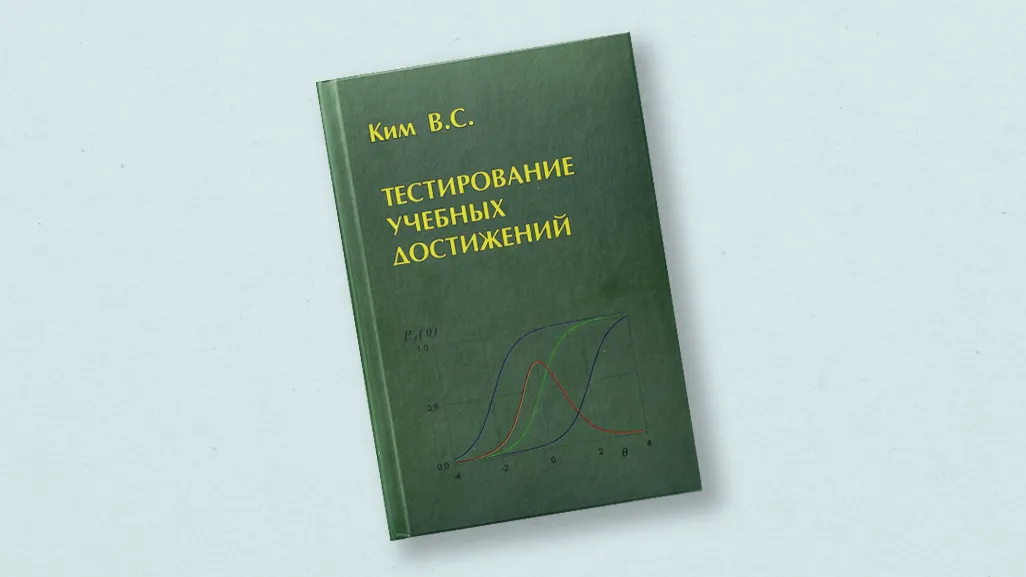
The first chapters of this monograph examine the key concepts of testology, as well as the principles of the structure and design of test items. However, the author focuses primarily on methods for improving the quality of testing, which is an important aspect in the field of knowledge and skills assessment.
Vladimir Kim notes that even if the developer managed to create high-quality tasks in a test format, this does not guarantee that they are truly effective test items. A real check of their performance is possible only after testing in conditions close to real ones. To assess the reliability and validity of the developed test, it is important to identify weaknesses in the tasks and ways to improve them. Kim emphasizes that statistical analysis of test results is an important tool for achieving this goal and occupies a central place in one of the chapters of his work.
The author examines the influence of test takers' motivation on test results and suggests ways to take this factor into account when analyzing data and converting scores into grades. The final chapter of the monograph discusses Item Response Theory, which is a modern method for designing, analyzing, and evaluating tests. This approach allows for a more accurate assessment of test takers' abilities and adaptation of tests to their level of preparation.
"Test Control in Education"

This manual analyzes pedagogical measurements through the prism of education quality, considering them as an effective tool for assessing and improving educational outcomes.
The first chapter focuses on the concept of educational quality, its main criteria and indicators. The author analyzes monitoring methods at various stages of education, including entrance, ongoing, and final testing, and also considers various types of assessment materials and procedures. The manual also discusses the basics of test construction. A separate section is devoted to qualimetric monitoring, which is the measurement of educational quality using quantitative indicators. As the author notes, this approach allows not only to assess student achievement but also to certify teachers and educational institutions.
The book examines testing as a key method for both academic performance monitoring and learning. The author shares recommendations for organizing educational testing and offers strategies for preparing students for tests. This approach not only helps to assess knowledge, but also promotes deeper assimilation of the material.
«Theory and Practice of Designing Pedagogical Tests»

This manual is intended for teachers and educators who are developing homogeneous tests for the first time. Homogeneous tests in psychometrics are tools for assessing knowledge in one specific subject. This distinguishes them from heterogeneous tests, which are aimed at assessing interdisciplinary knowledge. Homogeneous tests help to more deeply assess the level of material assimilation and identify gaps in students' knowledge, which contributes to a more effective learning process.
The author examines the various types and functions of pedagogical control, as well as the stages of test development and the principles of choosing their content in accordance with educational goals. Chelyshkova also examines various forms of test items and provides a comparative analysis. A separate chapter focuses on the collection and analysis of test results, as well as issues of test validity and reliability. The author also discusses methods for interpreting test results and assigning grades, which is an important aspect of assessing educational achievement.
The book examines the use of testing in collaborative settings between teachers and students. The author proposes a methodology for selecting assignments tailored to students' knowledge levels. This methodology aims to ensure that performance monitoring not only assesses knowledge but also motivates students to learn, preventing the urge to simply copy correct answers. This approach promotes a deeper understanding of the material and active student participation in the learning process.
"Reference Guide to Test Construction"

This book is a unique reference book in which the reader will find detailed explanations of many specialized terms in the field of psychometrics. In addition, it serves as a methodological guide, providing valuable recommendations for test development.
The author of this book is a British psychologist, and it primarily focuses on psychological tests. However, the information presented by Kline will be useful for creating valid and reliable tests in various fields, including pedagogy. In addition, the second chapter of the manual is entirely devoted to the development of cognitive tests, which includes traditional knowledge tests widely used in educational practice.
Paul Kline deeply analyzes various types of tasks in his book. He is not limited to standard multiple-choice questions, but also considers tasks on analogy, determination of sequence and correspondence, as well as tasks in which it is necessary to identify the odd one out. For each type of task, the author offers effective principles for their development and use. An important part of Kline's work is item analysis, including assessment of test reliability and validity, making his work useful for specialists in the fields of education and psychometrics.
"Psychological Testing"

This publication is a comprehensive encyclopedia of testing. The authors thoroughly examine the history and background of testing in its modern format, and also discuss the use of tests in various fields, including education. The book covers key concepts, such as test reliability and validity, and presents various types of tasks. This guide will become a valuable resource for testing specialists and anyone interested in the development of assessment and diagnostic methods.
The book examines ability tests, including academic achievement tests. Anastasi and Urbina analyze both individual tests and tests designed for specific populations, such as preschoolers and people with mental retardation. Group testing methods, including computerized versions, are also discussed. Particular attention is paid to the ethical and social aspects of testing, which highlights the importance of a responsible approach to ability assessment.
Learn more about educational trends and news in our Telegram channel. Subscribe to stay up-to-date with important updates!
Reading is an important part of our lives, and it brings many benefits. It not only develops mental abilities but also broadens horizons. Reading books, articles, and other materials helps improve vocabulary and writing skills. In addition, regular reading helps reduce stress and improve concentration. It is important to choose a variety of genres and topics for reading to enrich your knowledge and discover new passions. Remember to set aside time for reading every day to get the most out of this activity.
- Psychometrics: What is it and why is it needed in education?
- Developing educational tests: instructions on how to do it.
- How to take an online test in the Russian service myQuiz.
- How to make tests that work. An excerpt from the Edutainment textbook.
The Methodologist profession from scratch to PRO.
You will improve your skills in developing curricula for online and offline courses. You will master modern pedagogical practices, structure your experience and become a more sought-after specialist.
Find out more