

Learn: Educational Program Methodologist
Learn moreRobert Gagné is a prominent American educational psychologist. He received his bachelor's degree from Yale University and his doctorate from Brown University in 1940, which led him to begin his career in experimental psychology. Gagné was one of the first to explore the possibilities of computer-assisted learning and taught at renowned universities in the United States. His expertise in instructional design formed the basis for numerous publications, including several seminal books on learning. His work "The Conditions of Learning," first published in 1965, became most popular among education professionals. In this book, Gagné presented levels of learning and nine key teaching events, which are essential steps in the educational process that contribute to its effectiveness. These ideas remain relevant and in demand in the modern educational context.
Based on these events, training programs are being developed for both children and adults.
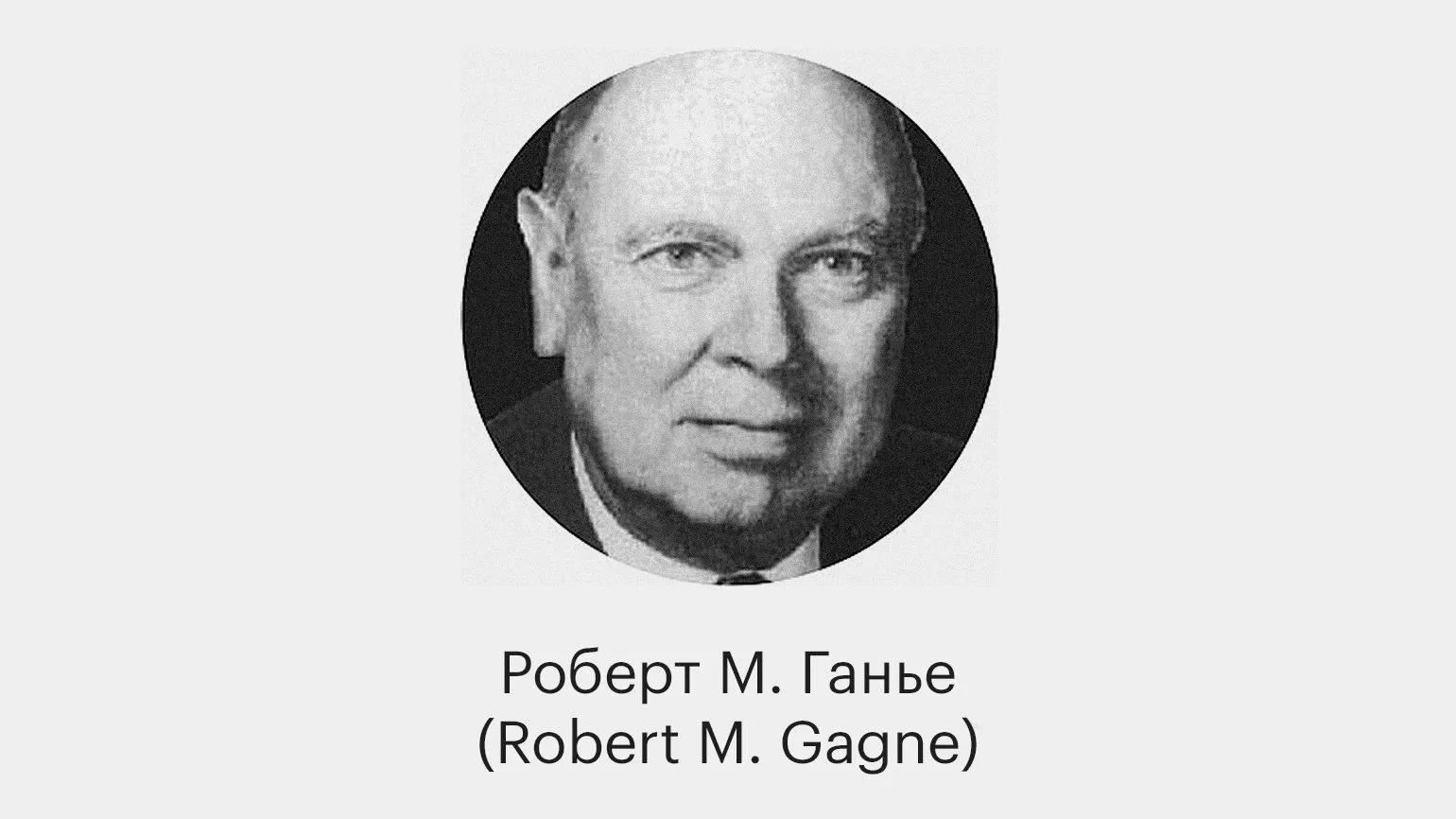
What is the essence of Robert Gagné's approach?
Teaching, According to Gagné, internal learning is a set of external events that support a student's internal learning processes. Internal events include physiological processes occurring within the learner, such as the perception of information through the senses and its storage in long-term memory. These elements play a key role in successful learning and knowledge formation, as they ensure the assimilation and integration of new information. Understanding these processes helps educators develop effective teaching strategies and increase student engagement.
Gagné argued that the primary goal of teaching is to facilitate internal learning processes. The student must move from one state of consciousness to another. The teacher plays a key role in this transition, which Gagné describes as a sequence of nine events. These events help structure the learning process and make it more effective, promoting a deep understanding of the material and better assimilation of knowledge.
All of the stages discussed were known to pedagogy before the development of Gagné's system, but they did not have a clearly defined structure. Gagné systematized these stages, combining them into a single methodological framework.
The scientist indicated that the sequence of events he proposed is the most accurate, but adherence to this order is not mandatory.
Some of the processes may be redundant. To determine which events can be skipped, Gagné suggests creating a checklist and evaluating each stage. It is important to ask the question: "Do students need support at this stage?" This will help optimize the learning process and focus on what is truly necessary, which will increase the effectiveness of the educational process.
The purpose of the nine events is to stimulate internal learning processes, not replace them. The more independent students become, the more teaching opportunities they take on. Gagné described this process as self-instruction. Effective self-study helps develop critical thinking skills and increases student engagement in the educational process.
In classes organized according to the Gagné event model, students have the opportunity to:
- understand the structure of the learning process;
- stay focused on the learning goal;
- construct new knowledge based on what they have already acquired;
- independently find answers to emerging questions;
- use acquired skills and knowledge in practice.

Teachers and methodologists should be aware of nine key events that can significantly improve their professional practice. These events promote the exchange of experience, professional development, and the implementation of innovative teaching methods. Participation in such events helps them stay informed about current trends in education, develop professional skills, and establish useful contacts with colleagues. This, in turn, positively impacts the quality of the educational process and increases the effectiveness of teachers.
- make lessons more structured;
- state learning objectives in language students can understand and stick to them;
- mentor students who are working independently;
- remember the importance of feedback;
- avoid cognitive biases when assessing students' work (when you want to praise yourself for the fact that the student seems to have learned everything, but in fact, he is far from it).
What are Gagné's nine events?
Let's look at each event in more detail, based on their description in the book "Conditions of Learning" and Gagné's later work "Principles of Instructional Design", published in 1974. Gagné uses examples from school pedagogy, which, due to their simplicity, are easy to understand and allow us to understand how these events can be adapted for adult learning. Effective instructional design incorporates these principles, which can significantly enhance the quality of the educational process and improve learning.
To effectively capture students' attention, it is necessary to arouse their curiosity. This can be done by varying stimuli, as in cinematography, or using phrases such as "Now notice this" or "What do you see here?" Visual accents, such as underlining, italics, bold font, and the use of different colors in educational materials, also help focus attention on key points. Furthermore, it is important to consider students' interests, which requires an individualized approach to learning, as each student has their own interests and preferences. This will increase engagement and make lessons more effective.
The main goal of this stage is to clearly define the criteria for successful learning. Students should have a clear understanding of the expected results. This understanding will allow them to more effectively focus on the learning process and achieve the set goals.
Learning goals are sometimes obvious. For example, it doesn't take much effort to explain the purpose of swing practice to a beginning golfer. However, when a student is learning about decimals, it's important to clearly set expectations: they should understand how to read fractions, or perhaps learn how to add them. Clear learning objectives promote more effective learning and increase student motivation.
"The student shouldn't have to guess what the teacher is thinking," noted Gagné. Discussing lesson objectives takes little time, but it's important for creating clarity. This helps both students and teachers stay on track and avoid going off-topic. Clearly stated objectives promote effective learning and increase student motivation, which in turn improves learning outcomes.
When teaching children, it's important to use accessible and understandable language. For example, an elementary school teacher wouldn't give students complex tasks such as: "Form a correct sentence using nouns that refer to the object and subject of the action and one action verb." Instead, he'll say, "We have three words: 'boy,' 'dog,' and 'catch.' Combine them into a phrase: 'The boy caught the dog.' This is called 'making a sentence.' I want you to do the same with the new words I'm showing you." This approach helps children better understand the tasks and develops their sentence-forming skills.
Learning tasks should be explained in a similar way to other students, including adults, especially if they are encountering a new topic. Clear and accessible explanations help students retain the material and facilitate the learning process.

Learning often relies on connections to previously learned concepts, as Gagne notes. For example, it's impossible to teach students how to calculate mass if they don't understand concepts like acceleration, force, and multiplication. Therefore, before introducing new ideas, it's important to review and reinforce existing ones. Before a student can learn that sodium is a metal, they must first remember what sodium is and what metals are. This approach helps deepen understanding and promotes more effective learning by creating a solid foundation for learning new topics.
Retrieving information from memory of previously learned material highlights the importance of contiguity in learning, as noted by Gagné. When two ideas are learned within close time intervals, a connection is formed between them. Ultimately, when one idea is encountered, the other is automatically activated in memory. Ideally, new knowledge should extend this chain of associations. This should be taken into account when designing curricula to increase their effectiveness and improve learning.
Explore the forgetting curve and how it affects the process of remembering information. Understanding this concept will help students more effectively absorb and retain knowledge over the long term. The forgetting curve demonstrates how quickly we forget information once it's acquired, emphasizing the importance of repetition and active engagement in the learning process. Adopting strategies based on the forgetting curve, such as regular review and using a variety of study methods, can significantly improve retention and memorization.
The essence of this event is clear: the teacher demonstrates the learning material to the student. If the student's task is to learn to read aloud, they are provided with the corresponding words. If the student must master a sequence of historical events, these events are described to them. Thus, the key moment is direct interaction between the teacher and student, which promotes deeper understanding and assimilation of information.
It is important to be careful when choosing learning materials. It is necessary to avoid providing students with content that does not contribute to the stated learning objectives. Properly selected resources promote the effective acquisition of knowledge and skills, which has a positive impact on learning outcomes.
If the learning goal is to teach students to answer oral questions in French, they should focus exclusively on oral practice. Ignoring this recommendation can lead to undesirable consequences, when students develop a skill, but not the one that was originally set as a goal. It is important to remember that correct practice is the key to successful language acquisition. To achieve desired results, the learning process must be focused on the specific skills that need to be developed.
New material must be accompanied by numerous examples. The more examples presented, the more visual and understandable the content will be. This will help readers better absorb the information and apply it in practice.
The essence of this event is to gently motivate students to actively participate in the learning process. This is achieved through the use of guiding questions that encourage students to analyze the material more deeply and develop critical thinking. This approach promotes more effective knowledge acquisition and increases student engagement.
The teacher guides students' thoughts, encouraging them to connect previously learned concepts with new knowledge. The level of this mentoring varies depending on the complexity of the skill or information being mastered, as well as the speed with which each student assimilates new ideas. Effective teaching requires a personalized approach to accommodate different learning paces and ensure deep understanding of the material.
A teacher could explain that current flows from higher to lower potential. However, instead, they take a different approach: "Remember that one point in an electrical circuit can have a higher potential than another. Which direction do you think the current will flow?" This approach not only reminds students of previously learned material but also encourages them to formulate their own rule, which fosters a deeper understanding of the topic.
Students who learn quickly may dislike excessive guidance and may become irritated by simple questions. To determine the optimal degree of mentoring, Gagné recommended using it periodically, carefully monitoring students' reactions. Some students only need one leading question, while others may need three or four additional questions to fully understand the topic. It's important to tailor your approach to each student to support their learning process as effectively as possible.
It's important to consider students' temperaments. Students prone to anxiety are advised to ask simpler questions to avoid causing them additional stress. Meanwhile, students with less anxiety can successfully tackle more complex questions that they perceive as an interesting challenge. By taking these characteristics into account, teachers can more effectively adapt their teaching methods, promoting the development and engagement of all students.
Examples, case studies, analogies, and illustrations are now being actively used to enhance the learning process. These tools help make material more accessible and understandable, promoting a deeper understanding of the topic. The use of real-life examples and visual aids increases student engagement and facilitates better information retention. Thus, examples and cases are becoming an integral part of modern educational methods.

At this stage of learning, students are most likely already confident in their abilities, and the joy of the learning process can be seen on their faces, as Gagne noted. They've realized what it means to understand the material, and now it's time to ask them: "Now show me what you know!" Students must demonstrate the skills or knowledge they've acquired, convincing not only the teacher but also themselves of their academic success. This is an important step in learning, helping to build their confidence and motivation for further development. Students begin with familiar examples and then move on to more complex problems. It's important for the teacher to ensure that students are able to demonstrate the skills they've learned and apply their knowledge in practice. This approach ensures a deep understanding of the material and prepares students to tackle more complex problems in the future.
Learning continues even after a student successfully demonstrates a mastered skill or knowledge for the first time. It is important to provide feedback, clarifying how well the task was completed. This approach promotes a deeper understanding of the material and helps avoid future mistakes. Feedback plays a key role in the learning process, as it allows students to recognize their strengths and weaknesses and motivates them to continue developing.
Feedback in learning can arise naturally. For example, when a student practices playing darts, they independently evaluate their performance based on how close their darts land to the center of the board. In mathematics textbooks, the correct answers are provided at the end of the problem books for this very purpose—to allow students to test their knowledge and understand how well they have mastered the material. This allows them to independently analyze their progress and identify areas for improvement.
Automated feedback does not always ensure complete comprehension of the material. In some cases, additional clarification is necessary. For example, to help a student understand whether they are using the English pronouns "I" and "me" correctly, teacher commentary is indispensable. In math problem books, the correct answers are listed at the end to provide necessary feedback, helping students check their knowledge and improve their skills. Without these clarifications, students may have difficulty understanding the material and may not understand where exactly they went wrong.
It is important to ensure that the student did not achieve a successful result by chance or simply guessing. Gagne recommended eliminating such doubts by asking the student to repeat the action or explain their reasoning. This approach helps assess true understanding of the material and reinforces knowledge.
The teacher must ensure that the student's reasoning is not distorted. To achieve this goal, it is useful to ask questions that cannot be answered simply by rote. This promotes a deeper understanding of the material and develops critical thinking in students.
Course planning should be based on the principle of regular review of material at intervals of several weeks or months. This technique, known as "spaced repetition," allows students to effectively consolidate knowledge and improve its retention. This technique allows students to actively recall previously learned information, which promotes deeper assimilation of information and improves the quality of learning.
Learn the 10 principles of effective learning and teaching proposed by brain researcher John Medina. These principles will help optimize the learning process and make it more productive. Using scientific approaches, Medina offers strategies that can significantly improve the comprehension and retention of information. Applying these principles to educational practice can lead to significant results for both teachers and students.
The ultimate goal of the learning process is transfer of learning, which involves applying acquired knowledge and skills in new situations different from those in which they were taught. For example, in the context of learning English, a student is introduced to the rules of verb agreement with pronouns (e.g., I am, she is, they are). During the training stage, the teacher asks the student to create sentences using these verbs and pronouns. To successfully transfer skills, students are tasked with describing an image using the pronouns and verbs they've learned. This approach fosters a deeper understanding of language and its practical application in a variety of contexts.
Gagne identifies nine key events in the teaching process, emphasizing that when using his framework for lesson planning, it's important to consider the flexibility of the order of these events. In some cases, students will need teacher support, in others, the teaching materials will suffice, and sometimes, students will be able to complete the task independently. The main focus should be on the learning objective to ensure effective assimilation of the material.
Read also:
- 30 rules of learning psychology that a teacher would be good to know
- 8 ways to focus on the student in the curriculum
- Why observations and experiments are more important than textbooks and tests