Contents:
Learn: Profession Methodologist from Scratch to PRO
Learn moreThe modern labor market is undergoing significant changes, and lifelong professions are becoming fewer. Experts say that modern professionals will have to change seven to eight different occupations during their careers. Currently, millions of workers worldwide face the problem of a skills gap, when their skills do not match the requirements of the position. This underscores the importance of continuous learning and adaptation to new conditions to remain competitive in the labor market.
Researchers and practitioners believe that the key solution to this problem is adult retraining. In this article, we discuss the current state and trends of adult retraining in Russia. We will pay special attention to the methods used for professional development, as well as programs aimed at adapting workers to changing labor market conditions. We will analyze what opportunities for retraining are available to Russians and how they contribute to the development of professional skills in the modern world.
- Is it beneficial to study as an adult?
- To what extent are Russians involved in lifelong learning?
- Why do adults go to study?
- And what hinders learning.
What benefits does learning give to adults?
Any expert report or study in the field of education confirms that to achieve success and be in demand in the future, it is necessary to regularly update professional and soft skills. Expanding competencies in related fields or even changing professions will become a prerequisite for many specialists. Currently, continuous education and lifelong learning are a reality for many industries. Investing in personal development and ongoing self-education will not only help you remain competitive but also adapt to rapidly changing labor market conditions.
The participation of the adult working population in education brings significant benefits to the country. Research shows that countries with a high percentage of adult learners have higher gross domestic product (GDP). Employee training contributes to increased productivity and the adoption of modern technologies in companies. Investments in adult education create sustainable economic growth and competitiveness in the global market. Developing workers' skills not only improves their career prospects but also fosters innovation and effective resource management within organizations.
Obtaining additional education significantly impacts the career prospects of adult learners. According to data from Russia, it can lead to an average salary increase of 8%. A survey conducted by the recruiting service SuperJob found that many participants noted that additional education increased their productivity at work, contributed to higher salaries, and contributed to career advancement. These results highlight the importance of continuing education for professional development and financial well-being.
Educational trends are significantly influencing the growing popularity of continuing education in Russia. In recent years, the Russian adult education market has demonstrated rapid growth. However, the heads of leading EdTech companies emphasize that the audience for educational projects remains limited.
According to Skillbox data presented at EdCrunch 2021 by CEO Dmitry Krutov, approximately 40 million people have the potential to participate in education in Russia. However, to date, only about 4 million Russians have purchased EdTech products, including courses on new professions, webinars on specific software, and foreign language lessons. This indicates significant potential for growth and development of the educational technology market in the country.
Statistics show that adults in our country rarely study, even in traditional formats. This indicates a low level of engagement in educational processes. Let's consider this issue in more detail.
How many adult learners are there in Russia?
Continuous education includes various forms of learning that promote the development of knowledge and skills throughout life. It covers formal education, such as studying at universities and colleges, as well as advanced training and professional retraining programs. In addition, continuous education includes informal learning, such as corporate training and seminars, as well as informal self-education, when a person independently studies new topics and skills. Continuous education is a key factor for professional growth and adaptation to changing labor market conditions.
There are various types of adult education that allow you to expand your knowledge and skills. The main forms include vocational education aimed at obtaining new qualifications or improving the level of existing ones. Distance learning also exists, providing the opportunity to study at a convenient time and in a comfortable environment.
Continuing education courses and seminars help adult professionals remain competitive in the labor market. Alternative forms of education, such as evening schools and university educational programs, also play an important role in adult education.
Furthermore, self-education allows people to study topics of interest on their own. This may include reading books, participating in online courses, and watching educational videos. Each of these types of education contributes to the professional and personal development of adults, making them better prepared for the challenges of the modern world.
The International Standard Classification of Education (ISCED), developed by UNESCO, distinguishes three main types of education: formal, non-formal, and informal. In Russia, adults have access to all these types of education, which allows them to expand their knowledge and skills in various fields. Formal education includes traditional educational institutions such as schools and universities. Non-formal education encompasses various courses and trainings, while informal education involves self-education and learning through life experience. The availability of all these forms of education in Russia contributes to the professional development and personal development of adults.
Formal education includes secondary school, as well as secondary and higher vocational education. Successful completion of these educational programs provides the opportunity to obtain the required qualification, which opens the door to further educational programs and enables employment in the relevant field. Formal education is typically completed before entering the labor market. However, adults with vocational education can also continue their education at colleges and universities, maintaining the same level of qualifications as recent high school graduates. In Russia, most educational programs have no age restrictions, but there are financial restrictions: the opportunity to obtain a higher vocational education funded by the state is available only once.
In Russia, non-formal education refers to a variety of types of training, including professional development programs at universities and colleges, corporate courses, trainings and master classes, and massive open online courses. These forms of training can be organized by licensed institutions and conducted in a structured format. However, it is worth noting that qualifications obtained through non-formal education are not always recognized to the same extent as qualifications awarded in the formal education system. Non-formal education plays an important role in professional development and increasing competitiveness in the labor market. Informal learning is an important aspect of the educational process that is not always covered by traditional educational institutions. It is purposeful and organized learning initiated by the individual, their family, or the community. Informal learning can occur in various contexts, such as the workplace, home, or everyday life. It involves self-education and the development of skills that do not always require a formal approach. Thus, informal learning becomes an integral part of personal and professional growth, allowing people to adapt to change and acquire new knowledge at their own pace and in a comfortable environment. UNESCO's classification places informal education in a separate category, distinct from casual and unsystematic learning. In the latter case, new knowledge arises as a byproduct of everyday activities, such as socializing, reading, or watching films, and does not have a clear educational purpose. However, in surveys, respondents often perceive self-education as any unstructured study of useful content, which can lead to confusion in understanding concepts.
The "Education Indicators" collection from the Higher School of Economics provides the most comprehensive overview of the state and trends in education. This resource is a valuable tool for analyzing educational indicators and helps understand key aspects of the development of the education system in Russia.
The research conducted by the Higher School of Economics (HSE) is based on statistical analysis covering more than 231,000 respondents in 2020. The study found that 43.2% of Russians aged 25 to 64 participated in continuing education during the year. For employed citizens of this age group, this figure is significantly higher and amounts to 49.1%.
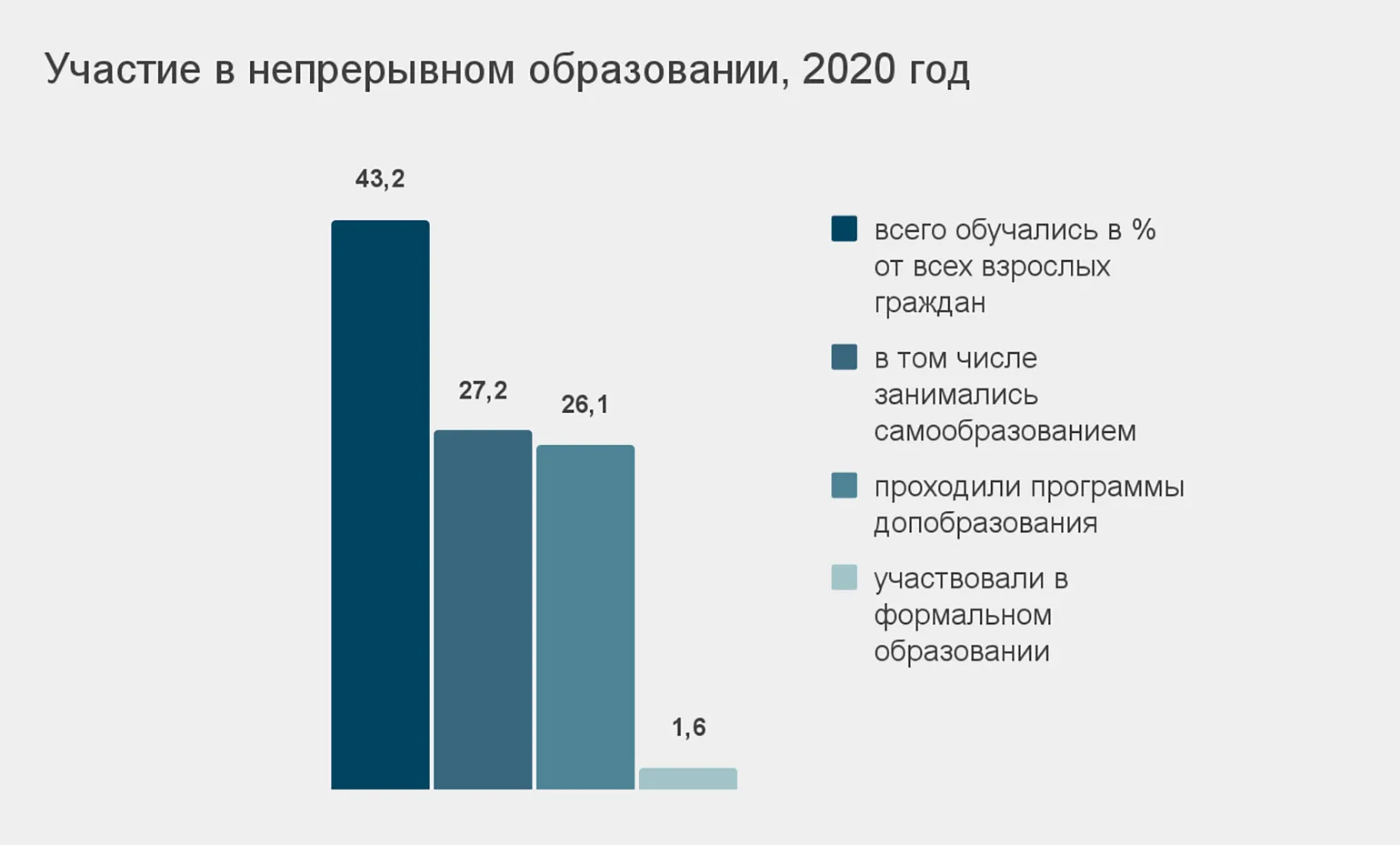
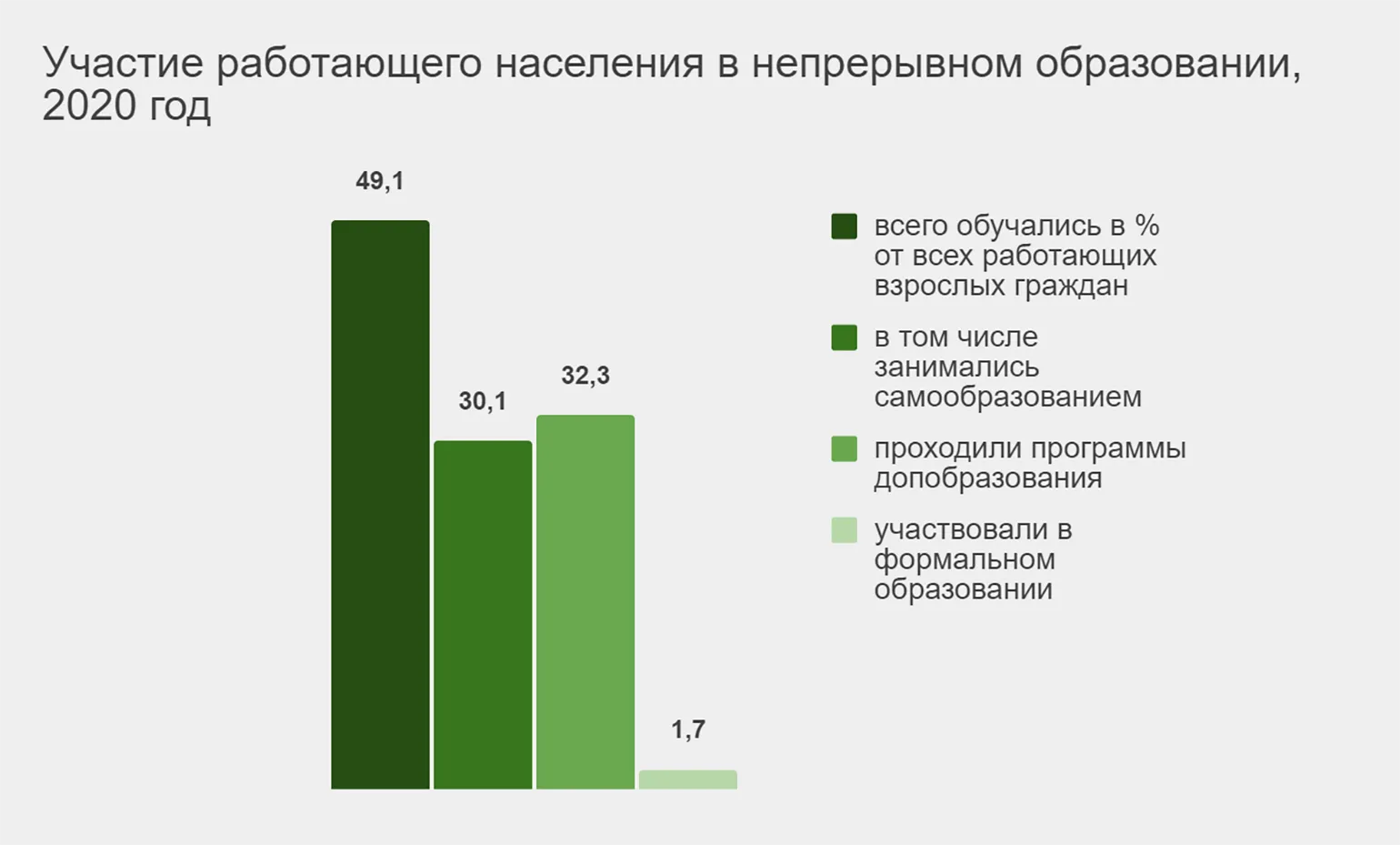
In some countries of the Organization for Economic Cooperation and Development (OECD), adult participation in formal and non-formal education reaches 70% (2016 data). In Russia, according to the "Education Indicators" data, this figure was only 27.6% in 2020. This means that less than a third of the adult population is willing to engage in targeted educational training. Is this a high figure? For some industries, particularly in information technology (IT), this rate of training is insufficient. It is estimated that Russia has a shortage of approximately 1 million IT specialists. To address this issue, active retraining of adults is planned within the framework of the "Digital Professions" program, which provides for 50% state co-financing. This is an important step towards improving the skills of workers and meeting the labor market demand for highly qualified personnel.
Currently, Russians are increasingly preferring short programs of additional vocational education over traditional educational programs, such as a master's degree. This is due to the desire to quickly acquire new skills and increase their competitiveness in the labor market. As a result, the number of citizens aged 25 to 64 entering universities and colleges is less than 2%. This choice reflects modern trends in education, where the emphasis is on practical skills and adaptation to employer requirements.
Why people go to school as adults
The difference in the level of training among the general population and the working-age contingent indicates that Russians are most actively engaged in training when it is related to their professional activities. This underscores the importance of a practical approach to education for professional development and career advancement.
People don't always pursue education out of compulsion or necessity. In the corporate sector, employers often determine course topics, but survey results don't provide a clear answer to the question of when employees choose training at the direction of management and when they are guided by personal professional ambitions. Nevertheless, professional development remains the primary motivation for adults, along with the desire to gain new knowledge. Education is becoming an important tool for achieving career goals and improving skills.
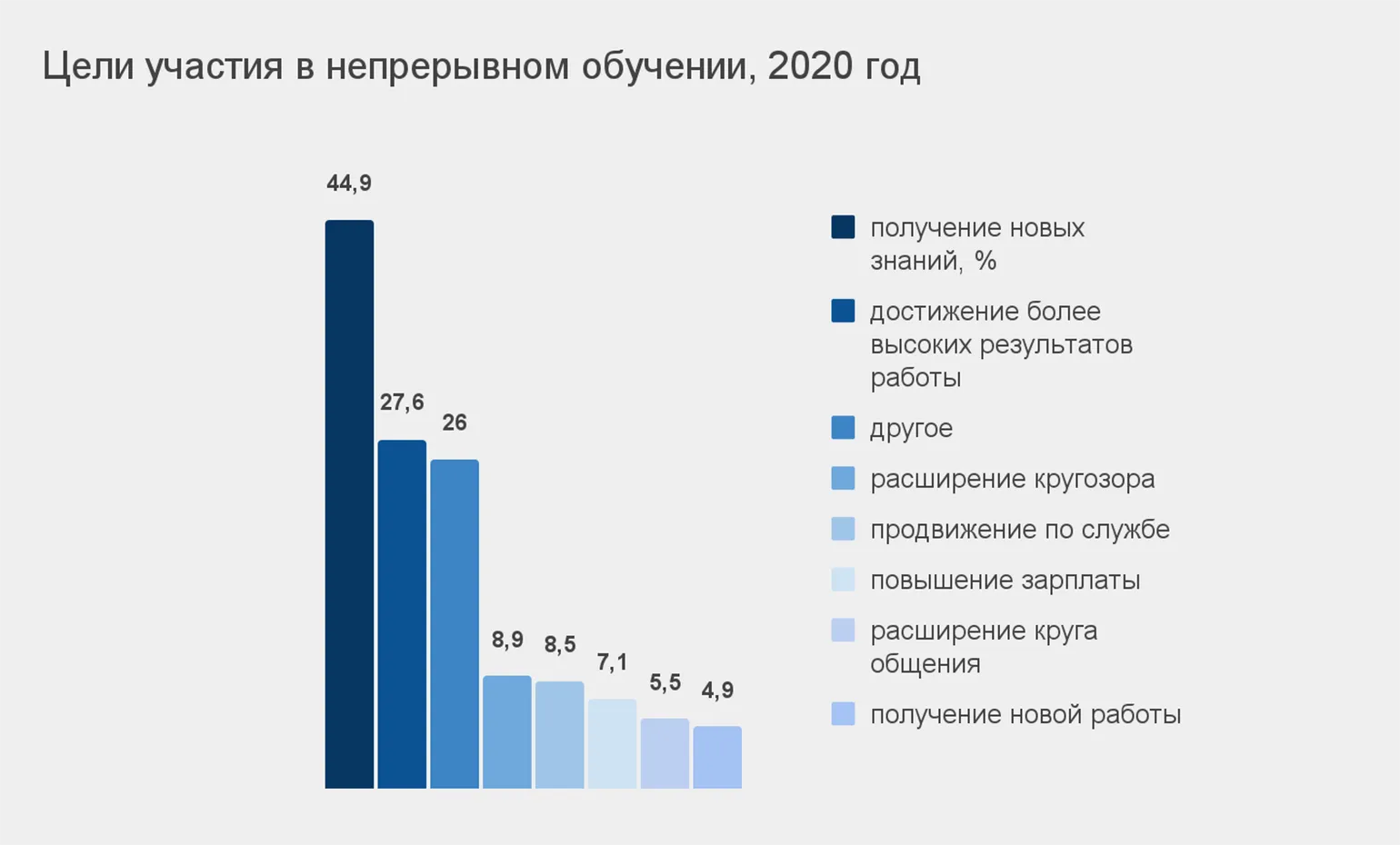
In the statistical In the survey on which the Education Indicators data is based, respondents were asked about the purpose of their most recent education. In broader surveys, the option "Studied to change profession" is often the most popular. According to SuperJob, 19% of adult students study to change professions. Moreover, in some surveys regarding future educational intentions, the majority of respondents express a desire to change professions. This underscores the relevance of professional retraining and professional development in modern society. Research shows that many people looking to change professions prefer online courses over traditional university-based professional development programs. Surveys conducted by EdTech companies such as Netology indicate that long-term professional online courses are more often chosen for mastering a new profession rather than improving skills in an existing specialty. This confirms the growing popularity of online education as an effective tool for career changes and professional growth.
Research shows that effective self-education relies not only on professional aspects but also on personal interests. In 2019, 64% of people engaged in self-education indicated a desire to deepen their knowledge in various fields "for general development." The pandemic has contributed to increased interest in courses on soft skills and other universal skills that are useful not only within a specific profession but also in everyday life. This demonstrates that modern education is becoming more multifaceted and focused on comprehensive personal development.
According to the 2020 Coursera report, the top 10 most popular courses among Russian users included in-demand IT topics such as Python fundamentals, machine learning, and mathematics for data analysis, as well as general-interest courses. These include programs on learning, mental well-being, communication psychology, and English language learning. An analysis of statistics from Russian educational platforms during the same period revealed growing interest in programs aimed at business development, management skills, personal productivity, and other important cross-professional skills. This demonstrates a growing emphasis on soft skill development among Russian users and their desire to improve their qualifications in various fields.
Why People Are Giving Up Education
Adult education offers numerous benefits, and surveys confirm growing confidence in its necessity. However, despite this, participation in lifelong learning remains low. According to the latest data, more than 57% of Russians do not engage in self-education or other forms of learning. The main barriers to learning include a low level of primary education, financial difficulties, a lack of necessary conditions, and age factors. To change this situation, it is important to overcome these barriers and create accessible programs that will stimulate interest in lifelong learning.
The need to acquire new skills and knowledge is most pressing for people with a high level of education. According to 2019 statistics, 60% of those with higher education were actively engaged in self-education, while among people with a secondary education or less, this figure was only 22%. This demonstrates that professional development and a desire to learn are important factors for career success and personal growth.
A clear trend is observed in corporate training. Managers and highly and semi-skilled specialists involved in information preparation undergo on-the-job retraining significantly more often than workers in industry, agriculture, equipment operators, and other specialists with secondary vocational or general education. This underscores the importance of continuous professional development for highly qualified personnel in today's environment. A company's success depends largely on its employees' ability to adapt to new demands and technologies.
People who most need to improve their skills and increase their income often study less frequently. This may be due to limited access to retraining programs due to a lack of financial resources or insufficient awareness of opportunities. Recent studies show that this category of workers feels the need for employer-funded training and career guidance. The lack of extensive educational experience makes them less aware of educational opportunities.
According to a survey conducted by the Higher School of Economics, employees of Russian small businesses are interested in continuing education, but most are only willing to study if they receive partial or full funding from their employer or the government. This fact underscores the importance of support from companies and government agencies in improving employee skills and investing in their professional development.
Managers, professional specialists, and engineers annually invest more than 30,000 rubles in their training. The remaining workers spend between 5,000 and 14,000 rubles on developing their skills. Education and advanced training are becoming important aspects of career advancement and competitiveness in the labor market.
Over the past two years, Russians have become more open to the costs of education. According to Tinkoff Data, during the first year of the pandemic, education spending increased by 80% for some citizens. In 2021, this trend continued, and the average bill for EdTech services increased by 18%. However, according to the Education Indicators collection, more than 63% of additional educational programs are still funded by employers. This may indicate that many people cannot afford additional education. In a 2021 survey by the recruiting platform SuperJob among 1,600 respondents, 41% of participants cited high tuition costs as the main reason why they do not plan to continue their education. Thus, despite the overall increase in interest in education, financial barriers remain a significant obstacle for many Russians.
Education, including online learning, primarily appeals to residents of large cities and active internet users. This is confirmed by a VTsIOM survey. This may be due not only to access to educational resources, as residents of large cities often have higher incomes and better technical conditions for online classes, but also to digital literacy. The more time a person spends online, the more likely they are to learn about various educational opportunities. Furthermore, experienced internet users easily master online learning platforms, unlike those with lower digital skills. Thus, all these factors are interconnected and influence the choice of educational formats.
In recent years, representatives of EdTech companies engaged in continuing education for adults have actively discussed a pressing issue: the market for professional courses still serves only a limited number of consumers. These consumers are typically those with higher education, knowledgeable about new professions, and experience with online learning. However, further development of EdTech requires attracting new audiences, which requires the development of innovative approaches. For example, Marianna Snigireva, CEO of Netologia, shares a successful case: to teach digital skills to people with low levels of digital literacy, the company organized an introductory course, "Digital. User's Guide," which covered basics such as using Google, searching for information, and installing apps on mobile devices. This is an example of how to expand the target audience and make education more accessible to everyone.
With age, the number of people who have undergone retraining decreases. This trend is observed in all countries, but it is more pronounced in Russia. For example, in 2013, the proportion of retrained citizens aged 50-59 in Russia was 5-6 times lower than in countries such as Germany or Sweden. This highlights the need to develop programs aimed at improving the skills and professional adaptation of older workers in Russia.
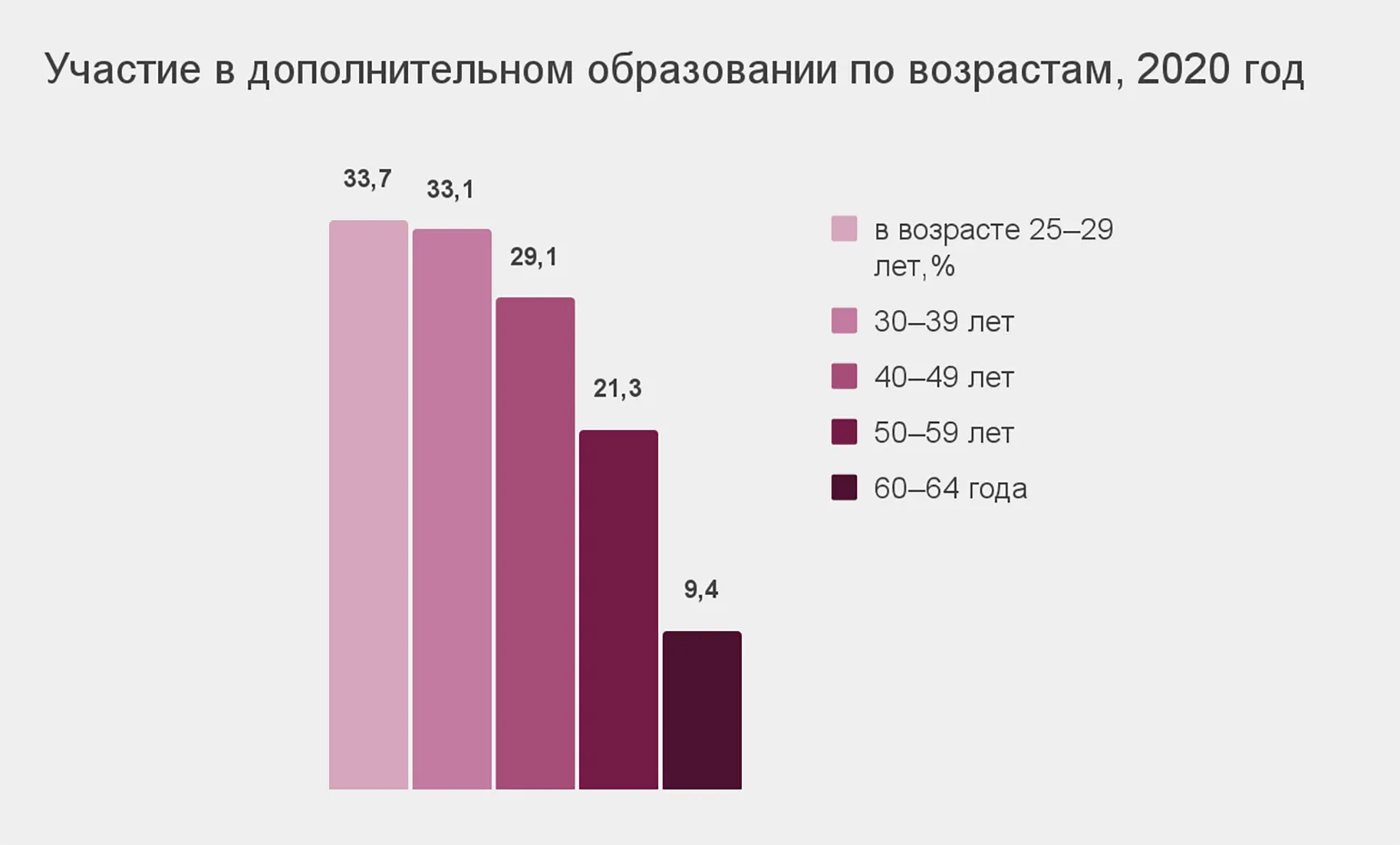
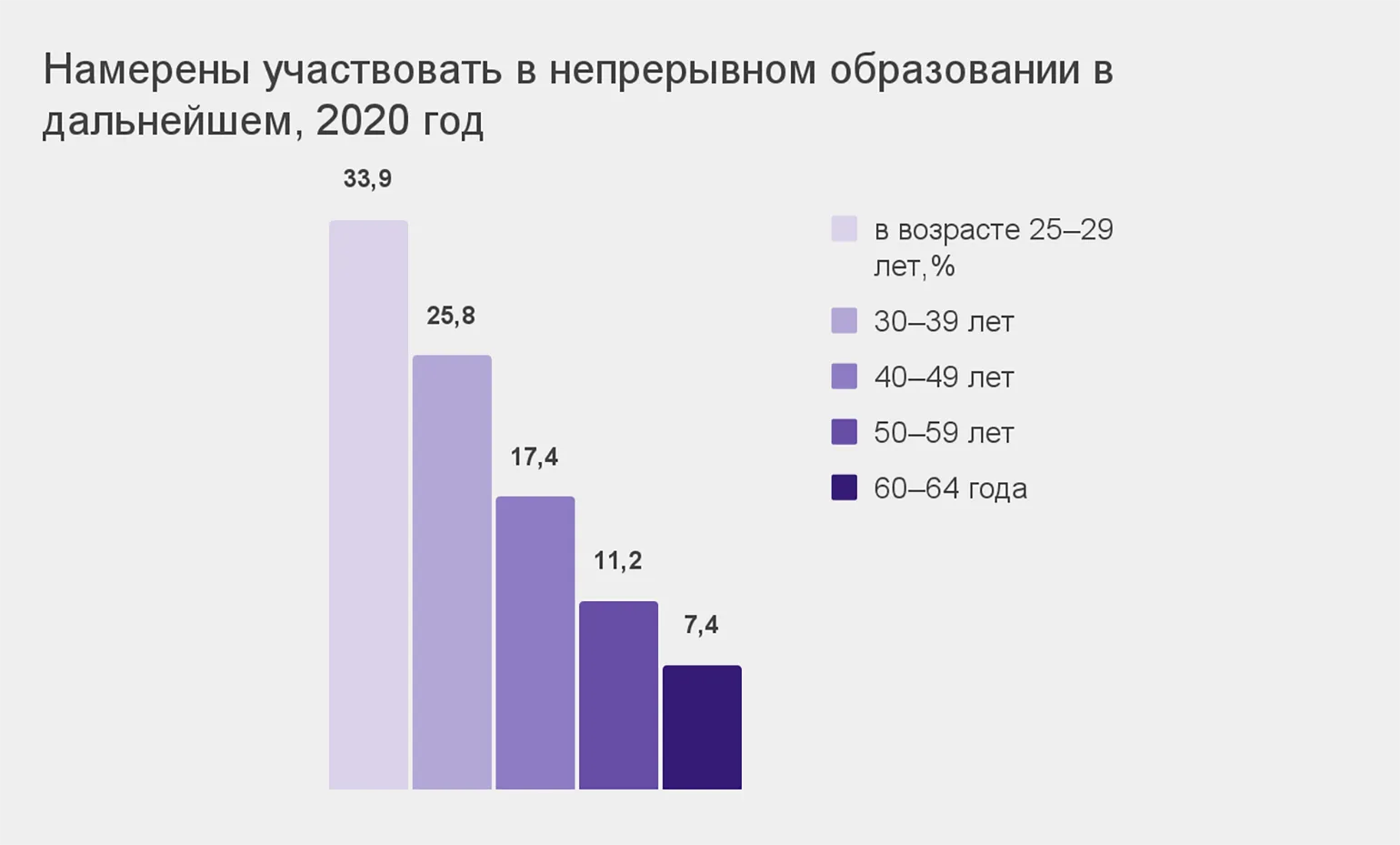
Data on engagement in self-education shows a clear trend: as the age group increases, the number of people showing interest in learning decreases. Young employees are more active in seeking certificates, diplomas, and other official documents confirming their qualifications and knowledge. This underscores the importance of supporting training programs for different age groups in order to improve the overall level of professional skills and competitiveness in the labor market.
In the field of continuing education, there appears to be no gender discrimination. Research in recent years shows that in Russia there are slightly more men among participants in continuing education programs. Scientists suggest that this is due to the country's economic structure, where traditionally male-dominated industries predominate. In areas such as education, healthcare, and financial services, women significantly outnumber women, and it is in these industries that they are more likely to undergo retraining.
According to the latest data from the Education Indicators, women are increasingly outnumbering men in continuing education. Retraining programs are particularly active among women on maternity leave, with nearly 30% of mothers participating in both basic and supplementary education. Women are also more likely to express an intention to continue their education, highlighting their desire for professional development and professional development. The reasons for not pursuing continuing education are varied. One of the main ones is a lack of desire and need for training at their current place of work, as confirmed by survey data conducted in 2017, where up to a third of respondents indicated this. Lack of time is also a significant barrier: even among those who acknowledge the importance of continuing education, the majority are willing to devote only three hours a week to training. This underscores the importance of creating flexible and accessible educational programs that can fit into the busy schedules of professionals. There are other opinions on this issue. For example, Dmitry Sudakov, head of the ASI "Atlas of New Professions" project, asserts that Russians are generally averse to learning. School, college, and university are perceived as unpleasant obligations, and only a few view education as a way to realize their interests and achieve personal goals. This perspective underscores the importance of not only improving opportunities for continuing education for adults in Russia but also the need for education aimed at attracting new audiences. For the successful development of educational projects, it is important to create attractive conditions for learning, as well as change attitudes towards the educational process so that it becomes a conscious and desired choice.
Read also:
- Why adults should be taught differently than children
- How to motivate adults to learn
- What is transformative adult learning
- The State Duma has taken up wish marathons and other online courses
The Profession of Methodologist from Scratch to PRO
You will improve your skills in developing curricula for online and offline courses. You will master modern pedagogical practices, structure your experience and become a more sought-after specialist.
Find out more