
Contents:

Learn: The Profession of a Methodologist from Scratch to PRO
Find out moreThe HSE Institute of Education has published the results of two studies on the influence of teachers' attitudes on their professional activities. The scientific findings presented in the journal "Education Issues" highlight the importance of understanding the psychological aspects of teachers' work. Teachers' attitudes can significantly influence the quality of education and student outcomes, making research on this topic relevant for improving the effectiveness of the educational process.
The study examines the role of teacher agency in shaping students' academic success. Agency is a complex concept, and this study focuses on one of its components: teachers' confidence that their actions can influence student outcomes. This phenomenon is called self-efficacy. The key question of the study is whether teachers believe in their ability to influence children's educational achievement and which factors they believe have the greatest impact—teacher input, parental support, or the child's innate abilities.
Why is this important? People reflect their beliefs in their behavior. If they believe they cannot influence certain phenomena, they are unlikely to take action. This underscores the importance of developing a positive attitude and self-confidence, which, in turn, can facilitate greater engagement in change. By convincing people that their actions matter, their motivation and engagement can be significantly increased.
The second study tested the hypothesis that information about student abilities can influence teacher expectations and, ultimately, student academic achievement. If teachers express expectations of students, and these expectations vary depending on the individual student, they are likely to provide them with different learning opportunities. This highlights the importance of teachers being aware of their biases and their potential impact on the educational process.
What skills is the school responsible for developing?
In May 2018, the authors of the first study conducted 12 focus groups in six schools in the Moscow region, which included elementary school teachers, as well as middle school and high school teachers. The study also used data from an online survey in which 4,405 teachers from 84 regions of Russia participated. The survey was conducted as part of the "Universal Competencies and New Literacies" project, organized by the HSE Institute of Education and Sberbank's "Contribution to the Future" foundation. The study aims to examine modern educational approaches and teachers' needs, which is crucial for improving the quality of education in the country.
A survey was conducted in focus groups to explore teachers' attitudes toward the educational process. Participants were asked about their perceived responsibility for developing various skills and abilities in students. Response options included: "school/teachers," "clubs/activities," "family," and "child." As expected, most teachers believe their primary task is to impart the knowledge necessary for mastering the school curriculum. Teachers emphasize the importance of teaching children how to express their thoughts and distinguish reliable from unreliable information. However, many of them believe that the development of non-cognitive skills, such as group work, self-organization, and creativity, should take place outside the school setting.
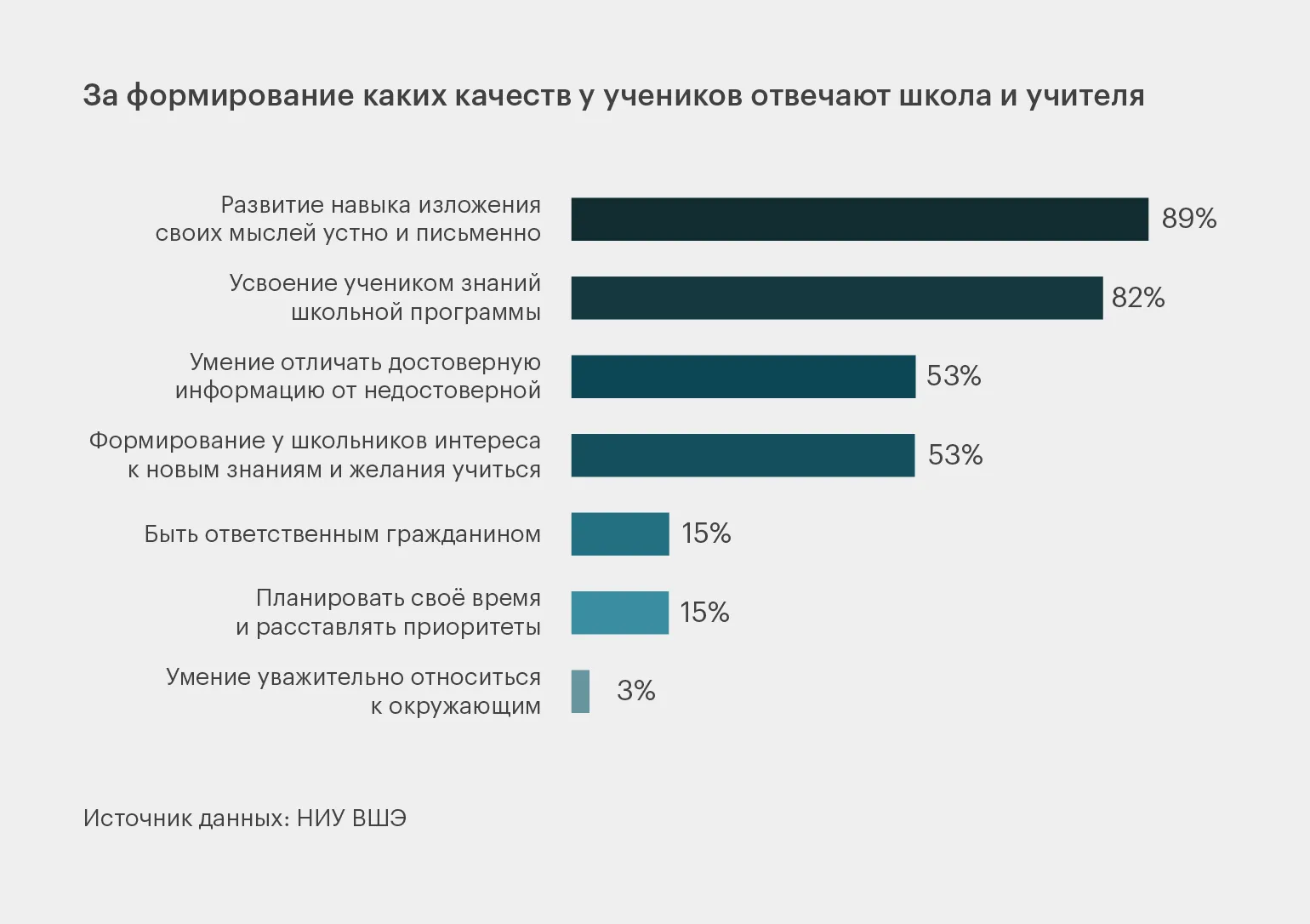
Primary school teachers are less likely than pedagogical specialists at the middle and senior levels to set the goal of developing critical thinking in students and teaching them to effectively apply the acquired knowledge in real life.

Reading is an important part of our lives, and it Reading brings many benefits. It not only develops imagination and thinking, but also improves writing and communication skills. Regular reading helps expand your vocabulary and deepen your knowledge in various fields. In addition, books can serve as a source of inspiration and motivation.
Modern research shows that reading helps reduce stress and promotes relaxation. It is a great way to escape from everyday worries and immerse yourself in another world. Reading also develops critical thinking and the ability to analyze information.
If you want to improve your reading skills, try to set aside time for this activity every day. Choose genres that interest you and experiment with new authors. Don't forget about the benefits of reading in both print and electronic form. Each work you read can enrich your inner world and strengthen your knowledge.
Research has shown that teachers tend to inflate grades for their favorite students. This phenomenon can negatively affect the educational process, as it creates an uneven playing field for all students. Inflated grades can demotivate those who don't receive such attention and distort the true picture of academic performance. Therefore, it is important to consider the influence of teacher preferences on the assessment system and strive for more objective methods of assessing student knowledge.
What about the role of parents and the abilities of the children themselves?
Research shows that in focus groups, most respondents identify the family as the key source of a child's motivation to study. Parents play an important role by setting an example and inspiring children to acquire knowledge. In addition, the emotional and psychological support provided by the family significantly influences children's academic success.
Some teachers note that parents often shift full responsibility for the educational process of their children to the school. This causes dissatisfaction among teachers, since without the active participation and interest of both parents and students, responsibility for academic results falls entirely on the shoulders of teachers. It is important for parents to recognize their role in education and actively support their children, which in turn will positively impact the quality of education and academic success.
Student motivation is a key factor for educational success, according to many teachers. A focus group survey revealed that teachers associate their students' academic achievement with important qualities such as good manners and cultural awareness. The importance of innate abilities, such as natural literacy and mathematical skills, was also discussed. In contrast to positive characteristics, teachers noted negative aspects such as laziness, irresponsibility, passivity, and a lack of interest in learning. These factors seriously interfere with the learning process and can negatively impact student achievement.
Read also:
Parents are classified by their levels of involvement in their children's school education. This classification helps to better understand how different parental approaches can influence the learning process and student outcomes. Active parental involvement in educational activities helps create a favorable learning atmosphere and strengthens the connection between home and school. Understanding types of engagement allows educational institutions to develop more effective support programs for families, which in turn can improve student achievement and motivation.
According to the survey results, teachers believe that the children themselves and their parents' active involvement in the educational process play the primary role in student success.
Between 50 and 75% of focus group participants believe that school-related factors, such as teacher performance, the school climate, and the quality of educational materials, are not able to guarantee student academic success. Educators believe that their role is to help unlock the child's potential, but ultimately, student success is beyond their control.
Among the key factors influencing children's educational achievement, respondents identified the child's own efforts (67%), interest in the material being studied (53%), and parental support (46%). Survey participants noted that teacher input was not among the three most significant factors. This emphasizes the importance of children's intrinsic motivation and active participation in the learning process, as well as the role of family support in achieving academic success.

Revised text:
Explore current topics and expand your knowledge. We offer a variety of information to help you deepen your understanding of the issues that interest you. Stay tuned and follow our new publications to stay up-to-date on the latest events and trends. Our content is focused on development and learning, making it useful for a wide audience. Don't miss the opportunity to increase your awareness and develop your skills by reading our materials.
Students' personal qualities and soft skills play a key role in their educational process. These characteristics not only determine their academic performance but also contribute to their overall personal development. Effective communication allows students to actively participate in discussions and group projects, which improves the quality of their learning.
Self-organization and time management help students successfully cope with academic workloads and deadlines. Critical thinking skills facilitate information analysis and problem-solving. Emotional intelligence, which includes the ability to understand and regulate one's emotions, as well as empathy, allows students to interact more effectively with classmates and teachers.
Furthermore, persistence and motivation are important factors in achieving academic goals. Students who possess these qualities are more likely to achieve high results and successfully overcome challenges. It is important to develop these soft skills during education, as they not only contribute to success in school but also lay the foundation for future professional life.
Research shows that teachers lack high agency, which is associated with established beliefs. However, many teachers believe that while they cannot change the "innate abilities" of their students, they can influence their motivation. About half of respondents believe that they can be a powerful motivator for learning, which emphasizes the importance of the teacher's role in the educational process.
The teacher plays a key role in developing student interest in a subject. If the teacher is inspiring and engaging, the student is motivated to delve deeper into the topic. However, if the teacher is unappealing, even the most gifted student may lose motivation and struggle to excel. Therefore, the teaching approach and methodology are crucial for student development and academic success.
The study's authors note that low teacher agency is one of the main factors hindering the successful implementation of curriculum reform. Research confirms that school-based factors play a key role in students' overcoming difficulties and achieving academic success. However, teachers' limited understanding of schools' ability to influence student outcomes holds them back and forces them to adhere to established practices, which negatively impacts the educational process.
How Teachers' Expectations of Different Students Work and Don't Work
The second study, conducted by HSE researchers between 2018 and 2022, covered 4,460 first-graders from 188 schools in one region of Russia. This analysis provided a deeper understanding of educational trends and children's adaptation to the school environment.
Study participants were divided into a control and experimental group. Teachers in the control group received information only about their students' basic skills, while teachers in the experimental group had access to data on cognitive skills (including reading and mathematics) and non-cognitive skills (such as personal and social-emotional skills). However, the hypothesis about the influence of expectations on student performance was not confirmed: the presence of additional information by teachers did not significantly affect the children's results in the final mathematics test.
In the control and experimental groups, teachers sought to create a comfortable psychological atmosphere and motivate all students to learn, regardless of their initial skills. During the interviews, teachers noted that they did not express their expectations and tried to provide each student with equal attention and objective feedback. This approach helped to avoid the effect of a self-fulfilling prophecy, since the teachers' attitude did not depend on their knowledge of the students, which, in turn, did not affect the students' academic results.
Read also:
- Curiosity vs. Leadership: What Motivates Children to Learn and How to Maintain Interest in Learning
- Academic success depends even on those parental genes that the child did not inherit
- How do people learn and teach? 20 Answers from 2021 Research
- 30 Rules of Learning Psychology That Every Teacher Would Do Well to Know
The Profession of Methodologist from Scratch to PRO
You will improve your skills in developing curricula for online and offline courses. Master modern teaching practices, structure your experience, and become a more sought-after specialist.
Find out more