
Contents:

Learn: The Profession of a Methodologist from Scratch to PRO
Learn MoreIn this article, you will find information about the key aspects of the topic. We will cover the main points that will help you better understand the subject of discussion. Read on to gain valuable knowledge and recommendations.
- how are educational outcomes defined in formal education (in schools, colleges, universities, vocational retraining centers);
- how are educational outcomes defined in non-formal education (in courses, trainings, master classes);
- what is outcome-based design of an educational program (reverse design);
- what approaches do methodologists use to correctly formulate educational outcomes.
Educational program outcomes are clearly defined achievements that students should achieve. These outcomes include the knowledge, abilities, and skills that students will acquire upon completion of the program. They also reflect the formed competencies that will help students in further education and professional activity. A correct understanding and clear presentation of program outcomes contribute to more effective learning and development of students, ensuring their readiness for future challenges.
Outcomes are assessed differently in different education systems. Each type of education has its own criteria and assessment methods, which influences the understanding of student success and achievement. It is important to consider that these differences can be associated with both levels of education and approaches to teaching. Understanding these aspects can help in choosing the most appropriate educational program and in the further development of students.
Educational program outcomes in general, higher and secondary vocational education
General and higher education, as well as secondary vocational education, make up the formal education sector. The main customer in this area is the state, which means that it is the state that formulates the goals and outcomes of mastering educational programs.
The planned educational outcomes clearly define the knowledge and skills that a graduate should have upon completion of each educational stage. These outcomes serve as the basis for the formation of curricula and help in assessing the quality of the educational process.
Basic educational outcomes are established at the federal level in state educational standards (FSES). These are the minimum achievements that school and university graduates must demonstrate, for example. Universities and private gymnasiums have the option to formulate other educational outcomes, but they must meet the established requirements of the Federal State Educational Standard and not be below the specified level. This allows educational institutions to adapt programs to the needs of students while maintaining compliance with federal standards.
The formal education system uses various approaches to planning outcomes. In general education, which encompasses primary, middle, and high school, a systemic-activity approach is used. All planned outcomes are classified into three main groups: personal, meta-subject (also known as universal learning activities (ULA)), and subject-specific. This division allows us to organize the educational process more effectively and focus our efforts on developing students' key competencies.

A competency-based approach is actively used in higher education and the vocational education system (SVE). It aims to integrate the educational process with professional activity, and the results of this approach are formed on the basis of lists of competencies. A competency is a set of knowledge, skills, and personal qualities necessary for the effective performance of professional tasks. This approach allows students not only to acquire theoretical knowledge but also to develop practical skills, which in turn facilitates their successful integration into the labor market.
Federal educational standards for secondary vocational education (SVE) distinguish between general and professional competencies. In turn, federal state educational standards for higher education (FSES VO) distinguish between universal, general professional, and professional competencies. However, the current FSES VO do not list professional competencies, but emphasize that universities have the ability to independently define them based on current professional standards. This allows educational institutions to adapt educational programs to the demands of the labor market and the specifics of professions.

In additional professional education A similar approach is used in continuing education programs (CEP), particularly in the area of advanced training and professional retraining. For a number of professions, such training is mandatory, necessitating compliance with formal requirements. These requirements ensure that training programs align with current standards and labor market needs, which is especially important for professionals seeking career advancement and competitiveness in their fields. The outcomes of continuing education programs and professional retraining are governed by professional standards and qualification requirements that apply to specific professions. It is important to note that such standards are not developed for all specialties. For a number of professional fields, such as medicine and emergency situations, relevant agencies, including the Ministry of Health and the Ministry of Emergency Situations, approve standard programs, ensuring consistency and quality of training. This ensures that specialists meet current requirements and standards in their fields. Professional retraining programs must take into account the outcome requirements established in the relevant Federal State Educational Standards for higher or secondary vocational education. This is important because graduates of these programs receive a new profession and must meet modern standards and requirements of the labor market. The main focus should be on practical skills and knowledge that will ensure the successful integration of specialists into various fields of activity.
Outcomes of educational programs in non-formal education
In formal education, learning outcomes are determined by various regulatory documents that set clear frameworks and standards. In contrast, in non-formal education, which encompasses courses, trainings, and master classes, the approach to learning is much more flexible. Here, the emphasis is on the individual needs of participants and their interests, which allows for the creation of unique educational programs. Thus, non-formal education offers opportunities for self-development and practical application of knowledge in various fields.
In the field of education, the absence of government regulations regarding the goals and learning outcomes allows educational program developers, such as methodologists and instructional designers, to formulate these aspects independently. They are based on market analysis, study of the needs of the target audience and the goals of the customer, for example, online schools or corporate universities. This approach ensures more flexible and effective training, adapted to modern realities and user requirements.

Reading is an important part of our lives. Reading not only helps develop thinking but also enriches our inner world. Books, articles, and blogs provide us with new knowledge and ideas, promote self-improvement, and broaden our horizons. Reading also improves writing and communication skills. In today's world, where information is available in vast quantities, the ability to select quality sources is especially important. Regular reading improves concentration and memory and helps reduce stress. Therefore, set aside time for reading every day to enrich your knowledge and skills. Before designing a course, a course designer must conduct a series of studies to determine the needs of the target audience, as well as the structure and content of the course. First, it is worth analyzing the educational program market to understand which courses are already offered and which are the most popular. This will help avoid duplication and identify unique offerings. The next step is to research the target audience. The course designer must determine who will be learning: students, company employees, specialists in a particular field, and so on. To do this, you can use surveys, interviews, and focus groups to gather information about the needs, expectations, and preferences of potential students.
Furthermore, it is important to study current trends in the educational field, such as the use of technology, interactive teaching methods, and current topics. This will make the course more engaging and relevant to current needs.
It is also worth analyzing the available resources and technologies that can be used in the course. This includes online learning platforms, content creation tools, and opportunities for interaction with students.
As a result of the research, the methodologist will be able to create a course that is not only relevant and in demand, but also effective in achieving the educational goals.
A modern approach to the educational process emphasizes the goals and expected learning outcomes as the starting point for curriculum development. Methodologists formulate program content and select the forms, methods, and means of instruction based on what students should know and be able to do. This model is known as outcome-based learning design or "backward design." The founder of this approach is William Spady, an American educator and psychologist. His works, such as "Outcome-Based Education: Critical Issues and Answers" and "Outcome-Based Education's Empowering Essence," examine in detail the key issues and principles of outcome-based education. Implementing this model in educational institutions can significantly improve the quality and effectiveness of education, as well as better prepare students for the demands of the modern labor market.
There are three key concepts that can be applied when developing outcome-based programs. These concepts will help you more effectively organize the development process and achieve the desired results. We discussed them in detail in another article.
- backward design;
- outcome-based education;
- understanding by design.
When developing an online course for training as a 3D artist from scratch, it is important to consider the requirements of the labor market, despite the lack of official professional standards in Russia. To successfully design an educational program, the methodologist must identify the key work tasks that the specialist will face and consult with industry experts. A job analysis will identify the necessary knowledge and competencies expected of 3D artists. This approach will ensure the relevance of the course and will help prepare qualified specialists who meet modern market requirements.
As a result, an up-to-date list of key competencies that a 3D artist must possess is compiled. This includes an understanding of the process of creating 3D models for film and video games, the ability to work with high- and low-poly models, and the skills to manually create procedural assets. These knowledge and skills are the core outcomes of the educational program, which students should strive to achieve. Training should cover all aspects of a 3D artist's work in order to prepare specialists capable of effectively creating high-quality content for various media formats.

What should be the planned outcomes of the educational program?
Educational program methodologists often use Bloom's taxonomy to formulate learning outcomes. This system of learning objectives is organized according to the principle "from simple to complex" and is used both in the creation of entire educational programs and in the development of individual modules or lessons. Bloom's taxonomy helps to structure the learning process, ensuring the consistent development of students' knowledge and skills. The use of this methodology contributes to a more effective achievement of educational outcomes and allows teachers to clearly formulate learning objectives. Thanks to the taxonomy, it is possible to create more targeted and adapted learning materials to the needs of students.
Bloom's taxonomy, widespread among methodologists around the world, is presented in the form of a pyramid consisting of six levels, each of which corresponds to the development of a specific thinking skill. These levels are arranged in a sequential order: to reach the “application of knowledge” stage, a student must first go through the “memorization” and “understanding” stages. This approach promotes the systematic development of learning and critical thinking skills.
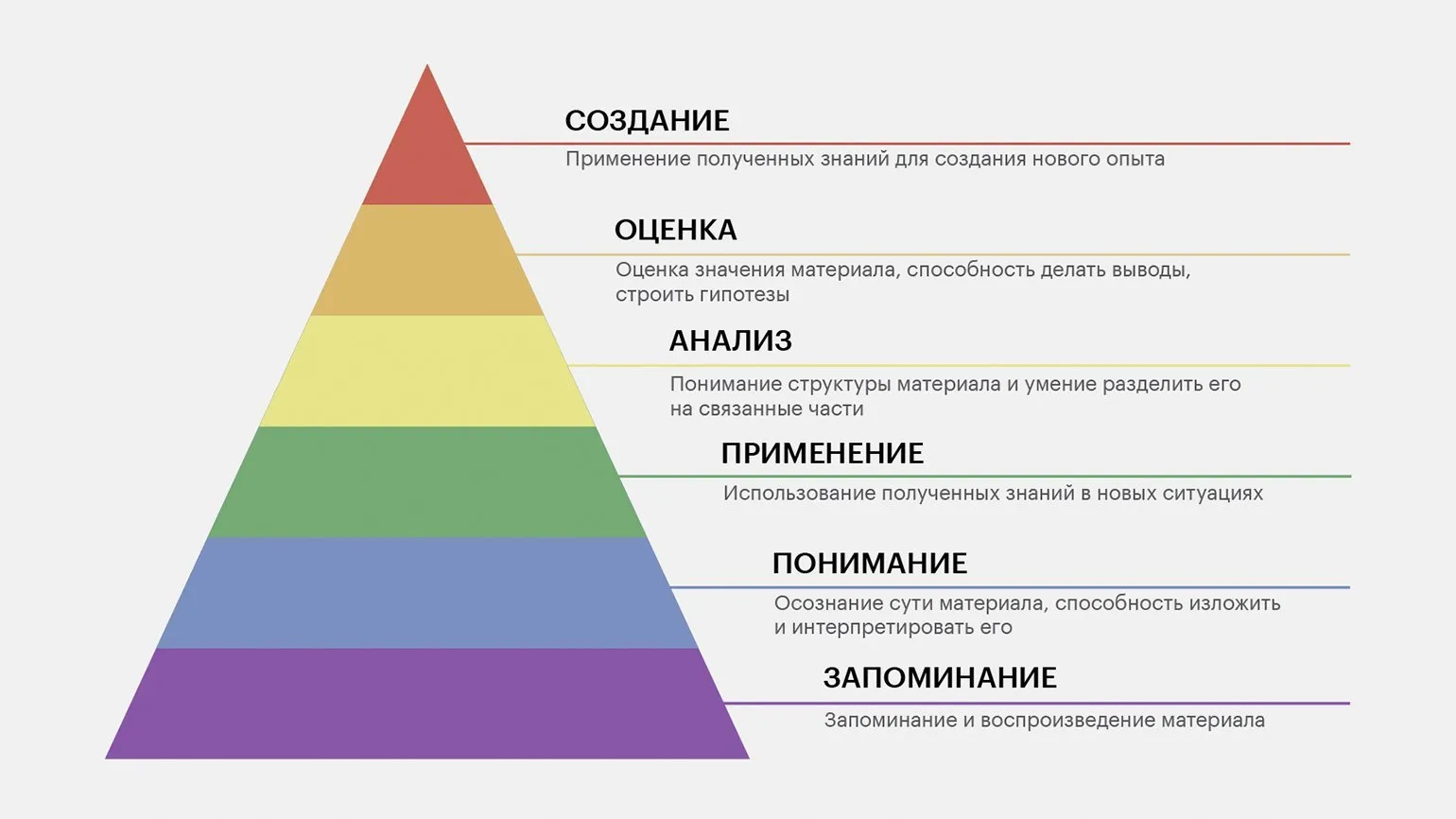
Using Bloom's Taxonomy allows you to detail educational objectives, breaking them down into specific outcomes. It is important to consider the sequential levels, although not all levels necessarily need to be included in a single educational program. This approach facilitates more effective planning and implementation of educational processes, ensuring a clear understanding of the expected learning outcomes.
The goal of the ceramics workshop for beginners is to create their own mug using the provided template. The educational outcomes will take into account the first three levels of Bloom's pyramid: knowledge, understanding, and application. Participants will master basic clay working techniques, learn how to shape pieces, and gain an understanding of the firing process. These skills will form the foundation for further development in ceramic art.
- Memorization: Know which clay is suitable for sculpting and what tools are needed;
- Understanding: Understand the sequence of actions required to make a ceramic mug;
- Application: Using the knowledge gained in previous levels, mold a mug according to the proposed pattern and prepare it for firing.
For those who have already mastered the basics, it is worthwhile to complicate the educational goals and expand the expected learning outcomes. This will deepen knowledge and skills, and also prepare students for more complex tasks. Improving educational outcomes promotes the development of critical thinking and creativity, which is an important aspect of modern education. When introducing more complex tasks, it is important to consider the interests and abilities of students to ensure an effective and engaging learning process.
- Analysis: Understand the stages and processes involved in ceramic production, why they are the way they are, and the similarities and differences between creating pieces of different shapes and sizes, with different functions;
- Evaluation: Evaluate and compare existing methods of molding, firing, and glazing;
- Synthesis: Create a ceramic piece according to your own design.
Methodologists often use the ABCD model along with Bloom's Taxonomy. This model helps to detail learning outcomes, focusing on four key aspects. Each of these aspects allows for more precise goal formulation and assessment of student achievement, which contributes to an effective learning process. Using the ABCD model provides a structured approach to developing educational programs and helps educators better understand how to achieve their learning goals.
- Actors are those who learn.
- Behavior is the observed action.
- Conditions are the context in which the action occurs.
- Degree is the level of proficiency required (i.e. speed, accuracy, quality).
These elements form a formula:
An educational outcome is formed on the basis of several key factors: the learning conditions, the participants in the process, specific activities, and the methods used. Learning conditions include the physical and psychological atmosphere, available resources, and technology. Participants are both learners and teachers, each of whom plays an important role. Specific activities determine what steps will be taken to achieve the educational goals. Teaching methods cover a variety of approaches and techniques that will help effectively transfer knowledge and skills. Understanding these components allows for a more accurate assessment of the learning outcome and its achievability.
After listening to a lecture on ceramics technologies, a student taking a beginner's course will be able to correctly select tools and materials for creating a mug, avoiding common mistakes.
When defining learning outcomes, it is important to consider general principles. In 2019, HSE presented methodological recommendations identifying five criteria for the correct formulation of learning outcomes. These criteria will help ensure the clarity and measurability of learning outcomes, which is a key aspect in the process of assessing and improving the quality of education. Correctly formulating outcomes contributes to more effective learning and allows students to better understand the expected achievements.
- Defined from the student's perspective, not the teacher's. That is: "The student will be able to accurately convey human anatomy in 3D models," not "The student will be presented with the basics of anatomy..."
- Achievable by every student, provided they take a responsible approach to the course. Proper course positioning and promotion are also important here, so that, for example, beginners are drawn to a program for beginners rather than advanced 3D artists. They are relevant to the goals of the educational program and its subject area, take into account the current state of science, and reflect its latest achievements. In corporate programs, the results should align with the company's business goals, and in vocational training, with labor market demands. They serve as the basis for choosing pedagogical technologies. That is, the desired results determine which forms, methods, techniques, and teaching aids will be most effective. They are verifiable and measurable. Moreover, the assessment and monitoring methods should correspond to the type of educational outcomes. Here, too, Bloom's taxonomy can be used as a guide. For example, if a test is suitable as an assessment tool at the "knowledge" level, then practical tasks will be needed at the "application" level, and the case study method will be adequate at the "analysis" stage.
Learn more about modern trends in education and interesting news in our Telegram channel. Subscribe to stay up to date with the latest changes and receive useful materials.
Read also:
- The goal of the educational program: how it is defined
- What is pedagogical design and who is a pedagogical designer
- What do methodologists do in schools, kindergartens, secondary vocational education institutions, universities, EdTech
- How to design higher education using the ADDIE model without violating the Federal State Educational Standard
The educational outcome is formed depending on the conditions, participants in the process, and the actions performed. It is important to consider the conditions in which the training takes place, who is participating in it, what exactly will be done and how it will be implemented. These factors determine the quality and effectiveness of the educational process, as well as its final results.
The Methodologist profession from scratch to PRO
You will improve your skills in developing curricula for online and offline courses. You will master modern pedagogical practices, structure your experience and become a more sought-after specialist.
Find out more