Contents:
Learn: The Philosophy of Artificial Intelligence
Learn More
Head of the Academic Department of the Skysmart online school, which specializes in teaching children and adolescents. Our school offers a variety of courses and programs aimed at developing students' skills and knowledge in various subjects. We strive to create a comfortable and effective educational environment where each student can reach their potential under the guidance of experienced teachers. Skysmart focuses on modern teaching methods and an individual approach to each child, which helps achieve high academic results.
AI-powered chatbots, such as ChatGPT and its analogs, can significantly simplify the work of teachers. Understanding how this technology works opens up new possibilities for its application in education. This article presents ideas and recommendations, tested by our online school's methodologists, that will help effectively use neural networks in teaching practice.
What a teacher can do with ChatGPT
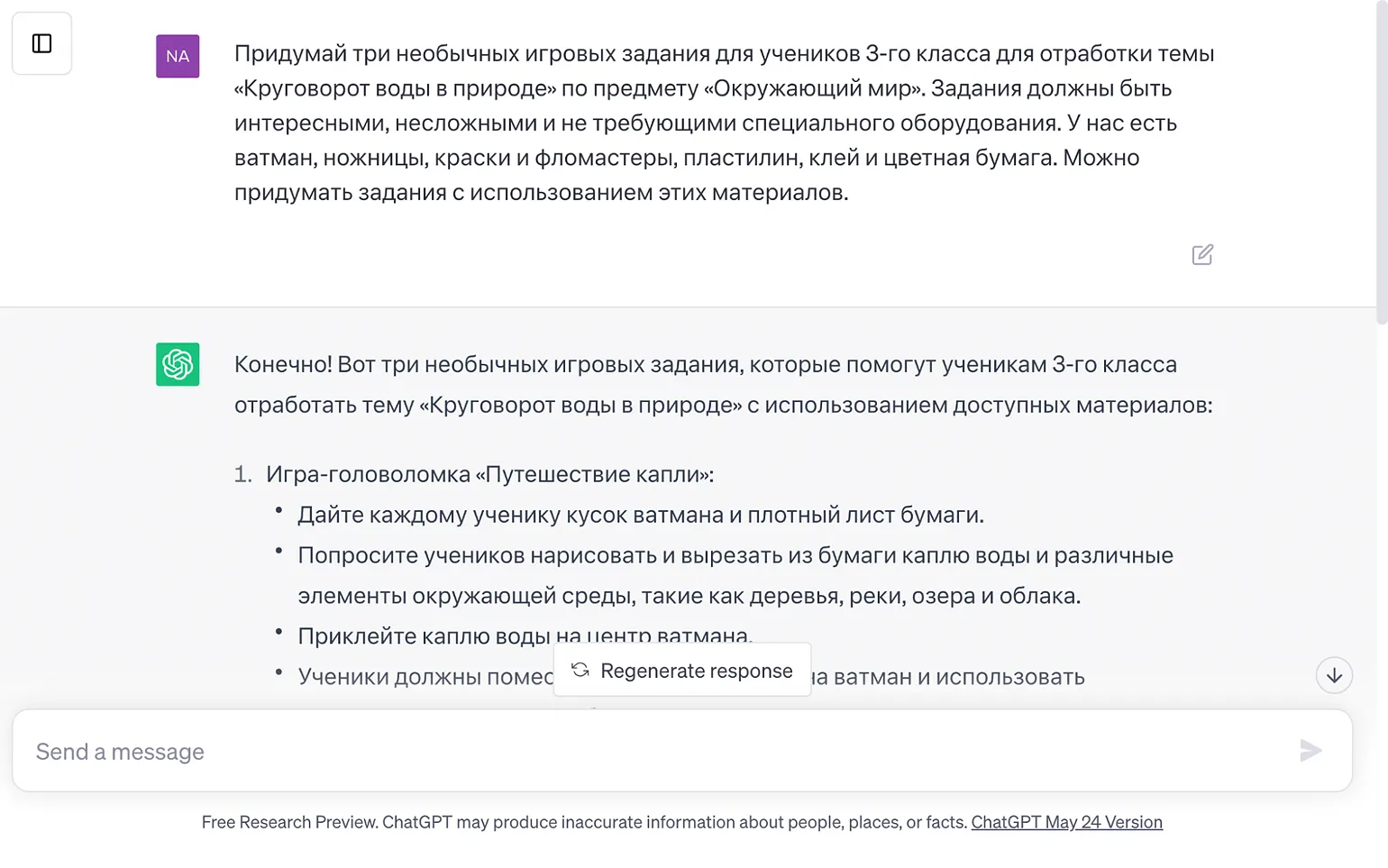
A chatbot can be an effective tool in the educational process, from selecting examples to explaining rules to creating a lesson plan. Using a chatbot can simplify many tasks related to teaching. It can help teachers create interactive materials and offer adaptive approaches to learning, taking into account the individual needs of students. The chatbot can also provide feedback, analyzing student progress and suggesting additional resources for study. Integrating a chatbot into the educational process significantly improves its effectiveness and makes learning more accessible and engaging. Students can be asked to use artificial intelligence to generate a literary essay outline, and then develop or refute the ideas suggested by the neural network. This exercise will help children learn to formulate clear queries to the AI, which, in turn, will lead to more meaningful responses. The more precise and clear the query, the more meaningful the result. This approach will also demonstrate that one shouldn't always rely on AI, and it is important to develop one's own critical thinking and analytical skills. ChatGPT can generate interesting ideas for assignments. Although the system doesn't always produce perfect results on the first try and sometimes requires clarification, in most cases it offers several suitable options. If the general direction of the response matches your expectations, you can get additional ideas by clicking the "Regenerate" button. This functionality makes ChatGPT a useful tool for finding inspiration and new approaches.
Tutors should always provide an individual approach to each student, but creating personalized lesson plans can be time-consuming. The use of neural networks significantly simplifies this process, allowing for the quick and efficient development of unique learning programs tailored to the needs of each student. This not only saves teachers time but also improves the quality of instruction by more accurately addressing each student's strengths and weaknesses.
A foreign language teacher can use a chatbot to generate a text passage on a given topic, taking into account the students' level and age. Each student will receive individually prepared material, significantly saving preparation time. Artificial intelligence can also adapt assignment content to each student's knowledge gaps and interests, making learning more effective and personalized.
In the screenshot below, the neural network was tasked with creating an English exercise tailored to the interests of a teenage girl. For a more precise understanding of the request, we provided her with an example.
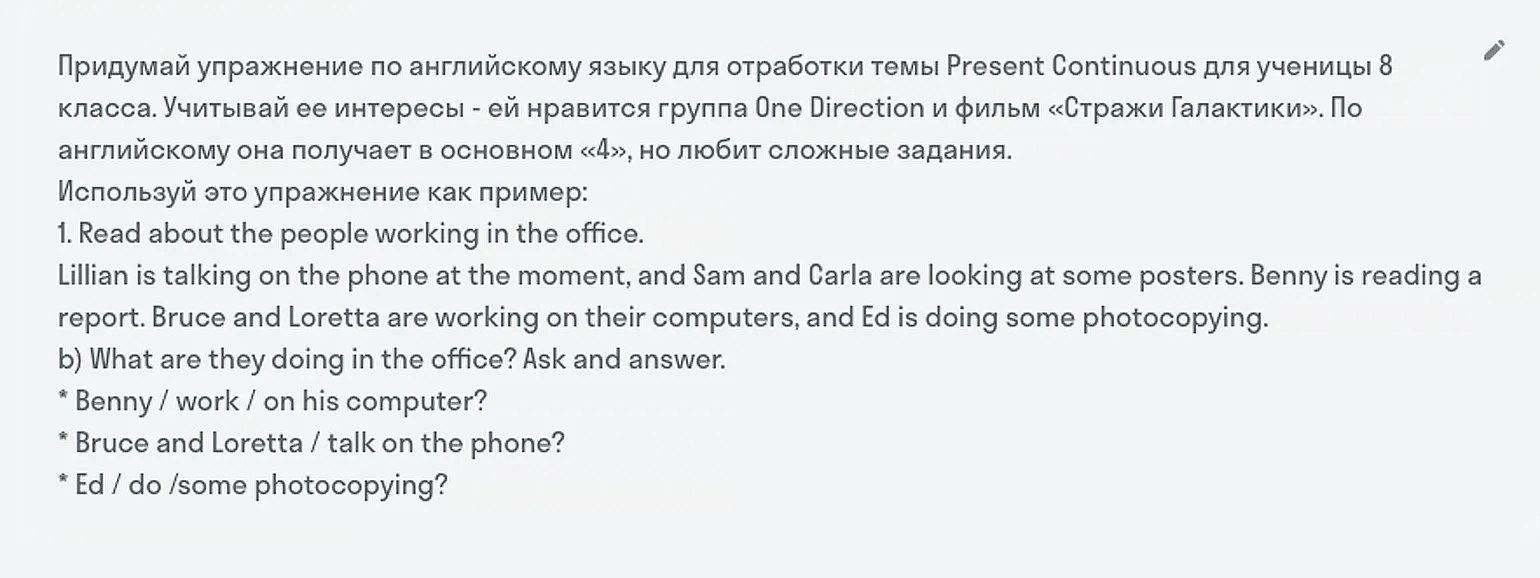
The neural network successfully completed the task, and we don’t It was necessary to explain who the members of the student's favorite band are and what her favorite movie is about.
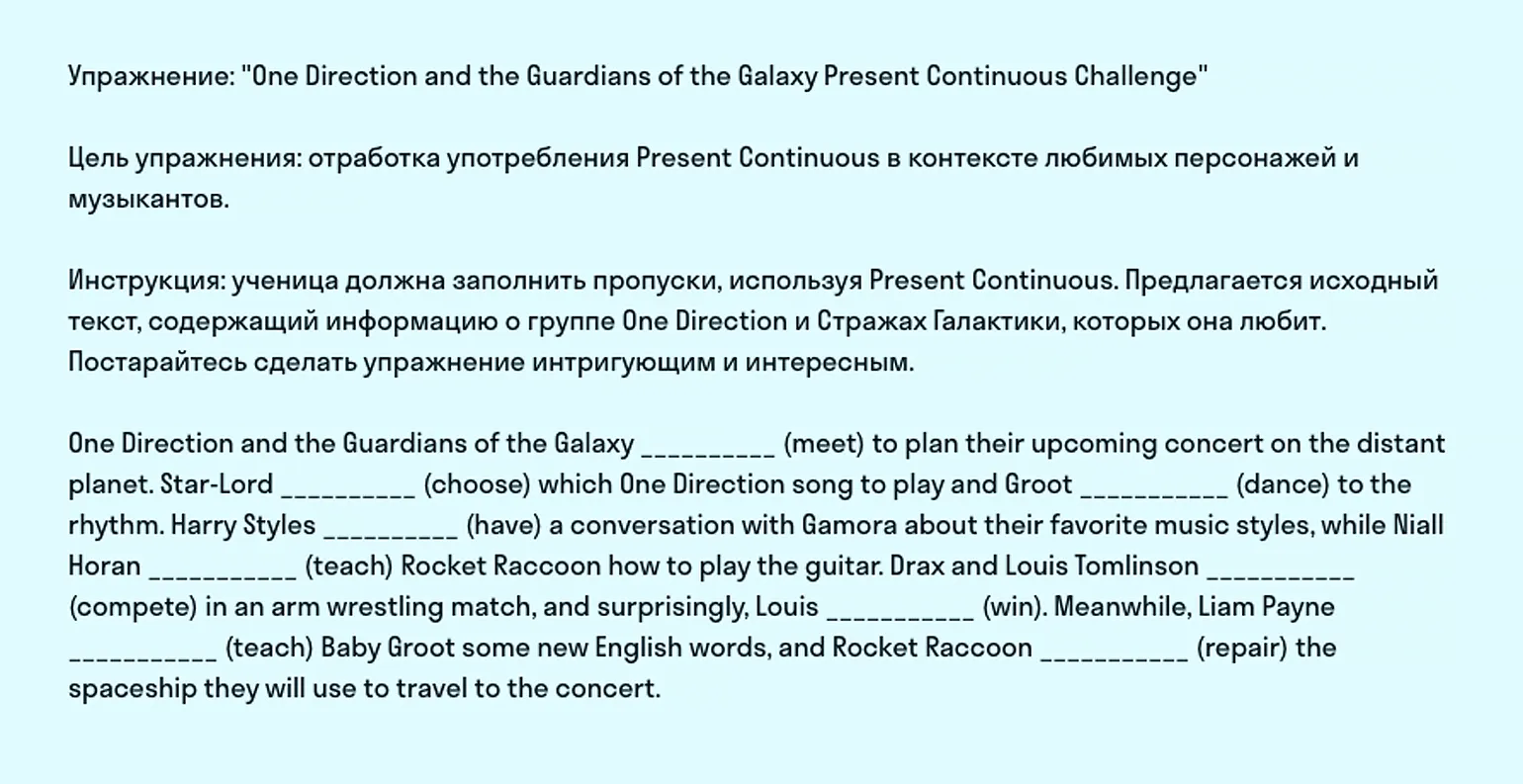
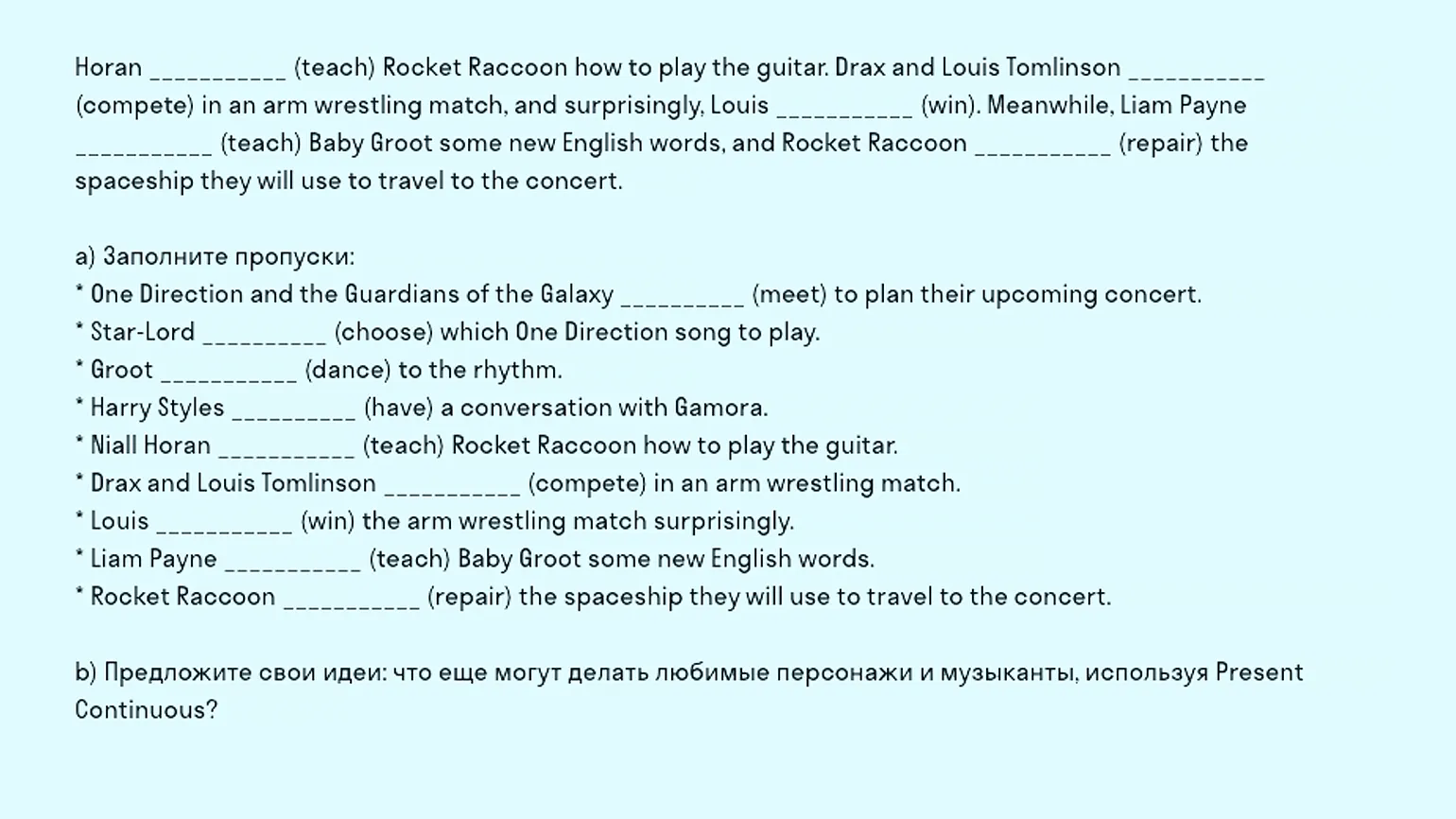
The neural network has the ability to generate examples on any topic and subject. For example, for a Russian language lesson, artificial intelligence can create illustrative examples that help learn grammar rules. In the context of a foreign language lesson, AI can generate numerous sentences with new words or develop original dialogue that facilitates the practical acquisition of conversational skills. Thus, the use of neural networks in the educational process opens up new opportunities for teachers and students, providing an individualized approach to learning.
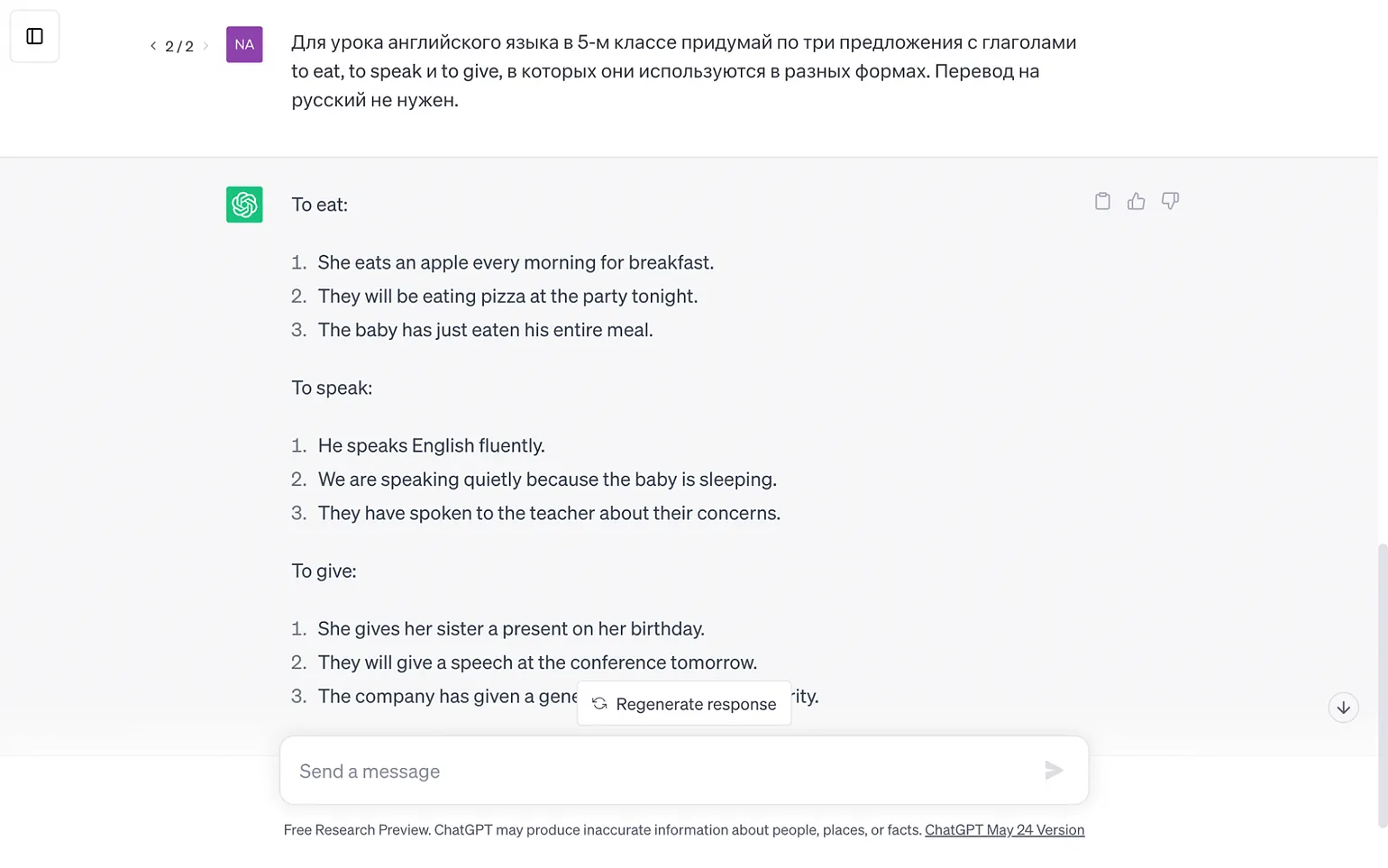
Quizzes make lessons more dynamic, help to activate students' attention and at the same time Test their knowledge. Preparing questions and answers can be time-consuming, but with ChatGPT, this task can be accomplished much more quickly. You can create quizzes on all topics for the entire year in advance and have them on hand at all times. If you have a few minutes left at the end of class, they can be put to good use with a quiz, which will help improve the classroom atmosphere and increase student engagement.
Questions and answers generated by a neural network must be verified, as this rule applies to all content created using artificial intelligence. Verification ensures the accuracy and quality of the information, which is especially important in an environment of constant technological growth and development. Proper content verification will help prevent the dissemination of false information and increase trust in materials created using neural networks.
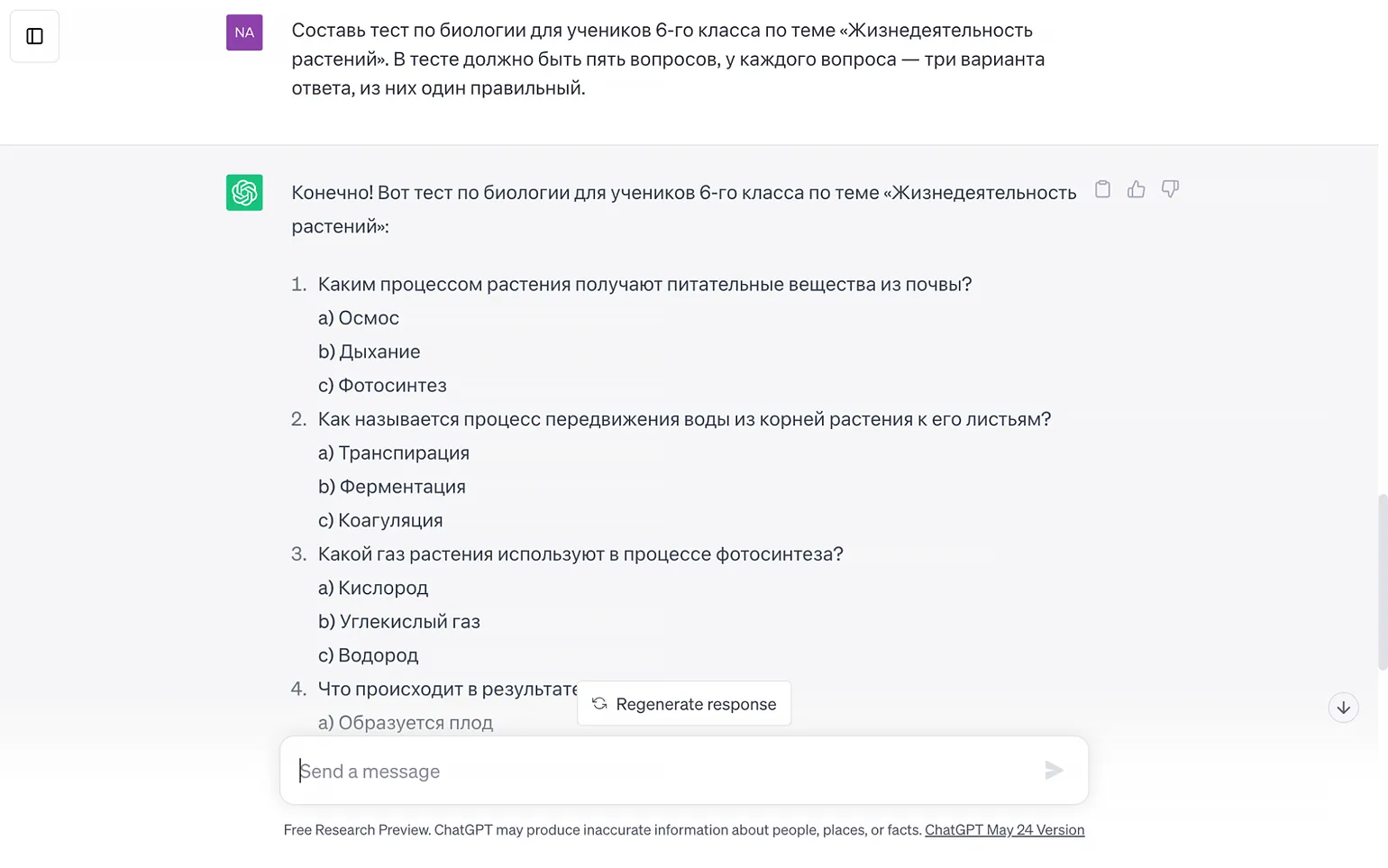
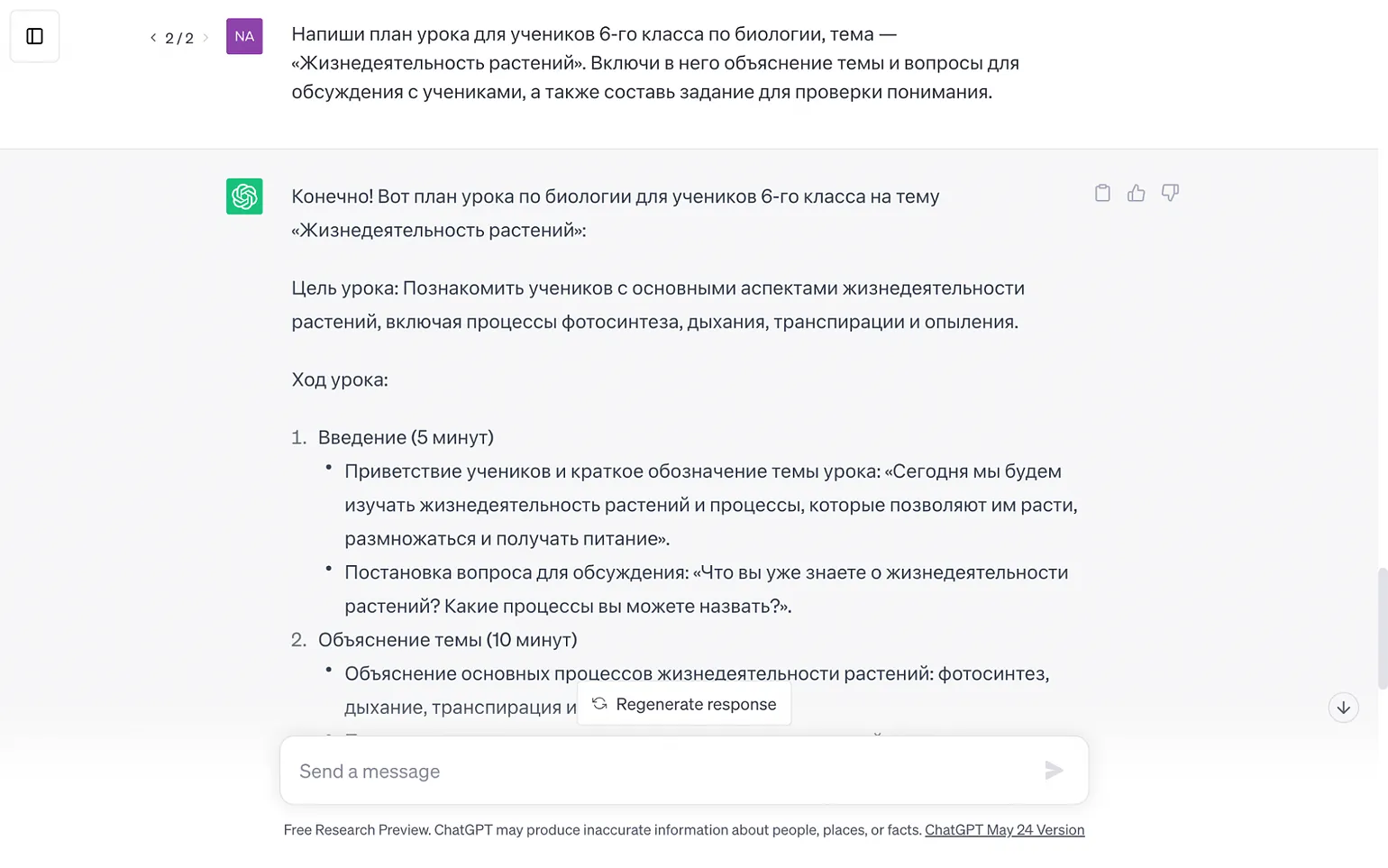
ChatGPT significantly simplifies the lesson planning process. You can request a lesson structure from them, and they will take all your requirements into account. The model can adapt the plan to new instructions, make it more complex or simpler, add original tasks, explanations, and materials, and prepare discussion questions. Using ChatGPT in the educational process allows you to effectively save time and effort, while ensuring high-quality educational content.
How to compose a request to get the appropriate answer from AI
The five guidelines below will help you formulate queries for a neural network, ensuring you receive useful and high-quality results. Proper structure and clarity of your query are key factors in using neural networks. By following these tips, you can significantly improve the effectiveness of your interactions with artificial intelligence.
A neural network is not capable of intuitively perceiving context the way humans do. It may not take into account the number of students in a group or the specific interests of children of a certain age. Therefore, the more specific information you provide to the AI, the better the result you will get. For example, instead of the general term "excellent student," it is worth using a more detailed description, such as "a 7th-grade student, a 12-year-old boy who has mastered basic mathematics." This will allow the neural network to better understand the task and tailor the information to your students.
Optimizing text for neural networks requires using short sentences. This helps avoid confusion with participial and adverbial phrases. Before requesting information, it is important to clearly formulate your requirements. If you need a structured response, specify this in your request. For example, specify that you need an introduction, a list, and a conclusion. This approach will ensure more accurate and useful results.
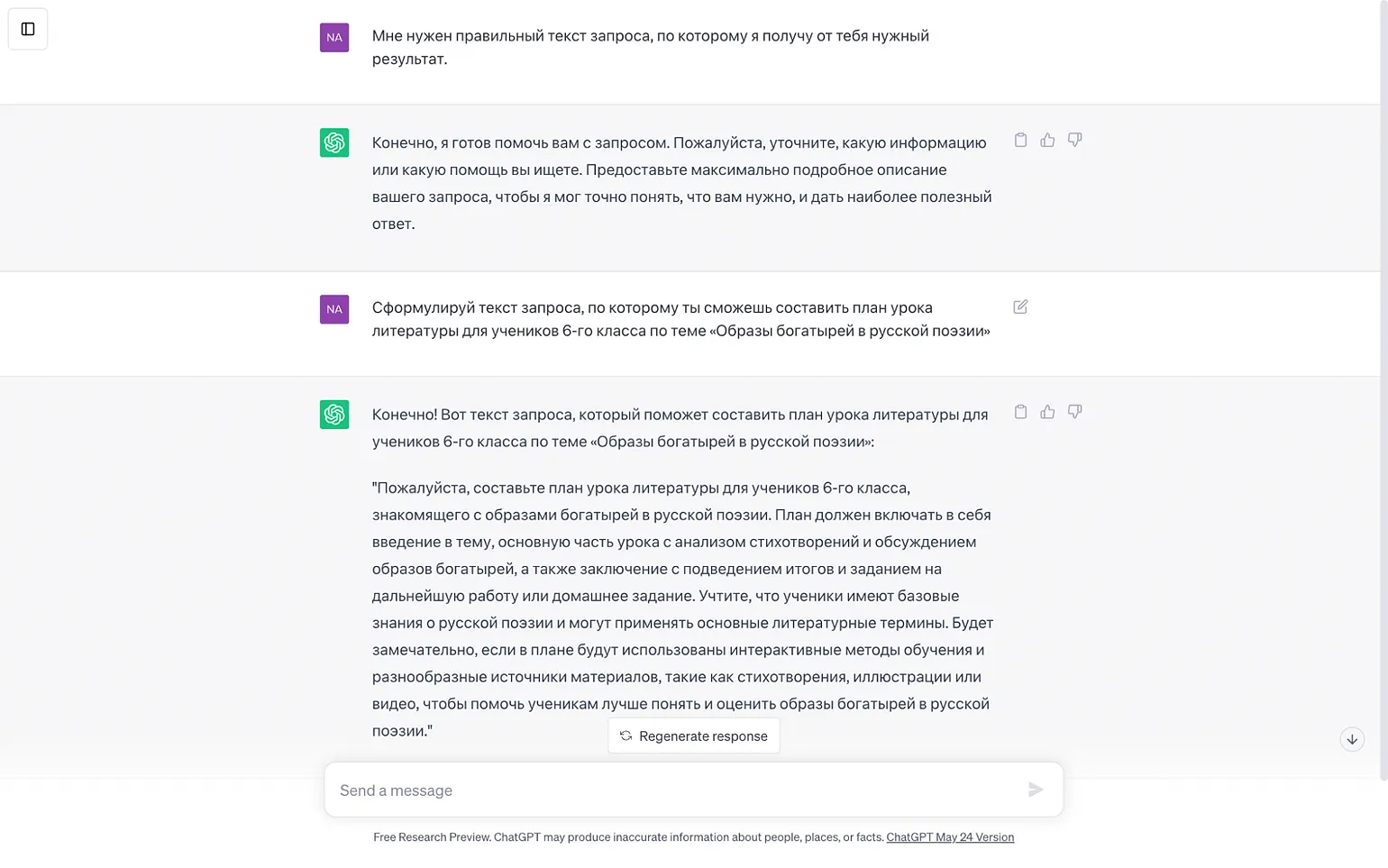
If you're unsure how to formulate a prompt, you can ask ChatGPT for help formulating a correct request. Start by stating your goal: "I need the correct request text to get the desired result from you." The AI will confirm its willingness to help and ask you to clarify the purpose and topic of your request. Then you can get more specific, for example: "Formulate the request text so that you can create a literature lesson plan for 6th-grade students on the topic 'Images of Bogatyrs in Russian Poetry.'" The resulting prompt can be further adapted to suit your needs before use.
When using ChatGPT, it's important to formulate queries correctly. Starting with the phrase "Formulate a query text for which..." can lead to the model not understanding that it needs to create a prompt and immediately jumping into the task. As a result, the resulting text is often of lower quality compared to queries with a more detailed and comprehensive description. If you explain the request to the neural network in advance in a new chat, it will be able to better remember the context. This approach allows you to use the chat to formulate various queries, clearly stating the purpose and topic of each. Effective query formulation helps to obtain higher-quality content and optimize interaction with the neural network.
You can attach a ready-made example to any query, for example, a lesson plan found on the Internet. This will help the neural network better understand the task at hand. To do this, simply formulate your request and add "Use this text as an example" at the end, followed by the corresponding sample. This approach will significantly improve the quality and accuracy of the resulting output.
The resulting output can be resent to the chat so the neural network can check it for logical, stylistic, and factual errors. In this way, the neural network will act as your editor and suggest improvements. However, it's important to keep in mind that ChatGPT can make factual errors and sometimes invent information when there's insufficient data. Therefore, it's important to independently check the text to avoid potential errors.
Learn more about education news and trends by subscribing to our Telegram channel. Receive up-to-date information and helpful tips delivered straight to your smartphone. Join our community and stay up to date with the latest developments in education.
Learn more:
- What AI assistants have learned to do in education
- How to access ChatGPT in Russia
- How to use ChatGPT and its analogues in education: a comprehensive overview
- ChatGPT - what it is and how the neural network works: capabilities and use cases
Philosophy of Artificial Intelligence
You will receive answers to important questions about "machine thinking" and understand the role of philosophy in the development of AI. You will identify the key differences between natural and machine intelligence, and will be able to conduct relevant scientific research and present in public.
Find out more