
Contents:

Learn: The Profession of a Methodologist from Scratch to PRO
Find out moreIn this article, you will get information about…
- how targeted training appeared and why it is needed at all;
- how the rules have changed Admission to targeted places;
- Who do targeted students most often study?
- What are the three main problems with targeted education and why are targeted students expelled?
- How is it planned to reform targeted education.
How can you get into a good university on a state-funded place if you don't have outstanding abilities? Competition is particularly high in popular programs at prestigious universities, and getting in with an average Unified State Exam score above 90 becomes virtually impossible. Participation in school Olympiads is an option, but it isn't suitable for everyone, as it requires significant effort and talent. Moreover, starting next year, the number of Olympiad winners will be limited, which will make admission more difficult for many applicants.
It is important to approach preparation for the Unified State Exam with the utmost responsibility and consider all possible options, such as additional points for individual achievements or participation in various competitions. Create a preparation plan in advance and actively use available resources to improve your knowledge.
In the absence of various social benefits for applicants, such as support for students with disabilities or children of military personnel who have died or been injured, admission through a targeted education quota remains possible. This option provides an opportunity to obtain an education for those who meet established criteria and need support. The targeted education quota facilitates the admission process for applicants with certain social or professional circumstances and ensures access to quality education.
To enroll in targeted education, you must sign an agreement with a government agency, government institution, state corporation, or state-owned company. This agreement must be presented to the university during the admissions campaign. One of the key conditions of such an agreement is a commitment to work in the interests of the client for three or more years after graduation. The work can be carried out either directly at the client's site or at a subordinate organization, which will also be a party to the contract.
Targeted education is available at all levels of education, including undergraduate, specialist, master's, residency, and doctoral programs. According to the government report on the implementation of state education policy, more than 54,000 students were enrolled in targeted programs at Russian universities in 2021. Of these, almost 53,000 received federal funding, representing 9% of the total number of students admitted to state-funded places (570,106). Targeted training helps prepare specialists in in-demand fields, which is an important aspect of the development of the country's educational system.
How Targeted Training Came About
Higher education in Russia faces a serious problem: up to 60% of graduates do not work in their field of study, while yesterday's school graduates continue to enroll in universities without taking into account the priority programs established by the state. The introduction of targeted training could solve this problem, ensuring an influx of young specialists into key economic and social sectors. Graduates required to work off their education will guarantee that the necessary personnel will be attracted to important areas. Additional support measures, such as scholarships and financial assistance, can help attract students to targeted programs.
This approach serves as a way to attract labor to regions that are unpopular among young people due to unfavorable working conditions. In economically depressed areas where finding work independently is difficult, targeted placement can be advantageous for graduates. This allows them to obtain a guaranteed, albeit unattractive, source of income.
The idea of training professionals tailored to the needs of the state has deep roots and dates back not only to the Soviet era but also to the Russian Empire. At that time, students receiving state-funded education were required to work in state institutions after completing their studies. This practice emphasized the importance of linking the educational process with the needs of society, ensuring the state has qualified personnel. This approach remains relevant in today's context, where it is crucial that educational programs meet labor market demands and contribute to the development of the public sector.
In the Soviet Union, with its planned economy, graduates were assigned to jobs, usually for three years. This practice was introduced in 1933 and continued until the end of the USSR. In the 1960s, the placement system was expanded to include targeted training for specialists for specific companies, conducted through postgraduate and residency programs. Organizations in regions without their own postgraduate programs were able to send their employees to other cities for training. After completing their studies, graduates were required to return to their jobs, which contributed to the development of human resources in various sectors of the economy.

In 1987, the Council of Ministers of the USSR decided to transition to a new system of personnel training, focused on a target approach. As part of this initiative, it was envisaged to conclude agreements on the training of specialists between the ministries and departments for which personnel were being trained, and the Ministry of Higher and Secondary Specialized Education of the USSR. It was also planned to establish direct links between enterprises, organizations and higher education institutions. This system was aimed at more effectively matching the training of specialists with the demands of the labor market and the needs of various sectors of the economy.
After the collapse of the USSR, both the Soviet system of targeted training and the main distribution system ceased to exist. However, in 1995, new rules for targeted training were officially approved by a decree of the Government of the Russian Federation. In subsequent years, these rules have undergone changes, adapting to modern requirements and conditions of the educational system.
The 1995 decree was in effect until 2013 and applied to students studying on a budgetary basis - both federal and regional. In this context, the discussion was not about targeted training, but about the employer's ability to enter into an agreement with the student regarding future employment. As part of this process, two contracts were drawn up: one between the student and the educational institution, and the other between the student and the employer. During the course of study, the employer had the right to pay the student additional benefits, and upon completion of their studies, guaranteed a job for up to three years. Moreover, the list of potential employers was unlimited, which contributed to broader opportunities for students.
In 2002, a clause was added to the Education Law allowing universities and secondary vocational education institutions to implement targeted admissions for the needs of state and local government bodies. State-funded places were allocated for this purpose. Government agencies generated applications for the required number of targeted places and compiled lists of applicants, which were then submitted to educational institutions. Universities, in turn, allocated places and held a competition among applicants for admission. This mechanism for targeted admissions facilitates the training of specialists who meet the needs of regions and government agencies.
As a result, two parallel systems operated: targeted student admission through a separate competition and targeted contract-based training for applicants who had already been admitted under the general procedure. This allowed for the creation of a flexible training model that takes into account the needs of both students and educational institutions. Targeted admission ensures the ability to attract talented young people, while contract-based training provides the opportunity for in-depth education and practical training for already enrolled students.
In 2013, a new targeted training system was introduced, enshrined in the Law "On Education in the Russian Federation," which included Article 56, which addressed this issue. The law continued to operate both targeted admission and the opportunity for students admitted to universities under the general procedure to enter into targeted training agreements with future employers. In this case, students receive not only a guaranteed job but also a range of social benefits from their employer, such as a stipend, financial assistance, and housing. This creates additional incentives for students choosing targeted education, as they can count on support from their future employers.
Budget-funded places are available for targeted admission within a special quota. These places are only available to applicants who have previously entered into a targeted education agreement with a government agency (federal, regional, or local government), government institution, state enterprise, state corporation, state company, or organization with state participation. According to this agreement, the client requesting targeted education undertakes to employ the graduate, but this does not necessarily have to take place within the organization with which the agreement was concluded. The law does not establish specific deadlines for employment, which provides flexibility for both graduates and clients.
Since 2019, the Law "On Education in the Russian Federation" has been amended. Admission to targeted education for budget-funded places remains, but is now regulated by a separate Article 71.1. It is also now possible to enter into a targeted training agreement with a future employer after a student has enrolled in an educational institution on a general basis, without a targeted quota. These changes expand opportunities for students and employers, allowing for a more flexible approach to education and employment.
The number of budget-funded places for targeted students is determined by a quota that takes into account the economy's need for qualified personnel and the specific needs of specific industries. Depending on the source of funding for the training, the quota may be determined by the Government of the Russian Federation, regional authorities, or municipalities. As mentioned earlier, most targeted places are funded from the federal budget. This ensures access to education for students seeking to work in in-demand professions and contributes to the development of key economic sectors.
A separate competition is held within the quota for applicants on targeted programs, which differs from the general competition.
The number of potential clients for targeted training funded by the state has increased, but all of them are affiliated with government agencies.
The new law introduces a minimum mandatory work-off period of three years for graduates on targeted programs. It also details the consequences for both students and clients for violating this requirement. Failure to comply with this requirement will result in penalties.
The procedure for concluding contracts for targeted training is regulated by a Government Resolution adopted in 2020. This Resolution establishes the basic rules and procedures regarding targeted training, thereby improving the training of specialists in line with the needs of the labor market. It is important to read this document for complete information on the terms and conditions of such agreements.
Currently, targeted training agreements can be concluded not only by government institutions but also by private companies and individual entrepreneurs. However, it is worth noting that students studying under such agreements are not eligible for state-funded places. This is because admission is on a commercial basis, and tuition costs are covered by the clients.
Training in fee-paying places financed by a private employer does not necessarily have to be documented as targeted. Universities, students, and companies can enter into a commercial training agreement, where the company acts as the payer. The relationship between the employer and the student regarding future work experience can be regulated by a special apprenticeship agreement, as already provided for by the Labor Code. However, a targeted training agreement offers additional opportunities for the employer, allowing them to monitor the training process. The employer can request information from the university about the student's achievements and make proposals for organizing the internship. This approach helps ensure higher quality training of specialists who meet employers' requirements.

Who do people most often go to study for? According to legislation, targeted quotas for state-funded places at universities are determined based on the economy's need for qualified specialists and the specifics of various industries. However, in practice, targeted places are allocated for many fields of study, including those that may seem excessive. For example, law, as well as disciplines not always considered economically important, such as philology, philosophy, and theology, each receive 10% of state-funded places in undergraduate programs. Popular fields of study, such as media communications and design, receive quotas of 15% and 10%, respectively. Linguistics and international relations receive even larger shares—from 34% to 35%. It is important to note that significant quotas are also allocated to areas related to art, which may indicate the specificity and characteristics of the relevant industries.
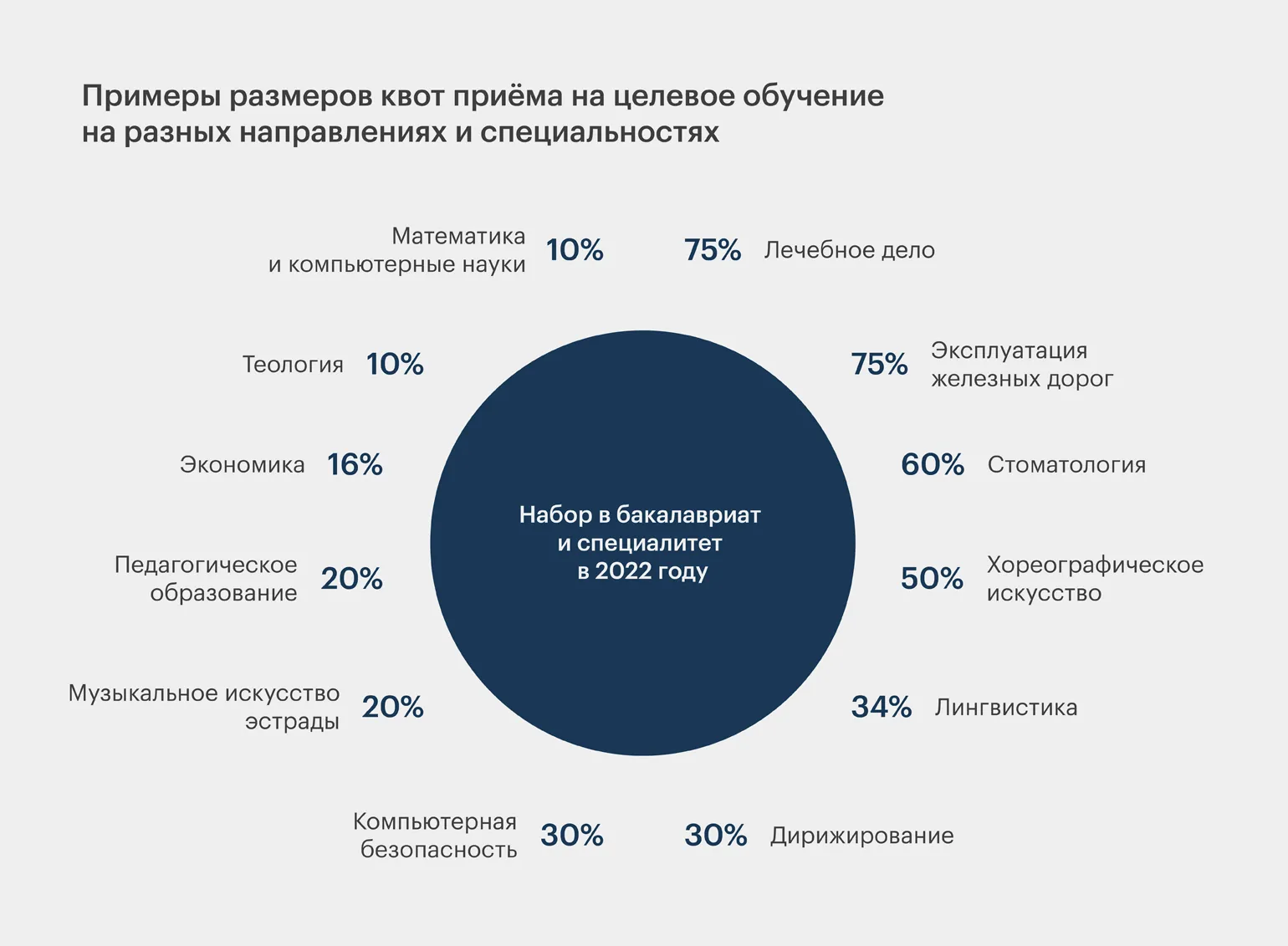
The highest quotas for targeted admissions are traditionally allocated to specialties related to the defense industry, civilian infrastructure, and medicine. Quotas for medical specialties were increased in 2020 by special order of the president, underscoring the importance of this field. In some cases, all or a significant portion of admissions are carried out through targeted recruitment, particularly for military specialties, as well as for judicial and prosecutorial activities. This demonstrates the growing demand for qualified specialists in these critical sectors.
In 2022, the education market is experiencing intense competition for places in targeted training. According to analytics, the fields of study and specialties with the highest share of places in targeted training include medical, engineering, and IT specialties. These fields continue to attract the attention of applicants due to their high employment prospects and the demand for specialists. In particular, medical specialties such as dentistry and pharmaceuticals offer a significant number of targeted places, as healthcare requires a constant renewal of personnel. Engineering fields, including mechanical engineering and construction, also have many targeted places, due to the active development of infrastructure and technology. Furthermore, IT specialties such as programming and cybersecurity continue to gain popularity amid the digitalization of the economy. Therefore, when choosing a field of study, it is worth considering these in-demand specialties, which offer a high probability of admission to targeted training.
The employment quota for graduates is established by the government in advance, usually in November of the previous year. This document determines the regions in which graduates can work in their specialty. However, for some specialties, the opportunity to work throughout Russia is provided. Examples of training fields and specialties included in the list for 2022 are presented in the table above.
The quota, as a percentage of allocated budget places for a particular specialty, differs from the absolute number of students admitted through targeted admission. Which fields of study have the largest number of targeted students? According to the 2021 report on the implementation of educational policy, the largest number of targeted students were enrolled in the following specialties: General Medicine (11,212 targeted students), Pediatrics (4,346 targeted students), and Teacher Education (4,701 targeted students). These data highlight the popularity of these fields and their importance in providing qualified specialists in their respective fields.
In other fields of study, the number of targeted students is significantly less than a thousand. This is due to the fact that the total number of state-funded places in highly specialized fields is limited compared to the widespread medical and pedagogical specialties. At pedagogical universities, even a small share of 20% of places allocated for targeted training (the same as in 2021) in absolute numbers of students significantly exceeds the number of admitted students, for example, in the military journalism specialty, where the targeted quota is 100% and only one university offers training.
General medicine and pediatrics are currently the leading fields in medical education, demonstrating the highest number of admitted targeted students and a significant share of state-funded places, amounting to 75%. This means that the majority of future doctors enter universities through targeted admissions, underscoring the importance of these specialties for healthcare. Targeted admission ensures the training of qualified specialists necessary to meet the needs of the medical field.
The order on the quota for targeted education is published after the total number of budget-funded places at universities across the country for the following year has been determined and distributed through a competition. Places for targeted education are allocated from this total. If the number of applicants for targeted education exceeds the number of available places, a separate competition is held among applicants. If some targeted places remain unfilled, they will be returned to the general admission pool based on Unified State Exam (USE) scores.
In most areas, the quota allocated for targeted education remains unfilled. According to university representatives, in 2022, many applicants with targeted programs did not take advantage of them due to their high USE scores. As a result, the quotas remained unfilled, and their return to the general competition occurred too late—by that time, applicants had already submitted their consent for admission to universities with higher chances of admission. According to Fontanka, this situation has developed, in particular, in medical universities, which has led to a shortage of students. This allowed some applicants with lower USE scores to take up available places.

The main problems of the targeted education system The legal insecurity of targeted education has been a key problem in the education sector for many years, as highlighted by researchers. This admissions model is often misused as a way to circumvent general rules and obtain a state-funded place with less effort than through participation in the general competition based on Unified State Exam results. This distorts the essence of targeted education and calls into question its effectiveness.
Plans for future work experience can be fictitious for both applicants and the organizations sending them for training. In reality, both parties may have no interest in each other. At every stage, from the conclusion of the targeted education agreement to the employment of graduates, there is the potential for manipulation and violations of the law. These risks require careful monitoring and regulation to ensure the fairness and transparency of the process.
Admission to targeted education involves two main stages. The first stage involves submitting an application and collecting the necessary documents for participation in the program. At this stage, it is important to correctly complete all paperwork and provide up-to-date information. The second stage is the candidate assessment, which may include an interview or testing. Successful completion of these stages allows students to receive targeted training, which contributes to their professional development and increases their chances of finding employment in their chosen field.
- First, the applicant enters into a targeted training agreement with a government agency or state-owned company (in other words, with the customer), under which he will be obligated to work;
- Then, the applicant who has entered into such an agreement presents it at the university and participates in the admissions campaign. At each university with targeted places, the competition for targeted students is held separately from the general competition (as established by the Procedure for Admission to Study in Higher Education Programs).
At the first stage, federal legislation lacked clear requirements for applicants for targeted training, as well as a special procedure for interaction between applicants and organizations in need of young specialists. Targeted training was regulated only after the contract was signed, implying that the applicant and the organization had already met. This created difficulties in the search and selection process for targeted training candidates, as there were no transparent mechanisms for matching them. It is important to develop clearer and more accessible procedures to facilitate interactions between educational institutions and employers, which ultimately facilitates the development of qualified personnel who meet labor market requirements.
In 2022, uniform criteria were introduced for selecting applicants for targeted training from government agencies with a commitment to subsequent work in the civil service. The competition for applicants for such targeted training must be publicly held. However, these rules do not apply to targeted students with contracts concluded by state corporations and companies with state participation. At the federal level, the law still does not establish selection procedures for this category of students.
Regions have the right to independently establish criteria for candidates for targeted training. However, researchers emphasize that these requirements are often not publicly available. As a result, applicants and the organizations funding their education remain in an unclear and opaque environment. This creates risks of corruption and can lead to uncompetitive and closed employment in government institutions upon completion of targeted training. Transparency in establishing requirements and criteria for selecting candidates for targeted training is necessary to ensure fair competition and increase trust in the education system.
The problem lies in the second stage of admission to targeted training—the university competition. The competition for targeted students is held separately from the general competition, meaning that competition for targeted places depends on the number of applicants who have a contract with the client for targeted training. Success in this stage depends on the number of candidates and their willingness to meet the requirements established for targeted training.
If the number of applicants for targeted places is small, even students with low Unified State Exam scores may be able to enroll. Universities do not have the tools to change this situation. This is what researcher Yuri Ezrokh from the Novosibirsk State Technical University discusses in his article published in the journal "Higher Education in Russia." At the same time, in the general competition for state-funded places at this university in the same field, there is competition among applicants with high scores. Since the number of applicants through the general competition exceeds the number of students with targeted education agreements, high-scorers face significant competition for in-demand specialties. This creates additional difficulties for those seeking an education in popular fields. Olga Isabekova, a researcher, analyzed data from the Ministry of Education and Science and found that in the admissions campaigns from 2017 to 2019, the competition for targeted places was significantly lower than the general competition for state-funded places, being only 6-7 times lower. On average, the competition for targeted places nationwide did not exceed two applicants per place, indicating a virtual absence of competition in this field. This means that virtually anyone who has negotiated with a government agency can enroll in targeted education, highlighting the opacity of this process.
Recent federal statistics demonstrate that the situation with targeted admissions to universities is not catastrophic. In 2021, the average Unified State Exam score for applicants admitted through quotas was 66.8, only slightly lower than the overall competitive score of 70.3. However, this average conceals significant differences between individual educational programs, universities, and regions. These gaps highlight the importance of analyzing targeted admissions data, as it can vary significantly depending on local conditions and the specifics of educational institutions.
Yuri Ezrokh, after analyzing admissions orders for medical and IT programs at universities in the top 100 Forbes rankings for 2021, concluded that a third of universities, both metropolitan and regional, admitted targeted students with low scores to complex IT programs. Specifically, the admitted students had scores of less than 160 in three Unified State Exam (USE) subjects, raising questions about the quality of training for future specialists in these fields. This fact points to potential problems in the education system and how selection criteria affect student competencies.
At 75% of the analyzed universities, students applying through targeted programs would not have been able to secure state-funded places had they participated in the general competition. This suggests that even the lowest passing score for state-funded students applying through the general competition exceeds the highest score among targeted students. This information highlights the importance of transparency and fairness in the student admissions system.
An example from the information technology field demonstrates that targeted admission is often seen as an opportunity for those who would otherwise not be able to obtain a state-funded place. This gives a chance to applicants who face limitations in the traditional admissions process.

In 2021, the situation with admission to medical specialties turned out to be significantly different. The average score of admitted targeted students was lower, but the strongest applicants were able to secure state-funded places, as their Unified State Exam (USE) scores were quite satisfactory. Nevertheless, the gap between targeted students with low scores and applicants admitted through the general competition remains significant. In 2020, this gap reached 111 points at major Moscow universities, underscoring the relevance and competitiveness of medical schools. Among the 2021 first-year students admitted to fee-paying programs, approximately 13% were students with average USE scores of 80 or higher. These applicants were unable to secure state-funded places due to a lack of vacancies and were also unable to sign a targeted education agreement. The current situation raises questions about the fairness of the existing system for allocating places at universities.
The problem lies not only in fairness but also in the quality of training for students admitted to universities with low scores. According to some reports, up to 10% of targeted applicants fail to cope with the academic workload and are subject to expulsion. For example, at the Far Eastern State Medical University, from 2013 to 2018, there was a high attrition rate in the first and second years, exceeding 20% among targeted applicants. This indicates the need to revise approaches to student selection and training to ensure high-quality education and successful careers for future specialists.
In 2016, according to monitoring by the Ministry of Education and Science, more than 60% of targeted training contracts did not include specific employment deadlines. This was not unexpected, as the law did not require such deadlines. Before the introduction of the minimum three-year work-around period, employment was often formal in nature. This was also mentioned at a government meeting in 2016. If the primary condition for fulfilling a targeted training contract is merely the fact of "employment," rather than mandatory work for a specific period, then the employee may be hired for only one day. This highlights the need for stricter regulation in the area of targeted training to ensure the actual employment of graduates and improve the quality of education.
Researcher Yuri Ezrokh argues that employers show little interest in having young specialists work for them for three years. Furthermore, organizations often lack oversight over the quality of graduate training. In most cases, clients do not view targeted training as an effective way to attract new employees. This highlights the need for a more in-depth analysis of the interaction between educational institutions and employers, as well as the development of mechanisms that could improve the process of training specialists who meet labor market demands.
Students studying in targeted programs often do not see the benefit of such training for their careers. This is particularly noticeable in medical specialties, where many students believe that employers who fund targeted training offer graduates only low-prestige and low-paying positions. The obligation to work at a specific institution after graduation is perceived as a burden rather than an opportunity for a successful career launch. It is important to change this perception by emphasizing the benefits of targeted training and the prospects it can open for young professionals.
In 2011, according to estimates by educational institution directors, only about 40% of students studying in targeted programs returned to their jobs after completing their studies. The situation in the field of training specialists for the military-industrial complex also left much to be desired. For example, of the 150 targeted students who graduated from Orenburg State University in 2015, only 34% found employment at the companies for which they were trained. The introduction of a minimum three-year work-around period was intended to reduce the number of fictitious employment opportunities, but its effectiveness is currently difficult to assess. The first targeted bachelor's degree students required to sign contracts requiring three years of work-around will receive their diplomas only in 2023, while specialists will receive their diplomas in 2024.
The primary measure to combat failure to fulfill obligations under targeted training contracts is penalties. If the client requesting targeted training fails to employ a graduate, they will be required to pay compensation equal to three times the average salary in the region. Furthermore, the client is required to pay a fine to the university, as the lack of employment indicates that budget funds were used ineffectively. The fine is equal to the cost of educating the graduate according to state standards, which reflects the budget expenditure on their education.
In the event of a violation of the employment conditions after graduation, when a graduate fails to begin work at the agreed-upon position or resigns before the end of the established period, they are required to pay a fine to the university. The fine is determined proportionally to the time not worked if the graduate has partially fulfilled the conditions. In addition, the graduate must compensate the client for the costs incurred for additional support measures, such as payment for additional educational services, housing, or stipends. This condition encourages students to fulfill their obligations and minimizes financial risks for educational institutions and employers.
According to the mechanism established in the government decree, clients of targeted training are required to provide the university with written reports on the employment of targeted graduates within three years. If the client refuses to employ a targeted student, the graduate must notify the university accordingly. The effectiveness of this scheme is difficult to assess, as it only came into effect in 2021.
This year, medical schools, following the Ministry of Health's recommendations, implemented new measures to combat violations of the terms of the work-off period. Violators will now be unable to enroll in residency programs, even for fee-paying positions. This decision is aimed at improving the quality of medical education and strict adherence to professional standards.

The Profession of Methodologist from Scratch to PRO
You will improve your skills in developing curricula for online and offline courses. Master modern teaching practices, structure your experience, and become a more sought-after specialist.
Find out more