
Contents:

Learn: Online Course Producer from Scratch to PRO
Learn moreIn July 2022, a meetup entitled “How to Develop Employees When Studying Is Clearly Not a Priority” was held, organized by experts from LLLab, Esprezo, Pobudilnik, Ikra Group and School of Education. At the event, speakers shared their experiences while discussing new challenges in corporate training. They examined effective formats and methods that help develop employee skills in the face of limited learning time. The meetup served as a platform for exchanging ideas and finding solutions to current problems in professional development. Sonya Smyslova, curator and program director of the School of Education at Universal University, addressed the important topic of strategic quality management in education in times of uncertainty. She shared the quality management model she uses in developing educational programs and explained how this model can be effective for planning educational processes in times of crisis. In this context, special attention was paid to key aspects that will help educational institutions adapt to changes and maintain high standards of education.

What is "quality" as a coordinate system
Sonya Smyslova emphasized that the quality of education should be assessed not only through business metrics, but also through the experience of students, their impressions and feelings during the learning process. She shared the approach of Universal University, where the framework created by the British Agency for Quality Assurance in Higher Education is used in the development of educational programs. This approach allows for the integration into the educational process of elements that promote a deeper understanding and perception of the material, and also increase student satisfaction.
In this framework, the structure of the training program is divided into three key components: defining the desired results, practices for achieving them, and support practices. These elements function within the framework of two equal aspects, which ensures a comprehensive approach to training and development. The focus is on both achieving the stated objectives and supporting the learning process, which promotes deeper assimilation of the material and increases the effectiveness of the educational process.
- The content zone considers the qualifications and competencies the student will acquire as a result of the training;
- The form zone describes the student experience gained during the training process.
The speaker emphasizes that educational programs pay insufficient attention to the form of instruction. The quality of education is often assessed solely by achievements, such as the percentage of graduates who find employment after completing the course. However, this ignores an important aspect: the educational experience of students, as well as the methods and practices that contribute to its improvement. Paying attention to these factors can significantly improve the effectiveness of learning and student satisfaction, which in turn will be reflected in their professional success.

Be sure to read the additional information:
Measuring Quality Learning Experience in EdTech: Why It's Important
The quality of the learning experience in EdTech is becoming increasingly important for educational institutions, students, and educational technology developers. Measuring this quality allows us not only to evaluate the effectiveness of learning platforms but also to identify areas for improvement and tailor content to user needs.
One of the key reasons for assessing quality is to improve student achievement. Understanding how educational technologies impact learning helps develop more effective teaching methods and improve curricula. Furthermore, a high-quality learning experience promotes student engagement, which in turn increases their motivation and desire to learn.
Various methods are used to measure the quality of the learning experience in EdTech, including surveys, performance data analysis, and user feedback. This data helps create a complete picture of how students perceive the educational process and what aspects require improvement.
It's also important to consider that the quality of the educational experience influences the reputation of educational institutions and EdTech companies. Positive reviews and high student performance can attract more users and investment.
In conclusion, measuring the quality of the educational experience in EdTech is not just a formality, but a necessary step for creating effective and in-demand educational products. This not only improves learning but also ensures long-term success in a rapidly changing educational environment.
The program for a professional IT course can be structured as follows:
- Expected outcome: after four months of study, the student can take a junior position in an IT company.
- Practices for achieving this outcome include classes with industry specialists.
- Support practices include the creation of a methodological lab that will train specialists in teaching.
However, focusing exclusively on the educational process can lead to the formation of a graduate who experiences burnout from intensive training and loses interest in working in their specialty. The speaker notes that this situation is often encountered in professional courses. To prevent this, it is important to also consider the format of the training.
- Expected outcome: the student gains an inspiring experience, is charged with interest and a desire to develop in the profession.
- Achievement practices: a series of gradually more complex tasks or projects so that the student gets used to the workload.
- Support practices: a workshop where appropriate assignments for students are developed.
According to Sonya Smyslova, quality management in education contributes to the development of balanced programs for various formats of training and levels of education. However, in a rapidly changing situation and a shrinking planning horizon, certain difficulties arise. These challenges require flexibility and adaptability in approaches to educational methods and quality control systems.
Difficulties of crisis planning and ways to cope with them
The speaker identified three key problems that companies face in managing quality in a crisis. These challenges can significantly impact the efficiency of business processes and require special attention from management. It's important to understand how a crisis affects quality standards and what measures need to be taken to maintain them.
According to Sonya, the described system is based on hypotheses. For example, one could conduct a market analysis and assume that successful employment is a relevant outcome for IT students. However, as she emphasizes, this is just a hypothesis: "We can't say for sure that this is true. Reality is constantly changing: one thing is important today, and tomorrow it is no longer so."
The same applies to practices for achieving and maintaining results. Although everything can be planned in advance, during implementation, it may turn out that resources, such as money or time, are insufficient. In addition, the result itself may lose its relevance.

According to Sonya, opportunities to test hypotheses in education are quite rare, especially in the context of general education programs. In a crisis, time for such tests may not exist in vocational education, including EdTech, where the training cycle is significantly shortened. Effective hypothesis testing is becoming an important task for improving educational processes and developing relevant programs.
The speaker recommends reviewing expected results and focusing on the most important and significant. It is important to determine what needs to be achieved first. Key parameters in this process are financial indicators and student needs. Optimizing these aspects will help achieve the set goals more effectively.
Sonya argues that in a crisis, it is wiser to focus on projects that can be implemented quickly and with minimal costs. At the same time, large and complex projects carry increased risks, which may lead to the impossibility of their successful implementation for various reasons. Choosing simpler and more cost-effective solutions helps reduce risks and ensure stability in unstable times.
According to Sonya, a period of instability is not the right time for experiments. Therefore, when choosing methods for achieving and maintaining results, it's best to turn to proven and reliable practices. It's important to find the most effective approaches and adapt them to your goals to increase your chances of success in the face of uncertainty. Using established methods will help avoid unnecessary risks and focus on achieving desired results.
Sonya noted that the current measures are temporary. After the crisis ends, there will be an opportunity to return to experimentation, reassess priorities, and tackle more complex and interesting projects. At the moment, such solutions will help focus on the most important aspects and maintain the high quality of educational programs.

Reworked text:
Be sure to check out the additional materials:
Netology's research has identified key trends in online education that are having a significant impact on the educational process. In recent years, there has been a growing interest in flexible learning formats that allow students to independently choose the pace and time of classes. Demand for courses focused on practical skills and the application of knowledge in real-world settings is also increasing.
Popular areas include IT specialties, digital marketing, and design. An important aspect is the integration of new technologies, such as virtual and augmented reality, which makes learning more interactive and engaging. Furthermore, the importance of student communities and networking is growing, facilitating the exchange of experience and knowledge.
Thus, Netology's research emphasizes the importance of adapting educational programs to modern requirements and the interests of students, which ultimately contributes to a more effective learning process.
In times of crisis, the design of educational programs faces new challenges, including increased demands for efficiency. While achieving an educational outcome normally takes about four months, economic instability requires reducing this timeframe to three months. This requires educational institutions and teachers to adapt their methods and approaches to ensure high-quality learning within a short timeframe.
Sonya believes that solving this problem requires changes to specific parts of the system, whether it's outcomes, achievement practices, or support practices. To select the optimal solution, the speaker suggests using a simple matrix with two axes. This approach will help systematize information and make more informed choices, which, in turn, will increase the effectiveness of the methods and strategies used.
- Efficiency is the ratio of costs to results. Results refer to the target indicators of an educational program—students' final grades, success rates, or employment rates, etc. The lower the costs and the higher the results, the better.
- Reputation is the ratio of positive to negative reviews. These could include social media mentions, NPS (Net Promoter Score)—basically, anything that speaks to student sentiment.
First, you need to determine your program's position within these two parameters. This will help you understand how effectively your program meets the specified criteria and how it can be improved to achieve better results. By analyzing these aspects, you will be able to more clearly formulate a strategy for the development and optimization of the program.
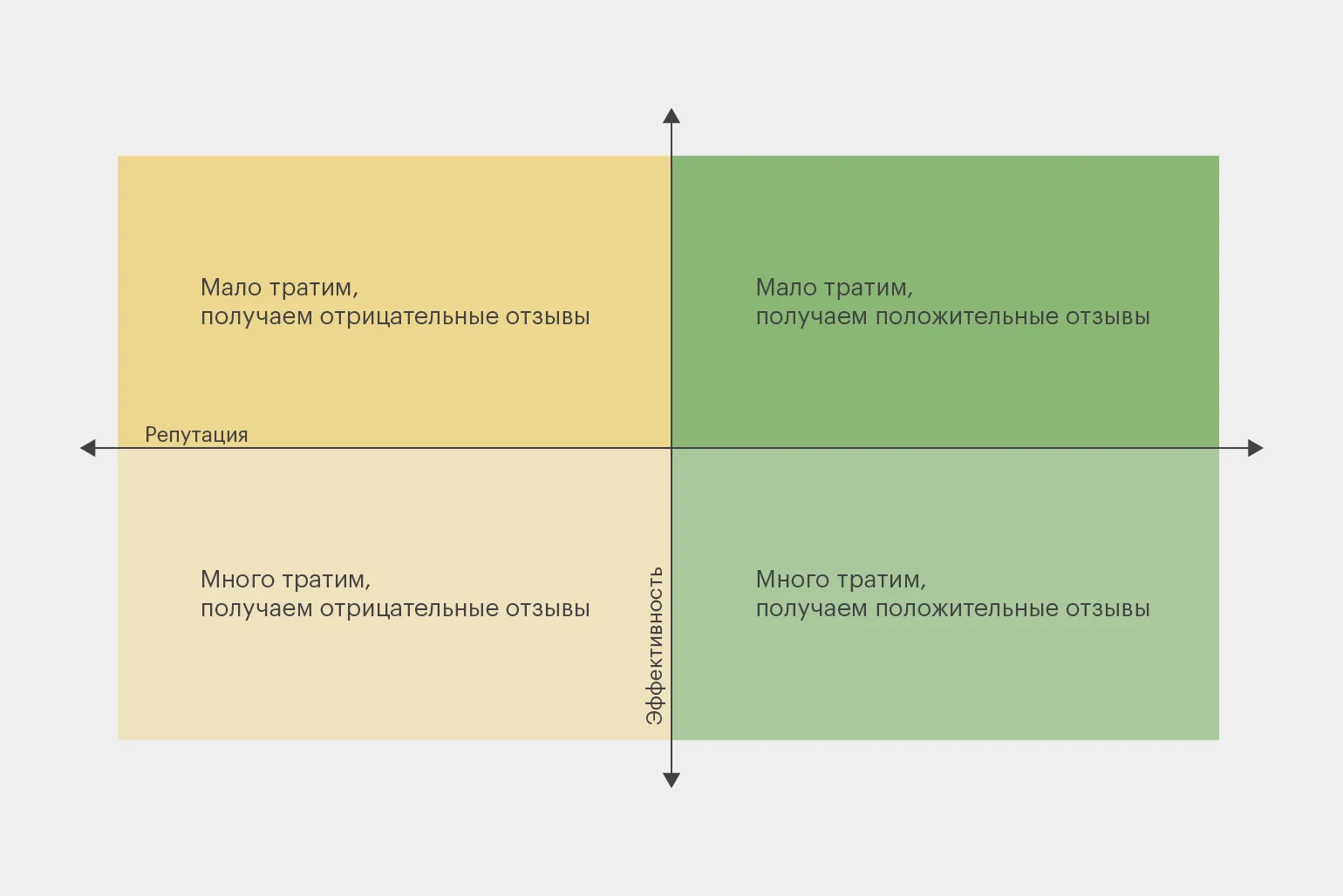
Effective programs are characterized by low costs and positive user reviews. Conversely, ineffective solutions often have high prices and a negative reputation. There are many options in between these two categories, which can vary in their characteristics and reviews. When choosing a program, it is important to consider not only cost but also actual effectiveness and user reviews to make the best choice to achieve your goals.
The matrix will help identify areas for compromise and improvement. For example, if your costs are minimal and reviews are mostly negative, you need to analyze what exactly students are not satisfied with during the learning process. This may be related to the format of classes, the level of teaching, the complexity of the material, or other factors. It is important to identify the root causes of dissatisfaction and develop a strategy to address them.
When students express interest in learning, but the results require significant costs, this can become a problem in a crisis, especially if sources of income begin to disappear. In such a situation, it is important to consider opportunities to improve the effectiveness of the educational program. Optimizing resources and implementing more cost-effective teaching methods will help achieve better results without increasing financial costs.

Explore our other materials:
An online course audit is the process of analyzing and evaluating the content, structure, and methodology of a course to identify its strengths and weaknesses. Conducting an audit allows the methodologist to improve the quality of the educational product, increase its effectiveness, and enhance student satisfaction.
To successfully audit an online course, the methodologist must carefully review the course materials, including video lessons, text materials, assignments, and tests. It is important to assess how well the course meets the stated goals and requirements of the target audience. The methodologist should also pay attention to ease of navigation, interactive elements, and the accessibility of the materials.
During the audit, it is recommended to conduct surveys among students to obtain feedback on the course. This will help identify problem areas and areas for improvement. In addition, it is worth analyzing statistics on student performance and engagement to assess the effectiveness of the course.
After conducting the audit, the methodologist should prepare a report with recommendations for course improvement. Implementing the proposed changes will improve the quality of the online course and attract more students, which in turn will positively impact the educational institution's reputation.
Sonya Smyslova suggests focusing on modeling to analyze possible changes and their impact on the current state of affairs. For example, it is worth considering how increasing the number of students in a course from 50 to 100 will affect the educational process. It is important to assess how this change will affect the quality of instruction, results, as well as financial aspects such as expenses and revenue. Modeling various scenarios allows for more accurate predictions of consequences and informed decisions to improve the educational program.
The speaker emphasizes the importance of maintaining a balance and carefully evaluating options that may require additional costs or negatively impact reputation.
Sonya Smyslova notes that in the future, we may return to a more familiar reality. However, during this time, we have already suffered significant financial losses and faced a loss of support from those around us. This will lead to personal crises and individual problems that we will have to resolve.
It is recommended to clearly separate expense items. Some can be eliminated completely, others should be reduced, and still others must be maintained to avoid deteriorating results or relationships with students. Proper expense management will help optimize the budget and improve the efficiency of the educational process.
Sonya Smyslova's presentation sounded an important warning: do not reduce everything to business metrics, as this will negatively impact the team developing educational programs. Education, even in a commercial format, is a socially oriented activity that requires a high level of responsibility. In a crisis, if an educational organization focuses solely on achieving financial results, this can lead to demotivation of employees. For example, canceling useful but low-profit programs can lead to a feeling of burnout among employees who are inspired by their work and understand its importance. Therefore, it's important to maintain a balance between business goals and the social value of education to maintain team motivation and effectiveness.
In a crisis, it's important to avoid the perception that optimizing an educational program portfolio simply means abandoning socially significant initiatives in favor of business efficiency. It's essential to clearly articulate both business outcomes and social achievements from the outset of each program's development. Education always impacts people's lives, opening up new opportunities and filling existing skill gaps. In the context of corporate training, outcomes can be linked to the company's overall social responsibility, which not only improves its image but also increases employee motivation. Thus, a balanced approach to educational programs ensures both economic benefits and a positive impact on society.
Sonya noted that achievement practices can vary in importance in a social context. It's important to choose those methods that most inspire your employees and foster their engagement. This not only improves team spirit but also increases overall productivity. Selecting the right practices can be a key factor in the successful development of a team.
The speaker emphasizes the importance of caring for the mental health of a development team, especially in times of crisis. Maintaining the psychological well-being of employees contributes to their productivity and creativity. In conditions of stress and uncertainty, paying attention to the team's mental state becomes a key factor for successful work and achieving shared goals.
Reading is an important aspect of our lives, allowing us to broaden our horizons and deepen our knowledge. It promotes critical thinking and improves communication skills. Books, articles, and other sources of information help us better understand the world around us and make more informed decisions. Regular reading has a positive impact on cognitive abilities and promotes personal growth. In the digital age, access to information has become easier, and everyone can find materials on topics of interest. Develop your reading skills and enrich your knowledge by choosing high-quality sources of information.
- New book: "Designing the Educational Experience" by Sonya Smyslova
- 11 educational metrics to evaluate the quality and effectiveness of a course
- Is it possible to find uniform quality metrics for education at different levels?
- 5 course design models: how to choose the right one
Online Course Producer from Scratch to Pro
You'll learn how to launch profitable courses and webinars with minimal investment. You'll understand how to turn existing EdTech projects into profits and make money from online learning.
Find out more