
Contents:
- How Failure Began to Be Discussed in the Academic Environment
- How Failure Summaries Inspired Help for Students
- Why Failure Summaries May Not Always Work as Intended
- How Else They Prepare for Failure and the Idea That Making Mistakes Is Okay
- Why Normalize Student Mistakes
- What Came from an Experiment in Which Schoolchildren Were Told About the Failures of Great Scientists

Learn: How to Make Money Giving Presentations
Learn MoreIn modern professional education, the concept that simply providing students with the knowledge and skills necessary for their future profession is becoming increasingly relevant. It is also important to prepare them for the real-world working conditions they will find themselves in is becoming increasingly important. It is essential to recognize that, despite high abilities and passion, the path to success will be accompanied by difficulties. This applies to both professional activity and the educational process. Accepting failures as a natural part of the journey helps students maintain motivation and confidence, especially when faced with initial difficulties. This approach promotes more effective adaptation to the professional environment and develops resilience to stress and challenges, which is an important aspect in developing the competencies of future specialists.
In this article, we will discuss how foreign universities prepare students for failure and what methods can be used in courses to achieve similar goals. Preparing for failure is an important part of the educational process, allowing students to develop resilience and find ways to overcome difficulties. This approach helps students develop the skills necessary for successful professional activity, including the ability to analyze mistakes and learn from them. Applying foreign experience in preparing students can significantly improve the effectiveness of training and prepare them for real challenges in the future.
How Failure Began to Be Discussed in the Academic Community
In 2010, Melanie Stephan, a researcher and lecturer in the School of Biomedical Sciences at the University of Edinburgh in Scotland, published an article in the journal Nature entitled "A Summary of Failure." In this article, she shared her recent experience of being rejected for an internship, one of many such experiences in her career.
Melanie calculated that for every hour she spends on a successful proposal, she needs to spend six hours working on proposals that will ultimately be rejected. This underscores the importance of thoroughly preparing and analyzing each proposal to increase your chances of success. Effective time management and a strategic approach to proposal creation can significantly improve results and minimize waste.

In the scientific field, as in other In many fields, failures are common. Each failure or mistake is often perceived as a solitary one, Melanie noted. Only achievements are typically publicly shared, while failures remain unnoticed. Therefore, she suggested that her colleagues create a "resume of failures," listing unrewarded research, rejected internships, and unpublished articles. This approach can help raise awareness of the importance of failures and their role in the scientific process. This list can significantly exceed the length of a standard resume, the researcher noted. It highlights the essence of scientific activity and shows that the path to success is not always straightforward. The most courageous researchers can make their failures public, demonstrating to others that failures are a natural part of the scientific process and that no one is alone in their difficulties. This approach contributes to a more open and supportive scientific environment, where mistakes are perceived as steps on the path to success.
Melanie Stefan's proposal proved beneficial for both faculty and students. This solution contributed to the improvement of the educational process, providing new opportunities for learning and interaction. As a result, all participants in the educational process were able to benefit from the proposed initiatives, which positively impacted the quality of education.
How a summary of failures inspired help for students
Stefan's article attracted the attention of the scientific community. A striking example of this is Professor Johannes Haushofer of Princeton, USA. He shared a list of his failures on social media: programs that did not accept him, awards he did not receive, and scientific journals that rejected his articles. This move became an important contribution to the discussion on the topic of failures in scientific careers and their impact on the research process. Such confessions highlight the importance of failure as a necessary part of success, which can inspire other scientists to speak openly about their struggles.
He sought to demonstrate to his students that failures and mistakes are a natural part of learning. It is important not only to acknowledge them but also to learn from them in order to continue moving forward and achieve success.
The final line of his résumé, reflecting on his 2016 achievements, read: "This unfortunate résumé of failures has attracted more attention than all my scientific achievements combined."
Haushofer's courage inspired his colleagues at Smith College in the United States. At the beginning of the winter 2017 semester, students entering the building were surprised by a huge screen installed on the wall. This screen has become not only a decorative element but also an important tool for student-faculty interaction. It was used to display relevant information, event announcements, and educational resources, significantly enhancing the learning environment and fostering student engagement in college life.
The discussion included remarks from administration, faculty, and students. One student shared his own failure: "I wrote a poem called 'Chocolate Caramels,' and it was rejected by 21 publishers." Another student recounted his experience: "I was expelled from college in my first year. I got Fs the entire semester." These stories highlight the challenges young people face in their academic and creative pursuits.
Even the college president participated, underscoring the importance of the event. Each student and staff member was given the opportunity to create their own "resume" and share it with other participants. The first person to share theirs was awarded a "certificate of failure." This certificate symbolized that even in the face of mistakes and setbacks, its recipient remains a worthy and valuable person. The campaign aims to support and develop students' confidence and overcome their fear of failure, which is an important aspect of personal growth.
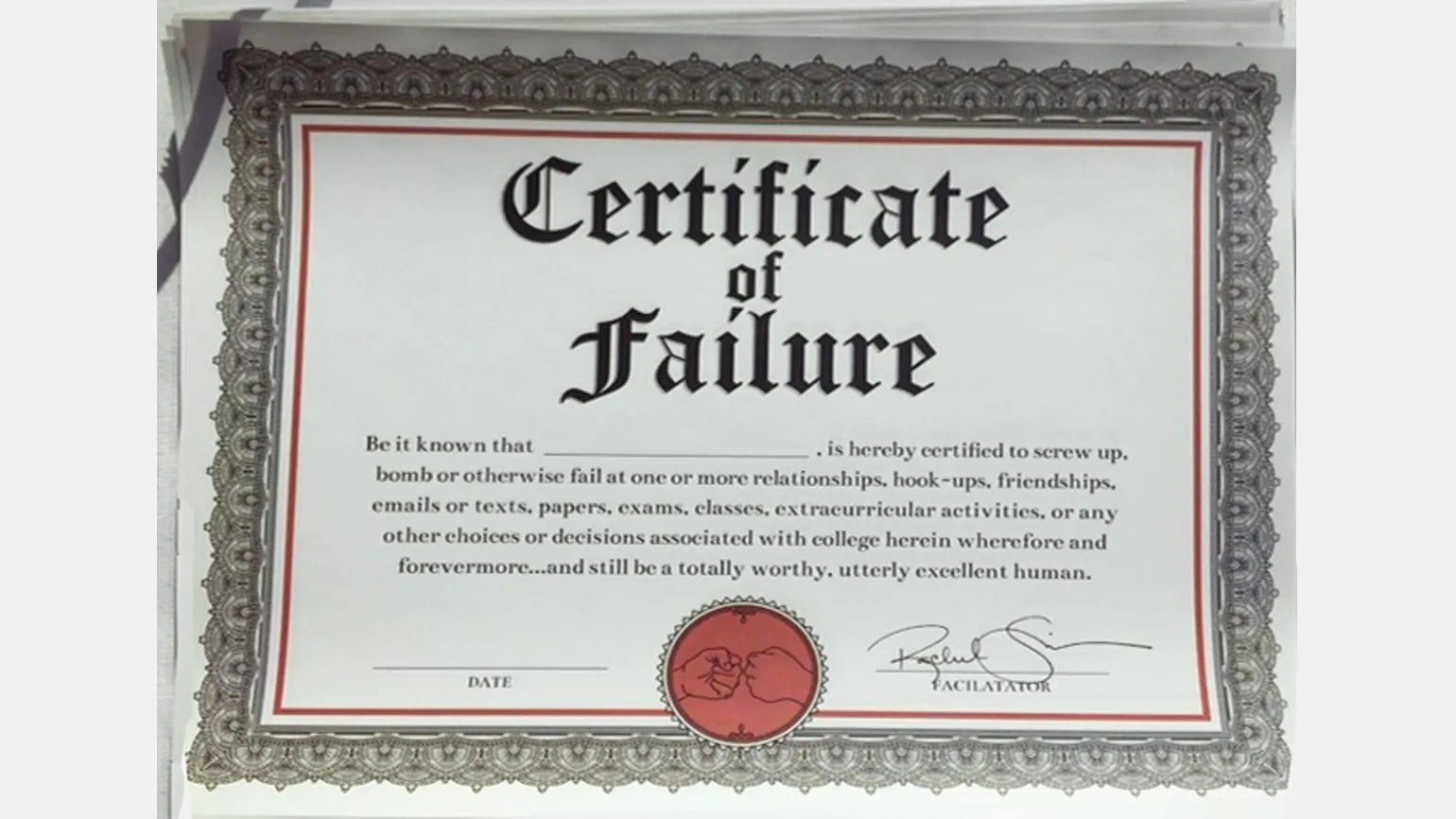
The campaign is part of the Failling Well project, which in English means "Fail with a good result." The project includes lectures, workshops, and unique events like the Stress Olympics, which help participants better understand and manage their emotions under stress.
Rachel Simmons, one of the initiative's creators, emphasizes the importance of students recognizing that making mistakes and choosing the wrong path is a natural part of their educational and life experience. Recognizing mistakes as part of the process of achieving success helps develop confidence and resilience, which ultimately leads to more informed decisions in the future.
Why Failure Recaps May Not Always Work as Intended
Some teachers and higher education institutions have encouraged students to openly share their failures, but The Guardian columnist Sonia Sodha has highlighted the downside of this initiative. She considers the consequences of publicly discussing failures and how this can affect students in their academic and personal lives. It's important to recognize that the vulnerability expressed in such conversations can be both a positive and a negative experience.
Reflecting on failures and sharing them with others may be comfortable for a successful person, such as someone working at Princeton. However, as experience shows, success is not always the result of hard work and mistakes. It's important to understand that success depends on many factors, including the right strategies, environment, and the opportunity to learn from experience.
Successful people may find it more useful to create a resume of successes than a resume of failures. In this document, you can highlight the positive aspects of your life: for example, that I was born into a middle-class family and that my natural abilities were supported by my parents and the educational system. This doesn't diminish my role in achieving my success, but I believe a resume of successes reflects a deeper reality about how society functions than a resume of failures. This approach allows for a better understanding of the factors that contribute to success and the recognition that success is not only the result of personal effort but also the influence of the environment.
While this approach won't teach students resilience, it will demonstrate that success isn't always associated with the ability to repeatedly overcome setbacks. It's important to understand that the factors influencing goal achievement can be varied and don't always depend on personal perseverance.
PhD, lecturer, and academic consultant Natalia Mosunova supports the columnist's position.
Discussing your failures is only possible with sufficient life experience and developed skills. An eighteen-year-old student whom we ask without prior preparation to talk about their failures will likely be unable to do so. This doesn't mean they haven't had any failures; rather, they are simply not ready for such a discovery. Having experience allows you to reflect on past mistakes and learn from them, which makes discussing failures more productive and meaningful. Natalia notes that compiling a "resume of failures" is especially effective in the academic environment. This is due to the high competition in this field and the many difficulties that professionals face. Using this approach allows you to better understand and analyze mistakes, which in turn contributes to professional growth and increases the chances of career success. According to statistics, less than one percent of people who choose an academic career achieve the status of professor. The rest are forced to take less prestigious positions or move into business and other fields. Publishing a summary of failures becomes a source of support for such people, allowing them to find like-minded people and realize that career difficulties are common. For students and schoolchildren, certain measures are an important step in normalizing mistakes and failures, the specialist believes. Two main aspects are key factors in this process. First, it is essential to develop the ability to accept failure as part of the educational process, which promotes growth and learning. Second, it is important to create a supportive atmosphere where students can openly discuss their mistakes and find ways to correct them. This approach not only helps them overcome difficulties but also builds self-confidence, which is an essential element of successful learning.
In educational systems where top marks are awarded only for flawless completion of assignments and the difference between grades is minimal, mistakes are perceived extremely negatively. Even a small error can lead to a significant decrease in grade. For example, a student who was previously an excellent student may become a good student after one mistake. This creates an atmosphere of anxiety and pressure, where the fear of making mistakes hinders the process of learning and development.
The grading system in the UK represents an alternative approach to traditional methods. Teachers do not limit themselves to simply assessing the "correct" or "incorrect" answers. To receive a high grade, a student's work must meet predetermined criteria. This method allows for a more comprehensive assessment of the level of knowledge and skills of students, taking into account their individual achievements and efforts. This creates a fairer and more objective assessment system that fosters students' critical thinking and creativity.
Important aspects taken into account include presentation skills and critical thinking. Critical thinking involves analyzing information, making connections between different data, and applying them in different contexts. These skills play a key role in developing the competencies needed for effective communication and informed decision-making.

Universities use a grading system that offers a more detailed grading scale. For example, within a 100-point system, a grade of 70 is considered honors, while achievements of 75-78 points open the door to publication in academic journals. This system allows for a deeper analysis of students' knowledge and skills, facilitating their academic development and increasing their chances of a successful career in science. Natalia notes that grading out to 100 points leaves ample room for growth, and the emphasis is placed on meeting specific criteria rather than achieving perfection. She also notes that a similar system is being implemented in Russian universities, but with a higher bar—an A can only be achieved with a score of 90 or higher. This limits students' opportunities for further development. The expert emphasizes the importance of evaluating not only individual achievements, but overall progress. Assessing progress allows for the mistakes that are inevitable at any stage of life. The key is the ability to develop and improve healthy, regardless of age. Feedback is no less important than evaluation. Receiving feedback can cause anxiety and stress for the person being evaluated. Therefore, it's important not only to develop a feedback system and make it accessible, but also to learn how to process it effectively. Accepting criticism and recommendations promotes personal and professional growth, improving work quality and strengthening teamwork.
Natalia analyzes her experience interacting with Russian and British students. British students actively seek feedback, striving for continuous improvement. Meanwhile, Russian students do not yet perceive it with the same importance. Many of them not only underestimate its usefulness but also experience difficulty perceiving it. This difference in attitudes toward feedback can impact the learning process and skill development of students in both countries.
In my practice, I encountered an interesting case in which the parents of Russian students asked to organize a course on feedback for their children. The students took feedback on their work too personally. It was important to explain to them that criticism concerns not their personal qualities, but the results of their work. This understanding is essential for developing professional skills and forming a sustainable attitude toward constructive criticism. This approach will help students not only improve the quality of their work but also improve communication with teachers and colleagues.
According to Natalia, feedback does not eliminate stress, but it provides important tools for managing it. It allows you to discuss emerging issues, ask questions and defend your point of view, which significantly improves the working atmosphere and promotes professional growth.

Study additional materials:
Parental attitudes play a key role in shaping the future of children, including their chances of admission to prestigious universities. Parents' attitudes toward education, their expectations, and their support can significantly influence a child's motivation and academic success.
Children who grow up in an environment where education is valued are more likely to achieve high academic results, which opens doors for them to top educational institutions. Parents who are actively involved in the educational process can help their children develop essential skills and self-confidence.
Furthermore, parental attitudes shape children's attitudes toward challenges and failures. Support and positive reinforcement can help children overcome difficulties, while negative attitudes can lead to decreased self-esteem and motivation.
Thus, a conscious influence of parents on their children's education can significantly increase their chances of entering a good university.
How else do they prepare for failure and the idea that it's okay to make mistakes?
Many educational institutions have realized the importance of caring for their students, understanding that learning involves not only the desire for success and achievement, but also the acceptance of mistakes as part of the process. Leading universities such as Stanford, Princeton, Harvard, and the University of Pennsylvania have developed programs that help students learn from their mistakes and develop resilience. These initiatives contribute to a more harmonious learning environment where both success and failure are valued, which ultimately leads to a deeper understanding and personal growth of students.
In 2009, Stanford University launched a program called the Resilience Project. As part of this initiative, faculty and administrative staff recorded videos sharing their own failures. The university also organized a series of workshops on various types of stress and coping strategies. This program aims to build resilience to stressful situations, an important aspect of the educational environment and promotes the development of emotional intelligence in students and staff.
The university offered students the services of academic coaches to help them prepare for inevitable failures. Interesting events were also organized, such as the "Stanford, I Failed!" celebration. At these events, students and alumni shared their stories of failure, which contributed to an atmosphere of support and mutual assistance.
One participant was unable to successfully complete a research project due to his passion for video games, another was fired from the startup he founded due to communication problems with colleagues. A third failed to cope with the highly competitive environment at the university and took an academic leave. While this may not be considered a failure for the average person, for students at prestigious universities, such situations can be perceived as significant setbacks.
Why Normalize Student Mistakes
Many people face challenges and bumps along the way, but most are able to overcome these obstacles on their own and move forward. Why emphasize this ability? Overcoming challenges shapes personal growth, strengthens character, and develops resilience. It is important to understand that every difficulty can be an opportunity for learning and self-improvement. Instead of dwelling on the negative, we should focus on how these challenges help us grow and develop.
As an example, consider data from Cornell University (USA) for 2020. Researchers conducted a survey among students, analyzing information 30 days before the survey. This study provides a deeper understanding of students' behavior and preferences in various aspects of their lives, including academic achievement, social interactions, and psychological factors. The data obtained can serve as a basis for further research and improvement of the educational process at the university.
- 28% of undergraduate students, 27.4% of graduate students, and 23% of professional students (those studying, for example, to become doctors or lawyers) were unable to study - missed classes, did not do homework - due to depression, anxiety, or stress.
- 46.3% of undergraduate students and 46.3% of graduate students experienced this themselves in the eight months since the beginning of the pandemic.
It can be concluded that the pandemic played a key role in the problems that arose. Students experienced anxiety due to the current situation. However, other significant factors were also identified that also influenced their experience.
According to research, 48.1% of undergraduates experience feelings of "imposterism," where they feel they are merely pretending to be knowledgeable and competent, although they actually lack the necessary skills. Academic issues top the list of factors influencing their experience, cited by 88% of students. This highlights the importance of academic support and self-confidence for successful completion of studies.

The fear of making a mistake or failing is familiar to many. We fear missing a deadline or answering an exam incorrectly, which could lead to failure. This fear can lead to anxiety about dropping out of college due to poor performance, which can negatively impact our future life and career. Understanding and working through these fears can help us overcome internal barriers and increase our self-confidence.
One could argue that such experiences are unique to students and will fade with time. Indeed, students are more likely to experience such feelings as they are just beginning their adult lives, facing new freedoms and responsibilities. However, if we don't work to overcome these fears and develop resilience to failure, they can persist into the future, impacting our personal and professional lives. It's important to recognize that self-improvement and managing fears are key to successfully adapting to adulthood.
In 2020, a study conducted by the job search service HeadHunter revealed important trends in the labor market. The results of the study demonstrated changes in the needs of employers and the expectations of job seekers. In a dynamically developing economy, more and more people are looking for new employment opportunities, and companies are striving to find qualified personnel. These changes highlight the need for both job seekers and employers to adapt to the current market.
- 32% of job seekers are afraid of not finding a job at all;
- 27% are afraid that they will not live up to the employer's expectations and will not cope;
- 23% are afraid of interviews;
- 21% are worried about being left without money if something goes wrong at their new job;
- 15% are afraid of looking for a new job and changes in general.
All these aspects are directly related to the fear of failure, which is especially evident in the context of age-related changes. As we age, many begin to experience anxiety about their achievements and capabilities, which increases the fear of failure. This state can influence decision-making and the pursuit of new goals, creating a vicious cycle that is difficult to escape. Understanding this connection can help overcome fears and find more productive approaches to personal growth and development.
Among the youngest job seekers, that is, people under 25, the main fear is not meeting employer expectations. This fear was noted by 40% of respondents. In second and third place, with equal rates of 39% each, are concerns about not finding a job at all and not securing a position with the desired salary. These data were presented by service representatives, emphasizing the importance of these factors for young people in the labor market.
Entering-age professionals experience similar fears: 45% of them are afraid of not meeting employer expectations, and 38% are worried about interviews. According to a 2019 VTsIOM survey, stress is most often experienced by young people aged 18–24, accounting for 30% of young people in Russia.
Some believe that anxiety issues are unique to the current generation, while previous generations dealt with similar feelings differently. However, Natalia Mosunova emphasizes that this is not only a problem for the so-called "snowflake generation," raised in an environment overly protected from stress. A key factor is the new reality, in which young people face unique challenges and stressors. Modern life, saturated with information and demands, requires young people to adapt and be resilient, which is not always easy.
Modern changes are occurring at such a speed that more changes occur in ten years than in the previous fifty, the expert notes. The intensity of stress has increased, and the need for continuous learning has become urgent. People are forced to adapt to new conditions, change, and face unpredictable situations, which leads to increased stress levels in their lives. In the context of rapid technological advancement and societal change, the ability to respond quickly and learn has become critical for a successful life and career.
Due to the relevance of mental health issues, many universities have begun actively implementing student support programs. They are opening psychological support services, organizing master classes and workshops, and developing special programs aimed at stress management and improving psycho-emotional well-being. This allows students not only to cope with academic workload but also to develop self-regulation skills and emotional intelligence.
What came out of an experiment in which schoolchildren were told about the failures of great scientists
Significant efforts are not always necessary to normalize the learning process. Often, it is enough to demonstrate to students through simple examples that mistakes can happen to anyone. This helps create an atmosphere of trust and understanding, facilitating more open and productive learning.
Columbia University researchers conducted an interesting experiment involving high school students, not college students. The study involved 402 students from science classes in New York City. The researchers initially conducted surveys to determine the participants' attitudes toward learning. During the course of the study, the students read excerpts about the lives of great scientists such as Marie Curie, Albert Einstein, and Michael Faraday. The study aimed to understand the influence of biographies of outstanding scientists on the motivation and interest in learning among high school students.
Students were randomly assigned to three groups.
- The first group read about the scientists' scientific achievements;
- The second group read about their personal troubles - for example, about the obstacles to women's scientific careers at that time or about how Einstein was forced to emigrate, fleeing the Nazis;
- The third group read about the scientists' professional failures - failed experiments, difficulties in confirming the correctness of their theories, and so on.
After the experiment, the researchers administered an additional survey and analyzed the students' academic performance before and after the intervention. The results showed that the group of participants who read the success stories demonstrated worse academic results compared to their performance before the experiment. Moreover, their results were lower than those of the other two groups. At the same time, students who read about failures improved their grades, especially those who had previously lagged behind in their studies. Interestingly, there was no significant difference in the perception of failure—whether personal or professional. These findings highlight the importance of the context of the information students consume for their academic performance.
The researchers did not set out to determine whether stories could develop resilience or flexibility. Their primary goal was to examine the impact of the myth that exceptional talent is necessary to achieve success. However, their research findings clearly demonstrate that analyzing the failures of others is significantly beneficial. Studying the failures of others can help us better understand how to cope with difficulties and develop the necessary qualities to achieve our own goals.
There are many methods for developing resilience, and this approach is just one of them. Educational institutions and teachers are developing various programs aimed at preparing students for academic challenges and adult life in general. It is important to keep in mind that effective development of stress resistance requires an individual approach and a combination of various strategies.
Read also:
- How to build a course that will lead a new student to professional mastery
- Psychological techniques for those whose anxiety interferes with their studies or work
- Unusual practice: creative methods for combating cheating
- How teachers creatively test students for attentiveness
How to Make Money Giving Presentations
Create impressive projects in PowerPoint and Google Slides! Present your ideas vividly and convincingly to colleagues, clients, and investors. And make money doing it. This is a highly sought-after skill.
Find out more