

Learn: The Profession of a Methodologist from Scratch to PRO
Learn MoreFull title: "Ten Steps to Integrated Learning. A Four-Component Model of Instructional Design." This work presents a structured approach to designing educational programs that focuses on the integration of various learning components. The model includes elements such as content, methods, technologies, and assessment, which help create an effective learning environment. The book is intended for educators, educational institutions, and specialists in the field of educational design who strive to optimize the learning process and increase its effectiveness. Familiarization with this model will help improve course design skills and adapt them to the needs of learners, which is a key aspect in modern education.
Book Title: "Ten Steps to Integrated Learning: A Systematic Approach to Four-Component Instructional Design."
This book offers a structured method for creating effective educational programs based on four key components. The authors emphasize the importance of integrating knowledge, skills, attitudes, and practical experiences in the learning process. Each of the ten steps is aimed at helping teachers and instructional designers develop courses that not only convey information but also build deep understanding and application of knowledge. By exploring each component, readers will be able to create a more holistic and effective approach to learning, enabling learners to achieve better results in their learning activities.
Zerde Publishing offers a wide range of literary works covering various genres and topics. We are committed to supporting talented authors and providing readers with quality content. Our goal is to inspire and enrich the world of literature by publishing books that resonate with readers. We pay special attention to every stage of publication, from editing to cover design, so that each book is not only interesting but also visually appealing. Zerde Publishing is your reliable partner in the world of books.
Year of publication: 2023.
In 1992, Jeroen van Marienboer, Professor of Learning and Pedagogy at Maastricht University in the Netherlands, and his co-authors developed a four-component learning design model, known as 4C/ID. This model emphasizes that curriculum design begins with a clear definition of the task the student must solve or complete. Supporting information, including the theoretical knowledge necessary for mastery, procedural information containing instructions and cues, and partial practice to hone the skills necessary for successful task completion, play a key role in this learning process. The 4C/ID model promotes more effective learning by integrating theory and practice, making it relevant to modern educational programs. Since its inception, this model has proven highly effective and gained popularity. It supports the development of professional educational programs in the EdTech sector, as well as in colleges and universities, helping students solve practical problems that require the integrated application of knowledge and skills. The 4C/ID model is also being applied in school education, helping children and adolescents develop the complex competencies needed for successful life in the modern world.
The design of an educational program based on the 4C/ID model, developed by Jeroen van Marienboer and Professor of Educational Psychology Paul Kirchner of the Open University of the Netherlands, is presented in the book "Ten Steps to Integrated Learning." The first edition was published in 2007, and in 2023, with the support of Skillbox, a completely revised Russian edition was published by Zerde Publishing. The new version includes a chapter dedicated to the development of universal 21st-century skills. This book will become an indispensable resource for specialists involved in the design of educational courses and programs, as well as for developers of integrated learning platforms.
You can receive a free electronic version of the book by filling out a request on our website. In this material, with the publisher's permission, we present an excerpt from the second chapter, "Four Components of the Project." This chapter discusses how to offer each student a customized sequence of tasks based on their needs and preferences. This will improve learning effectiveness and make learning more personalized.
Dynamic Task Selection
Dynamic task selection provides each student with the opportunity to receive the optimal sequence of learning tasks that meets his or her individual learning needs. Individualized learning programs tend to show higher achievement and successful transfer of knowledge to real life compared to one-size-fits-all approaches. Research (Corbalan, Kester, & van Merriënboer, 2008, 2009a; Salden et al., 2006; Salden, Paas, & van Merriënboer, 2006a) confirms that high-ability students can move from simple to complex tasks more quickly by focusing on tasks with minimal support. At the same time, low-ability students require more time to complete simple tasks and more support when solving more complex tasks. This approach makes the learning process more engaging for strong students and less stressful for those who struggle. As a result, the program becomes not only more attractive but also more effective for all participants (Camp et al., 2001; Salden, Paas, & van Merriënboer, 2006b).

The Ten Steps approach is an effective approach to creating individualized educational programs. For each student, the most appropriate task level can be selected with tasks of corresponding complexity, as well as the necessary level of support and guidance. In this context, it is useful to apply three rules of thumb that reflect the basic principles of using task classes, support and guidance, and variability of practice. This approach promotes a deeper understanding of the material and the development of skills, which in turn improves the overall effectiveness of learning.
Task classes represent a systematization of various types of tasks that specialists encounter in their work. They help organize the workflow and optimize task execution. Basic task classes can include routine, creative, analytical, and project-based tasks. Routine tasks usually require the performance of standard operations and are repeated on a regular basis. Creative tasks are associated with the generation of new ideas and concepts that require a non-standard approach. Analytical tasks require in-depth analysis of data and information to make informed decisions. Project tasks are related to the completion of specific projects and have clear deadlines and goals. Understanding and correctly classifying tasks can improve productivity, efficiency, and time management.
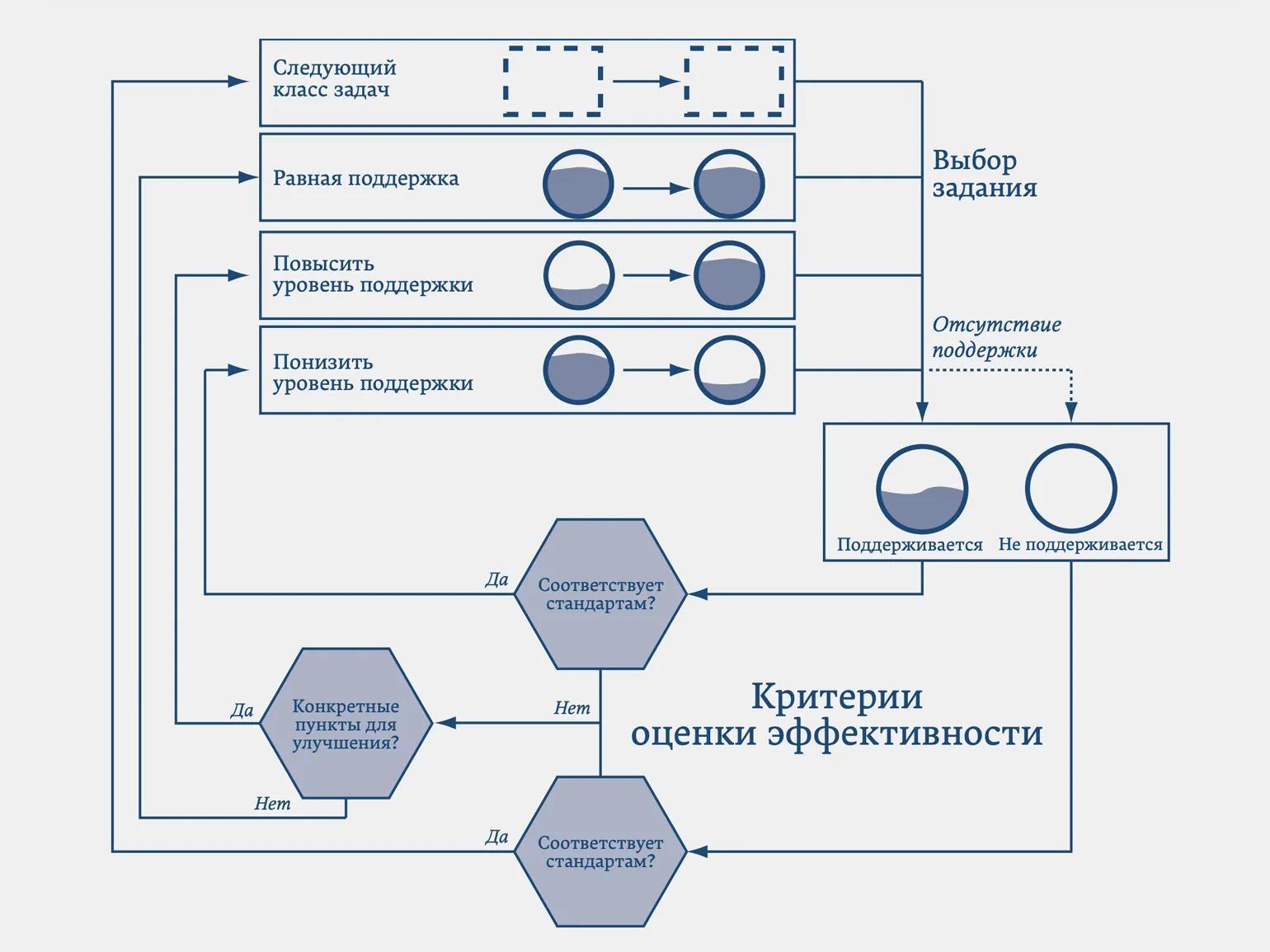
- If the performance of unsupported learning tasks meets all standards of acceptable performance (e.g., accuracy, speed, approach, and values), the learner moves on to the next class of tasks and works on more complex learning tasks with a high level of support and/or guidance.
- If the performance of unsupported learning tasks does not meet all standards of acceptable performance, the learner moves on at the current level of difficulty either to another unsupported learning task or to a learning task with specialized support and/or guidance.
Support and guidance are key aspects for the successful use of products and services. Effective support helps users quickly resolve problems that arise, and high-quality guidance ensures an understanding of the functionality and capabilities. Having accessible resources such as FAQs, training materials, and technical support significantly improves customer satisfaction. Investing in support and guidance not only improves the user experience but also helps build brand loyalty. Understanding the importance of these elements allows companies to better adapt to their customers' needs and retain them for the long term.
- If performance of supported learning tasks meets all standards of acceptable performance, the learner moves on to the next learning task with less support and/or guidance.
- If performance of supported learning tasks does not meet all standards of acceptable performance, the learner moves on either to a learning task with the same level of support and/or guidance, or to a learning task with a higher level of targeted support and/or guidance.
Variation is key in a variety of fields, including business, education, and the arts. It refers to the availability of many different options or ways to achieve the same goal. In a business context, variability can manifest itself in offering a variety of products or services, thereby better meeting customer needs. In education, variability in teaching methods helps to accommodate the individual characteristics of students, promoting more effective assimilation of the material. In the arts, variability is expressed in the diversity of styles and techniques, which enriches the cultural heritage. Thus, variability fosters innovation and development, creating new opportunities for growth and improvement.
- New learning tasks are always selected in such a way that the entire set of learning tasks ultimately varies along all parameters corresponding to the real world.
The dynamic selection of learning tasks requires regular assessment of the performance of each student. Their performance is assessed based on the standards established for the basic skills associated with specific learning tasks. Rubricators are used to assess various aspects of student performance, which help define performance criteria. These rubrics are an important tool for objectively analyzing student achievement according to all established standards.

Unsupported learning tasks play an important role in the process of assessing students' readiness for more complex tasks, that is, to the next level of learning. If a student's performance meets the standards for basic skills, they can move on to the next level of tasks. Assessing the performance of unsupported learning tasks can be used not only for formative assessment but also for summative performance assessment. In this case, these tasks should be considered tests, which serve as the basis for assigning grades and making decisions about passing and certification. This approach will be discussed in more detail in Chapter 15.
If a student has not achieved the required standards for basic skills, they can be offered additional tasks that match the current level of difficulty. If only additional practice is needed, tasks are provided without support. In cases where students experience difficulty with specific tasks, tasks with some additional support or guidance should be offered. This will help improve performance in the areas that cause difficulty.
Assessing the performance of learning tasks with the provision of support or guidance plays a key role in making decisions about adjusting the level of assistance in future assignments. This approach to assessment is used exclusively for formative assessment, which means that its primary purpose is to improve the quality of the educational process. If a student meets standards across all foundational skills, they will be presented with assignments with less support and guidance. This may eventually lead to the student completing tasks without any support, which promotes independence and confidence.
The student will complete additional tasks with support until they meet standards across all foundational skills. If additional practice is needed, they will be presented with tasks with a similar level of support. If the student experiences difficulty in certain areas, they will be presented with tasks with increased support and guidance to help them improve in these areas. This approach promotes deeper learning and increases the student's confidence in their abilities.
Who is in control?
Dynamic task selection is an iterative process that facilitates the creation of individualized learning trajectories. A key role in this process is played by an intelligent agent, which can be represented by a teacher, an e-learning application, or the learner themselves, acting on their own preferences. With systemic monitoring, the teacher or application analyzes the fulfillment of standards, allowing them to select subsequent learning tasks or groups of tasks appropriate to the learner's level. When the learner controls the process, they become self-directed and independently determine their next steps in learning (Corbalan, Kester, & van Merriënboer, 2011). This approach not only increases student motivation but also promotes deeper learning, as assignments are selected based on their current knowledge and skills.

Adaptive tutoring and on-demand tutoring represent two contrasting approaches to selecting learning tasks. In adaptive tutoring, a teacher or intelligent agent selects and presents tasks to each student that meet their individual needs. Intelligent tutoring systems often use an agent to select learning tasks, but this aspect is not discussed in this book. Interested readers can refer to Long, Aman, and Aleven (2015) or Nkambou, Bordeau, and Mizoguchi (2010) for more detailed discussions.
On the other hand, on-demand tutoring assumes that the learner independently searches for and selects suitable tasks from all available material. It is important that students select tasks that are appropriate for their level of difficulty, provide an optimal level of support and guidance, and provide sufficient variety. This allows them to effectively develop their skills and knowledge, adapting to individual requirements and learning goals.
The approach to supporting information can be divided into two main methods: planned and resource-based provisioning. With planned provisioning, an intelligent agent explicitly provides learners with the necessary information before they begin solving tasks of higher difficulty. This prepares students for upcoming challenges and improves their understanding of the topic. Resource-based provisioning, on the other hand, includes access to additional materials and resources as needed, promoting independent learning and deepening knowledge. Both methods play an important role in the educational process, providing support based on learners' needs.
With the resource-based approach, students independently explore a variety of information sources, such as books, textbooks, videos, online resources, and software, and consult with experts. This enables them to effectively solve problems, justify their conclusions, and make informed decisions. For example, architecture students, creating unique building designs, might consult experienced architects to learn about their methods. Meanwhile, education students seeking to develop student motivation skills might analyze children's television programs to learn the techniques used by producers. The key is to select reliable learning resources that provide the necessary information in the optimal amount—not too much and not too little. This significantly improves the quality of education and promotes a deeper understanding of the topics being studied.
The flexible approach to providing procedural information differs from the information-on-demand model. In the flexible approach, an intelligent agent offers supporting information regarding the performance of routine tasks explicitly and at the moment it is needed. This method enables more efficient task completion because the user receives up-to-date information at the right time, which promotes productivity and reduces stress.
On-demand information provision requires students to independently search for and study the necessary information to perform specific routine tasks. This may include studying manuals and reference books. For example, students studying aircraft maintenance and electrical troubleshooting consult technical manuals specific to each aircraft model. Similarly, students studying business writing explore how to use various word processor functions through the program's help system. This approach requires them to have the skills to search for accurate information and the ability to effectively distribute attention between studying the material and completing academic tasks.

The opposite of dependent partial practice is unassisted partial practice. In this approach, an intelligent agent clearly formulates a task for the learner regarding a recurring skill after the skill has been demonstrated as part of a holistic and meaningful learning task. Unassisted partial practice allows learners to develop skills more effectively because they can apply their new knowledge in context, which promotes greater retention and increased autonomy in learning.
Unassisted partial practice allows learners to independently determine what and when to practice in order to improve their performance on learning tasks. For example, economics students working on financial analysis tasks using spreadsheets can improve their skills through online courses. Conversely, medical students who need to refine critical care skills such as cardiopulmonary resuscitation, intubation, and external cardiac massage can attend specialized workshops. To learn successfully, students must be able to select appropriate learning methods and find opportunities for partial practice, which will ultimately lead to improved professional skills and more successful completion of academic tasks.
Get more interesting information about education by subscribing to our Telegram channel. We share relevant news, useful tips, and resources to support your learning and development. Join our community and stay up to date with the latest trends in education.
Please note the following recommendations:
- What is problem-based learning?
- Case study: How to create an online course that will suit both beginners and experienced people
- How to create a great assignment for online course students: a guide for novice methodologists
- Designing learning from results: 3 concepts you need to know
Methodologist Profession from Beginner to Advanced
You will develop skills in developing curricula for online and offline courses. You will master modern teaching practices, structure your experience, and become a more sought-after specialist.
Find out more