
Contents:

Learn: Profession Methodist from scratch to PRO
Learn MoreThere are many online course design models available for educators and instructional designers. However, high-quality models that can help organize teaching in an online environment are still lacking. Mostly, only isolated tips based on personal experience and the results of disparate studies are available. This creates a need for more systematic approaches that take into account the specific features of online education and help instructors effectively engage with learners.
Professor Florence Martin of North Carolina State University and Professor Albert Rietjapt of the University of Florida developed the IDEAS framework, which is the result of combining knowledge of best practices in the fields of learning and technology design. This framework is a recommended template that helps educators, instructional designers, and learning facilitators consider key aspects when organizing and delivering online courses. It also serves as a tool for assessing the quality of the educational process and selecting best practices. The authors presented their development in an article published on the EduCase media resource, where they described in detail the main principles and recommendations contained in the model.
How the IDEAS Framework Was Developed
The acronym IDEAS stands for "Ideas, Actions, Emotions, Analysis, Strategy." These five key components help develop effective projects and make informed decisions. Understanding each element allows you to create a holistic picture necessary for the successful implementation of ideas. It is important to remember that ideas form the basis for further action, while emotions influence perception and motivation. Analysis allows you to evaluate results, and strategy helps develop a long-term action plan. Thus, the IDEAS acronym covers important aspects that contribute to the achievement of goals and the successful development of projects.
- Inclusion - inclusion;
- Design - design;
- Engagement - involvement;
- Evaluation - course evaluation;
- Assessment - student assessment;
- Support - support.
The framework was developed based on the author's experience, interviews with recognized teachers, analysis of scientific research and consultations with experts in the field of online learning. This ensures high quality and relevance of materials, which makes it an effective tool for the educational process.
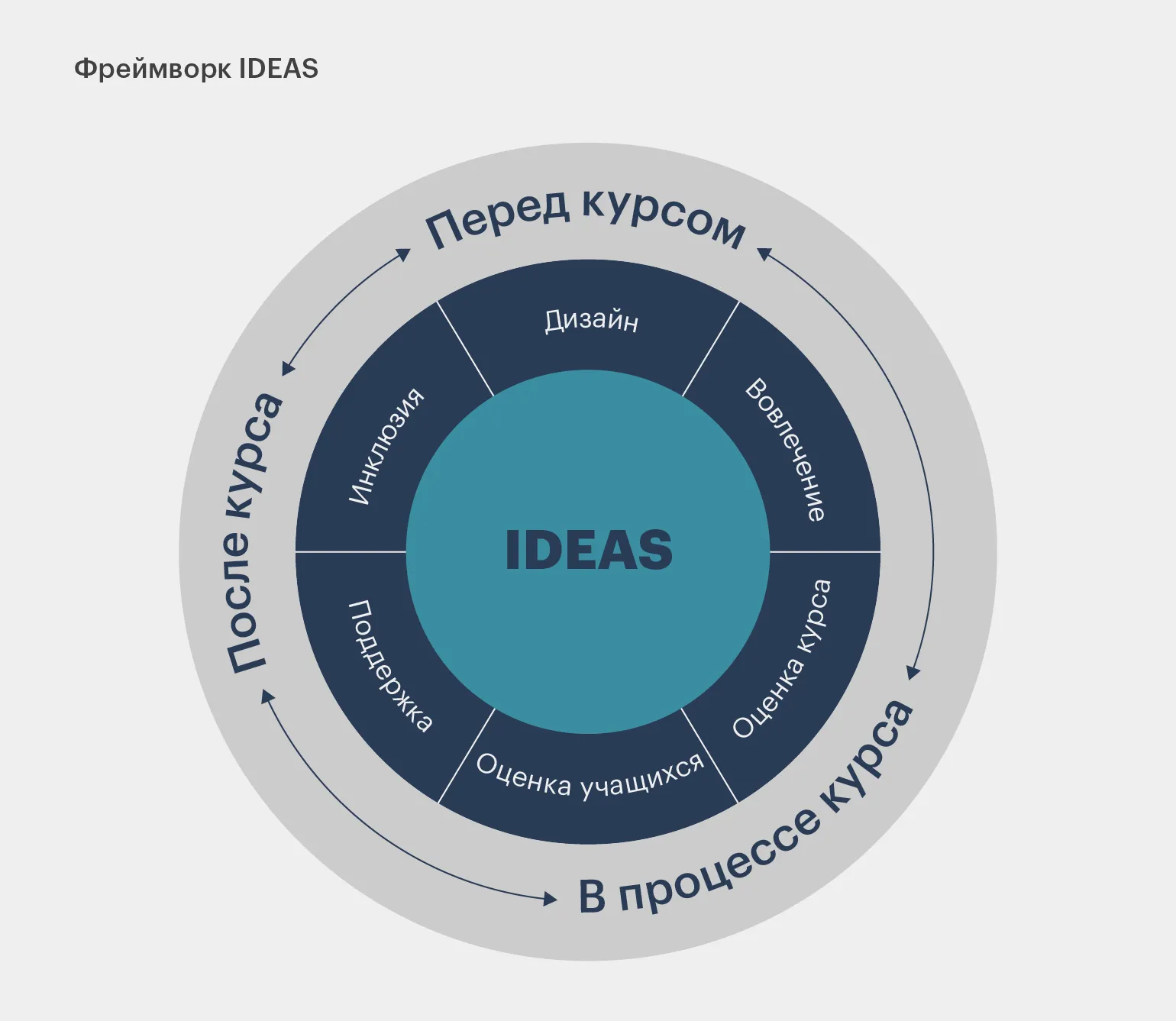
The framework includes Six sections containing 41 elements representing key practices for organizing online courses. According to Florence Martin and Albert Rietjapt, these sections are interconnected and influence each other. This means that decisions made by an instructor in one area can directly influence others. It is important to note that not all practices should be used within a single online course. The authors emphasize that the choice of methods and approaches to online teaching depends on the learning objectives and desired student outcomes. Proper integration of these practices contributes to increased learning effectiveness and improved interaction between instructor and students. In this text, we will examine each of the six sections of the framework in detail. This will help you better understand the structure and functionality of the framework, as well as its application in various scenarios. Each section will be analyzed separately, allowing us to focus on key aspects and features.
Inclusion
This section provides information on key aspects to consider. We will cover the essential elements that ensure a thorough understanding of the topic. Important details will also be highlighted to help deepen knowledge and improve comprehension. The focus will be on practical recommendations and relevant examples, allowing the reader to easily apply the acquired knowledge in practice.
- understanding their students,
- commitment to DEI,
- situational and contextual sensitivity,
- belonging and welcoming,
- course accessibility,
- intercultural and diverse perspectives,
- additional learning resources,
- support for a safe digital learning environment.
The "Inclusion" section includes a key rule: all students should feel welcome in the course. The authors of the framework emphasize that one of the most important aspects of learning in an online environment is a commitment to equity. They encourage instructors to get to know their students deeply, providing them with the opportunity to openly share their needs and expectations. Furthermore, it is important for instructors to critically evaluate their own biases, as well as their expectations of students and their behavior, as this may differ significantly from reality. Ensuring inclusion in the educational process helps create a comfortable and supportive atmosphere, which, in turn, increases student engagement and success.
When choosing learning environments, it is important to pay attention to the availability of resources for all students, including a stable internet connection. It is also important to consider the needs of individuals with disabilities. Strategies to support such students should be developed and additional resources should be offered to ensure their comfortable learning.
Design
This section includes key components that ensure a thorough understanding of the topic. It presents the main aspects and information necessary for an in-depth study of the issue. This section includes content that covers all the important points, providing the reader with comprehensive data. This content is created in accordance with current trends and standards, making it useful for a wide audience. We strive to provide the most informative materials to help you better understand the subject.
- Information about the instructor,
- Learning outcomes,
- Learning sequence,
- Systematic design,
- Various sources,
- Activity and assessment criteria design.
This section is devoted to the structure of course materials and their connection to the target learning outcomes. We will consider how to properly organize the content so that it best meets the expectations and learning objectives. This will help students more effectively absorb the material and achieve their goals.
The framework authors offer several useful recommendations for optimizing this process. These tips will help improve the efficiency of working with the framework and enhance the quality of the final product. By following these recommendations, developers will be able to use the framework's capabilities more effectively, which in turn will lead to improved application performance and stability. It is important to consider these recommendations at all stages of development to achieve the best results.
- Students should be provided with the teacher's contact information so that they can contact him or her if necessary, preferably through different channels.
- The course should include learning activities for interaction - between students and the teacher, with each other, and with the learning materials. All this will help students feel part of the learning community.
- The course should use a variety of learning resources: textbooks, videos, articles, online materials.
- Variety should also be maintained in the development of assignments - these can be, for example, discussions, projects, articles, presentations, quizzes and regular exams. Of course, you will have to carefully consider not only these, but also how the results of these assignments will be assessed.
Engagement
This section includes the main elements that ensure its functionality and information content. It contains key information needed to understand the topic and provides access to useful resources and materials. Each element is selected based on relevance and significance to users, ensuring their needs are met in the most effective manner. This section serves as an important part of the overall structure, helping to direct users to the information they need and improve engagement with the content.
- periodic announcements
- setting expectations
- instructor availability
- timely responses
- grading and feedback
- facilitating discussions
- forming study groups
- supporting student interaction
- shaping behavior
- facilitating community building
- monitoring student progress.
At the beginning of an educational program, a key factor in engagement is how instructors set student expectations for the course. During the learning process, according to the framework's authors, it is important to regularly remind students of the opportunity for face-to-face communication with the instructor and explain how this can be organized. Instructors can help students identify areas for further development by providing high-quality and timely feedback. This contributes to increased engagement and a better educational experience.
During the process, it is important to use various facilitation strategies, as well as organize discussions and group activities. These activities can be conducted both online and asynchronously. Using such approaches promotes an atmosphere of collaboration and interaction among participants, as emphasized by the framework's authors. Effectively organizing discussions and activities helps create a more productive environment where everyone can contribute and feel part of a community.

Reading additional materials can significantly expand your knowledge and deepen your understanding of the topic. We recommend paying attention to related articles and research that will help you better understand the issues discussed. This will not only enrich your experience but also allow you to stay up-to-date with the latest trends and news in the field. Networking in an online course is key to successful learning and building professional connections. To effectively interact with other participants, it is recommended to use several strategies. First, it is important to actively participate in discussions on forums and in course chats, asking questions and sharing your opinions. This will not only help you better understand the material but also draw attention to yourself. Second, it is worth looking for opportunities for joint projects or studying a topic in a group. Creating work groups or group chats can facilitate deeper interaction and the exchange of experiences. It is also useful to use social media to maintain contact with classmates. Creating a separate group or page on such networks will help you stay in touch and share useful information. Also, do not forget about the importance of feedback. Leave comments on the work of other participants, offer help and support. This will create an atmosphere of trust and collaboration. Participating in webinars and additional course events also helps expand your network.
Finally, active participation in the course, creating groups for interaction, and using social platforms will help organize effective networking and establish useful professional connections.
Course Evaluation
This section covers key aspects that ensure a thorough understanding of the topic. It includes information regarding basic concepts, terminology, as well as practical examples and recommendations. It also addresses current questions and problems that users may encounter, and suggests solutions. This section is an important source of knowledge that will help readers obtain relevant and useful information on this topic.
- feedback from the instructional designer,
- feedback from students,
- feedback from the supervisor,
- teacher reflection,
- information on student assessment.
This section emphasizes the importance of a comprehensive online course evaluation, which promotes the continuous implementation of improvements at all stages of learning. All participants in the process, including methodologists, administrators, and students, can contribute to this evaluation. This approach not only improves the quality of courses but also ensures more effective communication between all parties, which ultimately leads to an improvement in the educational process.
Course evaluation begins long before its official launch. For example, if a teacher is developing a curriculum independently, it is advisable to seek advice from an instructional designer or methodologist at the stage of finalizing the preparation of the main material. It's important to collect feedback from students and tutors starting from the first few lessons, as this will help identify weak points in the course. Also, the developer, whether a teacher or a methodologist, should independently evaluate their work, analyzing which aspects require improvement or changes. This approach improves the quality of the educational process and allows for the creation of a more effective course.

Read also:
11 Key Educational Metrics for Assessing the Quality and Effectiveness of an Online Course
When developing and delivering online courses, it is important not only to create high-quality content but also to evaluate its effectiveness. There are various metrics that help determine the success of a course and how it can be improved. Key metrics include course completion, learner engagement, learner satisfaction, return rate, performance, time spent on assignments, and participant feedback. It is also important to consider the number of questions and support requests, which can indicate the complexity of the material. By analyzing these metrics, you can identify the strengths and weaknesses of a course and tailor the content to learners' needs. Using these metrics helps improve the quality of online learning and increase its effectiveness.
Learner Assessment
This section provides information about the content and key elements that will be covered. Here you will find key aspects important for understanding the topic. Key concepts are discussed, as well as practical examples and recommendations that will help you gain a deeper understanding of the topic. This section aims to provide the reader with a clear and complete understanding of the material covered, as well as to answer potential questions.
- measuring students' prior knowledge, skills, and attitudes;
- formative and summative assessment;
- additional assessments during assignment completion;
- traditional and authentic assessments;
- individualized feedback;
- automated assessment;
- student self-assessment and reflection;
- assessment rubrics.
This section is devoted to tools that assist both teachers and students in assessing learning achievements. The use of such tools allows for more effective tracking of progress, identification of strengths and weaknesses, and improvement of the quality of the educational process. Assessment of learning achievements plays a key role in developing an individual approach to learning and contributes to a deeper understanding of the material.
The creators of the framework emphasize the importance of the initial stage of learning. Teachers need to analyze students' existing knowledge and skills and then closely monitor their progress. During the learning process, the authors of the framework recommend using combined assessment methods. This can include traditional methods, such as exams and tests, as well as authentic methods, including group work, portfolios, and blogs. Additionally, assessments for participation in synchronous activities and additional assignments should be taken into account. This approach facilitates a deeper understanding of students' level of preparation and helps adapt the learning process to their needs.
Automation of the assessment process allows students to receive regular and timely feedback, according to the IDEAS authors. In cases where assignments are assessed manually, the use of clear assessment criteria, such as rubrics, significantly simplifies the work of assessors and increases the objectivity of assessment.
Based on scientific literature, the IDEAS authors emphasize the importance of reflection in online courses, as it facilitates a more in-depth analysis of student actions and results. Reflection helps students recognize their successes and shortcomings, which in turn improves the learning process and increases the effectiveness of material acquisition. It is important to integrate reflective practices into online education to achieve maximum results.
Support
This section includes key elements that ensure a thorough understanding of the topic. It presents the main aspects and details necessary for in-depth analysis and study. Each element is carefully selected to fully cover the topic and provide the reader with all the necessary information. We strive to ensure that the information is relevant and useful, which contributes to better perception and assimilation of the material.
- administrative support (schedule, registration);
- instructor support (teaching assistants, mentors);
- support during the course creation;
- technological support;
- built-in library.
This section discusses instructor support. The framework authors recommend considering the following aspects:
Ensuring the availability of resources and materials for instructors, creating a platform for the exchange of experiences and teaching methods, and organizing regular trainings and seminars. It is important that instructors have the opportunity to receive feedback and consult on any issues that arise. Support from administration and colleagues contributes to the improvement of the quality of education and the professional development of teachers.
- The ability to develop the course at your own pace—at least a semester before its start (that is, 3-4 months).
- Receiving professional support—for example, colleagues or mentors during the development process, assistants during the training process.
- Technical support—means both preliminary training of teachers in working with technologies and tools, and assistance during the course (for example, from system administrators or technical staff).
- Content support—simply put, a built-in library that will be of assistance to both teachers and students.
The authors of the framework note that they were not able to cover all the necessary details in the initial version, but consider this only the beginning. They hope that in the future, the IDEAS framework will be expanded and supplemented with new features. In its current form, it can already serve as a useful tool for those creating and delivering online courses.
Learn more about the world of education by subscribing to our Telegram channel. We share current news, useful tips, and interesting materials to help you stay up-to-date on the latest trends in education. Don't miss the opportunity to gain valuable knowledge and expand your horizons. Join us!
Read also:
- The Role of the Teacher in a Synchronous Online Class: How Scientists View It
- Synchronous or Asynchronous? Which format to choose for your course?
- How to organize hybrid learning: advice from those who have already done it
The Methodologist profession from scratch to PRO
You will improve your skills in developing curricula for online and offline courses. Master modern teaching practices, structure your experience, and become a more sought-after specialist.
Find out more