

Learn: Profession Methodist from scratch to PRO
Learn moreA design model is an essential tool for developers, enabling them to create comprehensive and effective learning programs. These models cover all stages of development of an educational product, facilitating the process's structure and ensuring attention to important aspects. Applying a design model helps avoid oversights, improve the quality of educational content, and make it more accessible to the target audience. Using such models in educational projects increases their effectiveness and efficiency.
Frameworks are versatile tools that enable developers to create programs in various fields. However, with so many frameworks available, choosing the most appropriate one can be a daunting task, especially for beginners. This requires careful analysis and understanding of the specifics of each of them in order to make the optimal choice for a particular task.
We suggest you familiarize yourself with several popular models.
- ADDIE is a classic model required by all course methodologists;
- ASSURE is a model that emphasizes standards and the use of technology;
- SAM is a model for quickly launching small educational products without strict professional requirements of the environment;
- ALD is a model based on the Agile approach, allowing you to quickly teach a skill;
- 4C/ID is a complex but effective model based on problem-based learning.
Later, we will discuss how to choose the right model based on specific needs and situations.
ADDIE
A methodologist can have any level of training. This opens up opportunities for people with diverse experience and expertise who wish to develop in this field. A methodologist is a specialist who plays a key role in the organization and methodological support of the educational process. Regardless of their level of training, it is important to strive for continuous learning and professional growth to effectively fulfill their responsibilities and adapt to changes in the educational environment. A methodologist can work in a variety of educational institutions, including schools, colleges, and universities, as well as in institutions of additional education. The focus should be on practical skills, such as curriculum development, the use of modern technologies in teaching, and working with teaching staff. Open online courses, educational institutions, and the corporate sector are key areas where modern educational technologies can be effectively utilized. Open online courses provide access to high-quality training for a wide range of people, allowing them to develop skills and knowledge at a convenient time and in a comfortable environment. Universities can integrate online courses into their curricula, which facilitates flexibility and diversity in educational formats. The corporate sector uses online training to enhance employee skills, which helps improve business performance and adaptability in a rapidly changing marketplace. Synchronous and asynchronous formats represent two primary approaches to interaction across various systems and processes. Synchronous formats involve simultaneous task completion, with participants interacting in real time. This can be useful in situations that require immediate feedback, such as video conferencing or phone calls. Asynchronous formats, on the other hand, allow participants to interact independently over time. Such systems are ideal for messaging, email, or online forums where an immediate response is not required. An asynchronous approach provides flexibility and the opportunity to consider a response before sending it. The choice between synchronous and asynchronous formats depends on the specific goals and objectives, as well as the preferences of the participants. Synchronous interaction promotes a more rapid exchange of information, while asynchronous interaction allows for a more thorough analysis of the data provided and the formation of high-quality responses.
ADDIE is a classic instructional design model that is ideal for most educational programs. It was developed in the United States in the 1980s and has since become the basis for the work of methodologists and methodologists around the world. This model includes five key stages: analysis, design, development, implementation, and evaluation. Due to its versatility and effectiveness, ADDIE continues to be used in various educational contexts, helping to create high-quality and structured learning materials.
The ADDIE model is a methodology consisting of five key stages necessary for developing a high-quality course. The name of the model is an acronym that includes the following stages: analysis, design, development, implementation, and evaluation. Each of these stages plays an important role in the creation of educational content, ensuring its effectiveness and meeting student expectations. Analysis helps determine the needs of the audience and learning objectives. Design includes creating a course structure and selecting teaching methods. The development stage involves the creation of educational materials and resources. Implementation involves the implementation of the course in the educational process, and evaluation allows us to assess its effectiveness and make any necessary adjustments. Using the ADDIE model ensures a systematic approach to course development and contributes to their successful implementation.
- Analyze — studying the needs of the training customer and the market, researching the target audience (TA). This analysis becomes the basis for program design.
- Design — forming the course structure, competency map, and motivational strategy. Simply put, this is creating the "skeleton" of the program. At this stage, you can also create a Student Journey Map.
- Development — program content. At this stage, assignments, lectures, and lesson plans are created — everything that the student will cover in the future.
- Implementation — the educational process itself. In an asynchronous format, this could be publishing the course on the website, while in a synchronous format, this could be the first series of seminars.
- Evaluation is the stage at which training developers evaluate the extent to which they have achieved the goal. The analysis is carried out using metrics (for example, how many students can actually bake a cake after culinary master classes) and feedback.
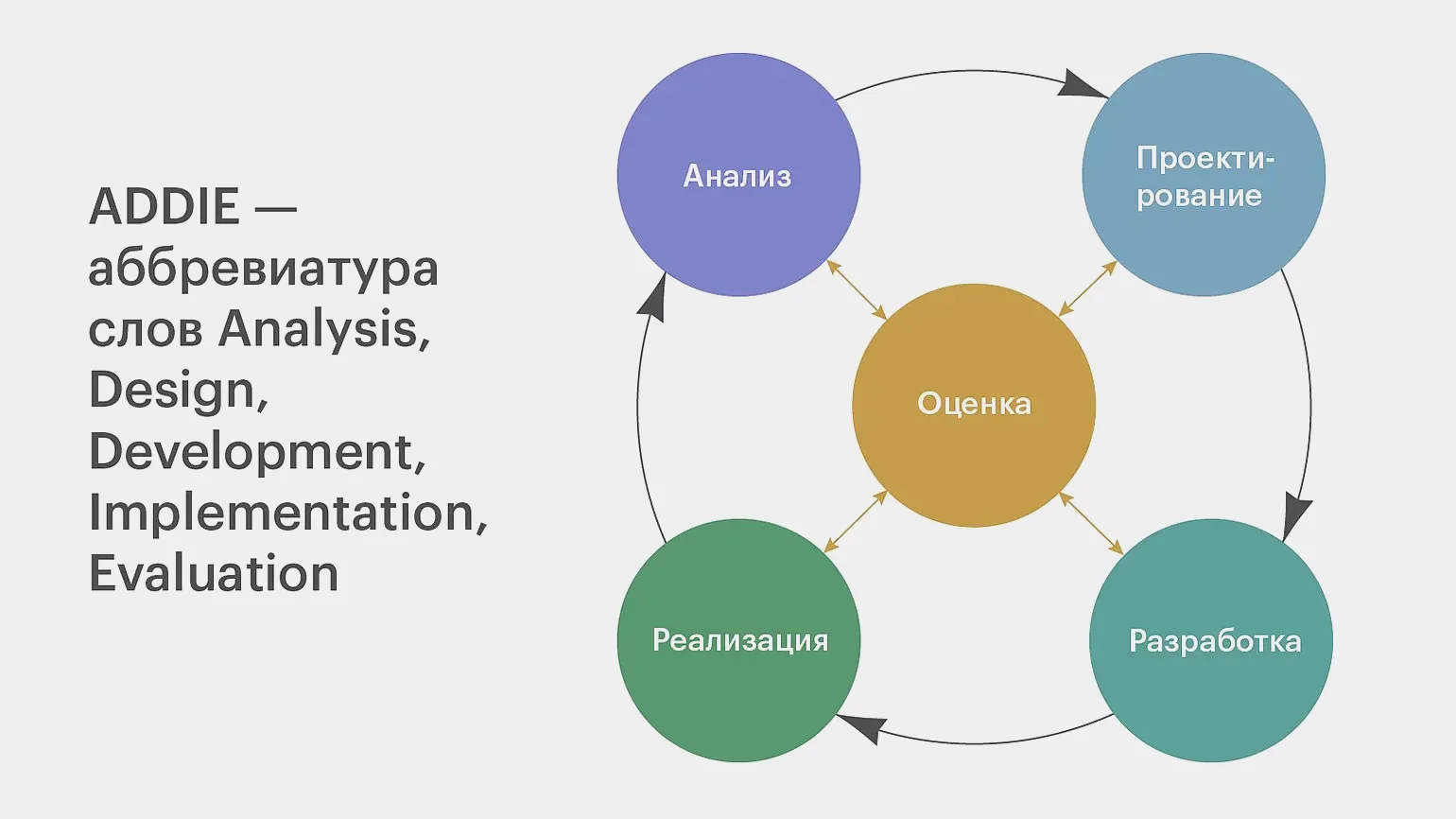
The ADDIE model offers several significant advantages. First, it provides a structured approach to developing training programs, which facilitates more effective planning and implementation of training materials. Second, the model allows for flexible adaptation to changes, making the training process more relevant and responsive to the needs of the target audience. Furthermore, ADDIE improves the quality of training through continuous analysis and evaluation of results, allowing for necessary adjustments at each stage. As a result, using the ADDIE model increases the overall effectiveness of educational processes and helps achieve set goals.
- Universality — the model is used in public education, the corporate sector, and online schools.
- Comprehensiveness — ADDIE takes into account not only the design stage, but also the preparation, production, and evaluation stages.
- Deep analysis — the ADDIE program is based not on speculation and guesswork, but on clear hypotheses based on research results.
The model also has its drawbacks. The analysis and design process can take a significant amount of time, depending on the program's scope and the depth of its development. This sometimes causes dissatisfaction among clients expecting more efficient training.
The ADDIE program requires detailed development at each stage. The feedback process can take a significant amount of time, making it difficult to make changes to the final product. This emphasizes the importance of careful planning and implementation of all components of the ADDIE model to achieve effective results.

Read also:
Designing Higher Education Using the Modern ADDIE Model
The ADDIE model is a systems approach to developing educational programs and courses. It includes five key stages: analysis, design, development, implementation, and evaluation. Each of these stages plays a significant role in creating an effective learning process.
The analysis stage requires identifying student needs and requirements for the educational program. This includes researching the target audience, evaluating existing resources, and identifying the necessary knowledge and skills.
Design involves creating a course structure, defining learning objectives, and selecting teaching methods and formats. It is important to consider the diversity of student learning styles and integrate modern technologies.
The development stage involves creating learning materials, including presentations, assignments, and tests. It is also important to ensure that the materials are accessible to all students.
Course implementation involves organizing the learning process, interacting with teachers and students, and monitoring the plan.
Evaluating the outcome allows you to determine how successfully the program has been implemented and identify areas for improvement. This may include both quantitative and qualitative assessment methods.
By using the ADDIE model, educational institutions can create more effective and adaptive programs that meet modern requirements and student expectations.
ASSURE
A methodologist can have any level of training. Regardless of education and experience, every methodologist has the opportunity to develop and improve their skills. An important aspect is the desire to learn and adapt to new methods and approaches in work. Methodologists with different levels of training can effectively participate in the development and implementation of educational programs, as well as in conducting educational seminars and trainings. The key factor for success is professional motivation and the desire for self-development.
This technology can be used in various fields. It is used in public education, which helps improve the quality of the educational process and increase the availability of educational resources. Corporate training is also actively implementing this technology, which contributes to the improvement of employee qualifications and the development of necessary skills. It is also used in continuing professional education, enabling specialists to gain new knowledge and adapt to changing labor market demands. Learning formats include synchronous, asynchronous, and hybrid. Synchronous learning occurs in real time, allowing students to interact with each other and the instructor simultaneously. Asynchronous learning offers flexibility, allowing students to study materials at their own pace. Hybrid learning combines both approaches, providing the opportunity to alternate between classroom and online learning. Each of these formats has its own advantages and can be adapted to the individual needs of students. The choice of the appropriate format depends on the learning objectives, student preferences, and the capabilities of the educational institution. The ASSURE model is similar to the ADDIE model, as both describe a structured process for curriculum development. However, ASSURE emphasizes the consideration of professional and state standards. This makes the model particularly suitable for university and corporate educational programs, as it already incorporates necessary requirements, such as the Federal State Educational Standard, and requires no additional adaptation. Using the ASSURE model allows you to create high-quality and standards-compliant educational materials, optimizing the learning process and increasing its effectiveness.
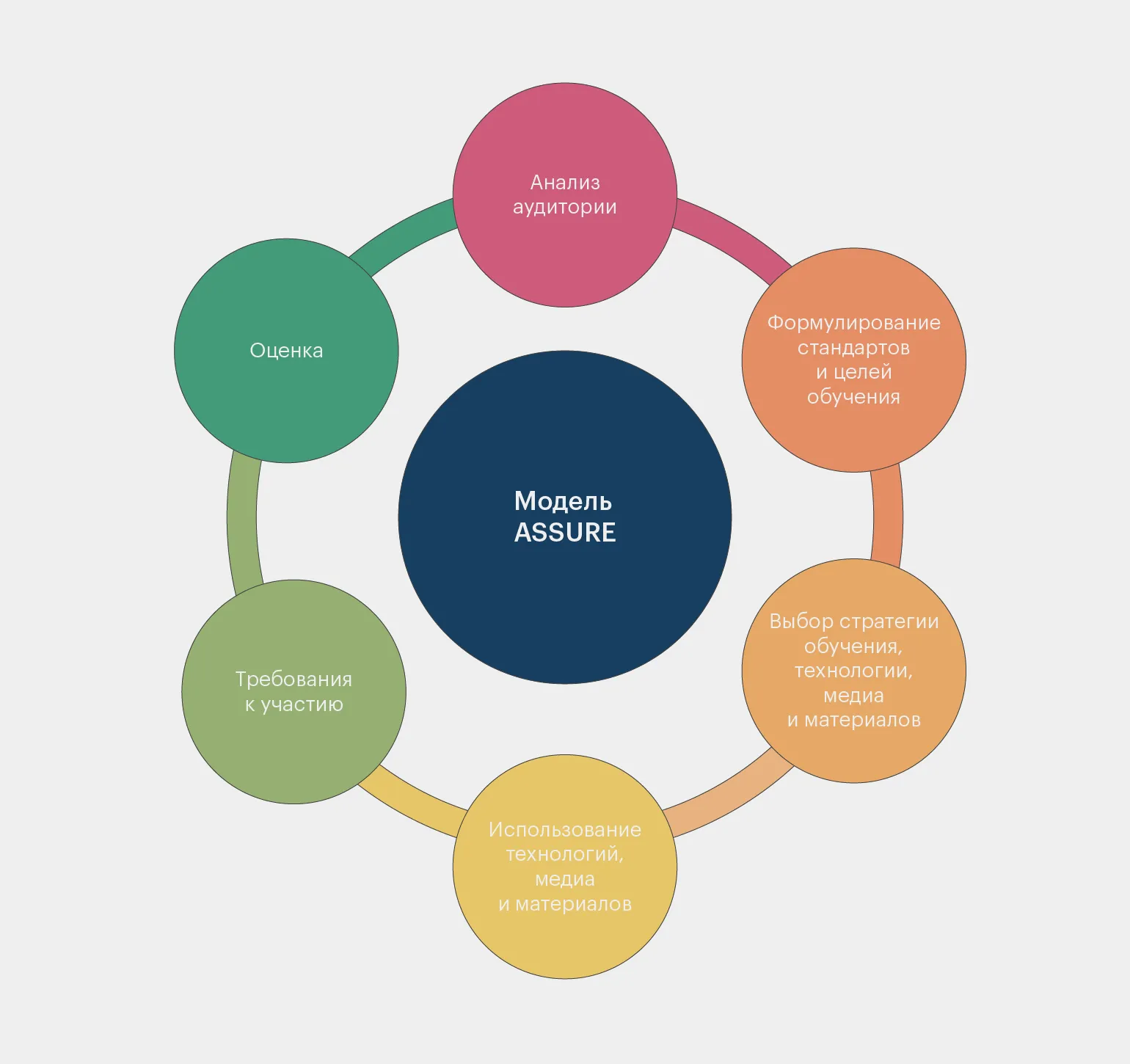
ASSURE stands out for its active The use of technology and media. The model was developed in the early 1990s, at a time when digitalization was just beginning to develop. Today, modern technologies are actively integrated into the creation of hybrid training and educational programs. This significantly improves the quality of education and makes it more accessible and interactive. The use of digital tools helps adapt the educational process to the needs of students, which contributes to increased learning effectiveness.
The name of this model is an acronym, where each letter corresponds to a specific stage.
- Analyze Learners — researching the target audience and finding an answer to the question of who exactly will be learning, what their expectations, goals, and pain points are.
- Formulating State Standards and Objectives — at this stage, a competency map is created, that is, what the student should ultimately know and what skills they need to master are formulated. However, unlike ADDIE, this process involves more than just an expert — the methodologist needs to understand what standards need to be taken into account in the process and how to integrate them into the program. Learning objectives are formulated using the ABCD method and Bloom's taxonomy.
- Select Strategies, Technology, Media, and Materials — this stage involves selecting the tools, media content, and additional materials needed for the program.
- Utilize Technology, Media, and Materials — at this stage, the methodologist chooses how exactly to apply the tools already selected.
- Require Learner Participation — this stage involves developing a strategy for engaging students. How can they be motivated to participate in the learning process?
- Evaluate and Revise — as in ADDIE, the final stage comes down to assessing the effectiveness of the training. A methodologist evaluates whether the tools were successfully selected and the objectives achieved.
The ASSURE model is effectively applied in school programs and corporate training. However, it faces the same problems as the ADDIE model. In addition, ASSURE is considered less flexible compared to other course development methods.
SAM
A methodologist can have any level of training, but a high degree of expertise in another field is required. This allows the methodologist to effectively develop and implement educational programs, taking into account the specifics of the subject and the needs of students. Expert knowledge combined with methodological skills ensure high-quality learning and student development.
Open Massive Courses (OMCs) and the corporate sector are ideal platforms for implementing modern educational methods. Accessible to a wide audience, OMCs allow people to learn at their own pace and gain knowledge in in-demand areas. The corporate sector, in turn, actively uses such courses to improve employee skills, adapt to new market demands, and improve overall productivity. The introduction of online learning in these areas contributes to the development of skills necessary for career success and increased competitiveness.
An asynchronous format is a method of interaction that allows participants to communicate and exchange information at a time convenient for them. This approach is especially useful in situations where differences in time zones, work schedules, or personal commitments must be taken into account. Asynchronous communication can take various forms, including emails, instant messages, forum comments, and social media posts.
The key advantages of an asynchronous format are flexibility and the opportunity for a more deliberate approach to communication. Participants can reflect on their responses, which promotes deeper analysis and better discussion. This avoids the rush that often occurs with synchronous communication, such as video conferencing or phone calls.
Using an asynchronous format also helps improve productivity, as it allows participants to focus on the task at hand without the distraction of immediately responding to messages. In today's world, where time and information are at a premium, asynchronous interaction is becoming increasingly important.
Thus, an asynchronous communication format is an effective tool for collaboration in the digital age, allowing participants to find optimal solutions and achieve their goals without unnecessary stress.
SAM (Successive Approximation Model) is a development model that is considered a simplified version of ADDIE. Unlike ADDIE, which describes a strictly linear process, SAM offers a sequence of short steps that allow for the gradual introduction of new elements and improvements. This model emphasizes an iterative approach, which promotes a more flexible and efficient learning and course development process. SAM is ideal for projects that require rapid adaptation and testing, allowing developers to make changes based on feedback.
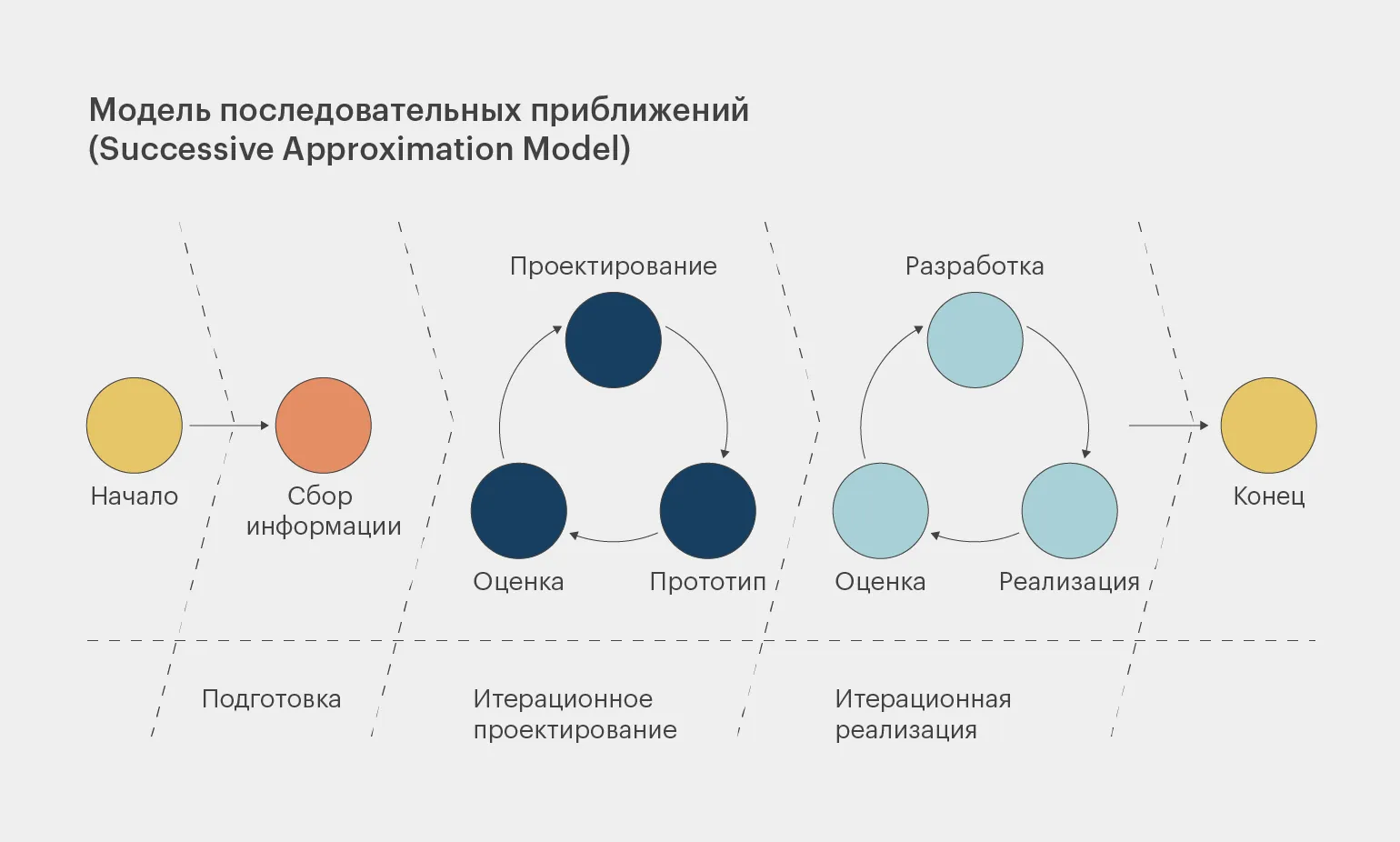
This model allows you to quickly develop A basic course that can be gradually adapted and improved.
The model includes three main steps. Each plays a key role in achieving the result. The first step involves analyzing the current situation, which allows for the identification of key problems and opportunities. The second step focuses on developing a strategy aimed at addressing the identified issues and optimizing processes. The third step involves implementing the strategy and monitoring it, which allows for the ability to adjust actions based on the results obtained. This sequence of steps helps effectively achieve goals and improve results.
- Preparation — the methodologist collects all possible information for the future course. This can include interesting materials, expert opinions, and anything else related to the subject. At this stage, a profile of the target audience is also created. After this, a brainstorming session begins, with participants including colleagues (for example, other methodologists or producers), audience representatives, and the training client. At this stage, they determine what the basic version of the product, or MVP, will look like.
- Iterative Design — this step involves preparing the program and creating the first version of the product so that all stakeholders can evaluate it. This is an important point: it is easier to get feedback when there is already something to evaluate.
- Iterative Development — the release of the product and its ongoing refinement. If, for example, an online course is being created, it is published and then evaluated and refined as much as necessary.
The number of iterations in the SAM model is practically unlimited. The main advantages of this model are high speed of preparation, quick feedback, and the possibility of constant changes. This makes SAM an effective tool for adapting and improving processes, which is especially important in dynamic markets.
This model is more suitable for entertainment programs and courses, where there are no clear expectations for the end result. However, it is worth considering that during the process of constant iterations, the project team may be distracted by other tasks, which will lead to a lack of resources for further refinement. This can negatively affect the quality of the final product and slow down its development.
ALD
Level of training of the methodologist: a qualified specialist with extensive experience.
Corporate training and higher education are important aspects of professional development. These two areas allow companies and educational institutions to effectively transfer knowledge and skills to their employees and students. Corporate training is aimed at improving the skills of employees, which contributes to improving the productivity and competitiveness of the company. Higher education, in turn, provides students with deep theoretical and practical knowledge necessary for a successful career. Both areas play a key role in the formation of a qualified talent pool and the development of professional competencies.
Synchronous format is a method of interaction in which all participants in the process act simultaneously. In such settings, information is transmitted in real time, enabling instantaneous exchange and maintaining a high level of interaction. Synchronous formats are often used in webinars, online courses, and video conferences, where it is important for all participants to be able to promptly ask questions and receive answers. This approach creates a more lively and dynamic atmosphere, promoting better absorption of the material and interaction between participants. Using a synchronous format helps organizations effectively conduct training, presentations, and business meetings, ensuring maximum engagement and productivity. The ALD (Agile Learning Design) model originated in the field of instructional design, borrowing ideas from the business world. Agile is a flexible approach to product development, making this model adaptive and fast. ALD is ideal for situations where it is necessary to quickly lead students to the final result. Using Agile Learning Design allows you to effectively respond to changes in the educational process and quickly adapt educational programs to student needs. This model emphasizes collaboration, active student engagement, and continuous improvement of the learning experience, which contributes to the achievement of high learning outcomes.
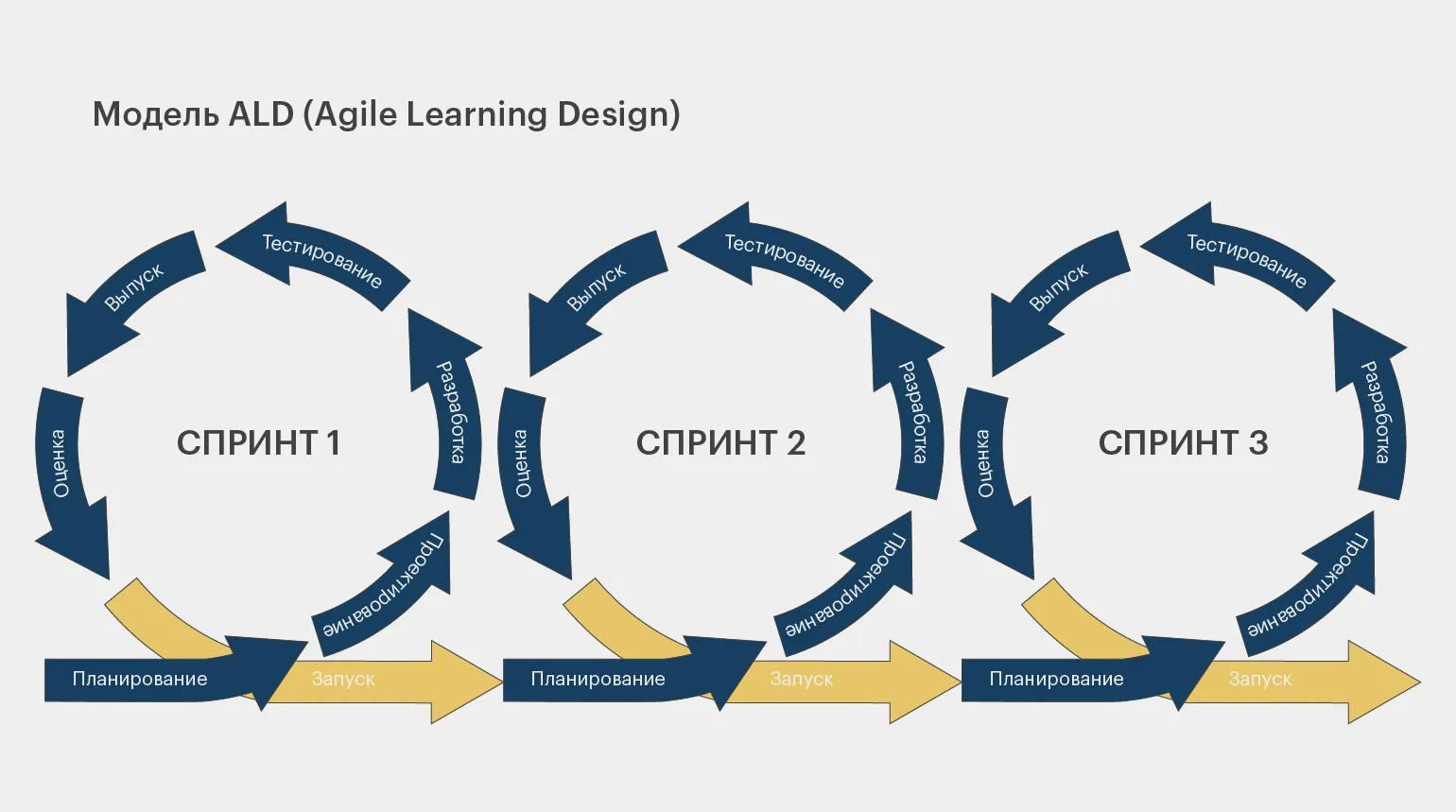
ALD design implies Regularly modifying and adapting content to meet student needs, as well as focusing on specific, practical tasks, allows for the creation of more effective educational programs that promote deep learning and the development of essential skills.
The design process has much in common with the SAM model, but several key features should be considered. First and foremost, it's important to understand that the design process involves a sequential process that encompasses the analysis, design, and implementation stages. This allows for more effective problem-solving and goal achievement.
Furthermore, the design algorithm emphasizes adaptability and flexibility, allowing it to be customized to specific project requirements. It is important to carefully evaluate input data and consider its impact on the final result. Furthermore, attention must be paid to testing and validation to ensure the high quality of the developed product.
These features make the design algorithm a valuable tool for development and design professionals, enabling the creation of effective and innovative solutions.
- Training is built on sprints—that is, short, time-bound stages with a clear end result.
- Detailed descriptions, instructions, and templates are prepared for each training stage to quickly lead students to the goal.
- The material is presented as concisely as possible; this model does not involve lengthy discussions and explanations.
ALD courses are primarily aimed at motivated students seeking to acquire practical skills. However, for developers, this approach requires constant interaction with students, maintaining dialogue, and demonstrating a high level of mastery. This creates a dynamic educational environment conducive to effective student learning and development in the field of ALD.
4C/ID
Methodologist qualification: experienced developer with deep knowledge and skills in their field.
Corporate training and higher education are important areas where different methods and approaches to training can be applied. Corporate training is aimed at developing the professional skills of employees, which in turn contributes to increased work efficiency and improved team dynamics. Higher education provides students with the knowledge and skills necessary for a successful career in their chosen field. Both training formats can use modern technologies, such as online courses and interactive platforms, which make the learning process more flexible and accessible.
Training formats include synchronous, asynchronous, and hybrid approaches. Synchronous learning involves real-time learning, where the teacher and students interact simultaneously. Asynchronous learning allows students to study material at their own pace, without the need for synchronous participation. A hybrid format combines elements of both approaches, allowing for the benefits of both synchronous and asynchronous learning. The choice of format depends on the learning objectives, student preferences, and the specifics of the subject matter. Each format has its own advantages and disadvantages, making them suitable for different educational contexts.
The modern pedagogical model, with its developed scientific and theoretical foundation, is one of the cutting-edge concepts in education. Its name has a specific meaning that reflects the key principles and approaches underlying this model.
- 4C (Four Components) - four components (that is, four types of course tasks and materials);
- ID (Instructional Design), that is, pedagogical design.
Methodologists use the 4C/ID model to create an educational experience that is as close as possible to real life. This methodology involves completing authentic tasks that help students gain a deeper understanding of the subject and acquire practical skills. The learning process becomes more effective when knowledge is applied in practice, which contributes to better assimilation of the material and the development of critical thinking.
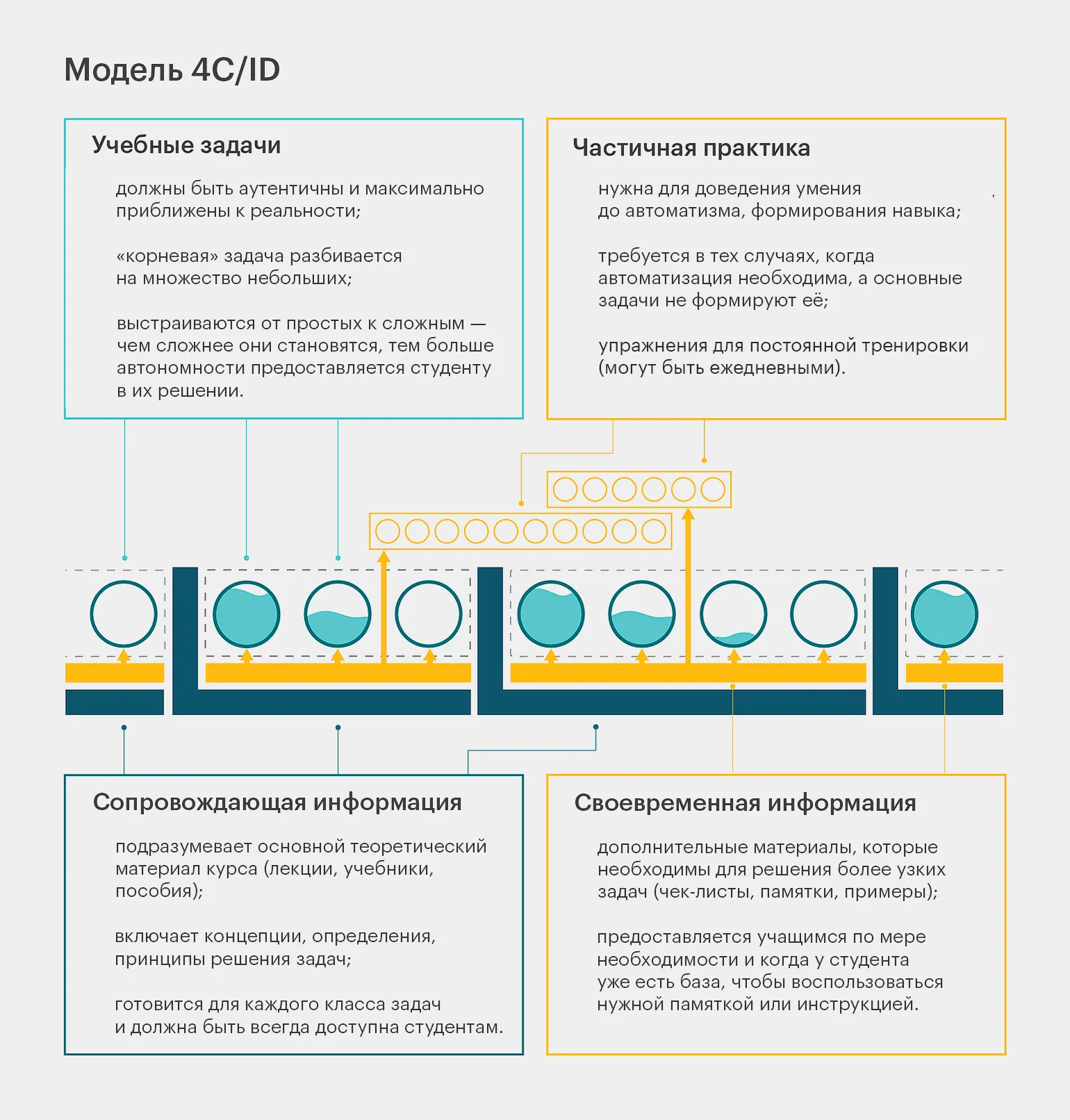
Design includes ten key stages that ensure successful project completion. Each step plays a vital role in achieving a high-quality result. The key design stages help define goals, develop a plan, gather the necessary resources, and implement the plan. Following these steps helps minimize risks and improve work efficiency. Thus, careful design is the basis for achieving the set goals and objectives.
- developing learning objectives;
- defining assessment criteria;
- sequencing tasks;
- designing accompanying information;
- analyzing cognitive strategies;
- analyzing mental models;
- preparing timely information;
- analyzing cognitive rules;
- analyzing prior knowledge;
- designing partial practice.
A clear understanding of the 4C/ID concept and the problem-based approach on which it is based is available for study at the following link. This approach is an important tool in the educational process, allowing for effective problem solving and skill development. 4C/ID focuses on a holistic perception of learning, which contributes to a deeper assimilation of the material. If you'd like to learn more about the principles and application of the 4C/ID, please read the detailed description at the link provided.
The model is well suited for programs focused on developing practical skills. However, courses based on it are quite rare. Despite its high effectiveness, implementing this model is considered a complex task.
How to choose a model for your course
The choice in most cases is determined by three key factors.
- development time;
- learning objectives;
- course format.
To simplify the selection process, we offer a clear and accessible diagram.
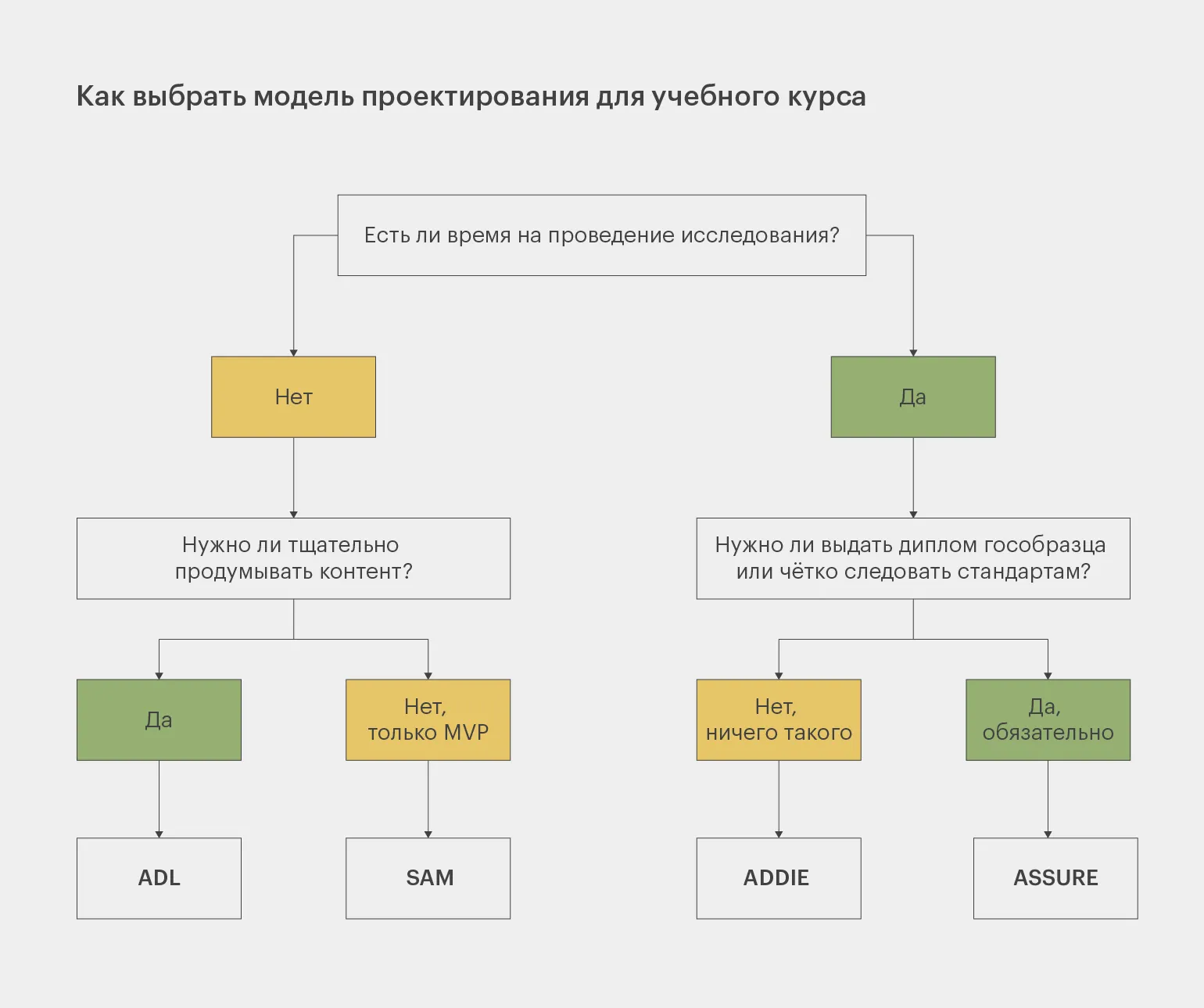
There are many models beyond the five mentioned, but most often they are variations on them. Basic models form the foundation for effective work and allow you to solve the key problems of any methodologist. If a product has non-standard characteristics, then you can safely apply experimental approaches.
Learn more about education by subscribing to our Telegram channel. Here you will find current news, useful tips, and interesting materials that will help you in your studies and professional development. Don't miss the opportunity to stay up to date with the latest trends in learning and educational technology.
Read also:
- How to build a course that will lead a novice student to mastery
- How to design a corporate course if the topic is extremely boring
- CRAFT/ED: what is this tool for educational designers?
- Narrative design techniques: how to capture a student's attention
Profession Methodologist from scratch to PRO
You will improve your skills in developing curricula for online and offline courses. Master modern teaching practices, structure your experience, and become a more sought-after specialist.
Find out more