Contents:
Learn: The Profession of a Methodologist from Scratch to PRO
Learn MoreProfessional development is a key aspect for most people. However, only a small segment of the population turns to serious educational programs. Most prefer a simpler learning format, consisting of reading materials or listening to lectures. This conclusion is based on the results of a survey conducted by GeekBrains among 1,000 people aged 18 to 55, available through Skillbox Media. This underscores the importance of an accessible and convenient learning format for a wide audience.
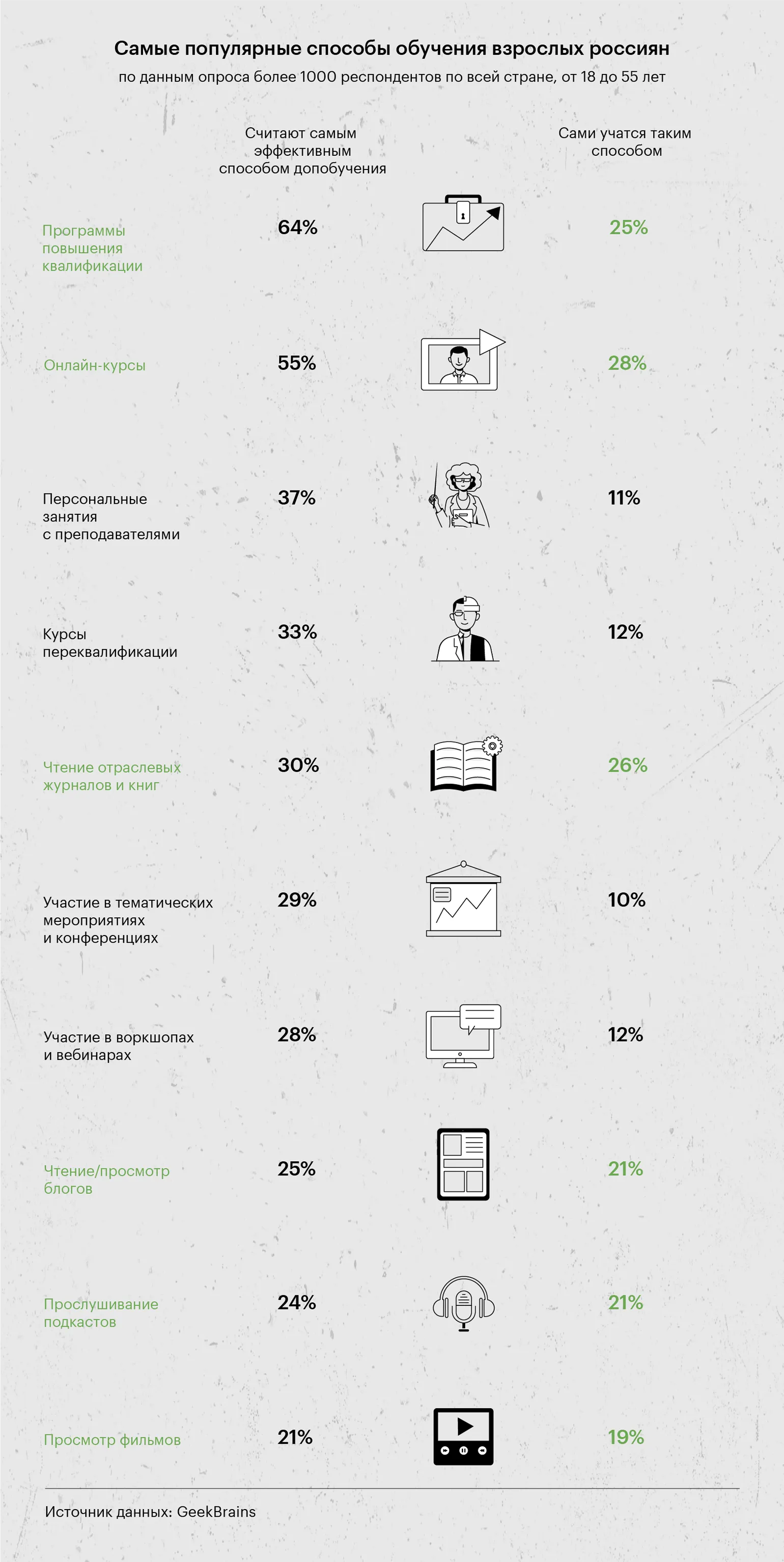
The survey showed that 89% of respondents support the concept of lifelong learning. 64% of respondents consider advanced training methods to be the most effective, while 55% highlight online courses. However, in practice, less than a third of respondents actively use these methods: only 25% prefer advanced training programs and 28% online courses. Thematic events such as conferences, workshops, and webinars are attended by only 10-12% of respondents, although 28-29% consider them useful. Only four self-education methods have similar perceptions of their effectiveness and actual use. These are methods that require minimal financial investment and effort.
- reading industry journals and books;
- reading blogs;
- listening to/watching podcasts;
- watching films.
When launching educational and informational outreach projects for adults, it is important to consider data on potential demand. This will allow you to more effectively plan the content and format of events, as well as adapt them to the needs of the target audience. Demand analysis will help identify relevant topics and interests, which in turn will increase participant engagement and project success. Comparing various methods of acquiring knowledge and skills, one can see the clear advantages of informal and unstructured education. This type of education is becoming increasingly popular due to its flexibility and accessibility. Informal education encompasses a variety of forms, including self-study, online courses, and participation in workshops. These methods allow people to adapt the learning process to their needs and schedule, making it more effective. As a result, many choose informal approaches, as they often prove more effective and relevant in a rapidly changing world.
- Formal education (advanced training programs and retraining courses) is practiced by a total of 37% of respondents;
- Non-formal education (online courses, personal lessons with teachers) is practiced by a total of 39%;
- Informal or unsystematic education (participation in thematic events and conferences, workshops and webinars, reading industry journals and books, blogs, listening to podcasts, watching films) is practiced by a total of 109% (the figure is greater than 100% because it was possible to select multiple answer options).
The data confirm the findings of other significant studies. Researchers Natalia Karmaeva and Andrey Zakharov, employees of the HSE Institute of Education, previously analyzed information from the Russian Long-Term Monitoring Survey of the HSE Population. This large, longitudinal study includes annual surveys of more than 10,000 respondents.
Studies conducted in 2018 and 2019 found that informal learning is the most popular way for adults to learn. This type of learning includes participating in workshops, webinars, conferences, and reading articles and blogs without obtaining a formal qualification. According to the survey, 36.7% of respondents reported engaging in informal learning unrelated to their professional activities, while 24.7% reported engaging in work-related learning. Approximately 5% of survey participants actively used online courses, and 4.7% were engaged in formal education, including higher education and continuing education courses. These data highlight the importance of informal learning in the modern world and its role in developing professional skills and personal growth.
Read also:
If you'd like to deepen your knowledge on this topic, we recommend consulting additional materials. This will help you better understand the key aspects and apply them in practice. Detailed information and helpful tips await you in our articles. Don't miss the opportunity to expand your horizons and gain new skills.
- The harsh Russian lifelong learning: why Russian adults study and don't
- What online education trends were revealed by a large study by Netology
- Learning to change: what is transformative adult learning
- How to motivate adults to study
Profession Methodologist from scratch to PRO
You will improve your skills in developing curricula for online and offline courses. Master modern teaching practices, structure your experience, and become a more sought-after specialist.
Find out more