Contents:

Course with employment: "The Profession of a Methodologist from Zero to PRO"
Find out moreFull title: "New Worlds of Education: Transforming Learning in the Age of Artificial Intelligence." This study is devoted to the changes in the educational system caused by the development of artificial intelligence technologies. With the rapid advancement of AI, educational methods and approaches are undergoing significant changes, opening up new horizons for students and teachers. Studying the impact of artificial intelligence on the educational process reveals new opportunities for personalizing learning, increasing its effectiveness and accessibility. It is important to consider how AI can transform traditional teaching methods and what skills will be in demand in the future.
New Horizons: How Artificial Intelligence Will Change Education. Artificial intelligence (AI) is becoming an essential tool in education, opening up new opportunities for students and teachers. It helps adapt educational materials to individual student needs, offering personalized approaches to learning. AI can analyze student progress data, identifying their strengths and weaknesses, allowing for more effective learning planning.
Furthermore, the use of AI in education contributes to the creation of interactive and engaging learning resources that increase student motivation and engagement. The use of adaptive technologies and virtual assistants makes the learning process more accessible and convenient.
Considering all these factors, it is safe to say that artificial intelligence will continue to transform the educational sphere, making it more efficient and tailored to the needs of each student.
Alpina PRO Publishing House offers a wide range of literature covering various genres and topics. We strive to provide readers with high-quality books that inspire, educate, and entertain. Our goal is to make the best works of both domestic and international authors accessible. We are proud to collaborate with talented writers and experts in their fields, ensuring high publishing standards. Alpina PRO Publishing House is your reliable partner in the world of knowledge and literature.
Year of publication: 2025.
In 2025, many significant events and innovations are expected that could impact various areas of life. In the field of technology, we can see the development of artificial intelligence, new advances in medicine, and improved environmental solutions. It is also worth paying attention to changes in the economy and social sphere, which can form new trends and directions. The year 2025 will be a significant milestone for many industries, and its impact will be felt well into the future.
In 2008, Salman Khan, a graduate of MIT and Harvard, launched the free online educational platform Khan Academy, which offers video lessons on school subjects with an emphasis on mathematics and other sciences. Lessons are available on YouTube, and on the platform itself, as well as in a mobile app, students can complete exercises and practical tasks and track their learning progress. By 2024, the number of uploaded video lessons exceeded 10,000, they were translated into numerous languages, and the total number of students reached more than 150 million. Khan Academy continues to expand its resources and capabilities, helping students around the world study a variety of subjects.
In an era of significant transformation in education caused by the development of artificial intelligence, Salman Khan advocates for the integration of neural network tools into the educational process. He emphasizes that in the future, the use of AI will become common practice in professional work, and instead of banning the use of neural networks in schools, it is necessary to teach students how to use them effectively. Today, AI-powered assistant bots are already actively assisting teachers by checking assignments and providing constructive feedback. For students, these technologies act as tutors, ready to answer questions at any time, explain complex topics, and facilitate the acquisition of skills such as essay writing. Effective use of AI in education can significantly improve the quality of learning, making it more accessible and personalized.
In 2023, Khan Academy introduced a new assistant bot, Khanmigo, based on GPT-4 technology. This tool aims to support students by providing recommendations, asking guiding questions, and providing feedback, but does not solve problems or write essays for them. Khanmigo can evaluate written assignments by analyzing the structure, argumentation, and style of the text, and can also detect plagiarism, for example, if a student submits an essay generated using ChatGPT. For teachers, Khanmigo offers the ability to generate lesson plans, test questions, and grading criteria, and also generates reports on typical student difficulties and errors. This bot is becoming a valuable teaching tool, helping both students and teachers improve the learning process.
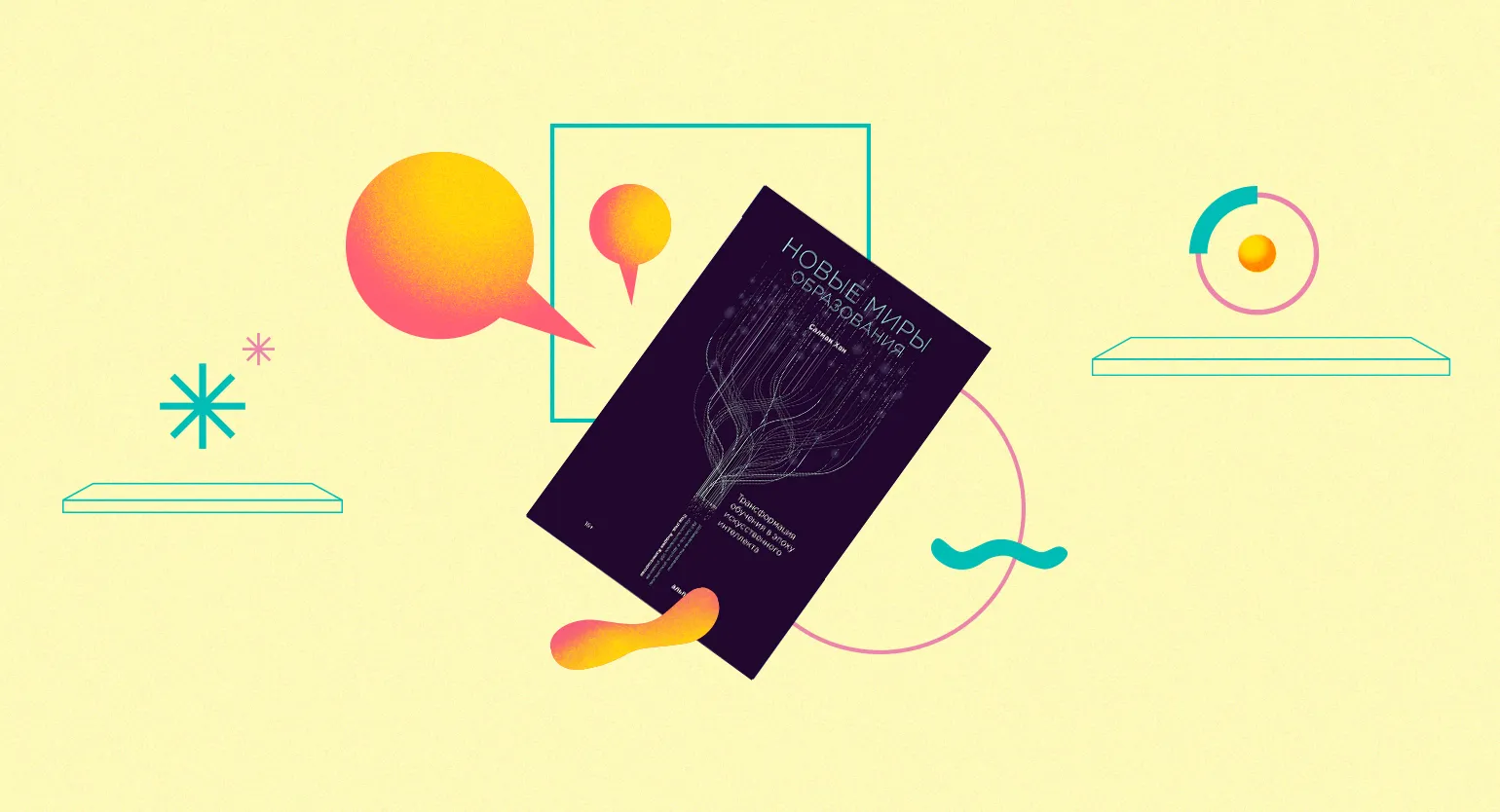
Salman Khan's book, "New Worlds of Education: Transforming Learning in the Age of Artificial Intelligence," details the creation of Khanmigo and the impact of AI tutors on modern education. It describes the opportunities afforded by artificial intelligence, as well as the educational challenges it can address. The book highlights how technology can transform traditional teaching methods, making them more accessible and effective for students.
The Russian-language edition includes a foreword by specialists from the More Data laboratory, headed by Andrey Komissarov, head of artificial intelligence development projects at SberUniversity. In this section, the authors share their experience developing an AI tutor for physics and social studies, detailing the technical aspects of creating such educational tools. They explain the principles of a knowledge graph, which is a knowledge base and network of semantic relationships used by a bot to generate responses to queries. They also focus on image processing algorithms and the development of AI systems for assessing pedagogical competencies and formative student assessment. This publication is a valuable resource for anyone interested in modern educational technologies and the application of artificial intelligence in the learning process.

The main part of the book begins with the story of how OpenAI co-founders Sam Altman and Greg Brockman approached Salman Khan with a proposal to collaborate before launching GPT-4. Their goal was to develop an innovative neural network-based tutoring bot capable of providing an unprecedented level of personalization in education. The author shares impressions of GPT-4's capabilities and describes the creation of Khanmigo, emphasizing how this project can change the approach to learning and make it more accessible and adaptive for each student.
In the following chapters, Khan examines common concerns that arise when integrating artificial intelligence into the educational process. Some believe that generative neural networks encourage cheating, stifle students' creativity, and create a dependence on technology for problem solving. Khan argues that these problems are not a consequence of the technology itself, but rather arise from how it is configured and used. With a responsible approach and an understanding of the limitations of AI, this tool has the potential to open up new opportunities for all interested parties that previously seemed unattainable.
With the advent of artificial intelligence, the barriers that previously limited people in mastering various crafts are being erased. Previously, learning to draw required developing a specific set of skills. Now, thanks to AI tutors powered by large language models, anyone can easily master the art of drawing. Imagine having an AI assistant that offers ideas, assistance, and constructive feedback. It introduces various artistic styles, themes, and compositions, generating reference images and samples. As you work, the AI provides real-time feedback, ensuring proper composition, proportions, and color selection. Modern large language models are capable of understanding the meaning of images. The AI can suggest a student to draw a picture and then provide constructive criticism. Moreover, it can ask students to express their thoughts and explain what they have drawn, which fosters a deeper understanding of the creative process.
"New Worlds of Education" is a book written by Salman Khan, founder of Khan Academy. It examines modern approaches to learning and the importance of making knowledge accessible to all. Khan shares his vision for the educational system, focusing on how technology can transform traditional learning. He emphasizes the need to adapt educational methods to student needs, as well as the importance of self-study and individualized approaches.
The book touches on interactive learning, online courses, and the role of teachers in the digital age. Khan argues that education should be accessible and personalized, allowing each student to learn at their own pace. His work inspires educators and students, demonstrating how innovations in learning can lead to deeper understanding of subjects and the development of critical thinking.
Salman Khan also discusses the future of education, including the impact of artificial intelligence and new technologies on the learning process. This book is an important contribution to the discussion about how we can improve educational systems and make them more effective and accessible to all.
There are other issues that require special attention from teachers and parents whose children use artificial intelligence, as Khan notes. These include neural networks "hallucinating" and spreading misinformation in response to queries, as well as the unethical use of collected data. The founder of Khan Academy emphasizes that these problems existed even before the advent of ChatGPT. Information in the media and other sources also requires careful fact-checking. Neural networks continue to evolve, and with each new generation, they "hallucinate" less. Any online service, not just those based on AI, can misuse user data. Therefore, the only solution is to ensure that the tool used meets high data protection standards.
Salman Khan argues that artificial intelligence is fundamentally changing education, the labor market, and other areas of society, and this process is inevitable. It is important to focus on ensuring that technology is used for good, ethically, and responsibly. Bans and strict restrictions can lead to the emergence of "bad actors" in this field who will exploit artificial intelligence for their own selfish purposes. It is necessary to focus on creating a safe and beneficial environment for the use of technology to maximize its positive impact on society.
This text will be useful for anyone interested in the development of artificial intelligence technologies and their application in education. AI technologies are opening new horizons for learning, improving the quality of the educational process and making it more accessible. Interest in this topic is growing among educators, students, and researchers, contributing to a deeper understanding of the possibilities of AI in the educational environment.
Learn more about education by subscribing to our Telegram channel. We share relevant information, news, and interesting facts to help you stay up-to-date on all developments in education. Join us and stay connected!
Read also:
- Threat or Opportunity? What Concerns Educators Around the World About AI Development
- Can AI Replace University Teachers? Interview on the results of a series of experiments
- Will neural networks leave tutors without work?
- Virtual tutors with artificial intelligence are being developed in the UAE
- Generative AI has helped improve the work of tutors