
Contents:

Learn: Online tutor
Learn more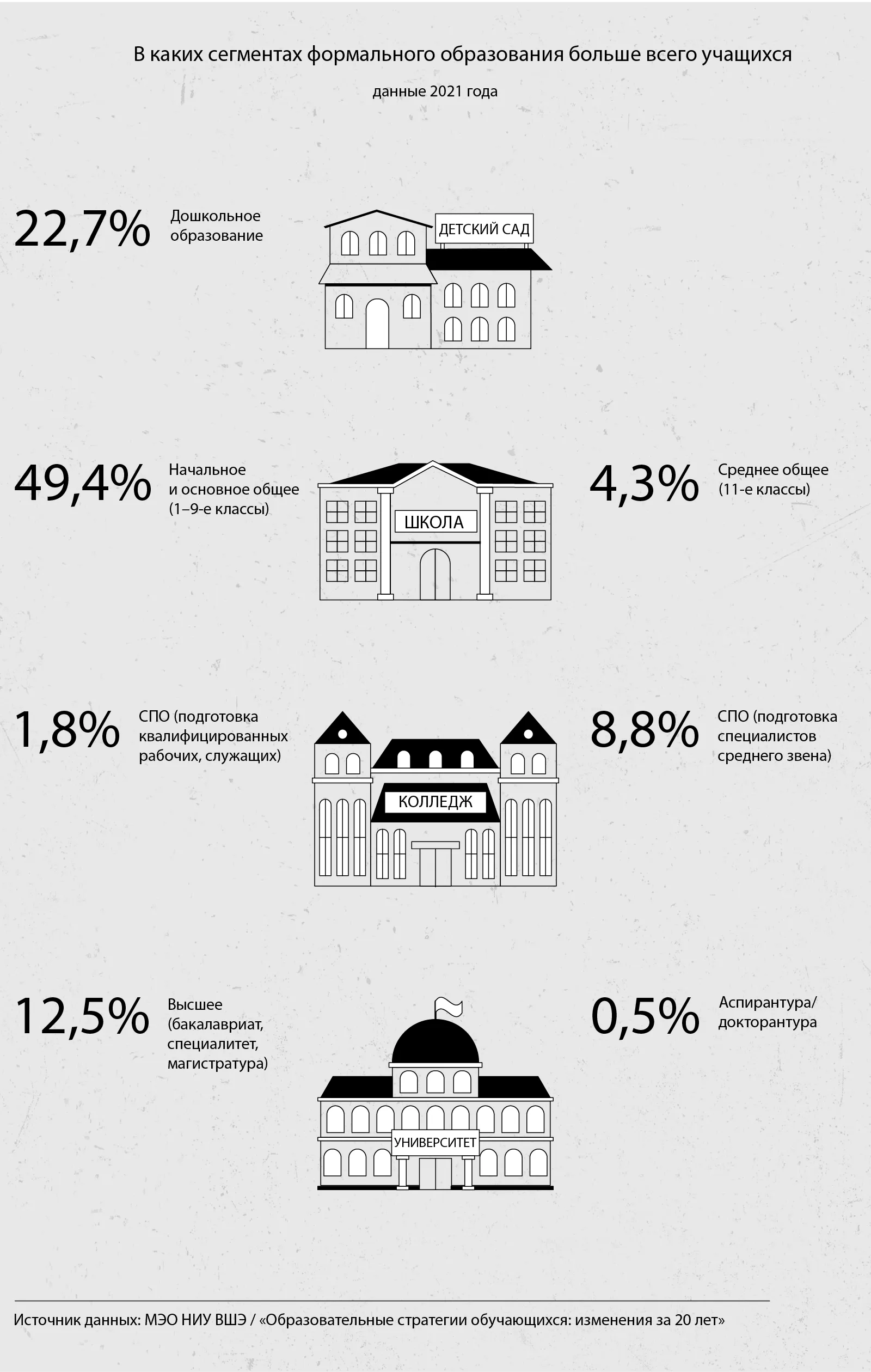
A new issue of the HSE Education Monitoring newsletter has been released. This issue examines changes in educational strategies for students at various levels of formal education in Russia from 2001 to 2021. It analyzes trends and key factors that have influenced the development of educational practices in the country over two decades. The review is based on statistical data and research that highlight the significance of transformations in the educational sector. The first figure shows the distribution of students across various levels of education. The largest number of students is concentrated in basic school, from grades 1 to 9, due to the mandatory nature of this level for all students. However, an analysis of optional educational programs is more interesting. The data shows that colleges and secondary vocational education institutions (SVE) enroll twice as many students in mid-career specialist programs as in grades 10 and 11. At the same time, SVE programs aimed at training skilled workers and employees are the least popular. The number of students here is half that of high school students, and almost five times smaller than that of secondary vocational programs for mid-level specialists. Thus, there is a clear trend toward young people choosing more in-demand and promising educational paths.
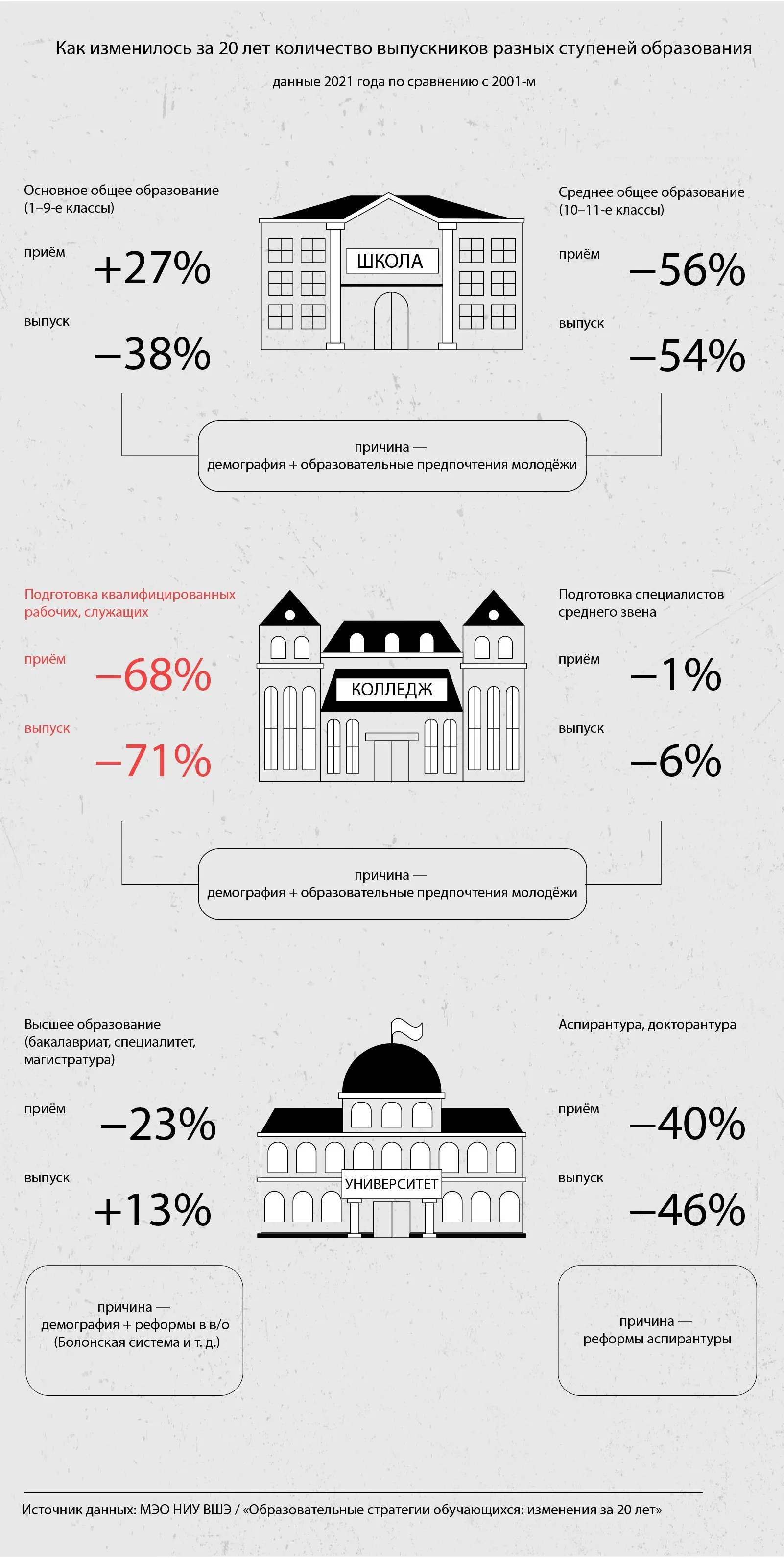
In the newsletter The HSE Monitoring of Education presents data on the dynamics of student admission and graduation over the past 20 years at various levels of education. The base value is the 2001 figures, and then their annual dynamics are presented up to 2021. These data reflect changes in the education system and can be useful for analyzing trends in higher and secondary education.
The changes are due to three main groups of factors:
- demographic (due to the low birth rate in the 1990s and early 2000s, the number of students at all levels decreased, but then the birth rate began to rise, so admission to the first grades increased);
- reformist (some things changed in the structure of education itself);
- changes in the educational preferences of young people.
Reformist reasons manifested themselves in an increase in the number of graduates from higher education institutions, despite a decrease in the number of applicants. This is due to the introduction of the Bologna system, which has led to an uneven distribution of graduates: some students complete their bachelor's degree in four years, others their specialist degree in five, and a two-year master's degree has also been introduced. Furthermore, there has been a decline in the number of applications for distance learning. Since 2006, a campaign to improve the quality of higher education has been underway, leading to a restructuring of universities and a reduction in the number of branches offering distance learning. At the same time, interest in full-time education has remained stable, as the authors of the bulletin note. The decline in the number of applicants to postgraduate studies is not solely due to demographic factors. The main reason is the shortcomings of the recently implemented reform, which is now being addressed.
Changes in educational preferences are becoming particularly noticeable at the high school and secondary vocational education (SVE) levels. SVE programs are divided into two main categories: mid-level specialist training and skilled worker training. In recent years, there has been an increase in the popularity of mid-level specialist programs, although the overall number of enrollments remains below 2001 levels. This is due to demographic issues, as illustrated by a comparison of admission and graduation data for grades 10 and 11. At the same time, interest in skilled worker training programs has significantly declined, and the number of people seeking training in these fields has become minimal. Thus, it can be stated that educational trends in secondary vocational education are undergoing significant changes, which requires the attention of educational institutions and policymakers.
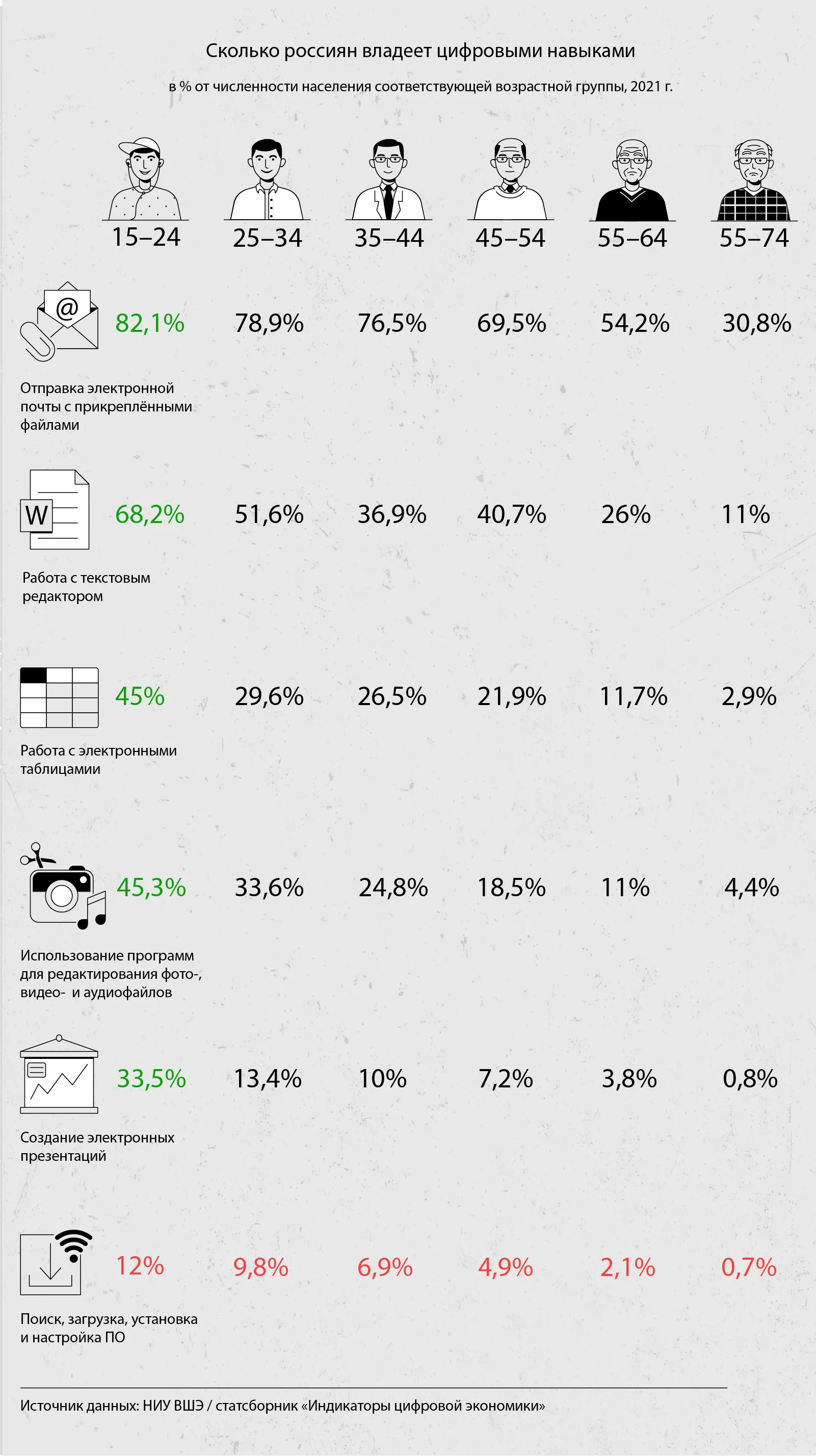
The Institute for Statistical Studies and Economics of Knowledge at the National Research University Higher School of Economics has published a statistical digest titled "Digital Economy Indicators: 2022." It compiles data from the Ministry of Digital Development and Communications and Rosstat on the creation, dissemination, and use of digital technologies, as well as related products and services. One of the key indicators is the level of digital skills among Russians. The digest provides valuable information for analyzing current trends in the digital economy and allows one to assess the population's readiness to use modern technologies.
The infographic clearly demonstrates the dependence of digital skills on generation. Although it does not represent people over 75, it is safe to say that among them, the level of proficiency in even basic digital skills is significantly lower than among representatives of younger age groups. Millennials and, especially, Zoomers possess significantly more advanced digital skills than their parents, not to mention their grandparents, most of whom lack the ability to perform even the most basic digital tasks. This trend underscores the importance of digital literacy in modern society and the need to teach older generations the basics of technology.
The older generation is most often opposed to the digitalization of education, as in other areas. For them, this environment seems alien and incomprehensible, while young people perceive it as a natural part of life. However, even among young people, gaps exist: not everyone has the skills to find and independently install the necessary software. Thus, even Zoomers largely remain mere consumers of digital technologies, unable to customize them to their needs. This underscores the importance of developing digital literacy at all levels of education so that young people can not only use technology, but also effectively adapt it to their needs.
Also explore:
- "A diploma is only a certificate of intelligence": quotes about the "eternal" in education
- 144 Russian universities included in the top 15% of the world's best universities
- Active use of the Internet does not necessarily indicate digital literacy
Online Tutor
It doesn't matter what you teach—English, CrossFit, yoga, vocals, or culinary arts. Everything you previously taught in schools, studios, and offices can now be taught online. Promote your knowledge and skills and earn money from anywhere in the world.
Find out more