
Contents:

Course with employment: "The profession of a Methodologist from scratch to PRO"
Find out moreMethodologies are found in various professional fields. According to the Great Russian Encyclopedia, methodology, in the broad sense, is a set of methods applied in a specific field of activity to achieve specific goals. For example, there are accounting methodology, business process methodology, evaluation methodology, scientific research methodology, drug development methodology, and educational methodology. Thus, each field of activity has developed its own unique methodological approaches that enable effective problem-solving and goal achievement.
Methodologists are specialists who study, analyze, and synthesize the principles and methods of organizing various types of activities. Their work enables the systematization of knowledge and optimization of processes, which contributes to more effective management and project implementation in various fields. Methodologists play a key role in developing methodologies that help improve productivity and work quality.
If you select vacancies using the word "methodologist" on major job search portals, you will notice that this designation is most often used in the following contexts:
- business analysts and business process organizers;
- accounting specialists;
- product development specialists (product managers);
- a special function in educational organizations.
We will talk about the last option, which is practically no different from the functions of methodologists involved in product development. In this case, the product is an educational program, most often presented in the format of an online course, which imposes certain peculiarities on the development process.
Methodologist and Methodologist: What's the Difference?
In the field of education, methodologists are in demand both in online schools for children and adults, and in the corporate training departments of large companies. Job titles may vary, such as online course methodologist, head of methodology department, educational product methodologist, and e-learning methodologist. This indicates a high demand for specialists capable of developing and implementing effective educational programs. Methodologists play a key role in creating high-quality content that meets student needs and current market demands. Their work includes analyzing educational processes, developing teaching materials, and evaluating the effectiveness of educational programs. Thus, the profession of methodologist is becoming increasingly relevant in the context of the digitalization of education and the rapid development of online formats.
- primarily about informal education (that is, this is usually work outside of schools, colleges, and universities);
- most often, about online education (usually in the form of courses).
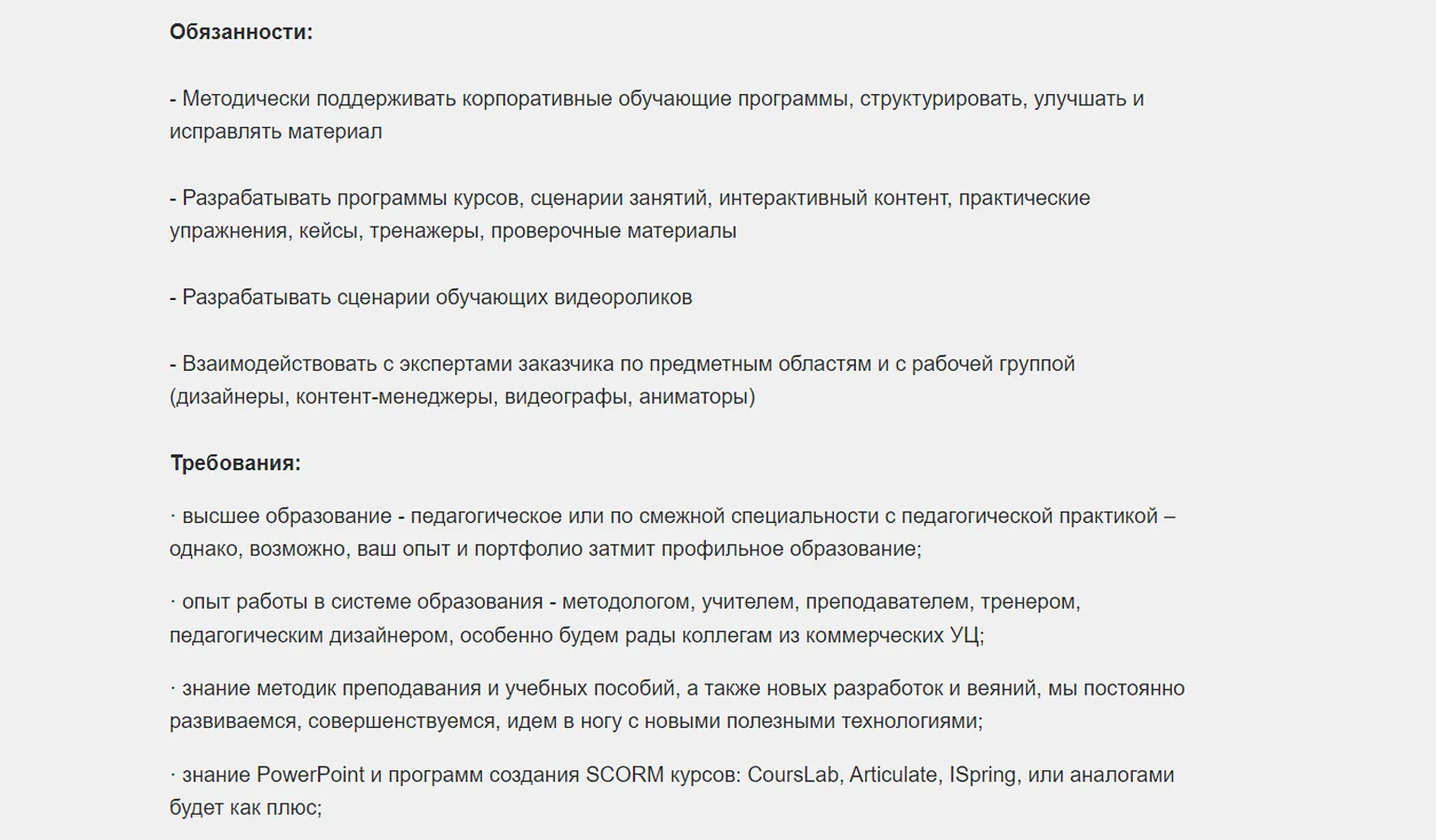
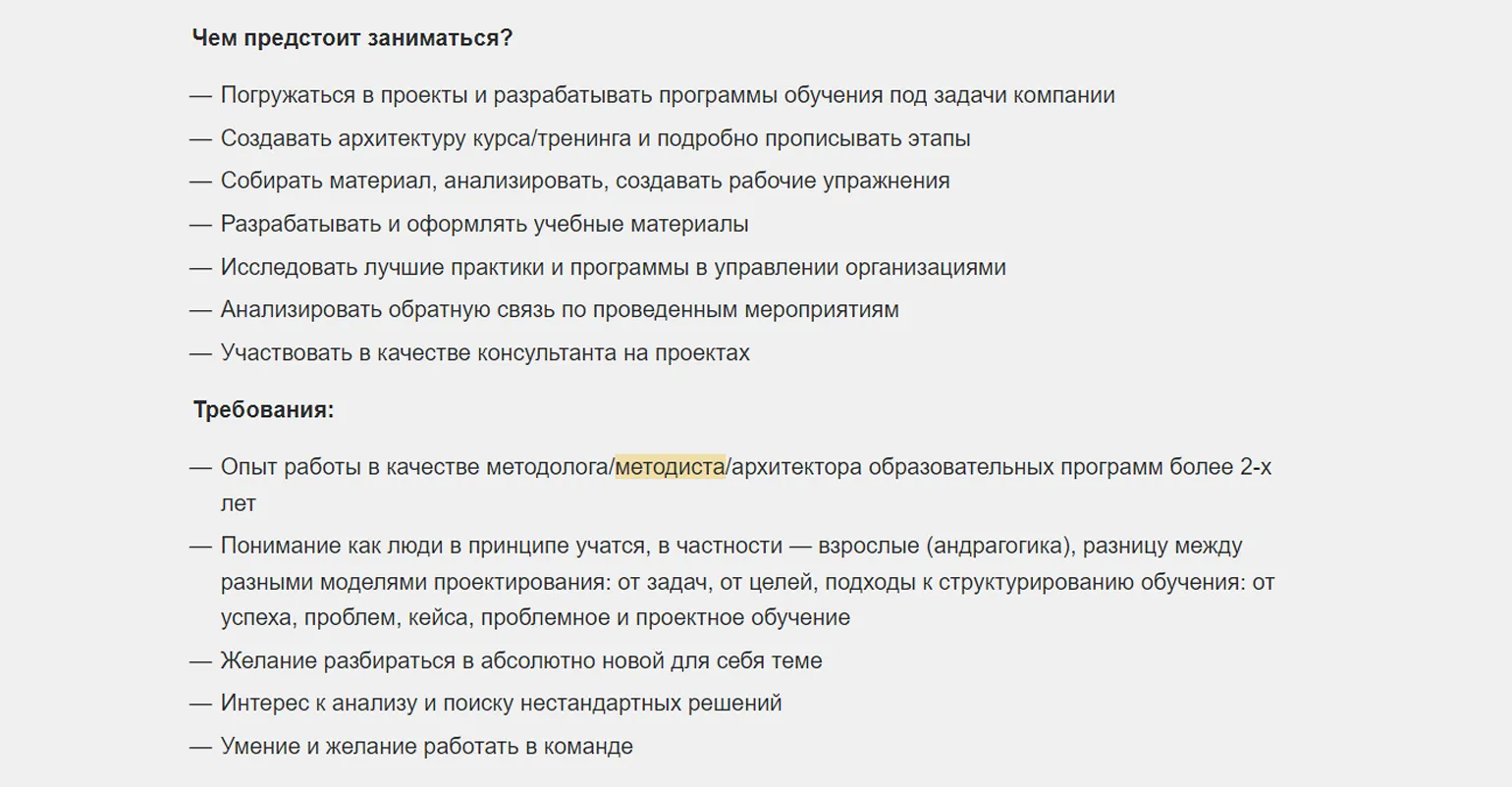
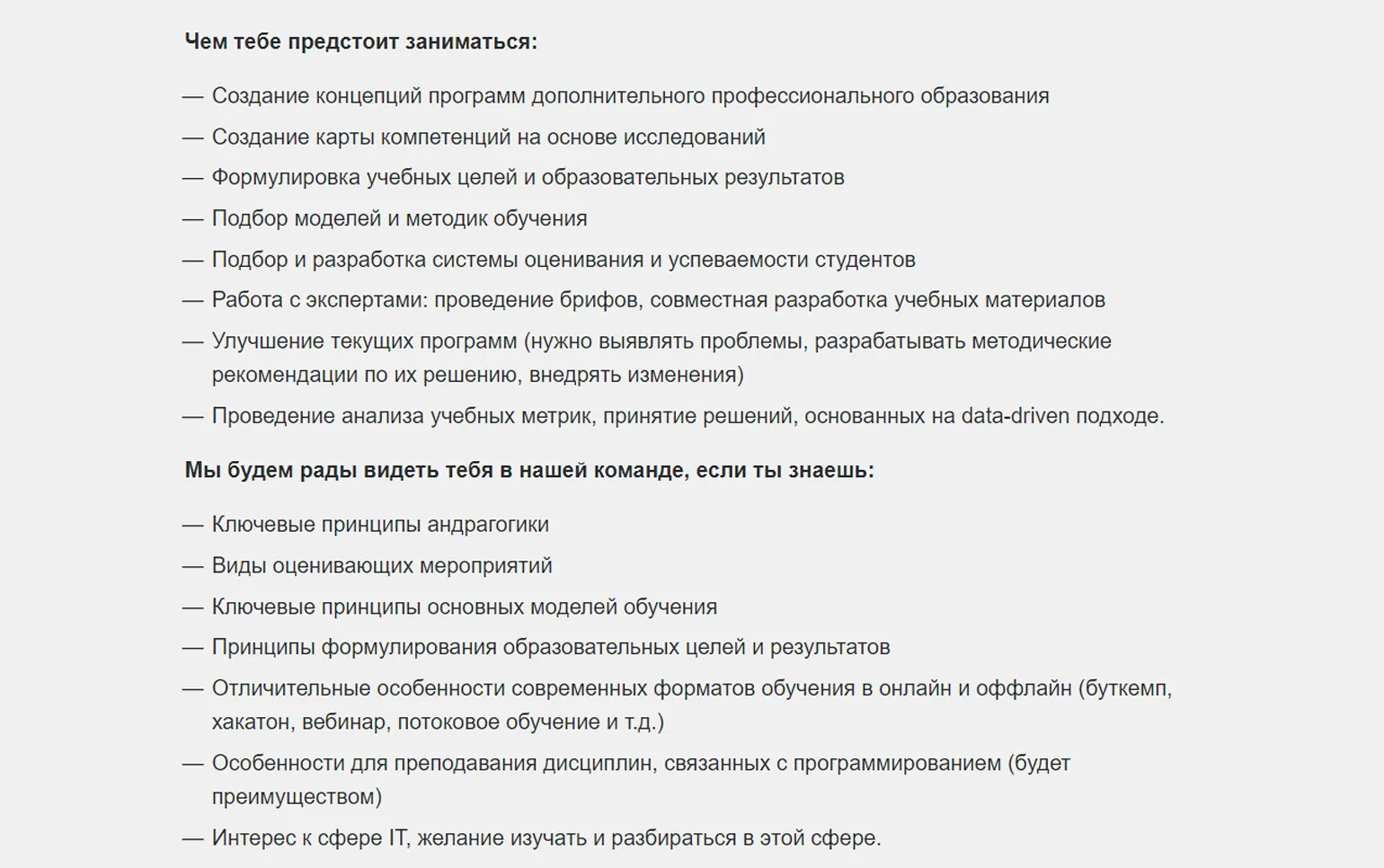
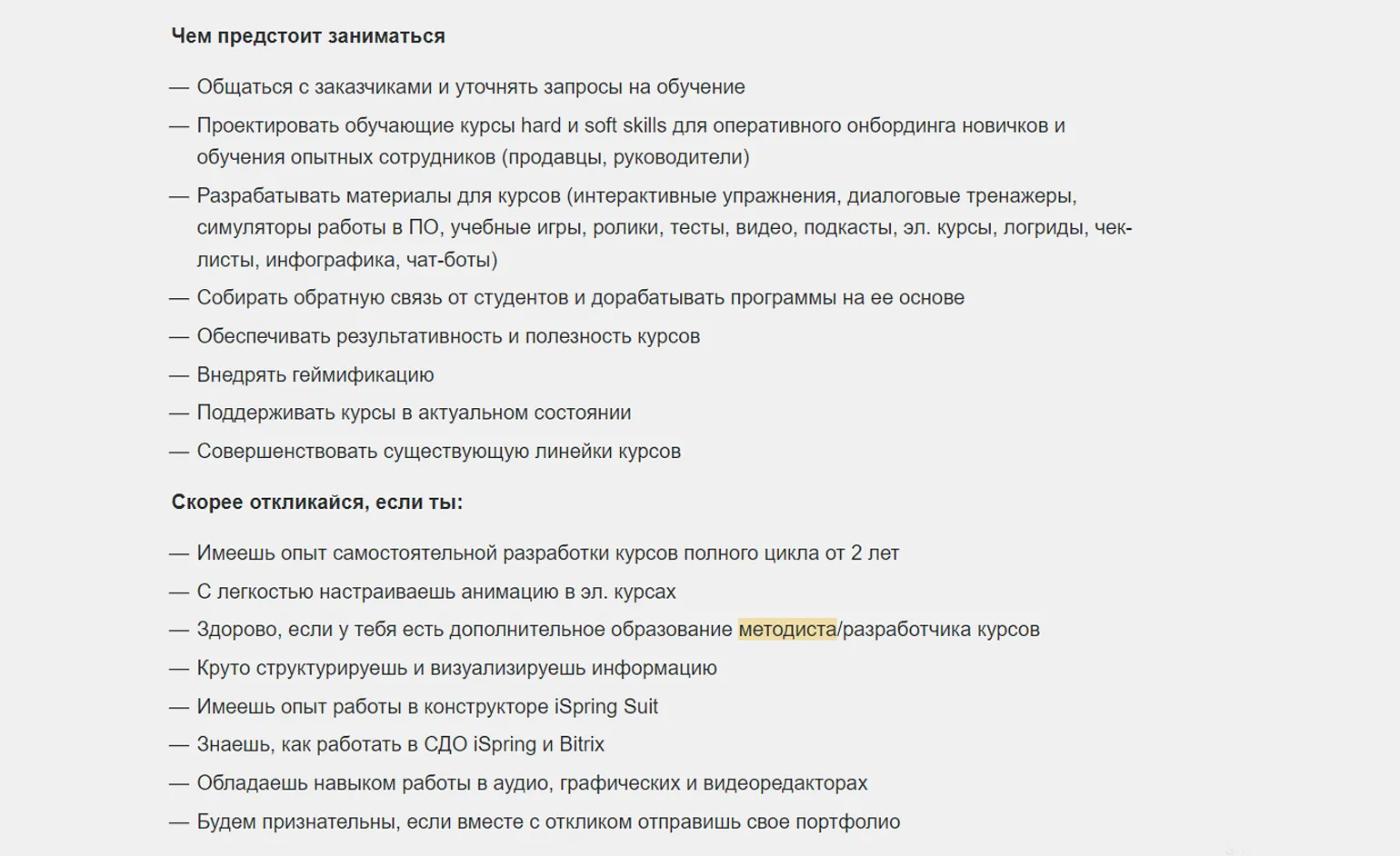
The description of tasks for the vacancies "Methodologist", "Online Course Methodologist", "EdTech Methodologist", and "E-Course Methodologist" include the development of educational programs, the creation of teaching materials and methodological recommendations. Methodologists are responsible for analyzing modern educational trends and implementing innovative approaches in the learning process. Their responsibilities also include evaluating the effectiveness of courses, conducting research, and collecting feedback from students. Methodologists must interact with teachers and other specialists to optimize the educational process and achieve high learning outcomes. It is important that they have skills in working with various educational technologies and can adapt materials to the needs of the target audience.
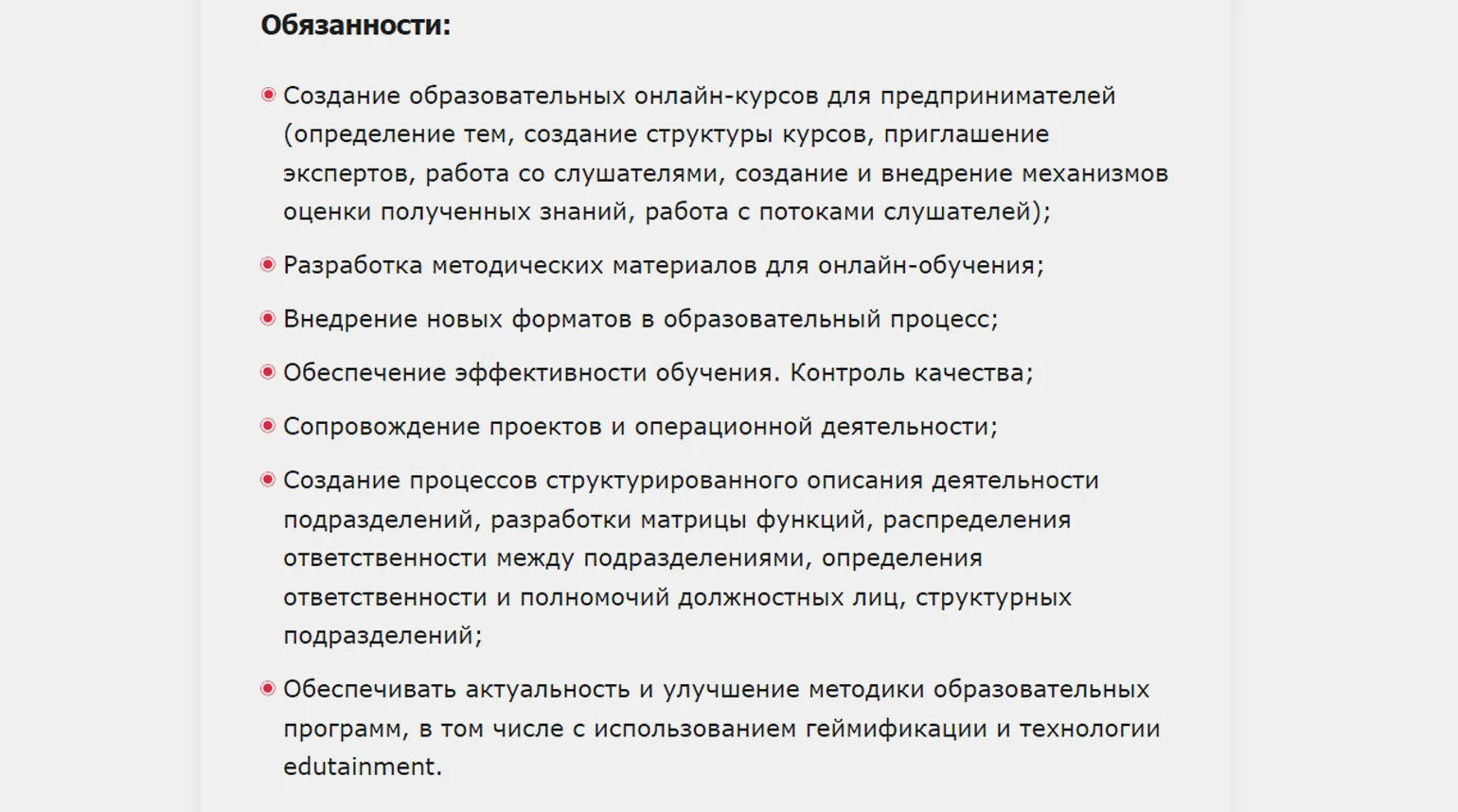
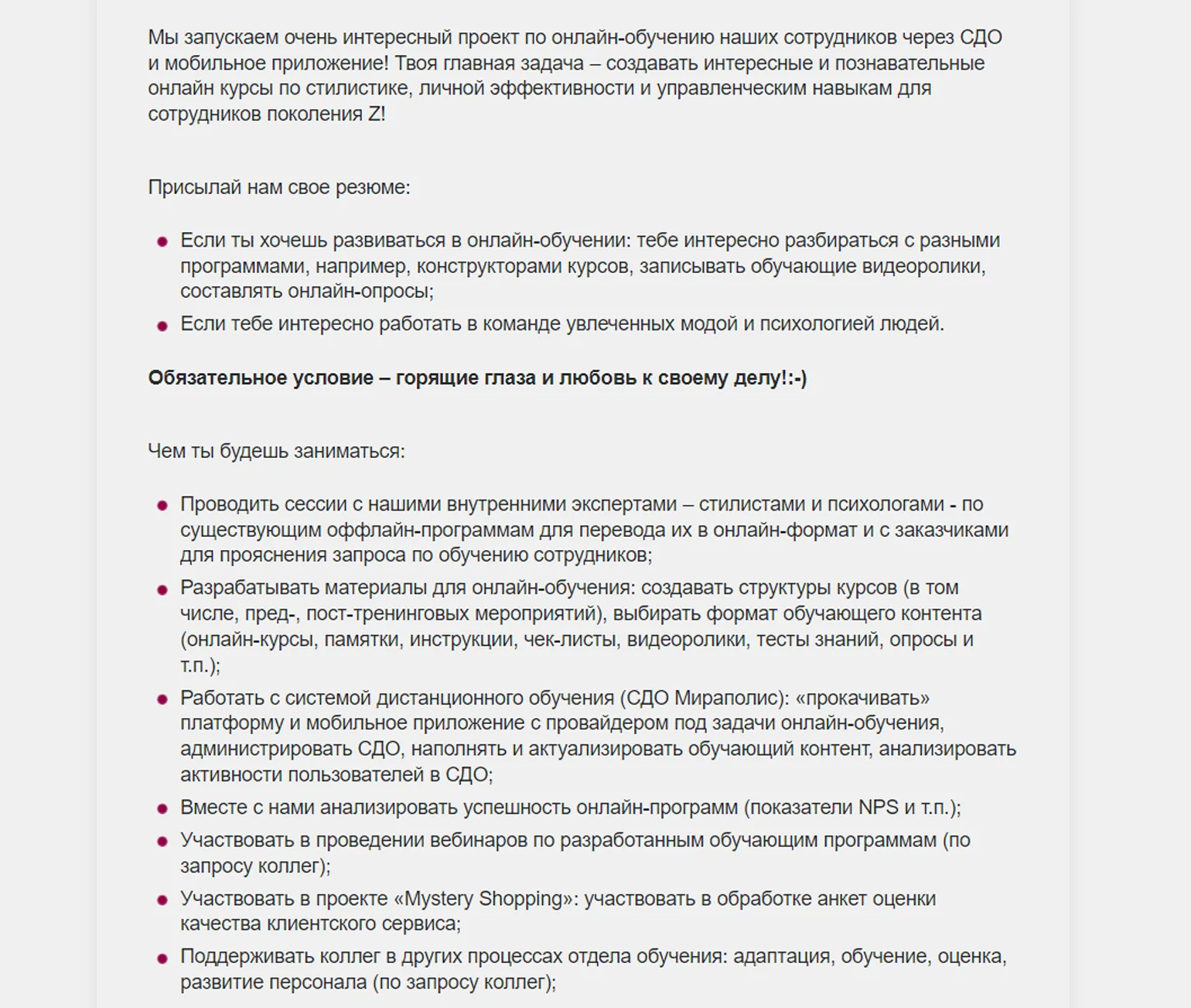
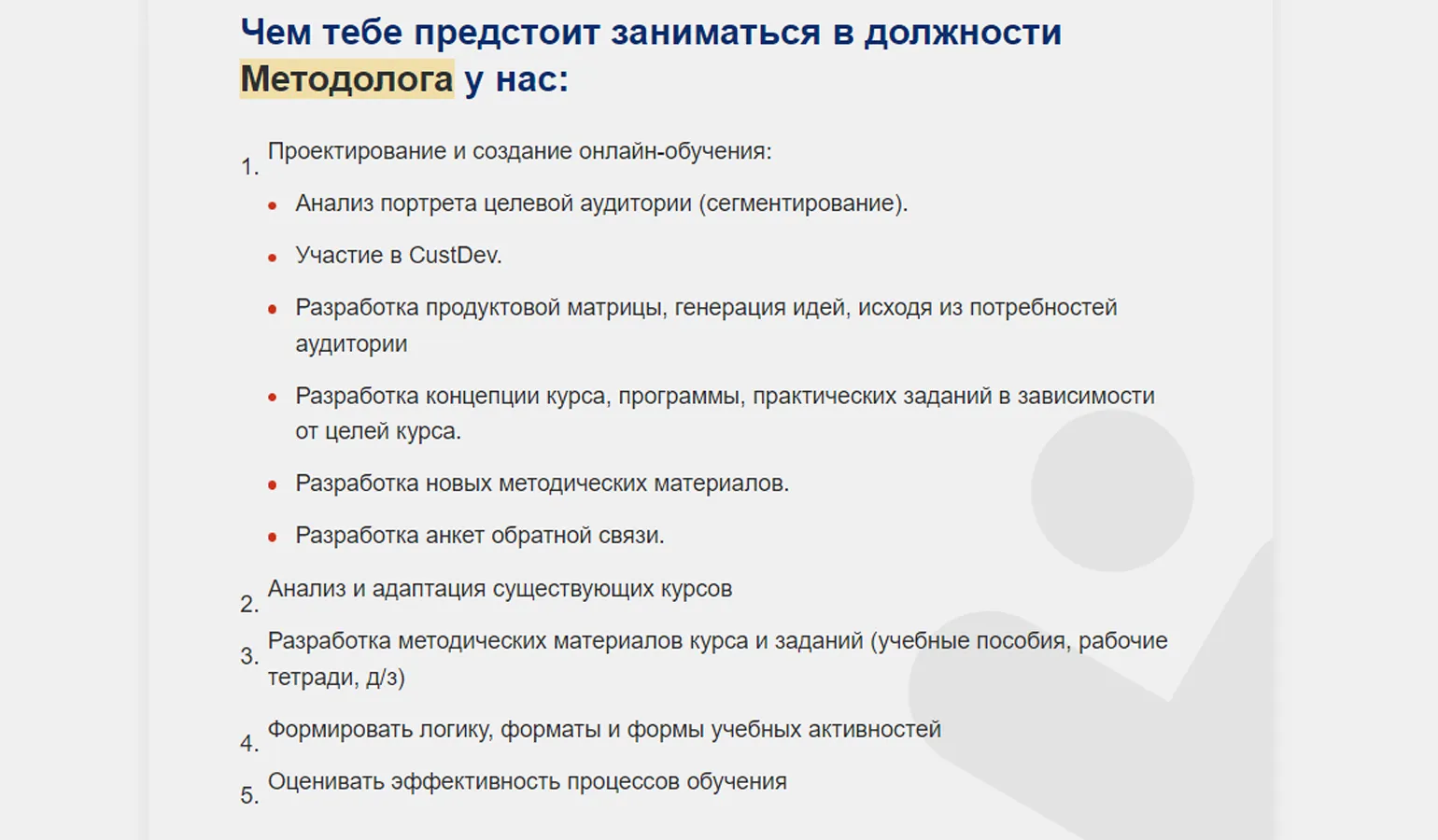
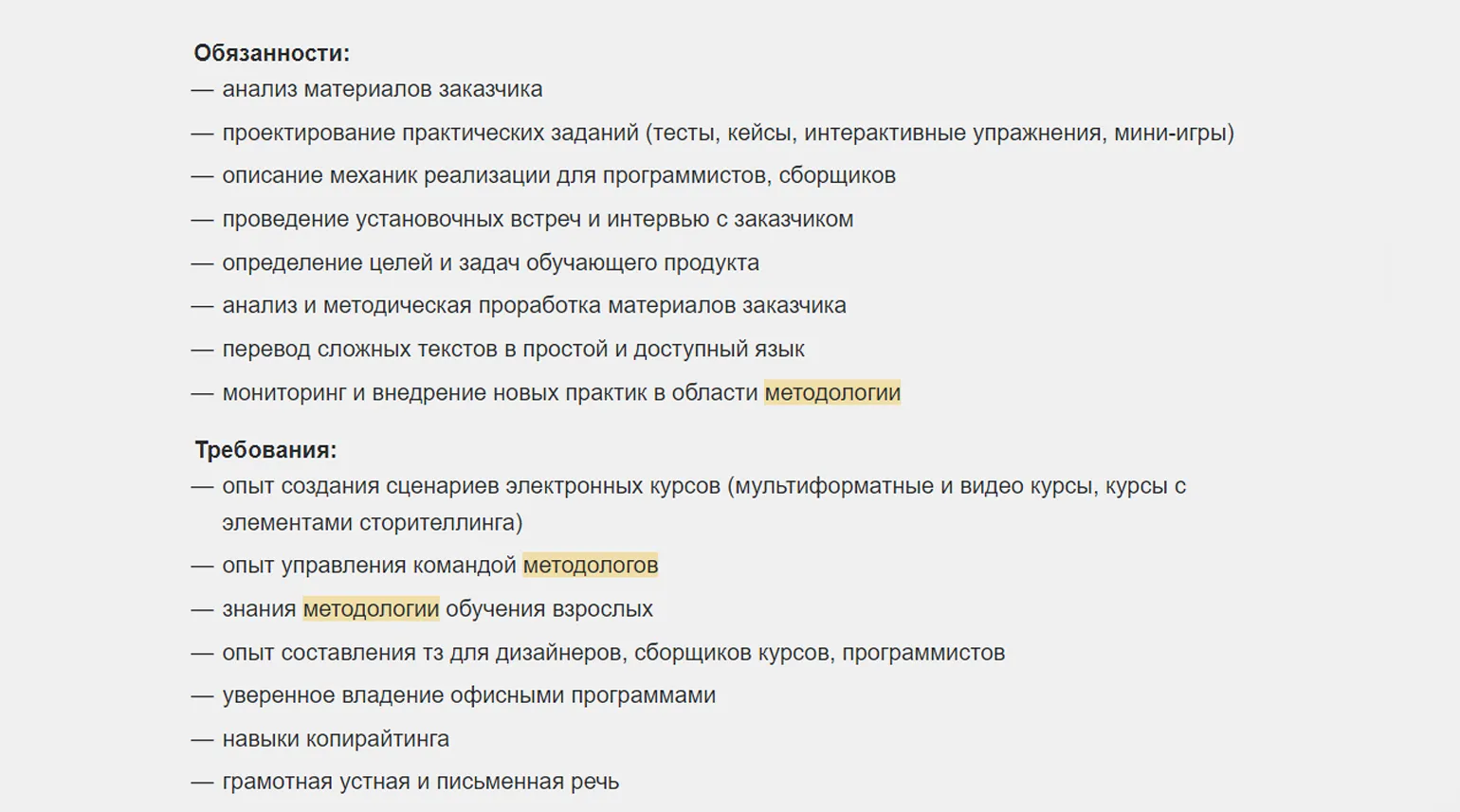
This text presents descriptions of four vacancies related to methodology and training in the educational sphere. Openings include the positions of "Head of Methodology Department," "Head of Methodology and Training Department," "Educational Program Methodologist," and "Educational Product Methodologist/Producer." Each of these roles entails responsibility for the development and implementation of educational strategies and methodologies, as well as for coordinating training processes and methodological support. Key candidate requirements include experience in education, curriculum development skills, and project and team management skills. These openings emphasize the importance of high-quality methodological support for achieving high educational results.
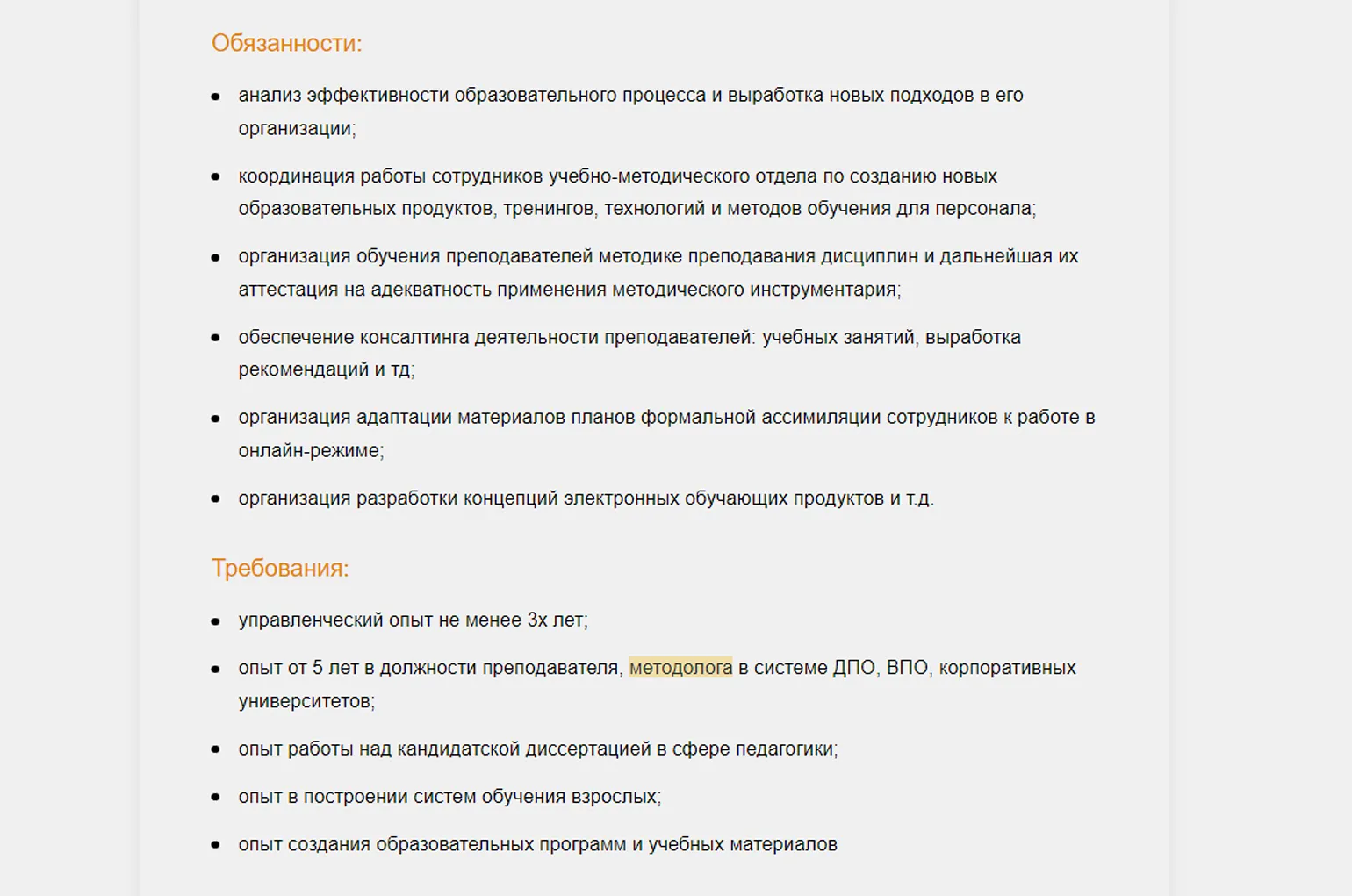
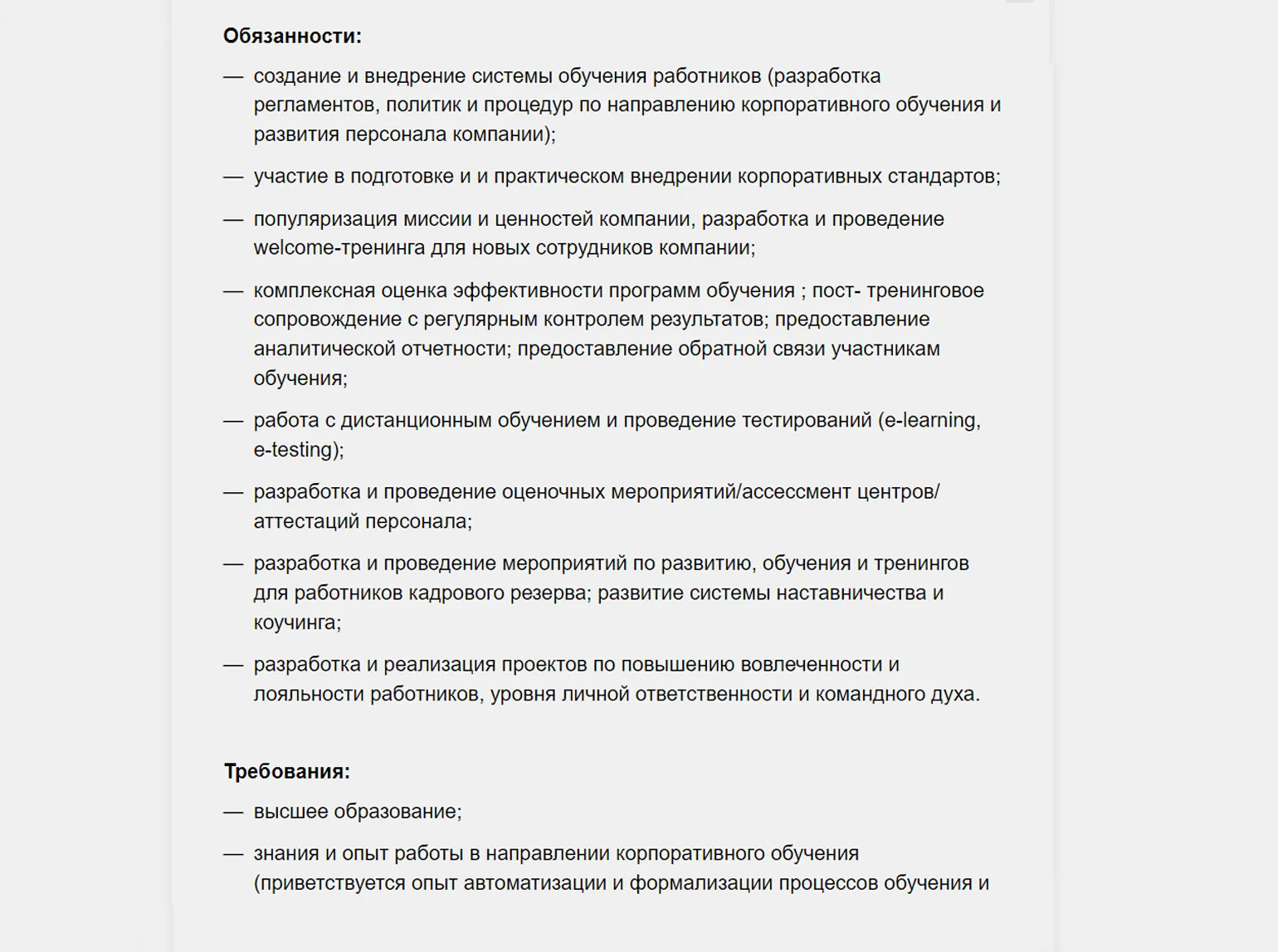
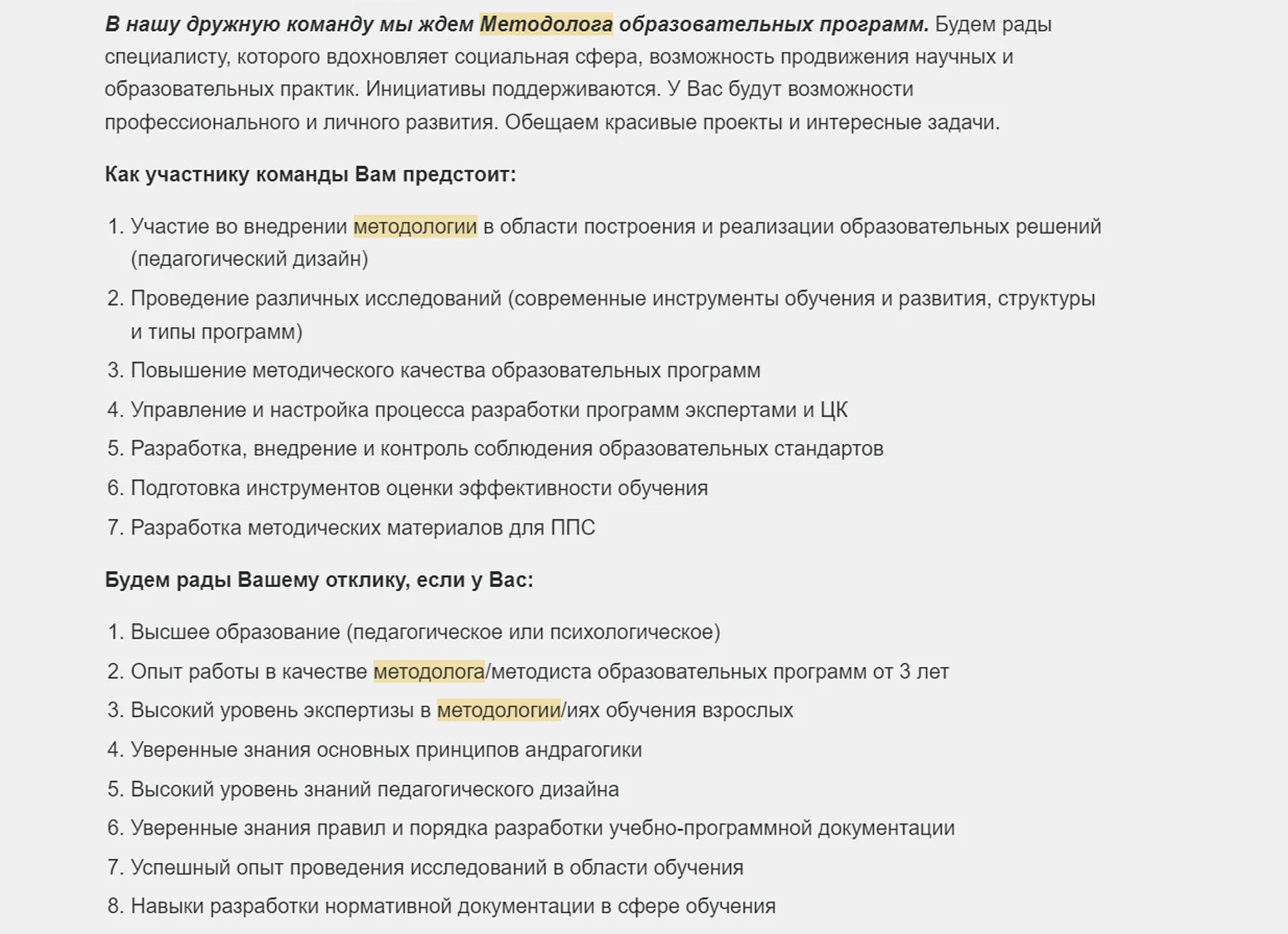
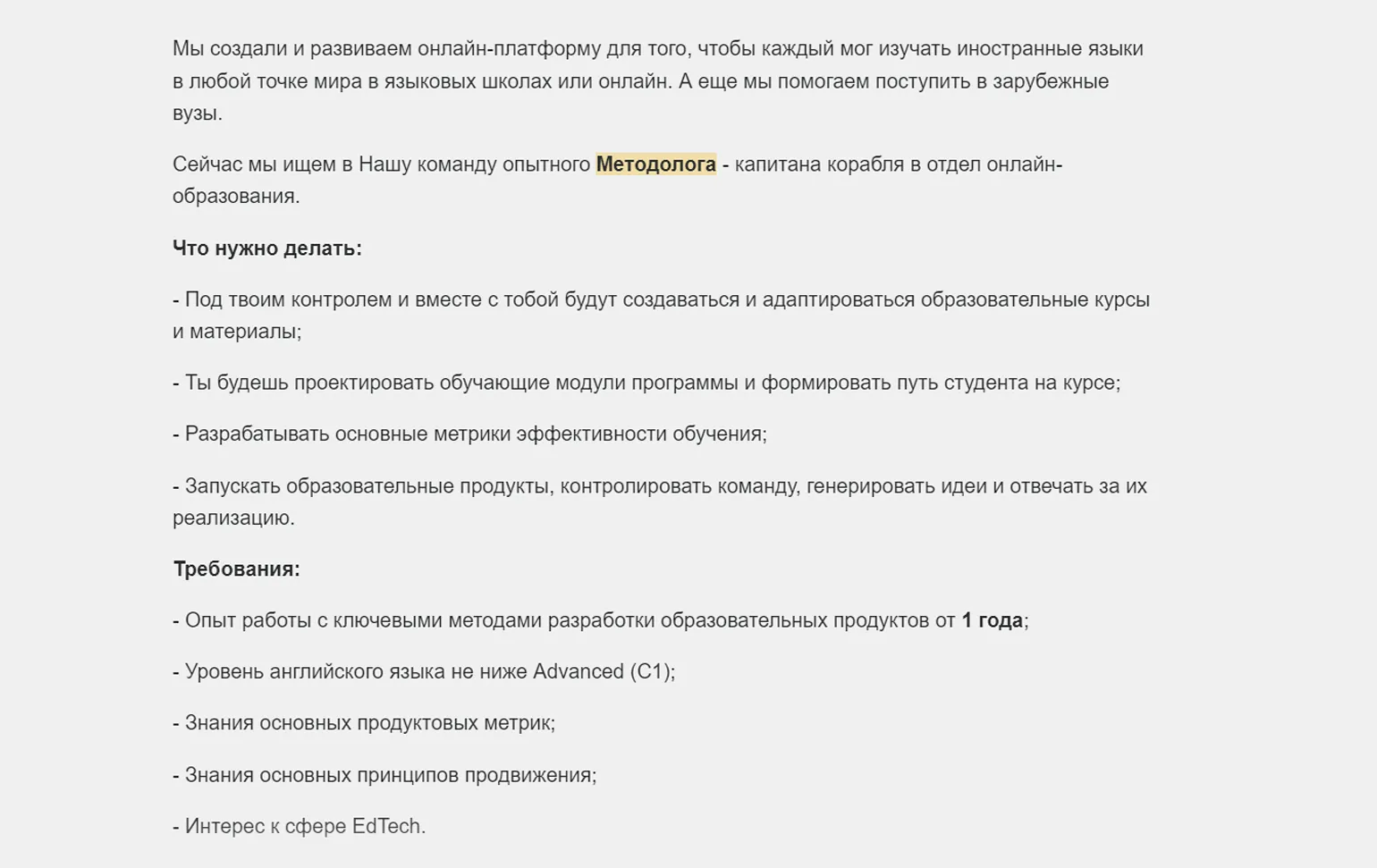
Methodologists also work in the field of formal education, although their tasks differ from the tasks facing specialists in other fields. For example, at the Federal Institute for Pedagogical Measurements, methodologists develop assessment and certification systems, as well as create assignments for the Unified State Exam (USE) and the Main State Exam (OGE). Their work is aimed at improving the quality of the educational process and ensuring the objectivity of student assessment.
Methodologists are not limited exclusively to online learning; they also develop programs for in-person classes. Currently, online learning is gaining popularity, and in corporate training, it is difficult to find a company that exclusively trains employees in an offline format. In almost every case, both formats are used, effectively combining the advantages of traditional and distance learning.
In the field of education, in addition to methodologists, methodologists play an important role. When comparing job openings in online education and corporate training that use the term "methodologist" with similar offers that list the title "methodologist," no significant differences are often found. Moreover, similar functions can be performed by specialists labeled "instructional designers" or simply "online course developers." This demonstrates that roles and responsibilities often overlap in the professional environment, making the selection of a suitable position more flexible for job seekers.
A methodologist is a specialist responsible for the development and implementation of educational programs. Their responsibilities include methodological support for the educational process, the creation of educational materials, and the analysis of the effectiveness of educational activities. A methodologist plays a key role in organizing training, ensuring its compliance with modern requirements and standards.
A methodologist (distance learning specialist) focuses on the creation and implementation of online educational programs. They develop content adapted for distance learning, select suitable platforms and technologies, and train teachers and students in their use. Ensuring the quality of the educational process and supporting participants throughout the learning process is a key aspect.
A training and educational program methodologist is responsible for organizing and delivering trainings, seminars, and courses aimed at developing professional skills. They develop methodological materials, assess student needs, and analyze learning outcomes. This specialist must have excellent communication skills and the ability to work in a team.
An instructional designer is a professional who creates educational programs and materials taking into account modern pedagogical technologies. They develop courses taking into account the characteristics of the audience, goals, and objectives of the learning process. An instructional designer uses innovative approaches to increase student engagement and the effectiveness of the learning process.
An online course developer creates interactive and accessible courses for distance learning. Their responsibilities include designing the course structure, creating content, and testing educational materials on various platforms. The developer must be familiar with current trends in online education and have skills in working with various tools and technologies.

The reason for this situation is that the job function in question is of relatively recent origin. Areas requiring such specialists, such as e-learning, online learning and EdTech, as well as corporate training, are also in the formation stage. As a result, these fields have not yet established uniform standards for the content of the profession and its universal title. The same position may be referred to by various terms in different companies: methodologist, methodologist, online learning developer, instructional designer, and others. As these professions continue to evolve, it is important to keep in mind that titles may vary depending on the company and the specifics of the job.
Representatives of this profession have not yet reached a consensus on the title and the exact list of their responsibilities. The lack of a professional standard creates uncertainty, although the methodological community is actively working on its development. Nevertheless, these specialists share one key function: learning design. This task requires a deep understanding of pedagogical principles and methodologies, which is the foundation for effective educational practice.
A methodologist is a specialist who designs educational processes. They develop both specific curricula and general approaches applicable to various educational courses. A methodologist plays a key role in the creation of effective and targeted educational materials, which contributes to improving the quality of education and meeting the needs of students.
It is believed that a methodologist's tasks are more general and theoretical in nature compared to those of a methodologist. A methodologist, drawing on scientific research, systematizes various educational approaches and develops new methods, models, and teaching formats. A methodologist, in turn, acts as a practical specialist who uses the tools created by methodologists to implement specific educational programs and develop courses.
The concept of methodology is based on its ancient Greek root "logos," which translates as "concept," "reason," or "law." This implies that methodology includes general and fundamental aspects, being theoretical in nature, and is not limited to specific and practical tasks, such as the creation of a specific course. However, in practice, the situation can be varied and does not always correspond to theoretical concepts. Methodology can adapt to various conditions and requirements, making it an essential tool in any field.
In educational technology, the terms "methodologist" and "methodologist" are often used interchangeably, which can cause confusion. Methodologists are often referred to as specialists who develop courses, while methodologists are the leaders of a team of methodologists who shape strategic approaches to learning. However, in practice, these definitions often overlap. To determine which specialist is needed for your company—a methodologist who will focus on creating uniform standards and principles for learning, or a methodologist who will develop and implement specific training programs independently—it is important to carefully review the requirements and details of job postings. Choosing the right role can significantly impact the effectiveness of the educational process within an organization.
The Tasks of a Methodologist
Since there are currently no universal approaches to this profession, the tasks performed in different workplaces can vary significantly. However, it is possible to identify the main key responsibilities of a methodologist that remain relevant in most cases. A methodologist should:
- Be able to develop curricula - that is, know what product approaches are used to build the course creation process, as well as what logical principles are used to collect the course educational material (it is not a fact that a methodologist will create courses and collect materials for them themselves, but if s/he sets general rules for methodologists for this work, s/he should also know them well).
- Conduct research to create an educational product.
- Know and apply modern learning theories and teaching methods, have an excellent understanding of different learning formats.
- Be able to build a path that will help students achieve their educational goals.
- Know how to motivate people to learn.
- Be able to develop practical assignments and tests for the course.
- Be able to evaluate the effectiveness of training and the success of the educational product according to certain metrics.
- Work on improving the course to make it more effective.
Methodologist, As the leader of a team of methodologists, I am responsible for developing unified approaches to their work and organizing the learning design process. Effective leadership and a systematic approach to methodological work contribute to the creation of high-quality educational programs and ensure the alignment of the entire team.
If a company refers to a standard curriculum developer as a methodologist, this implies that they are expected to independently develop courses. This includes creating the curriculum, creating learning materials in collaboration with a subject matter expert, and developing assessments. Furthermore, it is important to consider engaging elements to ensure the course is not only useful but also engaging for students. This approach promotes deeper learning and increases student motivation.
In large online schools and corporate training departments, the work of a methodologist is often limited to more practical tasks, such as developing curriculum and strategies. In such organizations, course creation is typically handled by other specialists. In contrast, in smaller companies, methodologists often have to independently develop educational presentations and assemble all learning materials into complete courses using specialized design programs. This requires not only a creative approach from them, but also skills in working with various tools for creating educational content.

The full range of functions of a methodologist depends on the specifics of the place of work. This is typical of many new professions, where each employer creates a unique set of responsibilities. For example, the role of SMM managers also varies. For some specialists, the main task is developing a content strategy for promoting a project on social media and analyzing key performance indicators, followed by strategy adjustments. Others not only develop the strategy but also actively participate in its implementation: managing social media groups, writing and publishing post texts, and creating visual content. This approach allows for flexible adaptation to market demands and increased efficiency in digital marketing. Entering a new profession becomes easier when its standards are not yet established. Unlike established professions, new fields often do not require a second higher education. Employers emphasize practical skills and a high-quality portfolio rather than diplomas. This opens up opportunities for those willing to learn and develop in relevant areas.
Does an online course methodologist need a teaching degree?
There is a common belief that a methodologist or methodologist must have a teaching degree to create an educational product. However, this is not a strict requirement. Currently, our country lacks clearly established professional standards, allowing people with varying education and experience to enter this field. In reality, the work of a methodologist or methodologist includes two key components: a deep understanding of the educational process and the skills to develop effective methods and materials. Thus, a successful specialist in this field can have a diverse professional background, which contributes to innovation and a variety of approaches in education.
- knowledge of how to structure education (this is about teaching methods);
- the ability to manage the process of designing and launching a new product (this is about product development methods).
Teacher education plays an important role in the educational process, as it includes knowledge of didactics - the science that studies the methods and principles of teaching. However, this may not be enough, especially in the context of adult learning, where andragogy plays a key role. This science focuses on the specifics and characteristics of adult learning, which makes it indispensable for the effective organization of educational processes for this category of students. Understanding both didactics and andragogy allows for the creation of higher-quality and more adapted approaches to teaching, which in turn contributes to better assimilation of knowledge and skills.
For the second component, related to the product, teacher education will not have a significant impact. Instead, experience as a product manager, UX designer, or marketer would be beneficial. These competencies will help you better understand user needs and effectively manage products, which is critical for success in this field.
Methodologists and methodologists often come from backgrounds in education or product development. However, to succeed in this profession, it's necessary to also explore other fields of expertise, as methodology is multifaceted. It's important to note that even people without direct experience in education or development can begin a career in this field. This may be because learning design methodology combines an analytical approach with creative elements, which appeals to many. As methodologist Evgeniya Goruneva notes, work in this field requires attentiveness and meticulousness, but at the same time it never becomes boring, since it involves constantly switching between different courses and exploring new topics.
The Methodologist profession from scratch to PRO
You will improve your skills in developing educational programs for Online and offline courses. Master modern teaching practices, structure your experience, and become a more sought-after specialist.
Find out more