
Contents:
- What is active learning and how is it different from passive learning?
- Are active and interactive learning the same thing?
- What types of active learning are there?
- Is it possible to organize active learning in an online course?
- Which is more effective - passive or active learning?
- Why active learning is not yet widespread?
- Why teachers need to be trained for active learning from the student bench.

Learn: The Methodologist Profession from Scratch to Advanced
Learn MoreIn this article, you'll learn the basics of a topic that interests many readers. We'll cover key points in detail, providing up-to-date information and helpful tips. You'll gain an understanding of the subject area and learn what steps you can take to achieve your desired results. This information will be useful for both beginners and experienced professionals. Stay with us to gain a deeper understanding of the issue under consideration and to put the acquired knowledge into practice.
- What is active learning, how it differs from passive and interactive;
- Is active learning really more effective than passive;
- Why, despite all the advantages, active learning has not won over passive;
- What is the connection between the popularization of active learning and teacher education.
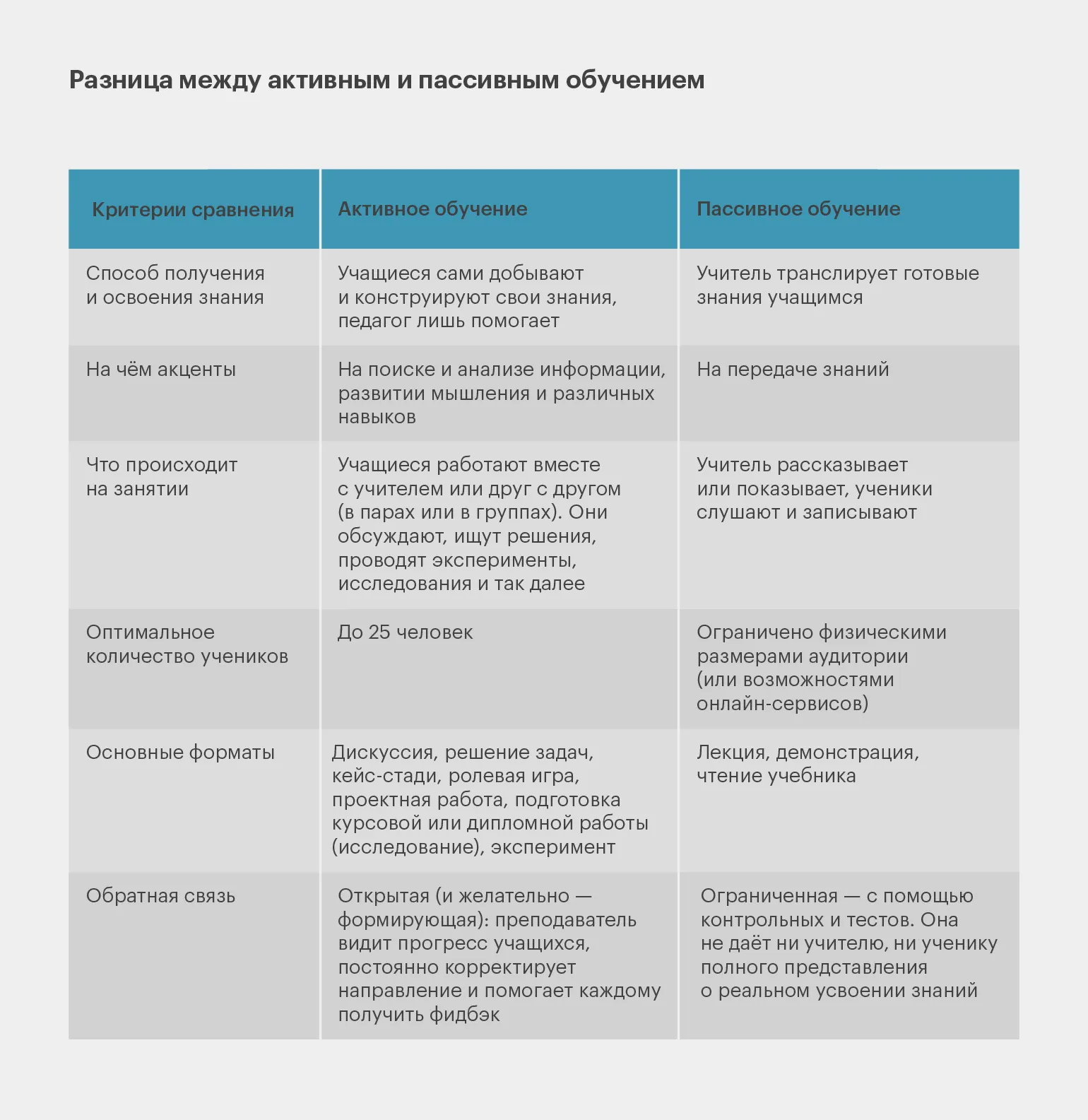
What is active learning and how it differs from passive
Active learning is a methodology in which students participate in the learning process actively, demonstrating productive, creative and search abilities. Active learning is based on a constructivist approach, in which the teacher does not simply impart knowledge, but creates conditions for students to independently search for and construct information. This approach promotes deeper assimilation of the material and the development of critical thinking. Active learning helps develop independent work skills and promotes more effective interactions between students and the teacher.
Active learning significantly differs from passive learning. While passive learning provides information readily available, as if on a platter, active learning allows students to independently explore and discover the necessary knowledge. This process can take place under the guidance of a teacher and in a specially created, safe environment using various resources and materials. This approach develops critical thinking and facilitates deeper assimilation of information. Active learning develops students' skills in independent data search and analysis, an important aspect of modern education.
Active learning involves students becoming active participants in the educational process. In this approach, the teacher's role changes from simply imparting knowledge to becoming a mentor, consultant, and facilitator, supporting students in their search and exploration of information. This creates a more engaged and productive learning environment where students can develop critical thinking and independence.
Active learning encompasses not only the process of acquiring knowledge but also the development of skills, particularly meta-subject ones, such as soft skills. These include the ability to plan activities, work in a team, and think creatively. In the context of children's education, the use of active learning methods in school helps children develop independent learning skills that will be in demand throughout their lives. These approaches not only make the learning process more engaging but also lay the foundation for successful professional work in the future.
The definition of the term "active" is used to emphasize the opposite of the traditional passive approach, in which knowledge is transmitted to the student in a ready-made form. Active learning involves students in the process, stimulating them to independently search for information and think critically. Unlike passive learning, where information is simply absorbed, active learning promotes deep understanding and the practical application of knowledge. A comparison of these two approaches illustrates how active methods significantly increase engagement and learning effectiveness.
Are Active and Interactive Learning the Same Thing?
In Russian-language literature, there are two key approaches to learning: active and interactive methods. These terms are often used synonymously, but there are important differences between them. Experts from Leningrad State University named after A.S. Pushkin emphasize that active learning methods involve students in the process, where they actively interact with the material. Interactive methods, in turn, focus on the interaction between participants in the educational process, including both teachers and students. These approaches promote deeper learning, the development of critical thinking and collaboration skills. It is important to consider that the effective use of these methods can significantly improve the quality of education and student satisfaction.
In modern pedagogical literature, as well as in the Federal State Educational Standards of Higher Education (FSES VO), the terms "active" and "interactive" Teaching methods are often used interchangeably. This is because many methods can simultaneously fall into both categories. Several studies consider interactive teaching methods a subset of active learning, emphasizing their interconnectedness and shared goals. Active and interactive methods promote deeper student engagement in the learning process, develop critical thinking, and improve learning outcomes. Micheline Chi, a professor at the University of Arizona and a renowned researcher in the field of active learning, emphasizes that similar processes are observed in international practice. To better understand the various definitions, she developed a framework known as the ICAP Taxonomy of Active Learning. This framework places emphasis not on teaching methods, but on various types of learning activities, which allows for a more effective organization of the learning process and engaging students in active participation.
- Interactive — students interact with each other on given topics, without ignoring the position of the interlocutor.
- Constructive — students create something based on ideas that lie beyond the information received (in simpler terms, they connect existing and new information that they seek out on their own).
- Active — students physically perform an action.
- Passive — students simply perceive information.
In Russian educational practice, interactivity most often implies interaction between students, while activity refers to communication between students and the teacher. However, in some cases, these terms can be used synonymously, which can cause confusion. It is important to clearly distinguish between these concepts for a more effective learning process and increased student engagement.

There are several classifications of active learning methods. In Russian practice, researchers divide active learning methods into simulation and non-simulation. Simulation methods include role-playing, case studies, and similar approaches that replicate specific activities. Non-simulation methods encompass such forms as discussions, project-based activities, conducting research, and writing term papers and theses. Active learning promotes deeper learning and the development of critical thinking, making it an important component of the modern educational process.
There are many types of divisions that can be applied in different contexts. Division can be the basis for organizing information, simplifying perception and improving usability. This can include both visual and functional aspects, allowing for effective structuring of data. Correct application of divisions helps improve navigation and enhance the user experience. Effective division of information plays a key role in creating high-quality content, which, in turn, positively affects the SEO optimization of a site.
- discussion,
- games,
- training,
- rating.
What types of active learning are there?
There are many approaches and techniques based on active learning. This list is not exhaustive, but it illustrates the variety of strategies that can be used to improve the effectiveness of the learning process. Active learning promotes deeper understanding of material and the development of critical thinking, making it an essential element of modern education.
- Problem-Based Learning.
The essence of this approach is that learning is based on tasks that are as close as possible to real-life conditions. Students cannot simply sit in the back row while the lecturer presents the material—they are forced to actively participate in the learning process. This method promotes a deep understanding of the subject, develops practical skills, and increases student motivation. Active engagement in tasks allows for better assimilation of information and its application in practice, which is a key aspect of effective learning.
In our article on problem-based learning, we examine this approach in detail. It is an effective method that promotes deep understanding of material and the development of critical thinking. Problem-based learning focuses on solving real-world problems, which allows students to apply their acquired knowledge in practice. This method is actively used in various educational institutions and helps prepare students for professional work. Read our article to learn more about the benefits and implementation methods of problem-based learning.
- Flipped learning.
This is an effective combination of passive and active learning. Students study theoretical material independently by watching lectures, reading textbooks, and taking notes. In class, they actively participate in the discussion of what they have learned with the teacher, not just listening, but also discussing the questions posed. Thus, classroom activities are organized using active learning methods, which contributes to a deeper understanding of the material.
- Phenomenon-based learning.
The Finnish educational approach turns students into researchers and involves them in the learning process. Students begin by asking questions: Why is everything arranged this way? Why is coffee so expensive, and do you have to wait so long at the traffic lights? Their task is not just to prepare a report, but to deeply examine the problem from different scientific perspectives and propose their own solution. This approach promotes the development of critical thinking and problem-solving skills in students, making education more relevant and productive.
- EduScrum.
Developed by Dutch educator Willy Wijnands, this method combines active and passive learning, with an emphasis on the active part. The teacher provides students with the necessary theoretical information and then organizes them into teams, each of which develops a project on a given topic over a set period of time (quarter, trimester, or semester). It is important to note that while the teacher provides supervision and feedback, the primary responsibility for the process lies with the students themselves. This method promotes the development of independence and teamwork, making it an effective tool in the educational process.
- Peer-to-peer, or mutual learning.
An educational model in which knowledge is transferred not from a professional teacher to a student, but from peer to peer, represents a unique approach to learning. In this format, people exchange experiences and knowledge, which promotes deeper learning and the development of critical thinking. Such learning can occur spontaneously, as in self-study, or be organized. In the latter case, the teacher, methodologist, or instructional designer acts as the creator and facilitator of the learning environment, guiding and supporting the exchange of knowledge and experience. This approach allows for more effective adaptation to the needs of students and creates conditions for everyone to actively participate in the educational process.

An ordinary school teacher is able to transform a traditional passive lesson into an active and engaging learning process. For example, in American schools, a teacher uses investigative storytelling in history lessons, allowing students to independently find and analyze information. In another example, a geography teacher asks students to develop a plan to rebuild the world after a hypothetical zombie apocalypse, which encourages them to actively apply their knowledge to solving practical problems. Such approaches not only promote deep learning but also help students connect different topics and fill in knowledge gaps if they missed certain classes. Active learning makes the educational process more interactive and significantly increases student interest in the subjects being studied.
Is it possible to organize active learning in an online course?
Online courses are available in a variety of formats. The simplest option is a series of recorded lectures, which usually includes tests to assess knowledge. However, this learning format can be considered passive. Another approach is problem-based courses. In these courses, participants independently search for and develop solutions to academic problems, which promotes active learning and allows for hands-on experience. These courses are typically delivered synchronously, facilitating interaction between students and instructors. Active online courses are becoming increasingly popular due to their effectiveness and the ability to deeply immerse themselves in the material.
Modern courses, like traditional offline programs, often combine elements of passive and active learning. For example, students can simultaneously view asynchronous lectures and work on their own projects in real time. One effective way to integrate active learning is to use a branching quest model, which allows students to independently explore the material and apply their acquired knowledge in practice. This approach promotes a deeper understanding of the topic and develops critical thinking skills.
Modern professional training programs for adults are often based on David Kolb's experience-based learning model. The essence of this model is that learning is a process of transforming experience through a cycle of trial and error. This approach to learning is active, and the main task of the instructional designer is to create conditions that facilitate this process. Effective use of this model allows adult learners not only to master new skills but also to apply them in practice, which significantly improves the quality of learning and its results.

Reading is an important aspect of our lives that contributes to broadening horizons and improving literacy. It helps develop critical thinking and analytical skills. Furthermore, reading books, articles, and other materials enriches our vocabulary and improves our communication skills. It's important to choose a variety of sources to gain a comprehensive understanding of the world. Reading is not only useful but also fascinating, allowing us to travel through different worlds and eras through the pages of literature.
Pay attention to current topics and new literature to stay informed about current trends and interesting ideas. Reading not only enriches your knowledge but also contributes to personal development. Set aside time for reading every day to get the most out of it.
13 Synchronous Activities for Asynchronous Online Courses
Asynchronous online courses offer students flexibility in their learning, but integrating synchronous activities can significantly increase engagement and learning effectiveness. Synchronous activities allow participants to interact with each other and their instructors in real time, which promotes better learning. In this context, we offer 13 synchronous activities that can be easily integrated into the structure of asynchronous courses.
Virtual seminars and webinars provide an opportunity to share knowledge in a live format. Discussion groups allow students to discuss key topics and share opinions. Collaborative projects can be a great way to collaborate with students, allowing them to work on assignments in real time. Chat sessions provide instant feedback and support, while online polls and voting help engage participants in the discussion. Role-playing and simulations create an interactive learning environment, promoting the practical application of knowledge. Masterclasses and practical exercises allow students to gain specific skills under the guidance of experts. Roundtable discussions can provide a platform for discussing current issues in a chosen field, while interactive quizzes and competitions make learning more engaging and competitive. Synchronous activities not only enrich asynchronous courses but also create communities of like-minded individuals, an important aspect of online learning. Using these methods will help improve the quality and appeal of your online courses.
Which is more effective: passive or active learning?
Research shows that the most effective way to learn is to combine passive and active methods. For decades, scientists have been conducting experiments to determine the optimal sequence of these methods. Current results indicate that one should begin with passive learning and then move on to active methods. These findings are also supported by practical experience applied in various educational approaches.
Active learning is considered more effective than passive learning, especially when given a choice. This is supported by the results of numerous experiments and studies demonstrating that engaging students in the learning process significantly improves material acquisition and promotes a better understanding of topics.
A meta-analysis conducted by researchers from the universities of Seattle, Florida, and Maine (USA) shows that students in STEM programs achieve higher academic results with an active learning approach. However, passive learning significantly increases the risk of exam failure. Additionally, a study conducted by Turkish scientists confirms that active learning has a positive impact on students' understanding of the curriculum and is more effective than passive methods. These data highlight the importance of actively engaging students in the learning process to improve their academic performance and satisfaction with learning.
Active learning improves student outcomes and effectively prevents cheating.
At first glance, if active learning produces such impressive results, why not abandon passive learning entirely and focus exclusively on active methods?
Why Active Learning Isn't Widespread Yet
Active learning is indeed an effective method, but the transition to it requires significant effort from both teachers and students. Successful implementation of this approach requires preparation, knowledge and experience, as well as creativity and, most importantly, time. Organizing active learning in a class of ten students is easier, since you can give each student individual attention and guide their search for knowledge. However, in a class of 30 people, this process becomes significantly more complex and requires additional strategies and methods for effective interaction.
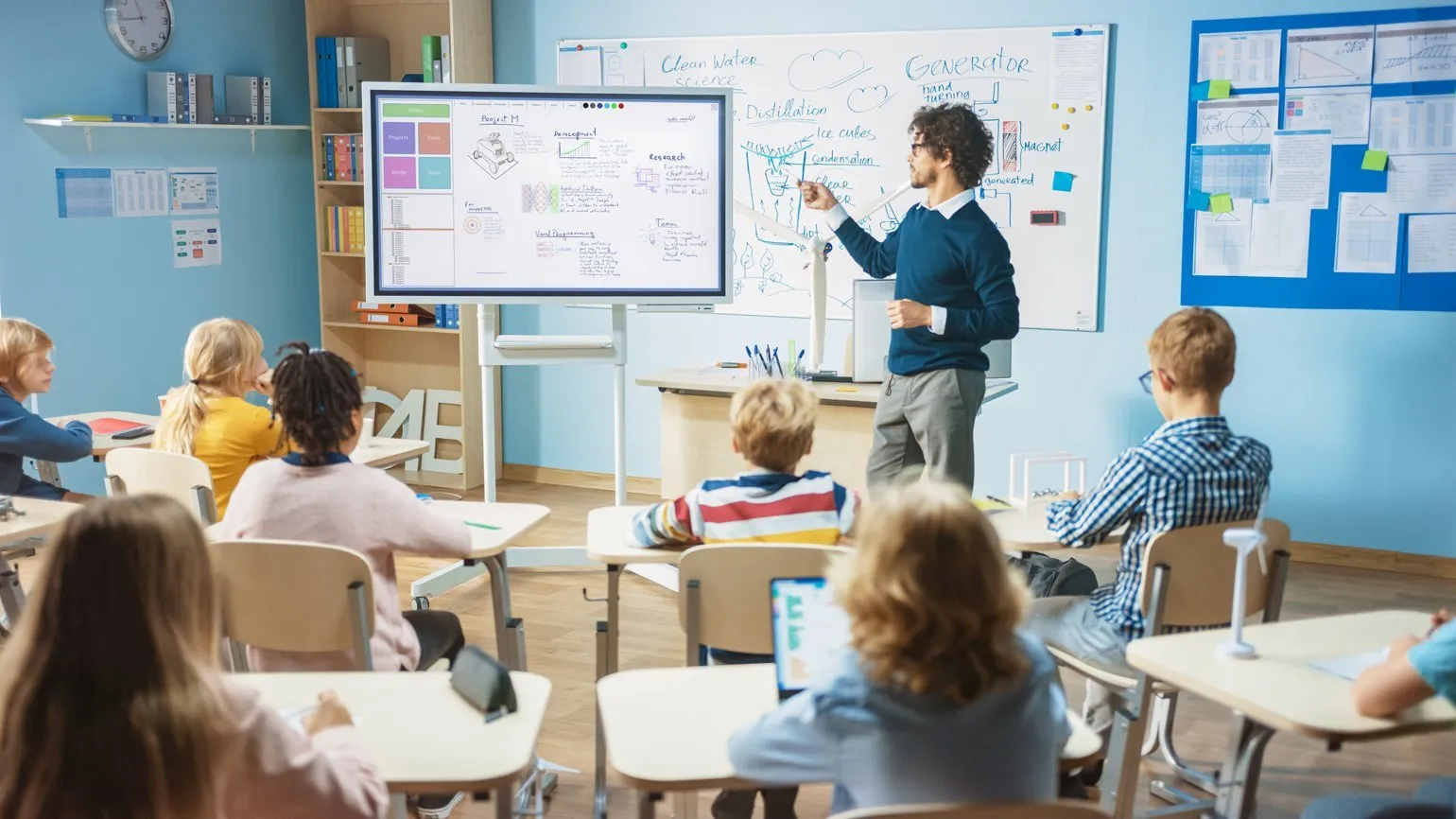
In educational institutions such as schools and universities, as well Active learning elements are also increasingly being used in combination with passive methods in informal learning. Active learning promotes deeper knowledge acquisition and the development of critical thinking in students, making it an important part of the modern educational process. The use of such methods allows for the effective engagement of students in the process, increasing their motivation and interest in the subjects being studied.
Passive learning involves preparing a detailed lecture or lesson plan, as well as assessment materials. This approach requires significantly less time and effort from the teacher compared to developing complex and multi-component lessons focused on the active participation of students. Passive learning can be effective, but it is important to consider that it does not always promote deep learning.
Dr. Susan Edwards, a professor at Augusta University (USA), conducted a study among secondary school teachers, identifying four key barriers they face when implementing active learning methods. These barriers significantly impact the effectiveness of the educational process and require the attention of educational institutions. Understanding these challenges will help develop strategies to overcome them and improve the quality of learning.
- systemic — these include lack of time to prepare for lessons and insufficient resources;
- “student”, that is, the behavior, cognitive characteristics, and motivation of students;
- content-related — difficulties with adapting material and making it relevant to students;
- teacher-related — fear of changing the approach to teaching, lack of ideas, and significantly increased effort spent on preparation.
Although the discussion focused primarily on teachers in schools, it is clear that similar difficulties are also experienced by high school teachers, university teachers, and specialists in additional education. These educational workers face challenges that require flexibility and innovative approaches to teaching, which emphasizes the importance of professional support and development for all levels of education.
The process of active learning raises certain difficulties, such as:
Difficulties in perceiving new information can hinder learning. Students may struggle to grasp material, especially when it is presented in a complex manner. A lack of motivation can also hinder their active participation in the learning process. Without interest in the subject, students may lose concentration and underperform.
Furthermore, group interaction can cause conflict. Different levels of preparation and learning styles among participants can lead to misunderstandings and reduce overall effectiveness.
The physical aspects of active learning must also be considered. For example, long sessions can cause fatigue, which negatively impacts the perception of information.
Therefore, although active learning has many benefits, it is important to be prepared for possible difficulties and find ways to overcome them.
- Lack of clear focus. In a standard lesson, the teacher explains something to the entire group at once. In an active environment, they must switch attention between groups of students, understanding what is happening in each of them and guiding them in a timely manner (for example, when students are working on projects).
- Many distractions. Group work, discussions, and other activities typically create a lot of noise. These conditions can make it difficult for both students and teachers to concentrate.
- Technology Challenges. If smartphones, laptops, and other gadgets are used in class, teachers can easily become overwhelmed—not only do they need to monitor and communicate with everyone, but they also have to deal with various technical difficulties if there is no special assistant. With the spread of hybrid learning, this is especially relevant, as special approaches must be used to conduct such classes.
Various scientific studies emphasize that, despite teachers' attempts to implement active learning, many of them face disappointment due to misconceptions about this approach. Experts from the University of Georgia (USA) point out that the introduction of active learning does not lead to immediate results, even if high hopes are placed on them. Therefore, it is important to approach the process of implementing active learning with caution and attention, taking into account its characteristics and requirements.
The danger of promises, both explicit and implicit, is that active learning is perceived as significantly more effective than traditional lectures. When instructors try to implement active learning methods but fail to achieve the expected results, they may revert to familiar methods. This can lead to a decline in trust in the value of educational research and active learning methods. Experts emphasize the importance of a deliberate approach to implementing new methods to avoid disappointment and strengthen faith in their effectiveness.
Online learning requires significant effort to implement an active approach, making it more challenging than traditional formats. Technical difficulties can arise when organizing various activities in the digital space. Furthermore, active learning methods, such as case studies and project-based activities, are difficult to adapt to asynchronous courses. This limits opportunities for interaction and practical application of knowledge, which is an important aspect of effective learning.

Why it is necessary to prepare teachers for active learning from the student Benches
Research conducted by scientists from various countries emphasize the importance of preparing teachers for active learning in higher education. In Turkey, where the 2005 reform of the educational system placed an emphasis on active learning methods, specialists decided to conduct a survey among students of the Faculty of Education at Erciyes University. The survey was implemented in 2014, which gave the system sufficient time to adapt, and active learning should not have come as a complete surprise to students. More than 300 future teachers participated in the study, confirming the relevance of the topic and the need for further study of approaches to teaching in teacher training universities.
Specialists conducted a study to determine the importance of active learning methods for students. It was found that active methods significantly impact the process of assimilation of material, increasing the level of engagement and interest of students. Students note that such approaches contribute to a better understanding of the educational material and the development of critical thinking. Active learning methods, including discussions, group projects, and hands-on assignments, allow students to not only absorb theory but also apply knowledge in practice, which in turn strengthens their skills and self-confidence.
- Active learning helps future teachers see their work differently. It opens up new horizons and provides an opportunity to better understand their role. Moreover, students noted that such learning becomes a way for them to find their "professional identity."
- Active learning encourages experimentation with new approaches to teaching. The explanation is simple: students can try and compare these approaches during the learning process, test everything through experience, and not be afraid of new things.
- Students' self-esteem increases. Active learning implies a democratic environment, support from peers and teachers—all of which affects self-perception during the learning process.
- Active learning becomes collaborative learning. There are many advantages to this: communication and teamwork skills are developed, experiences and knowledge are shared, and so on.
- Active learning turns students into "owners of their learning." Simply put, each student feels responsible for their own results, as they are engaged in real-world practice, not just listening to lectures. Students especially appreciated this because, as one study participant put it, "we weren't just given fish, we were taught how to catch them."
Certain obstacles to the implementation of active learning methods have emerged, illustrating the main challenges facing the education system. These issues may include a lack of teacher training, a lack of resources and infrastructure, and resistance to change on the part of both staff and students. It is important to understand that the successful implementation of active learning methods requires a comprehensive approach and a willingness by all participants in the educational process to embrace change.
- Incompetent teachers. In the context of the study, these are more likely those who are unwilling to adapt. It's noteworthy how students described some of their mentors: "Worried about losing control of the classroom," "His misconceptions about process management (he believes that if the classroom is noisy, it's a sign of poor management)," "Focuses only on theory, not practice."
- Overcrowded groups. Active learning works well in small classes, but "stream lectures" for 70-100 people are much more difficult to reformat. Students struggled both because of the physical limitations of the classroom and because of the difficulties in organizing discussions.
- Little time and a heavy workload. Sometimes lectures seemed simpler and more convenient because there was little time to prepare for active learning, and there was a lot to cover. Moreover, students understood that the instructors also lacked time. This, of course, led to unnecessary stress for both parties.
- Lack of resources. Old textbooks and teaching aids simply didn't offer new ideas, and some classes required students to spend their own money on necessary items (for example, when a computer, demonstration materials, and so on).
- The students' passivity. Indeed, it's not only schoolchildren who need to be motivated. Students noted that they were accustomed to the traditional, simple lecture format, so the transition to new forms of instruction was difficult for them. Other obstacles arose as well—fear of criticism, fear of public speaking—that is, things that could have been easily avoided before.
- The examination system. In Turkey, it is built on standardized tests and grades—in other words, on memorization and the ability to reproduce information. Why use active learning methods even in work if you still need to prepare students for tests?
Research shows that teacher training is a critical factor in the successful implementation of active learning. Such methods not only promote better assimilation of educational practices by teachers but also significantly increase their effectiveness in teaching. Despite the existing differences between theoretical foundations and the real-world training environment, it is essential to continue integrating active learning into the curricula of teacher training universities. This will improve the quality of education and prepare more competent professionals capable of adapting to the modern educational environment.
Learn more about education by subscribing to our Telegram channel. Here you will find current news, useful tips, and interesting materials to help you expand your knowledge and skills. Don't miss the opportunity to stay up to date with the latest trends in education.
Read also:
- Debunking myths about gaming practices in education: interview
- What is Edutainment: how to combine learning with entertainment
- Cognitive science in learning: what is this approach and why is it important?
- What is hyutagogy and how is it useful?
Profession Methodologist from scratch to PRO
You will improve your skills in developing curricula for online and offline courses. Master modern teaching practices, structure your experience, and become a more sought-after specialist.
Find out more