Contents:
- How is passive learning different from active learning?
- What are the methods of passive learning?
- Are lectures always passive learning?
- Are online courses always passive learning?
- Is passive learning always easier than active learning?
- Can passive learning be engaging?
- Why do students like passive learning?
- What are the risks of passive learning?
- False arguments against passive learning

Learn: The Profession of a Methodologist from Scratch to PRO
Find out moreIn passive learning, the teacher takes a central position, and students are asked only to assimilate pre-prepared material. They memorize information and then reproduce it without actively participating in the learning process. This contrasts with active learning, where students independently seek and acquire knowledge, engaging in the process and developing critical thinking. Passive learning can be less effective, as it doesn't promote deep understanding and application of the material being studied. Passive learning occurs when the teacher introduces the topic, provides examples, and explains how to complete the task. Students then study the material in textbooks and other sources. This approach can limit students' active engagement in the learning process, which negatively impacts the depth of knowledge acquisition. Effective learning requires students to not only listen but also actively engage with the material.
You will learn about:
- the difference between passive and active learning;
- what type of learning (passive or active) are lectures or online courses;
- why passive does not mean easy or boring;
- why students themselves usually prefer passive learning;
- why not all arguments about the lack of benefits of passive learning should be believed.
The difference between passive and active learning
Passive learning has a number of characteristic features that distinguish it from active learning. In passive learning, students receive information without active participation, which can lead to insufficient assimilation of the material. The main characteristics of passive learning include one-sided information acquisition, lack of interaction with the instructor and other students, and minimal hands-on activities. In contrast, active learning involves engaging students in the process, stimulating them to ask questions, discuss, and complete practical tasks, which significantly improves understanding and retention of information. Comparing these two approaches allows us to better understand the importance of active engagement in the educational process to achieve deeper knowledge and skills.
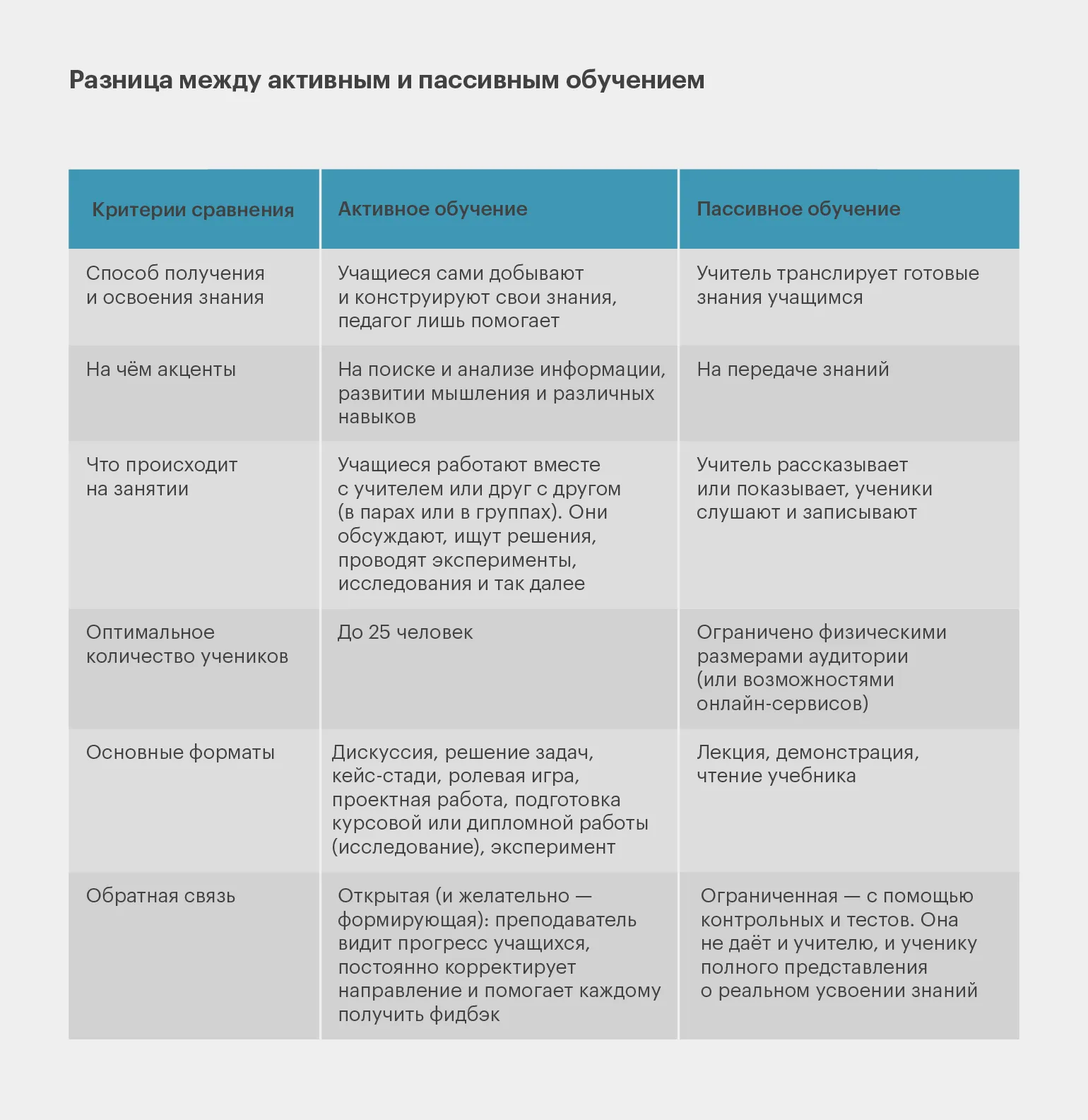
Passive learning For centuries, passive learning has dominated educational institutions, although active learning methods also have a long history. In the 20th century, passive learning gained a theoretical basis, particularly with the popularity of behaviorist ideas. Followers of this approach viewed the student as a blank slate or an empty vessel that needed to be filled with knowledge. From this perspective, the student occupies a passive position in the learning process, while the teacher acts as the "vessel filler."
Modern trends in education increasingly emphasize the importance of student active participation in the learning process. This creates an opportunity for deep learning and the development of critical thinking. Active learning methods, such as group discussions, projects, and practical assignments, promote more effective learning and increase student motivation. Thus, integrating active methods into the educational process can significantly improve the quality of students' knowledge and skills, making them better prepared for the demands of the modern world.
Over time, behaviorism has given way to more modern concepts, among which constructivism stands out. This approach emphasizes the learner, assuming they actively participate in the learning process, independently acquiring and constructing their own knowledge. Thus, the student becomes not a passive listener, but an active creator of their own educational experience. Constructivism promotes critical thinking, creativity, and the ability to independently solve problems, making it an important approach in modern pedagogy.
Passive learning methods continue to play a significant role in the educational process. A survey conducted by Tomsk State University in 2020 found that 90% of students and university staff continue to use approaches such as copying information from slides, taking lecture dictation, and memorizing notes and teaching materials. These practices are prime examples of passive learning, which, although criticized, remains popular among students.
Modern educational practices increasingly combine passive and active learning methods. Passive approaches alone are not sufficient for effective learning. The curriculum makes extensive use of a variety of active learning methods to promote deep understanding and student engagement. This approach not only diversifies the learning process but also improves its effectiveness, which is an important aspect of modern education.

Read also:
The main theories of learning include behaviorism, cognitivism, and constructivism. Behaviorism focuses on observable behavior and posits that learning occurs through interaction with the external environment. This approach emphasizes stimuli and responses, as well as reinforcement methods. Cognitivism, in contrast, emphasizes internal processes of thinking and understanding. It examines how information is perceived, processed, and stored in memory. Constructivism views learning as an active process in which students build their knowledge based on experience. These learning theories help develop effective educational strategies and methods that take into account the peculiarities of perception and assimilation of information. Understanding these approaches is key for educators and educational specialists, allowing them to adapt their methods to the needs of students.
What are passive learning methods?
Chris Drew, a lecturer at the University of Melbourne and author of the blog Helpful Professor, shares current examples of passive learning. Passive learning includes methods such as simply listening to lectures, reading course materials without active participation, or memorizing information without analyzing it. These approaches often result in limited knowledge acquisition and insufficient practice in applying the information learned. It's important to recognize that effective learning requires active engagement, which fosters deep understanding and retention of material. Using examples of passive learning, Drew emphasizes the need to find more active methods to help students better retain information and develop critical thinking.
- Lectures and "standard" lessons. For centuries, this was considered a completely effective teaching method (although Leo Tolstoy, for example, did not agree with this). Many teachers still believe that the lecture is an indispensable format at a university. But in reality, even the most wonderful and fascinating lecture is not so easy to remember (we will talk about this later).
- Podcasts and videos. They differ from lectures only in that the information can be received at any convenient time (asynchronously) and in a comfortable environment.
- Instructions. This is when students are explained the rules and shown how to perform a particular action.
- Observation or demonstration. We are talking about those cases when, for example, a teacher demonstrates something to students and they observe. For example, the teacher conducts a chemistry or physics experiment, and the class only observes. Or a teacher demonstrates how to perform a particular action in the software being studied during a webinar. But if students themselves participate in the same process (for example, conducting an experiment or attempting to independently complete the same task in the software), then learning becomes active.
Passive learning includes methods such as reading textbooks and other educational materials. In this approach, information is presented in a ready-made form, and the student simply absorbs it without actively participating in the learning process. Reading educational literature allows you to quickly absorb knowledge, but for a deeper understanding of the topic, it is recommended to supplement passive learning with active methods, such as discussing the material or completing practical tasks.

Read also:
Observational learning is a form of learning in which an individual masters New skills and knowledge are acquired by observing the behavior of others. This process involves perceiving actions, analyzing their consequences, and using this information to guide one's own actions. Learning is thus a social process, as it occurs in the context of interaction with others and is based on social experience.
Social learning emphasizes the importance of environment and cultural factors in the acquisition of knowledge. People learn not only from personal experience but also through examples provided by the community, which contributes to the formation of social norms and values. Observing the behavior of others, especially models such as parents, teachers, or peers, plays a key role in the development of skills and the formation of personal qualities.
Thus, observational learning and social interaction are important aspects of the educational process, promoting not only individual development but also cultural exchange within society.
Is a lecture always passive learning?
The classic lecture, in which the teacher conveys educational material, is a passive method of learning. However, there are problem-based lectures in which the teacher does not simply share new knowledge, but asks questions that encourage students to seek answers on their own. This approach is based on the Socratic method. The main task of the teacher is to formulate questions and problems that stimulate students to reflect, compare, analyze, and generalize different knowledge and points of view. This learning format is more like a discussion than a traditional lecture and represents an active learning method. Problem-based lectures promote critical thinking and help students absorb the material more deeply.
An interesting method encourages students to create visual sketches of lectures or textbook chapters instead of traditional note-taking. This approach promotes deeper understanding of new information and encourages creative interpretation of the material. As a result, passive perception of knowledge becomes an active process, which significantly increases the effectiveness of learning.
Are Online Courses Always Passive Learning?
Online courses represent a variety of learning formats. They can be classified as synchronous and asynchronous, as well as open and closed. Open courses are available to anyone, do not require pre-selection, and can be viewed by hundreds or thousands of people. While closed courses require a selection process and a limited number of places, they may or may not include homework, which affects the degree of student engagement and practical work. This approach allows for the most appropriate learning format to be selected based on student preferences and goals.
The simplest course format is a series of recorded lectures, often supplemented by quizzes to test knowledge. This approach represents passive learning. However, there are also more effective courses that focus on solving specific problems. In such courses, participants actively work through learning problems, independently finding solutions and gaining the necessary knowledge and practical experience. This teaching method is related to active learning and is most often implemented in a synchronous format.

Learning new topics and obtaining up-to-date information is always useful. Immersion in various aspects of knowledge allows you to broaden your horizons and deepen your understanding of issues of interest. Don't miss the opportunity to explore additional resources that may be useful for your learning and development. Read also:
Problem-based learning (PBL) is a teaching method in which students solve real-world problems, which promotes the development of critical thinking and problem-solving skills. Unlike traditional methods, which emphasize the acquisition of theoretical knowledge, PBL focuses on the practical application of knowledge in situations that are close to real-world conditions.
This approach promotes a deeper understanding of the material and improves collaboration skills, as students often work in groups, discussing and analyzing various aspects of a problem. Problem-based learning also helps develop autonomy, as students take responsibility for their learning and actively participate in the process.
Problem-based learning is widely used in various educational institutions and disciplines, including medicine, engineering, and business. Integrating PBL into the educational process helps students develop the competencies necessary for successful professional work in a rapidly changing world.
Modern courses, like offline programs, often combine elements of passive and active learning. For example, students can simultaneously view asynchronous lectures and develop their own projects. Active learning can also take various forms, such as group assignments or interactive discussions. One effective way to integrate active learning is through the use of a branching quest model, which allows students to independently explore topics and make decisions during the learning process.
Modern courses aimed at adult learning are often based on David Kolb's experience-based learning model. The core idea of this model is that learning is the transformation of personal experience through a cycle of trial and error. This approach emphasizes active learning, and the key task of the instructional designer is to create conditions conducive to this process. Effective learning requires not only the transfer of knowledge but also the engagement of students in practical activities, which allows them to master new skills and apply them in practice.
Is Passive Learning Always Easier Than Active Learning?
Passive learning does not mean that the material is easy to learn. Passivity only indicates the method of acquiring knowledge, but not its complexity. If the topic is complex, understanding it, even with a qualified teacher or a high-quality textbook, requires significant mental effort. At the same time, even a simple topic can become difficult if the teacher presents the material in a monotonous, confusing manner, and the textbook is poorly written. In such situations, active learning can be the solution. A student who takes the initiative and independently researches a topic using a variety of sources is able to significantly improve their understanding and assimilation of the material. Active involvement in the learning process promotes deeper processing of information and the formation of sustainable knowledge.
Can Passive Learning Be Engaging?
Quality teaching involves not only engaging presentation of material but also an interesting delivery of the topic. If the teacher is a talented storyteller and the subject is relevant and exciting, the lecture becomes a fascinating process. The textbook can also be made interactive and attractive, which will help hold students' attention and increase their engagement in learning. Innovative teaching approaches promote a deeper understanding of the material and develop critical thinking in students.
There are effective methods that help maintain student attention during passive learning. These techniques engage students in the process and motivate them to complete the course, whether it is an online course or a long-form educational read. The use of interactive elements such as quizzes, assignments, and visual materials helps increase interest and motivation. Adapting content to audience needs and creating user-friendly navigation also promotes deeper learning.
Engagement is achieved through entertaining elements such as storytelling and gamification. Storytelling involves introducing characters, which helps create an emotional connection with the audience. Gamification adds game elements to the educational process, making it more interesting and engaging. This has led to the term "edutainment," which refers to the combination of education and entertainment. This approach promotes deeper learning and increases student motivation.
Regular school teachers can easily add variety to standard lessons with unconventional techniques. For example, one Canadian educator began his online lessons during the pandemic with engaging intros that immediately piqued student interest. An Australian professor uses K-pop to explain economic concepts, and a Russian literature teacher incorporates rap music into her lessons. Some teachers add experiments, magic tricks, or even dance to their lessons, making learning more engaging and memorable. Such methods not only help to keep students' attention, but also promote a deep understanding of the educational material.

Why Students Love Passive learning
Research shows that active learning methods have significant benefits, yet many teachers and students continue to prefer passive learning, which emphasizes listening to material. In 2019, researchers from Harvard University conducted a study to evaluate how students perceive passive and active learning and what impact these methods have on their actual learning outcomes. The results of the study confirmed that active learning promotes better material acquisition and improved academic performance, making it a more effective approach in the educational process.
The researchers conducted an experiment with 149 students enrolled in a physics course. At the end of the course, the students were randomly assigned to two groups. Each group received two lessons on statics and hydrostatics. The study aimed to examine the effectiveness of various physics teaching methods and their impact on student learning.
Students in both groups were provided with instructional materials in the form of leaflets outlining the key concepts of the lesson topic, basic equations, and example problems. The leaflets also contained blank spaces for notes and answers, which encouraged active student engagement in the learning process and improved student learning.
One group studied the material passively, while the other studied it actively. In the next lesson, the groups switched approaches. This allowed each group to become familiar with both forms and better understand their application. This contributed to deeper learning and skill development. The lessons were conducted in an interactive format, allowing participants to actively engage in the learning process and share experiences.
- Active. The teacher asked students to solve the problems provided in the starting material by forming small groups. While the students were busy, the teacher moved around the room, answering questions and giving recommendations. When the groups completed work on a problem, he demonstrated and explained the correct solution.
- Passive. The teacher showed a presentation based on the educational material distributed to the students, gave detailed explanations, and demonstrated with examples how to solve the problems. The students listened and wrote down the solutions. The researchers in this experiment placed the main emphasis on the teacher's effective presentation of the material.
All participants in the experiment worked with the same problems and materials. The main difference was the approach to obtaining information about solution methods: some received solutions directly from the teacher (passive approach), while others looked for answers on their own (active approach). After each lesson, participants were asked to take a test to assess their knowledge, as well as fill out a questionnaire in which they shared their impressions of the learning process.
Research has shown that students participating in surveys express a preference for the lecture format of learning, considering it more effective for knowledge acquisition. However, test results have shown that students who actively participate in classes achieve higher grades. This suggests that active learning methods may be more effective than traditional lectures.
Researchers have identified three main reasons for this phenomenon.
- Because a good lecture presents the material sequentially, systematically, and in an interesting way, students feel they are receiving more information by listening than during active learning;
- Because the topics are new, students find it difficult to assess how much useful information they have actually received;
- Students who are new to active learning experience discomfort from the cognitive load, not realizing that this is precisely a sign of effective learning.
Rework the text while maintaining the main idea and topic, optimizing it for SEO. It is important to avoid adding unnecessary information and symbols. Avoid using lists and structured sections.
Read also:
Scientists have uncovered the reasons why the brain tires when solving complex problems. Research shows that mental stress causes significant energy consumption, leading to fatigue. When solving complex problems, certain areas of the brain responsible for concentration and analytical thinking are activated. This requires intensive neuronal activity and the use of glucose as a primary energy source. Furthermore, constantly switching between tasks and the need to maintain a high level of attention also contribute to rapid fatigue. Understanding these mechanisms can help develop methods for increasing productivity and optimizing brain function when solving complex problems.
Studies conducted by scientists showed that experiment participants had difficulty adapting to the "productive errors" method. This approach left them anxious and confused. Participants perceived their difficulties in solving problems as a sign of a lack of knowledge, although experts are confident that this is not the case. Some universities have special programs aimed at helping students learn to accept mistakes and failures as part of the learning process.

Students listened with interest lecture, as it was presented in a more accessible and understandable form.
Interestingly, after the presentation of the study results, students demonstrated a willingness to change their learning approaches. Of the 17 respondents surveyed, 14 expressed a desire to switch from passive to more active learning methods. Although passive learning was initially perceived as productive and convenient, most students realized that active learning methods actually provide greater effectiveness. This demonstrates the importance of informing students about learning methods and their effectiveness for achieving better academic results.
The experiment did not end there. The following semester, the physics instructor applied a similar strategy with active learning methods. At the beginning of the program, he gave a presentation in which he explained the benefits of active learning and warned students about possible reactions to this approach. This preparation helped create a more comfortable atmosphere for accepting the new learning format and increased student engagement in the learning process.
At the end of the semester, 65% of students noted a significant improvement in their opinions about active learning. 75% of students reported that the instructor's presentation helped them recognize the benefits of this approach in the learning process. Active learning promotes deeper understanding of the material and increases student engagement.
What are the risks of passive learning?
Passive learning can contribute to an increase in academic dishonesty, especially in the context of cheating on homework. This phenomenon is due to the fact that students who are not actively engaged in the learning process may feel less motivated and responsible for their results. Passive perception of information often leads to a decrease in critical thinking and independence, which in turn creates conditions for violations of academic integrity. The requirement for active participation in the educational process can help prevent such problems and increase the level of student responsibility.
Specialists from the HSE Institute of Education conducted a study based on data from the Higher Education Monitoring Survey collected in 2020. The aim of the study was to determine how the learning format affects the frequency of cheating among students. During the analysis, the researchers examined and compared the responses of more than 17,000 students, which allows them to draw valid conclusions about the impact of different educational models on academic integrity.
Of course, I am ready to help you with text editing. Please provide the text itself that you wish to change.
Students note that the most common pedagogical practices are rewriting course material and conducting discussions. These teaching methods take up more than 70% of the time in seminars and practical classes, with 36% of students highlighting rewriting and 32% highlighting discussions. Thus, it can be concluded that these forms of learning are important in the educational process.
Research shows that the more traditional the teaching methods, such as rewriting and retelling course materials, the higher the likelihood that students will resort to cheating. This is especially true in cases where passive practices take up from 30% to 70% of the total study time. Therefore, to improve the effectiveness of learning, it is necessary to reconsider approaches to reduce cheating and engage students. Activities such as discussions have a lower risk of cheating among students. This is because engaging in active discussion of materials promotes better understanding and retention of information. Thus, organizing the educational process with an emphasis on interaction helps create an honest and open learning atmosphere, where students are less likely to engage in dishonest behavior. According to the study, students whose practical activities accounted for more than 70% of their time were significantly less likely to cheat than those whose discussions accounted for less than 30%. However, no significant relationship was found between the frequency of case studies and presentations and the incidence of cheating. This highlights the importance of actively engaging students in hands-on learning to reduce instances of academic dishonesty.
False Arguments Against Passive Learning
Not all arguments about the limited effectiveness of passive learning are entirely credible. For example, proponents of active learning often cite the so-called "learning pyramid," developed by the US National Learning Laboratory in the 1950s, which illustrates the various levels of information acquisition. This concept emphasizes that active learning methods, such as discussions and practical application of knowledge, can significantly enhance retention and understanding of material. Understanding this pyramid helps to more consciously approach the choice of teaching methods, taking into account their effectiveness in different contexts.
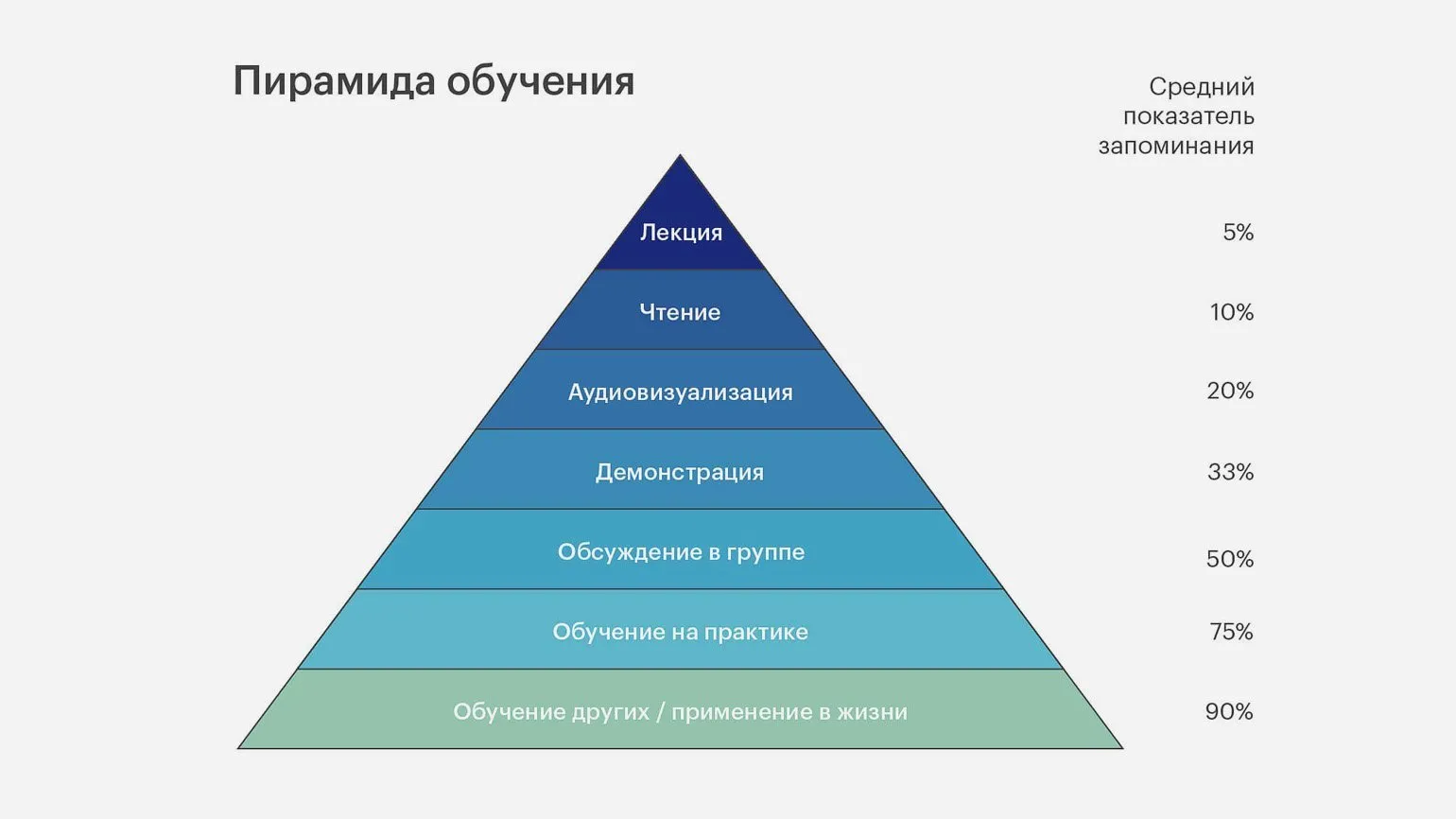
In The presented material displays the information retention indicators depending on various types of activities. The top four blocks relate to passive learning methods, while the bottom four blocks represent active methods. According to this model, active approaches to learning demonstrate significantly higher efficiency compared to passive ones. It is claimed that the results were obtained during a study conducted in a laboratory. However, it is worth noting that the laboratory did not provide the original study materials and reported their loss. This raises doubts about the reliability of the numbers presented in the pyramid and the methods based on this data.
There is a common myth about passive learning methods, which claims that educational information must be adapted depending on the type of perception: auditory, visual, and kinesthetic. However, numerous studies have refuted this theory, confirming that the effectiveness of learning does not depend on the presentation of material in different formats for different types of perception. Instead, it is important to focus on active learning methods that promote deep processing of information and its better assimilation. Understanding this myth helps optimize educational approaches and create more effective curricula.
It follows that completely eliminating passive learning from the educational process is impractical and practically impossible. However, when learning relies solely on passive methods, it negatively impacts learning outcomes. Effective education should combine both active and passive approaches to ensure maximum student engagement and understanding.
Reworked text:
Also study:
- 4 Fun Approaches to Teaching Tasks
- 6 Ways to Make a Curriculum Engaging
- How Changing Teacher Roles Can Help Motivate Students
- How to Teach While Having Fun: Insights and Helpful Tips
Profession Methodologist from scratch to PRO
You will improve your skills in developing curricula for online and offline courses. Master modern teaching practices, structure your experience, and become a more sought-after specialist.
Find out more