
Contents:

Course with employment: “Profession Methodist from scratch to PRO"
Learn MoreThis article will provide you with important information on the topic of your interest. We will cover key aspects that will help you better understand the subject matter. You will receive useful tips and recommendations that you can put into practice. Read on to deepen your knowledge and skills in this area.
- What is problem-based learning and what are its advantages;
- How does this model change the role of teachers and methodologists;
- What models of problem-based learning exist, and what is the essence of the most popular and modern of them - 4C/ID;
- Why, despite all its advantages, this approach is not ideal.

This article was prepared with the assistance of content marketing and SEO experts. They provided valuable recommendations and advice that contributed to improving the quality of the text. We are confident that this material will be useful to readers, providing them with up-to-date information and practical recommendations.
The Head of Quality Management in the Methodological Department at Skillbox is responsible for ensuring high standards of educational materials and programs. Their responsibilities include the development and implementation of effective assessment and quality control methods, as well as continuous monitoring of the educational process. This specialist actively collaborates with teachers and experts to improve the quality of content and enhance the student learning experience. The position requires in-depth knowledge of education, the ability to analyze and optimize processes, as well as team management skills. Working with Skillbox provides an opportunity to influence the quality of education and contribute to the successful development of students.
In 1969, the Faculty of Medicine at McMaster University in Canada introduced an innovative approach to teaching undergraduate students. Faculty realized that the traditional lecture format failed to convey the excitement of medicine, leading to boredom among students. Only through hands-on activities and patient interactions did budding physicians spark their interest. In response, Professor Howard Burrows, a researcher and renowned scientist, proposed a problem-based learning approach. Together with his colleague Robin Tamblyn, he pioneered problem-based learning, which significantly increased student engagement and improved the quality of medical education. This method became the foundation for subsequent educational reforms in medicine, emphasizing practical experience and critical thinking.
Burrows described problem-based learning as a method based on the process of understanding and finding a solution to a problem. In this approach, the problem acts as a key element that initiates the learning process. Problem-based learning emphasizes the active involvement of students in the analysis and solution of real-world problems, which promotes a deeper understanding of the material and the development of critical thinking.
The process of teaching using this approach can vary, but the lesson plans have much in common. Experts at Cornell University suggest the following lesson structure:
- students should study and define the problem;
- figure out what they already know about it;
- determine what else they need to know to solve it, where they can get the necessary information or tools;
- consider ways to solve the problem;
- solve the problem;
- write a report.
Over the past few decades, the ideas of Burrows and Tamblyn have evolved significantly and are now widely used, primarily in higher and professional education around the world. These concepts are relevant not only in medicine but also in other fields, contributing to the improvement of educational processes and the enhancement of the quality of teaching.
Problem-based learning (PBL) is a broad approach that combines various teaching methods focused on solving real-world problems. This approach encourages students to actively participate in the learning process, developing critical thinking and problem-solving skills. Within PBL, students work in groups, analyze situations, formulate questions, and seek solutions, which contributes to a deep understanding of the material. In the following, we will consider in more detail the various variations of PBL and their application in educational practice.
Differences between PBL and other approaches
Modern educational programs often emphasize the development of individual knowledge, skills, and competencies. These elements together create the basis for the practical application of acquired knowledge. However, many students find it difficult to understand how to integrate this knowledge and effectively use it in real-world work settings. It's important not only to acquire theoretical knowledge but also to be able to adapt it to solve practical problems. To successfully transition from learning to practice, it's necessary to develop strategies that help students see the connection between theory and practice. The advantages of problem-based learning are that it's based on real-world problems that students might encounter in their professional lives. This approach fosters the development of critical thinking and the practical skills necessary for career success. Students learn to solve real-world problems, making the learning process more effective and focused. A journalism course includes a variety of tasks aimed at achieving a final result. For example, one of the final results might be the creation of their own media project. In such a course, students write articles, select illustrations, create layout, and engage in other media-related activities. Unlike traditional courses, which emphasize theoretical knowledge of journalism, genres, and the fundamentals of stylistics, in practice, students do not always have the opportunity to integrate this knowledge to write structured and competent texts. Thus, a journalism course not only teaches theory but also provides the opportunity to apply acquired skills in real-world projects, which is an important aspect of training future journalists.
In the pure PBL approach proposed by Burrows, students must not only find answers and solutions but also identify areas of ignorance. This requires them to recognize the knowledge or skill gaps necessary to successfully complete a task and work to address these gaps. This is especially relevant for healthcare professionals, as their learning continues throughout their careers. This aspect is probably one of the reasons for the widespread popularity of PBL in educational systems around the world.

PBL (Project-Based Learning) Emphasizes the importance of process. It should be organized in such a way that students can develop a holistic understanding of the material being studied. A properly structured learning process promotes deep knowledge acquisition and the development of critical thinking.
In educational institutions focused on problem-based learning, information on each case is presented to students in sections. This allows them to independently explore the problem, find the necessary data, and formulate a final solution. After completing each stage of work and receiving answers to the questions asked, access to the next block of materials becomes available. This approach promotes a deep understanding of the topic and the development of analytical skills in students.
The diagnostic process in medicine resembles a real-life situation. Let's consider a simple example: a patient goes to a doctor with complaints, but the specialist does not have additional information. The doctor must independently determine the possible causes of the ailment, decide which tests will help clarify the situation, and select a temporary treatment to alleviate the patient's condition. After receiving the initial test results, the doctor can adjust the treatment, choose a different approach, or continue additional research for a more accurate diagnosis. This approach enables physicians to make informed decisions and provide high-quality medical care.
In an academic setting, formulating a problem or case is a complex task. Case development is often carried out by a team of faculty members who review them annually. The same case can be perceived differently by both students and faculty: students are given limited information and are forced to independently identify missing elements. It is important that the problem be educational, that is, within students' capabilities, but at the same time engaging enough to engage them and immerse them in the learning process. This approach promotes a deeper understanding of the material and the development of critical thinking.
Problem-based learning includes an important aspect: small group classes. Such groups typically consist of 10 to 15 students, which allows for more effective problem discussion and collaborative solution development. Small groups encourage active participation from each student, improve communication, and allow for a deeper dive into the topics under discussion. This approach helps develop critical thinking and teamwork skills, which is a significant advantage in the educational process.

Transformative adult learning is an approach to learning that focuses on profound changes in learners' perceptions, thinking, and behavior. This method is based on the concept that adults don't simply absorb new information, but rather reframe their life experiences, leading to personal and professional growth. Transformative learning stimulates critical thinking and self-reflection, enabling adults not only to acquire new skills but also to rethink their beliefs and values. Through this learning process, participants can identify and overcome internal barriers, which facilitates more effective learning and the practical application of acquired knowledge. This approach is particularly relevant in today's world, where constant change requires adults to be flexible and adaptable. Transformative learning helps not only in professional development but also in personal life, improving relationships with others and enhancing the overall quality of life.
How PBL Changes the Role of Methodologists and Educators
Effective development of lessons and courses within the framework of problem-based learning requires a deep understanding of the subject and professional aspects that students will face in the future. Methodologists often face difficulty in identifying the main problem around which to build an educational program. Correctly formulating this problem is a key element influencing the success of the entire educational process. Understanding the needs and challenges that students may face allows you to create relevant and practice-oriented lessons that promote the development of critical thinking and problem-solving skills.
Problem-based learning (PBL) significantly changes the professional role of the teacher. Instead of the traditional role of a "knowledge translator", the teacher becomes a facilitator and expert in their field. In her article "Possibilities of Applying Problem-Based Learning (PBL) in Higher Education Practice (using Tomsk State University as an Example)," Valeria Petrova, a candidate of psychological sciences, emphasizes that PBL requires teachers to perform a number of important tasks. They should not only guide students through the learning process, but also create conditions for their active participation in discussions, encourage critical thinking, and facilitate the development of research skills. This approach not only increases student engagement but also develops the skills they need for future professional success.
- forming a bank of problem-based cases,
- commenting on students' work,
- maintaining a positive atmosphere in the classroom,
- evaluating results together with students.
The main difference of PBL (Project-Based Learning) is the "horizontal" interaction between the teacher and students. In this approach, responsibility for the learning process, its control, and even the evaluation of their own work largely rests with the students themselves. This can create certain challenges for teachers, as they must adapt to a new format of interaction, where students become active participants in the educational process. PBL promotes critical thinking and teamwork, but requires teachers to adopt new skills and approaches to teaching. Teachers also have the opportunity to learn during classes. They don't always know the answers to questions that arise during discussions with students. No one can know all the answers to all questions. Teachers have the right to doubt, seek solutions, and learn. This, on the contrary, serves as an additional incentive for students, inspiring them to actively participate and deeply understand the material. For teachers, problem-based learning (PBL) is not only a source of difficulties. The authors of the article "Problem-Based Learning: Essence, Disadvantages, Advantages" note that teachers who successfully apply this model change their perception of the learning process. They begin to attend classes with an expectation of something new and unusual, as opposed to the usual predictable approach based on pre-prepared scenarios. At the same time, they have various questions and doubts. Teachers can't always predict how a specific clinical case discussion will proceed, or how engaged and willing students will be to participate. This approach not only promotes the development of critical thinking in students but also enriches the experience of teachers, creating a dynamic educational environment.

Reading is an important part of our lives. It not only broadens our horizons but also promotes the development of critical thinking. Reading books, articles, or blogs helps us gain new knowledge and ideas. In today's world, where information is available in large quantities, it is important to be able to filter and comprehend what you read. A good book can inspire new achievements, and an interesting article can change your mind on important issues. Read regularly to enrich your inner world and stay on top of current events.
Teaching Approaches According to Robert Gagné: 9 Key Events
Robert Gagné, a renowned psychologist and educator, developed a teaching model based on nine key events that facilitate effective learning. These events represent a sequence of steps that students must go through to achieve successful understanding and application of knowledge.
The first event is capturing students' attention. It is important to engage students from the very beginning of the lesson so that they are ready to perceive new information. The second event is related to defining learning objectives. Clearly stated objectives help students understand what exactly they should learn.
The third event is activating prior knowledge. Linking new information with already known concepts promotes better memorization. The fourth event involves presenting new material. Using a variety of teaching methods and tools, such as visual and audiovisual materials, enhances comprehension.
The fifth event is providing students with opportunities to practice. Practical application of knowledge helps consolidate the material and develop skills. The sixth event focuses on providing feedback. Assessment of assignment completion and constructive criticism help students improve their performance.
The seventh event is assessing learning outcomes. Testing the acquired knowledge allows you to determine the degree to which the set objectives have been achieved. The eighth event involves generalizing and systematizing the material, which promotes its better comprehension.
Finally, the ninth event is applying knowledge in new situations. Students should be able to apply the knowledge they gain in practical contexts, which strengthens their confidence and readiness for independent work.
Using Robert Gagné's approaches in teaching helps create a structured and effective educational environment that promotes deep knowledge acquisition and the development of critical thinking in students.
PBL-Based Learning Models
Problem-based learning has become the basis for the development of various models and their variations. In this article, we will consider several of the most well-known and interesting approaches that have arisen from this methodology.
Challenge Based Learning is a teaching method based on solving real-world challenges. This educational model was introduced by Apple in 2008 in collaboration with American educators. The main idea of Challenge Based Learning is that in the modern world, where digital technologies play a key role, it is necessary to develop so-called soft skills, such as teamwork and creative thinking. In this context, learning should focus on the practical application of knowledge and skills to solve real-world problems.
In Challenge Based Learning, the "problem" is framed around a significant idea or phenomenon that both students and their environment face. This creates conditions for students' active engagement in the learning process, allowing them to apply theoretical knowledge in practice and contribute to solving real-world problems. This approach not only promotes a deep understanding of the course material but also develops the skills students need for successful life and career in modern society.
CBL includes three key stages. The first stage is aimed at analyzing the current situation and identifying needs. The second stage focuses on developing strategies and methods that will help achieve the stated goals. The third stage involves implementing and evaluating the effectiveness of the proposed solutions. This approach not only systematizes the process but also ensures its effectiveness.
- engagement through questions,
- investigation,
- action.
If a city frequently suffers from flooding, a local school using the CBL model encourages students to investigate the causes of this phenomenon. They study the factors that contribute to flooding and develop ways to prevent it. Ultimately, they need to present potential solutions to the problem, such as the introduction of annual flood barriers during flood periods.

This training model is not typically used for Professional training, as it often emphasizes the public good. However, the challenge-based learning approach is actively used in educational institutions such as schools. This approach promotes the development of critical thinking and practical skills in students, enabling them to apply their acquired knowledge to real-world situations and solve pressing societal problems.
In Australia, problem-based learning (CBL) is used even in elementary grades. At one local school, students were given a project related to helping the local community after a natural disaster. The children investigated the causes of such disasters and their impact on people. They actively connected with people around the world to gain first-hand information. This practice not only develops critical thinking skills but also fosters social responsibility in children.
Pebble in the Pond is a model of the educational process developed in 2002 by researcher M. David Merrill. The model is based on problem solving and includes four key phases. The model helps structure learning, focusing on practical aspects and real-world situations, which promotes deeper assimilation of the material. The system allows students not only to master theoretical knowledge but also to apply it in practice, which makes the learning process more effective and targeted.
- activation of existing knowledge;
- demonstration of skills;
- application of acquired skills;
- integration or transfer of skills to the real world, that is, conditions other than educational ones.
The unusual metaphor used by Merrill has a profound meaning. The "pond" symbolizes the educational process and the learning conditions that the methodologist creates. The "rock" represents a complex task that it poses to students, which they must solve by the end of the training. As it sinks into the "pond," the "rock" creates several circles, reflecting the design stages that methodologists go through. These steps are essential for the successful development of the educational process and the achievement of the stated learning goals.
- First Circle: Demonstration of a complex "problem" or task. This involves not just a description of the problem, but a "prototype" that shows students the conditions for solving the problem, its consequences, and the steps to be taken.
- Second Circle: Construction of similar problems. They are constructed according to a standard principle—from simple to more complex. To solve each, students will need to apply new skills, gradually arriving at the final result.
- Third Circle: Identification of the knowledge and skills that will enable students to solve the tasks assigned to them. At the same time, it is necessary to ensure that together they truly form a range of competencies that will make it possible to solve a “large” complex problem.
- The fourth circle: choosing a teaching strategy. It should engage students in problem solving and help them master the knowledge or skills necessary for this. In this case, each new task should be built on the student’s previous experience. In addition, the strategy should include opportunities for student interaction with each other: discussions, reflection, and even debate, that is, the need to defend one’s point of view.
- The fifth circle: creating an interface. That is, adapting content and strategy to a specific situation.
- The sixth circle: developing assessment criteria, preparing materials, and launching the course.
The key feature of this model is that the learning process is focused on the course content. The traditional approach, according to Merrill, involves a simple presentation of information, which does not ensure the effective application of knowledge in practice. In the Pebble in the Pond methodology, as in other project-based learning (PBL) approaches, course content is shaped by course objectives, rather than the other way around. This allows students to engage more deeply with the material and develop practical skills, making learning more effective and purposeful. 4C/ID is a modern pedagogical model based on problem-based learning and consisting of four components. The acronym stands for 4 components and instructional design. This model promotes effective learning by emphasizing the development of problem-solving skills and the application of knowledge to real-world situations. 4C/ID enables the creation of curricula that foster deep understanding and critical thinking in students. This methodology is actively used in educational institutions to improve the quality of learning and prepare students for modern challenges. Rewrite the text, maintaining the main topic and avoiding unnecessary details. Optimize it for SEO by adding keywords and phrases. Do not use emojis or unnecessary symbols. Avoid structuring your text into sections or lists. Just provide plain text.
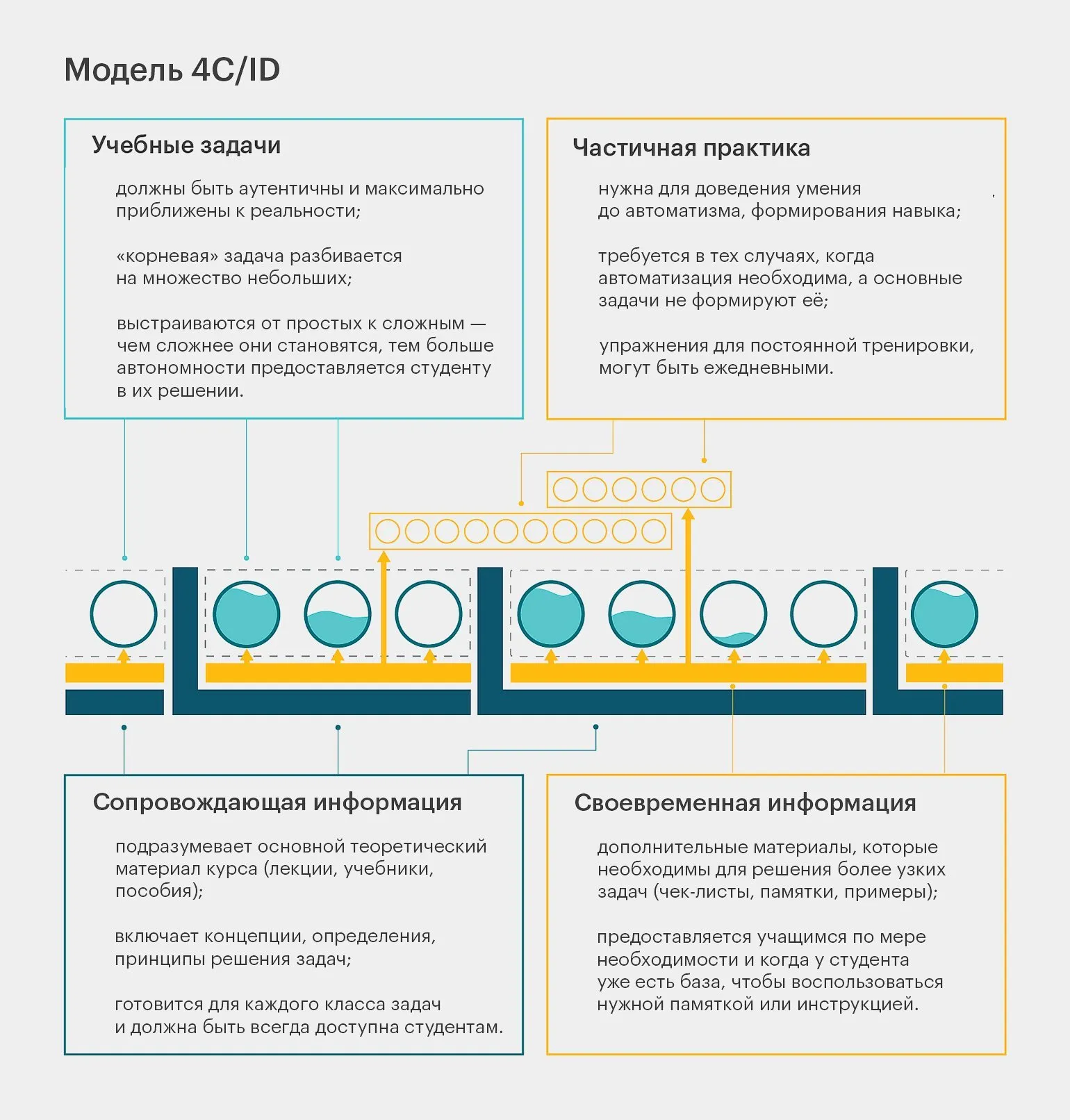
The model, proposed in the 1990s by Jeroen J. G. van Merienboer, PhD in psychology and professor at Maastricht University in the Netherlands, focuses on creating a comprehensive understanding of the subject being studied. The basic idea is that students gain knowledge through practical application, which promotes deeper assimilation of the material and the development of critical thinking. This teaching methodology is actively used in educational institutions and contributes to the development of the skills necessary for successful professional work.
The process is carried out thanks to four key components of the model. Each of them plays a significant role in ensuring the effective functioning of the entire system. These components interact with each other, creating an integrated and harmonious structure that allows you to achieve the set goals. Each element of the model is optimized to improve overall performance and increase efficiency, which makes it relevant and in demand in various fields.
The design of learning tasks begins with a clear definition of the goals that the student must achieve. These tasks should be authentic and as close as possible to real-life conditions. For example, future film critics might be tasked with writing a comprehensive review for a well-known magazine. For testers in training, identifying all the errors in the developed product will be an important task. This approach not only helps develop practical skills but also prepares students for real-world professional challenges.
The core problem, similar to the situation in Pebble in the Pond, is a multi-component task that is divided into many smaller steps, from simple to more complex. Initially, future film critics will be asked not to write an article, but to come up with a title for an existing work or select books to cite in their review. This approach will help develop critical thinking and analytical skills, which are essential for a successful career in film criticism.
Students have the opportunity to experience a practical solution to a real-world problem and analyze why it was chosen. For example, medical students must understand the factors their colleagues used to diagnose a patient. This not only deepens knowledge but also develops critical thinking and analytical skills, which are an important part of medical education.
Supporting information is key theoretical material designed to assist the student in solving a specific problem. Such materials include lectures, textbooks, articles, and research that can serve as useful examples and resources for a deeper understanding of the topic. This information helps students master the material and develop critical thinking skills, which is an important aspect of learning.
Relevant information is the materials needed to solve specific problems. These can be checklists, reminders, and examples that correspond to specific stages of learning. For medical students, such information is a reminder on "How to Read Blood Test Results," and for copywriting students, a checklist on "The Five Elements of an Essay." Proper use of timely information helps enhance the quality of learning and accelerate the process of mastering the necessary skills.
Partial practice plays a key role in achieving professional goals. Successfully solving complex problems requires developing skills to the point of automatism, and this is precisely what partial practice is designed for. These exercises can be performed daily, helping to reinforce the necessary skills. The author of the method emphasizes that practice is only required if the main tasks do not allow for the desired level of automation. Regularly performing such exercises contributes to increased efficiency and confidence in professional work. Designing a course using the 4C/ID method, like any other problem-based learning (PBL) method, requires a significant investment of time and effort. Merienbourg identifies ten steps based on the Pebble in the Pond model. These steps are grouped into key components, which helps structure the process and make it more manageable. This approach helps organize learning effectively, providing students with the opportunity to develop critical skills and deepen their understanding of the subject. The first component is the foundation for many systems and processes. It plays a key role in ensuring functionality and operational efficiency. This element is often used in various fields, including technology, industry, and everyday life. Its characteristics and features make it indispensable in the development and implementation of projects. Understanding the importance of the first component helps to better understand its impact on the final result. Proper integration and use of this component can significantly improve productivity and optimize processes.
The development of learning tasks begins with the careful collection of information necessary for defining authentic learning tasks. At this stage, it is important to establish the objectives of the tasks, determine the conditions for their implementation, and develop possible solutions. The correct approach to data collection allows you to create effective learning materials that will meet the requirements of the educational process and contribute to the achievement of the set goals.
Defining assessment criteria is an important step in the skills assessment process. At this stage, it is necessary to create a hierarchy of key skills necessary for the successful completion of an authentic task. For each skill, standards should be developed to help establish clear and objective assessment criteria. This will ensure a fair and transparent assessment of the level of training and competencies.
Sequencing learning tasks is an important stage in course development. After defining the tasks and correlating them with the hierarchy of skills, you can proceed to creating the program. Tasks should be categorized by difficulty level and organized in a logical sequence. The optimal approach is to start with simple tasks, providing the student with maximum support, and gradually move on to more complex assignments that require greater independence. This approach promotes effective learning and the development of essential skills.
The second component plays a vital role in the overall structure of the system. It ensures functionality and interaction with other elements, enabling optimal results. This component can be used in a variety of applications, from web development to programming. It is important to note that its effectiveness directly depends on high-quality integration with the first components. Optimizing the second component improves performance and enhances user interaction. When properly configured, it can significantly simplify tasks and improve the overall usability of the system.
Designing supporting information is a key stage in preparing for the educational process. At this stage, it is necessary to create the basic theoretical materials that students will need to successfully master the topic. If there is insufficient information for a full-fledged design, two additional stages can be considered to help supplement and enrich the content. These additional stages ensure a deeper understanding of the material and promote high-quality learning.
Analysis of cognitive strategies is an algorithm of actions for effectively solving specific problems. For example, when writing an analytical article, the sequence of actions may include researching the topic and selecting relevant sources of information, analyzing the collected data, structuring the article, writing the text, coordinating it, and making edits. The use of such cognitive strategies helps systematize the work process and improve the quality of the final result.
Analysis of mental models. Mental models provide the basis for understanding and mastering various topics. They include important concepts, definitions, and principles that help structure information. In the context of an analytical article, mental models encompass the concept and structure of the article, as well as the principles of its design. Understanding these models is essential for effective content creation and analysis, which enables deeper understanding of the material and improves the quality of the information presented.
The third component plays a key role in the system. It ensures functionality and improves user experience. This element can be used to optimize processes and increase overall efficiency. It is important to consider its capabilities when developing new solutions, as it can significantly simplify work and improve the quality of the final product. Implementing the third component allows for achieving high results and providing a competitive advantage.
Preparing timely information is an important step in the educational process. It involves collecting additional materials such as reminders, checklists, and instructions. To effectively organize this support, it is necessary to identify in advance the moments when students may need such resources. This will not only improve material acquisition but also create a favorable environment for the learning process. Properly prepared materials will help students cope with tasks more confidently and increase their motivation to learn.
Cognitive rule analysis is the process of identifying algorithms that enable the effective execution of routine tasks. Unlike cognitive strategies, cognitive rules focus on automating actions. At this stage, it is necessary to determine which rules are required to perform specific actions. For example, when choosing a genre for an article in a copywriting course, a student might use a cheat sheet that describes how to select a genre based on the topic. This will significantly simplify the writing process and improve the quality of the content.
Analyzing prior knowledge is an important step in the educational process. Prior knowledge represents the information necessary for the correct application of cognitive rules. It is important to determine what knowledge and skills a student must have to effectively select instructions or find solutions to problems. For example, a cheat sheet for choosing a genre will be useful for those who already understand how the article genre relates to the topic or target audience. This will allow students to more confidently navigate the content creation process and improve their ability to analyze and select appropriate writing approaches.
The fourth component plays a key role in the overall structure of the system. This element is responsible for optimizing processes and improving interactions between other components. Its functionality includes data analysis, resource management, and operational stability. The fourth component ensures high efficiency and performance of the entire system. It is important to consider its impact on the overall architecture and conduct regular updates to maintain relevance and security. The implementation and continuous improvement of the fourth component contributes to sustainable development and increased competitiveness.
Designing partial practice is an optional step in the model proposed by the author. Skill automation is not always mandatory, but if you decide to include partial practice in the process, Merienbourg recommends using the algorithm described in step 8. This algorithm will help organize and optimize the learning process, ensuring the effective acquisition of the necessary skills.
Disadvantages and Advantages of PBL
When choosing an approach for designing an educational experience, it is necessary to consider the goals and objectives of the course, its program, target audience, and context. Project-based learning (PBL) is effectively used in practice-oriented programs, but it can and should be combined with other methods, such as experiential learning, to achieve deeper understanding and skills in students. Combining different approaches allows for a more diverse and effective educational experience that meets modern demands and the demands of the labor market. A complete transition to project-based learning (PBL) is not feasible. Research and practical experience emphasize that the lack of a standard knowledge base makes working with authentic problems ineffective. This opinion is also shared by students. For example, Andrew Provan, a medical student at the University of British Columbia, notes that without the necessary knowledge and skills, using PBL will not lead to the expected results. This underscores the importance of combining traditional learning with a project-based approach to achieve successful educational outcomes. Idealized problem-based learning and its practical application differ significantly. For example, if the first lesson in this model is held on a Monday morning, students typically lack the necessary theoretical knowledge of the subject, which makes it difficult for them to understand the case. Some might object: "In real life, doctors also encounter patients about whom they don't have complete information!" This is true. However, in real practice, doctors have a vast knowledge base that they can use for diagnosis and treatment. Therefore, the importance of prior training and preparation within the framework of problem-based learning cannot be underestimated.

Study additional materials:
Dale's Pyramid: Hands-on Learning Beats Theory
The Dale Pyramid, developed by Edgar Dale, illustrates the effectiveness of various teaching methods. According to this model, hands-on learning is more effective than traditional theoretical approaches. Research shows that people retain information better when they are engaged in active activities, such as participating in real-world projects and practical exercises. Hands-on learning not only helps you remember the material but also applies it to real-life situations. Students who actively engage with the subject matter demonstrate a deeper understanding and higher achievement. This underscores the importance of integrating practice into the educational process, which contributes to the development of the skills necessary for professional success. Thus, Dale's pyramid serves as an important reminder that effective learning requires not only theoretical knowledge but also practical experience. Focusing on hands-on teaching methods can significantly increase information retention and prepare students for real-world challenges in their careers. The example above can be adapted to a variety of specialties, highlighting the challenges of designing courses using project-based learning (PBL). Learning tasks must be carefully tailored to the student's level to remain accessible and achievable. It's crucial to provide students with all the necessary tools to successfully solve problems from the very beginning. Keeping the prepared materials up-to-date is also paramount, as outdated resources will not meet the current demands of the job market. Problem-based learning (PBL) offers a number of significant advantages. This approach to learning fosters critical thinking and analytical skills in students as they encounter real-world problems. PBL helps students learn to work in teams, improves communication, and promotes active engagement in the learning process. Students learn to analyze situations, seek solutions, and apply knowledge, making learning more effective and memorable. PBL also develops students' independent information search and time management skills, which are essential for their future professional careers. It also simplifies entry into a future profession and demonstrates how certain skills are applied; introduces students to the real-world aspects of their chosen specialty; and develops soft skills that are critically needed in the modern world. Creating courses based on PBL can be a complex process for methodologists and a significant change for educators. However, the results of this approach often justify the effort. Properly organized training helps prepare qualified specialists ready to confidently take on new challenges in their profession. The PBL methodology helps develop critical thinking, creativity, and teamwork skills, making students more competitive in the labor market.
See also:
- Why and how Russian universities are implementing pedagogical design
- 6 useful resources in English for pedagogical designers
- What is transformative adult learning
- How to apply the ADDIE model in higher education